Pesquisa em Ensino de F´ısica
Many high-school students don’t want to study physics:
active learning experiences can change this negative attitude!
(Muitos alunos do ensino m´edio n˜ao querem estudar f´ısica: experiˆencias de aprendizagem ativa podem mudar esta atitude negativa!)
Mirko Maruˇsi´
c
1and Josip Sliˇsko
21First Gymnasium, Teslina 10, Split, Croatia
2Benemerita Universidad Autonoma de Puebla, Puebla, Puebla, Mexico
Recebido em 27/11/2011; Aceito em 27/2/2012; Publicado em 10/10/2012
A two-question survey has been prepared for and applied in this research with aim to assess the relative effi-ciency of two different teaching methods, calledReading, Presenting and Questioning (RPQ)andExperimenting and Discussion (ED), in changing students’ attitudes toward physics as a potential career choice. The data of a one-semester-long high-school project indicate that RPQ group (91 students) has not achieved a statistically significant improvement in attitudes, while the ED group (85 students) got an improvement of +10,0%. Theses results suggest that the ED method, based on active physics learning paradigm, is a good model for a significant improvement of students’ attitudes toward physics as a potential career choice, both with girls and boys who study high school physics.
Keywords: active physics learning, predict-observe-explain, observe-explain-predict-observe, physics as a pro-fessional choice, gender and physics learning.
Uum question´ario de duas perguntas foi preparadao e aplicado neste trabalho com o intuito de avaliar a eficiˆencia relativa de dois m´etodos de aprendizagem, viz.Ler, Apresentar, Questionar (LAQ)eExperimenta¸c˜ao, Discuss˜ao (ED), em mudar a atitude de estudantes em rela¸c˜ao `a potencial escolha de f´ısica como carreira. Os dados de um projeto de um semestre realizado em n´ıvel de ensino m´edio indica que os grupo LAQ (91 estudantes) n˜ao teve uma mudan¸ca de atitute estatisticamente signficativa, ao passo que o grupo ED (85 estudantes) teve uma melhora de +10,0%. Estes resultados sugerem que o m´etodo ED, baseado em um paradigma de aprendi-zagem ativa de f´ısica, ´e um bom modelo para se melhorar significativamente a atitude dos estudantes perante a f´ısica enquanto uma potencial carreira profissional, independentemente do sexo dos estudantes.
Palavras-chave:aprendizagem ativa de f´ısica, prever-observar-explicar, observar-explicar-prever-observar, f´ısica enquanto carreira profissional, sexo e aprendizagem de f´ısica.
1. Introduction
In the contemporary physics teaching milieu there has been an increased concern about the drop in the number of students who enrol in physics courses at universities. On the other hand, technology developments and the development of the society as a whole require a signi-ficant number of students of physics. Diminishing in-terest for scientific studies, lack of enthusiasm for phy-sics courses at school or avoiding phyphy-sics at colleges have all become international problems. Many studies indicate drop in the number of students enrolled into physics studies and therefore also the number of those graduating from such study programmes [1, 2]. Spall et al.. [3] report physics to be much less popular than biology. Some data also indicate that more students
choose chemistry and biology over physics [4]. E.g. in England and Wales the percentage of students in sci-entific and mathematics courses has dropped by more than a half since mid 1980s to early 2000s [2]. Simi-larly, higher education institution researches indicate not only a low enrolment rate in undergraduate physics study programmes, but also a decrease in interest for introductory physics courses [1]. As a result, a signifi-cant number of researches have focused on that problem [5-8].
Existing researches show that a drop of interest in physics happens already in lower grades of a high school [5] which then results in poor university enrolment num-bers [1].
Researches in the field of physics education in the
1E-mail: [email protected].
past twenty years have isolated a number of factors that contribute to low enrolment rates in physics courses in high school. Some of the recognised factors are: low enrolment rates among girls, students’ mathematical skills, students’ attitudes towards and perceptions of physics and contents of traditional physics curricula [4, 9-12].
Studies researching the choice of physics as a major are mostly focused on comparing the numbers of men and women enrolled in such study programmes [13, 14], interest and attitude of men and women towards phy-sics as a subject [15, 16] and parental influence as well as stereotypical believes [17].
Low percentage of girls who opt for science and te-chnology courses at the higher educational level, and a small number of women in the professions related to science and technology at both industrial and acade-mic levels, is a well recognized phenomenon [7, 18]. It might suggest that men and women have a significan-tly different attitude towards understanding of physics and mathematics which makes less likely that girls will choose a physics at a higher educational level or that they will build a positive attitude towards physics.
Carlone [10] argues that girls in high school phy-sics classes are more concerned about keeping their stu-dent istu-dentities, rather than about active participation in physics. She believes that girls in higher educational physics courses are not involved in understanding the true nature of physics as a discipline, but they are more concentrated it their own progress. Girls take physics as a means of achieving a certain level of education or as a prerequisite for entering a college or a university [10]. The choice of physics as a major field of study or taking more advanced physics courses is determined by students’ interest, motivation, and above all achieve-ments [5], self-concept in physics [5], personal effective-ness [19], pre-university preparation [20], and teacher training on implementation of innovative physics curri-culum [7].
Studies have shown that self-efficacy (SE), which is defined as a belief in the “capacity to carry out assign-ments”, is the main predictor of student academic achi-evement, interest in the selection and career [21]. Many factors affect the physics self-efficacy (PSE), and most of them are contextual variables, such as the stereoty-pical gender models in textbooks and materials used in classroom, the knowledge structure, and the organisa-tion and presentaorganisa-tion of that knowledge [22].
Studying physical contents, focused more on con-crete activities and individual exercises, takes girls away from social interaction [22]. This leads to a deficit of physical self-efficacy (PSE) of girls in physics, what, in consequence, results in smaller numbers of girls choo-sing physical fields of study.
Furthermore, there is evidence to suggest that inter-vention through the curriculum as well as innovations that deal with interests and experiences of girls have a
positive impact on girls’ motivation, achievement and interest in physics [15]. However, Hoffmann [5] found that the interest and motivation to study physics decre-ases with increasing level of education for both sexes.
In a study on the role of high school physics in the level of performance in university introductory physics courses, Sadler and Tai [20] found that the prepara-tion of students in high school is an important predic-tor of success at university, although there are those who, without a high school physics course, but with a strong academic background, can succeed at university. In another study, Schwartzet al. [23], it has been found that students who have thoroughly studied several phy-sics topics are more successful at university than those who have covered a wide range of topics in high school physics but at a more superficial level.
Nahshon [4] identifies three main reasons that in-fluence students’ choice of physics. These are mathe-matical phobia, beliefs and attitudes towards learning physics, and the students’ personal experience and ad-vice they get in schools.
Woolnough [24] provided arguments that the deci-sion of many students about whether to choose physics or not depends on the nature of the students (their abilities), their background (especially their families), and the value physics is considered to have in a cer-tain career in the country in which the student resides. Sheppard and Robbins [12] argue that there are lower enrolment numbers in physics due to the fact that stu-dents consider physics to be too extensive, too mathe-matical and too much oriented towards overviews, and greatly dependent on textbooks.
Recognizing the far reaching challenges, attempts were made to increase student interest in physics. These, among other things, include (a) the introduction of ”innovative”physics curricula [7, 25], using student-centred teaching strategies, and further teacher training to enhance their professional development [7], combi-ning physics with other disciplines in undergraduate courses; and (b) the launch of new graduate programs for physics graduates [1].
Specifically, many of these studies focused more on identifying factors that influence interest in physics among girls, introducing new learning experiences and teaching methods and measuring their impact on stu-dents, and interest in learning physics, starting from young learners [5, 16].
2.
Study design
In this study, we tried to answer the research question: Can two different approaches to active physics lear-ning,Reading, Presenting, and Questioning(RPQ) and Experimenting and Discussion (ED), change students’ attitudes toward physics as a profession?
Students’ attitudes toward studying physics after high-school were determined, prior and after new le-arning experiences, through their postures related to these affirmations:
1. I am considering studying physics be-cause I am attracted by the challenge of re-searching the unknown.
2. I am considering studying physics be-cause I am attracted by the challenge of its technological implementation in construc-ting new devices.
Although it might seem to someone, these two sta-tements do not exclude each other. On the contrary, they are interdependent. Namely, to develop new devi-ces much research of the unknown has to be performed. On the other hand, new devices improve significantly the possibilities of researching the unknown. We for-mulated these statements as seemingly separate ones, considering such a separation as a useful methodological tool to explore whether students see these two claims as opposing ones (attractiveness of pure vs. attractiveness applied physics from students’ point of view).
2.1. General information about students and curriculum
This research was conducted with 6 complete physics sections of senior students (17 – 18 years) in the last grade of a high school in Split (Croatia) during spring semester of 2009. This period is particularly suitable for conducting the project because the students are in the last semester of their high school education and al-ready possess knowledge from different scientific areas as well as attitudes towards them. The total number of students was 176 and they studied a classical and lan-guage - oriented curriculum. Although the study pro-gram is language - oriented, the students may decide to attend different courses at university level: from hu-manities to scientific and technical studies. However, it should be emphasised that students from humanities oriented high schools rarely consider physics as their possible career option. In the Republic of Croatia there is no major difference between different high school pro-grams.
They all try to prepare students for a vast area of university study programs. Namely, students are gi-ven the opportunity to find their real field of interest which often changes in the period of the four high school years. Therefore, the curriculum also includes science
subjects, such as biology, physics,and chemistry, which are present in the curriculum with two lessons per week, throughout the high school education.
The research on non - traditional teaching methods lasted one semester (spring semester) and was carried out with two groups of students, each group consisting of three physics sections. Both groups studied the to-pics that are set by the annual syllabus [27]. The main themes are energy spectra, atomic nuclei, elementary particles, evolution of Cosmos, deterministic chaos.
Within the obligatory physics curriculum, there is some time, limited to one 45-minute session per week, allocated to the free topic formation. This means that, apart from the topics set by the syllabus, the teacher is allowed to introduce some additional ones that may re-flect his/her or preferably the students’ interests. This free topic time was the time used for the research. In other words, a total number of 16 forty five - minute sessions (in the period of 16 weeks) were at the disposal for the project. These included 12 sessions for treating the chosen topics and 4 sessions for pre and post asses-sments. The topics were chosen by researchers.
2.2. The two different pedagogical methods 2.2.1. Reading, Presenting, and Questioning
(RPQ)
RPQ pedagogy was applied to a group of three physics sections (91 students) by introducing some of the topics related to the recent scientific discoveries in physics in the following way:
(i) students’ autonomous reading/study of popular articles suggested by the teacher–researchers,
(ii) reading/study of on-line resources, some obliga-tory and some discovered by the students them-selves in cyberspace,
(iii) students’ presentations of the learning results in PowerPoint format,
(iv) students’ questioning about unclear elements of reading and peer-presented materials.
The rationales behind this design was derived from successful practices like ‘read to learn” [28], “present to learn” [29], and “question to learn” [30].
Two examples were chosen to illustrate the ways in which modern science has gained new knowledge. 1. Large Hadron Collider (LHC) at CERN
- One huge experiment, Compact Muon Solenoid (CMS), was studied in detail along with its scien-tific potential and technologies developed for that purpose.
2. Wilkinson Microwave Anisotropic Probe (WMAP) - A detailed analysis was performed of how the
- Mentioning other experiments that confirmed the results of WMAP (e.g. Method supernova Ia). This teaching/learning design also involved breaking down each section into three different teams, with the purpose of encouraging discussion and further analysis of the suggested topics from the field of contemporary physics.
In each section, three teams were formed for the following tasks:
a. presenting the problems and questions that arise from the first topic (LHC),
b. presenting the problems and questions that arise from the second topic (WMAP),
c. critically analyze and evaluate reading materials and question the peers who were presenters.
The students chose the teams themselves, depen-ding on their interests as well as on the level of pro-ficiency in physics. In the case when the choice was questionable, the teacher resolved the problem by as-signing students to a suitable team.
The teacher appointed a team leader who was in charge of distributing reference materials and prepa-ring the group for their role in the project and presen-tation on the given topic, as advised by Slavin [31] and Johnson and Johnson [32]. Each team consisted of ap-proximately the same number of students and its size depended on the total number of students in a class (from 8 to 11 students per team).
The final aim was to encourage a discussion among the students’ teams which would reveal the cognitive processes, emotions,and motivation.
This part of the research was initiated by a lec-ture given by Professor of Physics Ivica Puljak, Fa-culty of Electrical Engineering, Mechanical Engineering and Naval Architecture, University of Split, Croatia, a member of the Croatian research team at CERN. The lesson served to inform students about all the relevant facts of the CERN project to the extent to which the
students were interested. The students were also given the opportunity and encouraged to ask questions. A significant interest in the project on behalf of a number of students was noticed, as well as a lively communica-tion with Professor Puljak.
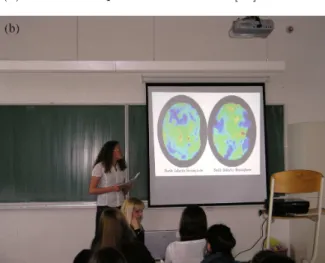
The following 8 sessions were dedicated to the pre-sentation of the contents by the students’ teams who used standard lecture mode aided by a number of vi-sually rich PowerPoint presentations (see Fig. 1). The rest of students used their notebooks to record impor-tant information and particular characteristics of each experiment. No particular oral discussion was noti-ced among the students in this phase of the project, although the teacher tried to encourage students’ oral questions. Only the members of “critique team” had to record all their questions and pass them in written form to the presenting teams. These questions were answered later in two discussion sessions. The seating arrangement was strictly set and it was the teacher -researcher who always conducted the session and con-trolled the classroom atmosphere.
Two of the last three project sessions were reserved for students of two presenting teams to answer the ques-tions posed previously by the “critique team”. Finally, in the last session of the project, the critique team was asked to prepare and conduct a debate about all “open issues” which, according to them, were not treated con-clusively. The debate triggered a number of interesting opinions about the project and the studied topics.
2.2.2. Experimenting and Discussion (ED) ED pedagogy was applied to a group of three physics sections (85 students) who were supposed to cover some classical physics topics in an active-learning way. As it is widely known, some of the sequential tasks which promote active learning are:
(1) Predict–Observe–Explain [33]; or
(2) Observe–Explain–Predict–Test [34].
These physics learning sequences activate the exis-tent students’ knowledge and test it by comparing the predicted and the observed. These sequences of active learning were carried out by using simple experiments to treat a selection of physical phenomena for which students’ alternative conceptions are well known [35],
(a) Force and the concept of motion (4 sessions),
(b) Pressure (hydrostatic, hydraulic, atmospheric, hy-drodynamic) (4 sessions),
(c) Heat (4 sessions).
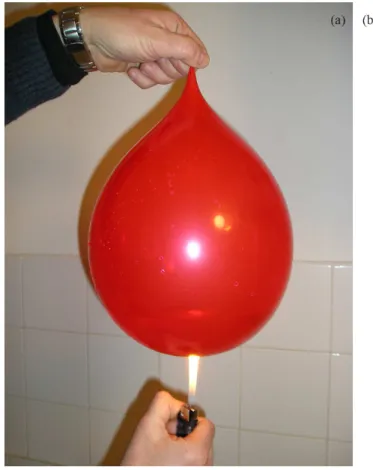
The teacher organized the teaching process in such a way that one simple experiment was carried out every session (see Fig. 2). At the beginning of each session an experiment was described to the students without actu-ally carrying it out. The students were asked to predict the possible results of the experiment. Both the pre-dicted results and their physical explanation had to be noted down in their notebooks. Then, they were asked to give their own, personal explanations of the anticipa-ted results. Once the possible results of the experiment were defined, i.e. when groups of students with the same ’physical’ views were formed, the students were able to debate and offer their explanations for the ex-pected results. The debate allowed the students’ pre-conceptions and the level of scientific reasoning to be
clearly recognized by both the instructor and the stu-dents themselves.
After the debate, the experiment was conducted by the teacher and the results were observed and recorded. Surprising results of experiments always provoked stu-dents’ delight and positive emotions. They often asked to repeat the experiment themselves because they did not believe the result was possible. Naturally, the tea-cher then always required the students to carry out the experiment themselves. The experiments were followed by another debate based on the reasons for predicting certain results of the experiment. This discussion, gui-ded and helped by the teacher, led to the construction of a better physical explanation of the observed pheno-menon.
The seating arrangement was informal, in particu-lar during the experiment itself. The students wanted to be as close as possible to the place where the expe-riment was being carried out and they were also given the opportunity to do it themselves.
In the course of the project, students participated gladly in situations enabling them to obtain new kno-wledge. They also recognized those situations in every-day life, which make possible a positive shift in their previous conceptions and knowledge. Student discus-sions about the physical phenomena observed in the classroom were also noticed in out-of-class situations.
The students who were not participative in regu-lar physics classes often showed a great improvement in active learning sessions. We found that the students were able to direct the learning process themselves by their reactions and answers, and to seek improvement of their initial answers without fearing bad grades or reprimands.
3.
Gender characteristics of two groups
and survey application
The above described, non-traditional methods of desig-ning physics leardesig-ning were applied in a course of the academic year 2008/09 in the spring semester with the senior students. This period is particularly suitable for conducting the project because the students are in the last semester of their high school education and already possess certain knowledge from different scientific areas as well as attitudes towards them. As was already said, the total number of students that took part in the rese-arch was 176, out of which 110 were girls and 66 were boys. They all come from 6 different classes of the same high school.
The total number is broken down into two groups for the purpose of the experiment, each group consis-ting of three classes. The RPQ group consists of 91 students altogether, out of which 56 girls and 35 boys, while the ED group consists of 85 students, out of which 54 girls and 31 boys (Table 1).
Tabela 1 - Gender information for groups surveyed.
All students RPQ group (Reading, Pre-senting and Questioning)
ED group (Experimen-ting and Discussion) girls 110 (63%) 56 (62%) 54 (64%) boys 66 (37%) 35 (38%) 31 (36%)
∑
176 (100%) 91 (100%) 85 (100%) The research task was to measure how two different methods of physics learning affect students’ attitudes and beliefs about physics as a possible career. In this study we used a survey that was administered at the beginning of each semester (pre-test) and again in the last week of the semester (post-test). As said before, the survey consists of 2 statements:
1. I am considering studying physics be-cause I am attracted by the challenge of re-searching the unknown.
2. I am considering studying physics be-cause I am attracted by the challenge of its technological implementation in construc-ting new devices.
Students could express their posture by choosing one of these Lickert possibilities:
(a) I agree totally;
(b) I agree;
(c) No idea;
(d) I disagree;
(e) I disagree totally.
In what follows, we will analyze the overall pre and -post results of the survey for each group. All evaluated students submitted valid pre and post tests so all data is matched and represents 100% of the students in the courses.
4.
Results and analysis
Before we start this analysis, we like to generally answer the question whether the students were able to feel in-terrelatedness between the two research goals (search of unknown and technological applications). The data show that there is not even one student in both groups with an opposing attitude towards the two offered sta-tements. Consequently, we may conclude that the stu-dents, as well as researchers, see these statements as interrelated.
We will first analyse in details the change in the percentage of students with positive attitudes towards the statements of the survey, i.e. percentage of students who opted for “I agree totally“ and “I agree.“
Pre and post percentages of students with a posi-tive attitude are shown in Table 2. Also shown are the results by gender of students, as well as the shift (Post - Pre).
Tabela 2 - Changes in the percentage of students with a positive attitude towards the statements of the survey (Pre - Post) for RPQ and ED Group (Standard error in parentheses; Large Shifts in Bold).
Statement RPQ group (N=91) (positive attitude) ED group (N=85) (positve attitude) Pre (%) Post (%) Shift (%) Pre (%) Post (%) Shift (%)
1. I am considering studying physics because I am attracted by the challenge of researching the unknown.
Overall 13.2 (2.2) 15.4 (2.3) 2.2 (0.7) 15.3 (2.3) 28.2 (2.7) 12.9(1.2) Girls 10.7 (2.3) 12.5 (2.3) 1.8 (0.8) 14.8 (2.3) 25.9 (2.8) 11.1(1.1) Boys 17.1 (2.1) 20.0 (2.2) 2.9 (0.7) 16.1 (2.2) 32.3 (2.7) 16.2 (1.2)
2. I am considering studying physics because I am attracted by the challenge of its technological implementation in constructing new devices.
Overall 13.2 (2.1) 16.5 (2.4) 3.3 (1.1) 16.5 (2.2) 23.5 (2.7) 7.0(1.0) Girls 10.7 (2.1) 14.3 (2.4) 3.6(1.0) 16.7 (2.2) 22.2 (2.6) 5.5(1.1) Boys 17.1 (2.1) 20.0 (2.3) 2.9 (1.2) 16.1 (2.1) 25.8 (2.9) 9.7(0.9)
Table 2 includes pre and post survey data, as well as the shift for RPQ and ED group.
Pre test results of the RPQ group show that 13.2% of students are considering studying physics either due to the challenges of the unknown or the challenges of technological applications of physics in the construc-tion of new devices. Upon compleconstruc-tion of the project there was no statistically significant shift in the num-ber of students who are considering studying physics because of the challenges of researching the unknown. For the other statement only the girls achieved a sig-nificant shift (3.6%). It is a little bit surprising that young men do not achieve a major shift in the possi-ble election of physics motivated by the possibility of its technological applications in the construction of new devices. Overall, RPQ group generates no statistically significant improvement.
In the ED group at the pre test students achieve a higher percentage of favourable results for both the first (15.3%) and the second statement (16.5%).
It has to be emphasized that there was no statisti-cally significant difference between RPQ and ED groups in the overall percentage of students with a positive at-titude on the pretest. Statistically significant difference emerges between the girls of the two groups. Namely, the percentage of girls with a positive attitude on the pretest in the ED group was statistically significantly higher for both statements than the percentage of girls in the RPQ group.
In this group, at the end of the project, a statis-tically significant positive shift was achieved. At the post test, 28.2% of students are considering studying physics because of the challenges of researching the unk-nown, which, if compared to the pre-test results gives a positive shift of 12.9%. Both girls (11.1%) and boys (16.2%) significantly contribute to the shift. In the sta-tement about considering physics because of technolo-gical applications in the construction of new devices, a statistically significant shift of +7.0% on the pre test (16.5%) was achieved. Men participated to this shift by a somewhat higher percentage (9.7%) than girls (5.5%). Overall, this group of students achieved a statistically significant shift of 10%.
The overall shift in both affirmations taken together for both group is given in the Fig. 3.
Figura 3 - Overall shift in positive attitudes (Pre – Post) for RPQ group and ED group.
4.1. Attitudes toward studying physics and sci-entific reasoning level of students
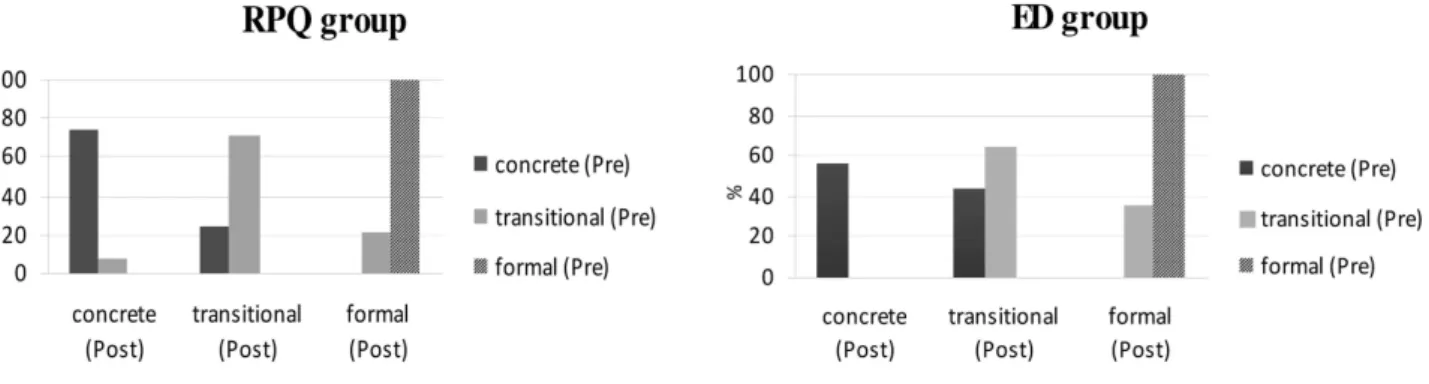
Within the broader framework of the same study stu-dents were classified, according to the level of scien-tific reasoning, into the Concrete thinkers, Transitio-nal thinkers and Formal thinkers. For this purpose the ’Lawson’s Classroom Test of Scientific Reasoning ”(LCTSR) [36] was used. In course of the project there was a migration of students in higher or lower levels of reasoning [37]. These results are shown in Table 3 and Fig. 4.
Tabela 3 - Percentages of RPQ and ED students in concrete-operational, transitional, and formal-operational thinking cate-gories as indicated by pre - and post-test scores on the LCTSR.
Concrete Transitional Formal RPQ group (%) Pre 26.4 57.1 16.5
Post 24.2 47.3 28.6 ED group (%) Pre 27.1 52.9 20.0 Post 15.3 45.9 38.8
Figure 4 show the pre - to – post-test changes in reasoning level for students in the RPQ group:
(a) 75% of concrete-operational thinkers remain at that level, while 25% of them shift to the transitional le-vel;
(b) 71.2% of transitional thinkers remain at that level, while 7.7% regress to the concrete-operational le-vel, and 21.1% advance to the formal-operational level;
(c) 100% of formal-operational thinkers remain at that level, not regressing to lower levels.
Figure 4 show the pre - to – post-test changes in reasoning level for students in the ED group:
(a) 56.5% of concrete-operational thinkers remain at that level, while 43.5% of them shift to the transi-tional level;
(b) 64.4% of transitional thinkers remain at that le-vel, and 35.6% of them advance to the formal-operational level;
(c) 100% of formal-operational thinkers remain at that level, not regressing to lower levels.
Figura 4 - Pre - to - post migrations between different levels of thinking for RPQ and ED groups.
Tabela 4 - Pre - to - post migrations between different levels of thinking for RPQ group. Percentage of students with a positive attitude (Pre – Post) and the shift for the survey statements for different levels of thinkers (Large Shifts in Bold).
RPQ group (%)
Concrete (Pre) Transitional (Pre) Formal (Pre) Concrete
(Post)
Transitional (Post)
Concrete (Post)
Transitional (Post)
Formal (Post)
Formal (Post)
75 25 7.7 71.2 21.1 100
Statement 1.
Pre 0.0 16.7 0.0 10.8 18.2 33.4
Post 0.0 16.7 0.0 10.8 27.3 40.0
Shift 0.0 0.0 0.0 0.0 9.1 6.6
Statement 2.
Pre 0.0 16.7 0.0 10.8 18.2 33.4
Post 0.0 16.7 0.0 10.8 27.3 46.7
Shift 0.0 0.0 0.0 0.0 9.1 13.3
Bold - p value<0.05.
⌈
Table 4 shows the percentages of students with a positive attitude towards the statements of the survey in different groups of thinkers (Pre - Post) for RPQ group. In the first statement, regarding the challenge of researching the unknown, a positive attitude is not pre-sent neither in students who remain concrete thinkers at the post-test nor in students who remain in the group of transitional thinkers. For students who move from concrete to the transition level, there was the same per-centage of students who expressed a positive attitude (16.7%) at both the pre and the post test. Students who remain at the transition level achieved the same percen-tage of positive attitudes (10.8%) at both pre and post test. The shift in the positive attitudes for the first statement was achieved by the students who migrate from the transition to formal level. Namely, 18.2% of them have positive attitudes at the pre-test, while at the post-test this percentage increased to 27.3%, achi-eving a statistically significant shift of 9.1%. All stu-dents who were at the formal level of thinking at the pre-test remain at that level at the post-test. 33.4% of them had a positive attitude at the pre-test, while at the post-test this percentage increased to 40.0%, achie-ving a statistically significant improvement of 6.6%. For the second statement, studying physics because of its technological applications, the results are comparable with those for the first one. A positive shift (9.1%) was achieved by thinkers who migrate from the transition to the formal level where the percentage of students with
a positive attitude increases from 18.2% (pre) to 27.3% (post). For the second statement the formal thinkers (those who remain at this level) achieve a more signifi-cant progress than for the first statement. Percentage of formal thinkers with a positive attitude changed from 33.4% (pre) to 46.7% (post), which means they achie-ved a statistically significant improvement of 13.3%.
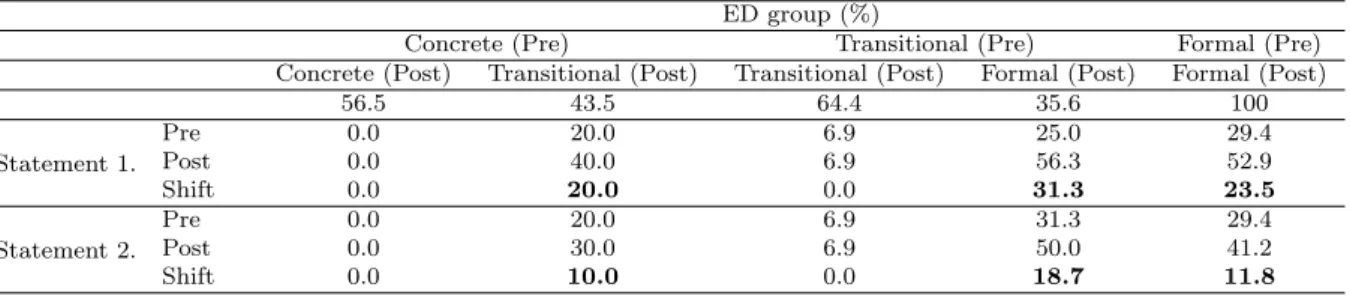
percentage increases to 56.3% at post-test, achieving a statistically significant improvement of 31.3%. In the initial group of formal thinkers (in which there is no migration at post-test) the percentage of students with a positive attitude grows from 29.4% to 52.9%, which means a statistically significant improvement of 23.5%. For the second statement, regarding the study of phy-sics because of its technological applications, a positive attitude (at both the pre and the post-test) 20% of stu-dents who migrated from the concrete to the transition level showed a positive attitude. Out of that group of students 30% have a positive attitude at the post-test, which indicates a statistically significant shift of 10%.
6.9% of students who stay in the transition group of thinkers at the post-test have a positive attitude, which remains unchanged at the post-test. A statistically sig-nificant gain of 18.7% was achieved by students who migrate from the transition to the formal level. 31.3% of them have positive attitudes at the pre-test, while the results increased to 50% at the post-test. With for-mal thinkers, where there is no migration into lower levels of thinking, there were 29.4% of students with a positive attitude at the pre-test and 41.2% at the post-test. Thus, the second statement made a statistically significant improvement of 11.8%.
⌋
Tabela 5 - Pre - to - post migrations between different levels of thinking for ED group. Percentage of students with a positive attitude (Pre – Post) and the shift for the survey statements for different levels of thinkers (Large Shifts in Bold).
ED group (%)
Concrete (Pre) Transitional (Pre) Formal (Pre) Concrete (Post) Transitional (Post) Transitional (Post) Formal (Post) Formal (Post)
56.5 43.5 64.4 35.6 100
Statement 1.
Pre 0.0 20.0 6.9 25.0 29.4
Post 0.0 40.0 6.9 56.3 52.9
Shift 0.0 20.0 0.0 31.3 23.5
Statement 2.
Pre 0.0 20.0 6.9 31.3 29.4
Post 0.0 30.0 6.9 50.0 41.2
Shift 0.0 10.0 0.0 18.7 11.8
Bold - p value<0.05.
⌈
5.
Discussion
Girls in both groups have significantly more negative attitudes than boys. This is not surprising, since the traditional teaching of physics hasn’t been modified to better suit girls, nor has it managed to improve attitu-des towards physics as a possible profession. Positive examples found in traditional teaching is most likely just the result of engagement of a teacher, which is not common.
In the case of RPQ physics teaching method there is no statistically significant shift in the percentage of stu-dents who would chose physics as a profession whether for the challenges of researching the unknown or be-cause of technological application of physics in the cons-truction of new devices. It is interesting to note that the only significant positive shift was achieved by girls for the second statement - challenge of technological ap-plication of physics in the construction of new devices. Significant gains in positive attitudes were achie-ved by those students who were at the post-test in the group of formal thinkers. However, the shift in the per-centage of students with a positive attitude also occurs with students who migrate from the transition to the formal level. Evidently, this teaching method triggers the interest in the study of physics only in students at the formal level of reasoning. For other thinkers, it does not create enough challenge for considering such a
career path.
ED physics teaching method results in a statisti-cally significant improvement with both boys and girls. The process of learning physics through active learning, which insists on finding the correct interpretation of the observed physical phenomena, awakens the challenge of studying physics for students of both sexes. This is a particularly important fact because of the well known efforts put into finding teaching interventions aimed at increasing the number of girls who would choose phy-sics. As for the results achieved according to the level of reasoning significant gains are obtained by the students who move from the concrete to the transition level, as well as those who migrate from the transitional to for-mal. It is important to note that the improvement in positive attitudes in this group is significantly related to the degree of progress in scientific reasoning. Of course, the results of formal thinkers of this group were expec-ted, and their statistically significant improvement is not surprising.
the ED group was significantly higher in the selection of physics because of the challenges of the unknown. This fact should be observed within the humanistic ori-entation of the high school in which the research was conducted. Namely, these students are more strongly oriented towards social contacts, and often assume that technology diminishes humanity.
Although the ED method obtains excellent results, it has to be emphasized that, due to its experimental nature, it is not equally applicable to all physics topics. For example, although highly appropriate for classical physics topics, it would be inappropriate for addressing quantum physics topics.
In order not to be misunderstood by some readers, we stress that in the ED method the experimental part takes only five to ten minutes (of 45-minute of class time). It means that the emphasis was entirely on stu-dents’ personal thinking and group discussions, i.e. on mental processes of building and revising of explanatory and predictive models. This makes the ED method fun-damentally different from a purely empirical method.
In both groups, the students’ reasons for choosing or not choosing physics as a profession can be explai-ned by a set of common arguments. Those students who express a positive attitude towards studying phy-sics emphasize the possibility of good jobs and succes-sful careers, desire to study nature and the need to address the world’s energy problems. Students with a negative attitude towards studying physics highlighted the complexity of physics, a lot of effort to be invested in order to gain an academic title, the fear of mathe-matics as well as interest in other areas that involve human interaction (humanistic studies, medicine, law, economics, . . . ).
6.
Conclusions
Results obtained at the beginning of the project show that less than 16% of high school graduates considered physics a potential occupational choice. This result is not surprising since the survey was conducted on the group of high school students with humanistic orien-tation,who generally do not choose physics as a profes-sion. Positive shifts are achieved through active physics learning experiences promoted in the Experimenting and Discussion (ED) group. It is a teaching method that significantly increases the number of students in-terested in physical science careers. The increase is sig-nificant for both girls and boys and shows that this method of physics teaching might contribute significan-tly to the improvement of students’ attitude towards physics. The percentage of students who would choose physics because of the challenges of the unknown, after the project shown a progress of 12.9%, while the percen-tage of those who are attracted to technological appli-cation of physics in the construction of new devices in-creased by 7%. This method significantly inin-creased the
percentage of students with a positive attitude towards studying physics in all groups of thinkers who migrate to higher levels of thinking. This important finding indicates a significant correlation between the impro-vement of positive attitudes towards studying physics and improvement of the scientific reasoning. However, the data also indicated that the students see the two research statements as interrelated since we found no opposing attitudes towards these two statements in any single student.
The method Reading, Presenting, and Questioning (RPQ) has led to no significant increase in the number of boys interested in physical science careers. Howe-ver, it should be noted that the girls achieved a sta-tistically significant improvement (3.6%) related to the interest in physics career because of technological ap-plications of physical knowledge. Girls like acquiring knowledge in a collaborative way which can be carried out through discussions that are a constituent part of the RPQ method. With this teaching method a signifi-cant shift in the percentage of students with a positive attitude is achieved by students who migrate from the transitional to the formal level. Since in the RPQ group a lesser number of students have migrated to higher le-vels of reasoning when compared to the ED group, this has also resulted in a lesser improvement in the per-centage of students with a positive attitude towards studying physics.
This study is a part of a larger study that offers po-tentially useful messages for teachers and researchers. New teaching interventions, promoting active physics learning experiences, are required in order to promote students’ interest in physics as a possible professional choice, as shown in this paper. In the development of better physics courses more attention should be paid to students’ gains in the field of reasoning and conceptual understanding. Also, one should assess the affective impact on students (motivation, interest, emotion, . . . ) and gain insight into students’ experiences and expec-tations of teaching.
Acknowledgements
We thank Mr Mladen Buljubaˇsi´c, prof., Ministry of Education coordinator for physics, for granting the per-mission for using up to a quarter of annual syllabus (16 lessons) for the project. We also want to thank Pro-fessor S. Pivac for the great support and effort she put into processing data, and highly apreciate help recei-ved from Dr. Josefina Barrera Khalil in traslating the abstract into Portuguese.
References
[2] J. Osborne, S. Simon and S. Collins, Int. J. Sci. Educ.
25, 1049 (2003).
[3] K. Spall, S. Barrett, M. Stanisstreet, D. Dickson and E. Boyes, Res. Sci. Technol. Educ.21, 193 (2003). [4] S.M. Nashon, in: Paper presented at the Annual
Mee-ting of the National Association for Research in Science Teaching (Philadelphia, PA, March, 23-26, 2003).
[5] L. Hoffmann, Learn. Instr.12, 447 (2002).
[6] Z. Hazari, H.R. Tai and P.M. Sadler, Sci. Educ. 91, 847 (2007).
[7] F. Lawrenz, N.B. Wood, A. Krichoff, N.K. Kim and A. Eisenkraft, J. Res. Sci. Teach.46, 961 (2009). [8] L.E. Kost, S.J. Pollock and N.D. Finkelstein, Phys.
Rev. ST Phys. Educ. Res.5, 010101 (2009).
[9] C. Angell, Ø. Guttersrud, E. Henriksen and A. Isnes, Sci. Educ.88, 683 (2004).
[10] H. Carlone, J. Res. Sci. Teach.4, 392 (2004).
[11] P. Haussler and L. Hoffmann, Sci. Educ. 84, 689 (2000).
[12] K. Sheppard and D.M. Robbins, Phys. Teach.41, 420 (2003).
[13] C.A. Ethington, J. Educ. Res.81, 354 (1988). [14] P. Tamir, Brit. Educ. Res. J.14, 127 (1988). [15] B. Hannover, Z. P¨adagog. Psychol.5, 169 (1991). [16] P. H¨aussler and L. Hoffmann, J. Res. Sci. Teach. 39,
870 (2002).
[17] A. Ziegler, P. Broome and K. Heller, Z. P¨adagog. Psy-chol13, 135 (1999).
[18] B. Whitten, S. Foster and M. Duncombe, Phys. Today
56, 46 (2003).
[19] P.R. Porter and P. Umbach, Res. High. Educ.47, 429 (2006).
[20] P.M. Sadler and R.H. Tai, Sci. Educ.85, 111 (2001).
[21] A. Zeldin and F. Pajares, Am. Educ. Res. J.37, 215 (2000).
[22] Z. Zhu, International Educational Journal 8, 204 (2007).
[23] M.S. Schwartz, P.M. Sadler, G. Sonnert and R.H. Thi, Sci. Educ.93, 798 (2008).
[24] B. Woolnough, Phys. Educ.29, 368 (1994).
[25] M. Lorenzo, C.H. Crouch and E. Mazur, Am. J. Phys.
74, 118 (2006).
[26] E.F. Redish, Teaching Physics with the Physics Suite
(John Wiley & Sons, New York, 2003).
[27] V. Paar, PHYSICS 4 – Coursebook for 4th Grade of Grammar Schools(ˇSkolska knjiga, Zagreb, 2006).
[28] V.R. Gillis and G. MacDougall, Sci. Teach. 74, 45 (2007).
[29] B. Daley, Phys. Teach.42, 41 (2004).
[30] C. Chin and J. Osborne, Stud. Sci. Educ.44, 1 (2008). [31] R.E. Slavin, Contemp. Educ. Psychol.21, 43 (1996). [32] D. Johnson and R. Johnson, Learning Together and
Alone: Cooperative, Competitive and Individualistic Learning(Allyn & Bacon, Boston, 1999).
[33] R. White and R. GunstonePrediction Observation -Explanation? in Probing Understanding (The Falmer Press, London, 1992), chapter 3.
[34] A. Van Heuvelen and E. Etkina, The Physics Active Learning Guide(Instructor Edition, Addison Wewley, San Francisco, 2006).
[35] L.C. McDermott and E.F. Redish, Am. J. Phys. 67, 755 (1999).
[36] A.E. Lawson,Classroom Test of Scientific Reasoning: Revised Pencil Paper Version (Arizona State Univer-sity, Tempe, 1996).