Declaration of Interest:The authors certify that they have no commercial or associative interest that represents a conflict of interest in connection with the manuscript.
Corresponding Author: Luis Eduardo Souza-Flamini E-mail: [email protected]
http://doi.org/10.1590/1807-3107BOR-2017.vol31.0029
Submitted: Nov 03, 2016
Accepted for publication: Mar 06, 2017 Last revision: Mar 13, 2017
Influence of root dentin treatment
on the push-out bond strength of
fibre-reinforced posts
Abstract: This study evaluates the inluence of root dentin
treatment with NaOCl alone and combined with EDTA, with and without ultrasound activation, on the push-out bond strength (BS) of iber-reinforced posts in weakened roots, cemented with RelyX or Panavia. The root canals of 42 maxillary canines were instrumented with Reciproc and 2.5% NaOCl. In the coronal 12mm of all canals, experimental weakening of the roots was produced by reducing dentin thickness with 2.44mm diameter diamond burs. The roots were assigned to 3 groups (n = 14) according to root dentin treatment: 2.5% NaOCl; 2.5% NaOCl + 17% EDTA; and 2.5% NaOCl + 17% EDTA, with solutions agitated using passive ultrasonic irrigation. After cementation of the iber-reinforced posts the roots were divided in thirds. The irst slice of each third was used for the push-out BS test, the second slice for confocal laser scanning microscopy and dentin microhardness (Knoop) analysis. Data were analysed by a two-way ANOVA and Tukey test (a = 0.05). NaOCl + EDTA provided highest BS values than NaOCl (p < 0.0001). Specimens cemented with Panavia presented signiicantly higher BS than those with RelyX in the three root thirds (p < 0.0001). The highest BS values occurred in the cervical third (p < 0.001). Ultrasound-activated NaOCl + EDTA promoted the greatest reduction in dentin microhardness, followed by NaOCl/EDTA and NaOCl. Ultrasonic activation of NaOCl and EDTA reduced root dentin microhardness, but did not improve the push-out BS of resin-based cements. Panavia presented higher BS than RelyX. RelyX was not inluenced by the root dentin treatment protocols.
Keywords: Microscopy; Confocal; Dental Bonding; Endodontics.
Introduction
The rehabilitation of endodontically treated teeth is directly related to the amount of remaining tooth structure.1 The absence of suficient coronal
remnant combined with the destruction of cervical root dentin results in very thin walls, allowing a higher root fracture rate when these teeth receive conventional restorations.2 In this situation, the combined use of
intracanal retainers and resin composite is recommended to reinforce the dental structure.3 The increase of the fracture strength of endodontically
treated teeth reinforced with prosthetic posts has been demonstrated
Altair Soares de MOURA(a)
Rodrigo Dantas PEREIRA(b)
Fuad Jacob Abi RACHED-JUNIOR(c)
Bruno Monguilhott CROZETA(b)
Jardel Francisco MAZZI-CHAVES(b)
Luis Eduardo SOUZA-FLAMINI(b)
Antonio Miranda CRUZ-FILHO(b)
(a) Universidade Estadual de Montes Claros –
Unimontes, Interinstitutional PhD program, Montes Claros, MG, Brazil.
(b) Universidade de São Paulo – USP, Ribeirão
Preto Dental School, Department of Restorative Dentistry, Ribeirão Preto, SP, Brazil.
(c) Universidade de Ribeirão Preto – Unaerp,
clinically.4,5 Glass-fiber posts feature advantages
over other intracanal retainers such as adhesion to restorative resinous materials, elastic modulus close to that of dentin, rapid and easy technique, uniform stress distribution and good corrosion resistance.6,7
The cementation of an intracanal retainer has a direct influence on the stability and longevity
of restorations in endodontically treated teeth.8
Adhesiveness of the luting agent is inluenced by moisture inside the canal, gutta-percha solvents
and polymerization shrinkage.9,10,11 Self-adhesive
resin cements have lower contraction stress than conventional resin cements.12
The use of resin-based luting cements is
recommended13 to promote mechanical adhesion
between the monomers of the material and the collagen ibers of dentin, with consequent formation of the hybrid layer.14 In this sense, removal of the smear layer
with consequent opening of dentinal tubules enhances the intertubular penetration of adhesive system and increases bond strength (BS).15 Removal of the organic
and inorganic components of the smear layer is achieved with irrigation with sodium hypochlorite (NaOCl) and EDTA solutions, respectively.16 NaOCl acts as an
organic tissue solvent17 and has a bactericidal action.
The chelating effect of EDTA promotes decalciication of the inorganic components exposing the dentin collagen network, which increases the adhesion of the luting agent. However, at the same time that it promotes an eficient cleaning of the root canal walls, EDTA reduces dentin microhardness, as a consequence of its decalcifying effects.18,19
The adhesion of resin composites used for reinforcement of weakened roots can also be inluenced by the presence of root canal sealer in the dentinal
tubules and along the canal walls.20 Residual root
canal sealer could reduce the intertubular penetration of the adhesive system as well as have a chemical interaction with the resin.
In this perspective, the objective of this study was to investigate the inluence of different root dentin treatment protocols, with the use of NaOCl alone or combined with EDTA, with and without ultrasonic activation, on the push-out BS of iber-reinforced posts cemented with Self-etch (Panavia F) and self-adhesive (RelyX U200) dual cure cements in experimentally
weakened roots. The null hypothesis of this study is that none of the treatment protocols or cements inluence the bond strength.
Methodology
Tooth selection and preparation
After Ethics Committee approval (Process number 482.179), 42 human permanent maxillary canines with a patent and single canal, fully formed apex, no internal calciications/resorption and no previous endodontic treatment were selected based on clinical and radiographic examinations from a pool of extracted teeth belonging to our endodontics laboratory collection and stored in 0.1% thymol solution. Sex, ethnicity and age of the tooth donors were unknown. After washing in running water for 24 hours, the teeth had the crowns removed close to the cementoenamel junction to obtain roots with a standardized length of 17 mm.
The working length was visually established as 1 mm shorter than the canal length. All teeth were prepared using the Reciproc system (#50.05) in an electric motor (VDW GmbH, Munich, Germany) adjusted for reciprocating motion according to the manufacturer’s instructions. During preparation, the canals were irrigated with 2 mL of 2.5% NaOCl; this was repeated each time the instrument was removed.
Experimental Root Weakening
Experimental root weakening was performed to simulate widely lared and clinically weakened roots. For the weakening protocol, the roots were inserted in a silicone cylinder, with the cervical and middle thirds remaining exposed. The cylinder was ixed to the base of a delineator and parallel to the low-rotation motor ixed to the device rod. The burs #4137 and #720G (KG Sorensen, São Paulo, SP, Brazil) were used with air/water spray coolant. At the end of the procedure, a 12-mm-long wear was obtained along the root canal.
Root Canal Filling
Munich, Germany) and an epoxy-resin sealer (AH Plus; DeTrey Dentsply GmbH, Konstanz, Germany) mixed with 0.1% Rhodamine B dye. Radiographs were taken to conirm the absence of voids in the illings and the canal access was restored with a temporary restorative material. The roots were stored in an incubator at 37 °C and 100% humidity for a period corresponding to three times the setting time of the sealer recommended by the manufacturer. To simulate the thermal changes occurring in the mouth, the specimens were subjected to a thermal cycling regimen of 3,600 cycles in water baths at 5 °C and 55 °C with a dwell time of 5 s between baths.
Post Space Preparation
After thermal cycling, gutta-percha was removed with heated endodontic pluggers, maintaining at least 5 mm of illing material in the apical third. The post spaces were prepared to a depth of 12 mm measured from the sectioned surfaces using the drills supplied with the iber post system. In each specimen, a White Post DC® #2 glass-iber post (FGM, Joinville, Brazil; 1.8 mm cervical diameter, 1.05 mm apical diameter and 20 mm length) was tested to it the canal space. For the relining procedure, the canal space was illed with a micro-hybrid light-cure resin composite (Filtek Z-250; 3M/ESPE, St. Paul, USA) (Table 1) inserted incrementally, from apical to cervical, and compacted apically with a hand compactor. In each canal, a post coated with a thin layer of petroleum jelly was inserted centrally into the resin mass along the whole post space extension. Photoactivation was performed using a LED curing unit with output intensity of 30 mW/cm2,
as measured by a curing radiometer (Optilux 501, SDS/Kerr, Orange, USA). The light-curing tip was placed over the post, activated for 5 seconds and then photoactivaton was carried out for 20 seconds on each face. After resin composite polymerization, the post was clamped with needle-nose pliers and removed from the canal.
Distribution of Experimental Groups
The roots were randomly divided into 3 groups (n = 14) according to the root dentin treatment protocols. A volume of 5 mL was used for all irrigation solutions: NaOCl: 2.5% NaOCl for 1 min; NaOCl + EDTA: 2.5% NaOCl for 20 s, 17% EDTA for 20 and 2.5% NaOCl for 20s; and NaOCl + EDTA+US: three 20-s irrigation cycles with 2.5% NaOCl followed by 17% EDTA and 2.5% NaOCl for 20 s each. The solutions in this group were agitated using passive ultrasonic irrigation with a size 20, .01 taper E1- Irrissonic ile (HELSE Capelli e Fabris Ind., Santa Rosa do Viterbo, Brazil) attached to a Jet Sonic ultrasonic device with power setting at 10% and 30 KHz of frequency (Gnatus, Ribeirão Preto, Brazil). For all groups, inal irrigation was performed with distilled water for 30s. In each group, half of posts were cemented with RelyX U200 (3M ESPE, St. Paul, MN, USA) and the other half with Panavia F (Kuraray Noritake, Tokyo, Japan). Prior to the cementation, 0.1% luorescein was added to both luting cements21.
Preparation of Root Dentin Slices
The restored roots were individually taken to a precision cutting machine with a water-cooled
Table 1. Partial and total mean values over the standard deviation total (MPa) of BS as the root reinforcement treatment protocol for each sealer and root third of the post.
Root dentin treatment
Panavia F RelyX U200
Root third Root third
Cervical Middle Apical Cervical Middle Apical
NaOCl 2.7 ± 0.6Ab 2.4 ± 0.5Ab 2.2 ± 0.4Aa 2.7 ± 0.5Ab 2.3 ± 0.6Aa 1.9 ± 0.3Aa
NaOCl+EDTA 9.3 ± 1.7Aa* 7.6 ± 1.1Ba* 3.5 ± 1.0Ca 3.9 ± 1.0Aab* 2.9 ± 0.9Ba* 2.3 ± 0.4Ba
diamond disc (Isomet 1000; Buehler, Lake Buff, USA) and serially sectioned perpendicular to the long axis of the post. Two 1.5-mm-thick (±0.1 mm) slices were obtained from the coronal, middle and apical root thirds. The irst slice from each root third was used for the push-out BS test and the second slice for confocal laser scanning microscopy (CLSM) and dentin microhardness analysis.
Push-out Test
After conirming thickness with a digital calliper, each slice was taken to an Instron machine (model 2519-106; Instron Corporation, Norwood, USA) with its coronal side facing the metallic base and the resin/cement/post section area coinciding with the 2.5-mm-diameter hole in the base. The posts were pushed out with cylindrical plungers of different diameters (2.5 mm, 2.0 mm, 1.5 mm, 1.0 mm) elected according to the size of the resin/cement/post section area. The plunger tip was positioned in such a way to touch only the post, avoiding any contact with the materials and dentin. The load was applied on the apical side of the root slice in an apical-coronal direction at a 0.5 mm/min crosshead speed, until bond failure occurred. The post was pushed toward the larger portion of the root slice to avoid limitation to its dislodgment due to canal taper. Care was also taken to ensure that the contact between plunger tip and the post section occurred over the most extended possible area to avoid notching effects on post surface, which would interfere with BS results. Bond failure was recorded by the extrusion of the post section from the root slice. In order to express the BS in MPa, the load at failure recorded in N was divided by the area of the bonded interface, which was calculated using the following equation: a ¼ 2pr h where p is the constant 3.14, r is the post radius, and h is the thickness of the slice in mm.
The failure type was evaluated by means of fractographic analysis, using a stereomicroscope (Leica M165C, Leica Microsystems GmbH., Wetzlar, Germany) at 50´ magniication. Failures observed after debonding were determined on a percentage basis and classiied in four types: adhesive (between the relining material and dentin), cohesive in the relining material, cohesive in dentin and mixed (combination of adhesive and cohesive in the relining material).
CLSM analysis
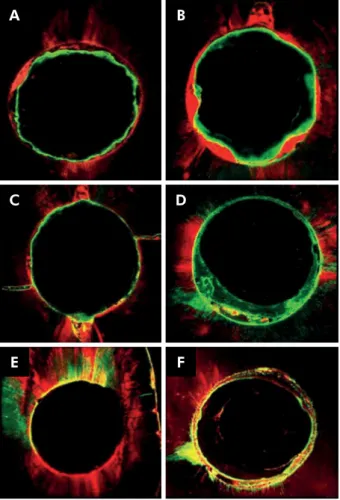
The second slices of each root third were evaluated qualitatively to assess the penetration of the materials throughout the dentinal tubules using a confocal inverted microscope (Leica TCS-SPE Leica, Mannheim, Germany) and a method of epifluorescence with wavelengths of absorption and emission to rhodamine B of 543/560 nm and to luorescein of 488/500 nm. The histotomographic images revealed the areas of dentinal tubules illed with AH Plus sealer mixed with rhodamine B (red), and Panavia F or RelyX U200 cements mixed with luorescein (green), as well as tubules in which sealer and cement were found
(yellow). The specimens were analyzed 10 mm below
the surface with 10× magniication, 5x5mm ield of vision with 512×512 pixel resolution.
Dentin Microhardness Analysis
The specimens were ground wet with 400-, 500-, and 600-grit silicon carbide papers, polished with felt disks embedded in aluminum oxide paste at low speed, washed in running water for 4 h, dried with gauze, and examined at 40× magniication to conirm smoothness. Measurement of microhardness is only possible on smooth dentin surfaces because the indentations are not visible on nonpolished
surfaces22. Dentin microhardness was measured
with a Knoop indenter (Shimadzu HMV-2000; Shimadzu Corporation, Kyoto, Japan) under 10-g load and 15-second dwell time. For each slice, three indentations were performed, starting from the root
canal lumen towards the cement, located 200 mm
apart from each other.
Statistical analysis
Results
Push-out Test
A two-way ANOVA in a split-plot arrangement revealed that BS was signiicantly affected by the root dentin treatment (p < 0.0001), cement (p = 0.0001), root third (p < 0.0001) and their interaction (p < 0.0001). For the root dentin treatments, specimens treated
with NaOCl + EDTA (4.9 ± 2.8) and NaOCl + EDTA
+ US (4.4 ± 2.2) showed higher BS than NaOCl alone
(2.3 ± 0.6). For the cements, signiicantly higher BS
was obtained with Panavia F (5.0 ± 2.7) than RelyX
U200 (2.8 ± 0.9). Comparing the root thirds, higher BS was observed in the coronal third (5.1 ± 2.7) compared with the middle (4.0 ± 2.1) and apical (2.5 ± 0.8) thirds. For Panavia F, dentin treatment with NaOCl+EDTA and NaOCl + EDTA + US increased the BS in coronal and middle thirds compared with NaOCl (p < 0.05). For RelyX U200, dentin treatment with NaOCl + EDTA + US increased the BS compared with NaOCl in the coronal third, but no signiicant increase in BS was observed in the other thirds. When root dentin was treated with NaOCl + EDTA and NaOCl + EDTA + US, Panavia F cement presented higher BS than RelyX U200, but no different was observed between the cements when root dentin was treated with NaOCl alone (Table 1).
The failure pattern data are presented in Table 2. All cohesive failures occurred in the relining material. Panavia F showed a predominance of cohesive and mixed failures in the coronal and middle thirds for NaOCl and NaOCl + EDTA
dentin surface treatments, When NaOCl + EDTA + US was used, there was a predominance of mixed failures in the coronal and apical thirds and mixed and cohesive failures in the middle third. For RelyX U200, the majority of failures were mixed in the coronal third and cohesive and mixed in the middle third, regardless of the dentin surface treatment. In the apical third, there was a predominance of adhesive and cohesive failures for NaOCl and NaOCl + EDTA + US and cohesive failures for NaOCl+EDTA dentin surface treatments.
CLSM Analysis
Figure 1 is a composite igure with images of 6 slices, each slice representing one of the three root dentin treatments and one of the two cements. In specimens treated with NaOCl alone, there was a predominance of AH Plus sealer in practically the entire root canal circumference, with very little or no evidence of penetration of Panavia (Figure 1A) or RelyX U200 (Figure 1B) cements throughout the dentinal tubules. In specimens treated with NaOCl + EDTA, most dentinal tubules were illed with AH Plus sealer and discreet penetration of Panavia F (Figure 1C) and RelyX U200 (Figure 1D) could be observed. In the group with solutions agitated using passive ultrasonic irrigation, although most tubules revealed the presence of AH Plus, several regions of dentin exhibited yellowish areas, resulting from the interaction between AH Plus sealer and Panavia F (Figure 1D) and RelyX U200 (Figure 1F) luting cements.
Table 2. Failure pattern distribution.
Resin cement Root dentin treatment
Root third
Coronal Middle Apical
A CR M CD A CR M CD A CR M CD
Panavia F
NaOCl 0.0 71.4 14.3 14.3 28.6 42.9 28.6 0.0 28.6 42.9 28.6 0.0
NaOCl + EDTA 0.0 57.1 28.6 14.3 14.3 28.6 57.1 0.0 42.9 28.6 14.3 14.3
NaOCL + EDTA + US 0.0 0.0 85.7 14.3 0.0 57.1 42.9 0.0 0.0 28.6 71.4 0.0
RelyX U200
NaOCl 0.0 28.6 51.7 14.3 14.3 42.9 42.9 0.0 42.9 42.9 14.3 0.0
NaOCl + EDTA 0.0 28.6 57.1 14.3 14.3 57.1 28.6 0.0 0.0 71.4 28.6 0.0
NaOCL + EDTA + US 28.6 0.0 57.1 14.3 14.3 42.9 42.9 0.0 57.1 28.6 14.3 0.0
Dentin microhardness
The analysis of variance indicated that there was difference only among the solutions (p < 0.001), without significant difference among the thirds (p = 0.511) and nor in the solution/third interaction
(p = 0.153). NaOCl (50.45 ± 5.9 KHN) promoted
the greatest reduction in dentin microhardness
followed by NaOCl+EDTA (56.70±6.6 KHN) and
NaOCl + EDTA + US (64.13 ± 4.7 KHN). Table 3 presents the Knoop microhardness mean values for each canal third according to the dentin treatment and cement used.
Discussion
The dentin treatment protocols as well as the luting cements inluenced the bond strength iber-reinforced post in weakened roots, thus rejecting the null hypothesis.
The use of glass iber posts for the restoration of endodontically treated teeth is a common procedure.23,24
The clinical success of the restorative treatment depends mainly on the BS between the post and the root dentin25 and therefore, the occurrence of failures
at the post-adhesive cement-dentin interface is critical. Treatments of dentin surface with different solutions have been proposed to increase the retention of the post/cement/dentin set, including EDTA, NaOCl, chlorhexidine, ethanol and ethylene acetate.26,27,28
Three root dentin treatments were evaluated in the present study: NaOCl alone, NaOCl and EDTA, NaOCl and EDTA with passive ultrasound activation. The purpose of root dentin treatment is basically the removal of smear layer, opening of dentinal tubules and exposure of collagen ibers to permit an adequate iniltration of the adhesive system and
Tabela 3. Mean values of dentin microhardness for each root canal third according to the cement and dentin treatment.
Variable
NaOCl NaOCl + EDTA NaOCl + EDTA + US
C M A C M A C M A
RelyX 62.6 ± 2.8 66.0 ± 2.8 67.6 ± 4.4 57.0 ± 2.2 51.3 ± 5.7 51.6 ± 3.9 50.3 ± 4.1 53.6 ± 4.3 54.1 ± 8.4
Panavia 65.8 ± 5.0 60.7 ± 6.9 62.1 ± 2.4 62.2 ± 8.3 56.1 ± 2.9 61.9 ± 7.0 49.3 ± 6.1 50.3 ± 6.0 44.9 ± 2.5
ẋ± SD 64.1 ± 4.7 56.7 ± 6.6 50.4 ± 5.9
Ẋ± SD = Mean ± standard desviation; C: coronal third; M: middle third; A: apical third. Figure 1. Histotomographic images representing the slices
according to each root dentin treatment. A) NaOCl/Panavia F: presence of AH Plus (red) in the dentinal tubules, without evidence of penetration of Panavia F(green); B) NaOCl/RelyX U200: predominance of AH Plus in the dentinal tubules with very few coloured tubules with traces of cementing agent (green); C) NaOCl + EDTA/Panavia F: tubules filled with AH Plus (red) and discreet penetration of Panavia F (green); D) NaOCl + EDTA/RelyX: several tubules filled with root canal sealer (red) and some tubules filled with RelyX U200 cement (green); NaOCl + EDTA + US: several yellow-coloured dentinal tubules resulting from the interaction between the filling material and Panavia F (E) and RelyX U200 (F).
A B
C D
formation of an hybrid layer, producing a high BS.15
The combination of NaOCl and EDTA has beneits7
while the halogenated solution promotes dissolution of organic tissues, the chelating agent acts on the inorganic portion of the smear layer.17,29,30 In addition,
ultrasonic activation enhances the actions of the
irrigants31 and increases the removal of residual
sealer of the dentinal tubules.32
Self-etch (Panavia F) and self-adhesive (RelyX U200) dual cure cements were used due to their wide clinical use.33
The combination of push-out test and CLSM allowed a better understanding and visualization of the relationship between the endodontic sealer, resin-based luting cements and root dentin at the tooth/material interface. In the histotomographic images, the red-colored dentinal tubules were
interpreted as those illed with AH Plus sealer at the time of root canal illing. The green-colored dentinal tubules were illed with luting cement (Panavia or RelyX) with no penetration of AH Plus sealer during root canal illing. This could be attributed to different factors such as insufficient amount of sealer, air bubbles inside the canal, illing technique, and sealer low capacity. The interaction between red and green colors resulted in yellow-colored dentinal tubules, interpreted as the interaction between the materials, that is, partial removal of the endodontic sealer and penetration of the luting cement in the tubules. Removal of part of the sealer from the tubules is most likely due to the use of ultrasound,32 since there are
no reports suggesting that the use of NaOCl or EDTA could be effective for such procedure. On the other hand, there is information that passive ultrasound
Figure 2. Schematic picture illustrating the study methodology. 1,5 mm 1st slice
2ndslice 1st slice 2ndslice 1st slice 2ndslice
weakened root
root filled (GP + AH Plus)
G1 (n=14) 2,5% NaOCI
Relyx U200 (n=7)
Panavia (n=7)
Relyx U200 (n=7)
Panavia F (n=7)
Relyx U200 (n=7)
Panavia F (n=7) glass - fiber
post
glass - fiber post rebased
17 mm 12 mm
G2 (n=14) 2,5% NaOCI + 17% EDTA
G2 (n=14)
2,5% NaOCI + 17% EDTA + US
1st slice - Push-out test 2nd slice - dentin microhardness and Cofocal microscopy
200 µm
post
A B C D
E
action displaces debris and induces turbulence of the irrigating luid with consequent luctuations in hydrostatic pressure. This turbulence can form bubbles resulting from physical cavitation phenomenon, which implode and produce increased temperature and pressure, resulting in impact waves against the canal walls and ultimately removing debris.34 The process
of debris removal is also assisted by the continuous low of the irrigating solution, promoting a better cleaning of canals.35
The results of this study showed that the root dentin treatments interfered with the BS of the tested materials. In general, specimens that had the dentin surface treated with NaOCl alone presented the lowest BS. These indings are consistent with those of other studies,36,37 which revealed that pre-treatment of dentin
with EDTA increased the BS of self-etch adhesive systems. In fact, NaOCl alone does not remove the smear layer,38 maintaining the dentinal tubules closed
and impeding penetration of the luting cement, and so the combination of NaOCl and EDTA is the main indication to remove remaining organic and inorganic matter.16 The resulting pH of this combination favors
the selectivity of the chelating agent for calcium ions, increasing its action. In addition, EDTA has the capacity of removing non-collagen and hydroxyapatite proteins selectively, avoiding major changes in the structure of collagen ibers.39 It contributes to preserve
the intraibrilar minerals, increasing the resistance
to dehydration39 and consequently improving the
iniltration of resinous materials.37
Other authors have found different results from ours, showing that the use of NaOCl alone increased the BS of adhesive systems.26 These differences could be
attributed to particular features of the dentin substrate or even to the incomplete removal of demineralized collagen zone due to low concentration of the solution and or insuficient application time.36
In the present study, EDTA was applied for 20s,
based on Calt & Serper,40 who showed that the
application of the chelating agent over 1 min promotes erosion of peritubular dentin. A 2.5% NaOCl solution was applied for 1 min and probably this concentration was not sufficient to remove the demineralized collagen zone. Studies reporting an increase in BS to
root dentin used a 5.25% NaOCl solution.26
No signiicant difference was between the protocols combining NaOCl and EDTA with and without ultrasonic activation. However, although the use of ultrasound did not increase BS, the qualitative analysis CLSM suggested removal of the root canal sealer and penetration of the cements into the tubules. This inding can be a very positive aspect for the future degradation of the resin cement.
Previous studies have shown that self-etch (Panavia F) and self-adhesive (RelyX Unicem) cements
have statistically similar BS.41 However, in those
studies, dentin surface was not treated after reduction of illing material and post space preparation. In the present study, the root dentin treatments interfered directly on the adhesion of the cements, since the BS of the self-adhesive cement (RelyX U200) and self-etch cement (Panavia F) decreased and increased, respectively. Panavia F presented significantly higher BS than RelyX U200. The results lead to the interpretation that the application of adhesive agents on the pretreated dentin is beneicial to the BS of self-adhesive cements, which do not require acid etching or use of an adhesive system. Particularly for Panavia F, the bonding agent presents in its composition a monomer that adheres chemically to the calcium of the hydroxyapatite remaining in
the hybrid layer,42 resulting in a compound with
low solubility and stable hydrolytic bond2. The
adhesion of RelyX U200 seems to be associated with the presence of smear layer on dentin surface since better results are found compared with smear-free dentin surfaces. In this study, root dentin treatment with NaOCl and EDTA, hypothetically removed the smear layer, exposing the collagen network and allowing the penetration of the adhesive system, which is a more favorable condition to the adhesion of Panavia F compared with RelyX U200.
histomicrographs. Nevertheless, this interaction did not affect the BS of the luting cements.
There are reports stating that, even if used alone, NaOCl has the capacity of removing the smear layer.39
CLSM analysis conirmed the partial removal of the smear layer, showing discrete presence of RelyX U200 inside the tubules.
In the region of root reinforcement with resin composite, there was a decrease in BS from coronal to apical, as observed in other works.43 This result could
be attributed to the more dificult access to the apical region with consequent limitation of cement low to that area as well as reduced light transmission to this region. Another factor is related to the distribution and density of dentinal tubules in the different regions of the root. There are reports that tubule density in the coronal region is greater than in the apical region and that the tubule diameter decreases in the apical direction.35
The failures observed after the push-out test were predominantly adhesive followed by mixed and cohesive in the relining material. These results are consistent with those of studies that investigated BS and failure mode after the displacement of different self-etch and self-adhesive resin cements from root dentin.36
Regarding dentin microhardness, the three treatment protocols differed significantly from each other. The use of NaOCl+EDTA with ultrasonic activation followed this combination without activation produced a greater decrease of dentin microhardness than the use of NaOCl alone, which is explained by the excellent chelating action of EDTA. This agent is capable of reducing dentin hardness from the irst minute of contact with the mineralized tissue,44 which
can be avoided by using EDTA for less than 1 minute.40
Conclusion
Within the limitations of this study, it may be concluded that ultrasonic activation of NaOCl and EDTA reduced root dentin microhardness, but it did not improve the push-out BS of resin-based luting cements. Panavia F presented higher BS in the three root thirds. RelyX U200 was not inluenced by the root dentin treatment protocols. Failures after the push-out test were predominantly adhesive followed by mixed and cohesive in the relining material. In view of these indings, dentin treatment with NaOCl + EDTA and cementation with Panavia F was the protocol that promoted the highest bond strength of iber-reinforced posts in experimentally weakened roots.
1. Cheung W. A review of the management of endodontically treated teeth. Post, core and the final restoration. J Am Dent Assoc. 2005;136(5):611-9. https://doi.org/10.14219/jada.archive.2005.0232 2. Yoshida Y, Nagakane K, Fukuda R,
Nakayama Y, Okazaki M, Shintani H et al. Comparative study on adhesive performance of functional monomers. J Dent Res. 2004;83(6):454-8. https://doi.org/10.1177/154405910408300604 3. Balkaya MC, Birdal IS. Effect of resin-based materials
on fracture resistance of endodontically treated thin-walled teeth. J Prosthet Dent. 2013;109(5):296-303. https://doi.org/10.1016/S0022-3913(13)60304-2 4. Melo MP, Valle AL, Pereira JR, Bonachela WC,
Pegoraro LF, Bonfante G. Evaluation of fracture resistance of endodontically treated teeth restored with prefabricated posts and composites with varying quantities of remaining coronal tooth
structure. J Appl Oral Sci. 2005;13(2):141-6. https://doi.org/10.1590/S1678-77572005000200009 5. Pereira JR, Ornelas F, Conti PC, Valle AL. Effect
of a crown ferrule on the fracture resistance of endodontically treated teeth restored with prefabricated posts. J Prosthet Dent. 2006;95(1):50-4. https://doi.org/10.1016/j.prosdent.2005.10.019
6. Novais VR, Quagliatto PS, Bona AD,
Correr-Sobrinho L, Soares CJ. Flexural modulus, flexural strength, and stiffness of fiber-reinforced posts. Indian J Dent Res. 2009;20(3):277-81. https://doi.org/10.4103/0970-9290.57357 7. Santos-Filho PC, Veríssimo C, Soares PV,
Saltarelo RC, Soares CJ, Marcondes Martins LR. Influence of ferrule, post system, and length on biomechanical behavior of endodontically treated anterior teeth. J Endod. 2016;40(1):119-23. https://doi.org/10.1016/j.joen.2013.09.034
8. Teixeira CS, Alfredo E, Thomé LH,
Gariba-Silva R, Silva-Sousa YT, Sousa-Neto MD. Adhesion of an endodontic sealer to dentin and gutta-percha: shear and push-out bond strength measurements and SEM analysis. J Appl Oral Sci. 2009;17(2):129-35. https://doi.org/10.1590/S1678-77572009000200011
9. Ari H, Erdemir A, Belli S. Evaluation of the
effect of endodontic irrigation solutions on the microhardness and the roughness of root canal dentin. J Endod. 2004;30(11):792-5. https://doi.org/10.1097/01.DON.0000128747.89857.59 10. Goracci C, Tavares AU, Fabianelli A, Monticelli F,
Raffaelli O, Cardoso PC et al. The adhesion between fiber post and root canal walls: comparison between microtensile and push-out: Bond strength measurements. Eur J Oral Sci. 2004;112(4):353-61.
11. Goracci C, Grandini S, Bossù M, Bertelli E, Ferrari M. Laboratory assessment of the retentive potential of adhesive posts: a review. J Dent. 2007;35(11):827-35. https://doi.org/10.1016/j.jdent.2007.07.009
12. Frassetto A, Navarra CO, Marchesi G, Turco G, Di Lenarda R, Breschi L et al. Kinetics of polymerization and contraction stress development in
self-adhesive resin cements. Dent Mater. 2012;28(9):1032-9. https://doi.org/10.1016/j.dental.2012.06.003 13. Sen D, Poyrazoglu E, Tuncelli B. The retentive
effects of pre-fabricated posts by luting cements. J Oral Rehabil. 2004;31(6):585-9. https://doi.org/10.1111/j.1365-2842.2004.01276.x 14. Nakabayashi N, Kojima K, Masuhara E. The promotion
of adhesion by the infiltration of monomers into tooth substrates. J Biomed Mater Res 1982;16(3):265-73. https://doi.org/10.1002/jbm.820160307
15. Mazzitelli C, Monticelli F, Toledano M, Ferrari M, Osorio R. Dentin treatment effects on the bonding performance of self-adhesive resin cements. Eur J Oral. 2010;118(1):80-6. https://doi.org/10.1111/j.1600-0722.2009.00703.x
16. Baumgartner G, Zehnder M, Paqué F. Enterococcus faecalis type strain leakage through root canals filled with Gutta-Percha/AH plus or Resilon/Epiphany. J Endod. 2007;33(1):45-7. https://doi.org/10.1016/j.joen.2006.08.002 17. Czonstkowsky M, Wilson EG, Holstein FA. The smear
layer in endodontics. Dent Clin North Am. 1990;34(1):13-25. 18. Aslantas EE, Buzoglu HD, Altundasar E, Serper A.
Effect of EDTA, sodium hypochlorite, and chlorhexidine gluconate with or without surface modifiers on dentin microhardness. J Endod. 2014;40(6):876-9. https://doi.org/10.1016/j.joen.2013.10.041
19. Kalluru RS, Kumar ND, Ahmed S, Sathish ES, Jayaprakash T, Garlapati R et al. Comparative evaluation of the Effect of EDTA, EDTAC, NaOCl and MTAD on microhardness of human dentin: an in-vitro study. J Clin Diagn Res. 2014;8(4):39-41.https://doi.org/10.7860/JCDR/2014/8386.4263
20. Aleisa K, Alghabban R, Alwazzan K, Morgano SM. Effect of three endodontic sealers on the bond strength of prefabricated fiber posts luted with three resin cements. J Prosthet Dent. 2012;107(5):322-6. https://doi.org/10.1016/S0022-3913(12)60084-5 21. Rached-Júnior FA, Sousa-Neto MD, Bruniera JF,
Duarte MA, Silva-Sousa YT. Confocal microscopy assessment of filling material remaining on root canal walls after retreatment. Int Endod J. 2014;47(3):264-70. https://doi.org/10.1111/iej.12142
22. Zaparolli D, Saquy PC, Cruz-Filho AM. Effect of sodium hypochlorite and EDTA irrigation, individually and in alternation, on dentin microhardness at the furcation area of mandibular molars. Braz Dent J. 2012;23(6):654-8. https://doi.org/10.1590/S0103-64402012000600005 23. Castro CG, Santana FR, Roscoe MG, Simamoto
PC Jr, Santos-Filho PC, Soares CJ. Fracture resistance and mode of failure of various types of root filled teeth. Int Endod J. 2012;45(9):840-7. https://doi.org/10.1111/j.1365-2591.2012.02041.x 24. Makade CS, Meshram GK, Warhadpande M, Patil PG.
A comparative evaluation of fracture resistance of endodontically treated teeth restored with different post core systems - an in-vitro study. J Adv Prosthodont. 2011;3(2):90-5. https://doi.org/10.4047/jap.2011.3.2.90 25. Baba NZ, Goodacre CJ, Daher T. Restoration of
endodontically treated teeth: the seven keys to success. Gen Dent. 2009;57(6):596-603.
26. Cecchin D, Almeida JF, Gomes BP, Zaia AA, Ferraz CC. Deproteinization technique stabilizes the adhesion of the fiberglass post relined with resin composite to root canal. J Biomed Mater Res B Appl Biomater. 2012;100(2):577-83. https://doi.org/10.1002/jbm.b.31946
27. Kim EH, Kim HK, Bae SJ, Chang HS, Park HW, Do MY et al. Fasting serum insulin levels and insulin resistance are associated with colorectal adenoma in Koreans. J Diabetes Investig. 2014;5(3):297-304. https://doi.org/10.1111/jdi.12178 28. Poggio C, Chiesa M, Lombardini M, Dagna A. Influence of
ethanol drying on the bond between fiber posts and root canals: SEM analysis. Quintessence Int. 2011;42(1):e15-21. 29. Ashraf H, Asnaashari M, Darmiani S, Birang R. Smear
layer removal in the apical third of root canals by two chelating agents and laser: a comparative in vitro study. Iran Endod J. 2014;9(3):210-4.
30. Kirchhoff AL, Viapiana R, Miranda CE, Sousa Neto MD, Cruz Filho AM. Comparison of the apple vinegar with other chelating solutions on smear layer and calcium ions removal from the root canal. Indian J Dent Res. 2014;25(3):370-4. https://doi.org/10.4103/0970-9290.138341 31. Al-Jadaa A, Paqué F, Attin T, Zehnder M.
32. Rached-Junior FJ, Sousa-Neto MD, Souza-Gabriel AE, Duarte MA, Silva-Sousa YT. Impact of remaining zinc oxide-eugenol-based sealer on the bond strength of a resinous sealer to dentine after root canal retreatment. Int Endod J. 2014;47(5):463-9. https://doi.org/10.1111/iej.12170 33. Faria-e-Silva AL, Mendonça AA, Garcez RM, Oliveira
AS, Moreira AG, Moraes RR. Adhesion strategy and early bond strengths of glass-fiber posts luted into root canals. Braz Oral Res. 2012;26(5):485-7. https://doi.org/10.1590/S1806-83242012005000017
34. Vansan LP, Pécora JD, Costa WF, Maia Campos G. Effects of various irrigating solutions on the cleaning of the root canal with ultrasonic instrumentation. Braz Dent. 1990;1(1):37-44. 35. Ferrari M, Mannocci F, Vichi A, Cagidiaco MC, Mjör IA.
Bonding to root canal: structural characteristics of the substrate. Am J Dent. 2000;13(5):255-60.
36. Bitter K, Hambarayan A, Neumann K, Blunck U, Sterzenbach G. Various irrigation protocols for final rinse to improve bond strengths of fiber posts inside the root canal. Eur J Oral Sci. 2013;121(4):349-54. https://doi.org/10.1111/eos.12057 37. Gu XH, Mao CY, Liang C, Wang HM, Kern M. Does
endodontic post space irrigation affect smear layer removal and bonding effectiveness? Eur J Oral Sci. 2009;117(5):597-603. https://doi.org/10.1111/j.1600-0722.2009.00661.x
38. Torabinejad M, Khademi AA, Babagoli J, Cho Y, Johnson WB, Bozhilov K et al. A new solution for the removal of the smear layer. J Endod. 2003;29(3):170-5. https://doi.org/10.1097/00004770-200303000-00002
39. Habelitz S, Balooch M, Marshall SJ, Balooch G, Marshall GW, Jr. In situ atomic force microscopy of partially demineralized human dentin collagen fibrils. J Struct Biol. 2002;138(3):227-36. https://doi.org/10.1016/S1047-8477(02)00029-1 40. Calt S, Serper A. Time-dependent effects of EDTA
on dentin structures. J Endod. 2002;28(1):17-9. https://doi.org/10.1097/00004770-200201000-00004 41. Chang HS, Noh YS, Lee Y, Min KS, Bae JM. Push-out
bond strengths of fiber-reinforced composite posts with various resin cements according to the root level. J Adv Prosthodont. 2013;5(3):278-86. https://doi.org/10.4047/jap.2013.5.3.278 42. Fukegawa D, Hayakawa S, Yoshida Y,
Suzuki K, Osaka A, Van Meerbeek B. Chemical interaction of phosphoric acid ester with hydroxyapatite. J Dent Res. 2006;85(10):941-4. https://doi.org/10.1177/154405910608501014 43. Miguel-Almeida ME, Azevedo ML,
Rached-Júnior FA, Oliveira CF, Silva RG, Messias DC. Effect of light-activation with different light-curing units and time intervals on resin cement bond strength to intraradicular dentin. Braz Dent J. 2012;23(4):362-6. https://doi.org/10.1590/S0103-64402012000400009 44. Cruz-Filho AM Sr, Pécora JD. Acción del EDTAC em