The aim of this study was to compare the antimicrobial activity of 5.25% NaOCl, Hypoclean and Chlor-Xtra at 20 °C and 45 °C in bovine root dentin. One-hundred-and-seventy dentin tubes prepared from bovine maxillary incisors were infected for 21 days with Enterococcus faecalis. The specimens were divided into the following groups: 1. 5.25% NaOCl 20 °C; 2. Hypoclean 20 °C; 3. Chlor-Xtra 20 °C; 4. 5.25% % NaOCl 45 °C; 5. Hypoclean 45 °C; 6. Chlor-Xtra 45 °C; 7. positive control; 8. negative control. Dentin chips were collected with round burs into Brain Heart Infusion (BHI) broth. After culturing, the number of colony-forming units (CFU) was counted. Statistical analyses were performed using descriptive statistics (mean, standard deviation, median), Shapiro-Wilk test, ANOVA and Tukey test. Significance level was set at p<0.05. In all experimental groups, CFU was minimum after treatment (day 0) and the obtained results were significantly different from each other at any period (p<0.05). After treatment, the Hypoclean and Chlor-Xtra showed the lowest numbers of CFU at 20 °C and 45 °C, whereas 5.25% NaOCl showed the highest number of CFU at both temperatures. In each group, the number of CFUs increased significantly with time (p<0.05). The antibacterial activity of Hypoclean and Chlor-Xtra at 45 °C were significantly greater than other tested solutions.
I n f l u e n c e o f Te m p e r a t u r e o n
t h e A n t i b a c t e r i a l A c t i v i t y
o f S o d i u m H y p o c h l o r i t e
Luciano Giardino1, Zahed Mohammadi2, Riccardo Beltrami3, Claudio Poggio4, Carlos Estrela5,Luigi Generali6
1Scientist Researcher, Private
Practice, Crotone, Italy
2Iranian Center for Endodontic
Research (ICER), Research Institute of Dental SciencesShahid Beheshti, University of Medical Sciences, Iranian National Elite Foundation, Tehran, Iran
3Department of Brain, Behavioral
Sciences, Section of Statistics, University of Pavia, Italy
4Department of Clinical, Surgical,
Diagnostic and Pediatric Sciences, Section of Dentistry, University of Pavia, Pavia, Italy
5Department of Stomatological
Sciences, Dental School, UFG - Universidade Federal de Goiás, Goiânia, GO, Brazil
6Department of Surgery, Medicine,
Dentistry and Morphological Sciences with Transplant Surgery, Oncology and Regenerative Medicine Relevance, School of Dentistry, Endodontic Section, University of Modena and Reggio Emilia, Modena, Italy
Correspondence: Prof. Luciano Giardino, Via Marinella 12, 88900 Crotone, Italy. Tel: 039 0962905137, Crotone, Italy. e-mail: [email protected]
Key Words: irrigants, temperature, sodium hypochlorite, surfactants, antimicrobial action, Enterococcus faecalis.
Introduction
Microorganisms persisting after sanitization process contribute significantly to failure of root canal treatment (1). The eradication of microorganisms from root canal systems is complex and requires a combined use of instrumentation and infection control strategies (2). The mechanical instrumentation is not able to eliminate completely the bacteria from the root canal system (3).
Ex vivo studies and clinical evidence have shown that mechanical instrumentation leaves untouched significant areas of the root canal walls (1,2,4,5). Therefore, some irrigation strategies are necessary to remove residual tissue and to control microorganisms (5).
An alternative protocol is to use antimicrobial agents that exhibit a higher antibacterial effectiveness to overcome the above-mentioned problems. Sodium hypochlorite (NaOCl) is the most commonly used root canal irrigation solution. It has both tissue-dissolving and antimicrobial properties (6). One of the major drawbacks of NaOCl is its high surface tension, which limits its penetration into irregularities of the root canal system such as fins, isthmi and dentinal tubules (7). NaOCl does not exert any residual antimicrobial activity (8) so that the recolonization of persistent microorganisms cannot
Influence of temperature on NaOCl its penetration ability into inaccessible areas of the root
canal system (RCS) and dentinal tubules.
Heating the sodium hypochlorite solutions can also change the tissue-dissolving capacity and bactericidal action (12-14). Abou-Rass and Oglesby (12) verified that regardless of concentration (2.6% or 5.25%), the sodium hypochlorite solutions heated to 140 °F (60 °C) were superior in dissolving rat connective tissue. Cunningham and Joseph (14) also compared the ability of the solutions to kill bacteria at different temperatures (21 °C and 37 °C), and tested the ability of 2.6% sodium hypochlorite in reducing a planktonic culture of Staphylococcus aureus,
Streptococcus sanguis, Escherichia coli, Proteus vulgaris
and Bacillus subtilis spores. Time to kill in vitro bacterial cultures was found to be significantly reduced at 37 °C. Results about an increased antibacterial capacity of heated NaOCl solutions were later confirmed by Sirtes et al. (15) who assessed the antimicrobial activity of the preheated solution. This study demonstrated a 100-fold increase in killing efficacy on E. faecalis between NaOCl solutions at 20 °C and 45 °C. Temperature increases not only the bactericidal action and tissue-dissolving capabilities of sodium hypochlorite solutions, but it is also one of the primary influencing variables affecting fluid viscosity and surface tension of NaOCl-based irrigants (15-17). When a liquid is heated the kinetic energy increases, its molecules become excited and begin to move. The energy of this movement is enough to overcome the forces that bind the molecules together, allowing the liquid to become more fluid and decreasing its viscosity.This phenomenon may be explained by thermal agitation of the molecules that move faster at 37 °C than at 22 °C (16). With the rise in temperature the surface tension also decreases because the kinetic energy (speed) of the molecules increases. Thus, the strength of intermolecular forces decreases, resulting also in the decline of surface tension (18).
The aim of this study was to evaluate the effectiveness of some NaOCl irrigants at different temperatures (20 °C or 45 °C) and time intervals (0, 7, 14, 21 and 28 days) on
E. faecalis infected bovine root dentin.
Material and Methods
The method of this study was based on the procedure previously described by Haapasalo and Ørstavik (19). Extracted bovine permanent maxillary anterior teeth were used. All teeth were kept in 0.5% NaOCl solution for up to 7 days. The coronal and apical thirds were removed from each tooth with a rotary diamond saw at 1000 rpm (Isomet Plus precision saw; Buehler, IL, USA) under water-cooling. Cementum was eliminated by using polishing paper (Ecomet 3, variable-speed grinder-polisher; Buehler), which resulted in a center-holed piece of root dentin with a 6-mm outer
diameter. The remaining piece of each tooth was then cut into 4-mm thick slices with a diamond saw, as above. The root canals of the 4-mm blocks were enlarged (standardized) with an ISO 023 slow speed round bur. All teeth and dentin slices were preserved in phials containing tap water during the procedures to prevent dehydration.
Each dentin block (n=170) was individually treated with 5.25% NaOCl and 17% ethylene diamine tetraacetic acid (EDTA) (pH 7.2), placed in an ultrasonic bath for 10 min and washed in tap water for 1 h to remove the smear layer. The specimens were then placed in brain heart infusion (BHI) broth (Oxoid, Basingstoke, UK) and autoclaved. To monitor the efficacy of the sterilization they were maintained in an incubator at 37 °C for 24 h. One bottle of Chlor-Xtra (Vista Dental Products; Racine, WI, USA) was purchased shortly before the beginning of the project; the solution was immediately transferred to an amber glass bottle, kept at 4 °C (following the recommendations of the manufacturer) and brought to room temperature before use. 5.25% NaOCl solutions were prepared by diluting a stock solution of 15% NaOCl (Ogna) in distilled water. Hypoclean solution (Ogna) was also freshly prepared by mixing 5.25% NaOCl and surfactants. The experiments were done at 20 °C and 45 °C. A water bath (BM 4 Falc Instruments, Treviglio, BG, Italy) was used for the experiments at 20 °C and 45 °C. The temperature of the solutions was checked with a thermometer (Checktemp Hanna Nord EST SRL Baranzate, MI, Italy).
One-hundred-and seventy specimens were randomly divided into groups as follows: 1. 5.25% NaOCl (Ogna) (n=25) at 20 °C; 2. Hypoclean (5.25%NaOCl modified with cetrimide and polypropylene glycol) (Ogna) (n=25) at 20 °C; 3. Chlor-Xtra (<6% NaOCl modified with Triton X100, proprietary surface modifiers and alkylating agents) (Vista) (n=25) at 20 °C; 4. 5.25% %NaOCl (Ogna) (n=25) at 45 °C; 5. Hypoclean (Ogna) (n=25) at 45 °C; 6. Chlor-Xtra (Vista) (n=25) at 45 °C; 7. Negative control (sterile dentin tubes) (n=10); 8. Positive control (infected dentin tubes) (n=10).
L. Giardino et al.
Isolated 24-h colonies of pure cultures of E. faecalis
(ATCC 29212) were suspended in 5 mL of BHI. The bottles containing each specimen in Groups 1, 2, 3, 4, 5 and 6 were opened in a laminar flow chamber. Two milliliters of sterile BHI were removed with sterile pipettes and replaced with 2 mL of bacterial inoculum. The bottles were closed and kept at 37 °C for 28 days, with the replacement of 1 mL of contaminated BHI for 1 mL of freshly prepared BHI every 2 days, to avoid medium saturation. After the contamination period, the bacterial growth was verified by a histological technique (Brown and Brenn staining method). Then, each specimen was removed from its bottle in aseptic conditions, and the root canal was irrigated with 5 mL of sterile saline and dried with sterile paper points. The outer surface of the specimens was covered with two layers of nail polish to prevent contact of the medicament with the external surface. After that, using decontaminated sticky wax, specimens were fixed at the bottom of 24-well cell culture plates, which also obliterated the apical surface of the root canal. Finally, the irrigating solutions were delivered into the canal lumen with sterile 3-mL plastic syringes and 27-gauge needles until the dentin tubes were totally filled. Solutions were removed using sterile paper points 10 min after placement into the lumen. The specimens were then incubated at 37 °C for 28 days to maintain humidity. At experimental times of 0, 7, 14, 21 and 28 days, dentin chips were removed from the root canals by sequential sterile low-speed round burs with increasing diameters of ISO sizes: 025, 027, 029, 031 and 033, respectively. Each bur removed approximately 0.1 mm of dentin around the canal. The powder dentin samples obtained with each bur were immediately collected in separate test tubes containing 3 mL of freshly prepared BHI. After that, 100 μL from each test tube was cultured on blood agar. Grown colonies were counted and recorded as colony-forming units (CFU).
Statistical Analysis
Statistical analysis was performed with Stata 12.0 software (Stata, College Station, TX, USA). Descriptive statistics, including mean, standard deviation, median, and minimum and maximum values were calculated for all irrigating solutions.
The normality of data was checked using the Shapiro-Wilk test. Analysis of variance (ANOVA) was applied to determine if there were significant differences in antibacterial effects among the irrigating solutions. Tukey’s post-hoc test was used. Mean comparison test for paired data was applied to assess significant differences for each antibacterial irrigating solution after 28 days. Significance for all statistical tests was set at p<0.05.
Results
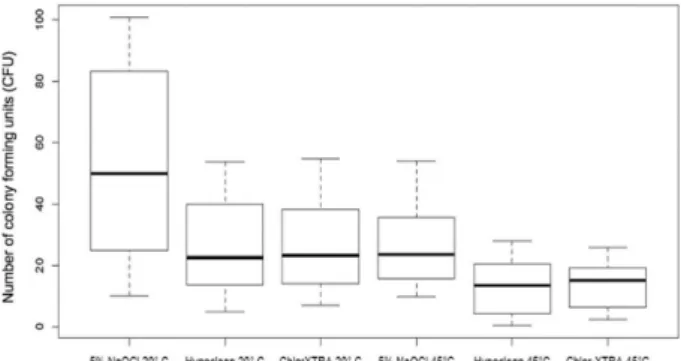
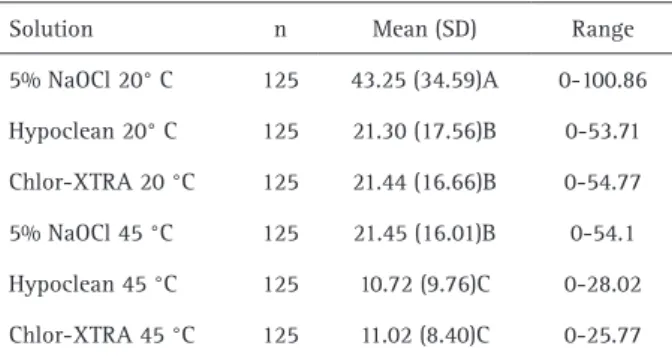
Table 1 reports the CFU average values recorded at each time point for each irrigant employed. ANOVA showed the presence of significant differences among irrigating solutions (p<0.0001) (Table 1 and Figures 1 and 2). The post-hoc Tukey test showed that 5% NaOCl 20 °C obtained the highest number of colony forming units (CFU) among all irrigating solutions, thus meaning low antimicrobial efficacy. Tukey test did not show any significant difference between the numbers of CFU of Hypoclean 20 °C, Chlor-XTRA 20 °C and 5% NaOCl 45 °C (p>0.05). Significantly lower numbers of CFU were obtained with Hypoclean 45 °C and Chlor-XTRA 45 °C (p<0.0001). All irrigating solutions showed a significant increase in CFU numbers over time as shown in Figure 2 (p<0.0001).
Discussion
There are several ways to increase the antibacterial activity of root canal irrigants. One of these ways is heating. The results of current study showed that both Chlor-XTRA
Table 1. Descriptive statistics of the data obtained for each irrigating solution
Solution n Mean (SD) Range
5% NaOCl 20° C 125 43.25 (34.59)A 0-100.86
Hypoclean 20° C 125 21.30 (17.56)B 0-53.71
Chlor-XTRA 20 °C 125 21.44 (16.66)B 0-54.77
5% NaOCl 45 °C 125 21.45 (16.01)B 0-54.1
Hypoclean 45 °C 125 10.72 (9.76)C 0-28.02
Chlor-XTRA 45 °C 125 11.02 (8.40)C 0-25.77
n: number of specimens; SD: standard deviation; range: Minimum-Maximum. Different capital letters indicate statistically significant differences between irrigating solutions. Significance for p<0.05.
Influence of temperature on NaOCl and Hypoclean at 45 °C presented the lowest CFU counts,
which suggests that heating increased the effectiveness of NaOCl-based irrigants. This action may be attributed to the effect of both surfactants and temperature rise.
Studies have shown the influence of temperature of sodium hypochlorite on the antibacterial activity (13,14). Mohammadi et al. (20) verified that NaOCl-based irrigants possess the most effective antimicrobial activity on E. faecalis, Candida albicans, Actinomyces israelii, Lactobacillus casei and Pseudomonas aeroginosa. Hypoclean was the most effective agent against L. casei,
P. aeroginosa and C. albicans, while Chlor-XTRA was the most efficient irrigant against A. israelii. Due to its high surface tension (21), regular NaOCl cannot penetrate into deeper layers of dentin. Palazzi et al. (7) showed that the surface tension of NaOCl solutions with added detergents (Hypoclean and Chlor-XTRA) were lower than NaOCl, agreeing with the findings of the present study. An ex vivo study compared the antibacterial power of 1% NaOCl with 1% acetic acid, 5.25% NaOCl and two NaOCl modified with surfactants in bovine root dentin at different days (22). According to the findings, all the NaOCl solutions showed small number of CFU over 28 days. NaOCl solutions with added surfactants had the smallest number of CFU at all times with greater antimicrobial efficacy than 5.25% NaOCl and 1% NaOCl solution with 1% acetic acid. Bolfoni et al. (23) evaluated the antimicrobial activity of sodium hypochlorite (5%, 2.5% and 1%) associated with a surfactant in human teeth infected with
Enterococcus faecalis. The addition of surfactant increased the antimicrobial activity of 1% NaOCl to levels similar to 5% NaOCl. Sirtes et al. (14) verified that the 1% NaOCl solution at 45 °C dissolved pulp tissues as effectively as the 5.25% solution at 20 °C, while the 60 °C/1% solution was significantly more effective, exhibiting a 100-fold increase in killing efficacy on E. faecalis between corresponding NaOCl solutions at 20 °C and 45 °C.
The data of this study confirm the best antibacterial activity of the NaOCl solutions heated at 45 °C compared to non-heated solutions (20 °C) (13,14). Tukey test did not show any significant difference between the numbers of CFU of Hypoclean 20 °C, Chlor-XTRA 20 °C and 5% NaOCl 45 °C. No differences between the CFU values of NaOCl solutions with added detergents at 20 °C (Hypoclean and Chlor-XTRA) and 5% NaOCl alone at 45 °C, highlighted in this study, is no surprise. Several studies (7,8,24) have reported that the addition of detergents reduced the number of bacteria within the canal after irrigation compared with NaOCl alone. Wettability was shown to play an important role in the penetration of disinfecting solutions into the root canal system and it depends on its surface tension (10). The addition of detergents in the used
disinfecting solutions increased their antibacterial effects against E. faecalis in the dentinal tubules independently of the temperature, which explains the results obtained in this research. In the present study the mean numbers of CFU increased with time. The likely reason is that free available chlorine (FAC), the active component of NaOCl-based irrigants, consumes with time (25). Presence of detergents in Chlor-XTRA and Hypoclean does not prevent consuming FAC. Significantly lower numbers of CFU obtained with Hypoclean and Chlor-XTRA compared to NaOCl are due probably to an increase in the depth of penetration of these solutions into dentinal tubules by decreasing surface tension and their greater wettability (10,24).
In the considered experimental conditions, the results of this study suggest use of heated irrigant solutions Chlor-Xtra and Hypoclean to improve the antibacterial activity of irrigating solutions in bovine root dentin blocks.
Resumo
O objetivo deste estudo foi comparar a atividade antimicrobiana do hipoclorito de sódio a 5,25%, Hypoclean e Cloro-Xtra a 20 °C e 45 °C em dentina radicular bovina. Um total de 170 tubos de dentina foram preparados a partir de incisivos superiores bovinos infectados por 21 dias com Enterococcus faecalis. Os espécimes foram divididos nos seguintes grupos: 1. NaOCl - 5,25% a 20 °C; 2. Hypoclean 20 °C; 3. Cloro-Xtra 20 °C; 4. NaOCl - 5,25% a 45 °C; 5. Hypoclean 45 °C; 6. Cloro-Xtra 45 °C; 7. Controle positivo; 8. Controle negativo. Raspas de dentina foram coletadas com brocas esféricas e cultivadas em infusão cérebro coração (brain heart infusion - BHI). Após a cultura, o número de unidades formadoras de colônias (UFC) foi contado. As análises estatísticas foram realizadas utilizando estatística descritiva (média, desvio padrão, mediana), teste de Shapiro-Wilk, ANOVA e teste de Tukey. O nível de significância foi estabelecido p<0,05. Em todos os grupos experimentais, o número de UFC foi mínimo após o tratamento inicial. Os resultados obtidos foram significativamente diferentes nos períodos de tempos experimentais (p<0,05). O Hypoclean e o Cloro-Xtra mostraram o menor número de UFC a 20 °C e a 45 °C, enquanto que o NaOCl - 5,25% apresentou maior número de UFC em ambas as temperaturas. Em cada grupo, o número de CFUs foi significativamente aumentado por período de tempo (p<0,05). As atividades antibacterianas do Hypoclean e Chlor-Xtra a 45 °C foram significativamente maiores do que nas outras soluções testadas.
References
1. Rosenthal S, Spångberg L, Safavi K. Chlorhexidine substantivity in root canal dentin. Oral Surg Oral Med Oral Pathol Oral Radiol Endod 2004;98:488-492.
2. Sundqvist G. Ecology of the root canal flora. J Endod 1992;18:427-430. 3. Hess W. Anatomy of root canals in the teeth of the permanent
dentition. New York: William Wood & Co.; 1925.
4. Peters OA, Laib A, Gohring TN, Barbakow F. Changes in root canal geometry after preparation assessed by high resolution computed tomography. J Endod 2001;27:1–6.
5. Sundqvist G, Figdor D, Persson S, Sjögren U. Microbiological analysis of teeth with failed endodontic treatment and the outcome of conservative re-treatment. Oral Surg Oral Med Oral Pathol Oral Radiol Endod 1998;85,86-93.
6. Hasselgren G, Olsson B, Cvek M. Effect of calcium hydroxide and sodium hypochlorite on dissolution of necrotic porcine muscle tissue. J Endod 1998;14:125–127.
L. Giardino et al.
three new sodium hypochlorite based endodontic irrigants. Int Endod J 2012;45:129-135.
8. Mohammadi Z, Giardino L, Mombeinipour A. Antibacterial substantivity of a new antibiotic-based endodontic irrigation solution. Aust Endod J 2012;38:26–30.
9. Glantz PO, Hansson L. Wetting of dentine by some root canal medicaments. Odontol Revy 1972;23:205-210.
10. Giardino L, Morra M, Becce C, Pappen FG, Mohammadi Z, Palazzi F. Comparative wettability of different sodium hypochlorite solutions. G It Endo 2012;26:57-62.
11. Mohammadi Z, Mombeinipour A, Giardino L, Shahriari S. Residual antibacterial activity of a new modified sodium hypochlorite based endodontic irrigation solution. Med Oral Patol Oral Cir Bucal 2011;16:e588-e592.
12. Abou-Rass M, Oglesby SW. The effects of temperature, concentration and tissue type on the solvent ability of sodium hypochlorite. J Endod 1981;7:376-377.
13. Cunningham W, Joseph SW. Effect of temperature on the bactericidal action of sodium hypochlorite endodontic irrigant. Oral Surg Oral Med Oral Pathol 1980;50:569–571.
14. Sirtes G, Waltimo T, Schaetzle M, Zehnder M. The effects of temperature on sodium hypochlorite short-term stability, pulp dissolution capacity, and antimicrobial efficacy. J Endod 2005;31:669–671.
15. Viswanath DS, Ghosh TK, Prasad DHL, Dutt NVK, Rani KY. Viscosity of Liquids Theory, Estimation, Experiment, and Data. 1st ed. Netherlands: Springer; 2007. p1-8.
16. Bukiet F, Soler T, Guivarch M, Camps J, Tassery H, Cuisinier F, et al.. Factors affecting the viscosity of sodium hypochlorite and their effect on irrigant flow. Int Endod J 2013;46:954-961
17. Gopikrishna V, Ashok P, Pradeep Kumar AR, Lakshmi LN. Influence of temperature and concentration on the dynamic viscosity of sodium
hypochlorite in comparison with 17% EDTA and 2% chlorhexidine gluconate: An in vitro study. J Conserv Dent 2014;17:57-60 18. Myers D. Surfaces, Interfaces, and Colloids: Principles and Applications.
2nd ed. John Wiley & Sons, Inc. Hoboken, NJ, USA. 1999. P143. 19. Haapasalo M, Ørstavik D. In vitro infection and disinfection of dentinal
tubules. J Dent Res 1987;66:1375-1379.
20. Mohammadi Z, Shalavi S, Giardino L, Palazzi F, Mashouf RY, Soltanian A. Antimicrobial effect of three new and two established root canal irrigation solutions. Gen Dent 2012;60:534-537.
21. Giardino L, Ambu E, Becce C, Rimondini L, Morra M. Surface tension comparison of four common root canal irrigants and two new irrigants containing antibiotic. J Endod 2006;32:1091-1093.
22. Giardino L, Estrela C, Mohammadi Z, Palazzi F. Antibacterial power of sodium hypochlorite combined with surfactants and acetic acid. Braz Dent J 2014;25:289-294.
23. Bolfoni MR, Ferla MS, Sposito OS, Giardino L, Jacinto RC, Pappen FG. Effect of a surfactant on the antimicrobial activity of sodium hypochlorite solutions. Braz Dent J 2014;25:416-419.
24. Wang Z, Shen Y, Ma J, Haapasalo M. The effect of detergents on the antibacterial activity of disinfecting solutions in dentin. J Endod 2012;38:948-953.
25. Rossi-Fedele G, Doğramaci EJ, Guastalli AR, Steier L, de Figueiredo JA. Antagonistic interactions between sodium hypochlorite, chlorhexidine, EDTA, and citric acid. J Endod 2012;38:426-431.