*Correspondence: M. V. R. Velasco. Laboratório de Cosmetologia, Depar-tamento de Farmácia, Faculdade de Ciências Farmacêuticas, Universidade de São Paulo, Av. Prof. Lineu Prestes, n. 580, bl. 13/15, Cidade Universitária, 05508-900 - São Paulo - SP, Brasil. E-mail: [email protected]
A
rti
Pharmaceutical Sciences vol. 45, n. 3, jul./sep., 2009
Physical and physicochemical stability evaluation of cosmetic
formulations containing soybean extract fermented by
Bifidobacterium animalis
Rafael Pinto Vieira, Alessandra Ribeiro Fernandes, Telma Mary Kaneko, Vladi Olga Consiglieri,
Claudinéia Aparecida Sales de Oliveira Pinto, Claudia Silva Cortez Pereira, André Rolim Baby,
Maria Valéria Robles Velasco*
Laboratory of Cosmetology, Department of Pharmacy, Faculty of Pharmaceutical Sciences, University of São Paulo
Peel off facial masks, based on polyvinyl alcohol (PVA), are formulations that, after application and drying, form an occlusive ilm over the face. After removing, they provide cleanness, tensor and moisturizing effects, removing dead cells, residues and other materials deposited on the stratum corneous. The soybean extract fermented by Biidobacterium animalis has sugars, amino acids, peptides, proteins and free isolavonoids in high concentrations, when compared to the unfermented extract, providing beneits to the cosmetic formulations like anti-aging effect, moisture, tensor action and emollience. The cosmetic bases of peel off facial masks, added with 5.0% w/w of fermented soybean extract, were submitted to Preliminary and Accelerated Stability Studies. Eight (8) preparations were evaluated in several conditions of temperature (-10.0, 5.0, 22.0 and 45.0 ºC) and time (maximum of 15 days), comparing the results with the initial condition (48 h after preparation). The variables observed were: organoleptic characteristics, pH and appearing viscosity value and ilm drying time. The preparation containing 17.0% w/w of PVA and 0.5% w/w of guar gum was selected between the eight preparations initially prepared, because it presented the best performance in the stability test, being recommended storage at low temperatures (5.0 ºC).
Uniterms: Cosmetic formulations/physical and physicochemical stability.Facial mask peel off. Polyvinyl alcohol. Soybean extract. Biidobacterium animalis/fermentation.
As máscaras faciais peel off a base de álcool polivinílico (PVA) são formulações que, após a aplicação e secagem, formam um ilme oclusivo sobre a face e, após sua remoção, conferem limpeza, ação tensora e hidratação à pele, retirando células mortas do estrato córneo, resíduos e outros materiais depositados. O extrato de soja fermentado por Biidobacterium animalis possui açúcares, aminoácidos, peptídeos, e alto teor de isolavonas na forma livre, quando comparado ao leite não fermentado, propiciando benefícios às formulações cosméticas, como ação antienvelhecimento, hidratação, efeito tensor e emoliência. As bases cosméticas de máscaras faciais peel off, acrescidas de extrato de soja fermentado 5,0% p/p, foram submetidas aos ensaios de Estabilidade Preliminar e Acelerada, avaliando-se 8 preparações em diversas condições de temperatura (-10,0; 5,0; 22,0 e 45,0 ºC) e tempo (máximo de 15 dias), em relação à condição inicial (48 h após o preparo). As variáveis observadas envolveram: características organolépticas, valor de pH, viscosidade aparente e tempo de secagem do ilme. A preparação contendo 17,0% p/p de PVA e 0,5% p/p de goma guar foi a selecionada dentre as oito preparações elaboradas inicialmente, por ter apresentado melhor desempenho no teste de estabilidade, sendo recomendado o armazenamento em temperatura reduzida (5,0 ºC).
INTRODUCTION
The use of facial masks is found in the Antiquity (Wilkinson, Moore, 1982). Nowadays, the interest regar-ding these topic formulations was re-gained due to several attributed effects, like: deep cleanness, toniication, astrin-gency, moisture, emollience (softening and soothing)and tensor action (Bonadeo, 1982; Draelos, 1999; Martine et al., 1995; Poucher, 1991; Nishikawa et al., 2007).
Peel off facial masks are constituted of polyvinyl alcohol (PVA) or polyvinyl acetate, utilized as ilm formers (Wilkinson, Moore, 1982; Aranha, Lucas, 2001). They produce occlusion and tensor action after drying, then, making the skin softer to touch. If an active substance is added to the formulation its action is increased (Baby et al., 2004; DeNaverre, 1975).
The determinant step in the development of a cosme-tic formulation involves stability study, with the objective of predicting physical, physicochemical, chemical and microbiological alterations that may occur since its manu-facturing, until the end of its expiration date (Brasil, 2004). Besides, this study allows the evaluation of the cosmetic product performance, safety and eficacy and contribu-tes for its development time reduction which is highly required by the market and the consumers. The stability test guides the development of cosmetic formulations, providing information for preparation improvements, in case of instability manifestations and/or incompatibility among ingredients (Brasil, 2004; Nishikawa et al., 2007; Baby et al., 2008).
For the stability test to be meaningful, it is impor-tant to establish variables that will be evaluated, deining the acceptance criteria and/or the methods able to mea-sure the attribute variations over time. The choice of the tests to be performed is responsibility of the researcher and the criteria and decisions are based on the type of cosmetic product related to the scientiic literature, gui-des and Oficial Compendiums, once each formulation has particular characteristics of ingredients and cosmetic forms. These criteria must take also into account the main product characteristics, because these attributes must remain with no alteration – or with alterations that do not compromise the performance and presentation of product (Barel et al., 2001).
The peel off facial masks may be used as vehicles for active substances (DeNaverre, 1975; Magalhães, 2000), like the soy milkfermented by Biidobacterium animalis, which presents as attributes the antioxidant and the mois-ture properties, indicating a cosmetic potential (Baumann, Lazarus, 2001; Lupo, 2001; Myiazaki et al. 2002; Otieno
et al., 2006; Prakash et al., 2007).
In this study, the physical and physicochemical stability of peel off facial mask formulations containing fermented soy milk, and their respective cosmetic bases, were compared by Preliminary and Accelerated Stability studies and formulation performance, evaluated by in vitro drying time.
MATERIAL AND METHODS
Formulations – composition
Ingredients utilized in formulations: polyvinyl alcohol, moisture agent (glycerin, propylenoglycol or bu-tylenoglycol), dimethyl dimethyl hydantoin/ iodopropynyl butylcarbamate, self-emulsifying base, silicone glycol copolymer, ethoxylated and propoxylated cetyl alcohol, blue colorant, essence, deodorized ethanol, tetrasodium EDTA and water. Thirty six (36) cosmetic bases were de-veloped, varying the proportion of ive components, thus, selecting the ones with best performance according to the Preliminary Stability Test for future incorporation of the soybean extract fermented by Biidobacterium animalis
(total of 8 preparations). For the Accelerated Stability Study, the two formulations with best performance on previous test, were selected.
Screening Study
Thirty six (F1 to F36) cosmetic bases were prepa-red without the addition of soybean extract fermented by
Bifidobacterium animalis, varying the concentration of polyvinyl alcohol (film former – 12,0 and 15,0% w/w), moisture agent (0.0, 6.0 and 8.0% w/w), self-emulsifying base (0.0, 1.0 and 2.0% w/w), silicone glycol copolymer (0.0, 1.0 and 2.0% w/w) and ethoxylated and propoxylated cetyl alcohol (0.0 and 2.0% w/w). It was prepared 100.0 g of each formulation, according to standardized method that consists on the dispersion of the PVA previously incorpora-ted to the moisture agent in distilled water at 80.0-90.0 °C, with constant mechanic agitation (Aranha, Lucas, 2001; Chiellini et al., 2003). After cooling the preparation bellow 40.0 °C, it was added in sequence and separately: ethanol, preservative (dimethyl dimethyl hydantoin/ iodopropynyl butylcarbamate), tetrasodium EDTA, essence (incorporated to the surfactant and silicon) and, inally, the blue colorant. The mass of inal preparation was completed with water.
Preliminary Stability Study
prepa-ration that presented the best performance in the previously mentioned screening study. The concentration of polyvinyl alcohol (film former) was varied (15.0, 17.0, 18.0 and 20.0% w/w) and 0.5% w/w or none of a new component, guar gum (thickener),was added targeting to reduce the in vitro drying time of the formulations. The other components remained unaltered in all formulations. The preparing pro-cedure was identical to that of the cosmetic bases, adding the guar gum after the cooling of the polymer dispersed in water. The soybean extract (5.0% w/w) was added at the end of preparation, after cooling the base and before completing with water the preparation mass .
Elapsed 48 hours from production for formulation stabilization, and considering this time as initial (t0), cos-metic bases and formulations were wrapped in packaging materials composed of opaque white polyethylene with declared capacity for 50 g and submitted to the conditions for each test (Baby, 2005; Brasil, 2004; Contreras et al., 2001, Pinto, 2005; Zague, 2007).
All cosmetic bases and formulation samples (tri-plicate) were submitted to Centrifugation (5.0 g at 1000, 2000 and 3000 rpm/15 minutes); Thermal Stress (10.0 g in water bath between 40.0 to 80.0 ºC, raising from 10.0 to 10.0 °C, for 30 minutes in each temperature value); and Oven (50.0 ± 2.0 °C/72 hours) (Baby, 2005; Brasil, 2004; Pinto, 2005; Baby et al., 2007).
Accelerated Stability Study
Samples, in duplicate, from the two best formu-lations selected in the Preliminary Stability Study were submitted to this Study. The evaluations considered seve-ral temperature conditions and times of analysis. Initially, they were evaluated after t0 (48 hours after preparation) in the conditions: Low Temperature (5.0 ± 1.0 ºC), Freezer (-10.0 ± 1.0 ºC), Room Temperature (22.0 ± 2.0 ºC) and Oven (45.0 ± 2.0 ºC) – analysis at 1st, 3rd, 7th and 15th days
and Freezing/Defrosting Cycles(45.0 ± 2.0 ºC / -5.0 ± 2.0 ºC – analysis at 6th and 12th days).
Variables analyzed and acceptance criteria
The criteria were established by the analyst and are described, as follows, comparing the results obtained with the initial condition (t0) (Baby, 2005; Brasil, 2004; Pinto, 2005; Baby et al., 2007; Zague, 2007).
For the Screening and Preliminary Stability Studies were evaluated: organoleptic characteristics, pH value and performance test – drying time. For the Accelerated Stability Study the viscosity determination was added, besides all the evaluations mentioned.
Organoleptic characteristics
Color: N – Normal / M – Modiied / IM – Intensely modiied Odor: N – Normal/ M – Modiied / IM – Intensely modiied Aspect: N – Normal/ M – Modiied / IM – Intensely modiied Spreadability and touch: A – pleasant touch, easy application/ D – unpleasant touch, sticky / MD – very unpleasant touch, very sticky, compromises skin application.
pH Value
As acceptance criteria, formulations with pH value variations higher than 15%, comparing with the initial va-lue, were reproved, considering the pH of isoelectric point of soy proteins is around 4.5 (precipitation may occur), and values beyond the range of 2 to 10 cause degradation of the proteins present in the soybean extract fermented by
Biidobacterium animalis (Genovese et al., 2006).
Performance test – drying and film formation
This methodology was developed and standardized, based on the use of commercial product. The test was per-formed after 48 hours after the preparation of the cosmetic bases and formulations of peel off facial masks (t0).
Samples, in triplicate, containing around 0.7 g of cosmetic base were weighted and spread using a painter’s brush, over an area of 5.0 x 2.5 cm in a glass slide, forming an uniform thin layer of about 1 mm, to mimic the ilm formed at the face after application of the peel off mask. The glass slide was put in oven at 36.5 ± 2.0 °C for 1 h, simulating the body temperature. The formulations were monitored during 10 min, until the drying process was completed and allowed the complete removal of the ilm from the glass slide.
Apparent Viscosity
The peel off facial masks submitted to the Accelerate Stability Study were analyzed in duplicate in Fungilab®
ViscoStar-R with a device for small samples (spindles TR10 and TR11), at 6 rpm. The results obtained at initial evaluation (t0) were considered reference value (100%) to calculate the observed variations (Maia, 2002). The apparent viscosity values (cP, centiPoise) were registered after 3 minutes of agitation at room temperature (Nishi-kawa et al., 2007).
RESULTS AND DISCUSSION
Screening Study
quantitative composition and the results of this Study are described in Tables I e II, respectively.
The evaluation of organoleptic characteristics and pH values results show that the base F35 was appropriate to continue the studies. However, in the in vitro drying time evaluation, it presented results above the recommended range for peel off facial masks (10 to 30 minutes) (Martine
et al., 1995, Charlet, 1996). Therefore, for the subsequent studies, besides adding fermented soybean extract to the base, it was evaluated the inluence of polyvinyl alcohol concentration and it was added a new component, the guar gum, in order to reduce the drying time of in vitro ilm formation, improving the performance of the previous selected formulation.
Preliminary Stability Study
From the base F35, 8 formulations containing soy-bean extract fermented by Biidobacterium animalis were prepared, keeping this codiication added by a number referring to the polyvinyl alcohol (PVA) proportion (17.0, 18.0 and 20.0% w/w) and G referring to the presence of guar gum 0,5% w/w.
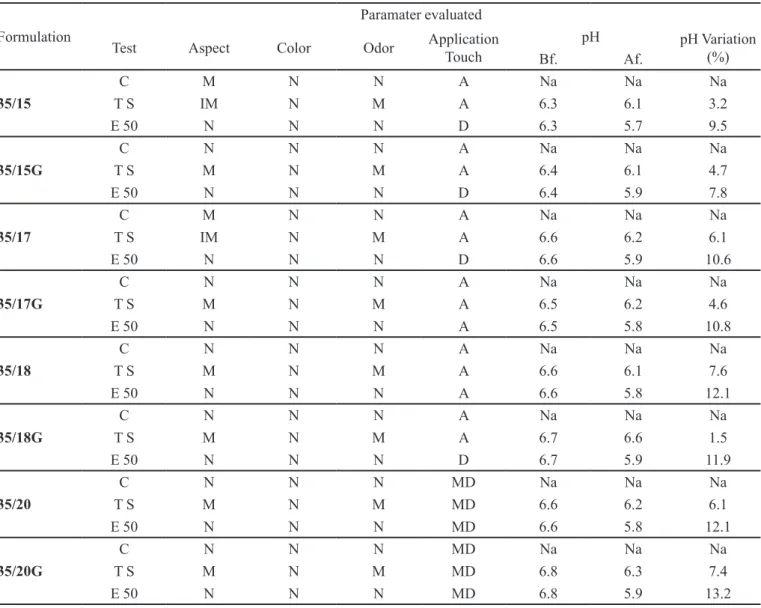
The obtained results respecting organoleptic cha-racteristics and pH values are described in Table III. The variable Aspect indicated supernatant liquid for-mation for the preparations F35/15 and F35/17, besides more fluidity during the Thermal Stress test, indicated by the results M/IM. Color alteration was not observed in any preparation, indicating good stability, mainly in high temperature conditions and compatibility with the colorant and other formulation components. The results of Odorindicated reduction of the fragrance intensity in the Thermal Stress test for all preparations. The formulations evaluated in the Application and Touch showed that those with 20% w/w of PVA (F35/20 and F35/20G), the higher polymer concentration presen-ted high consistency and compromised spreadability, reflecting a negative evaluation (MD – very unplea-sant touch, sticky), probably because of inadequate PVA proportion. The best performance formulations in the Application and Touch evaluation were those with intermediate PVA concentrations (F35/17G and F35/18, 17 and 18% polymer w/w, respectively). The alterations observed for the organoleptic characteristics in the Thermal Stress and Oven (50.0 ± 2.0 ºC) tests were accepted in the Preliminary Study, considering the drastic conditions that formulations were submitted to (Brasil, 2004).
TABLE II - Evaluation of organoleptic characteristics, pH value and drying time of the peel off facial mask cosmetic base (F35) in the Screening Study
Cosmetic Base
Parameter evaluated
Test Aspect Color Odor ApplicationTouch pH variation(%)pH Drying time (min)
Bf. Af.
F35
C N N N A Na Na 0
36.7
T S N N N A 7.2 6.7 6.9
E 50 N N N A 7.2 6.8 5.6
Legend:Cosmetic Base: group of initial preparations (F1 to F36); Test: C - Centrifugation; TS – Thermal Stress; E 50 – Oven
50 ± 2.0°C/ 72 hours; Aspect: N - Normal; M – Modiied; IM – Intensely modiied; Color: N - Normal; M – Modiied; IM – Intensely modiied; Odor: N - Normal; M – Modiied; IM – Intensely modiied; Application and Touch: A – Pleasant touch, easy skin application (spreadability); D – Unpleasent touch, sticky, relative dificulty to apply on skin (spreadability); MD – Very unpleasant touch, very sticky, compromises skin application; pH: Na – not applicable; Bf.: after 48 hours from preparation (t0); Af: after test condition.
TABLE I - Composition of cosmetic base F35 selected in the Screening Study
COMPONENTS % (w/w)
Aqueous Phase
Polivynil Alcohol (PVA) 15.0
Glicerin 6.0
Distilled water q.s.p. 100.0
Complementary Phase DMDM Hydantoin/
Iodopropynyl Butylcarbamate (IPBC)
IPBC 0.5
Ethoxylated and Propoxylated Cetyl Alcohol 2.0
Blue colorant 0.1
Deodorized alcohol 8.0
Essence 0.05
In vitro drying time and ilm formation
The in vitro drying time means (triplicate) for the formulations modified from F35 base are presented in Figure 1.
In accordance to the data presented, the formulations 35/17, 35/17G, 35/18, 35/18Gand 35/20 presented the best performance on the in vitro drying time test, which means they formed a resistant ilm easily removed from the glass slides at maximum time of 30.0 min and the formulation
TABLE III - Organoleptic characteristics and pH values evaluation of the peel off facial mask formulations (modiications from the F35 base) in the Preliminary Stability Study
Formulation
Paramater evaluated
Test Aspect Color Odor Application Touch pH pH Variation (%)
Bf. Af.
35/15
C M N N A Na Na Na
T S IM N M A 6.3 6.1 3.2
E 50 N N N D 6.3 5.7 9.5
35/15G
C N N N A Na Na Na
T S M N M A 6.4 6.1 4.7
E 50 N N N D 6.4 5.9 7.8
35/17
C M N N A Na Na Na
T S IM N M A 6.6 6.2 6.1
E 50 N N N D 6.6 5.9 10.6
35/17G
C N N N A Na Na Na
T S M N M A 6.5 6.2 4.6
E 50 N N N A 6.5 5.8 10.8
35/18
C N N N A Na Na Na
T S M N M A 6.6 6.1 7.6
E 50 N N N A 6.6 5.8 12.1
35/18G
C N N N A Na Na Na
T S M N M A 6.7 6.6 1.5
E 50 N N N D 6.7 5.9 11.9
35/20
C N N N MD Na Na Na
T S M N M MD 6.6 6.2 6.1
E 50 N N N MD 6.6 5.8 12.1
35/20G
C N N N MD Na Na Na
T S M N M MD 6.8 6.3 7.4
E 50 N N N MD 6.8 5.9 13.2
Legend:Formulation: preparations resulted from base F35 alterations; Test: C - Centrifugation; TS – Thermal Stress; E 50 –
Oven 50.0 ± 2.0°C/ 72 hours; Aspect: N - Normal; M – Modiied; IM – Intensely modiied; Color: N - Normal; M – Modiied; IM – Intensely modiied; Odor: N - Normal; M – Modiied; IM – Intensely modiied; Application and Touch: A – Pleasant touch, easy skin application (spreadability); D – Unpleasent touch, sticky, relative dificulty to apply on skin (spreadability); MD – Very unpleasant touch, very sticky, compromises skin application; pH: Na – not applicable; Bf.: after 48 hours from preparation (t0); Af: after test condition.
35/20G presented the lowest value (26.7 min). The redu-ced in vitro drying time is indispensable pre-requisite to the use acceptability of peel off masks (Wilkinson, Moore, 1982), just as the organoleptic characteristics, mainly the Application e Touch, because of the importance of mask adherence at the local of application.
se-lected to the Accelerated Stability Study. The 35/18G, 35/20 e 35/20G formulations were excluded of the research, as they showed poor spreadability due to their very high con-sistency (high percentage of PVA in the formulations). The 35/17 was excluded because its intense modiications during
the Thermal Stress. Between the F35/18and F35/17G for-mulations, the second one presented greater stability in the performed tests, associated to small variations in the in vitro
drying time, in comparison to F35/18, being so F35/17G the formulation indicated for cosmetic use.
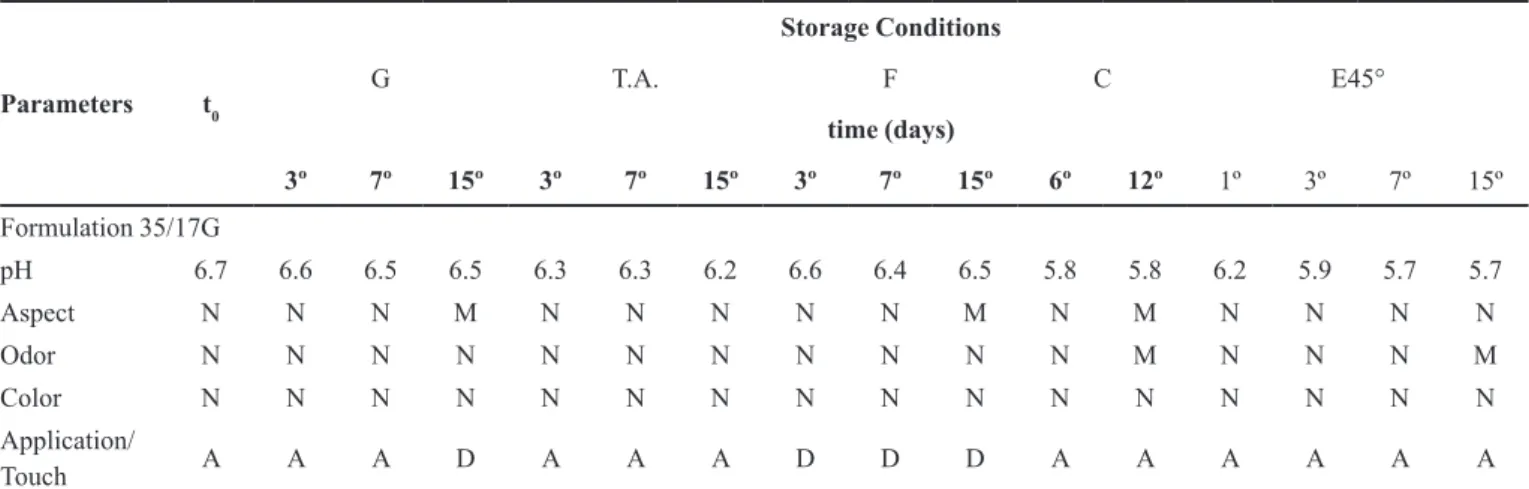
TABELE IV - Evaluation of the organoleptic characteristics, pH and apparent viscosity of formulation F35/17G, in the Accelerated Stability Study
Parameters t0
Storage Conditions
G T.A. F C E45°
time (days)
3º 7º 15º 3º 7º 15º 3º 7º 15º 6º 12º 1º 3º 7º 15º
Formulation 35/17G
pH 6.7 6.6 6.5 6.5 6.3 6.3 6.2 6.6 6.4 6.5 5.8 5.8 6.2 5.9 5.7 5.7
Aspect N N N M N N N N N M N M N N N N
Odor N N N N N N N N N N N M N N N M
Color N N N N N N N N N N N N N N N N
Application/
Touch A A A D A A A D D D A A A A A A
Viscosity 85600 114600 122550 113400 105250 102650 105600 96400 128000 130300 83450 97850 87100 84500 86450 82100 Legend: Test: G – Low Temperature (5.0 ± 1.0 °C); T.A. – Room Temperature (22.0 ± 2.0 °C); E45 - Oven (45.0 ± 2.0 °C); C – Freezing/Defrosting Cycles (45.0 ± 2.0 °C / -10.0 ± 1.0 °C); F – Freezer (-10.0 ± 1.0 °C); Aspect: N - Normal; M – Modiied; IM – Intensely Modiied; Color: N - Normal; M – Modiied; IM – Intensely Modiied; Odor: N - Normal; M – Modiied; IM – Intensely Modiied; pH – pH value; Viscosity: values measured in cP, using TR 11 needle and 6 rpm velocity; Application e Touch: A – Pleasant touch, easy skin application (spreadability); D – Unpleasant touch, sticky, relative dificulty to apply on skin (spreadability); MD – Very unpleasant touch, very sticky, compromises skin application;
TABLE V - Evaluation of the organoleptic characteristics, pH and apparent viscosity of formulation F35/18, in the Accelerated Stability Study
Parameters to
Storage Conditions
G T.A. F C E45°
time (days)
3º 7º 15º 3º 7º 15º 3º 7º 15º 6º 12º 1º 3º 7º 15º
Formulation 35/18
pH 6.5 6.5 6.4 6.4 6.2 6.2 6.2 6.8 6.4 6.5 6.0 5.8 6.2 6.6 5.7 5.7
Aspect N N N M N N N N N M N M N N N N
Odor N N N N N N N N N N N M N N N M
Color N N N N N N N N N N N N N N N N
Application/
Touch A A A D A A A A D D A A A A A A
FIGURE 1 - Mean of in vitro drying time (min-triplicate) of the formulations obtained from the modiications in the peel off facial mask F35, in the condition of Oven (36.5 ± 1.0 °C).
Accelerated Stability Study
The results obtained from organoleptic characte-ristics of the formulations 35/17G and 35/18, pH value
determination and apparent viscosity from the Accelerated Stability Study are described in the Tables IV and V and Figures 2, 3, 4, 5, 6 and 7. The result of drying time is represented at the Figure 8.
After analyzing the results from Tables IV and V, the Aspect evaluation showed that the formulation F35/17G presented higher consistency at the 15th day (visual
obser-vation) for the Low Temperature and Freezer conditions, and at the 12th day for the Freezing/Defrosting Cycles. This
fact was conirmed by the raise in the apparent viscosity until 52% in the Freezer condition (Figure 6). The formu-lation F35/18 also presented higher consistency at the 15th
day (visual observation) for the Low Temperature and Fre-ezer conditions and at the 12th day for Freezing/Defrosting
Cycles, also associated to the apparent viscosity variations, although with even higher observed values than the ones for the formulation F35/17G, reaching 119% of variation in the Freezer condition (Figure 6). Color alterations were not observed in the preparations, which indicated adequate
FIGURE 2 - Percentage variation of pH value for the test formulations F35/18 and F35/17G in the Oven (45.0 ± 2.0 ºC) storage condition in the Accelerated Stability Study.
FIGURE 4 - Percentage variation of pH value for the test formulations F35/18 and F35/17G in the Freezing/Defrosting Cycles (45.0 ± 2.0 ºC/-10.0 ± 1.0 ºC) storage condition in the Accelerated Stability Study
FIGURE 5 - Percentage variation of Apparent viscosity value for the test formulations F35/18 and F35/17G in the Oven (45.0 ± 2.0 ºC) storage condition in the Accelerated Stability Study
stability, mainly in the high temperature condition and good compatibility with the used colorant. The results for Odor indicated instability manifestations at the 15th
day of Oven and Freezing/Defrosting Cycles conditions, with lowering of fragrance odor intensity and other odors not being perceptible. This response was expected since drastic conditions were employed. The evaluation of Ap-plication and Touch showed that both formulations kept the pleasant touch, with good adherence and spreadabi-lity in the Oven, Freezing/Defrosting Cycles and Room Temperature, during all time period of evaluation. It was observed that the preparations became stickier comparing to t0 in the Freezer condition, in all days, except the formu-lation F35/18 that did not present modiications at the 3rd
day of test. Both preparations presented stickier and with compromised spreadability in relation to t0, at the 15th day
of Low Temperature condition.
The pH value presented variations inside of the specii-cations of this research (± 15%) in all conditions. In the Oven, the preparations presented similar tendency to lowering the pH value, being observed values until -15% for the formula-tion F35/17G at 7th and 15th days of evaluation (Figure 2). This
reducing pH value proile was also observed by Nishikawa and collaborators (2007), for peel off masks developed with PVA 12.0% w/w and rutin 0.05%, as active substance, where greater magnitude alterations in this parameter were obtained in the storage condition at 40.0 ± 0.5 °C. These variations, for both preparations, were acceptable because of the drastic storage condition (45.0 ºC). Furthermore, once the isoelectric point of soy proteins are within the pH value 4.5 – point in which proteins may precipitate –, and only values beyond the pH range from 2 to 10 cause degradation of proteins and isolavonoids present in the fermented soybean extract, the chemical stability was not expected to be compromised.
FIGURE 7 - Percentage variation of apparent viscosity value for the test formulations F35/18 and F35/17G in the Freezing/Defrosting Cycles (45.0 ± 2.0 ºC / -10.0 ± 1.0 ºC) storage condition in the Accelerated Stability Study.
FIGURE 8 - Percentage variation of in vitrodrying time for the test formulations F35/18 and F35/17G in the Oven (E45/45.0 ± 2.0 ºC), Refrigerator (Ge/5.0 ± 1.0 °C), Freezer (F/-10.0 ± 1.0 °C) and Room Temperature (TA/22.0 ± 2.0 °C) storage conditions
in the Accelerated Stability Study. The variations are due to the difference obtained from 15th to t
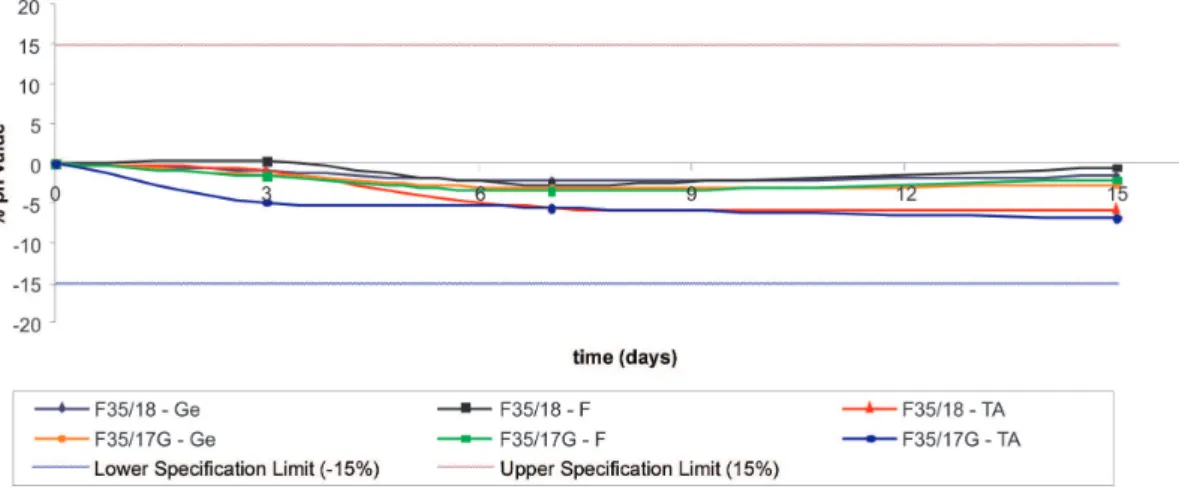
It was veriied pH value variations lower than 5.0% for both preparations, in the Low Temperature and Freezer conditions (Figure 3). Similarly, in the Room Temperature condition the values obtained were lower than 10% for both formulations, reaching the maximum of - 6% for the formu-lation F35/18 and - 7% for F35/17G at 15th evaluation day.
In the Freezing/Defrosting Cycles, the same tendency of decrease of pH value was observed over the days of evalu-ation for both formulevalu-ations (Figure 4), which the formulevalu-ation F35/17G presented higher variations, until - 13%. The same as in Oven condition, variations were expected and accepta-ble, inside the speciic range, because of the drastic conditions that the preparations were exposed.
At the same time of pH value determinations, the value of apparent viscosity was also evaluated in all Accelerated Stability Study conditions. In the Oven condition (Figure 5), it was observed that the F35/18 showed variations of up to 61% in viscosity value veriied at the 7th day, while F35/17G
showed maximum variation of 13% at the 3rd day of test.
Although it is a drastic condition, it was noticed that the pre-parations did not follow the same response tendency along the evaluation time of this condition.
This difference on the viscosity value variation betwe-en the formulations was observed in all storage conditions. In Low Temperature (Figure 6), F35/18 presented variations from 69 to 109%, while values from 32 to 43% were veriied for F35/17G. In Freezer (Figure 6), intervals from 87 to 119% were verified for F35/18, while F35/17G did not present values higher than 52%. In the Freezing/Defrosting Cycles (Figure 7), the maximum obtained was 82% at the 12th day of
evaluation for F35/18, while for F35/17G it was 14%. Finally, in Room Temperature (Figure 6), where the peel off facial masks are usually commercialized, a maximum variation of 59% in the viscosity value was veriied for F35/18 formula-tion, at the 15th day of evaluation; for F35/17G, the maximum
veriied in the same condition and period of time was 23%. The performance evaluation is determined through the
in vitro drying time. In the Accelerated Stability Study, the va-lue variations were evaluated after exposure to the conditions Oven, Low Temperature, Freezer and Room Temperature (Figure 8). It was performed at the 15th day of each condition,
the percentage variation in relation to the value obtained in t0 for the formulations.
No variations for the in vitro drying time were observed for F35/17G in the Oven and Low Temperature and for this reason, there was no graphical sign presented in Figure 8. For the same conditions, F35/18 presented variations of - 23% and 10%, respectively. The F35/17G formulation had 23% in Freezer, while no variation was veriied for F35/18 in the same condition. Both formulations presented variation of -33% in Room Temperature.
Considering the results obtained for drying time and the organoleptic characteristics evaluation, pH and apparent viscosity value, it was considered that, between the F35/18 and F35/17G formulations, the second one presented greater stability in the performed tests, associated to small variations in the in vitro drying time, in comparison to F35/18, being the F35/17G indicated for cosmetic use.
CONCLUSIONS
The F35/17G peel off facial mask formulation, containing 5.0% w/w of soybean extract fermented by Bi-idobacterium animalis, 17.0% w/w of polyvinyl alcohol and 0.5% w/w of guar gum was selected, from the eight (8) formulations evaluated, in the Preliminary and Accelerated Stability Studies. This formulation showed stability for the organoleptic characteristics, pH and apparent viscosity va-lues and in vitro drying time. It is recommended to keep the formulation under refrigeration (5.0 ± 1.0 ºC) to assure lower variations in the drying time and other variables analyzed, in accordance with the observed during the stability study.
REFERENCES
ARANHA, I.; LUCAS, E. Poli (álcool vinílico) modiicado com cadeias hidrocarbônicas: avaliação do balanço hidrófilo/
lipóilo. Polímeros: Ciência e Tecnologia(veriicar o título
não há indicação de registro ISSN), v.11, n.4, p.174-181, 2001.
BABY, A. R. Desenvolvimento e avaliação da estabilidade de
formulações cosméticas anticelulíticas contendo o extrato comercial de Trichilia catigua Adr. Juss (e) Ptychopetalum
olacoides Bentham, padronizado em lavonóides totais. São
Paulo, 2005. 159 p. [Dissertação de Mestrado. Faculdade de Ciências Farmacêuticas. Universidade de São Paulo].
BABY, A.R.; HAROUTIOUNIAN-FILHO, C.A.; SARRUF, F.D.; TAVANTE-JÚNIOR, C.R.; PINTO, C.A.S.O.; ZAGUE, V.; ARÊAS, E.P.G.; KANEKO, T.M.; VELASCO, M.V.R.
Estabilidade e estudo de penetração cutânea in vitro da rutina
veiculada em uma emulsão cosmética através de um modelo
de biomembrana alternativo. Rev. Bras. Cienc. Farm., v.44,
n.2, p.233-248, 2008.
BABY, A.R.; MIGLIATO, K.F.; MACIEL, C.P.M.; ZAGUE, V.; PINTO, C.A.S.O.; SALGADO, H.R.N.; KANEKO, T.M.; VELASCO, M.V.R. Accelerated chemical stability data of
O/W luid emulsions containing the extract of Trichilia catigua
Adr. Juss (and) Ptychopetalum olacoides Bentham. Rev. Bras.
BABY, A. R.; ZAGUE, V.; MACIEL, C.P.M.; KANEKO, T. M.; CONSIGLIERI, V. O.; VELASCO, M. V. R. Development of
cosmetic mask formulations. Rev. Bras. Cienc. Farm., v.40,
supl.1, p.159-161, 2004.
BAREL, A.O.; PAYE, M.; MAIBACH, H.I. Handbook of cosmetic
science and technology. New York: Marcel Dekker, 2001. p.19-27.
BAUMANN, L. S.; LAZARUS, M. C. The use of cosmeceuticals
moisturizers. Dermatol. Ther., v.14, n.3, p.200-207, 2001.
BONADEO, I. Cosmética ciência y tecnologia. Madri: Editorial
Ciência, 1982. p.86-89.
BRASIL. Ministério da Saúde. Agência Nacional de Vigilância
Sanitária, Séries Temáticas: Qualidade 1. Guia de Estabilidade
de produtos cosméticos. Brasília, 2004. v.1, 45 p.
CHARLET, E. Cosmética para farmacêuticos: ciência y tecnologia.
Zaragoza: Acribia, 1996. p.86-88.
CHIELLINI, E.; CORTI, A.; D’ANTONE, S.; SOLARO, R.
Biodegradation of poly (vinyl alcohol) based materials. Prog.
Polym. Sci., v.28, n.6, p.963-1014, 2003.
CONTRERAS, M. J. F.; SORIANO, M. M. J.; FLORES, E. S. Development of a cream from a self-emulsifying base and
moisturizing actives. Farmaco, v.56, n.5-7, p.513-522, 2001.
DeNAVERRE, M. Face Masks. In: DeNAVERRE, M. The
chemistry and manufacture of cosmetics. 2.ed. Orlando: Continental Press, 1975. v.3. p.421-441.
DRAELOS, Z. D. Cosméticos em dermatologia. Rio de Janeiro:
Revinter, 1999. p.224-226.
GENOVESE, M. I.; LAJOLO, F. M.; BARBOSA, A. C. L. Influence of temperature, pH and ionic strength on the
production of isolavone rich-soy protein isolates. Food Chem.,
v.98, n.4, p.757-766, 2006.
LUPO, M. P. Antioxidants and vitamins in cosmetics. Clin.
Dermatol., v.19, n.4, p.467-473, 2001.
MAIA, A. M. Desenvolvimento e avaliação da estabilidade de
formulações cosméticas contendo ácido ascórbico. São Paulo, 2002. 117 p. [Dissertação de Mestrado. Faculdade de Ciências Farmacêuticas. Universidade de São Paulo].
MAGALHÃES, J. Cosmetologia. Rio de Janeiro: Rubio, 2000.
p.82-159.
MARTINE, M. C.; CHIVOT, M.; PEYREFITTE, G. Cosmetología.
Barcelona: Masson, 1995. p.81-85.
MIYAZAKI, K.; HANAMIZU, T.; IIZUKA, R.; CHIBA, K. Genistein and Daidzein stimulate hyaluronic acid production in transformed human keratinocyte culture and hairless mouse
skin. Skin Pharmacol. Appl. Skin Physiol., v.15, n.3,
p.175-183, 2002.
NISHIKAWA, D.O.; ZAGUE, V.; PINTO, C.A.S.O.; VIEIRA, R.P.; KANEKO, T.M.; VELASCO, M.V.R.; BABY, A.R.
Avaliação da estabilidade de máscaras faciais peel-off contendo
rutina. Rev. Cienc. Farm. Básica Apl., v.28, n.2, p.227-232,
2007.
OTIENO, D. O.; ASHTON, J. F.; SHAH, N. P. Evaluation of enzymic potential for biotransformation of isoflavone
phytoestrogen in soymilk by Bifidobacterium animalis,
Lactobacillus acidophilus and Lactobacillus casei. Food Res.
Int., v.39, n.4, p.394-407, 2006.
PINTO, C. A. S. O. Estudo comparativo da estabilidade de
formulações cosméticas contendo papaína livre e modiicada.
São Paulo, 2005. 128 p. [Dissertação de Mestrado. Faculdade de Ciências Farmacêuticas. Universidade de São Paulo].
POUCHER, W. A. Poucher´s perfums, cosmetics and soaps. 9.ed.
London: Chapman and Hall, 1991. 751 p.
PRAKASH, D.; UPADHYAY, G.; SINGH, B.N.; SINGH, H.B. Antioxidant and free radical-scavenging activities of seeds and
agri-wastes of some varieties of soybean (Glycine max). Food
Chem., v.104, n.2, p.783-790, 2007.
WILKINSON, J.B.; MOORE, R.J. Face Packs and masks. In:
WILKINSON, J.B., MOORE, R.J. Harry’s Cosmetology. 7.ed.
London: Longman Group, 1982. p.276-284.
ZAGUE, V. Desenvolvimento e avaliação da estabilidade física
e físico-química de máscaras faciais argilosas. São Paulo, 2007. 160p. [Dissertação de Mestrado. Faculdade de Ciências Farmacêuticas. Universidade de São Paulo].
Received for publication on 16th July 2008