Correspondence: M. E. Pina. Center of Pharmaceutical Studies (CEF), Faculty of Pharmacy, University of Coimbra. Azinhaga de Santa Comba, 3000-548 – Coimbra – Portugal. E-mail: [email protected]
A
vol. 49, n. 2, apr./jun., 2013
Development and stability assessment of liquid paediatric
formulations containing sildenafil citrate
Fátima Roque
1,2, Ana Cristina Rama
2,3, João José Sousa
2, Maria Eugénia Pina
21Research Unit for Inland Development, Polytechnic Institute of Guarda, 2Center of Pharmaceutical Studies, Faculty of
Pharmacy, University of Coimbra, 3University of Coimbra Hospital
The purpose of this study is to develop and improve oral liquids formulations of sildenail citrate
for paediatric use.Four different formulations were developed, which are as follows: two aqueous
solutions of sildenail citrate (2.5 mg/mL), with or without preservatives, and two other solutions of sildenail in simple syrup (1.25 mg/mL), with or without preservatives. All of the formulations were
physically, chemically and microbiologically stable for three months. The results of the stability studies allowed for the optimisation of formulations without preservatives due to their simplicity and their similar stable conditions when compared to the formulations containing antimicrobials. The shelf life of both formulations was three months; however, upon opening, aqueous solutions should be used
within 10 days and kept refrigerated, and syrup solutions should be used within 14 days in a hospital
setting.
Uniterms: Chemical stability. Microbiological stability. Sildenail citrate. Paediatric formulations.
O objetivo deste trabalho é desenvolver e otimizar formulações líquidas orais de citrato de sildenail
adequadas ao uso pediátrico. Foram desenvolvidas quatro formulações diferentes: duas soluções aquosas
de citrato de sildenaila (2,5 mg/mL) com ou sem conservantes e duas soluções de citrato de sildenail em xarope simples (1,25 mg/mL) com ou sem conservantes. Todas as formulações desenvolvidas apresentaram
estabilidade quer físico-química quer microbiológica durante 3 meses. Os resultados dos estudos de estabilidade permitiram otimizar as formulações isentas de conservantes, uma vez que estas eram mais simples e apresentavam do mesmo modo uma boa estabilidade, comparando com as formulações que continham conservantes. O período de utilização de ambas as formulações é de três meses, no entanto,
após abertura do frasco, a solução aquosa deve ser utilizada durante 10 dias, acondicionada no refrigerador e o xarope deve ser utilizado durante 14 dias, mesmo em ambiente hospitalar.
Unitermos: Estabilidade química. Estabilidade microbiológica. Citrato de sildenail. Formulações
pediátricas.
INTRODUCTION
The lack of commercially available oral liquid dosage forms adequate for paediatric use remains a problem in many practice settings. Indeed, many medicines used to treat children are either unlicensed or are prescribed off-label (Tafuri et al., 2009; Kairuz et al.,
2007). A literature review (Pandolfini, 2005) revealed
that off-label/unlicensed prescription rates ranged from
11% to 80%, and higher rates were found in younger versus older patients and in hospital versus community settings. In paediatric hospital wards, the use of off-label/ unlicensed prescriptions ranged from 16% to 62%, and in the community setting, use rates ranged from 11% to 37% (Pandolini, 2005). Up to 90% of medicinal products used
lack of suitable formulations; lack of appropriate routes of administration; as well as the use of magistral or oficial formulations, which may be of poor quality for the treatment of paediatric populations (EMEA, 2006; EU, 2006). A study conducted in the United Kingdom showed that 54% of 112 paediatric extemporaneous formulations had inadequate data to guarantee their quality during the period of use (Brion, 2003). Many studies have been published with the purpose of assessing the extent to which formulations not studied in children are used. These studies have increased awareness of the need to develop new formulations suitable for paediatric use, which take into account the evaluation of their quality and stability using adequate stability studies (Jong et al., 2002; Schirm, 2003; Grieve et al., 2005; Ceci et al., 2006; Ghulam et al., 2007).
An example of an unlicensed and off-label use of a medication in children and neonates is the extemporaneous preparation of sildenail citrate from tablets, as a liquid preparation of sildenafil citrate is not commercially available. Sildenafil citrate has been used to treat pulmonary arterial hypertension (PAH) in children and neonates. A number of review papers and case reports on the use of oral sildenafil citrate as a treatment for PAH of different aetiologies in children have been published (Fernández-González et al., 2004;
García-Martinez et al., 2003; Humpl et al., 2005; Keller et al., 2004; Kothari, 2002; Ladha et al., 2005; Leibovitch,
2007; Namachivayam et al., 2006; Barnett, 2006). These
published documents demonstrate the eficacy and safety of sildenail citrate in the paediatric population, including newborns. Because the only commercially available dosage form of sildenail citrate is tablets, it is important to develop a liquid formulation of sildenafil citrate of adequate quality and stability to treat the paediatric population. Nahata (2006) developed two extemporaneous sildenail citrate oral suspensions from commercial tablets using methylcellulose and simple syrup as the vehicle or ready-to-use preparations of Ora-Plus and Ora-Sweet. However, in these formulations, all of the excipients included on the tablets are concomitantly administered to children.
Manipulating adult medicine products into paediatric forms should be considered a secondary option to be performed only when the pure active ingredient is not available (EMEA, 2006). Given this, the aim of this study was to develop an oral liquid formulation of sildenafil citrate, as it is an important drug used in the paediatric population, including neonates, for the treatment of PAH. The formulations were kept as simple as possible and were prepared from pure active ingredients and not from commercial tablets, to avoid the potentially undesirable
adverse effects of excipients (EMEA, 2006; American Academy of Pediatrics, 1997).
MATERIAL AND METHODS
Chemical and reagents
Sildenail citrate, pure active ingredient (99.2%), Lot SDC/0610003, was obtained fromMatrix Laboratories Limited, Secunderab - India. Methylparaben (99%), lot J7646A, and propylparaben (99%), lot D9626A, were obtained from Alfa Aesar GmbH, Kalsruhe, Germany. Propylenoglycol of analytical grade, lot 437727/1, was obtained from Alpha Chemika, Maharashatra India, and sucrose, G001, was obtained from SIDUL, Santa Iria Azoia, Portugal. Puriied water was obtained from Millipore system Millipore Corporation Progrard TM®, USA.
A solution of methylparaben and propylparaben (10%, 7:3, w/v) in propylenoglycol was also used after iltration.
Preparation of solutions
Four different solutions were prepared:
1. An aqueous solution of sildenail citrate 2.5 mg/mL containing preservatives
2. An aqueous solution of preservative-free sildenail citrate 2.5 mg/mL
3. A solution of sildenail citrate 1.25 mg/mL in simple syrup containing preservatives
4. A preservative-free solution of sildenafil citrate 1.25 mg/mL in simple syrup
Three preparations of each formulation were prepared. All preparations were stored in well-closed 60 mL amber, Type III glass bottles, lot nº 266077 obtained from Saint-Gobain La Grange, Segovia, Spain.
Method of preparation used for preservative-free aqueous solution sildenafil citrate 2.5 mg/mL
1. The required quantity of each ingredient for a 250 mL solution to be prepared was calculated. 2. Each ingredient was accurately weighed and/or
measured.
Azevedo Campos, Portugal. The inal solution was iltered.
Method of preparation for aqueous solution sildenafil citrate 2.5 mg/mL containing preservatives
1. The required quantity of each ingredient for a 250 mL solution to be prepared was calculated. 2. Each ingredient was accurately weighed and/or
measured.
3. 625 mg of sildenafil citrate was dissolved with 200 mL of water in a 250-mL volumetric lask. 4. A solution of 2.4 mL of methylparaben and propyl
-paraben was added to step 3.
5. Sufficient water was added to obtain a sufficient volume.
6. The dissolution was carried out with magnetic agitation using a 30 ºC water bath, and the solution obtained was iltered.
Method of preparation for a preservative-free solution of sildenafil citrate in syrup 1.25 mg/mL
1. The required quantity of each ingredient for a 250 mL solution to be prepared was calculated. 2. Each ingredient was accurately weighed and/or
measured.
3. Then, 312.5 mg of sildenail citrate was dissolved in 110 mL of water under magnetic agitation for 20 minutes using a 30 ºC water bath.
4. 220 g of sucrose was added and dissolved under agitation until a limpid solution was obtained and was followed by iltration.
Method of preparation for a solution of sildenafil citrate in syrup 1.25 mg/mL containing preservatives
1. The required quantity of each ingredient for a 250 mL solution to be prepared was calculated. 2. Each ingredient was accurately weighed and/or
measured.
3. Then, 312.5 mg of sildenail citrate was dissolved in 110 mL of water under magnetic agitation for 20 minutes using a 30 ºC water bath.
4. A solution of 2.4 mL of methylparaben and pro -pylparaben was added under agitation to complete dissolution.
5. 220 g of sucrose was added while maintaining the agitation until a limpid solution was obtained, fol-lowed by iltration.
Analytical method
Observation of Preparations
Samples were checked for organoleptic characteristics.
Measurement of pH
T h e p H w a s i m m e d i a t e l y m e a s u r e d i n a l l preparations and throughout the stability study (Meter pH 526, Multicar®, WTW, Germany).
Sildenafil Citrate Content
Sildenafil citrate content was determined after preparation and throughout the stability study using ultraviolet-visible (UV-VIS) spectrophotometric method at 292 nm (Shimadzu UV-Visible 1603, Shimadzu, Japan). The analytical methodology was validated for selectivity, linearity, precision, and accuracy. No interference of excipients was observed. The linearity of the standard curve was determined by linear regression analysis of sildenail citrate concentrations versus absorbance values (Figure 1). The correlation factor was 0.999, with intraday and interday coefficients of variation of 0.1 and 1.8, respectively. The percentage of recovery changed from 100.6 to 101.4 and 101.1 to 101.8 in the presence of the parabens or sucrose, respectively.
Stability studies
Protocols for stability studies have been performed according to the Committee for Proprietary Medicinal Product’s Guidelines on Stability Testing: Stability Testing of Existing Active Substances and Related Finished Products10 (CPMP, 2003a).
Chemical stability studies
Twelve sildenail citrate solutions were prepared.
Six solutions were aqueous; of these, three contained preservatives, and the other three were preservative free. Another six solutions were prepared in simple syrup. Of these, three were prepared with preservatives, and the other three were preservative free. Stability was evaluated for three months, during which time the preparations were stored in a chamber (Heraeus, Alemanha) under controlled conditions at 5 ºC ± 3 ºC and 25 ºC ± 2 ºC /60% RH ± 5% RH. Samples were collected at days 0, 7, 14, 28, 42, 56, 70, and 91. Appearance, pH, and sildenail citrate content were evaluated.
Microbiological stability studies
The microbiological quality of sildenafil citrate solutions stored during stability studies was assessed according to European Pharmacopoeia (EP, 2005)
Monograph 5.1.4.—Microbiological Quality of PharmaceuticalPreparations. Microbial examination was performed by counting total viable aerobic microorganisms using the plate-count method based on the EP from 2.6.12.
Microbial Examination of Non-Sterile Products: Total Viable Aerobic Count.
In-use stability
Preservative-free solutions were submitted to in-use
stability tests, in both hospital and ambulatory conditions, for 10 (aqueous solutions) and 14 days (syrup solutions), according to the Committee for Proprietary Medicinal Product’s Note for Guidance on In-use Stability Testing of Human Medicinal Products (CPMP, 2001).
RESULTS
Chemical stability
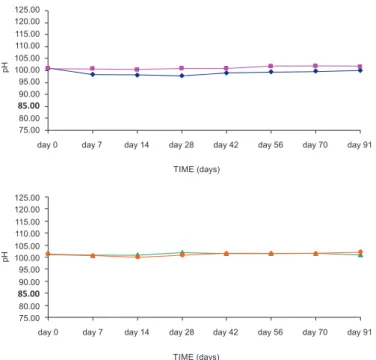
Aqueous sildenafil citrate solutions, with and without preservatives, were limpid, colourless, and odourless solutions with a slight bitter taste. Sildenail citrate in simple syrup, with and without preservatives was limpid, yellowish, and had a sweet taste. Both solutions remained unchanged in appearance at selected temperatures throughout the stability study. The pH values remained fairly constant without signiicant changes in the preparations (Figures 2, 3). At the end of stability studies under 5 ºC ± 3ºC, the pH of preservative-free aqueous solutions was the same as the initial determination (pH = 4.02) with no significant changes during study determinations (Figure 2). At day 91, the aqueous solutions with preservative had the same pH, independent of storage conditions; pH values ranged from 3.84 ± 0.15 or 3.98 ± 0.04 on day 28 and 4.11 ± 0.09 on day 91 (Figure 2).
The pH values of syrup solutions were slightly higher than aqueous solutions. In preservative-free syrup solutions, pH values changed from 4.27 ± 0.06 at the beginning of the stability studies to 4.30 ± 0.02 or 4.26 ± 0.13 at the end of the studies, respectively, at 5 ºC or 25 ºC (Figure 3). Initially, the pH in the syrup solutions containing preservatives was 4.30 ± 0.1, and during stability determinations, the values ranged from 4.22 ± 0.04 to 4.32 ± 0.02 at 5 ºC or between 4.19 ± 0.1 and 4.34 ± 0.1 at 25 ºC (Figure 3).
Sildenafil Citrate Content
Analytical results show that sildenail citrate content in all preparations remained above 95% (w/v) throughout 91 days in both conditions (Figures 4, 5). Initially, the percentage of sildenail citrate content in preservative-free aqueous solutions was 100.75 ± 0.96. At the end of 3 months, the percentages of sildenail citrate content were 100.04 ± 0.52 at 25 ºC and 101.69 ± 1.02 at 5 ºC (Figure 4). At day 91, the percentages of sildenail citrate content in solutions with preservative were 101.86 ± 1.30 at 25 ºC and 102.97 ± 0.34 at 5 ºC.
The percentages of sildenafil citrate content in preservative-free syrup solutions on day 91 were 99.19 ± 2.75 and 98.97 ± 0.99 at 25 ºC and 5 ºC, respectively. In solutions containing preservatives, the FIGURE 2 - The pH variation of sildenafil citrate aqueous
solutions (mean ± standard deviation; n = 3). preservative-free
solution stored at 5 ºC ± 3ºC and stored at 25 ºC ± 2ºC/60%
RH ± 5% RH solution containing preservative stored at 5 ºC
FIGURE 3 - The pH variation of sildenail citrate syrup solutions
(mean ± standard deviation; n = 3). preservative-free solution
stored at 5 ºC ± 3ºC and stored at 25 ºC ± 2ºC/60% RH ± 5%
RH solution containing preservative stored at 5 ºC ± 3ºC and
stored at 25 ºC ± 2ºC/60% RH ± 5% RH.
FIGURE 4 - Sildenail citrate content (%) variation on aqueous
solutions (mean ± standard deviation; n = 3). preservative-free
solution stored at 5 ºC ± 3ºC and stored at 25 ºC ± 2ºC/60%
RH ± 5% RH solution containing preservative stored at 5 ºC
± 3ºC and stored at 25 ºC ± 2ºC/60% RH ± 5% RH.
FIGURE 5 - Sildenail citrate content (%) variation on syrup
solutions (mean ± standard deviation; n = 3). preservative-free
solution stored at 5ºC ± 3ºC andstored at 25 ºC ± 2ºC/60%
RH ± 5% RH solution containing preservative stored at 5 ºC
± 3ºC and stored at 25 ºC ± 2ºC/60% RH ± 5% RH.
percentages of sildenail citrate content were 98.31 ± 2.65 and 98.97 ± 0.99 at 25 ºC and 5 ºC, respectively (Figure 5).
Microbiological stability
At the end of stability testing, all preparations were in accordance with EP’s Microbiological Quality of
Pharmaceutical Preparations, i.e., there was an absence of Escherichia coli, and the total viable aerobic count were below 103 bacteria and not more than 102 fungi per gram or per millilitre. Neither preservative-free solutions nor solutions containing preservative exhibited the development of microorganisms in storage conditions at 25 ºC and 5 ºC. This indicates that there is no advantage in using preservatives in these formulations.
In-use stability
Physicochemical stability
The results demonstrate that both solutions remained unchanged in appearance, pH, and active ingredient content (Table I) in both simulation conditions.
Microbiological stability
In solutions that both contained preservative and solutions that were preservative-free, which were either stored at home or at the hospital, it was determined that microbial contamination, according to EP and the results of this study, demonstrated the absence of Escherichia coli. The results of microbial contamination expressed as total aerobic viable counts showed 40 cfu/mL for aqueous solutions stored at the hospital and no development of colonies in aqueous solutions stored at home or in syrup solutions used at home or in the hospital. In syrup solutions, the high level of sucrose plays an antimicrobial role. Although some development of germs was observed, in aqueous solutions used at the hospital, the values were much lower than the test limit present in the EP
speciications.
DISCUSSION
Although excipients should be pharmacologically inactive, they may indeed cause adverse effects. It is important to consider that the physiology of neonates and infants differs considerably from that of adults. They may not be able to metabolise or eliminate an ingredient in a pharmaceutical product in the same manner as an adult (EMEA, 2006). It is common pharmacy practice when compounding extemporaneous oral liquid preparations from a commercially available solid oral dosage form for a paediatric patient who crushed tablets or the contents of a capsule are solubilised or suspended by the addition of water or juice. However, there are often limited data to support the stability or bioavailability of the inal liquid dosage form and the potential interactions between the excipients subjected to those procedures (Glass, 2006).
During this study, sildenail citrate solutions were kept as simple as possible and were prepared from pure active ingredients rather than from commercial tablets to avoid potential undesirable effects due to excipients.
Antioxidants and antimicrobial preservatives are ingredients that are used to increase the stability of medicines by retarding the oxidation of active ingredients and excipients or by reducing microbial proliferation. Certain chemical groups that make up the properties of these ingredients are usually aggressive towards living cells and lead to certain risks when used in humans. If these additional ingredients are not needed, then they should be avoided (CPMP, 2003b). Given this fact, we have prepared two very simple solutions: an aqueous solution and a syrup solution of sildenail citrate without preservatives. Nonsterile liquid formulations are easily contaminated by microbial agents, and we know that nosocomial infections are significant causes of mortality in newborns and infants who require intensive care. This evidence justifies the inclusion of preservatives in test formulations. Propylparaben and methylparaben are stable compounds that have been used as antimicrobial preservatives in foods, drugs, and cosmetics for over 50 years. The association of methylparaben and propylparaben promotes a better antimicrobial action (Soni, 2001,2002). Both the solutions containing preservatives and the preservative-free solutions retained their potency during the three months of the stability study. Appearance and pH values also remained unchanged. At the end of the stability study, no microbiological contamination was found in either solutions containing preservatives or preservative-free solutions, at 5 ºC or 25 ºC, showing that sildenafil citrate aqueous and syrup solutions are chemically and microbiologically stable.
In-use stability tests were designed to detect the stability of preservative-free solutions in real conditions of use after irst vial opening. In those samples stored at the hospital, microbial growth (40 cfu/mL) was detected in aqueous solutions; however, this value is below pharmaceutical speciications. In the syrup solutions, no
TABLE I - Results of physicochemical determinations after in-use stability studies
Tests Aqueous Solution Syrup Solution
Home Hospital Home Hospital
Observation Colourless limpid
solution, with a slight bitter taste
Colourless limpid solution, with a slight
bitter taste
Yellowish limpid solution, with a sweet
taste
Yellowish limpid solution, with a sweet
taste Sildenail citrate
content (%)
100.17
(2.504 mg/mL) (2.520 mg/mL)100.83 (1.255 mg/mL)100.43 (1.256 mg/mL)100.50
microbiological contamination was detected in either those samples used at home or at the hospital. Although these are promising results, the authors recommended that after the irst use, the preparations should be stored in a refrigerator.
CONCLUSION
The results of this study indicate that sildenail citrate is stable in both aqueous and syrup solutions without preservatives when packed in an amber glass bottle at both 25 ºC and at 5 ºC for 91 days. Based on these results, a 3-month shelf life can be assigned for these preparations. The studied formulations are very simple, containing only water or simple syrup as a vehicle, which is very important when formulations are created for paediatric use. When the vial is irst opened, its contents are exposed to atmospheric oxygen and microbial invasion. In-use stability studies indicated that preparations of aqueous solutions could be used within 10 days, and syrup solutions could be used within 14 days after irst use.
REFERENCES
AMERICAN ACADEMY OF PEDIATRICS. Committee on
drugs. “Inactive” ingredients in pharmaceutical products: update (subject review). Pediatrics, v.99, n.2, p.268-278,
1997.
BARNETT, C.F.; MACHADO, R.F. Sildenail in the treatment
of pulmonary hypertension. Vasc. Health Risk. Manag., v.2,
n.4, p.411-422, 2006.
BRION, F.; NUNN, A.; RIEUTORD, A. Extemporaneous
(magistral) preparation of oral medicines for children in European hospitals. Acta Paediatr., v.92, n.4, p.486-490,
2003.
CECI, A.; FELISI, M.; BAIARDI, P.; CATAPANO, M.; GIAQUINTO, C.; NICOLOSI, A.; STURKENBOOM, M.; NEUBERT, A.; WONG, I. Medicines for children licensed
by the European Medicines Agency (EMEA): the balance
after 10 years. Eur. J. Clin. Pharmacol., v.62, n.11,
p.947-952, 2006.
COMMITTEE FOR PROPRIETARY MEDICINAL
PRODUCTS. CPMP. Note for guidance on excipients,
antioxidants and antimicrobial preservatives, in the dossier for application for marketing authorization of medicinal products (CPMP/QWP/419/03). Available at: <http://
www.emea.europa.eu/pdfs/human/qwp/041903en.pdf>. Accessed on: 16 Jul. 2008.
COMMITTEE FOR PROPRIETARY MEDICINAL
PRODUCTS. CPMP Guideline on Stability Testing:
Stability Testing of Existing Active Substances and Related Finished Products (CPMP/QWP/122/02). Available at:
<http://www.emea.europa.eu/pdfs/human/qwp/012202en.
pdf>. Accessed on:7 Sep. 2008.
COMMITTEE FOR PROPRIETARY MEDICINAL
PRODUCTS. CPMP. Note for Guidance on In-use
Stability Testing of Human Medicinal Products (CPMP/
QWP/2934/99), 01 Mar. 2001. Available at: <http:// www.emea.europa.eu/pdfs/human/qwp/293499en.pdf>. Accessed on: 7 Sep. 2008.
EUROPEAN PARLIAMENT AND COUNCIL OF EUROPEAN UNION. Regulation (EC) No. 1901/2006 of the European Parliament and of the Council of 12 December 2006 on
Medicinal Products for Paediatric Use. Oficial Journal of
the European Union, 2006. Available at: <http://eur-lex.
europa.eu/LexUriServ/LexUriServ.do?uri= CONSLEG: 2006R1901:20070126:PT:PDF>. Accessed on: 18 Mar. 2010
European Medicine Evaluation Agency (EMEA), Committee for Medicinal Products for Human Use (CHMP) and Paediatric Committee (PDCO). Guideline on the Investigation of Medicinal Products in the Term and Preterm Neonate
EMEA/536810/2008, 25 jun. 2009. Available at: http:// www.ema.europa.eu/docs/en_GB/document_library/ Scientiic_guideline/2009/09/WC500003750.pdf. Accessed on: 01 Apr. 2010.
European Medicine Evaluation Agency (EMEA), Committee for Medicinal Products for Human Use (CHMP). Relection
paper: formulations of choice for the paediatric population.
EMEA/CHMP/PEG/194810/2005, 28 July 2006. Available at: <http://www.emea.europa.eu/pdfs/human/ paediatrics/19481005en.pdf>.
EUROPEAN Pharmacopoeia. 5ed. Council of Europe, 2005.
p.157-164, 519-520.
GONZALEZ, N.F.; FERNANDEZ, A.R.; ROJAS, J.J.; GARRIDO, S.M.P.; MENGUAL, L.M. Oral sildenafil:
a promising drug for persistent neonatal pulmonary hypertension. An. Pediatr. (Barc)., v.61, n.6, p.567-568,
GHULAM, A.; KEEN, K.; TULEU C., WONG, I.C. Poor preservation eficacy versus quality and safety of pediatric
extemporaneous liquids. Ann. Pharmacother., v.41, n.5,
p.857-860, 2007.
GLASS, B.D.; HAYWOOD, A. Stability considerations in
liquid dosage forms extemporaneously prepared from commercially available products. J. Pharm. Pharm. Sci.,
v.9, n.3, p.398-426, 2006.
GRIEVE, J.; TORDOF, J., REITH, D.; NORRIS, P. Effect of
the pediatric exclusivity provision on children´s access to medicines. Br. J. Clin. Pharmacol., v.59, n.6, p.730-735,
2005.
HUMPL, T.; REYES, J.T.; HOLTBY, H.; STEPHENS, D.; ADATIA, I. Beneicial effect of oral sildenail therapy on
childhood pulmonary arterial hypertension: twelve-month clinical trial of a single-drug, open-label, pilot study.
Circulation, v.111, n.24, p.3274-3280, 2005.
JONG, G.W.; ELAND, I.A.; STURKENBOON, M.C.; ANKER, J.N. Unlicensed and off label prescription of drugs to
children: Population based cohort study. BMJ Br. Med. J.,
v.324, n.7349, p.1313-1314, 2002.
KAIRUZ, T.E.; GARGIULO, D.; BUNT, C.; GARG, S. Quality,
safety and eficacy in the ‘off-label’ use of medicines. Curr.
Drug Saf., v.2, n.1, p.89-95, 2007.
KELLER, R.L.; HMRICK, S.E.; KITTERMAN, J.A.; FINEMAN, J.R.; HAWGOOD, S. Treatment of rebound and chronic pulmonary hypertension with oral sildenail
in an infant with congenital diaphragmatic hernia. Pediatr. Crit. Care Med., v.5, n.2, p.184-187, 2004.
KOTHARI, S.S.; DUGGAL, B. Chronic oral sildenail therapy
in severe pulmonary artery hypertension. Indian Heart J.,
v.54, n.4, p.404-409, 2002.
LADHA, F.; BONNET, S.; EATON, F.; HASHIMOTO, K.; KORBUTT, G.; THÉBAUD, T. Sildenafil improves
alveolar growth and pulmonary hypertension in hyperoxia-induced lung injury. Am. J. Respir. Crit. Care Med., v.172,
n.6, p.750-756, 2005.
LEIBOVITCH, L.; MATOK, I.; PARET, G. Therapeutic
applications of sildenafil citrate in the management of paediatric pulmonary hypertension. Drugs, v.67, n.1,
p.57-73, 2007.
MARTÍNEZ, E.G.; DE LROSA, I.I.; NAVERO, J.L.P.; MATEO, I.T.; MONTES, J.F.E.; CONDE, J.C. Sildenafil in the
treatment of pulmonary hypertension. An. Pediatr. (Barc).,
v.59, n.1, p.110-113, 2003.
NAHATA, M.C.; MOROSCO, R.S.; BRADY, M.T. Extemporaneous sildenail citrate oral suspensions for the
treatment of pulmonary hypertension in children. Am. J. Health Syst. Pharm., v.63, n.3, p.254-257, 2006.
NAMACHIVAYAM, P.; THEILEN, U.; BUTT, W.W.; COOPER, S.M.; PENNY, D.J.; SHEKERDEMIAN, L.S. Sildenail prevents rebound pulmonary hypertension after
withdrawal of nitric oxide in children. Am. J. Respir. Crit. Care Med., v.174, n.9, p.1042-1047, 2006.
PANDOLFINI, C.; BONATI, M. A literature review on off-label
drug use in children. Eur. J. Pediatr., v.164, n.9, p.552-558,
2005.
SCHIRM, E.; TOBI, H.; BERG, L.T.W. Risk factors for unlicensed and off-Label drug use in children outside the
hospital. Pediatrics, v.111, n.2, p.291-295, 2003.
SONI, M.G.; BURDOCK, G.A.; TAYLOR, S.L.; GREENBERG, N.A. Safety assessment of propyl paraben: a review of the
published literature. Food Chem. Toxicol., v.39, n.6,
p.513-532, 2001.
SONI, M.G.; TAYLOR, S.L.; GREENBERG, N.A.; BURDOCK, G.A. Evaluation of the health aspects of methyl paraben:
A review of the published literature. Food Chem. Toxicol.,
v.40, n.10, p.1335-1373, 2002.
TAFURI, G.; TROTTA, F.; LEUFKENS, H.G.M.; MARTINI, M.; SAGLIOCCA L.; TRAVERSA, G. Off-label use of
medicines in children: Can available evidence avoid useless
paediatric trials? The case of proton pump inhibitors for the
treatment of gastroesophageal relux disease. Eur. J. Clin.
Pharmacol., v.65, n.2, p. 209-216.
Received for publication on 11th June 2012