original article
Licence Creative Commom
CC
RBCDH
1 State University of Parana. Department of Music therapy. Curitiba, PR. Brrazil
2 Federal University of Santa Catarina. Department of Physical Education. Florianópolis, SC. Brazil
3 Federal University of Parana. Department of Physical Education. Curitiba, PR. Brazil
4 Dom Bosco College. Department of Physiotherapy. Curitiba, PR. Brazil
5 Brazilian Confederation of Athletics
Received: 12 December 2014 Accepted: 20 April 2015
Functional itness in older women from
southern brazil: normative scores and
comparison with diferent countries
Aptidão funcional em idosas do sul do brasil: valores
normativos e comparação com idosas de diferentes países
Gislaine Cristina Vagetti1
Valter Cordeiro Barbosa Filho2
Valdomiro de Oliveira3
Oldemar Mazzardo3
Natália Boneti Moreira4
Antonio Carlos Gomes5
Wagner de Campos3
Abstract– Functional itness loss during aging may compromise the quality of life and independence of older subjects. It is important to evaluate and diagnose the functional itness of the elderly population. his study proposed normative functional itness scores for a sample of elderly women from southern Brazil and compared values to their coun-terparts in the US, Extremadura (Spain), Taiwan (China) and Spain. he study sample consisted of 1,783 older women aged 60.0 to 84.9 years (mean 68.7 years; standard devia-tion 6.3 years) who performed the proposed motor tests of the “Senior Fitness Test” for functional itness in older women. he percentile values speciic to each age group were calculated based on the seven functional itness components: body mass index, 6-minute walk, arm curl, 30-s chair stand, chair sit-and-reach, backscratch, and 8-feet up-and-go. he non-parametric binomial test compared the 50th percentile value of Brazilian older women with those from other countries. Older women´s performance in the functional capacity tests decreased across age groups. he mean BMI varied among age groups from 29.11 to 26.76 kg/m2, 6-minute walk from 572.94 to 486.95 m, arm curl from 17.51 to 15.11 repetitions, 30-schair stand from 15.62 to 14.30 repetitions, chair sit-and-reach from 1.01 to – 0.47 cm, back scratch from -4.92 to -10.52 cm and 8-feet up-and-go from 5.96 to 6.83 sec. Functional itness scores among older women in diferent countries dif-fered signiicantly. However, the direction and magnitude of diferences were speciic to the functional itness component. Signiicant diferences were observed in the normative scores, suggesting that the use of international normative scores in Brazilian older women may underestimate or overestimate potential functional limitations.
Key words: Aging; Aptitude Tests; Health in the Elderly.
Resumo– A perda da aptidão funcional durante o envelhecimento pode comprometer a independência e qualidade de vida dos idosos. Sua avaliação é uma importante etapa do diagnóstico do estado de saúde dessa população. Objetivou-se propor valores normativos da aptidão funcional em idosas do sul do Brasil e comparar seus valores com idosas dos Estados Unidos, Estremadura (Espanha), Taiwan (China) e Espanha. A amostra do estudo foi composta por 1.783 idosas com idades entre 60,0 e 84,9 anos (média de 68,7 anos; desvio padrão de 6,3 anos), as quais efetuaram os testes motores propostos na “Senior Fitness Test” para a aptidão funcional em idosos. Os valores percentílicos, especíicos para cada grupo etário, foram calculados para os sete componentes da aptidão funcional. O teste não para-métrico binomial foi utilizado para comparar o percentil 50 das idosas brasileiras com o das idosas de outras localidades. Foi possível observar que o rendimento das idosas nos testes de capacidade funcional reduziu com o avanço da idade. A média do IMC variou entre os grupos etários de 29,11 a 26,76kg/m2; Andar 6 minutos de 572,94 a 486,95 m, Flexão de
INTRODUCTION
he aging process is a complex and multifaceted set of morphological changes in the cardiopulmonary, nervous, and immune systems,
includ-ing decreases in ventilatory peak low, mineral bone density, and others1.
Physiological declines on the musculoskeletal system result in muscle mass,
power and strength loss (sarcopenia), decreases in bone mineral density,
and cartilage and joint changes2. hese musculoskeletal alterations tend to
cause decreases in functional itness, in other words, the ability to perform daily activities safely and independently (e.g. diiculties in balance and
mobility and limitations in muscle skeletal strength)3.
Functional itness loss as a consequence of the aging process is associ-ated with diferent health factors, including chronic diseases (e.g., hyper-tension and orthopedic impairments), sedentary lifestyle, disabilities, and
low quality of life4. herefore, assessing the functional itness is important
in the health status diagnosis of older adults.
Diferent methods and motor tests have been developed to evaluate
the functional itness of older adults5,6. Rikli and Jones3 proposed a battery
of functional itness tests with normative scores for older adults based on a study that included 7,143 participants (4,058 women) aged 60-94 years from 20 diferent states of the United States (US). Tests included lower and upper body strength, aerobic endurance, lower and upper body lexibility, motor agility/dynamic balance, and body composition (body mass index
or BMI)3. Similar tests have been applied to develop normative scores for
older adults in the US, Extremadura (Spain), Taiwan (China) and Spain7-9. Sociocultural, behavioral and even biological diferences make it unfea-sible to use the same normative functional itness scores to populations of diferent countries. Moreover, contrasts among diferent individuals living in high-income (e.g. USA and Spain) and low-and-middle-income (e.g., Brazil and Taiwan) countries are still poorly understood. For older Brazil-ians, some studies have proposed normative scores, but they were limited
to certain age groups10-12, nonrandomized and small sample sizes13-19. A
study conducted in 2005 with older women from Curitiba compared nor-mative scores with older American women20. he study concluded that the functional itness of Brazilian women was lower than their American counterparts due to the lack of public health initiatives targeting functional itness in Brazilians. However, since then, government-based physical ac-tivity programs have been developed to increase the physical itness and function of older adults. To our knowledge, no study conducted in Brazil has compared diferent components of normative scores in diferent countries.
to the assessment and promotion of health and functional itness in the older population and allow the identiication of speciic actions to improve functionality and independence in this population.
METHODOlOgICAl PROCEDURES
Sampling procedures
A cross-sectional study was performed in Curitiba, southern Brazil (Hu-man Development Index = 0.856). his city had a population of 1,751,907 inhabitants in 2010, with 10.3% of the population aged 60 years or older (approximately 181,000 individuals). he municipal government developed a program speciically aimed at the elderly population of Curitiba: the
Idoso em Movimento (active older adults) program. his program provided information to this population on healthy lifestyles and promoted weekly physical activities (2–3 times per week, 45-minute sessions). In 2010, this program attended 4,346 women and 110 men distributed across 32 Public Health Care Centers in all city microregions. We evaluated only women because of the few men who participated in this program. herefore, women aged 60 years or over participating in this program composed the study population.
To calculate the sample required for this study, the following statisti-cal parameters were considered: (i) population of 4,346 individuals; (ii) prevalence of insuicient functional itness of 50%, which considers maxi-mum variance; (iii) conidence level of 95%; (iv) sampling error of three percentage points; (v) design efect of 2.0 to correct the error related to the conglomerate sampling process; and (vi) addition of 30% for possible losses and refusals. herefore, the sample was estimated to have 1,859 individuals. he sample was selected using a two-stage conglomerate sampling process. In the irst stage, two Public Health Care Centers were selected (primary sampling unit) in each of the nine microregions. In the second stage, group classes (Idoso em Movimento Program) were randomly se-lected (secondary sampling unit) proportionally to the number of older women in the respective city microregion. All individuals included in the group classes were invited to participate in this study. hus, the sampling selection included 18 Public Health Care Centers and 52 group classes (about 35 older women per class).
Individuals with severe musculoskeletal, neurological, and cardio-vascular disorders that could compromise motor test performances were not included in this study. Of the 1,895 older women who participated in data collection, 112 were excluded because they did not complete all motor tests. No refusals or losses were recorded during data collection. herefore, the inal sample consisted of 1,783 older women, or 94.1% of individuals initially evaluated.
Instruments and procedures
(descrip-tive variables), motor tests, and anthropometric measurements (weight, height) were performed by trained professionals with the Research Center for Sports and Exercise, from the Federal University of Parana, Brazil.
Functional itness evaluation
he motor tests proposed in the Senior Fitness Test (SFT) were used to
evaluate the functional itness of older women3. he detailed
descrip-tion of the motor tests is shown in Table 1. All tests were performed on a circuit in order to minimize localized fatigue efects. he performance of participants in the motor tests was individually recorded. Before starting the tests, all participants performed 10-minute warm-up exercises. he recovery period between tests was approximately two minutes. In order to become familiarized with the battery of tests, participants had a moment
for explanation and practicing the tests3.
Table 1. Description of “Senior Fitness Test” (SFT; Rikli and Jones3).
Test item Assessment category Description
Body mass index (BMI) BMI Ratio of body weight to squared height (kg/m2)
6-min walk Aerobic endurance Distance walked in 6 minutes around a 50-meter course Arm curl Upper body strength Number of biceps curls in 30 seconds holding hand weight (5 lb) 30-s chair stand Lower body strength Number of full stands in 30 seconds with arms folded across chest Chair sit-and-reach Lower body lexibility
From sitting position at front of chair, with leg extended and hands reaching toward toes, number of cm (+ or -) from extended ingers to tip of toe
Back scratch Upper body lexibility With one hand reaching over shoulder and one up middle of back, number of in (between) extended middle ingers (+ or -) 8-ft up-and-go Agility/Dynamic balance Number of seconds required to rise from seated position, walk 8 ft, turn around, and return to the sitting position
Descriptive variables
Information regarding age group (60.0–64.9, 65.0–69.9, 70.0–74.9, 75.0–79.9, and 80.0–84.9), Ethnicity (white, black, other), marital status (single, married, divorced, widowed), occupational status (retired, pen-sioner, housewife), and education level (incomplete elementary, complete elementary, complete high-school, complete higher education) was obtained during the interview. Socioeconomic class was assessed using
question-naire proposed by the Brazilian Association of Research Companies21. his
Questionnaire (IPAQ) short version22. he weekly time of each individual
spent in moderate-to-vigorous physical activities was classiied according to
the current guidelines23 of the World Health Organization (WHO) for older
people (up to 149.9 min/wk; 150–299.9 min/wk; and 300 or more min/wk).
Data Analysis
Descriptive statistics was based on mean, standard deviation, minimum and/or maximum value for continuous data, and absolute and relative fre-quency for categorical data. he percentile values (P5, P10, P25, P50, P75, P90, and P95) for each age group were calculated for the seven functional itness components. he non-parametric binomial test compared the 50th percentile (P50) of Brazilian elderly women to the same percentile of older
women from other locations3,7-9. he 50th percentile was selected for
com-parison because it represents a main tendency value for sample functional itness in each study.
Four studies were considered for normative score comparison: i) the
study by Rikli and Jones3, which included 7,183 participants (5,048 women)
aged 60 to 94 years from 20 diferent states of the United States; ii) the
study by Gusiy7, which included 6,449 participants (5,610 women aged
60 to 99 years) who lived in the region of Extremadura (Spain); iii) the
study by Chen8, which included 1,014 participants (501 women aged 60 to
92 years), from Taiwan (China); and iv) the study by Pedrero-Chamizo9,
which included 3,136 older adults (2,412 women), aged ≥65 years, from six regions in Spain.
hese studies were selected based on four criteria: 1) having used the same motor tests, 2) separate data for the same age groups as the present study, 3) having used probabilistic samples (i.e., random and comprehensive selection of the sample in the study region), and 4) having presented
nor-mative 50th percentile scores for the speciic age groups of each country or
region. All analyses were performed using SPSS 16.0 sotware; signiicance level of 5% was considered.
Ethical aspects
his study was approved by the Research Ethics Committee of the Federal University of Parana (protocol no.: 1040.165.10.11). All individuals provided written informed consent for study participation.
RESUlTS
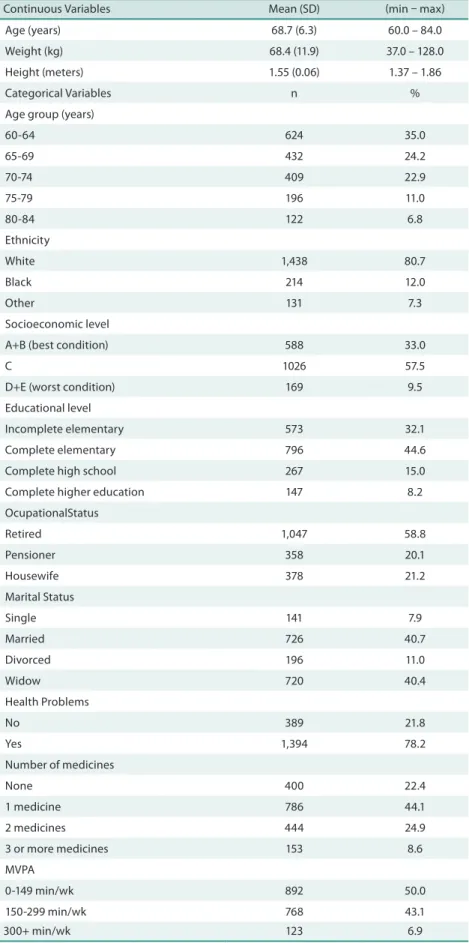
Table 2. Characteristics of the study sample. Curitiba, Brazil (n=1,783).
Continuous Variables Mean (SD) (min – max) Age (years) 68.7 (6.3) 60.0 – 84.0 Weight (kg) 68.4 (11.9) 37.0 – 128.0 Height (meters) 1.55 (0.06) 1.37 – 1.86 Categorical Variables n % Age group (years)
60-64 624 35.0
65-69 432 24.2
70-74 409 22.9
75-79 196 11.0
80-84 122 6.8
Ethnicity
White 1,438 80.7
Black 214 12.0
Other 131 7.3
Socioeconomic level
A+B (best condition) 588 33.0
C 1026 57.5
D+E (worst condition) 169 9.5 Educational level
Incomplete elementary 573 32.1 Complete elementary 796 44.6 Complete high school 267 15.0 Complete higher education 147 8.2 OcupationalStatus
Retired 1,047 58.8
Pensioner 358 20.1
Housewife 378 21.2
Marital Status
Single 141 7.9
Married 726 40.7
Divorced 196 11.0
Widow 720 40.4
Health Problems
No 389 21.8
Yes 1,394 78.2
Number of medicines
None 400 22.4
1 medicine 786 44.1
2 medicines 444 24.9
3 or more medicines 153 8.6 MVPA
0-149 min/wk 892 50.0
150-299 min/wk 768 43.1
300+ min/wk 123 6.9
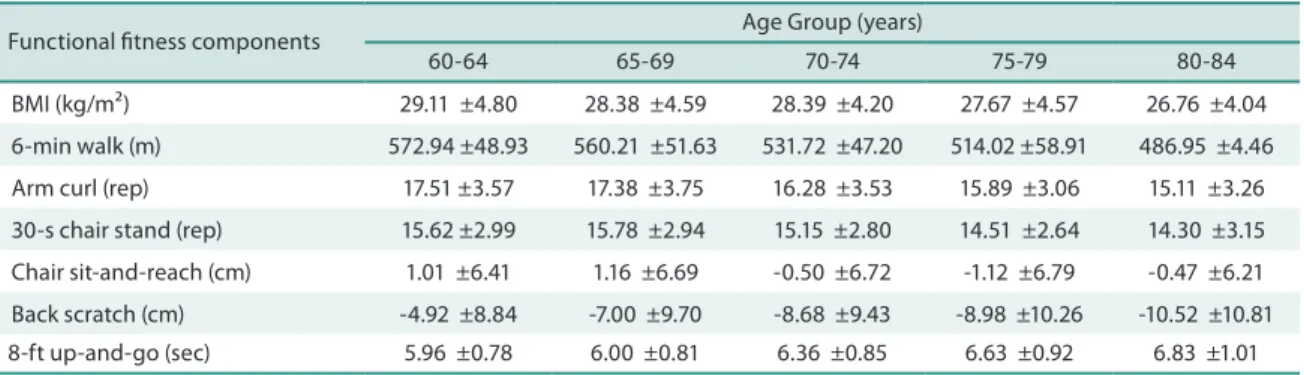
Table 2 shows means and standard deviations of each functional itness test for the Brazilian older women. here was a decline in performance throughout age groups in all tests. When comparing the scores of youngest
and oldest groups, the mean BMI varied from 29.11 to 26.76 kg/m2,
6-min-ute walk from 572.94 to 486.95 m, arm curl from 17.51 to 15.11repetitions, 30-s chair stand from 15.62 to 14.30 repetitions, chair sit-and-reach from 1.01 to -0.47 cm, back scratch from -4.92 to -10.52 cm and 8-t up-and-go from 5.96 to 6.83 sec. his tendency was also conirmed by the analysis of percentile values (Table 3).
Table 3 - Mean and standard deviation of functional itness tests in older women by age group. Curitiba, Brazil (n=1,783).
Functional itness components Age Group (years)
60-64 65-69 70-74 75-79 80-84 BMI (kg/m²) 29.11 ±4.80 28.38 ±4.59 28.39 ±4.20 27.67 ±4.57 26.76 ±4.04 6-min walk (m) 572.94 ±48.93 560.21 ±51.63 531.72 ±47.20 514.02 ±58.91 486.95 ±4.46 Arm curl (rep) 17.51 ±3.57 17.38 ±3.75 16.28 ±3.53 15.89 ±3.06 15.11 ±3.26 30-s chair stand (rep) 15.62 ±2.99 15.78 ±2.94 15.15 ±2.80 14.51 ±2.64 14.30 ±3.15 Chair sit-and-reach (cm) 1.01 ±6.41 1.16 ±6.69 -0.50 ±6.72 -1.12 ±6.79 -0.47 ±6.21 Back scratch (cm) -4.92 ±8.84 -7.00 ±9.70 -8.68 ±9.43 -8.98 ±10.26 -10.52 ±10.81 8-ft up-and-go (sec) 5.96 ±0.78 6.00 ±0.81 6.36 ±0.85 6.63 ±0.92 6.83 ±1.01
BMI: Body Mass Index;
Older women from southern Brazil showed signiicantly higher 50th
per-centile values for BMI compared to American (all p<0.001) and Taiwanese
women (all p<0.001). In contrast, 50th percentile BMI values were
signii-cantly lower compared to Extremaduran women (all p<0.001) (Figure 1A). On the 6-minute walk test (Figure1B), older Brazilian women had signiicantly higher 50th percentilen than Extremaduran women regard-less of age group (all p<0.001). Brazilians had signiicantly lower scores than American women in the three younger age groups (p<0.01), but had similar score in age group 75–79 and (p=0.62) higher score in age group 80-84 years (p<0.001). When compared to Spanish women, higher scores were observed for age groups 65-69 (p=0.02), 75-79 (p=0.01), and 80-84 (p<0.001) (Figure 1B).
In the analysis of upper limb strength (Figure 1C), Brazilian older
women had signiicantly higher 50th percentile values than American
women (all p<0.001). Similar scores were observed for upper limb strength between Brazilians and their Spanish age matched counterparts with the exception of age group 80–84 years (p=0.04), in which Spanish women showed better performance.
In the analysis of lower limb strength (Figure 1D), Brazilian women had
signiicantly higher 50th percentile values in almost all age groups compared
Table 4. Functional itness test percentiles in older women by age group. Curitiba, Brazil (n=1,783).
n P5 P10 P25 P50 P75 P90 P95 BMI (kg/m²)
60-64 624 21.99 23.36 25.77 28.64 32.00 35.59 37.85 65-69 432 21.52 22.77 25.11 28.07 31.12 34.46 36.32 70-74 409 21.98 23.27 25.37 27.97 30.93 33.85 35.88 75-79 196 21.06 22.04 24.20 27.32 30.24 34.48 36.44 80-84 122 20.28 22.02 23.58 26.27 29.52 32.25 34.28 6-min walk (m)
60-64 624 480.00 505.00 540.00 575.00 612.00 640.00 643.70 65-69 432 468.65 495.00 526.50 560.00 597.75 630.00 640.00 70-74 409 452.50 475.00 505.00 530.00 562.00 597.00 605.00 75-79 196 410.95 435.60 485.00 519.00 560.00 596.30 605.00 80-84 122 391.50 417.90 458.25 487.50 514.75 559.70 569.85 Arm curl (rep)
60-64 624 12 13 15 18 20 22 24
65-69 432 11 12 14 17 20 23 24
70-74 409 10 12 13 16 19 21 22
75-79 196 11 12 13 16 18 20 21
80-84 122 11 11 13 14 17 19.70 21.70 30-s chair stand (rep)
60-64 624 12 12 13 15 17 19 21
65-69 432 11 12 14 15 18 20 21
70-74 409 11 12 13 15 17 19 20
75-79 196 10 11 13 14 16 18 20
80-84 122 10 11 12 14 16 19 20
Chair sit-and-reach (cm)
60-64 624 -12.00 -7.00 0.00 2.00 4.00 8.00 10.00 65-69 432 -12.35 -6.70 0.00 2.00 5.00 8.00 11.00 70-74 409 -15.00 -10.00 -3.00 1.00 3.00 5.00 8.00 75-79 196 -15.00 -10.30 -3.00 0.50 3.00 5.00 7.00 80-84 122 -12.85 -9.70 -4.00 0.00 4.00 6.70 8.00 Back scratch (cm)
60-64 624 -20.00 -18.00 -11.00 -3.00 2.00 4.50 7.00 65-69 432 -25.00 -21.00 -14.00 -6.00 1.00 4.00 6.35 70-74 409 -26.00 -21.00 -14.00 -8.00 -2.00 2.00 4.50 75-79 196 -27.00 -23.00 -16.75 -9.50 1.00 3.00 5.15 80-84 122 -27.85 -23.70 -18.25 -10.00 0.00 2.70 4.85 8-ft up-and-go (sec)
60-64 624 4.76 4.99 5.40 5.93 6.44 7.08 7.34 65-69 432 4.87 5.01 5.43 5.93 6.50 7.06 7.46 70-74 409 5.12 5.29 5.71 6.26 7.00 7.51 7.93 75-79 196 5.19 5.46 6.00 6.60 7.19 8.01 8.35 80-84 122 5.20 5.43 6.10 6.65 7.45 8.34 8.68
su-perior scores against Spanish women (all p<0.05). No statistical signiicant diferences were observed in the 50th percentile scores between Brazilian and Extremaduran women.
In the analysis of the upper limb lexibility test (Figure 1F), Brazilian women had better scores than women from Extremadura in age groups 60-64 (p<0.001), 65-69 (p<0.001), and 80-84 (p<0.01) years. American women overcame their age matched Brazilian counterparts in all age groups (all p<0.001). On the other hand, higher results of Spanish women were only true for age groups 65-69 (p=0.02) and 70–74 years (p<0.001).
Finally, in the 8-t up-and-go test (Figure1G), older Brazilian women were signiicantly faster than Extremaduran women regardless of age group (all p<0.001). When compared to Taiwan and the US, only the oldest age group of
Brazilian women was faster (p=0.01). All other American and Taiwanese age groups outperformed the Brazilian counterparts in the agility test (all p<0.05).
DISCUSSION
Functional itness results from the interaction among physical health,
mental health, and social integration17. Functional itness is susceptible to
the aging process, therefore it is expected that the performance in the
func-tional itness tests decline overtime3. According to previous studies10,13,20, a
reduction in performance was observed as the age increased. he decline in performance for each functional itness test occurred at diferent rates,
corroborating previous data from Brazilian20, American3, and Spanish7
studies. his decline can be explained by the presence of major changes
in biological systems 24-27, even when physical activity behavior is present.
he main object of this study was to generate and compare normative functional itness scores. Signiicant diferences among normative func-tional itness scores from Brazil, Spain, Extremadura, Taiwan and the US
are present in all components of the functional itness test3,7-9. hese indings
emphasize the importance of considering data from Brazilian older women to classify functional itness in the country, since choosing normative scores from other countries can lead to underestimation or overestimation bias of functional itness. Collectively, comparisons between functional itness of Brazilian older women and older women from the US, Spain, Taiwan and Extremadura revealed that the BMI of women from Southern Brazilian was higher than in most countries. In addition, Brazilians generally perform better in aerobic endurance and strength tests and worse in lexibility and agility tests than their age matched counterparts from those countries.
he direction and magnitude of diferences among countries varied according to functional itness tests. he comparison of BMI demonstrated higher values among older women in Brazil than Americans and Taiwanese women and lower BMI values than Extremaduran women. his was the only variable that demonstrated relatively similar pattern of decline among age groups in diferent countries (see igure 1A), which could lead us to infer that BMI values are highly culturally speciic in the elderly population and follow a somewhat pre-determined development pattern. Nevertheless, high BMI values lead to public health concerns about the increase in the incidence of
functional limitation26-28 and lower quality of life in older adults29 .
Over-weight and obesity have been linked to negative efects on physical13,26 and
mental health29 in the elderly. here is also evidence of negative relationship
between BMI and performance in other functional itness components26,27 ; therefore, health promotion programs aiming to control and reduce nutri-tional status should be aimed at women from southern Brazil.
com-parison between Brazilian and American women20, in which Americans outperformed Brazilians in all age groups. In this research study, however, Brazilian women outperformed their North American counterparts in the oldest age group. An accentuated pattern of decline in performance was observed for American, Taiwanese and Extremaduran women, especially ater the age of 70 (see igure 1B), but not for Brazilians in our sample. Our indings suggest that the participation in physical activity governmental programs may have helped reducing diferences in aerobic endurance over age groups, favoring even more the two oldest groups by preventing the
loss of aerobic capacity, commonly observed at this age1-2.
he upper limb strength (arm curl) and lower limb strength tests were consistently higher for older Brazilian women than their American and Taiwanese counterparts. hese results contradict previous studies comparing Brazil and the US20, even though both studies extracted the population from the same region in Brazil. he diferences observed between these studies may be related to the fact that our sample was composed of older women who participated in a physical activity community program. he participation in structured physical activities, which included light strength training, may have accounted for the older Brazilian women superiority on strength tests. In both lexibility tests, Brazilians had lower performance and more pronounced declines in lexibility scores if compared to top performers in the Chair-Sit-and-Reach (igure 1 E), and the Back Scratch tests (igure 1 F). Maintaining optimal lexibility levels is important for preserving physical function and performing everyday activities. Flexibility is a fundamental
ca-pacity and its decrease is associated with the frequency of falls in the elderly30.
he 8-feet up-and-go test, which is a power, speed, agility and dynamic balance test, mirrored the results of aerobic endurance test, in which the tendency of decline in performance was less accentuated in the oldest
group, overcoming older Spanish9 and American3 women. hese results
partially support previous studies with women from southern Brazil20,
demonstrating superior results of American women, but also suggesting that declines in performance in the oldest age groups may be attenuated with physical activity interventions.
he relatively large sample size and the rigorous sample selection method can be highlighted as strengths of this study. his analysis em-phasized important diferences in several functional itness components of Brazilian and non-Brazilian older women.
he study also presented limitations. he irst was the inability to generalize normative scores for elderly patients with severe diseases, with cognitive limitations, or for males, because no elderly patients with such features were included. Similarly, the values found in this study cannot be generalized to older women throughout Brazil or in any other particular region of the country. Finally, the cross sectional model used in this study did not allow evaluating individual and natural changes due to aging.
he normative scores for Brazilian older women presented diferences among age groups, enhancing the use of speciic cut-of points for each age group in order to evaluate and diagnose potential functional limitations, either in clinical or epidemiologic studies. In addition, diferences in func-tional itness between older women from southern Brazil and those from other countries suggest that the use of international normative scores may underestimate or overestimate potential functional limitations in Brazilian older women. herefore, these normative scores may be used for evaluating and diagnosing functional itness in southern Brazilian elderly populations.
REFERENCES
1. Gouveia ER, Maia JA, Beunen GP, Blimkie CJ, Fena EM, Freitas DL. Functional itness and physical activity of Portuguese community-residing older adults. J Aging Phys Act 2013; 21(1):1-19.
2. Hügle T, Geurts J, Nüesch C, Müller-Gerbl M, Valderrabano V. Aging and osteo-arthritis: an inevitable encounter? J Aging Res 2012;2012:950192.
3. Rikli RE, Jones J. Functional itness normative scores for community-residing older adults, ages 60-94. J Aging Phys Act 1999;7(1):162-81.
4. Vagetti GC, Barbosa Filho VC, Moreira NB, de Oliveira V, Mazzardo O, de Cam-pos W. Association between physical activity and quality of life in the elderly: a systematic review, 2000-2012. Rev Bras Psiquiatr 2014; 36(1):76-88.
5. Fhon JRS, Fabrício-Wehbe SCC, Vendruscolo TRP, Stackleth R, Marques S, Rodrigues RAP. Accidental falls in the elderly and their relation with functional capacity. Rev Lat Am Enfermagem 2012; 20(5):927-34.
6. Brito TRP, Pavarini SCI. he relationship between social support and functional capacity in elderly persons with cognitive alterations. Rev Lat Am Enfermagem 2012; 20(4):677-84.
7. Gusi N, Prieto J, Olivares PR, Delgado S, Quesada F, Cebrián C. Normative Fitness Performance Scores of Community-Dwelling Older Adults in Spain. J Aging Phys Act 2012 ;20(1):106-26.
8. Chen H-T, Lin C-H, Yu L-H. Normative Physical Fitness Scores for Community-Dwelling Older Adults. J Nurs Res 2009; 17(510):30-43.
9. Pedrero-Chamizo R, Gómez-Cabello A, Delgado S, Rodríguez-Llarena S, Rod-ríguez-Marroyo JA, Cabanillas E, et al. Physical itness levels among independent non-institutionalized Spanish elderly: the elderly EXERNET multi-center study. Arch Gerontol Geriatr 2012; 55(2):406-16.
10. Benedetti TRB, Mazo GZ, Gobbi S, Amorim M, Gobbi LTB, Ferreira L, et al. Valores normativos de aptidão funcional em mulheres de 70 a 79 anos. Rev Bras Cineantropometria e Desempenho Hum 2007; 9(1):28-36.
11. Zago AS, Gobbi S. Valores normativos da aptidão funcional de mulheres de 60 a 70 anos. Rev Bras Ciênc Mov 2003; 11(2):77-86.
12. Hoefelmann CP, Benedetti TRB, Antes DL, Lopes MA, Mazo GZ, Korn S. Aptidão funcional de mulheres idosas isicamente ativas com idade a partir de 80 anos. Motriz 2010; 17(1):19-25.
13. Maia Ribeiro EA, Ribeiro EE, Viegas K, Teixeira F, dos Santos Montagner GFF, Mota KM, et al. Functional, balance and health determinants of falls in a free liv-ing community Amazon riparian elderly. Arch Gerontol Geriatr 2013; 56(2):350-7. 14. Aires M, Paskulin LMG, de Morais EP. Functional capacity of elder elderly:
com-parative study in three regions of Rio Grande do Sul. Rev Lat Am Enfermagem 2010; 18(1):11-7.
Corresponding author
Gislaine Cristina Vagetti Universidade Federal do Paraná Centro de Pesquisa em Exercício e Esporte
Rua Coração de Maria, 92, BR 116, km 95 Jardim Botânico, CEP 80215-370, Curitiba, PR, Brasil.
E-mail: [email protected]
16. Virtuoso-Junior JS, Oliveira-Guerra R. Caracterización del nivel de Aptitud Fun-cional de Mujeres Mayores Residentes en Comunidades de Bajos Ingresos. Rev Salud Publica 2008; 10(5):732-43.
17. Santos MIP de O, Griep RH. Capacidade funcional de idosos atendidos em um programa do SUS em Belém ( PA ). Rev Ciênc Saúde Colet 2013;18(3):753-62. 18. Perez AJ, Fiorin A, Robers DS, Tavares O, Farinatti PTV. Functional autonomy
of elder women living in urban and rural areas: a comparative study. Rev Bras Cineantropom Desempenho Hum 2012; 14(1):11-22.
19. Souza PD de, Benedetti TRB, Borges LJ, Mazo GZ, Gonçalves LHT. Aptidão fun-cional de idosos residentes em uma Instituição de Longa Permanência. Rev Bras Geriatr Gerontol 2009; 14(1):7-16.
20. Krause MP, Januário RSB, Hallage T, Haile L, Miculis CP, Gama MPR, et al. A comparison of functional itness of older Brazilian and American women. J Aging Phys Act 2009 ;17(4):387-97.
21. Associação Brasileira de Empresas de Pesquisa. Critério de classiicação econômica Brasil. São Paulo: Associação Brasileira de Empresas de Pesquisa; 2008.
22. Matsudo S, Araujo T, Matsudo V, Andrade D, Andrade E, Oliveira LC, et al. Ques-tionário internacional de atividade física (IPAQ): Estudo de validade e reproduti-bilidade no Brasil. Rev Bras Ativ Fís Saúde 2001; 6(2):5-18.
23. World Health Organization. Global recommendations on physical activity for health; 2010.
24. Andre MB, Dumavibhat N, Ngatu NR, Eitoku M, Hirota R, Suganuma N. Mini Nutritional Assessment and functional capacity in community-dwelling elderly in rural Luozi, Democratic Republic of Congo. Geriatr Gerontol Int 2013;13(1):35-42. 25. Alfonso-Rosa RM, Del Pozo-Cruz B, Del Pozo-Cruz J, Del Pozo-Cruz JT, Sañudo B. he relationship between nutritional status, functional capacity, and health-related quality of life in older adults with type 2 diabetes: a pilot explanatory study. J Nutr Health Aging 2013;17(4):315-21.
26. Dong H-J, Unosson M, Wressle E, Marcusson J. Health consequences associated with being overweight or obese: a Swedish population-based study of 85-year-olds. J Am Geriatr Soc 2012; 60(2):243-50.
27. Jensen GL. Obesity and functional decline: epidemiology and geriatric conse-quences. Clin Geriatr Med 2005; 21(4):677-87.
28. Mazo GZ, Kulkamp W, Lyra VB, Prado APM. Aptidão funcional geral e índice de massa corporal de idosas praticantes de atividade física. Rev Bras Cineantropom Desempenho Hum 2006; 8(4):46-51.
29. Vagetti GC, Oliveira V, Barbosa Filho VC, Moreira NB, Campos W. Predição da qualidade de vida global em idosas ativas por meio dos domínios do WHOQOL-BREF e do WHOQOL-OLD Predicting overall quality of life in active older women through the. Motri 2012; 8(2):709-18.