DOI: http://dx.doi.org/10.5007/1980-0037.2015v17n4p418
original article
Licence Creative Commom CC
RBCDH
1 Universidade Estadual do Norte do Paraná. Jacarezinho, PR. Brasil. 2 Universidade Estadual de Londri-na. Londrina, PR. Brasil.
Received: 10 August 2014 Accepted: 18 March 2015
Comparison of physical activity, sedentary
behavior and physical itness between
full-time and part-full-time students
Atividade física, comportamento sedentário e aptidão
física de escolares: comparação entre período integral e
parcial
Waynne Ferreira de Faria1
João Paulo de Farias1
Enio Ricardo Vaz Ronque2
Claudinei Ferreira dos Santos1
Antonio Stabelini Neto1
Rui Gonçalves Marques Elias1
Abstract – he aim of this study was to compare physical activity, sedentary behavior and physical itness between full-time and part-time students. he sample consisted of 72 students (9 to 12 years), 34 of them studying full time. he subjects answered a questionnaire about physical activity, sedentary behavior, and sociodemographic charac-teristics. Data regarding sexual maturation, body composition and physical itness were also collected. he results showed that girls studying full time spent less time per day in sedentary behavior compared to part-time girls (p<0.05). Analysis of anthropometric variables showed a signiicantly lower body fat percentage in boys studying full time. With respect to the physical itness tests, signiicant diferences were identiied in the sit and reach test, horizontal jump, medicine ball throw and agility, with the observation of higher performance in full-time students. Similarly, girls studying full time exhibited signiicantly higher performance in the horizontal jump and agility tests compared to their peers. It can be concluded that full-time students spend less time in sedentary behavior and exhibit better physical itness indices in most of the tests used, irrespective of gender. Key words: Adolescents; Motor activity; Motor Performance; School.
Resumo– Objetivou-se comparar a prática de atividade física, o comportamento sedentário
Studies in the literature have demonstrated several beneits of physical ac-tivity. here is evidence indicating that regular physical activity improves the body composition, motor performance, bone health, and lipid proile of children and adolescents1. Additionally, physical active youngsters show
better academic performance and are more likely to enter university2. hese
indings suggest the need to promote an active lifestyle since childhood. For this purpose, adolescents should engage in physical activity of moderate to vigorous intensity for at least 60 minutes per day. hese ac-tivities can be performed during or out-of-school hours in a structured or unstructured manner1. Despite the beneits of regular physical activity,
engagement in habitual physical activities has decreased systematically in the population, particularly during adolescence3. On the other hand,
the time engaged in sedentary behaviors increases with the arrival of adolescence and is associated with a high body mass index (BMI)4 and an
increased risk of metabolic syndrome, irrespective of the level of habitual physical activity, diet and other variables5.
he school has been shown to be a favorable place for behavioral change6. In this respect, the full-time program has been implemented
recently in Brazilian schools, which has the same objectives as the regular school, but prepares the students to exercise their citizenship through edu-cational and cultural activities (arts, dance, capoeira, chess, and additional physical education classes). herefore, the incorporation of psychomotor activities in ater-school programs may be a strategy to help young people meet the recommendations for moderate to vigorous physical activity and time spent in sedentary behavior. A meta-analysis showed that ater-school physical activity programs improve physical activity levels, motor performance indices, and other health-related parameters6.
However, few studies on adolescents studying full time have been con-ducted in Brazil. Such studies are of fundamental importance to provide the basis for public policies that contribute to the development of full-time school programs. Within this context, the objective of the present study was to compare physical activity, sedentary behavior and physical itness between full-time and part-time students.
METHODOlOgICAl PROCEDURS
Physical itness and sedentary behavior in schoolchildren Faria et al.
cultural and sports activities. In contrast, the part-time school attends its students in two periods (morning and aternoon). Only students attending the morning period, entering at 7:30 and leaving at 11:50 h, were included in the sample.
he sample consisted of 34 full-time and 48 part-time students. he criteria for inclusion in the study were age between 9 and 12 years, enroll-ment in one of the two schools selected for the study since the beginning of the school year, and presentation of the consent form signed by the parents or legal guardian. Students who were not in Tanner pubertal stage were excluded from the sample7.
he questionnaires of physical activity, sedentary behavior and soci-odemographic characteristics were applied by interview. Habitual physical activity was assessed using the International Physical Activity Question-naire (IPAQ-8, short form), computing the frequency, duration and inten-sity of physical activities performed in the week prior to data collection.
Sedentary behavior was evaluated based on screen time (computer and/or video game and/or television) of the subjects during the habitual week and weekend [screen time = (mean time during the week + mean time during the weekend)/2]8. he socioeconomic status was determined
using the questionnaire of socioeconomic classiication of the Brazilian Association of Research Companies9, which evaluates the education level
of the head of the household and items owned. Socioeconomic status was dichotomized into A and B and C, D and E according to the score obtained.
Biological maturation was evaluated by self-assessment of secondary sexual characteristics according to Tanner7 as follows: the students recorded
the option that was in accordance with their maturation stage (genitals for boys and breasts for girls). In order to minimize the possibility of embar-rassment of the subjects, the small groups were instructed by examiners of the same gender in diferent rooms. Additionally, one student could not observe the response of the other or see the igures of the opposite gender.
Body weight was determined with a Welmy digital scale to the nearest 100 g and height was measured with a portable wall-mounted stadiometer (0 to 200 cm) to the nearest 0.1 cm. he BMI was calculated by dividing the body weight in kilograms by the square of the height in meters. he cut-of values proposed by Conde and Monteiro10 and stratiied by gender and
age were used for criteria analysis. Triceps skinfold (taken in the vertical direction on the meso-humeral point) and medial calf skinfold (taken in the vertical direction on the medial point of the calf at the site of largest circumference) were measured with a Cescord caliper. he equation pro-posed by Slaughter et al.11 for children and adolescents aged 7 to 18 years
was used to estimate body fat percentage.
he students were submitted to a battery of motor tests of the Projeto Esporte Brasil12 for the analysis of diferent skills, except for aerobic power
in which the 9-min run/walk test was replaced with the 20-m shuttle run test proposed by Léger et al.13. To minimize the inluence of muscle fatigue
efort, followed by the muscle power, anaerobic agility and velocity tests and, inally, the aerobic test. First, the interviews were held, followed by the anthropometric assessments, and then the test battery was performed in the following order: sit and reach test, horizontal jump, medicine ball throw, agility test, 20-m running, one-minute sit-ups, and 20-m shuttle run test. he equation proposed by Léger et al.13 was used to estimate
maximum oxygen uptake.
Ethical considerations
he project was approved by the Ethics Committee of Universidade Es-tadual do Norte do Paraná (Permit No. 016/2011). he students were inter-viewed and evaluated ater they had received detailed information about the objectives of the study and had returned the free informed consent form signed by the parents or legal guardian.
Statistical analysis
First, the chi-squared test was applied to compare the proportions of gender, nutritional status, socioeconomic class and maturation stage between full-time and part-full-time students. he Shapiro-Wilk test was used to evaluate the normality of the data. he Mann-Whitney U test was applied to compare the dependent variables between full-time and part-time students. An alpha (p) value of 5% was considered in all analyses. Statistical analysis was performed using the SPSS 22.0 package.
RESUlTS
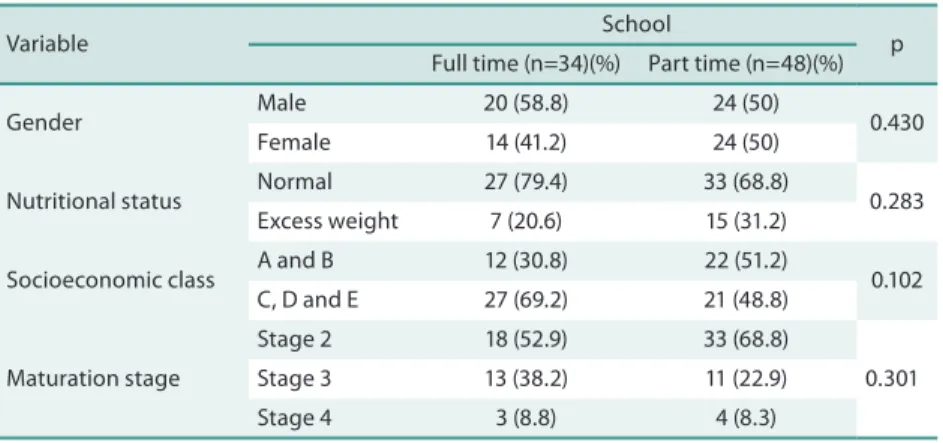
he descriptive characteristics of the full-time and part-time students are shown in Table 1. No signiicant diferences were observed between groups.
Table 1. Sociodemographic characteristics of the full-time and part-time students.
Variable School p
Full time (n=34)(%) Part time (n=48)(%)
Gender Male 20 (58.8) 24 (50) 0.430
Female 14 (41.2) 24 (50)
Nutritional status Normal 27 (79.4) 33 (68.8) 0.283
Excess weight 7 (20.6) 15 (31.2)
Socioeconomic class A and B 12 (30.8) 22 (51.2) 0.102
C, D and E 27 (69.2) 21 (48.8)
Maturation stage
Stage 2 18 (52.9) 33 (68.8)
0.301
Stage 3 13 (38.2) 11 (22.9)
Stage 4 3 (8.8) 4 (8.3)
Physical itness and sedentary behavior in schoolchildren Faria et al.
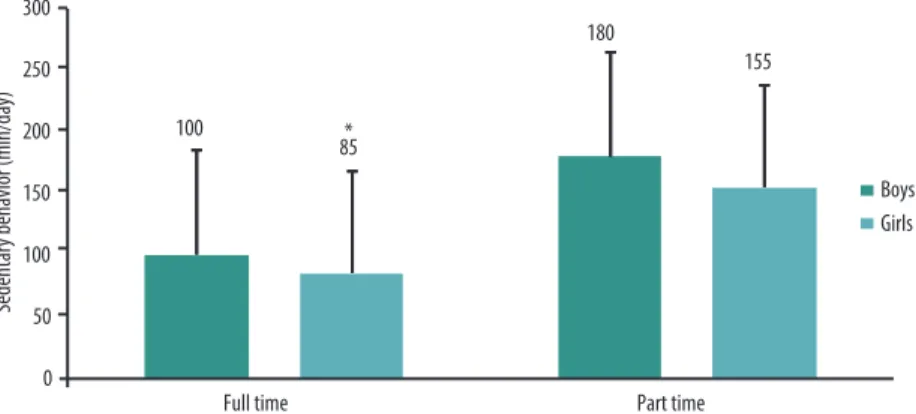
1, boys studying full time spent more time in vigorous to moderate activi-ties than part-time boys (p > 0.05). In contrast, girls studying part time reported greater engagement in moderate to vigorous activities compared to part-time girls (p > 0.05). Figure 2 shows that girls studying full time spent less time in sedentary behaviors than girls studying part time (p < 0.05).
Figure 1. Comparison of habitual physical activity between full-time and part-time students. Mann-Whitney U test. Data are expressed as the median and interquartile range.
Figure 2. Comparison of sedentary behavior between full-time and part-time students. * Signiicant diference between students. p < 0.05, Mann-Whitney U test. Data are expressed as the median and interquartile range.
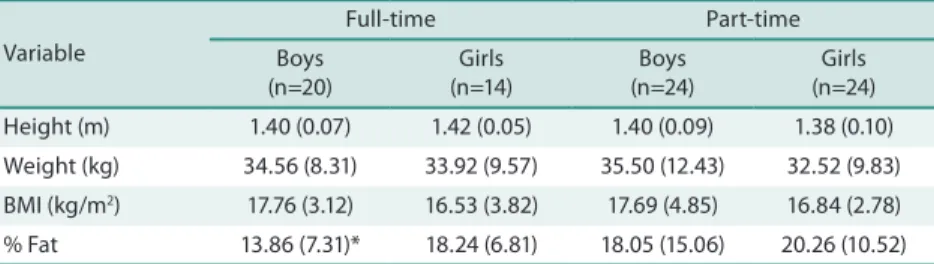
Table 2 shows the comparison of anthropometric variables between full-time and part-time students. here was a signiicant diference in body fat percentage between boys studying full time and boys studying part time. No signiicant diferences were observed in the other anthro-pometric variables.
Variable Boys (n=20)
Girls (n=14)
Boys (n=24)
Girls (n=24)
Height (m) 1.40 (0.07) 1.42 (0.05) 1.40 (0.09) 1.38 (0.10)
Weight (kg) 34.56 (8.31) 33.92 (9.57) 35.50 (12.43) 32.52 (9.83)
BMI (kg/m2) 17.76 (3.12) 16.53 (3.82) 17.69 (4.85) 16.84 (2.78)
% Fat 13.86 (7.31)* 18.24 (6.81) 18.05 (15.06) 20.26 (10.52)
* Signiicant diference compared to part-time boys. p < 0.05, Mann-Whitney U test. Data are expressed as the median and interquartile range (P75 - P25).
Table 3. Comparison of motor tests between full-time and part-time students.
Variable Full-time Part-time
Boys (n=20)
Girls (n=14)
Boys (n=24)
Girls (n=24)
Sit and reach (cm) 27.5 (9.5)* 27.50 (8.75) 23.0 (7.0) 23.50 (11.5)
Horizontal jump (cm) 156 (20)* 130 (41)† 123 (21) 110 (27)
Medicine ball throw (cm) 264 (58)* 230 (36) 237 (55) 217 (39)
Agility (s) 6.59 (0.42)* 6.88 (0.45)† 7.68 (0.68) 7.56 (1.25)
20-m run (s) 4.57 (0.64) 4.90 (1.09) 4.52 (0.57) 4.61 (0.65)
Sit-up (repetitions/min) 32 (6) 24.50 (6) 31.5 (9) 22 (14)
20-m shuttle run (ml.kg.min) 49.50 (5.48) 42.11 (5.55) 47.04 (4.65) 44.98 (5.71)
* Signiicant diference compared to part-time boys; † signiicant diference compared to part-time girls. Data are expressed as the median and interquartile range (P75 - P25).
DISCUSSION
In addition to the inluence of the physiological and anatomical changes resulting from increased hormonal discharges that occur at the onset of puberty, physical itness indices in youngsters are also inluenced by ha-bitual physical activity. his fact may explain the better indices of full-time students in the lexibility, agility and lower and upper limb power tests when compared to parti-time students, as also described in another study14.
Although aerobic power showed favorable levels in full-time students, no signiicant diference was observed between schools, in agreement with Herrick et al.15. Similar results have been reported by Ara et al.16 and Baquet
et al.17 who observed no diference in velocity or abdominal muscle strength
between students that regularly participated in ater-school programs and students that only attended the physical education classes in school.
Experimental studies in the literature have shown that moderate to vigorous activities in ater-school programs improve motor performance parameters 18. It is therefore believed that these activities can improve the
morphological, functional and metabolic characteristics of children and adolescents, leading to an increase in physical itness indices beyond that caused by the processes of growth and maturation19. However, although
Physical itness and sedentary behavior in schoolchildren Faria et al.
he similarity in the time engaged in activities of moderate to vigorous intensity among schools was not expected, since young people participating in ater-school programs exhibit greater energy expenditure and physi-cal activity levels than those who do not regularly participate in physiphysi-cal activity programs20. Although the level of physical activity of full-time
students did not difer signiicantly from that of their peers studying part time (58.8% vs 50%; data not shown), a higher proportion met the cut-of value of 300 minutes per week of moderate to vigorous physical activities when compared to students of the same age group from Pelotas (41.8%)21.
However, the efectiveness of ater-school programs is still supericial since the indings were obtained with limited methods and public investment is lacking6,22.
A meta-analysis6 identiied six studies that investigated physical activity
in ater-school programs. Four of these studies reported positive efects on this behavior. Pate and O’Neill22 included ive randomized controlled
tri-als using direct measures and observed that three of these programs were efective in increasing physical activity. he same authors evaluated the results of three studies that used self-report measures and found that one promoted a signiicant increase in physical activity. hese indings suggest that estimating physical activity in diferent samples using a questionnaire may yield inaccurate results.
Sedentary behaviors such as playing video games, computer use and especially television viewing have been associated with obesity4 and
other risk factors of cardiovascular diseases in children and adolescents, irrespective of physical activity level5. In this study, full-time students
spent signiicantly less time with electronic game and/or television and/ or computer use compared to part-time students. his inding disagrees with the results reported by Kelder et al.23 who found similar screen times
for controls and students of an ater-school program focusing on nutri-tion and physical activity. his result may explain in part the diference in indicators of body composition and motor performance between students. In this respect, French et al.4 observed a signiicant association between a
decrease in television viewing hours and weight reduction over one year. hus, a reduction in sedentary behavior may be an efective strategy to combat and prevent excess weight among young people.
Epidemiological studies have demonstrated weak and inverse associa-tions between physical activity, motor performance24 and television
view-ing25. In a randomized controlled trial, Robinson et al.26 found no changes
in minutes of moderate to vigorous physical activities or cardiorespiratory itness due to reduced screen time despite a decrease in physical inactiv-ity. Similarly, Ekelund et al.27 observed no association between television
Programs that promote ater-school physical activities increase energy expenditure6, and it is therefore expected that these programs contribute to
reduce or maintain indicators of body composition in their students. In this respect, the present study showed a diference, although not signiicant, in BMI values between full-time and part-time students, similar to the inding of Vizcaíno et al.28. his fact should take into consideration that the BMI
does not measure body adiposity and that the result may be inluenced by changes in lean mass, especially among young people engaged in physical activity programs.
Similar to the present indings, Gutin et al.18 observed lower body fat
percentage in students engaged in ater-school physical activity programs compared to those who do not regularly participate in systematic activities during this period. Also, Salvy et al.29 emphasized that factors other than
physical inactivity could be associated with increases in body composi-tion indicators, such as environmental inluences (family and friends) and genetic characteristics of the individual.
It is therefore possible that the activities and eating habits of full-time schools considerably contribute to the fact that their students obtain satis-factory indicators of body composition. Within this context, the full-time school program promotes the primary prevention of diferent chronic noncommunicable diseases.
he present study provides some of the irst evidence supporting full-time school programs and their relationship with physical itness indices and sedentary behavior in Brazilian schoolchildren. However, the study has some limitations such as the fact that the sample is based on a small number of schools and is not representative of the population, as well as the lack of evaluation of eating habits. he use of self-report measures of habitual physical activity, sedentary behavior and maturation stage is an-other limitation, although the international physical activity questionnaire and the self-assessment method of sexual maturation have been validated for Brazilian adolescents.
Further studies need to be conducted in other regions since there is a gap in the literature. he evaluation and monitoring of physical activity, sedentary behavior and motor performance in full-time and part-time pub-lic schools are important to better understand the inluence of these vari-ables on health- and sport-related parameters in children and adolescents.
CONClUSION
Physical itness and sedentary behavior in schoolchildren Faria et al.
other regions of Brazil are needed to provide the basis for public policies that will encourage the expansion and improvement of full-time school programs.
Acknowledgements
We thank Fundação Araucária for the scientiic initiation fellowships granted, and Grupo de Pesquisa em Estilo de Vida, Exercício e Saúde (GPEVES).
REFERENCES
1. Strong W, Malina R, Blimke C, Daniels S, Dishman R, Gutin B, et al. Evidence based physical activity for school-age youth. J Pediatr 2005;146(6):732-7.
2. Springer K, Diily D. he relationship between intensity and breadth of ater-school program participation and academic achievement: evidence from a short-term longitudinal study. J Community Psychol 2012;40(7):785-98.
3. Dumith SC, Gigante DP, Domingues MR, kohl III HW. Physical activity change during adolescence: a systematic review and a pooled analysis. Int J Epidemiol 2011;40(3):685-98.
4. French SA, Mitchell NR, Hannan PJ, Stat M. Decrease in television viewing predicts lower body mass index at 1-Year follow-up in dolescents, but not adults. J Nutr Educ Behav 2012;44(5):415-22.
5. Mark AE, Janssen I. Relationship between screen time and metabolic syndrome in adolescents. J Public Health (Bangkok) 2008;30(2):153-60.
6. Beets MW, Beighle A, Erwin HE, Huberty JL. Ater-school program impact on physical activity and itness: a meta-analysis. Am J Prev Med 2009;36(6):527-37. 7. Tanner J. Growth and adolescence. Oxford: Blackwell Scientiic Publication; 1962. 8. American Academy of Pediatrics. Committee on Public Education. Children,
adolescents, and television. Pediatrics 2001;107(2):423-6.
9. ABEP. Associação Brasileira de Empresas de Pesquisa. Critério de Classiicação Econômica Brasil [Internet]. 2014. Available from: http://www.abep.org/new/ codigosCondutas.aspx [2014 Jan 10].
10. Conde WL, Monteiro CA. Body mass index cutof points for evaluation of nutrition-al status in Brazilian children and adolescents. J Pediatr (Rio J) 2006;82(4):266-72. 11. Slaughter M, Lohman T, Boileau R, Horswill C, Stillman R, Van Loan M, et al. Skinfold equations for estimation of body fatness in children and youth. Hum Biol 1988;60(5):709-23.
12. Gaya A, Lemos A, Gaya A, Teixeira D, Pinheiro E, Moreira R. PROESP-Br Manual de testes e avaliação [Internet]. 2012. Available from: http://www.proesp.ufrgs.br/ [2014 Jan 15].
13. Léger L, Mercier D, Gadoury C, Lambert J. he multistage 20 metre shuttle run test for aerobic itness. J Sports Sci 1988;6(2):93-101.
14. Bortoni WL, Bojikian L. Crescimento e aptidão física em escolares do sexo masculino, participantes de programa de iniciação esportiva. Brazilian Journal Biomotricity 2007;1(4):114-22.
15. Herrick H, hompson H, Kinder J, Madsen K. Use of SPARK to promote ater-school physical activity. J Sch Health 2012;82(10):457-61.
16. Ara I, Moreno LA, Leiva MT, Gutin B, Casajús J. Adiposity, physical activity, and physical itness among children from Aragón, Spain. Obesity 2007;15(8):1918-24. 17. Baquet G, Berthoin S, Gerbeaux M, Praagh E Van. High-intensity aerobic training during a 10 week one-hour physical education cycle: efects on physical itness of adolescents aged 11 to 16. Int J Sports Med 2001;22(4):295-300.
Corresponding author
Waynne Ferreira de Faria, Universidade Estadual do Norte do Paraná,
Alameda Padre Magno, n° 841 CEP – 86400 000, Jacarezinho, PR, Brasil.
E-mail: [email protected]
20. Taverno Ross SE, Dowda M, Colabianchi N, Saunders R, Pate RR. Ater-school set-ting, physical activity, and sedentary behavior in 5th grade boys and girls. Health Place 2012;18(5):951-5.
21. Hallal PC, Bertoldi A, Gonçalves H, Victora C. Prevalência de sedentarismo e fatores associados em adolescentes de 10-12 anos de idade. Cad Saúde Pública 2006;22(6):1277-87.
22. Pate RR, Neill JRO. Ater-school interventions to increase physical activity among youth. Br J Sports Med 2009;43(1):14-8.
23. Kelder S, Hoelscher DM, Barroso CS, Walker JL, Cribb P, Hu S. he CATCH Kids Club: a pilot ater-school study for improving elementary students’ nutrition and physical activity. Public Health Nutr 2005;8(2):133-40.
24. Durant H, Baranowski T, Johnson M, hompson W. he relationship among television watching, physical activity, and body composition of young children. Pediatrics 1994;94(4):449-55.
25. Pate R, Ross J. he national children and youth itness study II: factors associated with health-related itness. J Phys Educ Recreat Danc 1987;58(9):93-5.
26. Robinson TN. Reducing children’ s television viewing to prevent obesity. JAMA 1999;282(16):1561-7.
27. Ekelund U, Brage S, Froberg K, Harro M, Anderssen S, Sardinha L, et al. TV viewing and physical activity are independently associated with metabolic risk in children: the european youth heart study. Plos Med 2006;3(12):e488.