DOI: http://dx.doi.org/10.5007/1980-0037.2015v17n4p389
original article
Licence Creative Commom CCRBCDH
1 São Paulo State University. Labo-ratory of Human Performance. Rio Claro, SP. Brazil.
2 São Paulo State University. Physical Activity, Sport and Health Center. Rio Claro, SP. Brazil. 3 Federal Institute of Education, Science and Technology. Muzam-binho, MG. Brazil.
4 Federal University of Ceará. Physical Education and Sports Institute. Fortaleza, CE. Brazil. 5 University of São Paulo. School of Physical Education and Sport of Ribeirão Preto. Ribeirão Preto, SP. Brazil.
Received: 06 November 2014 Accepted: 24 April 2015
Neuromuscular proile of Handball players
during a short-term condensed competition
in Brazil
Peril neuromuscular de atletas de handebol durante
curta competição no Brasil
Leonardo Coelho Rabello Lima1
Inaian Pignatti Teixeira2
Priscila Missaki Nakamura2,3
Marina Yumi Hayakawa2
Claudio Oliveira Assumpção1,4
Rafael Pombo Menzes5
Abstract – he aim of this study was to assess the neuromuscular proile of handball (TH) players during a short-term condensed competition. Nine TH athletes (age: 23 ± 3 years; height: 176.2 ± 10.5 cm; mass: 75.3 ± 8.6 kg) played 5 handball matches in 5 consecutive days and had exercise-induced muscle damage (EIMD) markers such as soreness (SOR), thigh circumference (CIR), knee range of motion (ROM) and countermovement jump height (CMJ) collected before the irst match and at the end of each day of competition. Changes over time in these markers were analyzed. Signiicant changes were found for all EIMD markers assessed. CMJ signiicantly decreased at the fourth day of competition when compared to baseline (0.41 ± 0.03 m vs. 0.45 ± 0.02 m). ROM decreased on the irst day of competition and remained stable until the last day of competition (baseline: 126.5 ± 7.2º; 1st day: 115.8 ± 5.9º; 2nd day: 115 ± 7º; 3rd day: 113.9 ± 8.8º; 4th day: 114.4 ± 8.6º). SOR and CIR were increased at the second day of competition and remained altered thereater. It was concluded that the characteristics of short-term condensed competition have led TH athletes to signiicant EIMD. If not avoided, EIMD might lead to reductions in performance in the most important (inal) matches.
Key words: Fatigue; Neuromuscular monitoring; Sports; Wounds and Injuries.
Resumo– O objetivo do presente estudo foi medir o peril neuromuscular de jogadores de handebol durante uma competição em formato de jogos. Nove jogadores de handebol (ida-de: 23 ± 3 anos; estatura: 176,2 ± 10,5 cm; massa: 75,3 ± 8,6 kg) jogaram cinco partidas da modalidade em cinco dias consecutivos e tiveram marcadores de DM [como percepção subjetiva de dor (PSD), circunferência da coxa (CIR), amplitude de movimento do joelho (ADM) e altura de salto com contra-movimento (AS)] coletados antes da primeira partida e ao inal de cada dia de competição. Mudanças ao longo do tempo nesses marcadores foram analisadas. Alterações signiicantes foram encontradas para todos os marcadores de DM coletados. A AS diminuiu signiicantemente durante o quarto dia de competição, quando comparado ao valor basal (0,41 ± 0,03 m vs. 0,45 ± 0,02 m). A ADM diminuiu após o pri-meiro dia de competição e permaneceu comprometida até o último dia (basal: 126,5 ± 7,2º;
1o dia: 115,8 ± 5,9º; 2o dia: 115 ± 7º; 3o dia: 113,9 ± 8,8º; 4o dia: 114,4 ± 8,6º). A PSD e a
INTRODUCTION
Handball (TH) is a collective sport based on characteristics like court invasion, opposition between opponent players and collaboration between players of the same team, which are determinant to its unpredictable and
complex scenario1. During matches, players perform diferent technical or
strategic-tactical elements to score a goal (in the ofensive phase) or avoid it from the opponent team (in the defensive phase).
Using spatial analysis, Bompa2 stated that the oxidative system is
re-sponsible for 50% of the energy production during TH matches, with the other 50% being divided between ATP-CP system (20%) and anaerobic glycolysis (30%). In a more detailed investigation, Póvoas et al.3 identiied,
also through spatial analysis, that TH players cover an average of 4.3 km during matches. According to the authors, athletes spend 80% of the total match time walking or standing still, while only 0.5% of the match time is dedicated to sprinting. he average heart rate obtained during matches was 139 bpm (72% of the maximal heart rate). hese data support the knowledge that the oxidative metabolism is very important for TH players, aiding in optimal recovery in intervals between maximal eforts like sprints, jumps and throws. However, the two aforementioned studies described the ef-forts of TH players based on spatial analysis during matches, ignoring that, even while athletes are stationary, they usually perform maximal or near-maximal strength in struggles for space with opponents and/or marking and blocking. herefore, although ignored by spatial analysis, explosive actions are of paramount for performance in TH.
Considering the high number of high-intensity motor actions and the vigorous energetic demands of TH, it is natural to expect the occurrence of EIMD ater matches. EIMD is characterized as the disorganization of basic muscular units (sarcomeres) ater performing high-intensity,
eccentric-based exercises4. TH not only involves high-intensity eforts,
known to induce EIMD, but it also requires players to perform consider-able numbers of eccentric contraction, mostly with knee extensors, in actions such as sprints, landings (ater jumps) and changing direction. he main symptoms assessed in order to identify and quantify EIMD are strength loss, compromised range of motion (ROM) and eiciency, leakage of intracellular proteins such as creatine kinase (CK) and myoglobin (Mb) to the blood stream, muscle swelling, and manifestation of delayed onset
muscle soreness (DOMS)5-9.
here is a gap of knowledge in literature about EIMD induced by TH
matches. A study conducted by Michalsik, Aagaard & Madsen10
unit recruitment11. here is an increasing number of studies investigating
EIMD response ater a number of athletic activities such as marathon12,13,
soccer14,15, basketball16-17, and tennis18 matches. However, these data cannot
be extrapolated for TH, since this sport has very speciic aspects related to performance and metabolism (i.e., powerful actions and resistance simul-taneously). Moreover, many competitions (especially in semi-professional and amateur levels) present condensed schedules that do not allow sui-cient recovery periods between matches, which could compromise proper recovery from EIMD.
Considering the above, it has been hypothesized that, during short-term condensed competitions, the performance levels of TH athletes would be compromised by EIMD. herefore, the aim of this study was to monitor classical EIMD symptoms of TH athletes throughout the Regional Games, a competition characterized as having very short interval (i.e., approximately 24 hours) between matches.
METHODS
Fourteen male athletes, members of a college TH team, participated in the competition. heir regular training regimen consisted of 3 to 4 two-hour training weekly sessions and had at least 5 years of experience as handball players. he team under study inished competition at the fourth place, out of 13 participating teams. Athletes that played less than 25 minutes (complete period of the game) (n=4), and sufered from articular injury (n=1) were excluded from the sample. herefore, considering the exclusion criteria, nine out of the fourteen team members composed the sample. heir mean age, body mass and height were 23 ± 3 years, 75.3 ± 8.6 kg and 176.2 ± 10.5 cm, respectively. All experimental procedures were con-ducted in accordance to the Declaration of Helsinki and all participants spontaneously consented on taking part in this investigation. he study protocol was approved by the Ethics Research Committee (CAAE number: 33739614.1.0000.5465).
All athletes performed anthropometric (weight, height, circumference and range of motion), jumping performance, and soreness perception tests at the end of each day of competition. No tests were conducted at the end of the last day of competition, since athletes had already let the concentration site. Baseline assessments were performed at the night before the irst day of competition. During the competition period, assessments were performed every day at 09:00 pm with a lexibility of ± 1 hour. he assessment time was ixed at this time point in order to avoid changes related to
physiologi-cal luctuations related to the circadian rhythm19. All assessments were
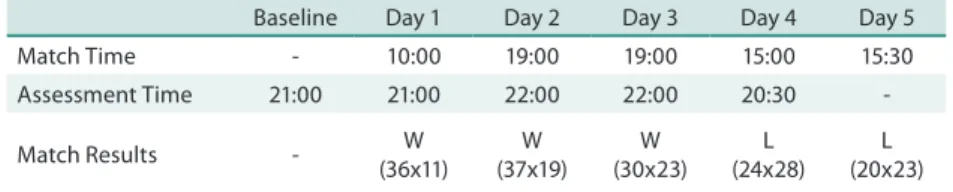
Table 1. Schedule of assessments, time of the day in which matches were performed and results of matches along the competition. W: Win; L: Loss.
Baseline Day 1 Day 2 Day 3 Day 4 Day 5
Match Time - 10:00 19:00 19:00 15:00 15:30
Assessment Time 21:00 21:00 22:00 22:00 20:30
-Match Results - W
(36x11) W (37x19)
W (30x23)
L (24x28)
L (20x23)
Four diferent neuromuscular function variables were assessed, all of them related to the diagnosis and quantiication of EIMD. All measure-ments were performed and repeated by the same professional in a rand-omized design in order to guarantee validity and reproducibility.
Perceived Muscle Soreness (SOR) was assessed through a test in which athletes sat and raised from a 45 bench without any assist from the arms. heir perceived soreness was then marked on a Visual Analogs Scale (VAS), which ranged from 0 (not sore at all) to 100 (very, very sore) in millimeters20.
All subjects were oriented to mark the scale considering only muscle sore-ness, disregarding articular and other types of pain.
Muscle swelling was measured by alterations in Circumference (CIR) of the mid portion of athletes’ thighs (50% of the distance between the greater trochanter and the lateral condyle of the femur). All CIR measurements were performed with an anthropometric tape measure.
he Range of Motion (ROM) of the knee articulation was assessed with a commercial plastic goniometer (CARCI, São Paulo – Brazil). ROM was calculated as the diference between maximal knee lexion (MKF) and maximal knee extension (MKE), considering the anatomic position of the knee as 0º21. MKE was assessed when athletes tried to maximally extend the
knee, while MKF was measured when they tried to maximally lex the knee. Both measurements were conducted with subjects in standing position.
devia-tion, while nonparametric data are represented by medians and interquartile variation. All statistical analyses were performed in the STATISTICA 7.0 sotware (Statsot, Boston – USA). Signiicance levels of p < 0.05 were adopted.
RESUlTS
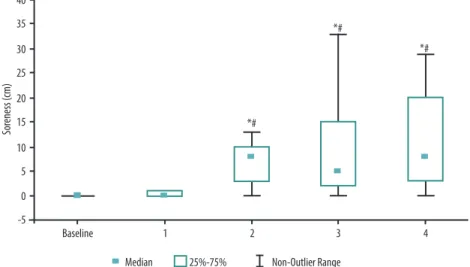
A signiicant time efect was identiied for SOR throughout the competi-tion (x2 = 18.66; p < 0.001). Values obtained at the second (M
d = 8 cm; IQR
= 7 cm), third (Md = 5 cm; IQR = 13 cm) and fourth (Md = 8 cm; IQR = 17
cm) days of competition were signiicantly greater (p < 0.05) than baseline
values (Md = 0 cm; IQR = 0 cm) and those obtained at the irst day of
com-petition (Md = 0 cm; IQR = 1 cm). SOR values are represented in Figure 1.
Figure 1 – Soreness values assessed at baseline and at the end of each day of competition. * p < 0.05 compared to baseline; # p <0.05 compared to the irst day.
Signiicant diferences through time were also identiied for CIR (x2
= 17.55; p = 0.001). CIR values assessed at the second day of competition (Md = 55 cm; IQR = 4.8 cm) were signiicantly greater (p < 0.05) than those
obtained at baseline (Md = 54.5 cm; IQR = 3.8 cm) and on the irst day of
competition (Md = 54 cm; IQR = 5 cm). Moreover, CIR values measured
on the third (Md = 55.8 cm; IQR = 5.5 cm) and fourth (Md = 56 cm; IQR
= 6.5 cm) days were signiicantly higher than those obtained earlier on competition. All CIR values are represented in Figure 2.
Figure 2 – Circumference values assessed at baseline and at the end of each day of competition. * p < 0.05 compared to baseline; # p <0.05 compared to the irst day; @ p <0.05 compared to the second day.
Figure 3 – Range of motion values assessed at baseline and at the end of each day of competition. * p < 0.05 compared to baseline.
DISCUSSION
he aim of our study was to assess the neuromuscular proile of TH athletes during a condensate, short-term, competition, testing the hypothesis that EIMD would compromise athletic performance by altering four mark-ers that are related to strength and technical performance. Our indings pointed to signiicant changes in all symptoms over time and, more im-portantly, during the last stage of competition.
It has been previously established that sports that require high number of powerful and intense actions lead to EIMD14-18. However, to the best of
our knowledge, there are no studies investigating the efects of TH matches on EIMD markers and, most importantly, subsequent performance. In our study, alterations in four frequently assessed EIMD markers (SOR, CIR, ROM and CMJ) were identiied throughout the competition. However, an addition efect might have led to greater changes in EIMD markers that would not be manifested ater a single match, as previously described in a
similar model22. However, considering that the most important TH
com-petitions have a short-term, condensed characteristic23, it is also important
to investigate the level of stress imposed to the neuromuscular system throughout them.
As shown in Figure 1, SOR levels signiicantly increased at the second day of competition and remained increased until the last assessment. his late development of SOR has been widely reported in EIMD studies and occurs due to a relatively slow response of the immune system to disrup-tions in the ultra-structural muscular components, characterizing the term
“delayed onset muscle soreness”5. Although it is common to observe a peak
in SOR 48 hours ater a damaging bout, it tends to decrease and be fully
recovered 4 to 5 days ater it21. We believe that SOR remained increased
throughout the competition due to the aforementioned addition conferred
by subsequent matches (damaging bouts). Moreover, Nelson24 states that
increased SOR can compromise the performance of high-intensity and technical activities and should be avoided by coaches and trainers during competitions. Additionally, although not systematically assessed, SOR was reported by athletes to coaches during the two inal competition matches. herefore, it is reasonable to assume that the changes found in SOR in the present study might have inluenced performance and disposition during the competition.
Similarly to SOR, CIR presented its irst signiicant increase in the second day of competition (Figure 2). However, on the third and fourth days of competition, CIR was signiicantly greater than in all previous days. It is common for CIR to respond similarly to SOR, since both are trig-gered by the inlammatory response to EIMD. CIR is actually an indirect
measurement of edema caused by inlammation4,16. However, it increased
athletes’ mood state, previous exposition to soreness and personality, as previously described 24.
As graphically represented in Figure 3, the ROM of athletes’ knee was signiicantly diferent than baseline values in all days of competition. hese changes were also expected, considering the intensity of matches and the manifestation of EIMD. Along with the other variables, and additional damaging efect was also identiied throughout the competition. ROM is usually used as an indirect marker of muscle passive stifness in studies
that investigate EIMD4,20,21. Increased stifness has been demonstrated to
compromise eiciency of the stretch-shortening cycle25,26. Running,
jump-ing and tackljump-ing are considered as key actions for successful performance in TH and require great levels of muscular power, which is optimized by the stretch-shortening cycle27. herefore, if the power generating capacity of
knee extensors is compromised by muscular stifness (induced by EIMD), decreases in performance might occur.
CMJ presented a diferent behavior, compared to the other EIMD mark-ers surveyed. As shown in Figure 4, the only time-point in which athletes presented decreased jump height was on the fourth day of competition. However, although no signiicant diferences were found, CMJ presented a slight decrease on the irst day of competition, remaining below baseline values up to the third day and, inally, falling to a signiicantly diferent level on the fourth day. We believe that this signiicant decrease might have
occurred due to the aforementioned addition efect 22, in which subsequent
ruptures on the muscular ultra-structural components kept weakening the athletes’ muscles up to a point in which it produced signiicant less power and, consequently, a shorter jump height. It is important to state that assessments were performed with athletes jumping with both limbs. However, during matches, athletes usually use only the non-dominant limb to perform jumps and landings.
Since CMJ was the only assessment performed in a bilateral mode, the non-jumping limb might have biased the measurement result. However, both limbs perform explosive actions like running and tackling during matches. herefore, it could be inferred that strength production was not as afected by the irst three matches as much as the other EIMD markers. Notwithstanding, strength performance was compromised ater the fourth match, which lead athletes to play the inal, and most decisive match, in a compromised state. Considering that jumping is a very important action for TH, we believe that performance on the last match of the competition might have been lower than expected due to EIMD.
Considering the alterations in parameters collected, coaches should focus on preparing their athletes to resist the damaging situations inherent to this type of competition. Literature provides many strategies to protect the neuromuscular system from EIMD, like performing a high-intensity
damaging bout previously to the competition6, performing maximal
isometric contractions a few days before it28, improving the athletes
athletes before and during the competition30. Another action that should
be considered by the organization of such sports events is to extend the competition calendar in order to allow at least 48 hours of rest between matches. However, we believe that this alternative is far from possible, considering the necessary logistics.
Finally, there are important limitations in the present study. he number of athletes that completed the testes was relatively low, which may have led to a type II error. A relatively high number of athletes (n = 14) volunteered for the study. However, four of them did not play more than 25 minutes during matches, which was considered insuicient for concrete manifestation of EIMD and fatigue, and another athlete was injured during the competition, not being able to complete all tests. Athletes from other teams could have been selected to participate in the present study in order increase statistical power and, most importantly, analyze the efects of this short-term competition in the neuromuscular proile of athletes that per-formed diferent training protocols and played at diferent positions in the competition. However, in order to assess so many diferent athletes, larger research team and the approval from diferent coaches and delegations would be required. he bilateral strength assessment protocol might have contributed to the unconventional data obtained for CMJ. Further studies should focus on examining the most commonly used limb. Also, match intensity was not controlled through spatial analyses or heart rate moni-toring. Unfortunately, heart rate monitoring cannot be performed during oicial TH matches due to the potential hazard that the harness might provide to athletes and spatial analyses requires authorization from other athletes and from the organization of the competition. Finally, matches were played at diferent times of the day, which might have inluenced performance in the matches and assessments. However, this is a reality in most competitions and more accurately relects neuromuscular changes when compared with highly controlled protocols with standardized time between sessions.
CONClUSIONS
It could be concluded that the short interval periods between TH matches in a short-term condensed competition can lead to insuicient recovery and, therefore, EIMD. he elicited EIMD was proven to be related to de-creases in performance in the inal and most important matches of the competition, in which athletes are expected to perform their best. We recommend that coaches focus on prevention strategies against EIMD, which are abundant in literature.
Acknowledgments
REFERENCES
1. Menezes RP. Contributions of the complex phenomena conception to the teaching of team sports. Motriz 2012;18(1):34-41.
2. Bompa TO. Periodization training for sports. 2nd ed. Champaign: Human Kinet-ics; 2005.
3. Póvoas SC, Seabra AF, Ascensão AA, Magalhães J, Soares JM, Rebelo AN. Physical and physiological demands of elite team handball. J Strength Cond Res 2012;26(12):3365-75.
4. Clarkson PM, Hubal MJ. Exercise-induced muscle damage in humans. Am J Phys Med Rehabil 2002;81(Suppl):S52-S69.
5. Tricoli W. Mechanisms involved in delayed onset muscle soreness etiology. Rev Bras Ciênc Mov 2001;9(2):39-44
6. McHugh MP. Recent advances in the understanding of the repeated bout efect: the protective efect against muscle damage from a single bout of eccentric exercise. Scand J Med Sci Sports 2003;13(2):88-97.
7. Hubal MJ, Rubinstein SR, Clarkson PM. Mechanisms of variability in strength loss ater muscle-lengthening actions. Med Sci Sports Exerc 2007;39(3):461-8. 8. Lima LCR, Denadai BS. Efeito protetor após sessões de exercício excêntrico:
com-paração entre membros superiores e inferiores. Motriz 2011;17(4):736-47. 9. Assumpção CO, Lima LCR, Oliveira FBD, Greco CC, Denadai BS.
Exercise-in-duced muscle damage and running economy in humans. Scientiic World Journal 2013;2013:1-11.
10. Michalsik LB, Aagaard P, Madsen K. Locomotion characteristics and match-induced impairments in physical performance in male elite team handball players. Int J Sports Med 2013;34(7):590-9.
11. Dimitrova NA, Dimitrov GV. Interpretation of EMG changes with fatigue: facts, pitfalls, and fallacies. J Electromyogr Kinesiol 2003;13(1):13-36.
12. Del Coso J, Fernández D, Abián-Vicen J, Salinero JJ, González-Millán C, Areces F, et al. Running pace decrease during marathon is positively related to blood markers of muscle damage. PloS One 2013;8(2): e57602.
13. Saugy J, Place N, Millet GY, Degache F, Schena F, Millet GP. Alterations of neuro-muscular function ater the World’s Most Challenging Mountain Ultra-Marathon. PloS One 2013;8(6): e65596.
14. horpe R, Sunderland C. Muscle damage, endocrine, and immune marker response to a soccer match. J Strength Cond Res 2012;26(10):2783-90.
15. Silva JR, Ascensão A, Marques F, Seabra A, Rebelo A, Magalhães J. Neuromuscular function, hormonal and redox status and muscle damage of professional soccer play-ers ater a high-level competitive match. Eur J Appl Physiol 2013;13(9):2193-2201. 16. Chatzinikolaou A, Draganidis D, Avloniti A, Karipidis A, Jamurtas AZ, Skevaki CL,
et al. he microcycle of inlammation and performance changes ater a basketball match. J Sports Sci 2014;32(9):870-82.
17. Moreira A, Nosaka K, Nunes JA, Viveiros L, Jamurtas AZ, Aoki MS. Changes in muscle damage markers in female basketball players. Biol Sport 2014;31(1):3-7. 18. Gomes RV, Santos RC, Nosaka K, Moreira A, Miyabara EH, Aoki MS. Muscle
dam-age ater a tennis match in young players. Biol Sport 2014;31(1):27-32.
19. Atkinson G, Reilly T. Circadian variation in sports performance. Sports Med 1996;21(4):292-312.
20. Chen TC, Nosaka K, Sacco P. Intensity of eccentric exercise, shit of optimum angle, and the magnitude of the repeated-bout efect. J Appl Physiol 2007;102(3):992-9. 21. Chen TC, Lin KY, Chen HL, Lin MJ, Nosaka K. Comparison in eccentric
exercise-induced muscle damage among four limb muscles. Eur J Appl Physiol 2011;111(2):211-23.
Corresponding author
Leonardo Coelho Rabello de Lima São Paulo State University Av. 24-A, 1515, Rio Claro, SP, Brazil ZIP: 13506-900.
E-mail: [email protected]
23. Bilge M. Game analysis of Olympic, world and European championships in men’s Handball. J Hum Kinet 2012;35(4):109-18.
24. Nelson N. Delayed onset muscle soreness: is massage efective? J Bodyw Mov her 2013;17(4):475-482.
25. Váczi M, Rácz L, Hortobágyi T, Tihanyi J. Dynamic contractility and eiciency impairments in stretch-shortening cycle are stretch-load-dependent ater training-induced muscle damage. J Strength Cond Res 2013;27(8):2171-9.
26. Lacourpaille L, Nordez A, Hug F, Couturier A, Dibie C, Guilhem G. Time-course efect of exercise-induced muscle damage on localized muscle mechanical proper-ties assessed using elastography. Acta Physiol 2014;211(1):135-46.
27. Kallerud H, Gleeson N. Efects of stretching on performances involving stretch-shortening cycles. Sports Med 2013;43(8):733-50.
28. Chen HL, Nosaka K, Pearce AJ, Chen TC. Two maximal isometric contractions attenuate the magnitude of eccentric exercise-induced muscle damage. Appl Physiol Nutr Metab 2012;37(4):680-9.
29. Chen CH, Nosaka K, Chen HL, Lin MJ, Tseng KW, Chen TC. Efects of lexibility training on eccentric exercise-induced muscle damage. Med Sci Sports Exerc 2013;43(3):491-500.