Original Article
400 Rev Bras Hematol Hemoter. 2013;35(6):400-3
Dombrock genotyping in Brazilian blood donors reveals different regional frequencies of
the HY allele
Fabiana Chagas Camargos Piassi1 Silvana Maria Eloi Santos1 Lilian Maria de Castilho2 Wilson Baleotti Júnior3 Rodrigo Buzinaro Suzuki3 Débora Moura da Cunha4
1Universidade Federal de Minas Gerais – UFMG, Belo Horizonte, MG, Brazil 2Centro de Hematologia e Hemoterapia, Hemocentro da UNICAMP, Universidade Estadual de Campinas - UNICAMP, Campinas, SP, Brazil
3Hemocentro da Faculdade de Medicina de Marília – FAMEMA, Marília, SP, Brazil 4Fundação Centro de Hematologia e Hemoterapia de Minas Gerais – Hemominas, Belo Horizonte, MG, Brazil
Conlict-of-interest disclosure:
The authors declare no competing inancial interest
Submitted: 2/28/2013 Accepted: 7/9/2013
Corresponding author: Fabiana Chagas Camargos Piassi
Universidade Federal de Minas Gerais – UFMG Departamento de Propedêutica
Complementar
Avenida Alfredo Balena, 190, Santa Eigênia 30.130-100 Belo Horizonte, MG, Brazil Phone: 55 31 3409-9774
www.rbhh.org or www.scielo.br/rbhh
DOI: 10.5581/1516-8484.20130128
Introduction
The Dombrock (DO) blood group system (ISBT 014) was irst described in 1965; since then, several studies have revealed its complexity(1). The analysis of gene polymorphisms was
made possible after the DO2 gene was cloned and sequenced (GenBank accession number: AF 290204). Genotyping is an important tool for predicting Dombrock phenotypes. DNA analysis can explain some observed variations in reaction strength during the serologic characterization of different phenotypes and unusual antibody production(1).
Single nucleotide polymorphisms (SNPs) in DNA are correlated with seven different antigens of this system: Doa, Dob, Hy, Joa, Gya, DOYA and DOMR(2-5). Do antigens are
carried on a 47- to 58-kDa glycoprotein attached to the red blood cell membrane via a glycosylphosphatidylinositol (GPI) bond(6). Individuals with the null phenotype or Gy-(a)
have no Dombrock antigens expressed in the red blood cell membrane; at least ive molecular alterations have been described(7-10).
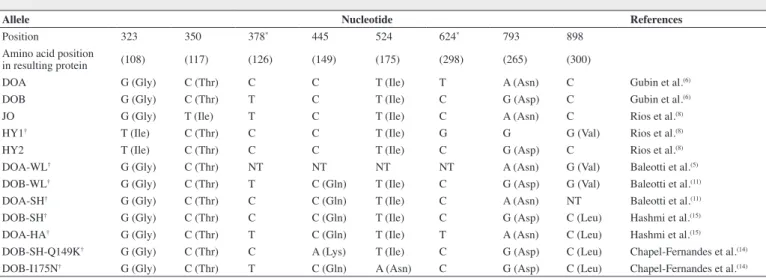
Several authors have emphasized the importance of regional studies aiming to identify Dombrock genotypes because of the high variability of alleles (Table 1). In Brazil, three new alleles have already been identiied: DO*B-WL (898C>G), SH (624T>C), and DO*A-WL (898C>G)(5,11). In addition, molecular studies of the DO alleles revealed that JO is more
common than HY in Brazil, whereas HY is more prevalent in New York(12).
The 898G SNP in the DO*B-WL and DO*A-WL alleles in the heterogeneous Brazilian population demonstrates that this polymorphism is not restricted to one racial group. This polymorphism was previously identiied only in association with the 323T SNP in the HY*1 variant allele and was described as a mutation apparently restricted to black African individuals(13).
Such diversity has also been observed in Africans tribes(14) after the identiication of
the variant alleles, DO*B-SH-Q149K (445C>A) and DO*B-I175N (524T>A), in which the protein contains altered nucleotides at different positions. Two other variant alleles, DO*B-SH (624T>C) and DO*A-HA (378C>T), were identiied in a cohort comprising various ethnic groups including blood donors from New York(15).
Background: Dombrock blood group system genotyping has revealed various rearrangements of the Dombrock gene and identiied new variant alleles in Brazil (i.e., DO*A-SH, DO*A-WL and DO*B-WL). Because of the high heterogeneity of the Brazilian population, interregional differences are expected during the investigation of Dombrock genotypes.
Objective:The present study aims to determine the frequencies of Dombrock genotypes in blood donors from Minas Gerais and compare the frequencies of the HY and JO alleles to those of another population in Brazil.
Methods: The frequencies of the DO alleles in Minas Gerais, a southeastern state of Brazil, were determined
from the genotyping of 270 blood donors. Genotyping involved polymerase chain reaction and restriction fragment length polymorphism analysis to identify the 323G>T, 350C>T, 793A>G, and 898C>G mutations, which are related to the HY, JO, DO*A/DO*B, and DO*A-WL/DO*B-WL alleles, respectively. Moreover, the frequencies of rare HY and JO alleles were statistically compared using the chi-square test with data from another Brazilian region.
Results: The HY allele frequency in Minas Gerais (2.4%) was almost twice that of the JO allele (1.5%). The
frequency of the HY allele was signiicantly higher (p-value = 0.001) than that in another Brazilian population and includes a rare homozygous donor with the Hy- phenotype. In addition, the DO*A-WL and DO*B-WL alleles, which were irst identiied in Brazil, were found in the state of Minas Gerais.
Conclusions: The data conirm that the frequencies of DO alleles differ between regions in Brazil. The
population of Minas Gerais could be targeted in a screening strategy to identify the Hy- phenotype in order to develop a rare blood bank.
Keywords: Blood donors; Polymerase chain reaction; Genotyping techniques; Blood group antigens;
401
Dombrock genotyping in Brazilian blood donors reveals different regional frequencies of the HY allele
Rev Bras Hematol Hemoter. 2013;35(6):400-3 Objective
Considering Brazilian miscegenation and the variability of the DO gene, the present study aims to determine the frequencies of Dombrock genotypes in blood donors from Minas Gerais with combinations of the following alleles: DO*A (SNP 793A), DO*B (SNP 793G), DO*A-WL (SNP 793A, 898G), DO*B-WL (SNP 793G, 898G), HY*1 (SNP 323T, 898G), HY*2 (SNP 323T, 898C), and JO (SNP 350T). In addition, it aims to compare the frequencies of the HY and JO alleles, which are related to the rare Hy- and Jo(a-) phenotypes, to those of another population in Brazil to identify possible regional differences in the frequencies of these alleles in order to guide the search for rare blood donors.
Methods
Samples of peripheral venous blood were collected in EDTA from 270 randomly selected blood donors from the Blood Center of Belo Horizonte, Minas Gerais. Subjects provided informed consent and the study was approved by the institutional review board. The sample size was calculated assuming a signiicance level of 5% and 80% power in relation to the prevalence of the DO*B-WL allele which has previously been identiied in a Brazilian population(11).
Genomic DNA was extracted from the leukocytes of blood samples using Ilustra TM blood genomicPrep Mini Spin Kit from GE Healthcare (Buckinghamshire, UK) according to the manufacturer’s instructions.
The segments of the gene were ampliied in a thermocycler (CT-412, Barloworld Scientiic Techne, UK) using three pairs of primers(13) under the following conditions: 95°C for 5 minutes; 35
cycles at 94°C for 20 seconds, 62°C for nt 793, 58°C for nt 323 and 350, or 55°C for nt 898 for 20 seconds followed by 72°C for 20 seconds; and inally 72°C for 10 minutes. The polymerase chain reaction used 100 ng of DNA, 2.0 pmol of each primer, 200 M
Table 1 - List of Dombrock alleles and their polymorphisms
Allele Nucleotide References
Position 323 350 378* 445 524 624* 793 898
Amino acid position
in resulting protein (108) (117) (126) (149) (175) (298) (265) (300)
DOA G (Gly) C (Thr) C C T (Ile) T A (Asn) C Gubin et al.(6)
DOB G (Gly) C (Thr) T C T (Ile) C G (Asp) C Gubin et al.(6)
JO G (Gly) T (Ile) T C T (Ile) C A (Asn) C Rios et al.(8)
HY1† T (Ile) C (Thr) C C T (Ile) G G G (Val) Rios et al.(8)
HY2 T (Ile) C (Thr) C C T (Ile) C G (Asp) C Rios et al.(8)
DOA-WL† G (Gly) C (Thr) NT NT NT NT A (Asn) G (Val) Baleotti et al.(5)
DOB-WL† G (Gly) C (Thr) T C (Gln) T (Ile) C G (Asp) G (Val) Baleotti et al.(11)
DOA-SH† G (Gly) C (Thr) C C (Gln) T (Ile) C A (Asn) NT Baleotti et al.(11)
DOB-SH† G (Gly) C (Thr) C C (Gln) T (Ile) C G (Asp) C (Leu) Hashmi et al.(15)
DOA-HA† G (Gly) C (Thr) T C (Gln) T (Ile) T A (Asn) C (Leu) Hashmi et al.(15)
DOB-SH-Q149K† G (Gly) C (Thr) C A (Lys) T (Ile) C G (Asp) C (Leu) Chapel-Fernandes et al.(14)
DOB-I175N† G (Gly) C (Thr) T C (Gln) A (Asn) C G (Asp) C (Leu) Chapel-Fernandes et al.(14)
*Silent SNP, †variant alleles. NT: Not tested
of each dNTP, 3.5 mM of MgCl2, 0.8 U of Taq DNA polymerase,
and buffer in a inal volume of 20 μL. The ampliication products were digested by restriction endonucleases to identify the following gene polymorphisms: Eam1105 I (MBI Fermentas®, NY, USA) for
793A>G (DO*A/DO*B), BseDI (MBI Fermentas, NY, USA) for 323G>T (HY), XcmI (New England Biolabs®, Ipswich, USA) for
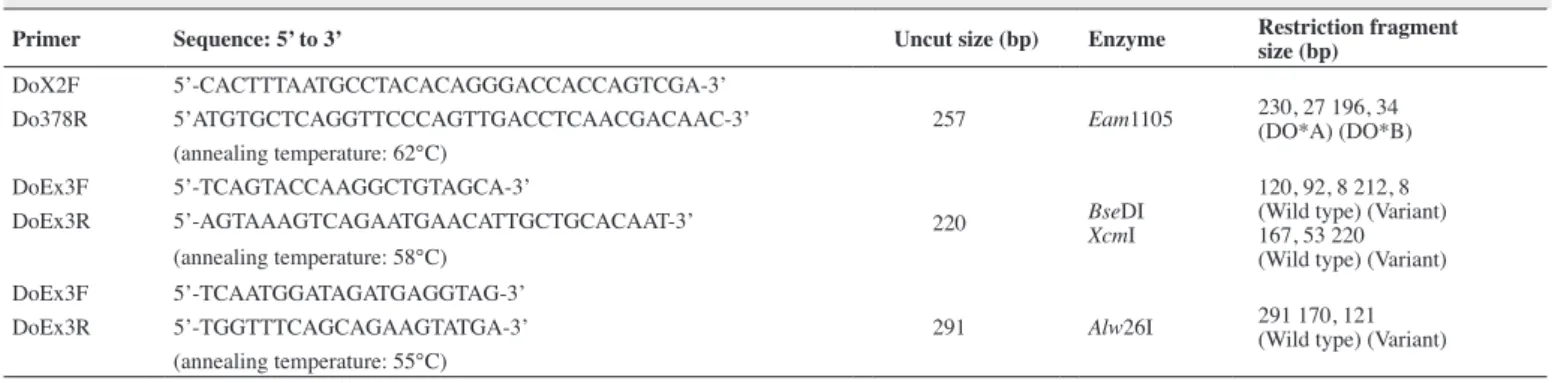
350C>T (JO), and Alw26I (MBI Fermentas, NY, USA) for 898C>G (HY*1, DO*A-WL and DO*B-WL). The concentrations of restriction enzymes and incubation temperatures were in accordance with the manufacturers’ recommendations. For identiication, the fragments of the enzymatic digestion were electrophoresed in 3% agarose gel, stained with ethidium bromide and revealed by ultraviolet light. The primer sequences, ampliication products, and sizes of restriction fragments are listed in Table 2.
The statistical signiicance between the frequencies of the HY and JO alleles in Minas Gerais as well as a previous population analysis in Brazil was established using the Chi-square test for each allele.
Results
The results of the Dombrock genotyping in blood donors from Minas Gerais are shown in Table 3.
The frequencies of the variant alleles, DO*A-WL and DO*B-WL, in a Brazilian population were previously reported to be 0.5% and 14%, respectively(5). In the present population, the
frequencies of DO*A-WL and DO*B-WL were approximately 0.7% and 7%, respectively. However, it was impossible to differentiate the genotypes DO*A/DO*B-WL and DO*B/DO*A-WL in 19 samples (7.04%) because the 898G SNP was associated with only one of these alleles.
The JO allele was heterozygous for the DO*B and DO*A alleles. In contrast, the HY allele was homozygous (HY*1/HY*1) in one sample.
402
Piassi FC, Santos SM, Castilho LM, Baleotti Júnior W, Suzuki RB, Cunha DM
Rev Bras Hematol Hemoter. 2013;35(6):400-3 Although the Hy- phenotype has been described in people of African descent, the high frequency of the HY allele in Minas Gerais indicates the relatively higher probability of inding an individual homozygous for this allele, making this donor population a target for investigating the Hy- phenotype. However, self-identiication does not accurately predict the degree of African ancestry of an individual and should not be applied as a variable in the screening of rare Hy- phenotypes in the mixed Brazilian population.
Conclusion
The present study shows that donors from Minas Gerais are more similar to African-American donors from New York than the other previously investigated Brazilian population in respect to the frequency of the HY allele. Therefore, we can conclude that comparisons should be made on the basis of the Brazilian region investigated and not the entire country.
Furthermore, the presence of the DO*A-WL and DO*B-WL variant alleles in donors from Minas Gerais justify the inclusion of the 898C/G SNP in genotype screening protocols for this population. bp: base pairs
Table 2 - Primers used for polymerase chain reaction and product sizes after enzymatic restriction
Table 3 - Dombrock genotyping results
Primer Sequence: 5’ to 3’ Uncut size (bp) Enzyme Restriction fragment
size (bp)
DoX2F 5’-CACTTTAATGCCTACACAGGGACCACCAGTCGA-3’
257 Eam1105 230, 27 196, 34(DO*A) (DO*B)
Do378R 5’ATGTGCTCAGGTTCCCAGTTGACCTCAACGACAAC-3’
(annealing temperature: 62°C)
DoEx3F 5’-TCAGTACCAAGGCTGTAGCA-3’
220 BseDI
XcmI
120, 92, 8 212, 8 (Wild type) (Variant) 167, 53 220 (Wild type) (Variant)
DoEx3R 5’-AGTAAAGTCAGAATGAACATTGCTGCACAAT-3’
(annealing temperature: 58°C)
DoEx3F 5’-TCAATGGATAGATGAGGTAG-3’
291 Alw26I 291 170, 121(Wild type) (Variant)
DoEx3R 5’-TGGTTTCAGCAGAAGTATGA-3’
(annealing temperature: 55°C)
Nucleotide
Genotype 323 350 793 898 Total (%)
DOA/DOB G/G C/C A/G C/C 087 (32.22)
DOB/DOB G/G C/C G/G C/C 080 (29.63)
DOA/DOA G/G C/C A/A C/C 025 (9.26)
DOB/DOB-WL G/G C/C G/G C/G 032 (11.85)
DOA/DOA-WL A/A C/C G/G C/G 004 (1.48)
DOB-WL/DOB-WL G/G C/C G/G G/G 003 (1.11)
DOA/DOB-WL
(or DOA-WL/DOB) G/G C/C A/G C/G 019 (7.04)
HY1/DOA T/G C/C G/A G/C 006 (2.22)
JO/DOB G/G T/C A/G C/C 005 (1.85)
JO/DOA G/G T/C A/A C/C 003 (1.11)
HY1/DOB T/G C/C G/G G/C 003 (1.11)
HY2/DOB T/G C/C G/G C/C 002 (0.74)
HY1/HY1 T/T C/C G/G G/G 001 (0.38)
Total 270 (100.00)
in another Brazilian population (0.7%) (p-value = 0.001)(12).
Moreover, a rare homozygous HY allele was identiied.
There was no signiicant difference between the present and previous studies regarding the frequency of the JO allele (1.5% vs. 1.75; p-value = 0.735)(12). In the previous study, the
frequency of JO was approximately twice that of HY. However, in the present study in Minas Gerais, the frequency of the HY allele was higher (62%) than that of the JO allele (38%) only considering the total frequency of these two alleles.
Discussion
This is the irst report about regional differences in the frequencies of DO alleles in blood donors in Brazil. The results highlight the necessity of local studies in highly heterogeneous populations.
The Brazilian population has extremely mixed ancestry, which can be explained by miscegenation between Africans brought as slaves, European settlers, and native Indians. When molecular markers are evaluated, the contribution of each of these groups in Brazilian ancestry varies by region(16).
The huge size of Brazil and internal migration may also explain this heterogeneity.
Since monoclonal antibodies are unavailable for the routine hemagglutination technique, advances in molecular techniques have led to a better understanding of the DO blood group system and the inference of its phenotypes. Furthermore, unlike hemagglutination, molecular techniques enable the screening of large numbers of donors to ind rare phenotypes.
This methodology revealed three novel DO alleles in the Brazilian population(5,11). Although no new alleles were
identiied in the present study, the regional differences found in the frequencies of the rare HY allele highlight the expressive heterogeneity of the Brazilian population.
The Hy antigen is present in over 99% of black African individuals and 100% of individuals in most other populations; its absence, which is associated with the presence of the HY allele, is rare(13). At least one case of active hemolysis by
anti-Hy antibodies has been reported(17). Moreover, the presence of
403
Dombrock genotyping in Brazilian blood donors reveals different regional frequencies of the HY allele
Rev Bras Hematol Hemoter. 2013;35(6):400-3
In routine transfusions, compatibility between donors and recipients prevents both the appearance of antibodies and immune hemolytic conditions when these antibodies are already present. From the perspective of developing a rare blood bank, the present data highlight the relevance of using particular protocols for DO genotyping established from local population studies to identify rare phenotypes.
Acknowledgments
We thank FAPEMIG and HEMOMINAS Foundation for inancial support.
References
1. Reid ME. Complexities of the Dombrock blood group system revealed. Transfusion. 2005;45(2 Suppl):92S-9S.
2. Lewis M, Allen FH Jr, Anstee DJ, Bird GW, Brodheim E, Contreras M, et al. ISBT Working Party on Terminology for Red Cell Surface Antigens: Munich report. Vox Sang. 1985;49(2):171-5.
3. Banks JA, Hemming N, Poole J. Evidence that the Gya, Hy and Joa antigens belong to the Dombrock blood group system. Vox Sang. 1995;68(3):177-82.
4. Mayer B, Thornton N, Yürek S, Wylie D, Hue-Roye K, Poole J, et al. New antigen in the Dombrock blood group system, DOYA, ablates expression of Do(a) and weakens expression of Hy, Jo(a), and Gy(a) antigens. Transfusion. 2010;50(6):1295-302.
5. Baleotti W Jr, Suzuki RB, Polotto M, Ruiz MO, Fabron A Jr, Castilho L. A PCR-based strategy for Dombrock screening in Brazilian blood donors reveals a novel allele: the DO* A-WL. J Clin Lab Anal. 2011;25(2):79-82. 6. Gubin AN, Njoroge JM, Wojda U, Pack SD, Rios M, Reid ME, et
al. Identiication of the dombrock blood group glycoprotein as a
polymorphic member of the ADP- ribosyltransferase gene family. Blood. 2000;96(7):2621-7.
7. Rios M, Hue-Roye K, Storry JR, Lee T, Miller JL, Reid ME. Molecular basis of the Dombrock null phenotype. Transfusion. 2001;41(11):1405-7. 8. Rios M, Storry JR, Hue-Roye K, Chung A, Reid ME. Two new
molecular bases for the Dombrock null phenotype. Br J Haematol. 2002;117(3):765-7.
9. Lucien N, Celton JL, Le Pennec PY, Cartron JP, Bailly P. Short deletion within the blood group Dombrock locus causing a Do(null) phenotype. Blood. 2002;100(3):1063-4.
10. Westhoff C, Vege S, Yazdanbakhsh K, Wylie D, Razib M, Hue-Roye K, et al. A DOB allele encoding an amino acid substitution (Phe62Ser) resulting in a Dombrock null phenotype. Transfusion. 2007;47(8):1356-62. 11. Baleotti W Jr, Rios M, Reid ME, Hashmi G, Fabron A Jr, Pellegrino J Jr,
et al. Dombrock gene analysis in Brazilian people reveals novel alleles. Vox Sang. 2006;91(1):81-7.
12. Castilho L, Baleotti W Jr, Tossas E, Hue-Roye K, Ribeiro KR, Lomas-Francis C, et al. Molecular studies of DO alleles reveal that JO is more prevalent than HY in Brazil, whereas HY is more prevalent in New York. Immunohematology. 2008;24(4):135-7.
13. Rios M, Hue-Roye K, Øyen R, Miller J, Reid ME. Insights into the Holley- and Joseph- phenotypes. Transfusion. 2002;42(1):52-8. 14. Chapel-Fernandes S, Callebaut I, Halverson GR, Reid ME, Bailly P,
Chiaroni J. Dombrock genotyping in a native Congolese cohort reveals two novel alleles. Transfusion. 2009;49(8):1661-71.
15. Hashmi G, Shariff T, Seul M, Vissavajjhala P, Hue-Roye K, Charles-Pierre D, et al. A lexible array format for large-scale, rapid blood group DNA typing. Transfusion. 2005;45(5):680-8. Erratum in: Transfusion. 2005;45(6):1045. Comment in: Transfusion. 2005;45(5):652-3. 16. Parra FC, Amado RC, Lambertucci JR, Rocha J, Antunes CM, Pena SD.
Color and genomic ancestry in Brazilians. Proc Natl Acad Sci USA. 2003;100(1):177-82.
17. Beattie KM, Castillo S. A case report of a hemolytic transfusion reaction caused by anti-Holley. Transfusion. 1975;15(5):476-80.