REVISTA
BRASILEIRA
DE
ANESTESIOLOGIA
OfficialPublicationoftheBrazilianSocietyofAnesthesiology www.sba.com.brSCIENTIFIC
ARTICLE
Addition
of
lidocaine
to
levobupivacaine
reduces
intrathecal
block
duration:
randomized
controlled
trial
Dilek
Yazicioglu
∗,
Taylan
Akkaya,
Ercan
Sonmez,
Haluk
Gumus
AnkaraDiskapiYildirimBeyazitTeachingandResearchHospital,Ankara,Turkey
Received13February2013;accepted10June2013 Availableonline11October2013
KEYWORDS
Levobupivacaine; Lidocaine;
Spinalanesthesia;
TUR-P
Abstract
Background: Thedurationofthespinalblockisaconcernforanesthetists.Lowdose intrathe-callidocainehasvasodilatoryeffectsandincreasesthelocalanesthetic clearancefromthe intrathecalspace.Theaimwastoinvestigatewhetherthiseffectoflidocainecanbeusedto increasetheresolutionoflevobupivacainespinalanesthesia.
Method: Afterobtainingethicalapprovalandinformedpatientconsent,40patientsunderwent transurethralprostateresectionwerestudied.Patientswererandomizedintotwogroupsand patientsreceivedeitherlevobupivacaine6.75mg+0.3mL2%lidocaine(GroupL)or levobupi-vacaine6.75mg+saline(GroupC).Themainoutcomemeasureswerethedifferencebetween groupsregardingthedurationofthespinalblockandPACUstay.Secondaryoutcomemeasures werethedifferencebetweengroupsinonsetandresolutionofthespinalblock,adverseevents andtreatmentswerealsoinvestigated.
Results:Spinal block resolved faster in Group L than Group C; 162.43±39.4min vs 219.73±37.3min (p=0.000). PACU time was shorter in Group L (109±49.9min in Group L vs 148±56.8min in Group C) (p=0.036). There was nodifference between groups with respecttotheincidenceofadverseeventsandtreatments.Groupswerealsosimilarregarding complications.PDPHandTNSwerenotobservedinanygroup.
Conclusion: Additionoflowdoselidocainetohyperbariclevobupivacainereducestheduration oftheintrathecalblockprovidedbyhyperbariclevobupivacaine.Thistechniquecanbeused toreducethespinalblockdurationforrelativelyshortprocedureslikeTUR-P.
© 2013SociedadeBrasileirade Anestesiologia.Publishedby ElsevierEditoraLtda.Allrights reserved.
∗Correspondingauthor.
E-mail:[email protected](D.Yazicioglu).
Introduction
The duration of the spinal block in short or medium duration procedures is a concern for anesthetists and is studiedwidely.Lowerdoses oflongacting local anesthet-icscompromisetheefficacyofanesthesia.1Addingopioids
to low dose local anesthetics for outpatient procedures causedurinaryretention,unpredictableonsetandextension ofthespinal block.2,3Lowdose lidocainehasvasodilatory
effectsand increasesthe local anestheticclearance from theintrathecal space asshown witha microdialysis tech-niqueinanimals.4Theclinicalstudiesreportedcontroversial
resultsregardingtheuseoflidocainetoshortenthespinal blockresolution.5,6Itwashypothesedthatthedurationof
the levobupivacaine intrathecal block could change when performedwithhyperbariclevobupivacainemixedwith lido-caine.
Methods
Patientsandprocedures
It was planned to enroll 40 patients requiring elective transurethral resection of the prostate (TUR-P) with a prospectiveprotocol.Allpatientssignedaninformed con-sent before the operation. The study was conducted in theYildirimBeyazitTeachingandResearchHospital.Ethical approvalforthisstudywasprovidedbytheYildirimBeyazit EAHEthicalCommittee,Ankara,TurkeyCh.ProfISencanon 30June2009(ClinicaltrialsIdentifierNCT01675895).
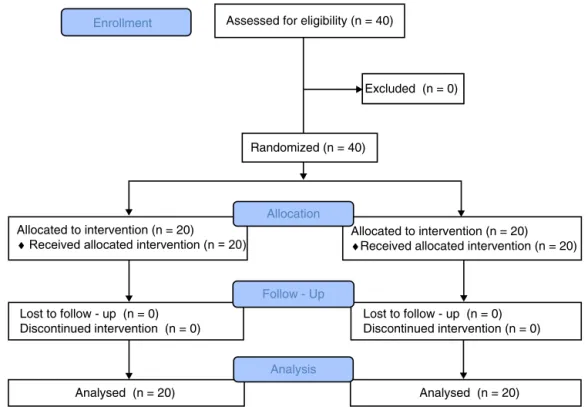
Patients with contraindications for spinal anesthesia, known sensitivity to the study drugs, emergency cases, andpatientswhorefusedspinalanesthesiawereexcluded. Thefollowingparameterswererecorded:gender,age,body massindex(BMI),concomitantdiseases, AmericanSociety ofAnesthesiologists(ASA)physiologicstate, andthe dura-tionofsurgery.Monitoringincludedelectrocardiogram(lead II), heart rate, noninvasiveblood pressureand peripheral oxygensaturation. It was ensuredthat every patient was hydrated 10mLkg−1 Ringer’s lactate solution before the spinalblock wascommenced. Patientswerenot premedi-cated.Patientswererandomizedbyanurseanesthesistin oneoftwogroups byusingcomputergenerated sequence ofnumbersandsealedenvelopeswereusedfor allocation (Fig.1).
Hyperbaric levobupivacaine was aseptically prepared just before the injection using 30% dextrose (%30 Dek-stroz,Turktipsan,Ankara,Turkey)andplainlevobupivacaine (Chirocaine5mgmL−1 Abbott Laboratories Elverium, Nor-way). The prepared hyperbaric levobupivacaine was containing 30mgmL−1 dextrose.7 Lidocaine group (Group
L) (n=20) received 1.5mL hyperbaric levobupivacaine (Chirocaine® 5mgmL−1AbbottLaboratoriesElverium, Nor-way)(6.75mg)+0.3mL2% lidocaine(6mg)(%2 Lidokain®, Adeka Ilac Sanayi, Samsun, Turkey) in total 1.8mL and Control Group (Group C) (n=20), hyperbaric levobupiva-caine0.5% (6.75mg)+saline (100mL0.9% IzotonikSodium Klorur® Turktıpsan, Ankara, Turkey) in the same volume. ThepHofthemixtureswas5.16and5.15(CorningPhmeter 450,Thermoscientific,8157phelectrode).Spinal anesthe-siawasperformed attheL4---5intervertebralspaces, with thepatientplacedinthelateraldecubitusposition:a mid-lineapproachwasusedwitha25GQuincke needle.After verifyingfreeflowofclearcerebrospinalfluidtheprepared solutionwas injected into the intrathecal space in 30sc. Thepatientswereplacedsupineaftertheinjection.Heart rate,bloodpressuresandperipheraloxygensaturationwere
measuredandrecordedevery5min.Hypotension(definedas a>30%decreaseinthesystolicbloodpressureincomparison withthebaselinevaluesorasystolicbloodpressurelessthan 80mmHg) wastreated with5mg i.v. ephedrineor 250mL crystalloidfluidboluses.Bradycardia(definedasaheartrate
≤50beats/min)wastreatedwith0.5mgi.v.atropine.
Assessmentofonsetandrecoveryoftheblock
Theonsetandrecoveryoftheblockwasassessedbyan anes-thetist whowasblindto groupallocation.Sensorial block was measured with pinprick test via a 22gauge hypoder-micneedle.Assessmentwasdonewith1minintervalsuntil the maximum block was achieved and with 15min inter-valsthereafter untilthe blockresolvedtoS1dermatome. Motorblockwasmeasuredwhenthesensorialblockreached maximumdermatomalspreadandwhentheblockresolved toS1. Themodified Bromagescale wasused(0:nomotor loss,fullmovement;1:inabilitytoflexthehip;2:inability toflexthehipandknee;3:inabilitytoflexthehip,knee andankle).Timeofsubarachnoidinjection,onsetof senso-rial block(block at L1dermatome), timetoreadinessfor surgery(blockatT10dermatome),maximum levelof sen-sorialblock,timetoreachmaximumlevelofsensorialblock wasrecorded.Resolutionwasdeterminedwiththetwo seg-ments,T10,L1andS1regressionofthesensorialblock.Time between subarachnoidinjectionandthe regressionof the sensorialblocktoS1wasdefinedasblockduration.TheS1 resolutionofthesensorialblockwaschosenforthe determi-nationofblockdurationconsideringpatientcomfortduring the assessment and since all the patients had an urinary catheteraftersurgeryfurtherassessmentwasunnecessary. Perirectalsensoryevaluationwasnotdone.Surgerystarted whentheblockreachedtheT10dermatome.Ahead-down tilt for 5min was used as a rescue maneuver when the sensorialblockdidnotreachT10.Intraoperativeuseof fen-tanylasarescueanalgesicandmidazolamforsedationwere recorded.
Attheendofthesurgerythepatientsweretransferred tothepostanesthesiacareunit(PACU).Aftertheblockwas resolvedtoS1dermatomeandfulfillinganAldretescore≥9, patients were transferred to the surgical ward. Pain was measured withavisualanalog scale (VAS)(0:nopainand 10:worstpainever).Postoperativeanalgesiawasprovided withacetaminophen(Parol10mg/mL,AtabayKimya, Istan-bul,Turkey)1000mgi.v.threetimesadaywiththefirstdose administeredwhentheblockresolvedtoT12orearlierwhen thepainscorewas>3.Rescueanalgesiaconsistedofperoral 50mgtramadol(Contramaltb50mgAbdiIbrahimIlac, Istan-bul,Turkey)whenthepainscorestillwas>3.Thepatients wereassessedforpostduralpunctureheadache(PDPH)and transientneurologicsymptoms(TNS,definedaspainand/or dysesthesia inthe buttocksand lowerextremities) at the dayofsurgeryandfollowing3days.TNSassessmentswere madewithastandardizedquestionnairebydailyvisitsduring hospitalizationandbytelephonecallsafterdischarge.
Statisticalanalysis
Assessed for eligibility (n = 40)
Excluded (n = 0)
Analysed (n = 20) Lost to follow - up (n = 0) Discontinued intervention (n = 0) Allocated to intervention (n = 20)
♦ Received allocated intervention (n = 20)
Lost to follow - up (n = 0) Discontinued intervention (n = 0) Allocated to intervention (n = 20)
♦Received allocated intervention (n = 20)
Analysed (n = 20) Allocation
Analysis Follow - Up Randomized (n = 40) Enrollment
Figure1 Consortflowdiagramofthestudy.
wasusedtotestthenormalityofdistributionfor continu-ousvariables.Whilethemeandifferenceswerecompared by unpaired t test, Mann---Whitney U tests was used for the comparison of median values. Hemodynamic parame-ters(i.e.systolic,diastolicandmeanbloodpressures,pulse rate and oxygen saturation) were evaluated by Repeated Measures of ANOVA. The Greenhouse---Geisser test statis-tics wasappliedfor testing thesignificance ofinteraction term (i.e.Time×Group). Nominal datawere analyzedby Fisher’sexacttest.Apvaluelessthan0.05wasconsidered statisticallysignificant.
Asamplesizeof19patientsineachgroupwascalculated fromapilotstudyof16subjectswhichachieved95%power witha˛=0.05(GroupCmean228.3±50.0minandGroupL mean172.5±52.3minforS1regressiontimes).Weincluded 20patientsineachgroupforpossibledropouts.
Theprimaryendpointwasthedifferencebetweengroups regardingthedurationofthespinalblock(S1regressionof the block). Secondary end points were onsetof sensorial block(block atL1dermatome), timetoblock atT10 der-matome,maximumblocklevel,timetomaximumblock,the intensityofthemotorblockatmaximumblockandthetimes totwosegmentsregression,T10regression,LIregressionof theblockandpostoperativecareunit(PACU)stay.
Results
The study wascompleted with40 patients.There wasno difference between groups regarding age, weight, height andBMI.Thedurationofsurgerywasalsosimilar(Table1). Durationof thespinal block(sensorial blockregression to S1)wassignificantlyshorterinGroupL(162.43±39.34min inGroupLversus219.73±37.3min inGroupC;p=0.000). PACUtimewasalsosignificantlyshorterinGroupLcompared
to Group C (109±49.9min versus 148.15±56.7min; p=0.036).TimetoT10blockadewaslongerinGroupLmean 6.55±2.13minversus4.55±1.76min(p=0.04).Theblock didnotreachT10in3patientsinGroupLaheaddown res-cuemaneuverwasusedfortheesepatients.Thetimetotwo segmentregressionandL1regressionwerealsosignificantly shorterinGroupL(p=0.02andp=0.02).TimetoT10 regres-sionwasnotdifferentbetweengroups(Table2).Theonset timesof sensoryblock andthedegrees of motorblock at thetimeofmaximumblockadewerenotdifferent.InGroup C9patientsandinGroupL10patientsexperiencedmotor block.Thehighest Bromagescorewas2.The motorblock resolvedin both groupsby thetimetheblock resolvedto S1dermatome.The maximum blocked sensoriallevel was T8dermatome(GroupC,minT10,maxT4andGroupLmin T10maxT4).Bloodpressuresandheartratesofthepatients weresimilar.ThemeanMAP’sweresimilaratthetimethat theblocksreached maximum sensorylevel.There wasno differencebetweengroupswithrespecttotheincidenceof adverse events complicationand treatments.Onepatient ineachgroupexperiencedhypotensionthatneeded treat-ment withintravascular volumeexpansion and ephedrine and3patientsinthecontrolgroupneededtreatmentwith
Table1 Demographicdata.
GroupC(n=20) GroupL(n=20)
Age(yr) 68±8.6 68±8.9
Weight(kg) 79.5±11.6 76.4±11.2
Height(m) 1.69±0.06 1.71±0.05
BMI(kgm−2) 27.6±4.4 25.8±3.6
Durationofsurgery(min) 61.9±32.2 57.5±25.9
Table2 Onsetandrecoveryprofilesofsensoryandmotorblock,andPACUtime.
GroupC(n:20) GroupL(n:20) P
Onsetprofile
Maxsensoryblocklevel(median) T8(T8−T6) T8(T10−T4) 0.863
TimetoL1block(onsettime)(min) 1.9(1.07) 1.9(0.82) 1.000
TimetoT10block(min)* 4.5(1.76) 6.5(2.13) 0.004
Motorblock(n,maxdensity) 9,Bromage2 10,Bromage2 0.465
Duration(min)* 160.2(40.1) 131.8(32.4) 0.003
Recoveryprofile
Timeto2-levelregression(min)* 97.9(±38.9) 55.2(±38.7) 0.002
TimetoT10regression(min)* 97.3(±45.5) 60.7(±39.7) 0.019
TimetoL1regression(min)* 160.7(±44.3) 101(±64.3) 0.001
TimetoS1regression(min)* 219.73(±37.3) 162.43(±39.4) 0.000
PACUtime(min)* 148(±56.8) 109(±49.9) 0.036
Valuesaremean±SDornumbers,exceptthepeaksensoryblocklevelsdescribedwithmedian(range).
* TherewerestatisticallysignificantdifferencesbetweenLandCgroupsregardingthetimestosensorialblockonsetatT10,block
regressionatT10,L1andS1,andpostanesthesiacareunit(PACU)stay.
atropine. Two patients in each group needed additional intraoperativesedation.Thetotalmidazolamdosewas5mg in both groups. The use of postoperative rescue analge-sia was also similar. Tramadol50mg peroral was used in onepatientinbothgroupsatthepostoperativesixthhour. Groupswerealsosimilarregardingcomplications(Table3). PDPHandTNSwerenotobservedinbothgroupsat 3days followup.
Discussion
Theresultsshowedthat 6mgof2% lidocaineshortensthe durationofthelevobupivacainespinalblockapproximately 50minandthePACUstay45min.Thisisanimportantfinding becausedecreasingthePACUtimebyatleast10%makesit possibletodecreasethenumberofpatientsinPACUby20% thisenablesPACU’stolowerthecosts,increasethenumber ofpatientsadmitted,increasethequalityofcaredelivered andreducetherisksafteranesthesia.8
Evidence concerning duration of the spinal block with levobupivacaine reflects variations. These variations can
Table 3 Adverse events, complications and treatments duringsurgeryand3daysfollow-up.
GroupC(n=20) GroupL(n=20)
Hypotension 1 1
Bradycardia 3 0
Additionalfluids 3 0
Atropine 3 0
Ephedrine 1 0
Nausea/vomiting 1/0 0/0
Additionalsedation 2 2
Additionalanalgesia 1 1
PDPH 0 0
TNS 0 0
Dataarepresentedascountsoffrequencies.
Therewasnostatisticallysignificantdifferencesbetweenthe groups.
be related to dose differences of the local anesthetics
administred.TimetoS1sensationrecoveryfromintrathecal
administred2.5mL0.5%isobariclevobupivacainewasmean
256.2mininapreviousstudy.9Thesamedoseisobaric
lev-obupivacainewasalsoinvestigatedbyCuvasandcoworkers. Theyobservedmean355.2minfortimetoregressionofthe sensoryblocktoS1dermatome.10 Thiswasalmosttwofold
thedose usedinthisstudy.Thesestudieswereconducted withplainlevobupivacaine.
Studieswithsimilardosesofhyperbariclevobupivacaine asinthisstudy alsoreportedlongerrecovery times.Alley etal.assessedthedurationofblockade,withspinal hyper-bariclevobupivacaine8mg0.5%involunteers.Intheirstudy timeto L1regression wasmean 147min.11 In thepresent
study,timetoL1regressionwasmean101min inthe lido-caineaddedgroup.
InapreviousstudyLeeandcoworkersreportedthatthe additionof lidocaine tobupivacaine providedan increase in the resolution of the spinal block.5 On the contrary in
a recent report the authors did notconfirm this shorten-ingeffectoflidocaine.This differenceinoutcome canbe relatedtodifferencesinmethodology.Thebupivacainedose washigherandthepatientsstayedinthelateraldecubitus positionaftertheintrathecalinjection.6
Althoughitisexpectedthataddingashortactinglocal anesthetic toa mixture would speed upthe onset of the block we did not observeany difference between groups regarding onset of the block. The dose of lidocaine used wastoolowtoproducelocalanestheticactionandthepH ofbothstudydrugsweresimilarandasidotic.
InthelidocainegrouptimetoT10blockwaslongerthan thecontrolgroup.ParticularlytheblockdidnotreachT10 in3patientsatthe9th,10thand11thmin.When adminis-teringsmalldoses(3---6mg)oflevobupivacaine,theeffect ofthepostureofthevertebralcolumncanbecrucialdueto thehyperbaric characterofthedrug.12 Theresults ofthis
anesthesia by effecting readiness for surgery and thus prolongingoperation roomtime.The hyperbaric levobupi-vacaine solution with 30mgmL−1 dextrose has a density of 1.00945 (0.00016) at 37◦C.13 The baricity of sodium
chloride 0.9%0.99951 (0.00001) andlidocaine 2%0.99994 (0.00000)areveryclose.14Itwasreasonabletoacceptthat
there was no clinically relevant difference between the study drugsconcerning baricityevenif thedensity of the study drugs were not measured. Consequently, the high-estdermatomalspreadandmaximumblocklevelswerenot different.
The resolution of motor block can be a problem in recovery from spinal anesthesia. Adding lidocaine to lev-obupivacaine did neither affect the incidence nor the densityofthemotorblock.
The overall incidence of adverse events (hypotension, bradycardia, nausea) was low in both groups. TNS after spinal anesthesia have been reported most commonly in association with lidocaine, but have been observed with other local anesthetics. After spinal anesthesia with lev-obupivacaine, the incidence of TNS is much less than after lidocaine. However, it appears that TNS may occur in association with levobupivacaine.15 The patients were
meticulouslyquestionedforsuchsymptomsduringthewhole studyperiod.WedidnotobserveanyTNS.
Levobupivacaine 0.5% mixed with lidocaine 2% is pre-viouslyusedinsub-tennon’sanesthesiaandinfraclavicular block withsuccsess.16,17 To ourknowledge thisis the first
studyusinglevobupivacaine5%andlidocaine1%togetherin theintrathecalroute.
We conclude that spinal anesthesia performed with the levobupivacaine---lidocaine mixture has shorter block durationandprovidesashorterPACUstaycomparedto lev-obupivacainealone.Thismethodcanbeusedtoreducethe levobupivacaine spinal block duration in TUR-P and oper-ationswithsimilarduration.The validitiyof thiseffectof lidocaineonotherlocalanesthesicagentsstillneedsfurther research.
Conflicts
of
interest
Theauthorsdeclarenoconflictsofinterest.
References
1.ArzolaC,Wieczorek PM.Efficacyoflow-dosebupivacaine in spinalanaesthesiafor Caesarean delivery:systematic review andmeta-analysis.BrJAnaesth.2011;107:308---18.
2.Bachmann M, Pere P, Kairaluoma PH, et al. Randomised comparison of hyperbaric articaine and hyperbaric low-dose bupivacainealongwithfentanylinspinalanaesthesiafor day-caseinguinalherniorrhaphy.EurJAnaesthesiol.2012;29:22---7. 3.Gupta A, AxelssonK, ThörnSE,et al.Low-dose bupivacaine plusfentanylforspinalanesthesiaduringambulatoryinguinal herniorrhaphy:acomparisonbetween6mgand7.5mgof bupi-vacaine.ActaAnaesthesiolScand.2003;47:13---9.
4.ClementR, Malinovsky JM,CorreP,et al.Spinal biopharma-ceutics of bupivacaine and lidocaine by microdialysis after their simultaneous administration in rabbits. Int J Pharm. 2000;203:227---34.
5.LeeSJ,BaiSJ,LeeJS,etal.Thedurationofintrathecal bupi-vacainemixedwithlidocaine.AnesthAnalg.2008;107:824---7. 6.JacobsenJ,HusumB,StaffeldtH,etal.Theadditionof
lido-cainetobupivacainedoes notshorten thedurationofspinal anesthesia: a randomized, double-blinded study of patients undergoingkneearthroscopy.AnesthAnalg.2011;113:1272---5. 7.LuckJF,FettesPD, WildsmithJA.Spinalanesthesia for elec-tivesurgery:acomparisonofhyperbaricsolutionsofracemic bupivacaine,levobupivacaine,andropivacaine.BrJAnaesth. 2008;101:705---10.
8.DexterF,TinkerJH.Analysisofstrategiestodecrease postanes-thesiacareunitcosts.Anesthesiology.1995;82:94---101. 9.VanaO,ChumsangL,ThongmeeS.Levobupivacaineand
bupiva-caineinspinalanesthesiafortransuretheralendoscopicsurgery. JMedAssocThai.2006;89:1133---9.
10.CuvasO,OngenE,BasarH.Spinalanesthesiafortransurethral resection operations: bupivacaine versus levobupivacaine. MinerAnestesiol.2008;74:697---701.
11.Alley EA, Kopacz DJ, McDonald SB, et al. Hyperbaric spinal levobupivacaine:acomparisontoracemicbupivacainein vol-unteers.AnesthAnalg.2002;94:188---93.
12.KorhonenAM, ValanneJV,Jokela RM,et al.Influenceofthe injection site (L2/3 or L3/4) and the posture of the verte-bral columnselective spinal anesthesia for ambulatory knee arthroscopy.ActaAnaesthesiolScand.2005;49:72---7.
13.McLeod GA. Density of spinal anesthetic solutions of bupi-vacaine, levobupivacaine and ropivacaine with and without dextrose.BrJAnaesth.2004;92:547---51.
14.HorlockerTT,WedelDJ.Density,spesficgravityandbaricityof spinalanestheticsolutionsatbodytemperature.AnesthAnalg. 1993;76:1015---8.
15.Eberhart LH,Morin AM,KrankeP,et al.Transientneurologic symptoms after spinal anesthesia. A quantitativesystematic overview (meta-analysis) of randomized controlled studies. Anaesthesist.2002;51:539---46.
16.Raman SV, Barry JS, Murjaneh S, et al. Comparison of 4% articaineand 0.5%levobupivacaine/2% lidocainemixture for sub-Tenon’sanesthesiainphacoemulsificationcataractsurgery: arandomisedcontrolledtrial.BrJOphthalmol.2008;92:496---9. 17.Kus¸A,GürkanY,GökCN,etal.Infraclavicularblockwith