ABSTRACT
Buccal cells DNA extraction to obtain high quality
human genomic DNA suitable for polymorphism
genotyping by PCR-RFLP and Real-Time PCR
Erika Calvano KÜCHLER1, Patricia Nivoloni TANNURE2, Priscila FALAGAN-LOTSCH3, Taliria Silva LOPES4, Jose Mauro GRANJEIRO3,5,6, Lidia Maria Fonte AMORIM6
1- PhD, Molecular Biology Laboratory, Cell Therapy Center, Unit of Clinical Research, University Hospital Antonio Pedro, Fluminense Federal University (UFF), Niteroi, RJ, Brazil.
2- PhD, Department of Pediatric Dentistry and Orthodontics, Federal University of Rio de Janeiro (UFRJ); Discipline of Pediatric Dentistry, School of Dentistry, Veiga de Almeida University (UVA), Rio de Janeiro, Brazil.
3- PhD, Molecular Biology Laboratory, Cell Therapy Center, Unit of Clinical Research, University Hospital Antonio Pedro, Fluminense Federal University (UFF), Niteroi, RJ, Brazil.
4- MSc student, Molecular Biology Laboratory, Cell Therapy Center, Unit of Clinical Research, University Hospital Antonio Pedro, Fluminense Federal University (UFF), Niteroi, RJ, Brazil.
5- PhD, Senior Researcher, Bioengineering Program, National Institute of Standardization, Quality and Technology (Inmetro). Duque de Caxias, RJ, Brazil. 6- PhD, Associate Professor, Department of Molecular and Cellular Biology, Federal Fluminense University (UFF), Niteroi, RJ, Brazil.
Corresponding address: Lidia Maria da Fonte de Amorim - Universidade Federal Fluminense (UFF), Instituto de Biologia, Departamento de Biologia Celular e Molecular, Campus Valonguinho - Outeiro São João Batista, s/n0 - Niterói - RJ - Brasil - 24210-130 - Phone +55 21 2629-2259 - Fax +55 21 2629-2284 -
e-mail [email protected]
O
bjective: The aim of this study was to evaluate, by PCR-RFLP and Real-time PCR, the yield and quality of genomic DNA collected from buccal cells by mouthwash after different storage times at room temperature. Material and Methods: A group of volunteers was recruited to collect buccal cells using a mouthwash solution. The collected solution was divided into 3 tubes, one tube were used for immediate extraction and the remaining received ethanol and were kept at room temperature for 4 and 8 days followed by DNA extraction. The concentration, purity and integrity of the DNA were determined using spectrophotometry and electrophoresis. DNA quality differences among the three incubation times were also evaluated for genotyping EGF +61 A/G (rs 4444903) polymorphism by PCR-RFLP and for IRF6 polymorphism (rs 17015215) using Real-Time PCR. Results: There !" ## different incubation times. DNA obtained from different incubation times presented high-molecular weight. The PCR-RFLP and Real time PCR reactions were successfully performed for all DNA samples, even those extracted after 8 days of incubation. All samples genotyped by Real-Time PCR presented C allele for IRF6 gene polymorphism (homozygous: CC; heterozygous: CT) and the C allele was used as a reference for Ct values. The samples presented the same genotype for the different times in both techniques. Conclusion: We demonstrated that the method described herein is simple and low cost, and that DNA can $%&'*" "##""Key words: DNA. Saliva. PCR. Genetic polymorphism.
INTRODUCTION
In the last years, the advances in molecular genetics research provided substantial progress # <<# pathogenesis of human alterations and diseases2. Molecular epidemiological studies regarding
the association of mutation/polymorphisms with orofacial diseases, including oral clefts, developmental dental alterations and oral diseases (i.e. caries lesion and periodontal disease), advanced on many levels14,19,20.
obtaining high-quality genomic DNA is critical. In most cases the preferred source of material is peripheral blood. Blood sampling, however, may be problematic in cases such as extreme illness or elderly people, babies and people that are reluctant to be submitted to this invasive procedure. For this reason, buccal cell collection is gaining recognition as an alternative specimen source for DNA isolation in clinical and research testing6. Additionally, clinical validation studies have shown that DNA diagnostic results from patient-matched buccal cells and whole blood are comparable3.
Buccal cells can be obtained for DNA isolation using mouthwashes, cytobrushes, swabs, treated cards and whole saliva collection. Mulot, et al.12 (2005) compared cytology brushes, mouthwash and treated cards for DNA collection and concluded that cytobrush appears to be the most appropriate method with good quality and high security in multicenter studies. On the other hand, another study comparing oral rinse, cytobrush and swab using OrageneTM DNA collection kit to extract DNA # # < quantity and quality better than the buccal swab and brush techniques16.
Commercially available DNA isolation kits are produced mainly in industrialized countries, and may not be readily available at affordable prices in developing and underdeveloped countries1. In order to establish DNA collection of a large number of samples for epidemiological studies, we used
"=1,7. The aim of
this study was to evaluate, by restriction fragment length polymorphism-PCR (PCR-RFLP) and Real-time PCR, the yield and quality of genomic DNA collected from buccal cells by mouthwash after different storage times at room temperature.
MATERIAL AND METHODS
A group of 12 volunteers of both genders (with ages ranging from 20 to 54 years) were enrolled to collect buccal cells using a mouthwash solution. Ethical approval was obtained from the Human Ethics Committee of the Health Department of the city of Rio de Janeiro, Rio de Janeiro, Brazil (113/09). Informed consent was obtained from all participating individuals. The individuals were instructed to brush their teeth or rinse the mouth with water for at least 2 h prior to saliva collection.
Saliva collection
Buccal cells were collected by rinsing the mouth for 60 s with 15 mL of saline and expectorating the rinse in a 50 mL propylene tube. In order to assess the DNA integrity over time, the mouthwash solution was divided into 3 tubes.
One tube was used for immediate extraction
(T0) and the two remaining received ethanol up to >?" temperature for 4 (T4) or 8 (T8) days followed by DNA isolation.
DNA extraction
Genomic DNA was extracted from buccal epithelial cells following a modified protocol reported by Aidar and Line1@KQU incubation the tubes were centrifuged for 10 min at 550 xg at room temperature to pellet the bucal cells. The supernatant was discarded and 1 mL of extraction solution (Tris-HCl 10 mM, pH 7.8; EDTA 5 mM; SDS 0.5 %) containing proteinase K (100 ng/ mL) (Invitrogen, Grand Island, NY, USA) was added to cause lysis of cells and proteins. After overnight incubation the non-digested proteins were removed $ [\]^_"""`# solutions were mixed by gently reversing the tube 20 times and centrifuged at 12,000 xg for 15 min. Supernatant was separated into two clean 1.5 mL "$\]# \]=@{'|" centrifugation for 20 min at 12,000 xg at 4°C, the supernatant was poured off and the pellet washed with 1 mL of 70 % ethanol. Ethanol was decanted carefully after centrifugation at 12,000 xg for 15 min at 4°C, the tubes were reversed and allowed to air-dry during 45 to 60 min on an absorbent paper. ^\]`}$^"_ Tris (pH 7.8) and 1 mM EDTA) and stored at -20°C.
Criteria for evaluating DNA extraction after different incubation times
1. Concentration measurement assays
The concentration and purity of the DNA was determined by spectrophotometry using NanoDrop 2000c. DNA concentration was evaluated at 260 nm and the ratio of readings at 260 nm and 280 nm was used to estimate the DNA purity.
2. DNA integrity
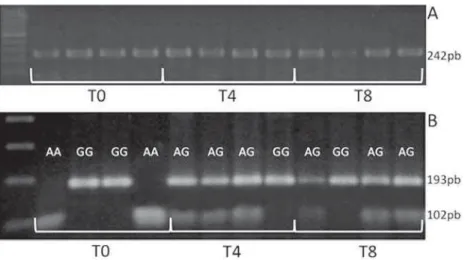
The integrity of genomic DNA for 0, 4- and 8-day incubation times was assessed by resolving DNA on a 0.8 % agarose gel by electrophoresis, followed by visualization with ethidium bromide staining.
3- DNA quality and polymorphism genotyping.
PCR Assays and RFLP
(Forward: 5’ TGTCACTAAAGGAAAGGAGG3’; Reverse: 5’ TTCACAGAGTTTAACAGCCC 3’ – Invitrogen, Grand Island, NY, USA) and 1 U Dream Taq DNA Polymerase (Fermentas, Maryland, NY, USA). The cycling conditions comprised an initial denaturation step for 10 min at 96°C, followed by 44 cycles consisting of three steps: 96°C for 30 U!^{'|@{'^" extension step was performed at 72°C for 10 min.
`#" "@[@$ with 2 U of Alu I (New England Biolabs, Beverly, MA, USA) at 37°C overnight, electrophoresed on a 2.5% agarose gel stained with ethidium bromide and photographed under UV illumination. Four fragments (15, 34, 91 and 102 bp) were produced in the presence of A allele and three fragments (15, 34 and 193 bp) were produced in the presence of G allele. In the gel, the 15 and 39 bp fragments were not visible. Therefore, the G allele was differentiated from the A allele by visualization of a single 193 bp fragment instead of the 91 and 102 bp fragments.
7DT0DQDPSOL¿FDWLRQ
DNA quality differences among the three incubation times were also evaluated by Real-Time &'* `# ## ' # "$#Q to cross the threshold. In a real time PCR assay a positive reaction is detected by accumulation Q ' < < proportional to the amount of target nucleic acid in the sample.
[ "]! ng of DNA were used to perform the genotyping of IRF6 polymorphism (C/T transition, rs 17015215)
using Taqman probes15 in an Sequence Detection System instrument (Mx3005P system; Stratagene). Assays and reagents were supplied by Applied Biosystems (Foster City, CA, USA). Determination ""'< the MxPro-Mx3005p software supplied by the manufacturer.
Statistical analysis
Comparisons of the three incubation times were made to determine differences in mean total DNA &'**=`""' different sample storage times were tested using ANOVA.
RESULTS
The total DNA yield measured at 260 nm was ^[[~ ^^^=|~ U@[@^|~ =^~ @^^|~ |=[