ABSTRACT:Introduction: A growing number of studies have shown consistent evidence of the harmful efects of air pollution on human health, as well as its efects on newborn weight. The objective of this study is to evaluate the efect of air pollution on birth weight, more speciically the insuicient birth weight (identiied between 2,500 and 2,999 grams). Methods: This was a cross‑sectional study based on data gathered from all babies born to mothers living in São José dos Campos, São Paulo, Brazil, between the years of 2006 to 2010. The association between maternal exposure to air pollution and birth weight was examined using logistic regression (both univariate and multivariate) to consider the average concentration of each pollutant during the 1st and 3rd trimesters and the months of the 1st trimester. Results: Of the 39,453 total live births during the study period, 10,542 (26.7%) newborns had insuicient weight. In multiple logistic analysis, maternal exposure to particulate matter in the 1st and 3rd trimester of pregnancy had a greater chance for insuicient weight. There is a chance of 1.07 (95%CI 1.00 – 1.14) for an insuicient weight scenario for exposure (to the 2nd quartile) of particulate matter in the 1st trimester and 1.10 (95%CI 1.04 – 1.18) for exposure (the 3rd quartile) in the 3rd trimester. Conclusion: The survey results indicate that maternal exposure to air pollution in the 1st and 3rd trimesters of pregnancy for residents of São José dos Campos create considerable potential to cause insuicient weight.
Keywords: Child health. Air pollution. Logistic models. Birth weight. Infant, newborn. Environmental science.
Air pollutants associated
with insuicient birth weight
Poluentes atmosféricos associados ao peso insuiciente ao nascimento
Veridiana de Paula SantosI, Andréa Paula Peneluppi de MedeirosI, Thaiza Agostini Cordoba de LimaI, Luiz Fernando Costa NascimentoI
IUniversidade de Taubaté – Taubaté (SP), Brazil.
Corresponding author: Andréa Paula Peneluppi de Medeiros. Rua Frei Modesto Maria de Taubaté, 135, Jardim Santa Clara, CEP: 12080‑020, Taubaté, SP, Brasil. E‑mail: [email protected]
Conlict of interests: nothing to declare – Financial support:Fundação de Amparo à Pesquisa do Estado de São Paulo (FAPESP), process No. 2012/08741‑4.
INTRODUCTION
A growing number of studies published around the world, especially within the last 20 years, have showed consistent evidence of the harmful efects of air pollution in human health1. The main pollutants are: particulate material (PM
10), ozone (O3), sulfur dioxide (SO2), carbon monoxide (CO), and nitrogen oxides.
Researches indicate that the fetus and the newborn (NB) are more susceptible than adults to environmental toxic substances2.
Although the greatest concern of the researchers in studying the birth weight is mainly regarding low birth weight (LBW), their risk factors and consequences for the life of the individual in short and long terms seek the attention to the proportion of children who are born with insuicient weight (birth weight between 2,500 and 2,999 g)3.
Studies show that children born with insuicient weight (IW) have higher risk than the ones born with appropriate weight, with greater probability of death, higher chance of respiratory infections, and delayed growth and development, in addition to greater possi‑ bility of occurrence of chronic diseases in the future4‑6.
The adverse consequence of the IW acquires great magnitude when considering that an expressive fraction of NBs has weight in that range. In Brazil, the prevalence of low birth weight in 2011 was 8.5%7. Some studies show that the number of children with IW is two to three times higher than in the ones with LBW8,9.
Pufer et al.10 carried out a study in which the importance of birth with favorable weight (> 3,000 g) for survival, growth, and health development were already stressed. This study demonstrates the characteristics of birth weight in several countries. In India, for example,
RESUMO:Introdução: Um número crescente de estudos tem mostrado evidências consistentes dos efeitos nocivos da poluição do ar na saúde humana e afetando também o peso do recém‑nascido. O objetivo deste estudo é avaliar o efeito da poluição do ar sobre o peso ao nascer, mais especiicamente o peso insuiciente ao nascer (entre 2.500 e 2.999 g). Métodos: Trata‑se de um estudo transversal com dados relativos a todos os nascidos de mães residentes no Município de São José dos Campos, São Paulo, nos anos de 2006 a 2010. Para examinar a associação entre exposição materna à poluição do ar e o peso ao nascer foi utilizada a regressão logística (univariada e múltipla), considerando‑se a média da concentração de cada poluente do 1º e 3º trimestres e dos meses do 1º trimestre. Resultados: Do total de 39.453 nascidos vivos do período estudado, 10.542 (26,7%) recém‑nascidos apresentaram peso insuiciente. Na análise logística múltipla, a exposição materna ao material particulado no 1º e 3º trimestre de gestação apresentou maior chance para o nascimento de uma criança com peso insuiciente. Há uma chance de 1,07 (IC95% 1,00 – 1,14) de ocorrência de peso insuiciente para exposição (ao 2o quartil) ao material particulado no 1º trimestre e de 1,10 (IC95% 1,04 – 1,18) para exposição (ao 3o quartil) no 3º trimestre. Conclusão: Os resultados da pesquisa indicam que a exposição materna no 1º e 3º trimestres de gestação à poluição do ar no município de São José dos Campos pode determinar o peso insuiciente de recém‑nascidos.
from 1969 to 1972, 45.8% had IW at birth. In 1977, 24.9% of the children in Chile and 24.2% in Uruguay were born in that weight range.
In Brazil, there are regional diferences in the distribution of LBW and IW. However, most studies are restricted to hospitals or partial populational data and are not representa‑ tive of the population11.
Although several studies regarding the efects of air pollution on pregnancy outcomes have been developed worldwide, the knowledge of these efects about the population is still quite restricted. The IW range, more frequent than the LBW, deserves greater attention, not only due to its mortality but also due to its risk of morbidity3‑6.
The objective of this study was to evaluate the efects of air pollution on birthweight, more speciically insuicient weight at birth when being Born at São José dos Campos, São Paulo, within the years from 2006 to 2010.
METHODS
It is a cross‑sectional data obtained in the Live Birth Information System (Sistema de Informações sobre Nascidos Vivos – SINASC) through the Declaration of Live Birth (DB). In this document, there are information as for as the characteristics related to NB, to preg‑ nancy, to the birth, and to the mother.
The selection criteria of the sample for the study were: NB of mothers living in the municipality of São José dos Campos, born in the years from 2006 to 2010, at term of a single gestation, and with birth weight between 2,500 and 4,500 g. The dependent variable was insuf‑ icient weight (weighing between 2,500 and 2,999 g) or satisfactory weight (weighing between 3,000 and 3,999 g). There were selected variables which were shown in the literature as possi‑ ble factors for IW, it for this study, then, as independent variables; namely: gender of the NB, maternal marital status, maternal school education, number of prenatal consultations, birth route, age, and maternal parity. Among these variables, maternal marital status, maternal school education, number of prenatal consultations, and gender of the NB remained in the inal model of the multiple logistic analysis as possible modiiers of the efects of air pollution.
São José dos Campos is situated approximately 90 km from São Paulo and has a popula‑ tion of approximately 700,000 inhabitants. Its participation in the gross domestic product of the state is 1.93%, standing out in the economy by the industry and services12.
The pollutants studies were the PM10, SO2, and O3, which are quantiied by the measur‑ ing station of the Environmental Sanitation Technology company (Companhia de Tecnologia de Saneamento Ambiental – CETESB) of São José dos Campos, São Paulo. The concentration of pollutants (irst and third quarters, in addition to the months of the irst quarter) was recorded in quartiles, representing the values of concentration of the pollutants in ascend‑ ing order (irst, second, third, and fourth quartile).
in 30th November, was considered as having 39 weeks that day, and from this date on we cal‑ culated the mean pollutant concentration of the 9 months before birth, that is, the period between March and November. Thus, we obtained the mean pollutant concentration in the irst (March–May) and third (September–November) trimesters of pregnancy for that child. In the case of the irst trimester, the mean pollutant concentration was determined for each month (i.e. March, April, and May).
To analyze the IW at birth, the logistic regression was used (both univariate and multivariate one). The univariate logistic analysis examined, first, the relation of IW at birth with the maternal exposure to several pollutants with the objective of estimat‑ ing the gross effect, that is, with no adjustments, of this exposure in the weight of the child. Besides, this model was used to verify the relation of the outcome with each independent variable previously mentioned. In this case, the statistical analysis was based on the calculation of the odds ratio (OR) to estimate the chance of the NB with IW at birth associated to each variable. In all the analyses confidence intervals of 95% (95%CI) and significance level of 5% (a = 5%) were used.
From the results of this univariate model the variables for the models of multiple analy‑ sis were selected. The independent variables entered one by one, using the highest OR value observed in the univariate logistic analysis as an entrance criteria, showing a statistically signii‑ cant association (p < 0.001). And also to verify the importance of which variable for the model and its permanence, the likelihood‑ratio test was used, remaining at the end of the analysis only the variables with p < 0.05. After obtaining the complete models, the pollutants were included, individually and in group, and their association with weight at birth and IW at birth were tested.
The statistical analysis was performed in the Excel and STATA v.7 softwares.
This research was submitted to and approved by the Research Ethics Committee of the Universidade de Taubaté (approval number: 687.272).
RESULTS
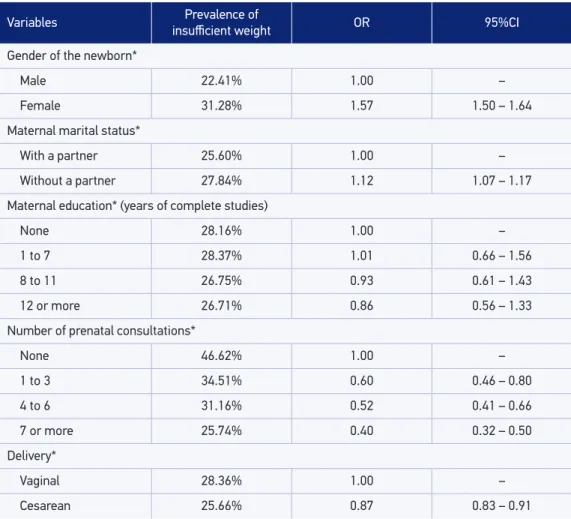
Initially, 45,671 live births were selected in the period between 2006 and 2010 in the city of São José dos Campos, São Paulo. After applying the selection criteria, 39,453 NBs were kept in the study. From the total live births analyzed, 10,542 (26.7%) NBs presented IW. Besides, approximately half of them were males and children of mothers with a partner, considering that more than 50% were born by cesarean (Table 1). The mean weight of NBs and the mean maternal age in this study are 3,253 g, standard deviation (SD) of 375.3 and 27 years of age (SD = 6.3).
For air pollutants, mean values of SO2, PM10, and O3 in µg/m3 (3.24 ± 2.39, 24.68 ± 12.84, and 72.78 ± 36.77, respectively) were observed. The means of the pollutants are within the acceptable standards of air quality, established in the last update of the recommendations of the World Health Organization (WHO), of 200513.
of a child being born with IW was higher among female NB and among mother without a partner. As for maternal education with 8 years or more of complete studies, from 1 to 7 prenatal consultations and cesarean delivery feature as a protection factor. The mater‑ nal education has been inversely associated to IW, meaning, the higher the education, the lower the chances of IW at birth. The same proile was observed in relation to the number of prenatal consultations (Table 2).
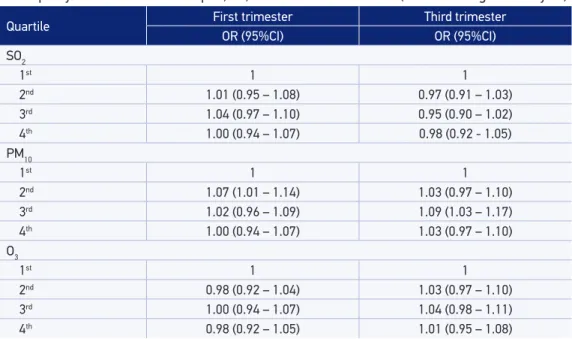
In the univariate logistic analysis, the maternal exposure to PM10 and SO2 in the irst tri‑ mester of pregnancy represented a higher chance of a child being born with IW. For example, there is a chance of 1.07 (95%CI 1.01 – 1.14) of occurrence of IW at birth for exposure at the second quartile of concentration of PM10 and 1.04 (95%CI 0.97 – 1.10) for exposure to the third
Variables n
(n = 39,453) % Weight
Favorable 28,911 73.3
Insuicient 10,542 26.7
Gender of the newborn
Male 20,273 51.4
Female 19,178 48.6
Maternal marital status
With a partner 19,611 50.2
Without a partner 19,439 49.8
Maternal education (years of complete studies)
None 103 0.3
1 to 7 6,605 16.9
8 to 11 24,152 61.6
12 or more 8,325 21.2
Number of prenatal consultations
None 296 0.8
1 to 3 762 1.9
4 to 6 4,573 11.7
7 or more 33,420 85.6
Delivery
Vaginal 15,480 39.3
Cesarean 23,950 60.7
Table 1. Distribution of live births of mother living in São José dos Campos, SP, in the period between 2006 and 2010, according to weight and gender of the newborn, marital status and maternal education, number of prenatal consultations, and kind of delivery.
Variables insuicient weightPrevalence of OR 95%CI
Gender of the newborn*
Male 22.41% 1.00 –
Female 31.28% 1.57 1.50 – 1.64
Maternal marital status*
With a partner 25.60% 1.00 – Without a partner 27.84% 1.12 1.07 – 1.17
Maternal education* (years of complete studies)
None 28.16% 1.00 –
1 to 7 28.37% 1.01 0.66 – 1.56 8 to 11 26.75% 0.93 0.61 – 1.43 12 or more 26.71% 0.86 0.56 – 1.33
Number of prenatal consultations*
None 46.62% 1.00 –
1 to 3 34.51% 0.60 0.46 – 0.80 4 to 6 31.16% 0.52 0.41 – 0.66 7 or more 25.74% 0.40 0.32 – 0.50
Delivery*
Vaginal 28.36% 1.00 –
Cesarean 25.66% 0.87 0.83 – 0.91
Table 2. Odds ratio with the respective conidence interval of 95% of insuicient weight of live births in the municipality of São José dos Campos, SP, of mothers living in this city in the period between 2006 and 2010, according to the gender of the newborn, maternal marital status and education, number of prenatal consultations, and kind of delivery.
OR: odds ratio; 95% CI: conidence interval of 95%; *p < 0.001.
Table 3. Odds ratio and confidence intervals of 95% for insufficient weight according to the quartiles of concentration of the air pollutants for the irst and third pregnancy trimesters, in the municipality of São José dos Campos, SP, between 2006 and 2010 (univariate logistic analysis).
OR: odds ratio; 95%CI: conidence interval of 95%; SO
3: sulfur dioxide; PM10: particulate material; O3: ozone.
Quartile First trimester Third trimester OR (95%CI) OR (95%CI) SO2
1st 1 1
2nd 1.01 (0.95 – 1.08) 0.97 (0.91 – 1.03)
3rd 1.04 (0.97 – 1.10) 0.95 (0.90 – 1.02)
4th 1.00 (0.94 – 1.07) 0.98 (0.92 ‑ 1.05)
PM10
1st 1 1
2nd 1.07 (1.01 – 1.14) 1.03 (0.97 – 1.10)
3rd 1.02 (0.96 – 1.09) 1.09 (1.03 – 1.17)
4th 1.00 (0.94 – 1.07) 1.03 (0.97 – 1.10)
O3
1st 1 1
2nd 0.98 (0.92 – 1.04) 1.03 (0.97 – 1.10)
3rd 1.00 (0.94 – 1.07) 1.04 (0.98 – 1.11)
4th 0.98 (0.92 – 1.05) 1.01 (0.95 – 1.08)
Quartile First trimester Third trimester OR (95%CI) OR (95%CI) SO2
1st 1 1
2nd 1.01 (0.94 – 1.07) 0.97 (0.91 – 1.03)
3rd 1.03 (0.96 – 1.10) 0.96 (0.89 – 1.02)
4th 1.00 (0.94 – 1.07) 0.99 (0.93 – 1.06)
PM10
1st 1 1
2nd 1.07 (1.00 – 1.14) 1.02 (0.96 – 1.09)
3rd 1.01 (0.94 – 1.07) 1.10 (1.04 – 1.18)
4th 0.99 (0.93 – 1.05) 1.04 (0.97 – 1.11)
O3
1st 1 1
2nd 0.98 (0.91 – 1.04) 1.04 (0.97 – 1.11)
3rd 0.99 (0.93 – 1.06) 1.05 (0.99 – 1.12)
4th 0.99 (0.93 – 1.05) 1.01 (0.95 – 1.08)
Table 4. Odds ratio and conidence interval s of 95% for insuicient weight according to the quartiles of concentration of the air pollutants for the irst and third trimesters of pregnancy, in the municipality of São José dos Campos, SP, between 2006 and 2010 (multiple logistic regression).
OR: odds ratio; 95% CI: conidence interval of 95%; SO
3: sulfur dioxide PM10: particulate material; O3: ozone.
Quartile First month Second month Third month OR (95%CI) OR (95%CI) OR (95%CI) SO2
1st 1 1 1
2nd 1.02 (0.96 – 1.09) 1.05 (0.99 – 1.12) 0.95 (0.89 – 1.01)
3rd 1.04 (0.97 – 1.11) 1.07 (1.00 – 1.14) 0.99 (0.93 – 1.05)
4th 1.00 (0.94 – 1.07) 1.03 (0.96 – 1.09) 0.96 (0.90 – 1.02)
PM10
1st 1 1 1
2nd 1.03 (0.96 – 1.10) 1.07 (1.00 – 1.14) 0.96 (0.90 – 1.03)
3rd 1.05 (0.99 – 1.12) 1.02 (0.96 – 1.09) 0.98 (0.92 – 1.05)
4th 1.03 (0.96 – 1.10) 1.03 (0.96 – 1.10) 1.01 (0.95 – 1.08)
O3
1st 1 1 1
2nd 0.95 (0.89 – 1.01) 1.01 (0.95 – 1.08) 1.00 (0.93 – 1.06)
3rd 0.97 (0.91 – 1.04) 1.06 (0.99 – 1.13) 0.94 (0.88 – 1.01)
4th 0.93 (0.88 – 1.00) 1.00 (0.94 – 1.07) 0.97 (0.91 – 1.04)
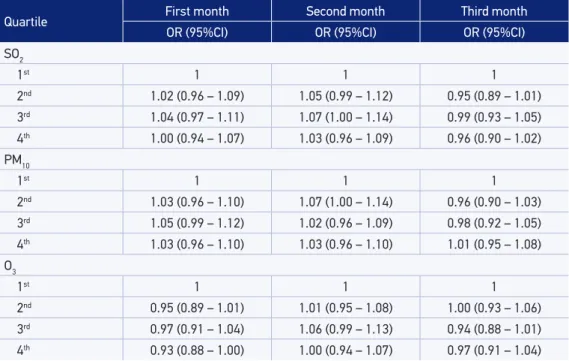
Table 5. Odds ratio and conidence interval s of 95% for insuicient weight according to the quartiles of concentration of the air pollutants for the irst and third trimesters of pregnancy, in the municipality of São José dos Campos, SP, between 2006 and 2010 (multiple logistic regression).
OR: odds ratio; 95%CI: conidence interval of 95%; SO
3: sulfur dioxide PM10: particulate material; O3: ozone.
Note: Adjusted model for the variables: maternal marital status, maternal education, number of prenatal consultations and gender of the newborn.
DISCUSSION
According to the recommendation by WHO, the proportion of children born with appro‑ priate weight, that is, heavier or equal to 3,000 g, should be at least 85%10,14. However, this did not occur in São José dos Campos in the period between 2006 and 2010, where a signif‑ icant proportion of children were born with IW (26.7%).
Air pollution as a determinant of harm to fetal development has already been evaluated in many studies15‑17. Some authors describe the relation between oxidative stress, systemic inlammation, and autoimmunity18.
Fetuses, in particular, are considered highly susceptible to a variety of toxics due to their pattern of exposure and physiological immaturity19. Their organ systems, still in development, may be more vulnerable to environmental toxic substances during critical gaps (sensitive period of development) due to their high rates of cell proliferation or due to changes in their metabolic capacity20.
Despite the diiculty in isolating the efects of each pollutant, due to their high cor‑ relation among each other, it may be observed that the SO2 and PM10 showed association with the weight of the NB, indicating a higher chance of presenting IW when the mother is exposed to those during the irst and third trimesters of pregnancy, however, there was no statistical signiicance.
Many studies found associations between pollution and birth weight24‑28. Medeiros et al.22 observed in their study that the maternal exposure in the irst pregnancy trimester to air pollution may contribute to lower gain of weight of the child at birth. Junger23 carried out a study in the city if Rio de Janeiro and found a positive association between PM10, SO2, and IW and the lower gain of weight at birth in the irst and third pregnancy trimester and a par‑ adoxical efect of the O3 for the same periods. Romão et al.29 also identiied a risk of LBW with the maternal exposure to PM10 (fourth quartile) in the third pregnancy trimester. Ha et al.26 examined the births at term in the period from 1996 to 1997, in Seoul, South Korea, to determine the association between LBW and exposure to CO, SO2, NO2, total suspended particles (TSP), and O3 in the irst and third trimesters. They found an association between CO, SO2, NO2, and TSP during the irst pregnancy trimester with LBW.
Efects of exposure to O3 about the health of population have been identiied from epi‑ demiological studies of time series. These studies have demonstrated the association of this pollutant and the occurrence of deaths13. However, in our study it was not possible to demonstrate evidence on the efects of pregnancy.
In this study some variables regarding the NB, the maternal characteristics, and the kind of birth labor were also identiied as risk factors for the occurrence of IW to birth. Azenha et al.25 found similar results, that is, factors such as female gender, mother without a part‑ ner, low maternal education, low number of prenatal consultations, and vaginal labor are presented as high risks for the lower gain of weight at birth.
The inluence of the gender of the NB on birthweight has already been demonstrated in many studies and may be explained, in parts, by the growth of male fetuses being greater from the 32nd to the 34th week of pregnancy on30. Despite this conclusion and the indings of many studies, the gender of the NB is a variable which has no possibility of intervention.
As for the prenatal, Antonio et al.31 found similar results to this study, meaning, mother who went to less than seven prenatal consultations have 1.42 more chances of having chil‑ dren with IW. These results reinforce the importance of having prenatal consultations, once that they allow greater opportunities for orientation and quality procedures, providing bet‑ ter chance of a NB being born with appropriate weight.
The proportion of NB with IW was greater among mother who had vaginal delivery. Many studies indicate that there is a higher occurrence of cesarean among groups of low obstetric risk and among women of higher social status, suggesting that the indications for this medical procedure are not exclusively technical32,33.
may diicult the collection of more expressive data, such as the ones found individually. However, as may be seen in the several literature presented, none of them used a direct and individual measure, whether by the high methodological cost or by operational diiculty. In addition to that, many of the results from the studies, which use indirect measures of exposure, have presented very consistent results, which support their use in future studies.
The relevance of this study is that it was still possible to ind the efects of air pollution on the birthweight after adjustment of the variables such as maternal marital status, mater‑ nal education, number of prenatal consultations, and gender of the NB; and determinants of IW at birth are discussed in the literature.
Despite the less severe outcomes, this group represent one‑fourth of births and the identiication and investments of diferentiated attention for these children could minimize further disadvantages. This work related risk factors connected to the IW outcome. Thus, measures to control factors such as air pollutions, quality of education of the population, and access to prenatal would have, most likely, a positive impact in the health and quality of life of the population of children in the city of São José dos Campos.
It is important to highlight that even in lower levels of pollution, it was still possible to observe an association between the exposure of the pregnant woman to air pollution with IW at birth. These results indicate the need for new policies focused on greater reduction of the levels of pollution in the city of São José dos Campos.
CONCLUSION
The results of the research indicate that the maternal exposure in the irst and third trimesters of pregnancy to the air pollution of the municipality of São José dos Campos, São Paulo, may determine the insuicient weight of NBs in the period between 2006 and 2010.
1. Brunekreef B, Holgate ST. Air pollution and health. Lancet 2002; 360(9341): 1233‑42.
2. Perera FP, Rauh V, Whyatt RM, Tsai W, Bernert JT, Tu Y, et al. Molecular evidence of an interaction between prenatal environmental exposures and birth outcomes in a multiethnic population. Environ Health Perspect 2004; 112(5): 626‑30. 3. Rocha JA. Baixo peso, peso insuiciente e peso adequado
ao nascer em 5940 nascidos vivos na cidade de Recife: associação com algumas variáveis maternas. J Pediatr (Rio J) 1991; 67: 297‑304.
4. Motta MEFA, Silva GAP, Araújo OC, Lira PI, Lima MC. O peso ao nascer inluencia o estado nutricional
ao inal do primeiro ano de vida? J Pediatr (Rio J) 2005; 81(5): 377‑82.
5. Yamamoto RM, Schoeps DO, Abreu LC, Leone C. Peso insuiciente ao nascer e crescimento alcançado na idade pré‑escolar, por crianças atendidas em creches ilantrópicas do município de Santo André, São Paulo, Brasil. Rev Bras Saúde Mater Infant 2009; 9(4): 477‑85.
6. Helena ETS, Sousa CA, Silva CA. Fatores de risco para mortalidade neonatal em Blumenau, Santa Catarina:
linkage entre bancos de dados. Rev Bras Saúde Matern
7. Brasil. Ministério da Saúde. DATASUS. Brasília: MS; 2002. Disponível em: http://tabnet.datasus.gov.br (Acessado em 31 de maio de 2015).
8. Almeida MF, Novaes HMD, Alencar GP, Rodrigues LC. Mortalidade neonatal no município de São Paulo: influência de peso ao nascer e de fatores sócio‑demográicos e assistências. Rev Bras Epidemiol 2002; 5(1): 93‑107.
9. Viana KJ, Taddei JAAC, Cocetti M, Warkentin S. Peso ao nascer de crianças brasileiras menores de dois anos. Cad Saúde Pública 2013; 29(2): 349‑56. 10. Pufer RR, Serrano CV. Caracteristicas del peso al nascer.
Washington: PAHO; 1988. Publicación Cientíica nº 504. 11. Pedraza DF, Souza, MM, Cristóvão FS, França ISX. Baixo peso ao nascer no Brasil: revisão sistemática de estudos baseados no sistema de informações sobre nascidos vivos. Pediatr Mod 2014; 50(2): 51‑64. 12. Prefeitura Municipal de São José dos Campos. Dados
da Cidade. Disponível em: http://www.sjc.sp.gov.br/ sao_jose/dados_da_cidade.aspx (Acessado em 11 de janeiro de 2016).
13. World Health Organization. WHO Air quality guidelines for particulate matter, ozone, nitrogen dioxide and sulfur dioxide: global update 2005. Geneva: WHO; 2006.
14. Monteiro CA, Benício MHD, Ortiz, LP. Tendência secular do peso ao nascer na cidade de São Paulo (1976 ‑ 1998). Rev Saúde Pública 2000; 34(Suppl 6): 26‑40.
15. Bonzini M, Carugno M, Grillo P, Mensi C, Bertazzi PA, Pesatori AC. Impact of ambient air pollution on birth outcomes: systematic review of the current evidences. Med Lav 2010; 101(5): 341‑63.
16. Ritz B, Wilhelm M, Hoggatt KJ, Ghosh JK. Ambient air pollution and preterm birth in the environment and pregnancy outcomes study at the University of California, Los Angeles. Am J Epidemiol 2007; 166(9): 1045‑52. 17. Srám RJ, Binková B, Dejmek J, Bobak M. Ambient
air pollution and pregnancy outcomes: a review of the literature. Environ Health Perspect 2005; 113(4): 375‑82.
18. Farhat SC, Silva CA, Orione MAM, Campos LM, Sallum AM, Braga AL. Air pollution in autoimmune rheumatic diseases: a review. Autoimmun Rev 2011; 11(1): 14‑21. 19. Perera FP, Jedrychowski W, Rauh V, Whyatt RM.
Molecular epidemiologic research on the efect of environmental pollutants on the fetus. Environ Health Perspect 1999; 107(Suppl 3): 451‑60.
20. Calabrese EJ. Age and susceptibility to toxic substances. New York: John Wiley & Sons; 1986.
21. Reis MM. Poluição atmosférica e efeitos adversos na gravidez em um município industrializado no estado
do Rio de Janeiro [tese de doutorado]. São Paulo: Universidade de São Paulo; 2009.
22. Medeiros A, Gouveia N. Relação entre baixo peso ao nascer e a poluição do ar no Município de São Paulo. Rev Saúde Pública 2005; 39(6): 965‑72.
23. Junger WL, Leon AP. Poluição do ar e baixo peso ao nascer no Município do Rio de Janeiro, Brasil, 2002. Cad Saúde Pública 2007; 23(Suppl 4): S588‑98. 24. Ritz B, Yu F. The efect of ambient carbon monoxide
on low birth weight among children born in Southern California between 1989 and 1993. Environ Health Perspect 1999; 107(1): 17‑25.
25. Azenha VM, Mattar MA, Cardoso VC, Barbieri MA, Ciampo LAD, Bettiol H. Peso insuiciente ao nascer: estudo de fatores associados em duas coortes de recém‑nascidos em Ribeirão Preto, São Paulo. Rev Paul Pediatr 2008; 26(1): 27‑35.
26. Ha EH, Hong YC, Lee BE, Woo BH, Schwartz J, Christiani DC. Is air pollution a risk factor for low birth weight in Seoul? Epidemiology 2001; 12(6): 643‑8. 27. Chen L, Yang W, Jennison BL, Goodrich A, Omaye ST. Air pollution and birth weight in northern Nevada, 1991‑1999. Inhal Toxicol 2002; 14(2): 141‑57. 28. Orione MA, Silva CA, Sallum AM, Campos LM,
Omori CH, Braga ALF, et al. Risk factors for juvenile dermatomyositis: exposure to tobacco and air pollutants during pregnancy. Arthritis Care Res (Hoboken) 2014; 66(10): 1571‑5.
29. Romão R, Pereira LA, Saldiva PH, Pinheiro PM, Braga AL, Martins LC. The relationship between low birth weight and exposure to inhalable particulate matter. Cad Saúde Pública 2013; 29(6): 1101‑8.
30. Ramos JLA, Vaz FAC, Calil VMLT. O recém‑nascido pequeno para a idade gestacional. In: Marcondes E, Costa FA, Ramos JLA, Okay Y. Pediatria básica: pediatria clínica. 9a ed. São Paulo: Sarvier; 2002. p. 353‑61.
31. Antonio MARGM, Zanolli ML, Carniel EF, Morcillo AM. Fatores associados ao peso insuiciente ao nascimento. Rev Assoc Med Bras 2009; 55(2): 153‑7.
32. Freitas PF, Drachler ML, Leite JCC, Grassi PR. Desigualdade social nas taxas de cesariana em primíparas no Rio Grande do Sul. Rev Saúde Pública 2005; 39(5): 761‑7.
33. Carniel EF, Zanolli ML, Morcillo AM. Fatores de risco para indicação do parto cesáreo em Campinas (SP). Rev Bras Ginecol Obstet 2007; 29(1): 34‑40.
Received on: 03/05/2015