Pak. J. Anal. Environ. Chem. Vol. 13, No. 1 (2012) 16-21
Physico-chemical Characteristics of Oil and Seed Residues
of Bauhinia variegata and Bauhinia linnaei
Sarfraz Arain
1, Najma Memon
1, Muhammad T. Rajput
2, Syed T. H. Sherazi
1*,
Muhammad I. Bhanger
1and Sarfaraz A. Mahesar
11
National Center of Excellence in Analytical Chemistry, University of Sindh, Jamshoro-76080, Pakistan 2
Institute of Plant Sciences, University of Sindh, Jamshoro-76080, Pakistan
Received 12 December 2011, Revised 17 May 2012, Accepted 11 June 2012
--- Abstract
Physico-chemical characteristics of two Bauhinia seed varieties (B. variegata and B. linnaei), were evaluated for commercial exploration. Physico-chemical characteristics of the oils for both varieties were demonstrated and mean values found to be refractive index (40 °C) 1.4589 and
1.4588, peroxide value 1.9 and 2.4 (meq O2 / kg of oil), iodine value 84.5 and 92.2 (g of I2/100g of oil), saponification number 191.3 and 195.5 (mg of KOH /g of oil), free fatty acids 0.6% and 0.9%, unsaponifiable matter 0.9% and 1.2% and color (1 in. cell), 2.2-2.9R + 30.0-25.0Y, respectively. Linoleic 42.1 and 45.8 %, oleic 13.4 and 12.6%, stearic 17.5 and 18.8% and palmitic 22.1 and 16.8% were the main fatty acids in the crude seed oils. Minor amounts of palmitoleic, margaric, linolenic, arachidic, behenic, eicosapentaenoic and nervonic acid were also identified. The composition of defatted seed residue of B. variegata and B. linnaei were found as: protein 41.9% and 38.6%, oil 18.0%, and 17.4% ash 4.8% and 4.2%, moisture 6.7% and 6.3%, fiber 6.9% and 7.3% and total carbohydrate 28.4% and 33.8%, respectively. Proximate and fatty acid composition of both Bauhinia varieties were found to be almost similar. It was concluded that
Bauhinia seed is a rich source of linoleic acid and could be explored for commercial uses.
Keywords: Bauhinia seeds; Physiochemical characteristics; Oil; Seed residues.
---
Introduction
Bauhinia is small evergreen medicinal tree belonging to the family Leguminosae (Caesalpinioideae), consisting of 300 species which are cultivated all over the world in the tropical regions. In Pakistan the trees are cultivated in plain and sub-mountainous tracks [1]. Bauhinia
has been widely planted in garden, park and roadsides as ornamental plant in many warm temperate and subtropical regions [2]. Leaves makes good fodder and eaten by sheep, goats and cattle. The main uses of Bauhinia plant is as fuel calorific value is 4 800 kcal/kg [3]. The mature seeds and young pods of Bauhinia are eaten, cooked and pickled in the native countries [4]. The
Bauhinia leaves extract are being used for medicinal purposes including anti-inflammatory,
antifungal, antipyretic, analgesic, antispasmodic, antitumor and antimicrobial activities [5,6]. The stems, roots and leaves are also used for the treatment of several diseases especially in pain, diabetes, infections, ulcer, jaundice, leprosy and also utilized as folk medicines [7-9]. Phytochemical study of bark extract revealed the presence of flavanoids which have anti-carcinogenic activity [10-12]. The plant extract of
Bauhinia variegata due to presence of â- sitosterol exhibited a significant hypolipidemic effect, reduced the obesity as well as decreased the levels of cholesterol, triglyceride, VLDL cholesterol (lipid profile) [13]. Lectins (glycol proteins) from
known to be good source of protein, vitamin A and minerals [15-17]. The objective of present study was to obtain knowledge about the physiochemical properties of oil and meal of B. variegata and B. linnaei seeds varieties grown in Pakistan for commercial exploration.
Experimental
Seed samples and reagents
The seeds of B. variegata and B. linnaei, harvested from three different locations (1kg of each variety) from plants grown in the campus of University of Sindh, Jamshoro, Pakistan. The samples were further identified by Professor Dr. Muhammad Tahir Rajput, Dean Faculty of Natural Sciences, University of Sindh Jamshoro. All chemicals and reagents used were of HPLC grade (highest purity) and purchased from Darmstadt, Germany (Merck). The standard of fatty acids methyl esters were obtained from Sigma Chemical Co (St. Louis, MO, USA).
Oil extraction
According to standard method ISO 659 [18], finely ground Bauhinia seeds (about 5g) (particle size =2 mm), were used to obtain oil by Soxhlet extraction using n-hexane for 6 h. The rotary evaporator was used to remove solvent at 40 °C. The oil was dried by nitrogen streaming and stored at – 20oC for further analysis.
Analysis of oil seed residue
Determination of moisture content
Moisture content of seed meal was determined by the AOCS method [19]. Five grams of test portion was taken in dish container and dried it in an oven at 130°C for 2h. Heated portion was allowed to cool in a desiccator to room temperature and loss of weight determined.
Determination of protein content
Kjeldahl digestion method (acid digestion and distillation) was used to determine total protein from seed residues as the nitrogen content of the sample multiplied by nitrogen factor. For the protein calculation nitrogen conversion factor
(6.25) was used according to the official standard method AOCS [19].
Determination of crude fiber
According to the AOAC official standard method (1993) [19], fiber content was determined using 2.5g defatted seed meal. The meal residue for digestion was boiled with sulfuric acid solution (0.26 mol/L), followed by washing and separation of insoluble residue, after digestion the residue + sodium hydroxide (0.31mol/L), was boiled followed by washing and separation, with distilled water, and drying. The residue was dried, ashed at 600 °C in a muffle furnace and loss in mass was calculated.
Determination of ash content
Powdered seed samples about 0.5 g was ignited and incinerates at 550 oC for about 12 h in muffle furnace, and then ash content determined according to AOCS standard method [19].
Determination of carbohydrate content
By the difference of mean values the content of carbohydrate was estimated, i.e. Carbohydrate content = 100 - [%Lipids + %Proteins + %Ash + %Moisture].
Analysis of Extracted Oil
Physical and chemical parameters of oil Refractive index
AOAC standard [20] method no. 969.18 was used to measure the refractive index of oil at 40 °C.
Determination of peroxide value
Determination of saponification value
It is the number of KOH required to saponify 1 gram of oil. Saponification value through hydrolysis of ester under alkaline condition was determined according to AOCS method Cd 3-25 [20].
Determination of iodine value
The iodine value of oil was determined according to AOAC [20], Wijs method Cd 3d-63. In which the dissolved oil sample (CCl4 used as solvent) was mixed with 25ml of Wij’s (0.1mol/L) solution and reacted with freshly prepared (10%) potassium iodide solution. The standard potassium thiosulphate (0.1 M) was used for titration with liberated iodine from solution. Starch was used as an indicator in this procedure.
Determination of acid value
Acid value used to measure the free acids (total amount) found in a given quantity of fat. Number of milligrams of KOH (potassium hydroxide) utilized to neutralizing the free acids found in one gram of the oil sample were determined by AOCS method Cd 3d-63 [20].
Determination color of oil
Lovibond Tintometer (Tintometer Ltd., Salisbury, U.K.), with a 1″ in. cell was used to measure the intensity of the color of oil.
Determination of fatty acid composition
Standard IUPAC method no. 2.301 [21], was used for the preparation of fatty acid methyl esters and analyze by gas chromatograph (model 8700) Perkin Elmer, fitted with a capillary column SP-2340 polar (60 m x 0.25 mm), and FID (flame ionization detector). As a carrier gas nitrogen (oxygen free) was used at a flow rate of 3.5 mL/min. Injector temperature: 260°C; detector temperature: 270°C, initial oven temperature: 130°C; and final temperature: 220°C with ramp rate: 4°C/min. A sample volume of 2.0 ì L was injected. Fatty acid methyl esters quantification and identification was carried out by comparing the retention time of peak area with those of pure
standards purchased from Sigma Chemical Co (St. Louis, MO, USA), under the same conditions. In lipid fraction the results were expressed as a percentage of individual fatty acids.
Data analysis
The mean values (means ±SD) were calculated from replicates of each experiment. Significant differences among means were determined by the analysis of variance (ANOVA) and comparison between means (P<0.05) was carried out by statistical package Statistica 7.1 (StatSoft, Inc., Tulsa, OK, USA) software.
Results and Discussion
Proximate composition of bauhinia seed meal
(Table 1) shows the proximate compositions of B. variegata and B. linnaei seed meal. The results revealed that high amount of protein content of the seeds ranging from 41.9-38.6%, where as fiber, moisture, ash and carbohydrates content were found to be 6.9-7.3%, 6.7-6.3%, 4.8-4.2% and 28.4-33.8%, respectively. The protein content of B. variegata 41.9% was higher as compared to B. linnaei (38.6%) and closely comparable to the previous reported data [15]. This analysis showed, that the meal of
Bauhinia seeds varieties with other essential nutrients (fiber, ash and carbohydrets) could be an excellent source of protein, which can be added to the chicken diets as a source of energy (calories) and it is a good substitute of (sunflower and soybean) meal for the local poultry feed industry. The oil content (Table 1) of B. linnaei and B. variegata seeds was in the range of 17.4-18.0 %.
Table 1. Proximate composition of B. variegata and B. linnaei
seeds.
Constituents B. variegata B.linnaei
Oil content (%) 18.0 ± 0.9 17.4± 0.6
Moisture (%) 6.7± 0.46 6.3 ± 0.4
Protein (%) 41.9 ± 1.6 38.6 ± 1.7
Ash (%) 4.8± 0.1 4.2 ± 0.3
Fiber (%) 6.9 ± 0.8 7.3 ± 0.6
Carbohydrates (%) 28.4 ± 1.6 33.8 ± 1.0
Values are means ± SD for triplicate determination.
Physical and chemical analysis of bauhinia seed oil
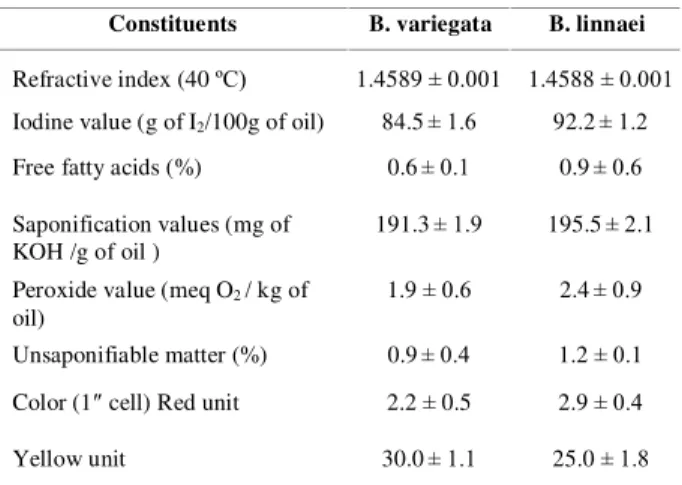
(Table 2) shows the results of physicochemical characteristics of extracted oils (B. variegata and B. linnaei). The refractive indices (40 ˚C) of the oils from B. variegata and B. linnaei, found in the present study 1.4589-1.4588 were comparable with those of olive oil [24]. Peroxide value and free fatty acids (FFA) are the measure of oil quality. The levels of FFA 0.6-0.9%, and peroxide value 1.9-2.4 (meq O2/kg of oil) were found to be comparable with those commonly suggested level for commercial vegetable oils [25]. The results regarding to the lower concentration of peroxide value and free fatty acids content indicate that B. variegata and B. linnaei seed oils could be used for edible purposes. The iodine values of these two species were in the range of 84.5-92.2 (g of I2/100g of oil), lower iodine value confers, to B. variegata oil, more stability and comparable with the iodine value of olive oil [26]. Iodine value correlated with the degree of unsaturation present in the oil of both varieties. The saponification value, found in the range of 191.3-195.5 (mg of KOH/g of oil), were in close agreement with those of olive oil and canola oil [26], indicating the presence of very high proportion of low molecular weight triacylglycerols in B. variegata and B. linnaei oils. The unsaponifiable matters of both varieties, ranged 0.9-1.2%, were in close agreement with those of corn, olive, sunflower and soybean [25]. Color of extracted crude oil from both varieties exhibited red unit 2.2-2.9 and yellow unit 30.0-25.0, respectively. The red and yellow units of investigated oil were found to be comparable with
those of good quality commercial vegetable oils [25].
Table 2. Physiochemical characteristics of B. variegata and B.
linnaei seedoils.
Constituents B. variegata B. linnaei
Refractive index (40 ºC) 1.4589 ± 0.001 1.4588 ± 0.001
Iodine value (g of I2/100g of oil) 84.5± 1.6 92.2± 1.2
Free fatty acids (%) 0.6± 0.1 0.9± 0.6
Saponification values (mg of KOH /g of oil )
191.3± 1.9 195.5± 2.1
Peroxide value (meq O2 / kg of oil)
1.9 ± 0.6 2.4± 0.9
Unsaponifiable matter (%) 0.9± 0.4 1.2 ± 0.1
Color (1″cell) Red unit 2.2 ± 0.5 2.9 ± 0.4
Yellow unit 30.0± 1.1 25.0 ± 1.8
Values are means ± SD for triplicate determination
Fatty acid composition of bauhinia seed oil
Fatty acids composition of Bauhinia
concentration (<1) in both the varieties. The results of fatty acid composition of B. variegata were found to be quite comparable with the results of previous study [15]. The major fatty acids were linoleic, oleic, stearic and palmitic acids in seeds oil of Bauhinia in which B. linnaei contributing to 45.8%, 12.6%, 18.8% and 17.3% of the total fatty acids and showed relatively high percentage 47.4% of polyunsaturated fatty acids as compared to the
B. variegata about 43.2% respectively. The fatty acid composition of Bauhinia seed oils (B.variegata and B.linnaei) shows that the oil is a good source of nutritionally important essential fatty acids. Both varieties contained high level of polyunsaturated fatty acids. Interest in health-promoting nutrients such as polyunsaturated fatty acids has expanded dramatically in recent years, and a rapidly growing literature illustrates their benefits [28]. Results revealed that with this special fatty acid composition the Bauhinia (B. variegata and B.linnaei) seeds oil can be explored for edible uses.
Table 3. Fatty acid composition of B. variegata and B. linnaei oil.
All values are means ± SD, analyzed individually in triplicate.
∑SAFA, total saturated fatty acids; ∑MUFA, total monounsaturated fatty acids; ∑PUFA, total polyunsaturated fatty acids
Figure 1. Representated GC-FID chromatogram of fatty acids methyl esters for Bauhinia variegata oil. Elution order of fatty acids with respect to retention time of fatty acids: C16:0, C16:1, C17:0, C18:0, C18:1 cis 9, C18:1 cis 7, C18:2, C20:0, C18:3 n-3, C18:3 n-6, C22:0, C20:5, C24:1. Retention time. 11.05, 11.84, 12.23, 14.07, 14.82, 14.90, 16.25, 16.95, 17.20, 17.62, 19.86, 21.92, 22.72.
Conclusion
The results of present study indicated that both Bauhinia seed varieties contained significant amount of oil which is comparable to soybean and cotton seeds. The presence of appreciable level of essential fatty acids and other favorable physiochemical characteristic make the Bauhinia
oil nutritionally viable for human health. The high protein content of Bauhinia seed meals could be suggested for their potential application in poultry and animal feed formulations as a good source of vegetable protein.
Acknowledgement
The authors would like to acknowledge the National Centre of Excellence in Analytical Chemistry, University of Sindh, Jamshoro, for the financial assistance to carry out the present work.
Fatty acids B.variegata B. linnaei
Palmitic C16:0 22.1± 1.5 16.8± 0.9
Palmitoleic C16:1 0.4± 0.1 0.5± 0.03
Margaric C17:0 0.3±0.04 0.5±0.02
Stearic C18:0 17.5±1.7 18.8± 1.2
Oleic C18:1 cis 9 13.4± 0.8 12.6± 1.3
Oleic C18:1 cis 7 0.5± 0.1 0.7 ± 0.2
Linoleic C18:2 42.1± 1.8 45.8± 1.4
Linolenic C18:3 n-3 0.6± 0.4 0.9 ± 0.3
Linolenic C18:3 n-6 0.5± 0.1 0.7 ± 0.2
Archidic C20:0 1.3± 0.6 1.2 ± 0.4
Behenic C22:0 0.5± 0.2 0.6 ± 0.3 Eicosapentaenoic C20:5
EPA 0.2± 0.4 0.4 ± 0.5
Nervonic C24:1 0.6± 0.6 0.5 ± 0.7
∑SAFA 41.7 37.9
∑MUFA 15.1 14.7
References
1. S. Arain, S. T. H. Sherazi, M. I. Bhanger, F. N. Talpur and S. A. Mahesar,
Themochemica Acta, 484 (2009) 3.
2.
D. Hocking, Trees for dry lands. Oxford & IBH Publishing Co. New Delhi. (1993).3.
R. Parkash and D. Hocking, Some favourite trees for fuel and fodder. Society for promotion of wastelands development, New Delhi, India (1986).4. N. Rajaram and K. Janardhanan, J. Sci. Food Agric., 55 (1991) 431.
5. Y. R. Kumar and G. P. Rajani, Int. J. Pharmacol., 616 (2011) 622.
6. R. N. Yadava and V. M. Redy, Nat. Prod. Res., 165 (2003) 169.
7. S. Pendy and R. C. Agraval, Glob. J. Pharmacol., 158 (2009) 162.
8. M. C. Gordon and J. N. David, Pharm Biol., 8 (2001) 17.
9. C. P. Khare, Verlin/Heidelberg, Springer, 86 (2007) 87.
10. B. Rajkapoor, B. Jayakar and N. Murugesh,
J. Ethnopharmacol., 107 (2003) 109.
11. B. Rajkapoor, B. Jayakar, N. Murugesh and D. Sakthisekaran, J. Ethnopharmacol., 407 (2006) 409.
11. J. H. Y. Vilegas, E. de Marchi and F. M. Lanças, Phytochem. Anal., 8 (1997) 74. 13. G. Balamurugan and P. Muralidharan.
BangladeshJ. Pharmacol., 8 (2010) 12. 14. A. Jose, C. S. Silva Daniela, P. A. Damico,
M. A. Baldasso, F. V. Mattiolo, J. C. N. Winck Fraceto and M. Sergio, The Protein J., 193 (2007) 201.
15. S. H. Zaka, M. Saleem, N. Shakir and S. H. Ahmed Khan, Eur. J. Lipid Sci. Tech., 85 (1986) 170.
16. A. I. Essien and B. L. Fetuga, Food Chem., 109 (1989)116.
17. L. Pinto, M. Andrade Neto, M. A. Bacarin, R. E. R. Castellon, T. Santi-Gadelha, C. A. A. Gadelha and B. S. Cavada, Revista Brasileira de Engenharia Agrícola e Ambiental, 9 (2005) 385.
18. Oilseeds determination of hexane extract (or light petroleum extract), International Standard. Geneva. ISO 659 (1998).
19. AOCS In: AOCS (ed) Official methods & recommended practices of the American Oil Chemists Society, 4th edn. Champaign, IL, Official Method Ai 275 (1993).
20. AOCS Official methods and recommended practices of the American Oil Chemists’
Society (5th ed.). Champaign, USA: AOCS Press (1997).
21. C. Paquot, IUPAC. Standard Methods for the Analysis of Oils, Fats and Derivatives (Pergamon Press, Oxford, United Kingdom) 3/e (1997) 15.
22. M. B. Atta, Food Chem., 63 (2003) 68. 23. J. L. R. Pritchard, Analysis and properties of
oilseeds. In Analysis of Oilseeds, Fats and Fatty Foods; J. B. Rossell, J. L. R. Pritchard, Eds.; Elsevier Applied Science: New York, 127 (1991) 80.
24. D. Rudan-Tasic and C. Klofutar, Acta Chim. Slov., 511 (1999) 521.
25. O. V. S. Norman, Composition and characteristics of individual fats and oils. In:
Bailey’s industrial Oil andFat Products.
(Vol. 1,4th edition, Swern, D., Ed.), John Wiley & Sons New York. (1979) 289. 26. N. A. M. Eskin, B. E. McDonald, R.
Przybylski, L. J. Malcolmson, R. Scarth, T. Mag, K. Ward, D. Adolph, Canola Oil. H.I. Hui (Ed.), Bailey's Industrial Oil and Fat Products, John Wiley and Sons, New York (1996) 53.
27. R. O. Vles and J. J. Gottenbos, Nutritional characteristics and food uses of vegetable oils, In: G. Röbbelen, R.K. Downey, and A. Ashri (eds.). Oil crops of the world (1989) 63.