Impact of Soil Cadmium on Land Snails: A
Two-Stage Exposure Approach under
Semi-Field Conditions Using Bioaccumulative and
Conchological End-Points of Exposure
Dragos V. Nica1*, Marioara Nicoleta Filimon2, Despina-Maria Bordean3,
Monica Harmanescu4, George Andrei Draghici3, Simona Dragan5, Iosif I. Gergen3
1Faculty of Animal Sciences and Biotechnologies, Banat’s University of Agricultural Sciences and Veterinary Medicine“King Michael I of Romania”from Timisoara, Timisoara, Timis, Romania,2Faculty of Chemistry-Biology-Geography, West University of Timisoara, Timisoara, Timis, Romania,3Faculty of Food Processing Technology, Banat’s University of Agricultural Sciences and Veterinary Medicine“King Michael I of Romania”from Timisoara, Timisoara, Timis, Romania,4Faculty of Agriculture, Banat’s University of Agricultural Sciences and Veterinary Medicine“King Michael I of Romania”from Timisoara, Timisoara, Timis, Romania,5Department of Cardiology,“Victor Babes”University of Medicine and Pharmacy, Timisoara, Timis, Romania
Abstract
Land snails are highly tolerant to cadmium exposure and are able to accumulate soil cadmi-um independently of food ingestion. However, little information exists on the kinetics of cad-mium retention in terrestrial gastropods exposed to an increase in the soil cadcad-mium content, over time. There is also little knowledge about how exposure to cadmium-polluted soils in-fluences shell growth and architecture. In this context, we examined cadmium accumulation in the hepatopancreas and shell of juvenileCantareus aspersusexposed to elevating high levels of cadmium in soil. Also, the toxicity of cadmium to snails was assessed using a range of conchological endpoints, including shell height, width, volume, allometry and integ-rity. Test snails, aged three months, were reared under semi-field conditions, fed an uncon-taminated diet and exposed first, for a period of 30 days, to a series of soil cadmium concentrations, and then, for a second period of 30 days, to soils with higher cadmium con-tent. Cadmium showed a dose-dependent accumulation in both the hepatopancreas and shell. The kinetics of cadmium retention in the hepatopancreas of snails previously exposed to cadmium-spiked soils was significantly influenced by a new exposure event. The shell was not a relevant bioaccumulator for soil cadmium. Under the present experimental condi-tions, only high cadmium exposure significantly affected either the shell growth or snail sur-vival. There was no consistent effect on shell allometry, but the shell integrity, especially in rapidly growing parts, appeared to be affected by high cadmium exposure. Our results attest to the value of hepatopancreas for describing cadmium retention in land snails and to the difficulty of using conchological parameters in field surveys for estimating the environmental hazard of soil cadmium.
OPEN ACCESS
Citation:Nica DV, Filimon MN, Bordean D-M, Harmanescu M, Draghici GA, Dragan S, et al. (2015) Impact of Soil Cadmium on Land Snails: A Two-Stage Exposure Approach under Semi-Field Conditions Using Bioaccumulative and Conchological End-Points of Exposure. PLoS ONE 10(3): e0116397. doi:10.1371/journal.pone.0116397
Academic Editor:Zhen-guang Yan, Chinese Research Academy of Environmental Sciences, CHINA
Received:September 22, 2014
Accepted:December 9, 2014
Published:March 19, 2015
Copyright:© 2015 Nica et al. This is an open access article distributed under the terms of theCreative Commons Attribution License, which permits unrestricted use, distribution, and reproduction in any medium, provided the original author and source are credited.
Data Availability Statement:All relevant data are within the paper.
Introduction
Cadmium (Cd) has attracted a lot of attention as a soil pollutant because of its persistence, tox-icity and bioaccumulative potential along terrestrial trophic chains [1–3]. The United States Environmental Protection Agency (EPA) has classified Cd as a priority pollutant, whereas the European Community (EC) has included this metal on the Black List of chemicals [4]. Its aver-age concentration in the earth’s crust ranges between 0.1 and 0.5 milligrams per kilogram dry weight (mg/Kg d. wt), with the highest values reaching up to 25 mg/Kg d. wt in sedimentary rocks [3]. However, human activities, especially mining, smelting, chemical industry, agricul-ture, and burning fossil fuels, account for most cadmium in anthropized soils [3,4]. Moreover, cadmium is more soluble and mobile in soils than other priority pollutant metals, e.g., mercury (Hg), zinc (Zn), chromium (Cr) or lead (Pb) [5]; therefore, its environmental occurrence at high levels represents a serious hazard for terrestrial ecosystems.
Among soil-dwelling invertebrates, land snails closely adhere to preconditions for serving as a pertinent bioaccumulator for soil cadmium [6–8]. These mollusks are able to sequestrate and detoxify Cd via complexation to specific cadmium metallothioneins [9], and hence can accu-mulate Cd far above environmental concentrations without showing any metabolic disorders [10].Cantareus aspersus(syn.Helix aspersa) is the most often used terrestrial gastropod in en-vironmental monitoring and assessment. This species has a well known biology and physiology [11] and is easily reared under both field and laboratory conditions [11,12]. It acquires Cd di-rectly from soils [13], while showing a dose-dependent growth inhibition [13], and important-ly, is able to access the nonlabile soil Cd pool [14]. This species is equally efficient as
earthworms and much more sensitive than collembolas for assessing the degree of Cd-pollution in soils [8]. As a result,C. aspersusserves as an excellent study system for assessing the hazard of soil cadmium.
The kinetics of Cd transfer from soils to land snails has been extensively studied under both laboratory conditions [8,13–17] and semi-field conditions [18–20]. Cadmium was measured in the foot and viscera, not in the hepatopancreas although it accumulates primarily and in a dose-dependent manner in this organ [6,21]. The test specimens were continuously exposed for 2–12 weeks to constant Cd soil concentrations. A similar approach is used by the only stan-dardized toxicity test with land snails for determining soil quality, viz. ISO-15952:2006 [22]. In anthropized areas, land snails are regularly exposed to successive soil contamination events, and hence to an increase over time in the soil Cd content. However, the aforementioned test does not consider this exposure scenario. Moreover, anthropized soils tend to exhibit elevated small-scale variability in metal concentrations [23,24]. Therefore, land snails after being ex-posed to a low level of metals can be exex-posed to elevating high levels of metals in soil in a short lifetime although they have very limited movement [25]. The kinetics of soil manganese reten-tion in the hepatopancreas of snails previously exposed to Mn-spiked soils is significantly influ-enced by a new exposure event [26], and thus, we have hypothesized that a similar effect may occur in response to soil Cd exposure.
Most studies have used the fresh weight for assessing the influence of soil Cd on land snails [13,15,17,18], but rarely the shell growth, and only as a function of shell mass [16]. However, both these end-points of exposure are difficult to use under variable semi-field and field condi-tions. Thus, the snail weight depends on the state of hydration [27]. The shell mass closely re-lates to the shell thickness [28], and as a consequence, can vary in response to environmental factors, including metal pollution [29] and calcium bioavailability [30]. The increase in shell size is, by contrast, an irreversible biological process [31]; the shell volume may therefore serve as a more reliable test end-point for Cd exposure than either the fresh weight or shell mass. Moreover, Cd does accumulate in snail shells [32–36] and dietary Cd exposure was linked to
analysis, decision to publish, or preparation of the manuscript.
changes in the shell volume/size [37]. The shell allometry, which reflects the covariation be-tween different shell biometric traits [38], appears to be associated with long history of metal exposure in wild populations of land snails [1,34,39], but little information exists for short-term metal exposure (several months). The impact of Cd on the integrity of snail shells is cur-rently not known despite the evidence for metal-induced abnormal shell growth in these mol-lusks [40] and shell damages in bivalve mollusks in response even to short-term Cd exposure [41].
At least two important questions arise from the above considerations: (1) Does a new expo-sure event change the kinetics of soil Cd retention in the hepatopancreas of land snails? (2) What is the relevance of the shell as an end point of exposure to Cd-contaminated soils? To test these hypotheses, we have implemented a two-stage experimental design, in which test snails are exposed to increasing cadmium levels in the soil during two successive 30-day expo-sure periods. Cadmium concentrations were meaexpo-sured in the hepatopancreas and shell, where-as the shell volume (estimated via the shell height and width) wwhere-as used to where-assess the snail growth. The effect of soil Cd on shell allometry and integrity was also determined. Our results are important because they not only refine our knowledge on mechanisms underlying Cd accu-mulation in land snails, but also provide environmental scientists with an improved under-standing on the relevance of snail shell as an end-point of metal exposure in (eco)toxicological field studies.
Materials and Methods
Ethical statement
The present study was performed on private land (45.8747° lat. N, 22.2117° long. E, 85 Temer-esti, 305300 Faget, Romania) with the approval of the land owner (Stanila Doina). There were no specific permissions required to conduct the present experiments at this location. Ethical approval was not required for usingCantareus aspersusas study system in (eco)toxicological studies. However, our experiments were carried out in accordance with the internal guidelines of Banat’s University of Agricultural Sciences and Veterinary Medicine“King Michael I of Ro-mania”from Timisoara (BUASVMT), Romania. These guidelines comply with the national and European recommendations regarding the protection and welfare of laboratory animals. The purchase ofC. aspersussnails for this study did not involve endangered or
protected species.
Experimental design and snail rearing
The study was conducted outdoor in the village of Temeresti (Timis county, Romania). Six weeks before the start of the experiment (1st May 2011), 350 sub-adultC. aspersus, aged three months, were purchased from a snail farm in Romania (S.C. Edimpe Auto S.R.L., Muntenii de Sus, Vaslui county). The snails were maintained in 0.2 m3polypropylene terrariums (0.50 x 1.00 x 0.40 m), in groups of 70 specimens per each terrarium. Each terrarium contained a 15 cm-deep layer of dark brown chernozem soil as a substrate (mean weight: 400 ± 14.32 g); the soil had a silty clay loam texture (clay: 27.5%, silt: 25.7%, sand: 46.8%), pH of 6.78, and 7.5% or-ganic carbon content. The snails were fed ad libitum an uncontaminated fodder containing fodder chalk (15%), wheat meal (10%), corn meal (7%), soya grits (10%), corn germ grits (10%), sunflower grits (15%), monocalcic phosphate (3%), Inlavit (10%), wheat pollard (10%) and vitamin-mineral premix for piglets (10%) [26].
environment were checked twice a day (5.00 am and 23.00 pm, respectively) and their values within terrariums were adjusted accordingly by using a dew generator, a pressure sprayer and double distilled water. To avoid food contamination via soil contact, in each terrarium the fod-der was placed in a 7-cm-diameter Petri dish. The daily activity schedule involved fresh fodfod-der supply, monitoring snail fitness, removal of feces and uneaten food, and collecting the dead specimens. The terrariums were cleaned once a week with double distilled water.
Consistent with other studies, cadmium chloride (CdCl2) was used as a source for providing
high Cd concentrations in the substrate, i.e., between 25 and 250 mg/Kg d. wt [13,15,16]. Such elevated soil Cd levels have been reported occur in areas adjacent to mines, smelters, battery plants, soldering and pigment producing plants; and in agricultural soils intensively amended with Cd-rich fertilizers, animal manures and sewage sludges [3]. The snails were exposed first, for a period of 30 days, to a series of soil Cd concentrations (i.e., the E1 phase), and then, for a second period of 30 days, to soils with higher Cd concentrations (i.e., the E2 phase). The ratio-nality for applying a two-phase exposure setting was (1) to assess whether a new exposure event changes the Cd retention kinetics in land snails previously exposed to Cd-spiked soils (2) to improve the probability of observing the impact of Cd on snail shells by having different ex-posure regimes applied to juvenile specimens of different age and size. The duration of each phase was 30 days, which is consistent with the one advised by the ISO-15952:2006 standard, i.e., 28 days [22]. The spiking solutions had the following nominal concentrations (1) in the E1 phase: M1, control group; Cd1.1., 25 mg/L cadmium; Cd2.1., 50 mg/L cadmium; Cd3.1., 100 mg/L cadmium; Cd4.1, 125 mg/L cadmium; (2) in the E2 phase: M2, control group; Cd1.2., 50 mg/L cadmium; Cd2.2., 100 mg/L cadmium; Cd3.2., 200 mg/L cadmium; Cd4.2., 250 mg/L cadmium. The exposure route realistically simulated Cd transfer from soils to snails in natural environments, that is as a cumulative process that occurs via mixed dermal (diffu-sion through the foot epithelium) and digestive routes (ingestion of soil particles and detritus) [16,18,20]. For each experimental phase, Cd toxicity was assessed under static exposure condi-tions (substrate without renewal).
The substrate was sieved before being spiked by using a 5-mm mesh sieve to remove coarse materials (e.g., roots, rocks, macro-organic matter) and particles larger than 5 mm. Cadmium chloride (CdCl2, 99.99% trace metal basis, Sigma-Aldrich Chemie GmbH, Buchs, Switzerland)
was used to prepare the corresponding spiking solutions. After spiking, the substrate was ho-mogenized in batches in a Waring blender (about 1,200 g per each Cd treatment). The sub-strate followed an equilibration period for one week before the start of each experimental phase. The soil pH was measured at 0, 30 and 60 days of exposure by using a digital pH meter.
At the beginning of the E1 phase (15th June 2011) the snails were sorted based on their size. The shell volume was estimated as a function of shell height (SH) and shell width (SW). These conchological features were measured SW to the nearest 0.01 mm with a digital caliper; the protocol was compiled from the malacological literature [28]. Finally, 255 snails of similar shell height and width were selected and split in five samples (51 snails per bulk sample), one not ex-posed (the control group) and four exex-posed to different soil Cd concentrations. Three replicate jars (of 17C. aspersusjuveniles each) were used per each Cd treatment. All snails were num-bered with black water-insoluble paint, thus allowing the precise identification of
each specimen.
their entrance into estivation. The pattern of shell damage in response to Cd exposure was also determined in snails that were alive at the end of this phase of exposure.
For each replicate jar, five specimens were fasted for 48 h at the end of the E1 phase (day 30) and then sacrificed by freezing (−20°C, 4 h). After thawing, the soft body was removed from
the shell by using a hemostat. Among soft tissues, only the hepatopancreas (syn. digestive glands or midgut glands) was considered in the present work. The samples were washed in double distilled water and then stored until processing in the lab (chest freezer at−20°C). The
shells were also sampled; prior to chemical analysis, they were rinsed three times with sterile double distilled water, dried with sterile paper towels and then gently crushed in a mortar. The same experimental protocol was followed for the E2 phase (which started on 15th July 2011).
Chemical analysis
The concentrations of Cd in samples (soil, snail hepatopancreas and shell) were determined in the Environmental Research Test Laboratory (Banat’s University of Agricultural Sciences and Veterinary Medicine“King Michael I of Romania”from Timisoara, Romania). The soil samples were weighed on an analytical balance to the nearest 0.01 mg. Cadmium was extracted from soils to solution by wet extraction with nitric acid (HNO3). To this end, the soil samples were
digested in 50 ml of 0.5 N HNO3at a ratio of 1:10 soil and nitric acid solution (22°C, 24 h) and
then filtered through ash-free filter paper. For each sample, 10 ml of filtrate were transferred in a sterile polyethylene tube and brought up to 45 ml with 35 ml of 0.5 N HNO3. Various acid
mixtures (e.g., containing HClO4, HCl, HNO3and/or HF) provide a higher percentage
extract-ability for soil Cd [42], but wet digestion with HNO3is a convenient, simple and cost-effective
alternative for serial measurements. Metal mobility is key when evaluating the environmental risk of anthropized soils [42]. Using a 1:10 soil-to-HNO3ratio for wet extraction allows a
reli-able determination of mobile metals from highly polluted soils [43], as is the case of our study. The hepatopancreas samples were thawed, oven dried (105°C, 24 h), weighed to the nearest 0.01 mg by using an analytical balance and then calcinated in a muffle furnace (550°C, 4 h). The ash was dissolved in 10 ml of 0.5 N HNO3and filtered through ash-free filter paper. The
volume was brought to 45 ml with 35 ml of 0.5 N HNO3. After being calcinated (450°C, 48 h)
to reduce the shell organic matter content, the shells were digested in 10 ml of HNO3suprapure
(Merck, 65% suprapure), and brought to 45 ml with 35 ml of double distilled water.
The concentrations of Cd in the filtrates were assessed by flame atomic absorption spectro-photometry (FAAS) with high resolution continuum source (Model ContrAA 300, Analytik Jena, Germany). All results were expressed as milligram per kilogram dry weight (mg/kg d. wt). Mix standard solutions (1000 mg/L) of Cd- ICP multielement standard solution IV CertiPUR were purchased from Merck. Double distilled water (spectroscopic pure) was used to prepare the reagents and standard solutions. All glassware was treated with Pierce solution 20% (v/v), rinsed with cold tap water, washed with 20% (v/v) nitric acid and then rinsed again with double distilled water. For quality control purposes, all blanks and triplicate samples were analyzed during the procedure. NCS Certified Reference Material-DC 85104a and 85105a (China Na-tional Analysis Center for Iron&Steel) was analyzed for quality assurance. The percent recovery mean was 105%. The variation coefficient was 6%. Cadmium detection limit, as measured by using the calibration curve, was 0.01 mg/Kg d. wt. The blank reagent and standard reference soil were included into each sample batch to verify the accuracy and precision of the digestion procedure, as well as for the subsequent analyses.
Statistical analysis
Normality and homogeneity of variance for Cd concentrations in the soil, the snail hepatopan-creas and shell were verified by using an Anderson-Darling test and a Bartlet’s test, respectively. A simple linear regression analysis was applied to Cd concentrations in spiking solutions and substrates to check the accuracy of the spiking procedures. Differences in cadmium content of hepatopancreas and shell in each experimental phase were analyzed using a one-way ANOVA. Linear regressions were then conducted to investigate the relationships between Cd concentra-tions in the soil and those measured in either the hepatopancreas or the shell. To this end, five alive snails (per each replicate jar) were randomly selected and sacrificed at the end of each ex-posure phase. Regression slopes that were significant during both experimental phases resulted in the use of a one-way covariance analysis (ANCOVA) to distinguish between the subsequent kinetics of Cd accumulation in the hepatopancreas and/or shell. If significant differences were observed, another regression analysis was performed to examine the effect of a new exposure event on the kinetics of Cd accumulation in snails previously exposed to Cd-spiked soils (ex-cluding the control snails). The difference in soil Cd levels between the E2 and E1 phase was used as a predictor variable, whereas the corresponding differences for the hepatopancreas/ shell were considered as criterion variables.
The shell robustness, expressed as the relative shell height (RSH) via the ratio between SH and SW [1,39], was used to assess the allometry of the growing shells. All conchological param-eters (SH, SW, RSH) were checked for normality (using an Anderson-Darling test) and for the homogeneity of their variance (using a Bartlet’s test). An ANOVA test was further run to assess differences in growth in SH and SW after different times of exposure (day 0, 30, and 60), with a post hoc Dunnet’s test being applied for significant differences among treatments. A similar ap-proach was used for RSH. Finally, linear regressions were applied to assess the relationships be-tween Cd addition to the shell, as a predictor variable, and either SH or SW as criterion variables. The control snails were excluded from this statistical analysis.
At the end of each experimental phase, a Chi-Square test was conducted to determine the differences in frequency of damaged shells, with emphasis on damages occurring at the shell growing edge (i.e., around the aperture). Survival analysis was then carried out for each treat-ment by using a Log-Rank test, followed by application of Breslow’s tests for post hoc analysis. Survival rates of control groups during the E1 and E2 phase were compared using a Chi-Square test to assess the contribution of environmental factors to snail mortalities. The proportion of the snails surviving at successive times for each treatment was assessed using a Kaplan-Meier curve. The treatment was considered complete for the dead specimens and censored for the snails who were still alive at the end of the study. The average survival time was determined as the area under the Kaplan-Meier estimate of the survival curve [44].
Results
The soil pH remained relatively constant throughout the study (pH = 6.72–6.78). At the end of the experiment, the investigated snails were still sub-adults. The snails were generally observed spending 2–3 hours while feeding on the fodder in the Petri dishes before detaching from the substrate. Although the consumption rates were not measured, a small proportion of snails was observed in the E2 phase to almost completely reject the fodder; about 7.5% of the Cd4.2. snails and 4.25% of the Cd3.2. snails, respectively.
detection limit of FAAS. Therefore, any deposition of cadmium in the hepatopancreas was in-dependent of food ingestion and resulted from its direct transfer from soils to snails.
Kinetics of cadmium in hepatopancreas
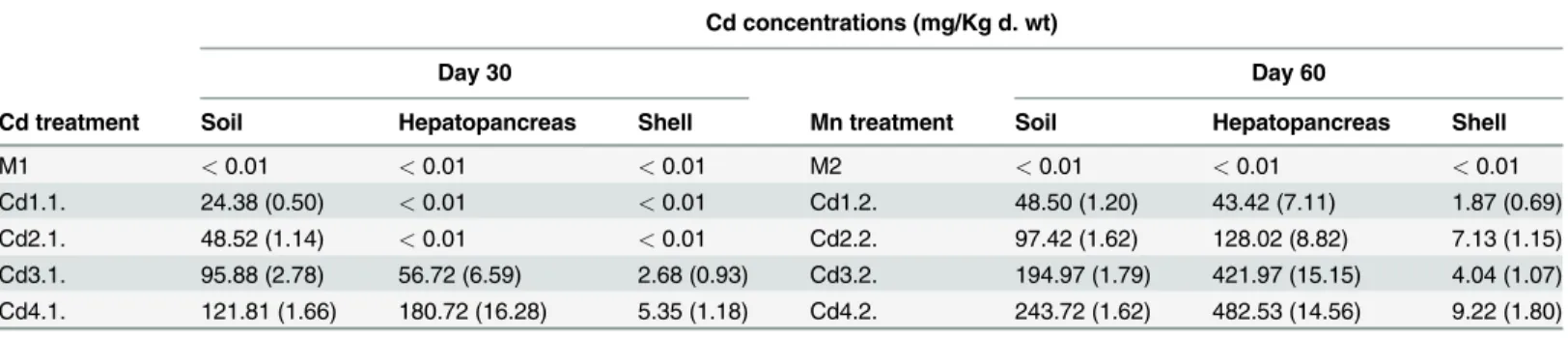
The control groups showed no detectable accumulation of Cd in the hepatopancreas (Table 1), as well as the Cd1.1. and Cd 1.2. snails. The hepatopancreas had up to eightfold higher concen-trations of Cd in the E2 phase than in the E1 phase, but the measured values were not at equi-librium. The hepatopancreas Cd content increased with soil Cd concentrations, irrespective of experimental phase (ANOVA, E1 phase:p= 0.000; E2 phase:p= 0.000).
The soil-to hepatopancreas regressions produced a very good fit to the data both in the E1 phase (p= 0.000,R2= 0.738) and E2 phase (p= 0.000,R2= 0.969), but the corresponding slopes (Fig. 1A) were significantly different one from each other (ANCOVA,p= 0.000). More-over, the increase in soil Cd content resulting from a new exposure event was a very good pre-dictor for Cd addition to the hepatopancreas of snails previously exposed to Cd-spiked soils (p= 0.000,R2= 0.920).
Kinetics of cadmium in shell
Cadmium accumulated to much lower levels in the shell than in the hepatopancreas. The mea-sured values generally increased with exposure time and dose, indicating that Cd did not reach equilibrium in the snail shell (Table 1). The shell of control snails, Cd1.1 snails and Cd2.1. snails revealed no detectable accumulation of Cd. Within the same group, the shell Cd content was always higher in the E2 phase than in the E1 phase. Analysis of variance showed that cad-mium accumulations in the shell differed significantly among treatments during each exposure phase (ANOVA, E1 phase:p= 0.000; E2 phase:p= 0.000). The soil-to-shell regressions (Fig. 1B) were highly significant, but their coefficients of determination were lower than those observed for the corresponding soil-to-hepatopancreas regressions (E1 phase:p= 0.000,
R2= 0.737; E2 phase:p= 0.000,R2= 0.581). Comparison of their regression slopes (Fig. 1B) re-vealed different kinetics of Cd retention in the shell between the E1 and E2 phase (ANCOVA,
p= 0.000), but the effect of a new exposure event was not significant (p= 0.390,R2= 0.112). Therefore, the dynamics of Cd accumulation in the shell appears to be related not only to soil Cd concentrations, but also to other contributing factors.
Table 1. Mean (and SD) for concentrations of Cd in the soil and the snail hepatopancreas and shell. Cd concentrations (mg/Kg d. wt)
Day 30 Day 60
Cd treatment Soil Hepatopancreas Shell Mn treatment Soil Hepatopancreas Shell
M1 <0.01 <0.01 <0.01 M2 <0.01 <0.01 <0.01
Cd1.1. 24.38 (0.50) <0.01 <0.01 Cd1.2. 48.50 (1.20) 43.42 (7.11) 1.87 (0.69)
Cd2.1. 48.52 (1.14) <0.01 <0.01 Cd2.2. 97.42 (1.62) 128.02 (8.82) 7.13 (1.15)
Cd3.1. 95.88 (2.78) 56.72 (6.59) 2.68 (0.93) Cd3.2. 194.97 (1.79) 421.97 (15.15) 4.04 (1.07) Cd4.1. 121.81 (1.66) 180.72 (16.28) 5.35 (1.18) Cd4.2. 243.72 (1.62) 482.53 (14.56) 9.22 (1.80)
The values were measured at the end of the E1 phase (day 30), and the end of the E2 phase (day 60).
Fig 1. The soil-to-organ regressions in the E1 and E2 phases.A) snail hepatopancreas; B) snail shell. The scatter plots correspond to the mean cadmium concentrations in the soil, the snail hepatopancreas and shell.
Cadmium toxicity
Globally speaking, the shell height varied little among test snails after 0, 30, and 60 days of ex-posure to Cd-spiked soils (Table 2). Similar results were obtained for the shell width (Table 3), as well as for the relative shell height (Table 4). At the start of the experiment (day 0), the inves-tigated conchological traits were highly homogeneous (ANOVA, SH:p= 0.234; SW:p= 0.244; RSH:p= 0.475). No significant growth inhibition or allometric changes were found after 30 days of Cd exposure (ANOVA, SH:p= 0.525; SW:p= 0.243; RSH:p= 0.373). After 60 days, soil Cd did not influence the shell allometry (ANOVA,p= 0.324), but reduced the growth in shell volume (ANOVA, SH:p= 0.042; SW:p= 0.045). Significant decrease in shell height and shell width when compared to the control occurred in the Cd3.2. snails (Dunnet’s test, SH:
p= 0.043; SW: 0.027) and the Cd 4.2. snails (Dunnet’s test, SH:p= 0.039; SW:p= 0.045), but not for the snails exposed to lower soil Cd levels (Dunnet’s test,p0.211). However, no rela-tionships existed between the rate to which Cd incorporates in the shell and growth in both SH (p= 0.497,R2= 0.126) and SW (p= 0.206;R2= 0.367).
Macroscopic examination of the shells of snails alive at the end of each exposure phase re-vealed different types of shell damages. The pattern of damage consisted mainly of thinned, fragile, and irregular edges of the shell at the growing edges (around the aperture), and, more rarely, deep wormholes in the body whorl and shell erosion along the suture line (Fig. 2). Simi-lar shell deformations were observed in the snails who died during the experimental period. The frequency of snails with damaged shells tended to increase with exposure duration and dose, and was above 30% after 60 days of exposure to the highest Cd treatments (Table 5). For the incidence of damaged shells, significant differences existed among treatments in the E2 phase, but not in the E1 phase (Chi-Square test, E1 phase:p= 0.392; E2 phase:p= 0. 027).
Table 2. Mean (and SD) for SH in snails exposed to Cd-spiked soils.
Day 0
Mean height (cm)
Cd treatment Day 30 Cd treatment Day 60
1.91 (0.23) M1 1.98 (0.27) M2 2.04 (0.28)
1.84 (0.16) Cd1.1. 1.87 (0.15) Cd1.2. 1.92 (0.15)
1.90 (0.17) Cd2.1. 1.96 (0.18) Cd2.2. 2.07 (0.16)
1.83 (0.18) Cd3.1. 1.85 (0.23) Cd3.2. 1.85 (0.17)*
1.84 (0.14) Cd4.1. 1.87 (0.16) Cd4.2. 1.89 (0.14)*
Marked boxes (*) indicate significant differences as compared to the reference group (Dunnet’s test, p<0.05).
doi:10.1371/journal.pone.0116397.t002
Table 3. Mean (and SD) for SW in snails exposed to Cd-spiked soils.
Day 0
Mean width (cm)
Cd treatment Day 30 Cd treatment Day 60
2.03 (0.22) M1 2.13 (0.28) M2 2.17 (0.24)
1.96 (0.19) Cd1.1. 1.99 (0.19) Cd1.2. 2.05 (0.18)
2.01 (0.14) Cd2.1. 2.09 (0.16) Cd2.2. 2. 12 (0.15)
1.92 (0.21) Cd3.1. 1.95 (0.25) Cd3.2. 1.98 (0.20)*
1.94 (0.13) Cd4.1. 1.95 (0.12) Cd4.2. 1.97 (0.12)*
Marked boxes (*) indicate significant differences as compared to the reference group (Dunnet’s test, p<0.05).
In the E1 phase, the survival rates (Table 5) were similar among different treatments and there was no clear pattern in the temporal distribution of snail deaths (Fig. 3). In the E2 phase, by contrast, the mortality rates were higher in the Cd-exposed snails than those observed in the control snails, excepting the lowest treatment (Table 5). Mortalities during the E2 phase reached a peak between 30 and 40 days of exposure for the Cd4.1. snails; and between 42 and 52 days of exposure for the Cd4.2. snails (Fig. 2). Survival analysis showed significant differ-ences in mortality distribution across groups in the E2 phase, but not in the E1 phase
(Log-Table 4. Mean (and SD) for RSH in snails exposed to Cd-spiked soils.
Day 0
Mean RSH
Cd treatment Day 30 Cd treatment Day 60
0.94 (0.03) M1 0.94 (0.02) M2 0.93 (0.03)
0.93 (0.02) Cd1.1. 0.93 (0.02) Cd1.2. 0.93 (0.02)
0.94 (0.04) Cd2.1. 0.94 (0.05) Cd2.2. 0.94 (0.04)
0.94 (0.02) Cd3.1. 0.94 (0.02) Cd3.2. 0.93 (0.03)
0.94 (0.03) Cd4.1. 0.94 (0.03) Cd4.2. 0.94 (0.03)
doi:10.1371/journal.pone.0116397.t004
Fig 2. Photograph of different types of shell damages (indicated with arrows) inC. aspersus sub-adults.A) Irregular edges around the aperture; B) Shell erosion along the suture line; C) Thinned, fragile, and irregular edges around the aperture and broken apex.
Rank test, E1 phase:p= 0.076; E2 phase:p= 0.022). Post hoc testing revealed that, for the two highest treatments, soil cadmium contributed significantly to snail mortalities (Breslow’s test,p0.048), whereas for the other treatments of the E2 phase, the snails showed no significant differences in survival dynamics as compared to the reference group (Breslow’s test,
p0.513). Moreover, the overall survival rates in control groups differed significantly between the E1 and E2 phase (Chi-Square test,p= 0. 001).
Table 5. Snail survival in percentage and mean survival time (and SD) for each Cd treatment.
Cd treatment
Day 30 Day 60
Survival (%)
Mean survival time (days)
Shell damage (%)
Cd treatment
Survival (%)
Mean survival time (days)
Shell damage (%)
M1 96% 29.22 (3.66) 12% M2 80% 27.65 (1.13) 8.25%
Cd1.1. 98% 29.86 (0.98) 10% Cd1.2. 81.25% 28.64 (4.13) 12.13%
Cd2.1. 98% 29.86 (0.97) 10% Cd2.2. 73.08% 26.04 (7.75) 3.57%
Cd3.1. 92% 29.42 (0.34) 14% Cd3.2. 50% 25.07 (6.98)* 30.77%
Cd4.1. 84% 28.45 (4.60) 18% Cd4.2. 58.33% 21.73 (11.16)* 41.67%
Marked boxes (*) indicate significant differences as compared to the reference group (Breslow’s test, p<0.05).
doi:10.1371/journal.pone.0116397.t005
Fig 3. Kaplan-Meier survival curves in the E1 phase (left) and E2 phase (right).The complete data relate to the death snails, whereas the censored data are associated with the living individuals.
Discussion
Kinetics of cadmium in hepatopancreas
To our knowledge, this is the first study to take into account an exposure scenario reflecting an increase over time in soil Cd concentrations and to provide quantitative data on Cd direct transfer from soils to the hepatopancreas of land snails. Cadmium did not accumulate in the hepatopancreas after 30 days of exposure to soil Cd concentrations of up to 50 mg/Kg d. wt. Soil alkalinization and organic matter content decrease Cd bioavailability to land snails [17]. Therefore, we suggest that Cd bioavailability in the soil was low, thus limiting its uptake by land snails. Exposure above 50 mg/Kg d.wt in the soil resulted in high Cd accumulation in the snail hepatopancreas. Since dietary Cd fell below the detection limit, one can easily conclude that Cd transfer from soils toC. aspersusjuveniles occurred independently of food ingestion. The soil ingestion and epithelial contact have been reported to be equally efficient in transfer-ring soil Cd to land snails [13]. However, the present work cannot delineate between these routes of penetration because the test snails were exposed to Cd-contaminated soils as a single source of contamination.
The maximum hepatopancreas cadmium concentrations were above 500 mg/Kg d. wt. These values are among the highest Cd concentrations ever reported in the literature for this route of exposure. Because the internal Cd concentrations are not at equilibrium, land snails are expected to concentrate in the hepatopancreas higher amounts of Cd than those found in the present work. Indeed, such elevated accumulations have already been reported in the (eco)toxicological literature. For example,Cepaea hortensisshowed hepatopancreas Cd levels above 1,600 mg/Kg d. wt when exposed for 14 days to dietary Cd doses of up to 254.14 mg/Kg d. wt [21].
The snails tended to concentrate Cd in the hepatopancreas relative to the soil, especially after 60 days of exposure to the highest Cd treatments. Most study authors reported lower lev-els of Cd in the viscera than in the soil, irrespective of exposure duration. The analyzed viscera included the digestive apparatus, kidney, heart, lung, and reproductive apparatus, and were routinely taken as a whole for assessing Cd bioaccumulation [8,13,15,18]. The hepatopancreas may therefore provide a more appropriate approach for characterizing the bioavailability of soil Cd than the use of snail viscera, as has already been proposed for biomonitoring metal ac-cumulation in terrestrial ecosystems [45].
Cadmium addition to soils resulting from a new exposure event explained very well the dy-namics of increase in Cd concentrations in the hepatopancreas. This implies that a new expo-sure event is an important factor contributing to the modification of Cd retention kinetics in the hepatopancreas of sub-adultC. aspersuspreviously exposed to Cd-spiked soils. Recently, we came to a similar conclusion regarding the soil manganese [26]. These data attest to the he-patopancreas of sub-adultC. aspersusthe potential to serve as a sensitive bioaccumulator not only for soil Cd and Mn, but also for other metals that accumulate in soils.
Kinetics of cadmium in shell
Little knowledge exists on Cd accumulation in land snail shells for exposure via soil [8,16]. The current study fills this gap by demonstrating that soil Cd does accumulate in the shell indepen-dently of food ingestion. The measured values are among the highest ever recorded in the shell of terrestrial gastropods. Considerable Cd accumulations have also been reported inHelix pomatiathat were sampled from two polluted areas in Romania, i.e., Medias and Copsa Mica. The average values were 5.99 and 3.72 mg/Kg d. wt Cd in the shell and 57.5 and 4.37 mg/Kg d. wt Cd in the soil, respectively [33]. Data in the literature generally show lower levels to which Cd accumulates in the gastropod shell. For example, the shell Cd content ofCepaea nemoralis,Theba pisabaandCepaea vindobonensisrespectively reached up to 0.36, 1.23, and 1.80 mg/Kg d. wt [35,36,47,48]. However, such comparisons must be treated with caution since even within closely related species of land snails there are significant differences in metal up-take and accumulation [49].
Food ingestion is more efficient in transferring Cd to land snails than exposure via soil [8]. Adult individuals ofC. aspersusfed for 120 days on Cd-enriched diets (up to 125 mg/Kg d. wt) retained Cd in the shell at values up to 0.230 mg/Kg d. wt [32]. Not only different age, species and Cd bioavailability, but also methodological issues may contribute to explaining these dif-ferences. The snail shell consists mainly of calcium carbonate (CaCO3), but its outer layer, viz.
the periostracum, contains a fibrous insoluble protein called conchiolin, which usually makes up to 5% of the shell [50–52]. This protein is an excellent biosorbent for metals, including Cd [51,52]. When directly treated with strong acids (e.g., nitric acid, hydrochloric acid), the shell is decalcified, while the acid-insoluble conchiolin precipitates [53]. Most of the aforementioned studies used strong acids to digest the dried shells without calcinating them prior to digestion [32,47,48]. This step produces an efficient destruction of the organic substances in the shell [54], and hence is expected to increase the concentration of Cd in the filtrates.
Cadmium accumulated to higher levels in the hepatopancreas than in the shell. Similar re-sults were reported in previous studies [35,55]. The soil-to-organ regressions clearly indicate that the hepatopancreas is more sensitive than the shell in biomonitoring Cd accumulation in soils. Moreover, the shell Cd content remained well below 5% of that measured in either the soil or the hepatopancreas. Therefore, the shell cannot be regarded as a pertinent bioaccumula-tor for soil Cd, and environmental Cd broadly. This is consistent with the findings from studies on land snails and dietary Cd exposure [32,47].
There was no relationship between the increase in soil Cd content resulting from a new ex-posure event and the rate of Cd addition to the shell. This suggests that the first exex-posure event influenced more strongly the kinetics of Cd accumulation in the shell than a new exposure event. Terrestrial gastropods store calcium in the hepatopancreatic lime cells, whence it is later transported dissolved in the blood fluid into body parts in need of lime, especially towards the shell during the growth period [25]. Cadmium and calcium are competitive antagonists [56], and therefore, one potential explanation is that external Cd influx may reduce Ca transport from the hepatopancreas into the shell via competitive antagonism.
Cadmium toxicity
specimens were exposed to Cd-contaminated soils (up to 100 mg/Kg d. wt) under laboratory conditions; the minimal duration that significantly inhibited the growth of shell mass was 70 days [16].
The standard ISO-15952:2006 recommends the use of juvenile snails between three and five weeks old for assessing soil quality [22]. By contrast, the age of snails used in this study was three months. Not only the age-related decline in growth rate [25], but also environmental fac-tors may account for our results, i.e., the reduced inhibitory effect of soil Cd on shell growth. Such factors (e.g., high temperatures, low relative humidity) are known to cause feeding cessa-tion and sealing of shell aperture in land snails [25], thus limiting their growth. Laboratory data indicate that the body weight of sub-adult snails is a more sensitive end-point of exposure to soil Cd that the shell size/volume [27,37]. However, this parameter is highly variable in natu-ral environments[27]. Therefore, both the shell size and body weight should be used with great caution in field research for assessing the sublethal effects of soil Cd.
Long-time exposure to metals has been linked to changes in shell size and allometry in adult land snails [1,48,57]. In our study, the shell robustness was not affected by soil Cd, but in adult
C. aspersusit appeared to be influenced by long exposure to high Pb concentrations in the envi-ronment [39]. Hence, one can expect that significant changes in shell size and/or allometry may occur only in snail populations that are exposed to environmental Cd for
several generations.
This study also provides scientists with pertinent information concerning the link between the hepatopancreatic Cd content and shell growth inhibition. Thus, under the present experi-mental conditions, the lowest-observable-effect concentration (LOEC) for the hepatopancreas cadmium should lie between 180 and 420 mg/Kg d. wt. Shell thinning and irregular growth around the aperture were the most frequently observed types of shell damage. Similar effects were reported at the growing edges of the common mussel (Mytilus edulis) when exposed to Cd-contaminated water [41], and as a consequence, we infer that Cd may interfere with Ca de-position in rapidly growing shell parts, that is around the shell aperture [25]. Such mechanisms are documented to exist in bones, wherein cadmium can antagonize and replace calcium in bone structure via competitive antagonism [58]. There is also indirect evidence that above a certain threshold level, Cd may inhibit Ca transport from the hepatopancreas into the shell. Thus, significant inhibition of shell growth and the most elevated frequencies of damaged shells were found for the highest Cd concentrations in the hepatopancreas.
Soil cadmium did not influence snail mortalities after 30 days of exposure, thus attesting to the high Cd tolerance of these invertebrates [16,32,37]. Not only Cd exposure, but also environ-mental factors appear to have contributed to high mortalities observed in the E2 phase since survival rates in control snails were significantly lower in this phase than in the E1 phase. This is most likely related to the fact that the peak of the summer 2011 temperatures in the study area was reached during the E2 phase [59]. Of note, in the E2 phase, mortality was higher for the second-highest-dose treatment than in snails exposed to the maximal soil Cd concentra-tion. As a result, tolerance against Cd stress may increase with the level of the initial exposure dose in snails previously exposed to Cd-spiked soils.
of environmental stress (mainly weather conditions) and progressive increase of Cd-MT satu-ration level with Cd exposure doses [60].
These results highlight the practical difficulties which arise when assessing cadmium toxici-ty using morphological end-points of exposure. In this context, more subtle biomarkers are re-quired for assessing the potential hazard of Cd on land snails. Combining different
histochemical, cytological, and cellular biomarkers of Cd exposure may represent a reliable op-tion, as already described forH. pomatia[61]. Of particular interest is the potential use of epi-genetic changes of Cd-MT gene promoter since there is strong indication for the existence of such a mechanism in land snails [62]. Such biomarkers have the potential to predict various ad-verse effects of Cd way before the first toxicity signs are observed at organismal, cellular, or subcellular level.
Conclusions
This study shows, for the first time, that an increase in soil cadmium concentration resulting from a new exposure event changes the kinetics of cadmium retention in the hepatopancreas of snails previously exposed to cadmium-spiked soils. Both hepatopancreas and shell accumu-lated soil cadmium in a dose-dependent manner. However, the shell did not serve as a relevant bioaccumulator for this metal. Cadmium did not influence shell allometry, but at high levels significantly affected shell growth and snail survival, and also appeared to affect shell integrity in rapidly growing shell parts. Our results attest to the value of hepatopancreas for describing cadmium retention in land snails and to the difficulty of using conchological parameters in field surveys for estimating the environmental hazard of soil cadmium.
Acknowledgments
All authors have equal rights and have contributed evenly to this paper. The present work was funded by the project“Post- doctoral School Of Agriculture And Veterinary Medicine Posdru/ 89/1.5/S/62371”, co-financed by the European Social Fund through the Sectorial Operational Programme for the Human Resources Development 2007–2013. In addition, the correspond-ing author (DVN) wish to thank D.C. for continuous support throughout his scientific career.
Author Contributions
Conceived and designed the experiments: DVN DMB. Performed the experiments: DVN. Ana-lyzed the data: DVN. Contributed reagents/materials/analysis tools: DVN MNF DMB MH SD IG. Wrote the paper: DVN DMB IG SD. Chemical analysis: DVN DMB GAD MH IG. Shell measurements: DVN MNF GAD.
References
1. Nica DV, Bura M, Gergen I, Harmanescu M, Bordean DM (2012) Bioaccumulative and conchological assessment of heavy metal transfer in a soil-plant-snail food chain. Chem Cent J 6: 55. doi:10.1186/ 1752-153X-6-55PMID:22703871
2. Veltman K, Huijbregts MA, Hendriks AJ (2008) Cadmium bioaccumulation factors for terrestrial spe-cies: Application of the mechanistic bioaccumulation model OMEGA to explain field data. Sci Total En-viron 406(3): 413–418. doi:10.1016/j.scitotenv.2008.05.049PMID:18722646
3. ATSDR (2012) Toxicological profile for cadmium. Agency for Toxic Substances and Disease Registry. Division of toxicology and environmental medicine/applied toxicology branch, Atlanta, Georgia. Avail-able:http://www.atsdr.cdc.gov/toxprofiles/tp5.pdf. Accessed 7 July 2014.
4. WHO Europe (2007) Health risks of heavy metals from long-range transboundary air pollution. World Health Organization Regional Office Europe. Available:http://www.euro.who.int/__data/assets/pdf_ file/0007/78649/E91044.pdf. Accessed 28 June 2014.
6. Berger B, Dallinger R (1989) Accumulation of cadmium and copper by the terrestrial snailArianta arbustorumL.: kinetics and budgets. Oecologia 79(1): 60–65. doi:10.1007/BF00378240
7. Gomot A (1997) Dose-dependent efects of cadmium on the growth of snails in toxicity bioassays. Arch Environ Contam Toxicol 33(2): 209–216. doi:10.1007/s002449900245PMID:9294251
8. de Vaufleury A, Coeurdassier M, Pandard P, Scheifler R, Lovy C, et al. (2006) How terrestrial snails can be used in risk assessment of soils. Environ Toxicol Chem 25(3): 797–806. doi:10.1897/04-560R. 1PMID:16566165
9. Dallinger R, Berger B, Triebskorn- Köhler R, Köhler H (2001) Soil biology and ecotoxicology. In: Barker GM, editor. The Biology of Terrestrial Molluscs. Wallingford: CABI Publishing, 489–525.
10. Dallinger R, Rainbow PS (1993) Ecotoxicology of metals in invertebrates. Boca Raton: Lewis Publish-ers. 461 p.
11. Garcia A, Perea JM, Mayoral A, Acero R, Martos J, et al. (2006) Laboratory rearing conditions for im-proved growth of juvenileHelix aspersaMüller snails. Lab Anim 40(3): 309–316. doi:10.1258/ 002367706777611505PMID:16803649
12. Bura M (2004) Cresterea melcilor o activitate profitabila. Timisoara: Ed. Eurobit. 120 p.
13. Coeurdassier M, Gomot DVA, Lovy C, Badot PM (2002) Is the cadmium uptake from soil important in bioaccumulation and toxic effects for snails? Ecotox Environ Saf 53(3): 425–431. doi: 10.1016/S0147-6513(02)00004-0PMID:12485588
14. Scheifler R, Schwartz C, Echevarria G, de Vaufleury A, Badot PM, et al. (2003).“Nonavailable”soil cad-mium is bioavailable to snails: evidence from isotopic dilution experiments. Environ Sci Technol 37(1): 81–86. doi:10.1021/es025677wPMID:12542294
15. Gimbert F, de Vaufleury A, Douay F, Scheifler R, Coeurdassier M, et al. (2006) Modelling chronic expo-sure to contaminated soil: A toxicokinetic approach with the terrestrial snailHelix aspersa. Environ Int 32(7): 866–875. doi:10.1016/j.envint.2006.05.006PMID:16824600
16. Gimbert F, de Vaufleury A, Douay F, Coeurdassier M, Scheifler R, et al. (2008). Long-term responses of snails exposed to cadmium-contaminated soils in a partial life-cycle experiment. Ecotox Environ Saf 70(1): 138–146. doi:10.1016/j.ecoenv.2007.05.014PMID:17644178
17. Pauget B, Gimbert F, Coeurdassier M, Scheifler R, Vaufleury DVA (2011) Use of chemical methods to assess Cd and Pb bioavailability to the snailCantareus aspersus: a first attempt taking into account soil characteristics. J Hazard Mater 192: 1804–1811. doi:10.1016/j.jhazmat.2011.07.016PMID:
21813240
18. Scheifler RM, Brahim B, Gomot-de Vaufleury A, Carnus J, Badot PM (2003) A field method using micro-cosms to evaluate transfer of Cd, Cu, Ni, Pb and Zn from sewage sludge amendedforest soils toHelix aspersasnails. Environ Pollut 122(3): 343–350. doi:10.1016/S0269-7491(02)00333-0PMID: 12547523
19. Gimbert F, Mench M, Coeurdassier M, Badot PM, de Vaufleury A (2008) Kinetic and dynamic aspects of soil—plant—snail transfer of cadmium in the field. Environ Pollut 152(3): 736–745. doi:10.1016/j. envpol.2007.06.044PMID:17693002
20. Pauget B, Gimbert F, Coeurdassier M, Crini N, Peres G, et al. (2013) Ranking field site management priorities according to their metal transfer to snails. Ecol Indic 29: 445–454. doi:10.4103/0970-9185. 119128PMID:24249978
21. Dallinger R, Lagg B, Egg M, Schipflinger R, Chabicovsky M (2004) Cd accumulation and Cd-metal-lothionein as a biomarker inCepaea hortensis(Helicidae, Pulmonata) from laboratory exposure and metal-polluted habitats. Ecotoxicology 13(8): 757–772. doi:10.1007/s10646-003-4474-4PMID: 15736847
22. van Gestel CA (2012) Soil ecotoxicology: state of the art and future directions. ZooKeys ( 176): 275–
296. doi:10.3897/zookeys.176.2275PMID:22536114
23. Madrid L, Díaz-Barrientos E, Ruiz-Cortés E, Reinoso R, Biasioli M, Davidson CM (2006) Variability in concentrations of potentially toxic elements in urban parks from six European cities. J Environ Monit 8:1158–1165. doi:10.1039/B607980FPMID:17075623
24. Wei B, Yang L (2009) A review of heavy metal contaminations in urban soils, urbanroad dusts and agri-cultural soils from China. Microchem J. doi:10.1016/j.microc.2009.09.014.
25. Barker GM (2001) The biology of terrestrial molluscs. Wallingford: CABI Publishing. 558 p.
26. Bordean D- M, Nica DV, Harmanescu M, Banatean-Dunea I, Gergen II (2014) Soil Manganese Enrich-ment from Industrial Inputs: A Gastropod Perspective. PLoS ONE 9(1): e85384. doi:10.1371/journal. pone.0085384PMID:24454856
28. Kerney MP, Cameron RAD (1979) A field guide to the land snails of Britain and northwestern Europe. London: William Collins Sons and Co. 288 p.
29. Ebenso IE, Ologhobo AD (2008) Edible land snail shell thickness as bioindicator of environmental lead metal pollution. Pollut Res (India) 27(2): 75–76.
30. Ireland MP (1991) The effect of dietary calcium on growth, shell thickness and tissue calcium distribu-tion in the snailAchatina fulica. Comp Biochem Physiol A Physiol 98(1): 111–116. doi: 10.1016/0300-9629(91)90587-3
31. Bardos DC (2005) Probabilistic Gompertz model of irreversible growth. Bull Math Biol 67(3): 529–545. doi:10.1016/j.bulm.2004.08.009PMID:15820741
32. Laskowski R, Hopkin SP (1996b) Accumulation of Zn, Cu, Pb and Cd in the garden snail (Helix aspersa): implications for predators, 289–297. Environ Pollut 91(3): 289–297. doi:10.1016/0269-7491 (95)00070-4PMID:15091421
33. Gheoca V, Gheoca D (2005) The accumulation of heavy metals in the tissues of Helix pomatia from lo-cations with industrial and town pollution. Transylvanian Rev Syst Ecol Res 2: 67–74. Available:http:// stiinte.ulbsibiu.ro/trser/trser2/contents.pdf. Accessed 2 July 2014.
34. Jordaens K, De Wolf H, Vandecasteele B, Blust R, Backeljau T (2006) Associations between shell strength, shell morphology and heavy metals in the land snailCepaea nemoralis(Gastropoda, Helici-dae). Sci Total Environ 363(1): 285–293. doi:10.1016/j.scitotenv.2005.12.002PMID:16414099
35. Mierzwa D (2011) Chemical composition of shells ofCepaea vindobonensis(Férussac, 1821)(Gastro-poda: Pulmonata:Helicidae) from localities with different substrata. Folia Malacol 19(2): 97–101. doi: 10.2478/v10125-011-0014-7
36. Madejon P, Arrebola J, Madejon E, Burgos P, Lopez-Garrido R, et al. (2013) The snailTheba pisanaas indicator of soil contamination by trace elements: Potential exposure for animals and humans. J Sci Food Agr 93(3): 2259–2266. doi:10.1002/jsfa.6035
37. Russell LK, DeHaven JI, Botts RP (1981) Toxic effects of cadmium on the Garden snail (Helix aspersa). Bull Environ Contam Toxicol 26: 634–640. doi:10.1007/BF01622148PMID:7260433
38. Kemp P, Bertness MD (1984) Snail shape and growth rates: evidence for plastic shell allometry in Littor-ina littorea. PNAS 81(3): 811–813. doi:10.1073/pnas.81.3.811PMID:16593415
39. Mulvey M, Newman MC, Beeby AN (1996) Genetic and conchological comparison of snails (Helix aspersa) differing in shell deposition of lead. J Molluscan Stud 62(2): 213–223. doi:10.1093/mollus/62. 2.213
40. Fritsch C, Coeurdassier M, Gimbert F, Crini N, Scheifler R, de Vaufleury A (2011) Investigations of re-sponses to metal pollution in land snail populations (Cantareus aspersusandCepaea nemoralis) from a smelter-impacted area. Ecotoxicology 20(4):739–759. doi:10.1007/s10646-011-0619-zPMID: 21369962
41. Sunila I, Lindstrom R (1985) Survival, growth and shell deformities of copper-and cadmium-exposed mussels (Mytilus edulisL.) in brackish water. Estuar Coast Shelf Sci 21(4): 555–565. doi:10.1016/ 0272-7714(85)90056-3
42. Matthews-Amune, Christiana Omono, and Kakulu Samuel (2012) Comparison of digestion methods for the determination of metal levels in soils in Itakpe, Kogi State, Nigeria. Int J Pure Appl Sci Technol 13 (2): 42–48.
43. Saud S (2008) Impact of municipal and industrial waste on the distribution and accumulation of some heavy metals in sandy soils of Al-Qassim region at central of Saudi Arabia. Journal of Environmental Science and Technology, 1(3), 135–142.
44. Klein JP, Moeschberger ML (2003) Survival analysis: Techniques of censored and truncated data. New York: Springer-Verlag. 537 p.
45. Rabitsch WB (1996) Metal accumulation in terrestrial pulmonates at a lead/zinc smelter site in Arnold-stein, Austria. Bull Environ Contam Toxicol 56(5): 734–741. doi:10.1007/s001289900108PMID: 8661856
46. Williamson P (1980) Variables affecting body burdens of lead, zinc and cadmium in a road side popula-tion of the snailCepaea hortensisMuller. Oecologia 44: 213–220. doi:10.1007/BF00572682
47. Notten MJM, Oosthoek AJP, Rozema J, Aerts R (2006) The landsnailCepaea nemoralisregulates in-ternal Cd levels when fed on Cd-enriched stinging nettle (Urtica dioica) leaves at low, field-relevant con-centrations. Environ Polut 139(2): 296–305. doi:10.1016/j.envpol.2005.05.007PMID:16040172
48. Jordaens K, De Wolf H, Vandecasteele B, Blust R, Backeljau T (2006) Associations between shell strength, shell morphology and heavy metals in the land snailCepaea nemoralis(Gastropoda, Helici-dae). Sci Total Environ 363(1): 285–293. doi:10.1016/j.scitotenv.2005.12.002PMID:16414099
50. de Paula SM, Silveira M (2009) Studies on molluscan shells: contributions from microscopic and analyt-ical methods. Micron 40(7), 669–690. doi:10.1016/j.micron.2009.05.006PMID:19524444
51. Jatto EO, Asia IO, Egbon EE, Otutu JO, Chukwuedo ME, et al. (2010) Treatment of waste water from food industry using snail shell. Academ Arena 2(1): 32–36. Available:http://sciencepub.net/academia/ aa0201/06_0805_treatment_pub_aa0201.pdf. Accessed 4 July 2014.
52. Kano N (2013). Biosorption of lanthanides using select marine biomass. In: Matovic MD, editor. Engi-neering“Biomass Now—Sustainable Growth and Use”. Rijeka: Intech Open, 101–124.
53. Florkin M, Scheer BT (1994) Chemical Zoology. Vol VII Mollusca. London: Academic Press. 590 p.
54. Soido C, Vasconcellos MC, Diniz AG, Pinheiro J (2009) An improvement of calcium determination tech-nique in the shell of molluscs. Braz Arch Biol Techn 52(1): 93–98. doi:
10.1590/S1516-89132009000100012
55. Nowakowska A, Laciak T, Caputa M (2012) Organ profiles of the antioxidant defence system and accu-mulation of metals in Helix aspersa snails. Pol J Environ Stud 21(5): 1369–1375. Available:http://www. pjoes.com/pdf/21.5/Pol.J.Environ.Stud.Vol.21.No.5.1369-1375.pdf. Accessed 5 July 2014.
56. Massaro EJ (1997) Handbook of human toxicology. Boca Raton: CRC press. 1111 p.
57. Eeva T, Rainio K, Suominen O (2010) Effects of pollution on land snail abundance, size and diversity as resources for pied fl ycatcher,Ficedula hypoleuca. Sci Total Environ 408(19): 4165–4169. doi:10. 1016/j.scitotenv.2010.05.028PMID:20542535
58. Akesson A, Bjellerup P, Lundh T, Lidfeldt J, Nerbrand C, et al. (2006) Cadmium-induced effects on bone in a population-based study of women. Environ Health Perspect 114:830–834. doi:10.1289/ehp. 8763PMID:16759980
59. Moisa C, Mircov VD, Cozma A (2012) Drought—a risk factor in agriculture in Western Plain of autumn 2011. RJAS 44(3): 86–94. Available:http://www.rjas.ro/volume_detail/2. Accessed 6 July 2014.
60. Chabicovsky M, Klepal W, Dallinger R (2004) Mechanisms of cadmium toxicity in terrestrial pulmo-nates: programmed cell death and metallothionein overload. Environ Toxicol Chem 23(3): 648–655. PMID:15285358
61. Hodl E, Felder E, Chabicovsky M, Dallinger R (2010) Cadmium stress stimulates tissue turnover in Helix pomatia: increasing cell proliferation from metal tolerance to exhaustion in molluscan midgut gland. Cell Tissue Res 341(1): 159–171. doi:10.1007/s00441-010-0980-xPMID:20480182