Acquired dysgraphia in adults following
right or left-hemisphere stroke
Jaqueline de Carvalho Rodrigues1, Denise Ren da Fontoura2, Jerusa Fumagalli de Salles3
ABSTRACT. Objective: This study aimed to assess the strengths and difficulties in word and pseudoword writing in adults with left- and right-hemisphere strokes, and discuss the profiles of acquired dysgraphia in these individuals. Methods: The profiles of six adults with acquired dysgraphia in left- or right-hemisphere strokes were investigated by comparing their performance on word and pseudoword writing tasks against that of neurologically healthy adults. A case series analysis was performed on the patients whose impairments on the task were indicative of acquired dysgraphia. Results: Two patients were diagnosed with lexical dysgraphia (one with left hemisphere damage, and the other with right hemisphere damage), one with phonological dysgraphia, another patient with peripheral dysgraphia, one patient with mixed dysgraphia and the last with dysgraphia due to damage to the graphemic buffer. The latter patients all had left-hemisphere damage (LHD). The patterns of impairment observed in each patient were discussed based on the dual-route model of writing. Conclusion:
The fact that most patients had LHD rather than right-hemisphere damage (RHD) highlights the importance of the former structure for word processing. However, the fact that lexical dysgraphia was also diagnosed in a patient with RHD suggests that these individuals may develop writing impairments due to damage to the lexical route, leading to heavier reliance on phonological processing. Our results are of significant importance to the planning of writing interventions in neuropsychology.
Key words: agraphia, cognitive neuropsychology, written language, cerebral dominance.
DISGRAFIAS ADQUIRIDAS EM ADULTOS APÓS ACIDENTE VASCULAR CEREBRAL UNILATERAL NOS HEMISFÉRIOS DIREITO E ESQUERDO RESUMO. Objetivo: Investigar aspectos preservados e dificuldades na escrita de palavras e pseudopalavras em adultos que sofreram acidente vascular cerebral (AVC) à esquerda e à direita e discutir os perfis de disgrafia adquirida nesses indivíduos. Métodos: Investigaram-se perfis de disgrafia adquirida a partir da avaliação das habilidades e dificuldades na escrita de palavras e pseudopalavras de seis adultos que sofreram AVC no hemisfério direito (LHD) e no hemisfério esquerdo (LHE), comparados a adultos neurologicamente saudáveis. Realizou-se análise de séries de casos com os pacientes que apresentaram desempenho deficitário na escrita de palavras, que indicavam a presença de uma disgrafia adquirida. Resultados: Foram identificados dois casos com disgrafia lexical (sendo um com LHE e outro com LHD), um caso com disgrafia fonológica, um com disgrafia periférica, um com disgrafia mista e um com disgrafia por déficit no buffer grafêmico, todos estes com LHE. Destacou-se nesse estudo a heterogeneidade das habilidades linguísticas dos casos clínicos, discutidas de acordo com o modelo cognitivo de dupla-rota de escrita. Conclusão: O maior prejuízo encontrado nos pacientes com LHE ressalta a importância desse hemisfério cerebral para o processamento da escrita de palavras. A presença de um caso com LHD com perfil de disgrafia lexical destaca a necessidade de melhor estudar o papel do hemisfério direito no processamento de palavras. Espera-se que esse estudo contribua para o planejamento de estratégias de intervenção neuropsicológica direcionadas à escrita de palavras.
Palavras-chave: agrafia, neuropsicologia cognitiva, linguagem escrita, dominância cerebral.
INTRODUCTION
A
cquired dysgraphia (or agraphia) is the partial or total inability to producewrit-ten language following neurological damage.1,2
According to cognitive models of writing, dys-graphia may be either a result of language
im-1Psychologist, Master Degree and Doctoral Student in Psychology, Graduate Department of Psychology, Federal University of Rio Grande do Sul – UFRGS, RS,
Brazil. 2Speech/Language Pathologist, PhD in Psycholinguistics, Master Degree in Neuroscience, Specialist in Speech Pathology Rehabilitation, Post graduated
in Neuropsychology, RS, Brazil. 3Speech/Language Pathologist, Master Degree and PhD (Psychology), Adjunct Professor of the Department of Developmental and
Personality Psychology, Graduate Department of Psychology, Federal University of Rio Grande do Sul - UFRGS, Head of the Cognitive Neuropsychology Research Group - NEUROCOG., RS, Brazil
Jaqueline de C. Rodrigues. Instituto de Psicologia – Rua Ramiro Barcelos 2600 / 114 – 90035-003 Porto Alegre RS – Brazil. E-mail: jaquecarvalhorodrigues@ gmail.com / [email protected]
pairment3-5 or of praxis and visuospatial dysfunction.7-9
According to the dual-route or multiple route model, one of the most widespread and well-accepted models of writing,10-14 written word production may occur
ei-ther through phonological mediation (the conversion of phonemes to graphemes) or by direct lexical access. While the phonological route is involved mainly in the production of unfamiliar words and pseudowords, the lexical route is preferred when writing familiar words, and the only suitable means of writing irregular words.15
he diferent types of dysgraphia caused by distinct patterns of impairment in one or more components of the dual route model can be identiied by the assess-ment of psycholinguistic efects in writing (word length, regularity, frequency, etc.) and of the types of errors observed in word/pseudoword writing.15 According to
a cognitive model of writing to dictation in the Brazil-ian Portuguese language developed by Lecours and Parente,16 dysgraphia can be divided into the following
subtypes: central (lexical, phonological, semantic and deep dysgraphia) and peripheral (in the case of damage to the graphemic or allographic bufers, or impairments in the planning and execution of hands articulatory movements).6
Lexical dysgraphia occurs when there is damage to the lexical route and heavy reliance on phonological writing strategies, leading to adequate performance in tasks involving words and pseudowords, but diiculty writing ambiguous and irregular words. Regularization errors are common in these patients, as is the tendency to perform better when writing frequent as opposed to infrequent words.15 his type of dysgraphia is often
caused by lesions to the left parietal lobe.4
Phonological dysgraphia is associated with extreme diiculty in writing pseudowords as compared to real words due to impaired phoneme-grapheme conversion, which may also lead to problems when writing unfamil-iar words.17 As a result, lexicalization errors, as well as
frequency and lexicality efects, are often observed in these cases. his type of dysgraphia is often reported in patients with damage to perisylvian cortical regions.18,19
Mixed (or global) dysgraphia is associated with im-pairment to both lexical and phonological mechanisms. Patients with this condition are able to write some regu-lar words but have diiculty writing irreguregu-lar words and pseudowords.20,21 Semantic dysgraphia refers to the
inability to attribute meaning to written words, and is often observed following left hemisphere lesions.5 Deep
dysgraphia is associated with phonological deicits, which lead to semantic paragraphias, lexicality efects, and diiculty writing pseudoword, as well as
unfamil-iar and abstract words.22 Semantic dysgraphia has been
found to occur following extensive lesions to the supra-marginal gyrus and insula.1
Peripheral dysgraphia caused by damage to the gra-phemic bufer leads to diiculties in lexical access and phoneme-grapheme conversion during the writing pro-cess.23,24 Patients with this condition retain the ability
to write well-formed graphemes, although the substi-tution, omission, addition or transposition of letters within words may be observed.24 Damage to the
allo-graphic bufer, on the other hand, tends to impair the grapheme selection process, which often results in the use of both upper and lower case letters and cursive and block letters in the same word.26 hese diiculties may
be associated with damage to the left temporo-parieto-occipital cortex.2 Lastly, apraxic dysgraphia is caused by
alterations in the planning and generation of the mo-tor sequences required to write letters.6 his condition
is believed to be caused by damage to the left parietal cortex.28
Language impairments following left hemisphere damage (LHD) have been extensively investigated in the literature. However, few studies have investigated the performance of patients with right hemisphere damage (RHD) on word writing tasks. Furthermore, the quali-tative nature of language impairment in dysgraphia has only been scarcely studied.24 herefore, this study
aimed to assess the strengths and diiculties in word and pseudoword writing in adults with left- and right-hemisphere strokes, and discuss the proiles of acquired dysgraphia in these individuals.
METHOD
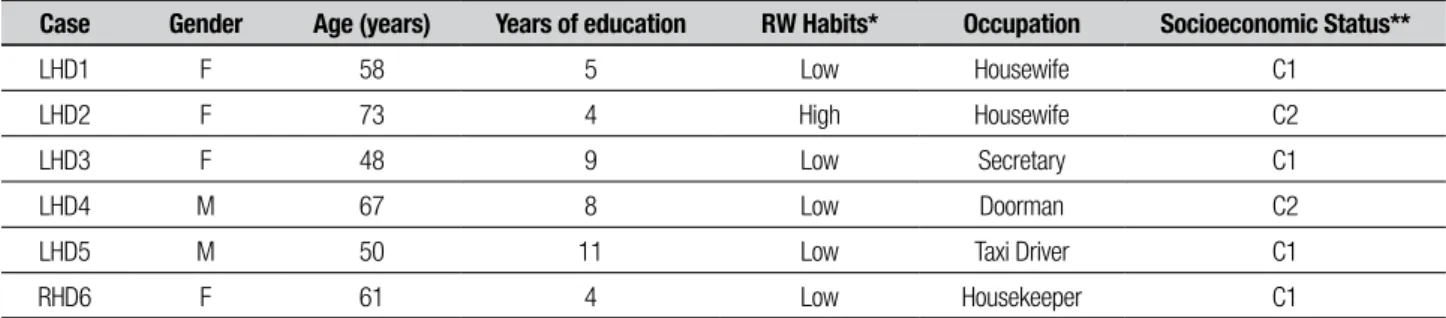
Participants. his was a series of case studies39
involv-ing six patients, Brazilian-Portuguese native speakers, with acquired dysgraphia following stroke. Five of the patients had LHD while one had RHD. hese patients were drawn from a sample of 40 right-handed adults who completed writing tasks, ten of whom had LHD (M=59.2; SD=8.6 years old), ten had RHD (M=53.3; SD=9.7 years old) and 20 were neurologically healthy (M=55.7; SD=9.3 years old). Control participants were matched to patients by gender, age and years of edu-cation. Dysgraphia was considered when patients ob-tained a score below two standard-deviations from the control mean in a word/pseudoword writing task or when the number of errors on the task was over two standard-deviations above the control mean (Z score). he cases selected had distinct sociodemographic char-acteristics, which are displayed in Table 1.
pa-tient are described in Table 2. Two of the papa-tients with LHD had Broca’s Aphasia (LHD3 and LHD4), while one patient had transcortical motor aphasia (LHD5).
Instruments and procedures. All participants or caregivers provided written informed consent prior to enrollment in the study, which was approved by the local ethics committee. he patients did not have severe depres-sion (Yesavage Geriatric Depresdepres-sion Scale – GDS-1532 or
Beck Depression Inventory BDI-II)33 or impairments in
language comprehension (Token Test – short version).35
Furthermore, patients were not aphasic and had pre-dominantly expressive language impairment (Boston Aphasia Diagnostic Test - short version)29,30
Patients were administered the spoken and written language subtests of the Brazilian Brief Neuropsycho-linguistic Assessment Battery for Expressive Aphasia (NEUPSILIN-Af).36,37 he spoken language subtests
in-cluded in this battery assess Automatic Language, Nam-ing, Repetition, Spoken Comprehension and Inferential Processing. Written language was assessed through reading aloud, written comprehension, spontaneous writing, and copying and dictation tasks.
he word/pseudoword writing task (TEPPs)38 was
used to assess written language skills. he participant was also asked to write down a series of words dictated
by the examiner to exclude individuals with hearing impairment. Participants were allowed to complete the task using the hand with which they were most com-fortable for writing. he percentage of correctly written Words (Regular, Irregular, Short, Long, Frequent, Infre-quent) and Pseudowords (Short and Long), as well as a total score (72 stimuli), were calculated for the task. he inluence of psycholinguistic variables on performance was assessed using the diference between the percent-age of correctly written short and long words (length efect), regular and irregular words (regularity efect), frequent and infrequent words (frequency efect) and words and pseudowords (lexicality efects). Errors were also categorized as linguistic (verbal paragraphia, unfa-miliarity with contextual rules, accentuation, regulariza-tion, lexicalizaregulariza-tion, neologisms, nonwords and non-an-swer) or peripheral (graphemic and graphomotor errors, rotated or mirrored writing, inclined or wavy writing, spacing between letters, tremor and perseveration).
RESULTS
Diferent types of dysgraphia were classiied based on comparisons between the performance of cases and controls (matched by gender, age and education). he following variables were used to categorize dysgraphia: number of errors, number of correct answers,
psycho-Table 1. Patient sociodemographic data.
Case Gender Age (years) Years of education RW Habits* Occupation Socioeconomic Status**
LHD1 F 58 5 Low Housewife C1
LHD2 F 73 4 High Housewife C2
LHD3 F 48 9 Low Secretary C1
LHD4 M 67 8 Low Doorman C2
LHD5 M 50 11 Low Taxi Driver C1
RHD6 F 61 4 Low Housekeeper C1
LHD: left hemisphere damage; RHD: right hemisphere damage; M: male; F: female; R: reading; W=writing. *Scores between 0 and 13 were indicative of a low frequency of reading and writing, while scores between 14 and 28 corresponded to frequent reading and writing habits. This variable was assessed by a reading and writing inventory, published by Pawlowski et al., 2012.**Assessed according to the Brazilian Economic Classification Criteria (ABEP, 2012).
Table 2. Patient neurological data.
Case Etiology Region of stroke Location of stroke Months since stroke
LHD1 H Subcortical Basal Ganglia 28
LHD2 I Subcortical Parieto-occipital 24
LHD3 I Cortico subcortical Fronto-temporal 70
LHD4 I Cortico subcortical Fronto-temporal 18
LHD5 H Subcortical Insula and periventricular region 48
RHD6 H Cortical Frontal 22
linguistic efects, types of error observed, as well as qualitative diferences between the errors observed in patients and controls. Two patients were diagnosed as having lexical dysgraphia (LHD2 and RHD6), two as phonological dysgraphia (LHD3 and LHD5), one as mixed dysgraphia (LHD1) and one with peripheral dys-graphia (LHD4). hese data are shown in Table 3.
DISCUSSION
Patients LHD2 and RHD6 displayed regularity and fre-quency efects as well as regularization errors and gra-phemic paragraphias, suggesting the predominant use of phonological processing for writing words/pseudo-words, and the presence of impairments to the lexical route (lexical dysgraphia).4 Most of the errors made
by patient LHD2 consisted of letter omissions, which were observed in the spontaneous writing and sentence copying tasks of the NEUPSILIN-Af. Letter omissions often result from diiculties in the identiication and production of words as a whole (lexical processing) and in phoneme-grapheme conversion when writing to dic-tation. Patient LHD2 also displayed letter formation errors (graphomotor) and excessive spacing between letters, neither of which were observed in case RHD6. Similar peripheral errors have been reported in cases of lexical dysgraphia, suggesting that damage to left
cor-tico-subcortical circuits, which involve structures such as the putamen, the thalamus, and the premotor and sensorimotor cortices, can inluence grapheme forma-tion.40 Parieto-occipital lesions, such as those found in
patient LHD2, have also been identiied as an important cause of lexical dygraphia.41
Patient RHD6 had no symptoms of aphasia, suggest-ing the presence of right hemisphere language special-ization, which is found in two percent of right-handed individuals.42 his patient’s proile was similar to that
reported by Rothi, Roeltgen and Kooistra (1987),43 who
described the case of a right-handed adult with RHD which displayed both regularity efects and regulariza-tion errors. hese authors suggested that patients with RHD may have diiculty using visual (or lexical) strate-gies to write words as a whole, relying instead on phono-logical strategies.
he patient with RHD assessed in the present study had a similar performance to that of an adult with posterior callosal damage described in a previous in-vestigation, who was found to have diiculty writing Kanji (ideograms with no systematic relationship to corresponding spoken sounds).44 he study in
ques-tion also found that the right hemisphere relies more on lexical-semantic processing than on phonological representations for word writing, possibly because
pho-Table 3. Types of dysgraphia according to percentage of correct answers, number of errors, psycholinguistic effects and types of errors in the TEPPs, and
impairment in the Spontaneous Writing and Sentence Copying tasks of the NEUPSILIN-Af.
Cases
Correct
answers Errors
Main psycholinguistic
effects Types of writing errors
Impairment in supplementary tasks Lexical
dysgraphia
LHD2 37 89 Regularity and frequency Letter omission, graphomotor errors, regularization, graphemic paragraphia, spacing between letters
Spontaneous writing and sentence copying
RHD6 49 42 Regularity and frequency Regularization and graphemic paragraphia
Spontaneous writing
Phonological dysgraphia
LHD3 44 46 Word length, frequency and lexicality
Neologism, letter substitution, lexicalization, non-answer, semantic paragraphia
–
LHD5 54 44 Word length and lexicality Letter substitution and omission, neologisms, non-answers, lexicalization
Spontaneous writing and sentence copying
Mixed or global dysgraphia
LHD1 4 227 Regularity Graphomotor, tremor, neologism, omission, perseveration, letter substitution, graphemic and verbal paragraphia
Spontaneous writing
Peripheral dysgraphia
LHD4 39 61 Word length and regularity Mirrored writing, inclined writing, graphemic paragraphia, letter omission, addition and substitution
Spontaneous writing
nological processes are more closely associated with the left hemisphere.45 Lexical processing strategies, on the
other hand, tend to be more closely related to activation in frontal regions of the brain.46 herefore, it is possible
that the writing impairments observed in patient RHD6 as well as his lexical dysgraphia may have been caused by frontal damage to the right hemisphere. However, fur-ther studies of patients with frontal RHD are required to conirm this hypothesis. here is also a need for re-search involving larger samples of patients with RHD, since few studies have investigated the role of the right hemisphere in lexical processing, especially in Brazilian samples.
In the present study, two patients with LHD (LHD3 and LHD5) had signiicantly greater diiculty writing pseudowords as compared to real words (lexicality ef-fect), and long words as compared to short ones (length efect). hese error patterns are indicative of phonologi-cal dysgraphia. he patterns of brain damage observed in these patients corroborate the hypothesis that a com-plex neural network involving left perisylvian regions is responsible for phoneme-grapheme conversion in word and pseudoword writing, and that damage to this struc-ture may be the cause of phonological dysgraphia.2,18,19
In addition to lexicality efects, these patients also exhibited neologisms, letter substitutions, lexicaliza-tion errors and non-answers in both the TEPPs and the Spontaneous Writing tasks of the NEUPSILIN-Af, prob-ably due to impaired phoneme-grapheme conversion and to the exclusive reliance on lexical processing when writing words and pseudowords.20 hese patients also
made similar errors in spoken language tasks, in which phonological paraphasias, anomias and agrammatisms were observed. Some of the speech impairments dis-played by patients with Broca’s and Transcortical Motor Aphasia were also evident in their performance of word and pseudoword writing tasks.47
Semantic paragraphias, which are not commonly seen in phonological dysgraphia but are a common consequence of deep dysgraphia, were only observed in patient LHD3. During the writing-to-dictation task, the patient in question wrote down the word “birds” in response to the word “wing.” According to Rapcsak et al. (2009),19 the degree of phonological processing deicits
presented by patients can have a direct impact on the severity of their writing deicits. Given the presence of both semantic and orthographic errors in some of the most severely impaired participants, the authors pro-posed the existence of a continuum of written language impairment, comprising phonological dysgraphia on the least severe end of the spectrum, followed by deep
dys-graphia and global or mixed dysdys-graphia, which are asso-ciated with similar severity levels. herefore, it is possi-ble that patient LHD3 may have transitioned from deep dysgraphia to the less severe phonological dysgraphia in the time since their stroke, either due to spontaneous language recovery, or to the beneicial efects of speech rehabilitation on phonological impairment. LHD3 is the youngest patient described in the present study with the longest time since stroke of 70 months, having already been through a long recovery period for their deicits. However, a longitudinal evaluation of this patient, in-volving pre- and post-rehabilitation assessments, would be required to conirm this hypothesis.
he performance of patient LHD1 was similar to that observed in patients with mixed or global aphasia, which lead to substantial impairments in word writing tasks due to its efects on both lexical and phonological processing.20,21 However, these patients had less
diicul-ty writing regular words than irregular or pseudowords. he most frequent errors in our sample were periph-eral in nature. Tremor and graphomotor (poor letter for-mation) errors, for instance, were identiied in all writ-ten stimuli. hese errors are ofwrit-ten observed in patients with basal ganglia lesions, which have a signiicant im-pact on motor control.48 Perseveration errors (repeated
writing of previous stimuli) are also common in patients with damage to the basal ganglia. Patient LHD1 also ex-hibited both phonological and lexical errors, corroborat-ing the idea that both types of processcorroborat-ing are involved in word and pseudoword writing, although one may be more extensively involved than the other in certain cases.15
Luzzatti et al.20 suggested two main etiologies for
mixed dysgraphia: auditory/phonological impairment (diiculty segmenting spoken words into sounds) or lexical-phonological output disturbances (grapheme selection in writing). he latter was more evident in LHD1, since the patient had adequate spoken language (including word repetition).
LHD1 developed expressive aphasia following her stroke, and had spontaneous speech recovery, never having received speech therapy. herefore, it is possible that the stroke inlicted more damage to subcortical regions associated with word and pseudoword writing rather than to areas responsible for spoken language ex-pression. hese indings corroborated those of Scarone et al.,48 who demonstrated that the following cortical
some patients may appear to recover from aphasia, but not from writing impairments, suggesting that these disturbances are caused by diferent lesions.48
LHD4 made predominantly mirrored and inclined writing errors, although graphemic errors were also ob-served (omission, addition and substitution of letters). he patient also displayed length and regularity efects, since fewer errors were observed in short and regular words. hese features are characteristic of peripheral dysgraphia.2,6
Mirrored writing (writing some letters or the entire word in mirrored form) is a spatial error caused by im-pairments in the motor representation of letters, which is also observed in adults who are asked to write with their left hand.49 he motor sequences used for letter
writing are associated with the right hands of right-handed individuals, so that a new motor program must be learned when individuals attempt to write with their left hands. Due to stroke-associated motor deicits, pa-tient LHD4 performed the TEPPs with her non-domi-nant hand, which may explain the presence of mirrored writing in her responses to the task.
Patient LHD4 also had diiculty maintaining letter sequences while writing, possibly due to graphemic buf-fer damage.2 It is possible that these errors were caused
by dysfunctions in working memory (namely, in the buf-fer component) during word writing.23,24 he graphemic
bufer is also sensitive to word length efects, since lon-ger words take up more of its capacity.2,6 Furthermore,
patient LHD4 also displayed regularity efects, suggest-ing that the graphemic bufer may be more sensitive to certain letter sequences, such as those found in irregu-lar words. his inding has been previously observed in
a case of non-luent aphasia by Gvion and Friedmann (2010).50
he errors exhibited by patient LHD4, which con-sisted mostly of the omission, addition and substitution of letters, are often observed in cases of graphemic buf-fer impairment. Graphemic paragraphias, consisting of phonologically plausible letter substitutions, were also observed. Although these are usually considered phono-logical errors, it is possible that in the case of this spe-ciic patient, they may have been caused by damage to the graphemic bufer. Similar errors have been reported in patients who sufered extensive LHD25, akin to that seen in patient LHD4.
In conclusion, the fact that dysgraphia was diag-nosed in half the participants with LHD suggests that this hemisphere plays an important role in word writ-ing. he presence of lexical dysgraphia in a patient with RHD also underscores the need for further studies of the role of the right hemisphere in word processing.
he fact that two patients with LHD displayed poor performance and made several errors in the TEPPs, in spite of an absence of aphasia, suggested that the cogni-tive mechanisms involved in spoken language are distinct from those responsible for writing. On the other hand, patients with aphasia made similar errors on both spoken and written tasks, suggesting that, in more severe cases, both spoken and written language may be impaired, cor-roborating the hypothesis of a continuum of severity in dysgraphia. Results such as those of the present study help advance knowledge on written word processing, and may serve as a basis for neuropsychological inter-ventions which focus speciically on the diferent pat-terns of impairment observed in each type of dysgraphia.
REFERENCES
1. Ardila A, Rosselli M. Agraia. In: Ardila A, Rosselli M (eds), Neuropsi-cología Clínica. México: Editorial El Manual Moderno; 2007:101-113. 2. Rapcsak S, Beeson PM. Agraphia. Enciclopedia of the Human Brain
2002;1:71-86.
3. Henry ML, Beeson PM, Stark AJ, Rapcsak SZ. The role of left perisyl-vian cortical regions in spelling. Brain Lang 2007;100:44-52. 4. Rapcsak SZ, Beeson PM. The role of left posterior inferior temporal
cortex in spelling. Neurology 2004;62:2221-2229.
5. Rapcsak SZ, Rubens AB. Disruption of semantic inluence on writing following a left prefrontal lesion. Brain Lang 1990;38:334-44. 6. Carthery MT, Parente MAMP. Agraias adquiridas - Introdução histórica
e classiicação. In: Ortiz KZ (ed), Distúrbios Neurológicos Adquiridos, 2ª ed., Barueri: Manole; 2010:176-198.
7. Ardila A, Rosselli M. Spatial agraphia. Brain Cogn 1993;22:137-147. 8. Cubelli R, Guiducci A, Consolmagno P. Afferent dysgraphia after right
ce-rebral stroke: An autonomous syndrome? Brain Cogn 2000;44:629-644. 9. Seki K, Ishiai S, Koyama Y, et al. Effects of unilateral spatial neglect on
spatial agraphia of Kana and Kanji letters. Brain Lang 1998;63:256-275. 10. Beeson PM, Rapcsak SZ, Plante E, et al. The neural substrates of writ-ing: A functional magnetic resonance imaging study. Aphasiology 2003; 17:647-665.
11. Coltheart M. Acquired dyslexias and the computational modeling of reading. Cogn Neuropsychol 2006;23:96-109.
12. Houghton G, Zorzi M. Normal and impaired spelling in a connectionist dual-route architecture. Cogn Neuropsychol 2003;20:115-162. 13. Plaut DC, McClelland JL, Seidenberg MS, Patterson K. Understanding
normal and impaired word reading: Computational principles in quasi-regular domains. Psychol Rev 2006;103:56-115.
14. Rapcsak SZ, Henry ML, Teague SL, Carnahan SD, Beeson PM. Do dual-route models accurately predict reading and spelling performance in individuals with acquired alexia and agraphia? Neuropsychologia 2007;45:2519-2524.
15. Ellis AW. Leitura, escrita, dislexia. Uma análise cognitiva. Trad. Dayse Batista. 2a ed. Porto Alegre: Artes Médicas; 1995:153p.
16. Lecours AR, Parente MAMP. Dislexia: Implicações do sistema de es-crita do português. São Paulo: Artes Médicas; 1997:186.
17. Coltheart M, Rastle K, Perry C, Langdon R, Ziegler T. DRC: Dual-route cascaded model of visual word recognition and reading aloud. Psychol Rev 2001;108:204-256.
dysgraphia: Cognitive mechanisms and neural substrates. Cortex 2009;45:575-591.
20. Luzzatti C, Laiacona M, Allamano N, De Tanti A, Inzaghi MG. Writing disorders in Italian aphasic patients: A multiple single-case study of dys-graphia in a language with shallow orthography. Brain 1998;12:1721-1734.
21. Laiacona M, Capitani E, Zonca G, Scola I, Saletta P, Luzzatti C. Inte-gration of lexical and sublexical processing in the spelling of regular words: A multiple single-case study in Italian dysgraphic patients. Cor-tex 2009;45:804-815.
22. Jefferies E, Sage K, Ralph MAL. Do deep dyslexia, dysphasia and dys-graphia share a common phonological impairment? Neuropsychologia 2007;45:1553-1570.
23. Caramazza A, Miceli G, Villa G. The role of the (output) phonological buf-fer in reading, writing and repetition. Cogn Neuropsychol 1986;3:37-76. 24. Miceli G, Capasso R. Spelling and dysgraphia. Cognitive Neuropsychol
2006;23:110-134.
25. Miceli G, Benvegnù B, Capasso R, Caramazza A. The independence of phonological and orthographic lexical forms: Evidence from aphasia. Cognitive Neuropsychol 1997;14:35-70.
26. Di Pietro M, Schnider A, Ptak R. Peripheral dysgraphia characterized by the co-occurrence of case substitutions in uppercase and letter substitutions in lowercase writing. Cortex 2011;47(9):1038-1051. doi: 10.1016/j.cortex.2010.10.005
27. Rapp B, Caramazza A. From graphemes to abstract letter shapes: Lev-els of representation in written spelling. J Exp Psychol Hum Percept Perform 1997;23: 1130-1152.
28. Sakurai Y, Onuma Y, Nakazawa G, et al. Parietal dysgraphia: Character-ization of abnormal writing stroke sequences, character formation and character recall. Behav Neurol 2007;18:99-114.
29. Goodglass H, Kaplan E, Barresi B. Boston Diagnostic Aphasia Exami-nation Short Form. Philadelphia, USA: Lippincott Williams & Wilkins; 2001.
30. Radanovic M, Mansur LL, Azambuja MJ, Porto CS, Scaff M. Contribu-tion to the evaluaContribu-tion of language disturbances in subcortical lesions: A pilot study. Arq Neuropsiquiatr 2004;62:51-57.
31. Pawlowski J, Remor E, Parente MAMP, Salles JF, Fonseca RP, Bandeira DR. The inluence of reading and writing habits associated with educa-tion on the neuropsychological performance of Brazilian adults. Read Writ 2012;25:2275-2289.
32. Yesavage JA, Brink TL, Rose TL, Lurn O. Development and validation of a geriatric depression screening scale: a preliminary report. J Psychiatr Res 1983;17:37-49.
33. Gorenstein C, Pang WY, Argimon IL, Werlang BSG. BDI-II - Inventário de depressão de Beck. Porto Alegre: Casa do Psicólogo; 2011. 34. Chaves ML, Izquierdo I. Differential diagnosis between dementia and
depression: A study of eficiency increment. Acta Neurol Scand 1992; 11:412-429.
35. Moreira L, Schlottfeldt CG, Paula JJ, et al. Estudo Normativo do Token Test versão reduzida: Dados preliminares para uma população de ido-sos brasileiros. Rev Psiquiatr Clín 2011;38:97-101.
36. Fontoura DR, Rodrigues JC, Parente MAMP, Fonseca RP, Salles JF. Adaptação do Instrumento de Avaliação Neuropsicológica Breve NE-UPSILIN para avaliar pacientes com afasia expressiva: NENE-UPSILIN-Af. Ciênc Cogn 2011;16:78-94.
37. Fontoura DR, Rodrigues JC, Mansur L, Monção AM, Salles JF. Neu-ropsycholinguistic proile of patients post-stroke in the left hemi-sphere with expressive aphasia. Rev Neuropsic Neuropsiq Neurocien 2013;13:91-110.
38. Rodrigues JC, Salles JF. Tarefa de escrita de palavras/pseudopalavras para adultos: abordagem da neuropsicologia cognitiva. Letras de Hoje 2013;48:50-58.
39. Schwartz MF, Dell GS. Case series investigations in cognitive neuropsy-chology. Cogn Neuropsychol 2010;27:477-494.
40. Sakurai Y, Yoshida Y, Sato K, Sugimoto I, Mannen T. Isolated thalamic agraphia with impaired grapheme formation and micrographia. J Neurol 2011;258:1528-1537.
41. Roeltgen DP, Heilman KM. Lexical agraphia: Further support for the two-strategy hypothesis of linguistic agraphia. Brain 1984;107:811-827. 42. Springer JA, Binder JR, Hammeke TA. Language dominance in neu-rologically normal and epilepsy subjects: A functional MRI study. Brain 1999;122:2033-2045.
43. Rothi LJG, Roeltgen DP, Kooistra CA. Isolated lexical agraphia in a right-handed patient with a posterior lesion of the right cerebral hemisphere. Brain Lang 1987;30:181-190.
44. Yamadori A, Nagashima T, Tamaki N. Ideogram writing in a disconnec-tion syndrome. Brain Lang 1983;19:346-356.
45. Rapcsak SZ, Beeson PM, Rubens AB. Writing with the right hemi-sphere. Brain Lang 1991;41:510-530.
46. Hayashi A, Nomura H, Mochizuki R, et al. Neural substrates for writ-ing impairments in Japanese patients with mild Alzheimer’s disease: A SPECT study. Neuropsychologia 2011;49:1962-1968.
47. Helm-Estabrooks N, Albert ML. Manual of aphasia and aphasia therapy. Austin: Pro-Ed; 2003.
48. Scarone P, Gatignol P, Guillaume S, Denvil D, Capelle L, Duffau H. Agraphia after awake surgery for brain tumor: New insights into the anatomo-functional network of writing. Surg Neurol 2009;72:223-241. 49. Balfour S, Borthwick S, Cubelli R, Della Sala S. Mirror writing and re-versing single letters in stroke patients and normal elderly. J Neurol 2007;254:436-441.