Systematic Review
Revisão Sistemática
Oropharyngeal dysphagia and related
factors in post-cardiac surgery:
a systematic review
Fatores relacionados à disfagia orofaríngea no
pós-operatório de cirurgia cardíaca:
revisão sistemática
Roberta Weber Werle1
Eduardo Matias dos Santos Steidl1
Renata Mancopes1
Keywords
Heart Diseases Thoracic Surgery Deglutition Disorders Risk Groups Intensive Care Units
Descritores
Cardiopatias Cirurgia Torácica Transtornos de Deglutição Grupos de Risco Unidades de Terapia Intensiva
Correspondence address:
Renata Mancopes
Centro de Ciências da Saúde, Universidade Federal de Santa Maria – UFSM
Av. Roraima, 1000, prédio 26, sala 1410, Bairro Camobi, Santa Maria (RS), Brazil, CEP: 97105-900. E-mail: [email protected]
Received: August 03, 2015 Study carried out at Programa de Pós-graduação em Distúrbios da Comunicação Humana, Universidade Federal
de Santa Maria – UFSM - Santa Maria (RS), Brazil.
1 Universidade Federal de Santa Maria – UFSM - Santa Maria (RS), Brazil.
Financial support: Coordenação de Aperfeiçoamento de Pessoal de Nível Superior (CAPES).
Conlict of interests: nothing to declare. ABSTRACT
Purpose: To identify the main factors associated with oropharyngeal dysphagia following cardiac surgery through a systematic review of the literature. Methods: A bibliographic search was conducted in the PubMed and ScienceDirect databases using the following keywords: “cardiac surgery”, “deglutition disorders”, and “dysphagia”. Selection criteria: Articles published in Portuguese, English, or Spanish addressing oropharyngeal dysphagia following cardiac surgery were selected with no time limitation. Only studies available in full were included. Data analysis: First, articles were screened for title and abstract. Subsequently, they were submitted to full assessment by two blinded referees. The following data were extracted: authors, year of publication, study design, sample size, variables evaluated, and main results. Results: The main factors related to oropharyngeal dysphagia in post-cardiac surgery were advanced age, presence of comorbidities and other diseases, intubation time, and surgical conditions. Conclusion: The studies showed high heterogeneity, demonstrating that individuals who undergo cardiac surgical procedures, especially the elderly, present several factors related to oropharyngeal dysphagia postoperatively, such as cardiopulmonary bypass, transesophageal echocardiography, associated comorbidities, development of postoperative sepsis, and previous heart conditions.
RESUMO
Objetivo: Identiicar os principais fatores relacionados à disfagia orofaríngea no pós-operatório de cirurgia
cardíaca, por meio de uma revisão sistemática de literatura. Método: Foi realizada pesquisa bibliográica nas bases PubMed e ScienceDirect, utilizando os termos cardiac surgery, deglutition disorders e dysphagia. Critérios de seleção: Foram selecionados artigos sem limitação de ano escritos em português, inglês ou espanhol e que referissem disfagia orofaríngea no pós-operatório de cirurgia cardíaca. Apenas os estudos disponíveis na íntegra foram incluídos. Análise dos dados: Cada artigo passou pela análise de títulos e resumos, sendo posteriormente
submetido à avaliação na íntegra por dois juízes cegados. Os seguintes dados foram extraídos: autores/ano,
desenho do estudo, amostra, variáveis avaliadas e principais resultados. Resultados: Os principais fatores
relacionados à disfagia orofaríngea no pós-operatório de cirurgia cardíaca foram: idade avançada, presença de
comorbidades e outras doenças associadas, tempo de intubação e condições cirúrgicas. Conclusão: Os estudos
foram bastante heterogêneos, demonstrando que sujeitos submetidos a procedimentos cirúrgicos cardíacos, em especial idosos, apresentam diversos fatores relacionados à disfagia orofaríngea no pós-operatório, como o uso de circulação extracorpórea e ecocardiograia transesofágica, comorbidades associadas, desenvolvimento de
INTRODUCTION
Transmissible chronic diseases are the leading causes of disability and mortality worldwide. Cardiovascular conditions, cancer, and diabetes mellitus are among the most important diseases in the ield of public health. Among the cardiovascular diseases (CVD), cerebrovascular ischemia and systemic arterial hypertension should be highlighted(1). Epidemiological studies
indicate that CVD accounts for one third of all deaths in the world, with myocardial ischemia as the main cause(1,2). Also,
it is estimated that CVD will be responsible for 25 million deaths in 2020(3).
Heart surgery is among the therapeutic methods commonly employed for the management of cardiac patients. Heart surgeries can be corrective (defects of the ductus arteriosus; atrial or ventricular septum), reconstructive (coronary artery bypass grafting (CABG); aortic, mitral or tricuspid valve plasty), or of replacement (valve transplants and replacements)(1). Reconstructive
surgeries, particularly CABG, occur most often. In adults and the elderly, the conditions that require cardiac surgery most often are coronary atherosclerosis and valvular diseases(4,5).
Deglutition is a complex activity involving coordinated voluntary and involuntary actions, as well as neuromuscular structures of the oropharyngolaryngeal region and the esophagus, which aims to maintain the nutritional status and protect the airways. Any alteration in this process is identiied as dysphagia. Dysphagia is associated with increased morbidity and mortality, and it may cause several clinical complications, such as dehydration, malnutrition, and aspiration pneumonia(6,7).
Impairment of the swallowing function may be present in various conditions in hospitalized patients, such as in the cases of trauma, stroke, and chronic obstructive pulmonary disease, as well as in patients with cardiopathies(8). In this context, in
recent years, research has indicated a possible relationship between cardiac surgery and the development of oropharyngeal dysphagia in the postoperative period due to exposure of patients to various risk factors, such as endotracheal intubation (OTI), cardiopulmonary bypass (CPB), transesophageal echocardiography (TEE), among others(8-11).
A study conducted with 361 patients undergoing CABG showed an incidence of 53.5% of respiratory infection postoperatively(12),
indicating the need to evaluate the presence of oropharyngeal dysphagia in this population, especially in individuals at risk for aspiration(13).
PURPOSE
In this context, the aim of the present study was to identify the main factors associated with oropharyngeal dysphagia following cardiac surgery through a systematic review of the literature.
METHODS
Study design
The guidelines of the Cochrane Handbook(14) and the information
provided by Sampaio and Mancini(15) were considered for the
realization of this systematic review. The following survey
question was used: What are the factors related to oropharyngeal dysphagia in patients following cardiac surgery?
Search strategy
A search was conducted in the PubMed and ScienceDirect databases. The keywords “cardiac surgery” and “deglutition disorders” and the free search term “dysphagia” were used in the search for published works. Association between them was conducted by means of the Boolean operator “AND”. The search occurred between April and May 2015.
Articles published in Portuguese, English, or Spanish addressing oropharyngeal dysphagia following cardiac surgery were selected with no limitation of time. Only studies available in full were selected. The following publications were excluded from the search: expert opinions, dissertations, theses, monographs, reviews, and studies involving other types of thoracic surgery, children, drugs, esophageal dysphagia, and epidemiological data.
Selection of studies
Initially, articles were screened for title and abstract. All articles that met the eligibility criteria of the proposed theme were selected. They were then submitted to full, independent assessment by two blinded referees.
Data analysis
After selection, in case of disagreement, a third referee evaluated the article and provided a inal opinion on its inclusion or exclusion. Using a standardized form, each reviewer extracted the following data: authors, year of publication, study design, sample size, variables evaluated, and main results, which compose the descriptive summary presented in Chart 1.
RESULTS
Selection of studies
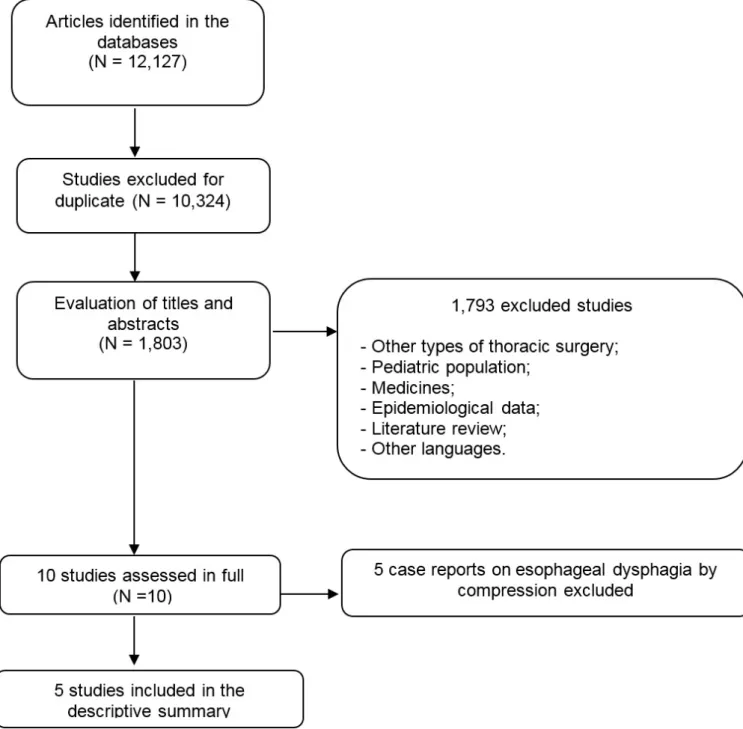
The search found 12,127 articles with the proposed keywords published in the databases consulted (3009 at PubMed and 9118 at ScienceDirect). Of these, 10,324 were excluded for duplicate and 1793 for other reasons. Eventually, 10 studies were read in full by the researchers, but ive of them were case reports that addressed only esophageal dysphagia for heart or vascular compression and, consequently, were also excluded. Only ive studies addressing oropharyngeal dysphagia following cardiac surgery were left. One master’s thesis(8) and one doctoral dissertation(16) accomplished in
Brazil were found; however, they were not considered in the analysis of results and were used only for the theoretical substantiation of this review.
Characterization of studies
Only studies published in English conducted in the United States (60%)(9,10,17) and Canada (40%)(11,18) were included in this
literature review. The study sample ranged from 254(18) to 1042(10)
individuals (mean 781.2). Age varied from 65.4±12.1(18) to
74.3±8.7(11) years between the groups of patients with dysphagia
and from 62.8±11.8(10) to 63±0.4(17) years between the groups
of patients without dysphasia. The study by Rousou et al.(9) did
not consider age as a factor for the development of dysphagia between the groups of individuals undergoing TEE.
All of the articles selected in the review search were retrospective, cross-sectional studies which included analysis of medical records of patients who underwent cardiac surgery. The most common interventions were valve repair/replacement, coronary bypass, and CABG. Chart 1 shows the descriptive summary of every study listed for the literature review.
According to the studies investigated, the main factors related to oropharyngeal dysphagia following cardiac surgery were advanced age, presence of comorbidities and other diseases, intubation time, and surgical conditions.
Chart 1. Descriptive summary of studies
Authors Study design
Total of sample/ dysphagia patients
Surgical procedures Variables assessed Factors related to oropharyngeal dysphagia
Rousou et al.(9) Retrospective cross-sectional
838/ 23
CABG, coronary bypass and valve repair/
replacement
Time of OI, previous S, CPB, left ventricular ejection fraction, time of
surgery, type of surgery (with or without CABG).
Time of OI and CPB, reduced left ventricular ejection fraction, time and
type of surgery (CABG).
Ferraris et al.(10) Retrospective cross-sectional
1042/
31 CABG
Age, height, weight, ejection fraction, CPB,
DM, creatinine>2.5, increased cholesterol level, presence of COPD,
PVD, S, CCF, aspirin therapy preoperatively,
preoperative shock, SAH, unstable angina,
non-CABG heart surgery, NYHA>2, and
reoperations.
Advanced age, DM, hyperdyslipidemia, RI and
CCF.
Skoretz et al.(11) Retrospective cross-sectional
909 / 51
CABG and valve repair/replacement
Age, comorbidities, time of OI, reintubation,
reoperation, atrial fibrillation, readmission in ICU post-extubation, length of stay in ICU, pre- and post-operative
hospitalization time and total length of
hospitalization.
Advanced age, CCF, atrial fibrillation, previous
S, NYHA>2, OI>12 h, reoperation, reintubation,
length of stay in ICU, pre- and post-operative hospitalization time, total
length of hospitalization and use of TEE.
Hogue et al.(17) Retrospective cross-sectional
869/ 34
CABG, coronary bypass, valve repair/replacement, cardiac tumors, aortic
aneurysm repair, and congenital abnormalities
identified in adulthood,
Age, history of MI, SAH, DM, S, COPD, RI
and OI, left ventricular function, transthoracic echocardiography, time of EC, aortic clamping, low cardiac output after the operation, use of intra-aortic balloon pump,
new development of S, RI, hepatic dysfunction, parenteral nutrition,
sepsis.
Advanced age, time of OI, use of TEE.
Barker et al.(18) Retrospective cross-sectional
254/ 130
CABG and valve repair/replacement
Age, gender, smoking history, family history of
heart disease, surgical risk, DM, NYHA, CCF, SAH, hyperdyslipidemia, previous S, sinus rhythm,
COPD, renal risk.
Time of OI, perioperative S and sepsis.
The elderly are more likely to develop CVD, thus cardiac surgery rates in this population outnumber those in other age groups(19). In this population in particular, heart surgery is
related to high morbidity and mortality rates because of the high prevalence of associated comorbidities, especially metabolic disorders such as diabetes mellitus and dyslipidemia, and the lower functional reserve and depletion of lean body mass(10,19-21).
In this context, the elderly may present presbiphagia, which occurs owing to the physiological process of aging, which affects the phonoarticulatory neuromuscular structures responsible for the swallowing process(22). Presbiphagia associated with other
factors, such as comorbidities and the presence of CVD, can
negatively affect deglutition, predisposing for oropharyngeal dysphagia(23).
Congestive heart failure (CHF) is the most common cardiac diagnosis in patients over 65 years old and is a common cause of hospitalization and demise, presenting signiicant inancial burden(24). Gyalai-Korpos et al.(25) found that elderly people with
CHF often present hospitalization time longer than 12 days, according to the New York Heart Association classiication (NYHA>4), presence of one or more comorbidities, and associated chronic renal failure, as well as decreased pulmonary condition and physical functional capacity. These changes are associated with increased NYHA functional class, regardless of
the values of the left ventricular ejection fraction, relecting the impact of enhanced disease severity(26). Therefore, CHF alone
presents a number of factors that may explain the appearance of oropharyngeal dysphagia in the postoperative period of cardiac surgery, as reported by the studies listed in present review.
Another factor reported by the studies was the presence of preoperative cerebrovascular accident (S). Stroke is the leading cause of severe neurological disability and constitutes a public health problem due to its high treatment costs and because it is a major cause of death(27). Approximately 45% to 65% of
patients develop oropharyngeal dysphagia, and its presence is associated with increased risk of pulmonary complications owing to aspiration of saliva and/or food, malnutrition, dehydration, prolonged hospitalization, and demise(28,29).
Dysphagia is common among critically ill patients(30), with
asymptomatic or symptomatic aspiration as an important risk factor for the development of acute lung injury, prolonged hospital stays, and increased mortality rates(31). Swallowing
dysfunction in critical illness has been identiied as an important area of research because of its negative inluence on the clinical prognosis of patients(32).
Recently, research has shown a possible correlation between the development of sepsis and oropharyngeal dysphagia among seriously ill patients. The incidence of severe sepsis increases morbidity and mortality rates in this group of patients(33,34). A study
conducted with 30 patients with severe sepsis and 30 without sepsis reported that 19 patients evolved to oropharyngeal dysphagia 14 days after ICU admission in the group with sepsis, whereas only seven individuals in the group without sepsis developed oropharyngeal dysphagia(35).
Therefore, severe sepsis is an independent factor related to dysphagia development in severely ill patients, justiied by the electrophysiological indings of polyneuropathy and myopathy in all septic patients, causing muscle weakness and playing an important role in the development of dysphagia(35).
Artiicial airways have a negative effect on the larynx and general physiology of swallowing. The literature describes high incidence of dysphagia following intubation, varying widely between 3% and 83%(10,36). The studies investigated showed
that prolonged intubation may be an independent predictor for dysphagia(18) and that artiicial airways increase the risk of lesions
in the upper airways and the larynx, which, in turn, affect the mechanics, aerodynamics, and relex protection of the irst(36).
Kwok et al.(37) demonstrated that orotracheal intubation (OI)
time is strongly associated with post-extubation dysphagia. Each day, after the irst 24 hours on mechanical ventilation, increased the odds of developing dysphagia by 25%. Two days after OI, the risk of oropharyngeal dysphagia reached 50%. The mechanisms that lead to post-extubation dysphagia include multifactorial aspects, such as prolonged inactivity of oropharyngeal muscles, glottal injury, mucosal inlammation, and ulceration of the vocal cords, in addition to mechanical and sensory changes(38).
Another important factor mentioned in the studies analyzed addresses the surgical condition, such as the use of CPB and/or TEE. CPB is commonly used during surgery of coronary and
valvular insuficiencies because it allows safety optimization and provides reproducibility of results; however, due to its systemic inlammatory response, CPB is associated with postoperative complications(8,39). Respiratory complications are the most
important, because systemic inlammation alters the vascular permeability of the lung and also causes acute pulmonary injury, respiratory distress syndrome, increased incidence of pneumonia, and longer mechanical ventilation (MV) time(8,40,41).
TEE allows dynamic visualization of the surgical procedure, especially in valvular and revascularization surgeries, by means of an esophageal tube; thereby it detects the functionality of the heart and the newly implanted valve(8). Studies have reported
association between the use of TEE and the development of oropharyngeal dysphagia postoperatively owing to injuries that can occur in the oropharynx and/or esophagus during OI(7,17).
Also, the retrospective, cross-sectional studies included in this review only provided data regarding factors related to oropharyngeal dysphagia. Nevertheless, case-control and/or cohort studies, which can identify risk factors for oropharyngeal dysphagia in the population undergoing cardiac surgery, are extremely important.
CONCLUSION
Through this literature review, it was possible to observe that patients undergoing cardiac surgery present several factors related to the development of oropharyngeal dysphagia. The most prevalent factors found in the studies assessed were advanced age, use of cardiopulmonary bypass (CPB) and transesophageal echocardiography (TEE) during the surgical procedure, and associated comorbidities (neurological, metabolic, development of postoperative sepsis, and previous heart conditions).
Furthermore, articles conducted in Brazil were not found; therefore, the authors suggest research in this theme in order to highlight the reality of the country, such as the characterization of the population undergoing cardiac surgical procedures and incidence and identiication of factors that may affect deglutition.
It is worth mentioning the limitations of this review regarding the small number of studies; restriction to Portuguese, English, and Spanish in the inclusion process; and the inability to perform meta-analysis owing to the heterogeneity of the outcomes assessed and the surgical interventions to which the individuals were submitted.
REFERENCES
1. Rocha LA, Maia TF, Silva LF. Diagnósticos de enfermagem em pacientes
submetidos à cirurgia cardíaca. Rev Bras Enferm. 2006;59(3):321-6. http:// dx.doi.org/10.1590/S0034-71672006000300013. PMid:17175721.
2. OPAS: Organização Pan-Americana da Saúde. CARMEN: iniciativa para a prevenção integrada de doenças não-transmissíveis nas Américas. Brasília: OPAS; 2003.
de revascularização do miocárdio. Arq Bras Cardiol. 2003;80(1):41-50. PMid:12612724.
4. Giffhorn H. Avaliação de uma escala de risco em pacientes submetidos
à cirurgia de revascularização do miocárdio: análise de 400 casos. Rev
Bras Ter Intensiva. 2008;20(1):6-7. http://dx.doi.org/10.1590/S0103-507X2008000100002. PMid:25306942.
5. Nobre F, Serrano CV Jr. Tratado de Cardiologia SOCESP. Barueri: Manole; 2005.
6. Etges CL, Scheeren B, Gomes E, Barbosa LR. Instrumentos de rastreio em disfagia: uma revisão sistemática. CoDAS. 2014;26(5):343-9. http://
dx.doi.org/10.1590/2317-1782/20142014057. PMid:25388065.
7. Skoretz SA, Flowers HL, Martino R. The incidence of dysphagia following endotracheal intubation: a systematic review. Chest. 2010;137(3):665-73.
http://dx.doi.org/10.1378/chest.09-1823. PMid:20202948.
8. Duarte ST. Fatores de risco para disfagia em pacientes submetidos à cirurgia cardíaca [dissertação]. Curitiba: Universidade Tuiuti do Paraná; 2010. 95 p.
9. Rousou JA, Tighe DA, Garb JL, Krasner H, Engelman RM, Flack JE 3rd, et al. Risk of dysphagia after transesophageal echocardiography during cardiac operations. Ann Thorac Surg. 2000;69(2):486-9. http://
dx.doi.org/10.1016/S0003-4975(99)01086-3. PMid:10735685.
10. Ferraris VA, Ferraris SP, Moritz DM, Welch S. Oropharyngeal dysphagia after cardiac operation. Ann Thorac Surg. 2001;71(6):1792-5. http://dx.doi.
org/10.1016/S0003-4975(01)02640-6. PMid:11426749.
11. Skoretz SA, Yau TM, Ivanov J, Granton JT, Martino R. Dysphagia and associated risk factors following extubation in cardiovascular surgical patients. Dysphagia. 2014;29(6):647-54. http://dx.doi.org/10.1007/s00455-014-9555-4. PMid:25119447.
12. Iglézias JCR, Oliveira JL Jr, Dallan LAO, Lourenção A Jr, Stolf NAG. Preditores de mortalidade hospitalar no paciente idoso portador de doença arterial coronária. Rev Bras Cir Cardiovasc. 2001;16(2):94-104. http://
dx.doi.org/10.1590/S0102-76382001000200002.
13. Hammond CAS, Goldstein LB. Cough and aspiration of food and liquids due to oral-pharyngeal dysphagia: ACCP evidence-based clinical practice guidelines. Chest. 2006;129(1, Supl 1):S154-68. http://dx.doi.org/10.1378/ chest.129.1_suppl.154S. PMid:16428705.
14. Higgins J, Green S, editors. Cochrane Handbook for Systematic Reviews of Interventions. Version 5.1.0 [updated March 2011] [Internet]. The Cochrane Collaboration; 2011 [citado em 2015 Jan 29]. Disponível em:
http://www.cochrane-handbook.org
15. Sampaio RF, Mancini MC. Estudos de revisão sistemática: um guia para síntese criteriosa da evidência científica. Rev. Bras. Fisioter. 2007;11(1):83-9. http://dx.doi.org/10.1590/S1413-35552007000100013.
16. Dantas MOR. Disfagia em cardiopatas idosos: teste combinado de deglutição e monitorização dos sinais vitais [tese]. São Paulo: Universidade de São Paulo; 2008. 95 p.
17. Hogue CW Jr, Lappas GD, Creswell LL, Ferguson TB Jr, Sample M, Pugh D, et al. Swallowing dysfunction after cardiac operations: associated adverse outcomes and risk factors including intraoperative transesophageal echocardiography. J Thorac Cardiovasc Surg. 1995;110(2):517-22. http://
dx.doi.org/10.1016/S0022-5223(95)70249-0. PMid:7637370.
18. Barker J, Martino R, Reichardt B, Hickey EJ, Ralph-Edwards A. Incidence and impact of dysphagia in patients receiving prolonged endotracheal intubation after cardiac surgery. Can J Surg. 2009;52(2):119-24. PMid:19399206.
19. Laizo A, Delgado FEF, Rocha GM. Complicações que aumentam o tempo de permanência na unidade de terapia intensiva na cirurgia cardíaca. Rev Bras Cir Cardiovasc. 2010;25(2):166-71. http://dx.doi.org/10.1590/S0102-76382010000200007. PMid:20802907.
20. Alves L Jr, Rodrigues AJ, Evora PRB, Basseto S, Scorzoni A Fo, Luciano PM, et al. Fatores de risco em septuagenários ou mais idosos submetidos a revascularização do miocárdio e ou operações valvares. Rev Bras Cir Cardiovasc. 2008;23(4):550-5. http://dx.doi.org/10.1590/S0102-76382008000400016. PMid:19229429.
21. Carrascal Y, Maroto L, Rey J, Arévalo A, Arroyo J, Echevarría JR, et al. Impact of preoperative anemia on cardiac surgery in octogenarians. Interact Cardiovasc Thorac Surg. 2010;10(2):249-55. http://dx.doi.org/10.1510/ icvts.2009.220160. PMid:19889715.
22. Acosta NB, Cardoso MCAF. Presbifagia: estado da arte da deglutição do idoso. RBCEH. 2012;9(1):143-54.
23. Lima R, Diniz R, Césio A, Vasconcelos F, Gesteira M, Menezes A, et al. Revascularizaçãzo miocárdica em pacientes octogenários: estudo retrospectivo e comparativo entre pacientes operados com e sem circulação extra-corpórea. Rev Bras Cir Cardiovasc. 2005;20(1):8-13. http://dx.doi.
org/10.1590/S0102-76382005000100006.
24. Linné AB, Liedholm H, Jendteg S, Israelsson B. Health care costs of heart failure: results from a randomized study of patient education. Eur J Heart Fail. 2000;2(3):291-7. http://dx.doi.org/10.1016/S1388-9842(00)00089-1. PMid:10938491.
25. Gyalai-Korpos I, Ancusa O, Dragomir T, Tomescu MC, Marincu I. Factors associated with prolonged hospitalization, readmission, and death in elderly heart failure patients in western Romania. Clin Interv Aging. 2015;10:561-8. PMid:25792819.
26. Di Naso FC, Pereira JS, Beatricci SZ, Bianchi RG, Dias AS, Monteiro MB. A classe da NYHA tem relação com a condição funcional e qualidade de vida na insuficiência cardíaca. Fisioter Pesq. 2011;18(2):157-63. http://
dx.doi.org/10.1590/S1809-29502011000200010.
27. Sacco RL. Patogênese, classificação e epidemiologia das doenças vasculares cerebrais. In: Rowland LP. Tratado de neurologia. Rio de Janeiro: Guanabara Koogan; 2007. 255 p.
28. Marik PE, Kaplan D. Aspiration pneumonia and dysphagia in the elderly. Chest. 2003;124(1):328-36. http://dx.doi.org/10.1378/chest.124.1.328. PMid:12853541.
29. Martino R, Foley N, Bhogal S, Diamant N, Speechley M, Teasell R. Dysphagia after stroke: incidence, diagnostic and pulmonary complications. Stroke. 2005;36(12):2756-63. http://dx.doi.org/10.1161/01.STR.0000190056.76543. eb. PMid:16269630.
30. Batty S. Communication, swallowing and feeding in the intensive care unit patient. Nurs Crit Care. 2009;14(4):175-9. http://dx.doi.org/10.1111/j.1478-5153.2009.00332.x. PMid:19531034.
31. Mirzakhani H, Williams JN, Mello J, Joseph S, Meyer MJ, Waak K, et al. Muscle weakness predicts pharyngeal dysfunction and symptomatic aspiration in long-term ventilated patients. Anesthesiology. 2013;119(2):389-97.
32. Moraes DP, Sassi FC, Mangilli LD, Zilberstein B, Andrade CR. Clinical prognostic indicators of dysphagia following prolonged orotracheal intubation in ICU patients. Crit Care. 2013;17(5):R243. http://dx.doi.org/10.1186/ cc13069. PMid:24138781.
33. Martin GS. Sepsis, severe sepsis and septic shock: changes in incidence, pathogens and outcomes. Expert Rev Anti Infect Ther. 2012;10(6):701-6.
http://dx.doi.org/10.1586/eri.12.50. PMid:22734959.
34. Winters BD, Eberlein M, Leung J, Needham DM, Pronovost P, Sevransky JE. Long-term mortality and quality of life in sepsis: a systematic review. Crit Care Med. 2010;38(5):1276-83. http://dx.doi.org/10.1097/ CCM.0b013e3181d8cc1d. PMid:20308885.
35. Zielske J, Bohne S, Brunkhorst FM, Axer H, Guntinas Lichius O. Acute and long-term dysphagia in critically ill patients with severe sepsis: results of a prospective controlled observational study. Eur Arch Otorhinolaryngol.
2014;271(11):3085-93. http://dx.doi.org/10.1007/s00405-014-3148-6. PMid:24970291.
36. Tolep K, Getch CL, Criner GJ. Swallowing dysfunction in patients receiving prolonged mechanical ventilation. Chest. 1996;109(1):167-72. http://dx.doi.
org/10.1378/chest.109.1.167. PMid:8549181.
37. Kwok AM, Davis JW, Cagle KM, Sue LP, Kaups KL. Post-extubation dysphagia in trauma patients: it’s hard to swallow. Am J Surg. 2013;206(6):924-7.
http://dx.doi.org/10.1016/j.amjsurg.2013.08.010. PMid:24119720. 38. Bordon A, Bokhari R, Sperry J, Testa D 4th, Feinstein A, Ghaemmaghami
V. Swallowing dysfunction after prolonged intubation: analysis of risk factors in trauma patients. Am J Surg. 2011;202(6):679-82. http://dx.doi.
org/10.1016/j.amjsurg.2011.06.030. PMid:21982681.
39. Braile DM. Circulação extracorpórea. Rev Bras Cir Cardiovasc. 2010;25(4):1-5. PMid:20563461.
40. Nozawa E, Kobayashi E, Matsumoto ME, Feltrim MI, Carmona MJ, Auler JJ. Avaliação de Fatores que influenciam no desmame de pacientes em ventilação mecânica prolongada após cirurgia cardíaca. Arq Bras Cardiol. 2003;80(3):301-5. PMid:12856273.
41. Torrati FG, Dantas RAS. Extracorporeal circulation and complications during the immediate postoperative period for cardiac surgery. Acta Paul Enferm. 2012;25(3):340-5. http://dx.doi.org/10.1590/S0103-21002012000300004.
Author contributions