Cognitive and renal dysfunction in the elderly
Francisco Souza do Carmo1, Sueli Luciano Pires2, Milton Luiz Gorzoni3, Luiz Antonio Miorin4
ABSTRACT. Cognitive impairment has been associated with several diseases and organic disturbances but few studies have explored the relationship between renal function and cognition. Objective: The aim of this study was to compare the renal function of elderly patients with and without Alzheimer’s disease, and to identify potential associated comorbidities, as well as the presence of microalbuminuria. Methods: A group of 60 patients with dementia syndrome and probable Alzheimer’s disease, and 20 patients without dementias, followed at the Geriatric outpatient unit of the Santa Casa de São Paulo Hospital, were selected for this study. Results: The results showed that the groups studied differed in terms of age, gender and Mini-Mental State Exam score, but no statistical difference was found for the presence of comorbidities (diabetes mellitus, dyslipidemia and systemic arterial hypertension). A significant difference in estimated creatinine clearance was observed between the two groups, with the Alzheimer’s disease patients presenting significantly lower values than control subjects. Similarly, analysis of a portion of the two groups for the presence of microalbuminuria revealed a statistically significant difference between the two groups. Conclusion: The study conclusions were that patients with Alzheimer’s disease had lower glomerular filtration and a higher incidence of microalbuminuria, yet without having more classic risk factors for Alzheimer’s disease such as systemic arterial hypertension, diabetes mellitus or dyslipidemia.
Key words: elderly, Alzheimer’s disease, dementia, renal function, albuminuria.
ALTERAÇÕES COGNITIVAS E RENAL NOS IDOSOS
RESUMO. Alterações cognitivas são associadas a diversas doenças e distúrbios orgânicos, mas poucos estudos exploram a relação entre a função renal e a cognição. Objetivo: Este estudo buscou comparar a função renal de pacientes com e sem demência de Alzheimer, além de identificar possíveis comorbidades associadas e a presença de microalbuminúria. Métodos:
Foram selecionados 60 pacientes com síndrome demencial, provável doença de Alzheimer e 20 pacientes sem qualquer demência, que estavam em acompanhamento no ambulatório de Geriatria da Santa Casa de São Paulo. Resultados: Os resultados mostraram que os grupos estudados diferiram em relação à idade, sexo e mini-exame do estado mental, mas não houve diferença estatística quanto à presença de comorbidades (diabetes mellitus, dislipidemia e hipertensão arterial sistêmica). Em relação ao clearance de creatinina observou-se uma diferença significativa entre os grupos, o com doença de Alzheimer apresentou um valor significativamente menor que o controle. Também a análise da presença de microalbuminúria entre uma parte dos dois grupos estudados, mostrou uma diferença estatística significante. Conclusão: Concluiu-se que os pacientes com doença de Alzheimer tiveram menor filtração glomerular e maior percentual de microalbuminúria, mesmo sem apresentarem mais fatores de riscos clássicos para a doença de Alzheimer, como hipertensão arterial sistêmica, diabetes mellitus e dislipidemia.
Palavras-chave: idoso, doença de Alzheimer, demência, função renal e albuminúria.
INTRODUCTION
T
he ageing process, under certain circum-stances, can imply evolving to potentially debilitating conditions such as dementia, one of the most prevalent neurological disorders alicting the elderly.1,2Alzheimer’s disease (AD) is a progressive and fatal neurodegenerative disease
charac-terized by cognitive and functional decline, and which sometimes causes behavioral changes. he incidence of AD rises exponen-tially with decades of life and, within the space of a few years, the consequent level of physical, mental and social dependence be-comes critical for the majority of families of
1Post-Graduate Student of the Geriatric Discipline, Santa Casa de São Paulo Faculty of Medical Sciences, São Paulo SP, Brazil. 2 Assistant Professor, Head of the
Hospital Geriátrico e de Convalescentes Dom Pedro II, São Paulo SP, Brazil. 3 Associate Professor and Head of the Geriatric Discipline, Santa Casa de São Paulo,
Faculty of Medical Sciences, São Paulo SP, Brazil. 4 Associate Professor of the Nephrology Discipline, Santa Casa de São Paulo, Faculty of Medical Sciences, São
Paulo SP, Brazil.
Francisco Souza do Carmo. Av. Dr. Altino Arantes, 701 – 04042-033 São Paulo SP – Brasil . E-mail: [email protected] Disclosure: The authors report no conflicts of interest.
AD patients. he prevalence of the disease doubles ev-ery ive years beyond 60 years of age, reaching approxi-mately 30% at 85 years.3 Diabetes mellitus (DM),
dyslip-idemia (DLP) and systemic arterial hypertension (SAH) are considered risk factors for developing Alzheimer’s disease.4,5
Cognitive impairment has been associated with sev-eral diseases and organic disturbances but few studies have explored the relationship between renal function and cognition. his relationship warrants attention, because it directly impacts the independence of older adults. Many studies have sought to establish the pat-tern of decline of glomerular iltration rate and risk fac-tors for this dysfunction.5-8
Albuminuria is a marker of glomerular damage. It often occurs concomitantly with SAH and DM and is as-sociated with older age, systolic pressure and levels of in-lammatory factors. Many of these factors are present in patients with dementia. In addition, histopathological exams of kidney of individuals with albuminuria display many of the same indings identiied in brain capillaries of individuals with dementia and retinal vascular disease.8
Given that reaching a deinitive diagnosis of AD by clinical, laboratory and anatomopathological means is often challenging, eforts are warranted to conirm creatinine clearance values and the presence of micro-albuminuria as markers of dementia, particularly for Alzheimer’s disease.
METHODS
Patients. Of a total of 702 patients (60 years or over)
fol-lowed at the outpatient unit of the Geriatrics Depart-ment of the Santa Casa de Misericórdia de São Paulo Hospital, located at the Dom Pedro II Geriatrics and Convalescence Hospital in October 2008, 276 patients followed at the outpatient dementia clinic were includ-ed in this study of this group, 230 patients presentinclud-ed complaints of cognitive changes and were screened for cognitive decline using a test battery which included: the Mini Mental State Exam (MMSE),9 the Geriatric
De-pression Scale (GDS), the Hachinski score – a scale for diagnosing vascular dementia, the Katz index; the Law-ton index, and a neuropsychological assessment.
he anamnesis, physical examination, assessment instruments listed above and laboratory exams were used to rule out other pathologies including Parkinson’s-related, Lewy body, vascular, mixed and fronto-tempo-ral dementias, progressive supranuclear palsy, delirium, depression, history of psychiatric diseases as well as potentially reversible dementias including hypothyroid-ism, anemia, dialytic chronic renal disease,
hypovita-minosis (vitamin B12 and folic acid deiciency), neuro-infections such as neurosyphilis and neurocysticercosis, intermittent pressure hydrocephaly and intracranial expansive processes including primary and secondary neoplasias and subdural hematomas.10 Patients in use
of renal replacement therapy malnourished, obese, ede-matized, amputated, or who developed terminal renal disease during the study, were excluded.
Sixty patients with dementia syndrome and prob-able Alzheimer’s disease were Included in the present study. he diagnostic criteria for AD were based on the criteria of the National Institute of Neurological and Communicative Disorders and Stroke – Alzheimer’s Disease and Related Disorders Association (NINCDS-ADRDA)11 and the Diagnostic and Statistical Manual of
Mental Disorders (DSM IV).12
To serve as controls, 20 patients without AD or other types of dementia followed at the same outpatient unit were randomly included.
All patients from the control group and the respec-tive caregivers of patients with AD, signed a free and informed consent form, previously approved by the Medical Research Ethics Committee of the Irmandade da Santa Casa de Misericórdia de São Paulo Hospital.
he diagnosis of comorbidities (DM, SAH and DLP) was based on national and international guidelines.
All patients were submitted to renal function analy-sis to determine creatinine clearance, serum urea con-centration, and also underwent urinary sediment analy-sis. Clearance calculations were based on the formula by Cockcroft and Gault.13 Clearance values greater than
or equal to 90 ml/min were considered normal, accord-ing to K/DOQI guidelines. his formula was chosen for the present study because creatinine determination measures by urine collection over a given period, such as 24 hours, ofer no improvement in the estimate of glomerular iltration rate versus the values yielded by predictive formulas, and use of the formula also avoided the diiculties of bladder probe in demented patients.14
Two serum creatinine samples were collected from each patient with an interval of up to three months. Creatinine clearance was then calculated along with mean values. It is known that serum creatinine levels can luctuate by up to 20% from one day to the next. Only fasting samples were taken since increases of up to 30% in sera levels may occur after food intake.13
Urine samples for determination of microalbumin-uria were taken from 19 patients in the control group and from 18 patients in the AD group, who were select-ed using a random number table.15 he urine sample was
two hours. he nephelometry method was employed using an N anti-serum to human albumin reagent, ob-tained from immunized rabbits. he equipment used was of the Siemens brand, model BN2.
Microalbuminuria in isolated samples are expressed as albuminuria/creatinuria ratio, with values of less than 30 mg albumin/gram of creatinine considered nor-mal, whereas values between 30 and 300 mg/g indicate microalbuminuria.
Statistical analysis. he following formula was used to
cal-culate sample size:
n=2*[z (alpha/2)+z(beta)*SD]2
(mean1 – mean2)2
where: n=sample size z(alpha/2) and z(beta) obtained from the normal distribution; SD=estimated standard deviation. Mean 1 and mean 2=expected means of the two groups.
Analysis of variables. he quantitative variables were
ana-lyzed based on minimum, maximum values and cal-culations of means, standard deviations and median. Qualitative variables were assessed using absolute and relative frequencies.
Student’s t-test was employed to compare means of the two groups, and Mann-Whitney’s non-parametric test was used for non-normal data.
Homogeneity among proportions was evaluated
us-ing the Chi-squared test, or Fisher’s exact test when ex-pected frequencies were less than ive.
Means and gender of the two groups were compared using two-way variance analysis.16
All statistical analyses were carried out using Win-dows Oice 2000 and the statistical software package SPSS 15.0 for Windows.
he level of signiicance used for all tests was set at 5%.
RESULTS
Patients from the AD group were signiicantly older (79.5 y) than subjects from the control group (73.3 y) (p<0.001) and had signiicantly lower MMSE scores (p<0.001).
he mean age of study patients was 79.5 years (rang-ing from 60 to 89 years). Regard(rang-ing gender distribution, 14 patients were men and 46 women. he mean score of AD patients on the MMSE was 14.78. Mean age of controls was 73.35 years (ranging from 66 to 87 years). Regarding gender distribution, 10 control patients were men and 10 women. he mean score of controls on the MMSE was 27.1 (Table 1).
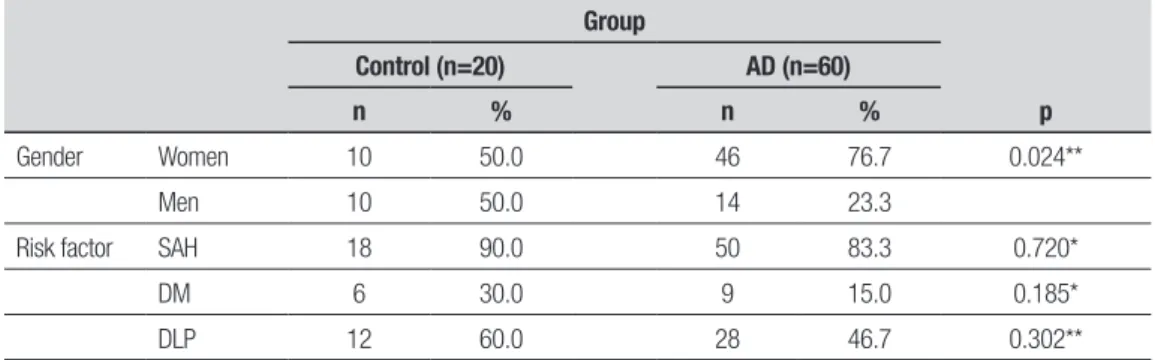
he groups also difered in terms of gender distri-bution, where the AD patient group contained more women than the control group (p<0.024). However, no diference was found between the groups for the risk factors SAH (p=0.720), DM (p=0.185) or DLP (p=0.302) (Table 2).
Table 1. Mean values, standard deviation, median, minimum and maximum for age and Mini Mental State Exam score (MMSE).
Group S Mean SD Median Minimum Maximum p*
Age Control 20 73.35 5.13 73 66 87 <0.001
AD 60 79.50 6.27 80 60 89
MMSE Control 20 27.10 2.65 27.50 20 30 <0.001
AD 60 14.78 6.81 15.50 0 29
Age(*) Student’s t-test; MMSE (*) Mann-Whitney test; S: sample size, SD: standard deviation.
Table 2. Absolute and relative frequencies of Gender and of Risk factor.
Group
p
Control (n=20) AD (n=60)
n % n %
Gender Women 10 50.0 46 76.7 0.024**
Men 10 50.0 14 23.3
Risk factor SAH 18 90.0 50 83.3 0.720*
DM 6 30.0 9 15.0 0.185*
DLP 12 60.0 28 46.7 0.302**
With regard to creatinine clearance estimated ac-cording to age, weight and gender, a signiicant difer-ence was observed between the groups, with the AD group having a signiicantly lower value than the control group (p<0.001) (Table 3A).
Analysis of the efect of gender and group factors showed a signiicant interaction between the two fac-tors for creatinine clearance value (p=0.044). Although no signiicant diference was found in the control group (p=0.538), a signiicantly higher value was found for male gender in the AD group (p<0.001). A signiicantly higher value for women was found in the control group compared to the AD group (p<0.001) (Table 3B).
Subsequently, groups were analyzed for a partition value of 60 mL/min indicative of moderate renal failure according to stage 3 of KDOQI guidelines. A signiicant diference between the two groups was found, revealing a higher percentage of individuals with chronic renal disease in the dementia group (p<0.007) (Table 4).
Analysis of the presence of microalbuminuria in a portion of the two groups revealed a statistically sig-niicant diference between the two, where the AD sub-group was found to have a greater incidence of microal-buminuria (p=0.02) (Table 5).
DISCUSSION
his study showed that the presence of chronic renal dis-ease was highly frequent among AD patients followed at our institution. Scant data is available in the literature assessing the prevalence of chronic renal disease (CRD) in this patient group.5-8 his inding has suicient
rel-evance to justify renal function assessment in all elderly patients with cognitive changes.17
AD is known to be the most prevalent form of
neu-rodegenerative dementia in the elderly population. In 2000 there were 4,500,000 cases of AD in the USA and this igure is set to rise to 14,000,000 by 2050.3 Global
projections for 2050 stand at 102,000,000 AD patients, 40% of whom will have reached an advanced stage of the disease.18 According to an anatomopathological
study published in 2002, AD was also the most common condition among patients from a Florida brain bank, ac-counting for 77% of the 382 brains assessed, while 77% of vascular dementia cases were found to have anato-mopathological changes consistent with Alzheimer’s disease.19
Clinical diagnosis of dementia remains questionable in terms of accuracy since there is not always diagnostic concordance among criteria employed. he NINCDS-ADRDA criteria, adopted in most studies to determine a clinical diagnosis of Alzheimer’s disease, are 62.5% to
Table 3A. Mean values, standard deviation, median, minimum and maximum estimated creatinine clearance.
Group S Mean SD Median Minimum Maximum p*
Control 20 68.95 18.42 66.29 43.37 102.63 <0.001
AD 60 51.66 18.56 48.09 22.36 117.85
*test t Student; S: sample size; SD: standard deviation.
Table 3B. Mean values, standard deviation, median, minimum and maximum estimated creatinine clearance.
Group Gender S Mean SD Median Minimum Maximum
Control Women 10 66.65 17.04 64.02 44.59 95.79
Men 10 71.25 20.34 71.72 43.37 102.63
AD Women 46 46.30 12.95 46.11 22.36 75.34
Men 14 69.30 23.38 71.97 30.85 117.85
S: sample size; SD: standard deviation.
Table 4. Absolute and relative frequencies of estimated creatinine clearance.
Clearance
Group
p*
Control (n=20) AD (n=60)
n % n %
< 60 8 40.0 44 73.3 0.007
≥60 12 60.0 16 26.7
*Chi-Square test.
Table 5. Absolute and relative frequencies of microalbuminuria.
Risk factor
Group
p Control (n=19) AD (n=18)
s % s %
Microalbuminuria 0 0.0 5 27.7 0.02*
93.0% consistent with pathological anatomy. Pathologi-cal anatomy is regarded as the “gold standard” but there is no consensus on the criteria for deinitive diagnosis of Alzheimer’s disease.19
In line with the indings of other authors, the pres-ent study idpres-entiied a higher prevalence of female AD patients. his may be explained by the higher life ex-pectancy of women creating a bias in the proportion of women in the elderly population, associated with longer survival of AD women compared to men.20
In the present study, AD patients were found to be older (79.5 y) than controls (73.35 y), a diference reaching statistical signiicance (p<0.001). his may be partially explained by the fact that studies indicate that age is the only proven risk factor for developing AD, i.e. the older the individual, the greater the incidence and prevalence of the disease.21
With regard to estimated creatinine clearance evalu-ated according to age, weight and gender, a signiicant diference was observed between the groups, with the AD group having a signiicantly lower clearance value than the control group (p<0.001). his may be explained by the older overall age of the group, yet no associa-tion between low clearance and the risk factors studied (SAH, DLP and DM) was evident in these patients.
Another study found the factors DM, SAH, heart dis-ease and smoking to be associated with higher risk for AD. he risk increased 3.4-fold in individuals presenting three or more of these factors. herefore, the risk of AD increases with number of vascular risk factors.4
Recent data published by Algotsson and Winbland22
indicated a concomitant relationship between glomeru-lar dysfunction and blood-brain barrier integrity in AD patients. he study showed these patients had com-promised barriers due to deposition of beta-amyloid peptides in the cerebral arterioles, responsible for the forming of senile plaques. Renal function may have a signiicant impact on blood-brain barrier function given renal dysfunction may reduce the elimination of this protein leading to renal and cerebral amyloid angiopathy.
he question remains as to whether CRD, i.e. indi-viduals with clearance lower than 60 mL/min, can be considered a risk factor for cognitive change, in the light of studies demonstrating lower MMSE scores in indi-viduals with impaired renal function.8,17,23
In the present study, a signiicant diference between the groups was found regarding the presence of micro-albuminuria. An important study published by Barzilay et al [8] found a strong association among albuminuria, chronic renal disease and dementia. hese authors pos-tulated that albuminuria increases the likelihood of an individual evolving with dementia and that this could be treatable. hey also emphasized that the albuminuria could be a complication of highly prevalent diseases in the elderly population such as DM and SAH.24
We believe the most salient aspect is the fact that AD patients presented a higher incidence of microal-buminuria coupled with lower creatinine clearance, and therefore had relative hyperiltration of remnant nephrons.
Microalbuminuria is a known marker of absolute hy-periltration in diseases such as DM and in situations of renal parenchymal loss, for instance following abla-tions. It is also a marker of early renal damage in SAH in which nephron loss progressively increases the burden on remnant nephrons. Our indings point to a possible association between function loss and change in the ability of the kidney to reabsorb the albumin iltered, detected as microalbuminuria in this study. Our group presented a higher proportion of patients with AD who had microalbuminuria. his may be suggestive of a new early marker of AD.
he results of this study allow us to conclude that pa-tients with Alzheimer’s disease have lower glomerular iltration and a higher incidence of microalbuminuria, yet without having more classic risk factors for Alzheim-er’s disease such as systemic arterial hypertension, dia-betes mellitus and dyslipidemia. Finally, further studies are needed involving a greater number of patients in or-der to conirm our preliminary hypothesis.
REFERENCES
1. Herrera Jr E, Caramelli P, Nitrini R. Estudo epidemiológico populacional de demência na cidade de Catanduva – estado de São Paulo – Brasil. Rev Psiq Clin 1998;25:70-73.
2. Kalache A, Veras RP, Ramos LR. O envelhecimento da população mun-dial. Um novo desafio, Rev Saude Publ 1987;21:200-210.
3. Cummings JL. Alzheimer’s disease. N Engl J Med 2004; 351:56-67. 4. Luchsinger J, Reitz C, Honig LS, Tang MX, Shea S, Mayeux R.
Aggre-gation of vascular risk factors and risk of incident Alzheimer’s disease. Neurology 2005;65:545-551.
5. Duron E, Hanon O. Vascular risk factors, cognitive decline, and demen-tia. Vasc Health Risk Manag 2008;4:363-381.
6. Lindeman RD, Tobin J, Shock NW. Longitudinal studies on the rate de-cline in renal function with age. J Am Geriatr Soc 1985;33:278-285. 7. Oreopoulos DG, Dimkovic N. Geriatric Nephrology is coming of age.
J Am Soc Nephrol 2003;14:1099-1101.
8. Barzilay JI, Fitzpatrick AL, Luchsinger J, et al. Albuminuria and Dementia in the Elderly: A Community Study. Am J Kidney Dis 2008;52:216-226. 9. Bertollucci PH, Brucki SM, Campacci SR, Juliano Y. The Mini-Mental
State Examination in a general population: impact of educational status. Arq Neuropsiquiatr 1994;52:1-7.
diag-nósticos e exames complementares. Recomendações do departamen-to cientifico de neurologia e do envelhecimendepartamen-to da academia brasileira de neurologia. Arq Neuropsiquiatr 2005;63:713-719.
11. McKhann G, Drachman D, Folstein M, Katzman R, Price D, Stadlan EM. Clinical diagnosis of Alzheimer’s disease: report of the NINCDS-ADRDA Work Group under the auspices of the Department of Health and Human Services Task Force on Alzheimer’s disease. Neurology 1984;34:939-944.
12. American Psychiatric Association – Diagnostic and Statistical Manual of Mental Disorders, 4 ed., American Psychiatric Association; Washington DC; 1994.
13. Cockcroft DW, Gault MH. Prediction of creatinina clearance from serum creatinine. Nephron 1976;16:31-41.
14. National Kidney Foundation, K/DOQI Clinical Practice Guidelines for chronic kidney disease: evaluation, Classification and Stratification. Am J Kidney Dis 2002;39:S1-S266.
15. Haahr M. Random.org. [online] True random number service, (accessed nov 30, 2009] Available from: http://www.random.org/integers 16. Rosner B. Fundamentals of Biostatistics, 2nd ed., PWS Publishers,
Boston; 1986.
17. Madan P, Kalra OP, Agarwal S, Tandon OP. Cognitive impairment in chronic kidney disease. Nephrol Dial Transplant 2007;22:440-444.
18. Brookmeyer R, Johnson E, Ziegler-Graham K, Arrighi HM. Forecasting the global burden of Alzheimer’s disease. Alzheimers Dement 2007;3: 186-191.
19. Barker WW, Luis CA, Kashuba A, Luis M, et al. Relative frequencies of Alzheimer disease, Lewy body, vascular and frontotemporal dementia, and hippocampal sclerosis in the State of Florida Brain Bank. Alzheimer Dis Assoc Disord 2002;16:203-212.
20. Cação JC, Souza DRS, Tognola WA, Godoy MRP, Pinhel MAS. Poli-morfismo da apolipoproteína e nos familiares em primeiro grau de pa-cientes com doença de Alzheimer familial ou esporádica, Arq Neurop-siquiatr 2007;65:1-6.
21. Chaimowicz F. A saúde dos idosos brasileiros às vésperas do século XXI: problemas, projeções e alternativas. Rev Saúde Publica 1997;31: 184-200.
22. Algotsson A, Winbland B. The integrity of the blood-brain barrier in Al-zheimer’s disease. Acta Neurol Scand 2007;115:403-408.
23. Kurella M, Chertow GM, Fried LF, et al., Chronic Kidney Disease and Cognitive Impairment in the Elderly: The Health, Aging, and Body Com-position Study. J Am Soc Nephrol 2005;16:2127-2133.