NITROGEN AVAILABILITY, LEAF LIFE SPAN
AND NITROGEN CONSERVATION MECHANISMS
IN LEAVES OF TROPICAL TREES
Guilherme Nascimento Corte1; Patrícia Macchiaverni1; Inácio Maria Dal Fabbro2; Claudia Regina Baptista Haddad1*
1
UNICAMP/Instituto de Biologia - Depto. de Biologia Vegetal, C.P.6109 - 13083-970 - Campinas, SP - Brasil. 2
UNICAMP/Faculdade de Engenharia Agrícola. *Corresponding author <[email protected]>
ABSTRACT: Evergreen species of temperate regions are dominant in low-nutrient soils. This feature is attributed to more efficient mechanisms of nutrient economy. Nevertheless, the cashew (Anacardium occidentale- Anacardiaceae), a deciduous species, is native to regions in Brazil with sandy soil, whilst the annatto (Bixa orellana- Bixaceae), classified as an evergreen species native to tropical America, grows spontaneously in regions with more humid soils. Evergreens contain robust leaves that can resist adverse conditions for longer. The physical aspects of the leaves and mechanisms of nutrient economy between the two species were compared, in order to verify whether the deciduous species had more efficient mechanisms that might explain its occurrence in regions of low soil fertility. The mechanisms of nitrogen economy were also compared for the two species at available concentrations of this nutrient. The following were analysed: (i) leaf life span, (ii) physical leaf characteristics (leaf mass per area, and rupture strain), (iii) nitrogenous compounds (nitrogen, chlorophyll, and protein), (iv) nitrogen conservation mechanisms (nitrogen resorption efficiency, resorption proficiency, and use efficiency), and (v) nitrogen conservation mechanisms under different availability of this mineral. The higher values of leaf mass per area and leaf rupture strain found in A. occidentale were related to its longer leaf life span. A. occidentale showed lower concentrations of nitrogen and protein in the leaves than B. orellana. Under lower nitrogen availability, A. occidentale hadhigher nitrogen resorption proficiency, nitrogen use efficiency and leaf life span than B. orellana. These characteristics may contribute to the adaptation of this species to sandy soils with low nitrogen content.
Key words:leaf deciduity, nitrogen resorption proficiency, nitrogen use efficiency, leaf rupture strain
DISPONIBILIDADE DE NITROGÊNIO, LONGEVIDADE FOLIAR
E MECANISMOS DE CONSERVAÇÃO DE NITROGÊNIO EM
FOLHAS DE ESPÉCIES ARBÓREAS TROPICAIS
an evergreen, but it grows preferentially in more hu-mid soils. It is native to tropical America showing spon-taneous growth in the Amazon forest (Lorenzi, 2000). The two species were chosen because when their leaf deciduousness is analyzed with regard to the fertility of their native habitats, it was found that they show opposite behaviors to those described in the literature. The aim of this study was to compare the two spe-cies in order to verify if more efficient mechanisms of nitrogen conservation can explain the existence of the deciduous species in low fertility soil.
MATERIAL AND METHODS
Characterization of the species and cultivation site
The study was carried out from July of 2002 to July of 2004, in Campinas, São Paulo State, Brazil (22°49' S, 47°06' W, and 670 m of altitude). The soil is a Rhodic Eutrudox. The climate is characterized by a dry, cold season from April to September and a wet, warm season from October to March. During the dry season the mean precipitation ± standard deviation is 44 ± 17 mm over six month periods. The mean mini-mum temperature is 14.3 ± 1.9°C and the mean maxi-mum temperature is 26.5 ± 1.6°C, over the same pe-riod. In the wet season the mean rainfall is 185 ± 50 mm and the mean minimum temperature is 18.9 ± 0.9°C and mean maximum temperature is 29.6 ± 0.4°C (data from http://www.agritempo.gov.br, years: 1984-2004). The transitional periods (March-April and September-October) are characterized by variation in temperature and precipitation. The strongest winds occur from August to November (Morellato & Leitão-Filho, 1996).
The species used were Anacardium occidentale L (Anacardiaceae) and Bixa orellana Benth (Bixaceae). The first experiment was carried out on mature trees, approximately fifteen years old, growing directly on a Rhodic Eutrudox. In the second experiment, the indi-viduals of both species were planted in pots with two types of substrate. In the first experiment the study was carried out with five individuals per species us-ing selected leaves (three for each individual) without visible signs of disease or herbivory. The trees of A. occidentale were grown in Campinas, SP, Brazil, where the soil total nitrogen content was 3.2 g kg–1 (analyzed by the Kjeldahl method -Bremner, 1996). The trees of
B. orellana were grown in an experimental farm in Campinas, SP, Brazil, where the soil total nitrogen con-tent was 2.6 g kg–1.
Mature green leaves were fully expandedand com-pletely green. Senescent leaves were comcom-pletely yellow and dropped when touched. Total chlorophyll concen-tration was determined in mature green (7.86 μg mg–1
INTRODUCTION
In low fertility soils the dominant species tend to be evergreens (Ishida et al., 2006). The longer life span of leaves of evergreen species and their lower nutri-ent contnutri-ent are important in the colonization of low fertility soils (Carrera et al., 2003). However, gener-ally, in the neotropical region, evergreen species pro-duce leaves intermittently and leaf fall is not concen-trated in a specific time of the year (Morellato et al., 2000), but may change continuously. Therefore, the fact that a species is an evergreen does not necessar-ily mean that its leaves have a longer life span than those from deciduous species. In fact, the differences found between evergreen and deciduous species are due mainly to differences in the leaf life span of the two types of plants (Reich et al., 1992).
Evergreens tend to have a higher leaf mass per area (Ishida et al., 2006) due to thicker leaf blades and a larger lignified area (Read et al., 2000). This allows these leaves to resist adverse conditions for a greater length of time (Gates 1914 in Chabot & Hicks, 1982). Removal of nutrients from leaves prior to abscis-sion and their transport to other organs is known as nutrient resorption (Wright & Westoby, 2003). The greater the resorption efficiency, the more nitrogen is reused by the plant (Hikosaka, 2005). This is an ad-aptation of some species to low fertility soils (Pugnaire & Chapin, 1993). Therefore, evergreens are likely to exhibit greater resorption efficiency in comparison to deciduous species. Nevertheless, there is no consen-sus when comparing these two groups of plants (Lal et al., 2001; Diehl et al., 2003). The relationship be-tween nutrient resorption efficiency and soil fertility is also controversial (Carrera et al., 2003; Lima et al., 2006b). Resorption proficiency, the absolute value by which nutrients are reduced in senescent leaves is a more objective measure of the degree by which the plants minimize nutrient loss (Killingbeck, 1996). The dominance of evergreen species in low fertility habi-tats may also be explained by their efficiency in nutri-ent use (Chabot & Hicks, 1982). There are indications that this variable also increases as soil nutrients decrease (Distel et al., 2003).
Often, little is known about the relationship between leaf life span and conservation of nutrients for tropi-cal trees, even though such knowledge is important for the recovery of degraded areas with native spe-cies. In this study, two tree species were examined: the cashew (Anacardium occidentale L
dry mass for A. occidentale and 11.16 μg mg–1 dry mass for B. orellana) and senescent leaves (3.07 μg mg–1
dry mass for A. occidentale and 1.60 μg mg–1 dry mass for B. orellana) in order to find the point in which there was a decrease in its concentration and thus establish the beginning of senescence (Smart, 1994) and nitro-gen resorption processes. Mature green leaves and se-nescent leaves were collected at the same time for both species (Table 1).
The leaf life span was monitored using dated plas-tic tape placed around the petioles of very young leaves (1 cm long petioles) (Lima et al., 2006a). The leaves of both species were dated at same time. Leaf abscis-sion was observed daily.
Physical aspects of leaves
The leaf mass per area was calculated using the for-mula: LMA = DMmature green leaves/Amature green leaves (g cm–2
), where DM = dry mass and A = leaf area.
Dry mass was obtained after leaves had been kept in an oven at 60°C for seven days. The leaf area was obtained for fresh leaves using a LI-COR instrument, model LI-300.
The rupture of leaves was determined through strain failure by carrying out uniaxial traction tests on mature green leaves. Leaves were taken to the labora-tory in humidity chambers to maintain their turgidity. They were cut into similarly-sized square strips and their edges were attached to hooks following the pro-cedure in Piedade et al. (2001). The hooks were at-tached to a testing press, model TA 500, Lloyd Instru-ments and to a data acquisition system. Strain failure was then calculated as reported by Dal Fabbro et al. (1980). The distance between hooks was fixed to 9 cm and the rupture strain test was carried out at a ve-locity of 0.6 mm s–1. The software used was Nexigen 3.0.
Nitrogenous compounds
Chlorophyll was determined according to Hiscox & Israelstam (1979). Portions of leaves (20 mg fresh mass) were immersed in dimethyl-sulphoxide (DMSO) in sealed tubes kept in the dark. The tubes were incu-bated in a water-bath at 65°C for 30 min and cooled
to room temperature. Total chlorophyll content was calculated according to Lichtenthaler & Wellburn (1983). For extraction of total soluble proteins the leaves were macerated using liquid nitrogen and ex-tracted with 0.1 N NaOH. After standing for 24 h, the extract was centrifuged at 2000 g (15 min, 4°C). The supernatant was used for the determination of total pro-teins (Bradford, 1976).
Determination of total nitrogen in the leaves and nitrogen conservation mechanisms
The determination of the total nitrogen content was made using samples of 100 mg from leaves dried at 60°C for seven days. The leaf tissue was placed in digestion tubes, containing 1 g of catalyst (100 g of K2SO4, 10 g of CuSO4.5H2O and 1 g of Se), 3 mL of concentrated sulphuric acid and 1 mL of hydrogen per-oxide (H2O2). Samples were digested at 360°C and their N content determined by the Kjeldahl method (Nelson & Sommers, 1973). Nitrogen resorption effi-ciency was calculated by:
NRE (%) = [(N mature green – N senescent) / N mature
green]*100, where: NRE = Nitrogen resorption effi-ciency, N mature green = Nitrogen in mature green leaves, N senescent = Nitrogen in senescent leaves (Pugnaire & Chapin, 1993).
Nitrogen use efficiency was calculated by: NUE (g of dry mass mg–1 of nitrogen) = 1 / [N mature green
(1-r)], where: NUE = Nitrogen use efficiency, N mature green = total nitrogen concentration in mature green leaves and r = NRE expressed in terms of a fraction (Aerts et al., 1999).
The nitrogen concentration in senescent leaves was used as an indicator of nitrogen resorption proficiency (Killingbeck, 1996).
Leaf longevity and nitrogen conservation mecha-nisms, under different availability of nitrogen
In the second experiment, seeds of both species were germinated in plastic boxes, in growth chambers kept at a controlled temperature of 30ºC, under con-tinuous daylight, for approximately ten days. The plants were selected and planted individually in 5 L plastic pots, and kept in the greenhouse with automatic
s e i c e p
S LeafArea FreshMass DryMass
. d i c c o .
A B. orell. A. occid. B. orell. A. occid. B. orell.
m c
-- 2------------- --------------------------------- g--------------------------------
-: f a e L f o d n i K
n e e r g e r u t a
M 158±28 204 ±32 4.0 ±0.7 3.5±0.7 1.2±0.2 1.2±0.3
t n e c s e n e
S 136±27 171±25 3.2±0.6 2.4±0.3 0.9±0.1 0.8±0.2
Mean values ± standard deviation of five replicates each comprised of three leaves.
irrigation under natural light and temperature condi-tions. The study was carried out using three leaves from each individual plant and with ten individuals per treatment.
The following substrates were used: (i) clayey soil material (two parts soil / one part sand), with 250 mL of Hoagland and Arnon nutrient solution (Hoagland & Arnon, 1938) added monthly to each pot, and (ii) pre-viously washed sand material, with 250 mL of Hoagland and Arnon nutrient solution without N, added weekly to each pot (Hoagland & Arnon, 1938). Irri-gation was suspended 24 h before adding the nutrient solutions to avoid dilution of the solutions and began again 24 h after their application.
Leaf life spans, nitrogen resorption efficiency, ni-trogen resorption proficiency and nini-trogen use effi-ciency were monitored according to the protocol de-scribed above. The senescent leaves used to calculate conservation mechanism analyses were collected as they fell and stored in a freezer at -20°C, until analy-sis.
At the end of experiment (after 336 days) the con-centrations of nitrogen (analyzed by the Kjeldahl method (Bremner,1996)) in the clay soil material, were 2.8 and 3.1 g kg–1
of dry mass for B. orellana and A. occidentale respectively, and in the sandy soil mate-rial 0.4 g kg–1 of dry mass for both species.
Statistical analyses
Statistical analyses were performed using the soft-ware SAS Institute (1990). The data were subjected to an analysis of variance and the means compared for significant differences by Tukey’s test (p < 0.05). Per-centage data in nitrogen resorption efficiency
analy-ses were converted into arcsine (Montgomery, 1992), and analysis of variance was then applied. Plants cul-tivated under different nitrogen availability were sub-mitted to a Two Way ANOVA. When there was a sig-nificant interaction of both factors (substrate and spe-cies), the data were submitted to simple analysis of variance followed by a Tukey’s pairwise means com-parison tests (p < 0.05).
RESULTS AND DISCUSSION
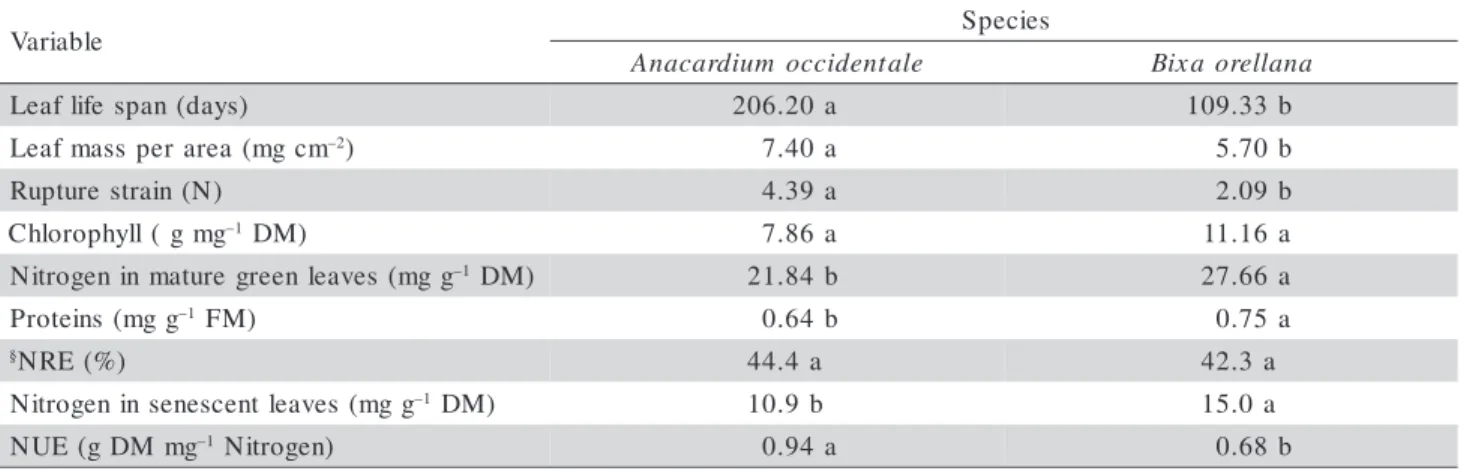
Greater leaf longevity in some species is per se a mechanism of nutrient economy, since it reduces min-eral nutrient losses (Carrera et al., 2000; 2003), as the removal of minerals before leaf abscission is not com-plete in any type of plant (Chabot & Hicks, 1982). Al-though A. occidentale is a deciduous species, its leaves had a greater leaf life span than those of the evergreen species (Table 2). Species that change leaves less fre-quently may be more successful in colonizing less fer-tile environments (Givnish, 2002).
There are no data in the literature relating rupture strain of leaves with leaf life span. A greater rupture strain was needed to break the leaves of A. occidentale
compared to those of B. orellana (Table 2). A. occidentale also revealed greater values of leaf mass per area compared to B. orellana, which is consistent with the earlier observations that species showing greater leaf longevity present a greater leaf mass per area (Reich et al., 1992; Castro-Diez et al., 2000; Givnish, 2002; Wright et al., 2002; Prior et al., 2003; Ishida et al., 2006). Therefore, the observation that evergreen species tend to have leaves with an increased mass to the area ratio, which allows these leaves to
e l b a i r a
V Species
e l a t n e d i c c o m u i d r a c a n
A Bixaorellana
) s y a d ( n a p s e f i l f a e
L 206.20a 109.33 b
m c g m ( a e r a r e p s s a m f a e
L –2) 7.40a 5.70 b
) N ( n i a r t s e r u t p u
R 4.39a 2.09 b
g m g ( l l y h p o r o l h
C –1DM) 7.86a 11.16 a
g g m ( s e v a e l n e e r g e r u t a m n i n e g o r t i
N –1DM) 21.84b 27.66 a
g g m ( s n i e t o r
P –1FM) 0.64b 0.75 a
§NRE(%) 44.4a 42.3a
g g m ( s e v a e l t n e c s e n e s n i n e g o r t i
N –1DM) 10.9b 15.0a
g m M D g ( E U
N –1Nitrogen) 0.94a 0.68 b
Different letters indicate differences between species (Tukey p < 0.05). §NRE values are presented in %, although statistical analysis
was carried out on values transformed to arcsine for achieving the statistical letters.
Table 2 - Mean values of leaf life span, leaf mass per area, leaf rupture strain andconcentrations of total chlorophyll, total nitrogen, and total soluble proteins in mature green leaves. Nitrogen resorption efficiency (NRE), total nitrogen in senescent leaves, and nitrogen use efficiency (NUE) of mature trees of Anacardium occidentale and Bixa orellana.
resist adverse conditions for a longer time (Gates 1914 in Chabot & Hicks, 1982), can also be applied to A. occidentale if one considers that Gates may have used the expression “evergreen species” as a synonym for species having greater leaf longevity. As well as con-tributing towards greater leaf resistance, a greater leaf mass per area of A. occidentale may also be involved in the adaptation to the dry environment of the natural habitat of this species, since a reduction in leaf area relative to leaf mass tends to reduce transpiration.
Species that have leaves with a longer life span show a lower level of total nitrogen (Chabot & Hicks, 1982; Diehl et al., 2003; Prior et al., 2003; Haddad et al., 2004; Ishida et al., 2006; Lima et al., 2006a; Sakata et al., 2006), chlorophyll (Prior et al., 2003; Haddad et al., 2004; Lima et al., 2006a) and soluble proteins (Haddad et al., 2004; Takashima et al., 2004; Lima et al., 2006a) in comparison to species that have leaves with a shorter leaf life span. The longer leaf life span and the lower nutrient content of the leaves are im-portant characteristics in making the colonization of low fertility soils possible (Carrera et al., 2003). Al-though the differences in chlorophyll contents between
A. occidentale and B. orellana were not significant (Table 2), our data are consistent with this proposal, since A. occidentale showed lower protein and total nitrogen content in mature green leaves than B. orellana (Table 2).
Greater leaf longevity may be accompanied by greater nitrogen resorption efficiency. The resorption efficiency shows the degree in which the nutrients are conserved in the leaves, thus minimizing the need for subsequent absorption of them. This parameter relates the nutrient content in mature green leaves to their re-sorption (Killingbeck, 1996). However, data in the lit-erature that relate leaf longevity and nitrogen resorp-tion efficiency are conflicting. Killingbeck (1996) as-cribes the lack of consistency in the data to environ-mental fluctuations that occur from one year to the next. In the present study there was no difference be-tween the results of the two species (Table 2).
Resorption proficiency is quantified by the absolute value by which nutrients are reduced in senescent leaves. Thus, the lower the concentration of a nutrient in se-nescent leaves, the greater is its resorption proficiency (Killingbeck, 1996). There is little data in the literature relating leaf longevity to resorption proficiency. Oleksyn et al. (2003) and Lima et al. (2006b) verified that the species with the highest leaf life span presented the greatest nitrogen resorption proficiency. Our results are consistent with these observations since nitrogen resorp-tion proficiency for A.occidentale was higher than for
B. orellana (Table 2), indicating that A. occidentale
losses this element to the environment are smaller.
There are indications that species with leaves with higher longevity are able to produce more organic mat-ter per unit of mineral nutrient than species with lower leaf longevity (Aerts et al., 1999; Haddad et al., 2004; Milla et al., 2005). This ratio represents the nutrient use efficiency (Vitousek, 1982). The residence time of the nutrient in the leaf, an important component of ef-ficiency in the use of nutrients, depends on leaf lon-gevity and the quantity of reabsorbed nutrients before leaf abscission (Aerts, 1990). Nitrogen use efficiency for A. occidentale was higher than for B. orellana
(Table 2). A.occidentale loses leaves less frequently, loses less nitrogen to the environment in the abscised leaves and manages to produce organic material using proportionally less nitrogen when compared to B. orellana. These characteristics may be contributing to the adaptation of this species to soils with a low avail-ability of this element.
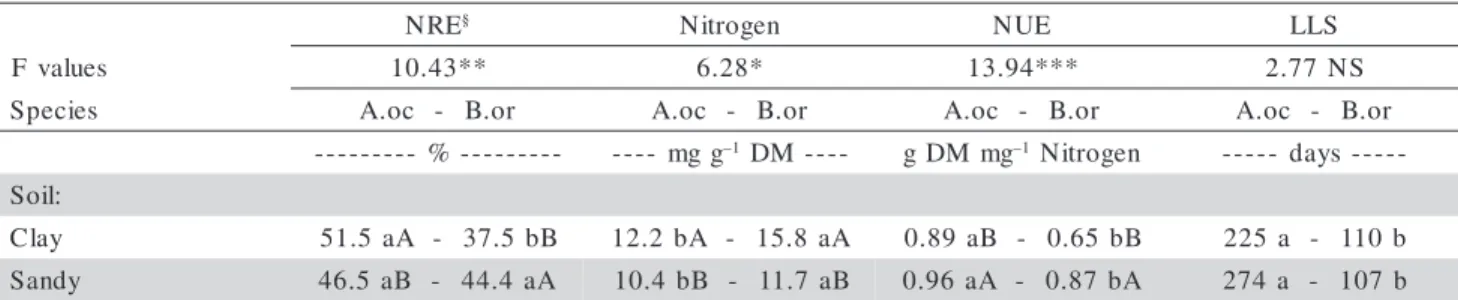
In the second experiment, there was a significant interaction between the type of substrate and the spe-cies in the nitrogen analysis of the senescent leaves, and in the nitrogen use efficiency and resorption effi-ciency (Table 3). Several authors believe that high re-sorption efficiency helps certain species to adapt to less fertile environments (e.g. Pugnaire & Chapin, 1993). However, when an attempt is made to relate this pa-rameter to soil fertility, the results are controversial (Cordell et al., 2001; Carrera et al., 2003; Feller et al., 2003; Distel et al., 2003; Richardson et al., 2004; Lima et al., 2006b). Nitrogen resorption efficiency data did not have a clear relationship with the availability of this element in the substrate (Table 3). Greater values were found in A. occidentale cultivated in clay soil and in B. orellana cultivated in sandy soil. When both species were compared in the same substrate, A. occidentale showed greater values only in the clay soil (Table 3).
When comparing both species in the same sub-strate, the resorption proficiency, nitrogen use effi-ciency and leaf longevity were all greater in A. occidentale (Table 3), indicating a higher potential in conserving nitrogen. Species adapted to fertile envi-ronments invest more in the acquisition of resources than species adapted to less fertile habitats, which in-vest more in the conservation of these resources (Westoby et al., 2002; Pujol et al., 2008).
In summary, although A.occidentale is considered a deciduous species, its leaves had a higher life span in comparison to the evergreen B. orellana. Therefore, in neotropical regions, the leaf deciduousness of the species does not necessarily have a direct relationship with leaf longevity. Many species of tropical rain for-ests are evergreen, although their leaves have leaf life spans of less than a year and show similar character-istics to deciduous species (Reich et al., 1991). The data observed for B. orellana fit these observations perfectly. Regarding to the results obtained for A. occidentale, Reich et al (1992) discuss that deciduous species, with a leaf life span of nine to ten months, are probably more similar to evergreen species than deciduous species with leaf life spans of only two to three months. It is possible that the greater capacity that A. occidentale has for conserving nitrogen in its leaves may contribute to its occurrence in low fertil-ity soils. Other factors may also be involved in the ad-aptation of this species to less fertile soils of the north-east region in Brazil. Givnish (2002) highlights the im-portance of verifying the allocation of resources in the underground organs. Thus, plants adapted to less fer-tile environments may have an underground system with a good mineral storage capacity. Or they may even have a more extensive root system that would allow more efficient absorption of minerals from the soil. As well as having less fertile soils, the natural en-vironment of A.occidentale is also arid. The
adapta-tion to arid environments implies in a greater investment in roots to replenish water lost by transpiration (Givnish, 2002). Thus, further studies related to the importance of the root system of A. occidentale in the adaptation of this species to its native habitat are necessary.
ACKNOWLEDGEMENTS
To Dr. Odair Bovi for granting permission to col-lect leaves of B. orellana, and to Prof. Ladaslav Sodek for revising the English version of the manuscript. Guilherme Corte is grateful to the CNPq for the award of PIBIC fellowship.
REFERENCES
AERTS, R. Nutrient use efficiency in evergreen and deciduous species from heathlands. Oecologia, v.84, p.391-397, 1990. AERTS, R.; VERHOEVEN, J.T.A.; WHIGHAM, D.F.
Plant-mediated controls on nutrient cycling in temperate fens and bogs. Ecology, v.80, p.2170-2181, 1999.
BRADFORD, M.M. A rapid and sensitive method for the quantization of microgram quantities of protein utilizing the principle of protein-dye binding. Analytical Biochemistry, v.72, p.248-254, 1976.
BREMNER, J.M. Nitrogen-Total. In:KLUTE, A.; WEAVER, R.W.; MICKELSON, S.H.; SPARKS, D.L.; BARTELS, J.M. (Ed.) Methods of soil analysis. Madison: SSSA, 1996. chap. 3, p.1085-1121. (Chemical Methods. Book Series, 5).
CARRERA, A.L.; SAIN, C.L.; BERTILLER, M.B. Patterns of nitrogen conservation in shrubs and grasses in the Patagonian Monte, Argentina. Plant and Soil, v.224, p.185-193, 2000. CARRERA, A.L.; BERTILLER, M.B.; SAIN, C.L.; MAZZARINO,
M.J. Relationship between plant nitrogen conservation mechanisms and the dynamics of soil nitrogen in the arid Patagonian Monte, Argentina. Plant and Soil, v.255, p.595-604, 2003.
CASTRO-DÍEZ, P.; PUYRAVAUD, J.P.; CORNELISSEN, J.H.C. Leaf structure and anatomy as related to leaf mass per area variation in seedlings of a wide range of woody plant species and types. Oecologia, v.124, p.476–486, 2000.
CHABOT, B.F.; HICKS, D.J. The ecology of leaf life spans. Annual Review of Ecology and Systematics, v.13, p.229-259, 1982. CORDELL, S.; GOLDSTEIN, G.; MEINZER, F.C.; VITOUSEK, P.M. Regulation of leaf life-span and nutrient-use efficiency of
Metrosideros polymorpha trees at two extremes of a long chronosequence in Hawaii. Oecologia, v.127, p.198-206, 2001.
Means followed by different small letters are different at the species level in the same substrate, and different capital letters indicate differences between substrates for the same species (Tukey p < 0.05). §NRE values are presented in %, although statistical analysis was
carried out on values transformed to arcsine for achieving the statistical letters
Table 3 - Factorial analysis of total nitrogen in senescent leaves, nitrogen use efficiency (NUE), nitrogen resorption efficiency (NRE) and leaf life span (LLS) in the pot experiments. The interaction between species Anacardium occidentale (A.oc) or Bixa orellana (B.or) and substrate (clay and sand or sand) is shown by F values followed by level of significance: * 5%, **1%, ***0.1%. NS = non significant, DM = dry mass.
E R
N § Nitrogen NUE LLS
s e u l a v
F 10.43** 6.28* 13.94*** 2.77NS
s e i c e p
S A.oc - B.or A.oc - B.or A.oc - B.or A.oc - B.or
-%
-- ---- mgg–1DM---- gDMmg–1Nitrogen ----- days----
-: l i o S
y a l
C 51.5aA - 37.5bB 12.2 bA - 15.8aA 0.89aB - 0.65bB 225 a - 110b
y d n a
DAL FABBRO, I.M.; MURASE, H.; SEGERLIND, L.J. Strain failure of apple, pear and potato tissue. In:SUMMER MEETING OF THE AMERICAN SOCIETY OF AGRICULTURAL ENGINEERS, Saint Joseph, 1980. Proceedings. Saint Joseph, 1980.
DIEHL, P.; MAZZARINO, M.J.; FUNES, F.; FONTENLA, S.; GOBBI, M.; FERRARI, J. Nutrient conservation strategies in native Andean-patagonian forests. Journal of Vegetation Science, v.14, p.63-70, 2003.
DISTEL, R.A.; MORETTO, A.S.; DIDONÉ, N.G. Nutrient resorption from senescing leaves in two Stipa species native to central Argentina. Austral Ecology, v.28, p.210-215, 2003. FELLER, I.C.; McKEE, K.L.; WHIGHAM, D.F.; O‘NEILL, J.P.
Nitrogen vs. phosphorus limitation across an ecotonal gradient in a mangrove forest. Biogeochemistry, v.62, p.145-175, 2003. GIVNISH, T.J. Adaptive significance of evergreen vs. deciduous leaves: solving the triple paradox. Silva Fenica, v.36, p.703-743, 2002. HADDAD, C.R.B.; LEMOS, D.P.; MAZZAFERA, P. Leaf life span and nitrogen in semideciduous forest tree species (Croton priscus
and Hymenaea courbaril). Scientia Agricola, v.61, p.462-465, 2004.
HIKOSAKA, K. Leaf canopy as a dynamic system: ecophysiology and optimality in leaf turnover. Annals of Botany, v.95 p.521-533, 2005.
HISCOX, J.D.; ISRAELSTAM, G.F. A method for the extraction of chlorophyll from leaf tissue without maceration. Canadian Journal of Botany, v.57, p.1332-1334, 1979.
HOAGLAND, D.R.; ARNON, D.I. The water culture method for growing plants without soil. Davis: University of California Agricultural Experimental Station, 1938, (Bulletin, 347). .ISHIDA, A.; DILOKSUMOUN, S.; LADPALA, P.; STAPORN, D.;
PANUTHAI, S.; GAMO, M.; YAZAKI, K.; ISHIZUKA, M.; PUANGCHIT, L. Contrasting seasonal leaf habits of canopy trees between tropical dry-deciduous and evergreen forests in Thailand. Tree Physiology, v.26, p.643-656, 2006. KILLINGBECK, K.T. Nutrients in senesced leaves: keys to the
search for potential resorption and resorption proficiency. Ecology, v.77, p.1716-1727, 1996.
LAL, C.B.; ANAPURNA, C.; RAGHUBANSHI, A.S.; SINGH, J.S. Effect of leaf habit and soil type on nutrient resorption and conservation in woody species of a dry tropical environment. Canadian Journal of Botany, v.79, p.1066-1075, 2001. LICHTENTHALER, B.K.; WELLBURN, A.R. Determination of
total carotenoids and chlorophylls a and b of leaf extracts in different solvents. Biochemical SocietyTransactions, v.11, p.591-592, 1983.
LIMA, A.L.S.; ZANELLA, F.; SCHIAVINATO, M.A.; HADDAD, C.R.B. Nitrogenous compounds, phenolic compounds and physical aspects of leaves: comparison of deciduous and semideciduous arboreal legumes. Scientia Agricola, v.63, p.40-45, 2006a. LIMA, A.L.S.; ZANELLA, F.; SCHIAVINATO, M.A.; HADDAD,
C.R.B. N availability and mechanisms of N conservation in deciduous and semideciduous tropical forest legume trees. Acta Botanica Brasilica, v.20, p.625-632, 2006b.
LORENZI, H. Árvores brasileiras. 3 ed. Nova Odessa: Editora Plantarum, 2000. 352p.
MILLA, R.; CASTRO-DIEZ, P.; MAESTRO-MARTINEZ, M.; MONTSERRAT-MARTI, G. Environmental constraints on phenology and internal nutrient cycling in the Mediterranean winter-deciduous shrub Amelanchier ovalis Medicus. Plant Biology, v.7, p.182-189, 2005.
MONTGOMERY, D.C. Introduction to linear regression analysis. 2 ed. New York: John Wiley, 1992. p 544 (Wiley Series in Probability and Mathematical Statistics).
MORELLATO, L.P.C.; LEITÃO-FILHO, H.F. Reproductive phenology of climbers in a southeastern Brazilian forest. Biotropica, v.28, p.180-191, 1996.
MORELLATO, L.P.C.; TALORA, D.C.; TAKAHASI, A.; BENCKE, C.C.; ROMERA, E.C.; ZIPARRO, V.B. Phenology of Atlantic rain forest trees: a comparative study. Biotropica, v.32, p.811-823, 2000.
NELSON, D.W.; SOMMERS, L.E. Determination of the total nitrogen in plant material. Agronomy Journal, v.65, p.109-112, 1973.
OLEKSYN, J.; REICH, P.B.; ZYTKOWIAK, R.; KAROLEWSKI, P.; TJOELKER, M.G. Nutrient conservation increases with latitude of origin in European Pinus sylvestris populations. Oecologia, v.136, p.220-235, 2003.
PIEDADE, S.; FABBRO, I.M.D.; VIDAL, B.C.; GAMGA, R. Ensaio uniaxial de tração de tendões de músculos grácil e semitendinoso. Acta Ortopédica Brasileira, v.9, p.5-11, 2001.
PRIOR, L.D.; EAMUS, D.; BOWMAN, D.M.J.S. Leaf attributes in the seasonally dry tropics: a comparison of four habitats in northern Australia. Functional Ecology, v.17, p.504-515, 2003. PUGNAIRE, F.I.; CHAPIN, F.S. Controls over nutrient resorption from leaves of evergreen Mediterranean species. Ecology, v.74, p.124-129, 1993.
PUJOL, B.; SALAGER, J-L.; BELTRAN, M.; BOUSQUET, S.; McKEY, D. Photosynthesis and leaf structure in domesticated cassava (Euphorbiaceae) and close wild relative: have leaf photosynthetic parameters evolved under domestication? Biotropica, v.40, p.305-312, 2008.
READ, J.; EDWARDS, C.; SANSON, G.D.; ARANWELA, N. Relationships between sclerophylly, leaf biomechanical properties and leaf anatomy in some Australian heath and forest species. Plant Biosystems, v.134, p.261-277, 2000. REICH, P.B.; UHL, C.; WALTERS, M.B., ELLSWORTH, D.S. Leaf
lifespan as a determinant of leaf structure and function among 23 tree species in Amazonian forest communities. Oecologia, v.86, p.16-24, 1991.
REICH, P.B.; WALTERS, M.B.; ELLSWORTH, D.S. Leaf life-span in relation to leaf, plant, and stand characteristics among diverse ecosystems. Ecological Monographs, v.62, p.365-392, 1992.
RICHARDSON, S.J.; PELTZER, D.A.; ALLEN, R.B.; McGLONE, M.S.; PARFITT, R.L. Rapid development of phosphorus limitation in temperate rainforest along the Franz Josef soil chronosequence. Oecologia, v.139, p.267-276, 2004. SAKATA, T.; NAKANO, T.; IINO, T.; YOKOI, Y. Contrastive
seasonal changes in ecophysiological traits of leaves of two perennial Polygonaceae herb species differing in leaf longevity and altitudinal distribution. Ecological Research, v.21, p.633-640, 2006.
SAS INSTITUTE. SAS/STAT user’s guide: version 8. Cary: SAS Institute, 1990. CD-ROM.
SMART, C.M. Gene expression during leaf senescence. New Phytologist, v.126, p.419-448, 1994.
SOIL SURVEY STAFF. Keys to soil taxonomy. 9 ed. Washington, D.C.: Natural Resources Conservation Service, US Department of Agriculture, 2003. 331 p.
TAKASHIMA, T.; HIKOSAKA, K.; HIROSE, T. Photosynthesis or persistence: nitrogen allocation in leaves of evergreen and deciduous Quercus species. Plant and Cell Environment, v.27, p.1047-1054, 2004.
VITOUSEK, P.M. Litterfall, nutrient cycling and nutrient limitation in tropical forests. Ecology, v.65, p.285-298, 1982. WESTOBY, M.; FALSTER, D.S.; MOLES, T.; VESK, P.A; WRIGHT, I.J. Plant ecological strategies: some leading dimensions of variation between species. Annual Review of Ecology and Systematics, v.33, p.125-159, 2002.
WRIGHT, I.J.; WESTOBY, M.; REICH, P.B. Convergence towards higher leaf mass per area in dry and nutrient-poor habitats has different consequences for leaf lifespan. Journal of Ecology, v.90, p.534-543, 2002.
WRIGHT, I.J.; WESTOBY, M. Nutrient conservation, resorption and lifespan: leaf traits of Autralian sclerophyll species. Functional Ecology, v.17, p.10-19, 2003.