Stabilizatio n o f se rum antibo dy
re spo nse s trigge re d by initial m uco sal
co ntact with the antige n inde pe nde ntly
o f o ral to le rance inductio n
Departamentos de 1Bioquímica e Imunologia and 2Morfologia, Instituto de Ciências Biológicas,
Universidade Federal de Minas Gerais, Belo Horizonte, MG, Brasil
B.A. Verdolin1, S.M. Ficker1,
A.M.C. Faria1, N.M. Vaz1
and C.R. Carvalho2
Abstract
Initial contacts with a T-dependent antigen by mucosal routes may result in oral tolerance, defined as the inhibition of specific antibody formation after subsequent parenteral immunizations with the same antigen. We describe here an additional and permanent consequence of these initial contacts, namely, the blockade of secondary-type responsiveness to subsequent parenteral contacts with the antigen. When repeatedly boosted ip with small doses (3 µg) of ovalbumin (OVA) (or lysozyme), primed B6D2F1 mice showed progressively higher antibody responses. In contrast, mice primed after a single oral exposure to the antigen, although repeatedly boosted, maintained their secondary antibody titers on a level which was inversely proportional to the dose of antigen in the oral pretreatment. This phenomenon also occurred in situations in which oral tolerance was not induced. For example, senile 70-week-old B6D2F1 mice pretreated with a single gavage of 20 mg OVA did not become tolerant, i.e., they formed the same secondary levels of anti-OVA antibodies as non-pretreated mice. However, after 4 weekly challenges with 3 µg OVA ip, orally pre-treated mice maintained the same anti-OVA serum levels, whereas the levels of control mice increased sequentially. This stabilizing effect of mucosal exposure was dose dependent, occurred with different proteins and was triggered by single or multiple oral or nasal expo-sures to the antigen.
Co rre spo nde nce
N.M. Vaz
Departamento de Bioquímica e Imunologia, ICB, UFMG Av. Antônio Carlos, 6627 31270-901 Belo Horizonte, MG Brasil
Fax: + 55-31-499-2640 E-mail: nvaz@ mono.icb.ufmg.br Research supported by CNPq (No. 520834) and FAPEMIG (No. 1516/96).
Received April 12, 2000 Accepted November 17, 2000
Ke y wo rds
·O ral tolerance ·Mucosal immunity ·Stability
·Memory
Intro ductio n
Single or repeated contacts of naive ani-mals with strong T-dependent immunogens by the oral route frequently result in partial inhibition of responses to subsequent paren-teral immunizations with these antigens in adjuvants. This phenomenon, known as oral
induction - for example, in aged animals (6) or less sensitive antigen-strain combinations (7,8), may result in oral immunization, expressed as the emergence of significantly high serum titers of specific antibodies, with-out any further parenteral injections of the antigen.
We have previously observed that, in contrast to animals primed by parenteral routes, animals showing serum antibodies resulting from oral immunization are re-fractory to boosting with further parenteral immunization (9). In the present study we confirm and expand these observations and show that this stability of specific respon-siveness arising after an initial mucosal ex-posure to the antigen is a general conse-quence of antigenic contacts initiated by mucosal routes, regardless of whether or not tolerance is induced. These steady states of specific antibody formation obtained either exclusively by oral immunization or by an initial mucosal contact followed by paren-teral immunization may be established at low, medium or high serum antibody levels.
Mate rial and Me tho ds
Mice
Groups of 5-8 young adult (8-10 weeks old) (C57BL/6J x DBA/2J) F1, or B6D2F1 mice raised in our colonies were used in most experiments. In some experiments se-nile (70 weeks old) B6D2F1 mice or mature (20 weeks old) Biozzis high-responder se-lection-III mice (or H-III) were used. H-III breeding pairs were a gift from Dr. O.A. SantAnna, Instituto Butantan, São Paulo, SP, Brazil.
Im m uno ge ns
GradesIII or V hens egg albumin (oval-bumin, OVA) and hens egg white lysozyme (HEL) were obtained from Sigma Chemical Co. (St. Louis, MO, USA).
O ral tre atm e nts (gavage )
Mice were lightly anesthetized with ether and intubated with a curved metal cannula (Animal Intubation Curved Needles with Spherical Tip, Thomas Scientific, Swedesboro, NJ, USA) attached to a 1-ml syringe for gavage administration of 0.5 ml saline or saline containing grade III OVA or HEL directly into the stomach.
Nasal instillatio n
Unanesthetized mice were hand held and made to inhale a total of 20 µl of either saline or grade III OVA solutions slowly dispensed into their nostrils in microdrops from a pre-cision micropipette (Eppendorf Standard Fixed-Volume Pipette, 20 µl; Brinkmann Instruments, Westbury, NY, USA).
Pare nte ral im m unizatio ns
For priming (primary immunization), mice were injected intraperitoneally (ip) with 0.2 ml of a saline suspension containing either 1 mg Al(OH)3 gel (Aldrox) as an
adjuvant, or the adjuvant plus 10 µg of either OVA (grade V) or HEL. Subsequent ip boost-ers with 0.2 ml of saline containing 3 µg of either OVA (grade V) or HEL without adju-vant were administered.
Ble e dings
A 200-µl amount of blood collected by retro-orbital puncture with calibrated mi-cropipettes (H.E. Pedersen, Copenhagen, Denmark) was centrifuged after clotting; the serum was diluted 1:10 in saline and frozen for subsequent ELISA. A blood sample was collected immediately before an ip booster injection and 7 days after the last booster.
ELISA
assayed by standard ELISA. High absorp-tion plates (Nunc, Roskilde, Denmark) were incubated overnight at 4o
C with 2 µg OVA or HEL per well. The plates were then washed twice with saline containing 0.05% Tween 20 (Sigma) and saturated with a 0.25% ca-sein solution in PBS at room temperature for 2 h. Plates were washed twice and incubated with 6 serial dilutions of test and control sera starting at 1:100 and ending at 1:102,400 (6 serial 1:4 dilutions). The plates were then washed 6 times with saline-Tween and incu-bated at 37oC for 1 h with
peroxidase-la-beled goat anti-mouse Ig serum (Southern Biotechnology Associates, Birmingham, AL, USA). Plates were again washed 6 times with saline-Tween and incubated for 20 min at room temperature and in the dark with citrate buffer, pH 5.0, containing H2O2 and
orthophenylenediamine as a chromogen. Reactions were ended by adding 20 µl of 1:20 H2SO4 and the absorbance at 492 nm
was read in an ELISA reader (model 450 Microplate Reader, Bio-Rad Laboratories, Hercules, CA, USA). For each serum, the absorbances of the 6 serial dilutions were added and multiplied by 1000 and these coded values were called ELISA* (ELISA scores), as done in previous studies by our group (6,10). These ELISA scores were used for statistical analysis.
Statistical analysis
ELISA scores were treated by analysis of variance (ANOVA) considering the differ-ent treatmdiffer-ent groups as nominal independ-ent variables (groups) and ELISA scores as continuous dependent variables. Within each experiment, a factorial model ANOVA was used to compare the different groups after the first ip booster (secondary responses) to determine the occurrence of oral tolerance. The sets of ELISA scores were compared by repeated measurements model ANOVA to determine the patterns developed after re-peated boosters. In all the ANOVA analyses,
the F-value for the independent variable was greater than 1 (F>1) and P<0.05. After these analyses were performed, the mean ELISA scores for each experimental group were compared by the post-hoc Scheffés test with P<0.05. In all figures, only the signifi-cance of the differences between the control group and the various experimental groups is shown.
Re sults
O rally im m unize d m ice are re fracto ry to
bo o ste r inje ctio ns
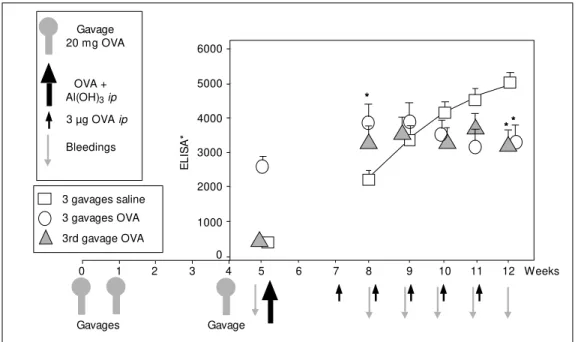
Three groups of mature (20 weeks old) H-III mice were given 3 gavages with 20 mg OVA on days 0, 7 and 28. A first control group received 3 gavages with saline, a sec-ond control group received 3 gavages with 20 mg OVA (orally immune), and for the third group (experimental group), only the third gavage (day 28) contained 20 mg OVA. One week later (day 35) all animals were test bled to assess the result of oral exposures to OVA. As shown in Figure 1, on this day, mice exposed to 3 gavages with OVA dis-played significant (orally induced) anti-OVA titers in serum, while control mice orally exposed to saline on these three days and mice exposed to OVA only in the third ga-vage displayed very low anti-OVA titers, not different from those found in normal mice.
On this day (day 35), all animals were immunized ip with OVA + Al(OH)3 and 14
8000
7000
6000
5000
4000
3000
2000
1000
0
Bleedings
3 µg OVA ip
10 µg OVA ip + 1 mg Al(OH)3
E
L
IS
A
*
0 7 14 21 28 35 42 49 56
Gavage 20 mg OVA
OVA + Al(OH)3ip
3 µg OVA ip
Bleedings
3 gavages saline 3 gavages OVA
3rd gavage OVA
6000
5000
4000
3000
2000
1000
0
E
L
IS
A
*
0 1 2 3 4 5 6 7 8 9 10 11 12 Weeks
Gavages Gavage
* *
*** * Figure 1 - Stabilization of
anti-OVA ant ibody product ion in orally immunized mice. Control mice (squares) received 3 ga-vages w ith saline; orally immu-nized mice (circles) received 3 gavages w ith 20 mg OVA; ex-perimental mice (triangles) re-ceived 2 gavages w ith saline and 20 mg OVA in the third gavage (4th w eek), one w eek before prim ing w it h 10 µg OVA + Al(OH)3 ip. Starting tw o w eeks after priming, all mice received 5 w eekly ip boosters w ith 3 µg OVA. Asterisks indicate signifi-cant differences betw een con-trol and experimental groups.
Figure 2 - Booster effect on the antibody response of parenterally immunized mice. After an initial bleeding to assess natural antibody levels, mice received 10 µg OVA + 1 mg Al(OH)3 ip: starting 14 days later, a se-quence of 6 w eekly challenges w ith 3 µg OVA ip w as performed (open squares); orbital bleedings w ere per-formed before each challenge. A control group of mice (filled squares) received only the first parenteral booster injection. The gray area displays the period during w hich the rising titers in sequentially boosted animals con-trasted w ith the declining titers of the mice boosted only once.
A single initial gavage with 20 mg OVA, therefore, although unable to induce oral tolerance or oral immunization, conferred a strong refractoriness to further increases in antibody production on the animals.
This particular experiment was conducted with mature (20 weeks old) Biozzis high-responder mice from selection-III (abbrevi-ated H-III) (11) because their antibody for-mation during oral immunization to OVA is especially vigorous. As shown in the next experiments, however, similar results are obtained with other mouse strains and other antigens.
It might be argued that the inability to booster orally immunized mice by parenter-al injection with smparenter-all doses of antigen (10 µg) derives from neutralization by preformed antibodies. The results presented in Figure 2 show that this is unlikely. Mice primed by the parenteral route responded to subsequent sequential boosters with even smaller doses of antigen (3 µg). They displayed sequential increases in antibody formation (gray area in Figure 2), whereas a control group of mice boosted only once with 3 µg OVA ip on day 14 displayed slightly declining antibody ti-ters. Control groups of mice injected ip with saline on the same days formed no anti-OVA antibodies throughout the experiment (data not shown).
Stabilizatio n o f se rum antibo dy re spo nse s
may be achie ve d at diffe re nt le ve ls,
de pe nding o n the do se o f antige n fe d
Oral tolerance induction depends on sev-eral factors besides mouse strain, one of which is the dose of protein given orally (2,5,12-14). B6D2F1 mice are highly sus-ceptible to oral tolerance induction when a single gavage of 20 mg OVA is used, but lower doses are not as efficient.
Figure 3 shows the result of oral pretreat-ment with different doses of either OVA or HEL before parenteral immunization. After priming with the specific antigens in Al(OH)3
ip, a series of booster injections and orbital bleedings similar to those performed in the previous experiment were performed. The gray area in Figure 3 (day 28) highlights the secondary responses. These results are high-lighted because they correspond to the val-ues classically used to characterize the in-duction of oral tolerance. Upon the booster injections of 3 µg of antigen ip, the specific antibody titers of control mice orally pre-treated with saline and serially boosted steadily increased. Oral pretreatment of mice with either 20 mg OVA or 10 and 30 mg HEL induced oral tolerance, as measured by the bleeding 7 days after the first booster (day 28). In this bleeding (day 28) the
anti-7000
6000
5000
4000
3000
2000
1000
0
E
L
IS
A
*
7000
6000
5000
4000
3000
2000
1000
0
E
L
IS
A
*
A (mg oral OVA)(0) B
(1)
(3) stable
(10) stable
(20) stable tolerant
(mg oral lyzozyme)
(0)
(3)
(10)
(30) stable
stable
stable tolerant
tolerant
Bleedings (days)
14 21 28 35 42 14 21 28 35 42 49 56
Bleedings (days)
*
*
*
*
*
*
*
*
*
OVA and anti-HEL titers of mice orally pretreated with lower doses of antigen were not significantly different from those of sa-line-pretreated mice. However, in the subse-quent bleedings, in spite of the repeated boosters, the anti-OVA titers of mice pre-treated with 3 mg and 10 mg OVA or the anti-HEL titers of mice pretreated with 3 mg HEL remained stable; mice pretreated with 1 mg OVA were not significantly stable (P = 0.56).
These data suggest that, more subtly than oral tolerance, the stabilization of antibody production is an indicator of previous oral exposure to antigens.
Re pe ate d o ral e xpo sure s are m o re e fficie nt
than a single gavage in e vo king bo th o ral
to le rance and the re fracto rine ss to bo o ste r
re actio ns
In the next experiment, B6D2F1 mice received gavages with saline alone or saline containing different doses of OVA on 3
consecutive days and were then submitted to the standard sequence of ip immunizations with OVA.
Figure 4 shows that, as measured 7 days after the first ip booster, only the gavages with 3 mg or 10 mg OVA resulted in a significant reduction of anti-OVA antibody formation, i.e., induced oral tolerance (P<0.001). In the remaining experimental groups the secondary antibody titers were not significantly different from those of con-trol animals. However, the mice in two of the remaining groups, those pretreated with 1 mg or 0.3 mg OVA, maintained stable anti-body titers following the sequential boosters (P<0.01 and P = 0.01, respectively), a treat-ment which progressively increased antibody titers in control mice. Mice orally pretreated with 0.1 mg OVA were not significantly different from control mice (P = 0.44). A comparison between these last two experi-ments (Figures 3 and 4) shows that repeated oral exposures are more efficient than a single gavage in evoking both oral tolerance and the refractoriness to booster reactions.
Stabilizatio n o f se rum antibo dy re spo nse
fo llo wing pre tre atme nts by the nasal ro ute
Similarly to oral contacts, nasal expo-sures to antigen have been shown to either inhibit or enhance subsequent responsive-ness to parenteral immunizations (4). We repeatedly pretreated mice with OVA by the nasal route at doses ranging from 1 to 25 µg. None of the chosen doses of OVA was able to induce tolerance (Figure 5); actually, the responses of mice instilled with the largest dose of OVA (25 µg) were significantly higher than those of control mice instilled with sa-line (P = 0.047). Nevertheless, the animals showed a stable response. Mice pretreated with 5 or 10 µg OVA were significantly more stable (P£0.03) than control mice, whereas those instilled with 1 µg or 2.5 µg were not significantly different from controls (P = 0.71 and P = 0.81).
Figure 4 - Effect of repeated oral exposures to antigen on the stabilization of serum antibody responses. M ice received 3 gavages w ith saline (controls, open squares) or w ith saline containing either 0.1 mg (open triangles), 0.3 mg (open pentagons), 1.0 mg (filled triangles), 3.0 mg (filled pentagons) or 10 mg OVA (filled squares), 7 days before primary ip immuniza-tion w ith 10 µg OVA + 1 mg Al(OH)3 ip; 14 days later a series of 4 ip w eekly challenges w ith 3 µg soluble OVA w as initiated. Immediately before each booster the mice w ere bled for measurement of antibodies by ELISA. Asterisks indicate significant differences betw een control and experimental groups.
7000
6000
5000
4000
3000
2000
1000
0
E
L
IS
A
*
days
14 21 28 35 42
stable stable
stable stable
*
*
*
*
*
*
tolerant 3 oral pretreatments
mg OVA 0 0.1 0.3 1.0 3.0 10
3 µg OVA ip
In this experiment, therefore, none of the experimental groups developed tolerance, but three out of these five groups became stable and the two remaining ones followed an intermediate path.
Stabilizatio n o f antibo dy re spo nse s in the
abse nce o f o ral to le rance in se nile B6D 2F1
In the next two experiments we tested the effects of initial mucosal antigenic contacts in old mice which are refractory to oral tolerance induction (3,6,7). Seventy-week-old B6D2F1 mice were pretreated with ei-ther saline or saline containing 20 mg OVA. As expected, the OVA-pretreated mice did not (P = 0.27) become tolerant (Figure 6). Nevertheless, they did become refractory to booster challenges upon subsequent immu-nizations (P = 0.048). As observed in previ-ous experiments (15), the control saline-pretreated senile mice were less able than young mice to develop progressively higher booster responses.
D iscussio n
Oral tolerance is classically demonstra-ble by the suppression of primary and sec-ondary humoral and cell-mediated responses after parenteral immunization with antigens previously contacting the host by the oral route (2,5,12,14,16). In some situations, de-pending on the strain or dose of antigen used, tolerance induction may be only par-tial and when the magnitude of the re-sponses is not significantly different from that of control animals it is simply assumed that nothing has happened. Another possible outcome of mucosal contacts with antigens is oral immunization which, in contrast with tolerance or parenteral immunization, results in significant serum titers of specific anti-bodies without further parenteral contacts with the antigen. There are thus three pos-sible results of oral exposures: oral toler-ance, partial oral tolerance (or even absence
of tolerance) and oral immunization. Here we have shown that there is an additional consequence of mucosal contacts with anti-gens that can be clearly observed after a sequence of ip immunizations with low doses
5000
E
L
IS
A
*
4000
3000
2000
1000
0
Saline 20 mg OVA
days
14 21 28 35 42
Figure 5 - Stabilization of serum antibody responses by nasal treatment w ith antigen. B6D2F1 mice w ere pretreated by nasal instillation for 5 consecutive days w ith either a microdrop (20 ml) of saline (open squares) or saline containing variable doses of OVA per exposure. Pretreatments ended 7 days before primary immunization w ith 10 µg OVA + 1 mg Al(OH)3 ip; 14 days later, a series of 4 w eekly challenges w ith 3 µg soluble OVA w as initiated. Immediately before each booster the mice w ere bled for measurement of antibod-ies by ELISA. Asterisks indicate significant differences betw een control and experimental groups.
Figure 6 - Stabilization of serum antibody responses in the ab-sence of oral tolerance in senile mice. Seventy-w eek-old B6D2F1 mice w ere pretreated w ith one gavage of either saline (open squares) or saline containing 20 mg OVA (filled squares) 7 days bef ore prim ary im m unizat ion w ith 10 µg OVA + 1 mg Al(OH)3 ip; 14 days later, a series of 4 w eekly challenges w ith 3 µg soluble OVA w as initiated. Im-mediately before each booster the mice w ere bled for meas-urement of antibodies by ELISA. Asterisks indicate significant dif-ferences betw een control and experimental groups.
stable
*
7000
6000
5000
4000
3000
2000
1000
0
E
L
IS
A
*
days
21 28 35 42
stable
stable stable
*
*
*
*
5 nasal pretreatments (day -11 to day -7)
µg OVA 0 1 2.5 5 10 25
3 µg OVA ip
Bleedings
3 µg OVA ip
of soluble antigens: the stabilization of se-rum antibody responses, i.e., a blockade of secondary-type responsiveness upon repeated exposures. This is a general consequence of oral exposures, common to oral tolerance, partial (or absence) of oral tolerance and oral immunization. The stabilization of specific antibody formation may occur at low, medi-um or high sermedi-um antibody levels.
The stabilizing effect was dose depend-ent (Figures 3 and 4), occurred with differdepend-ent proteins (Figure 3), was present in young and old mice (Figure 6) and was triggered by both the oral and nasal routes (Figure 5) even after a single initial oral exposure to the antigen (Figures 1, 3, and 6).
We suggest that oral tolerance or, more generally, mucosal tolerance, thus represents a particular instance of this stabilizing phe-nomenon, i.e., oral (mucosal) tolerance could be described as a situation in which antibody formation is stabilized at low levels. How-ever, as we presently show, depending on the experimental conditions, specific respon-siveness may also be stabilized at medium or high levels. In these situations, i.e., stabiliza-tion in the presence of ongoing high rates of antibody formation, we are neither dealing with deletion or anergy of responsive clones, nor with what is generally designated as suppression of immune responsiveness: we are facing high levels of stable respon-siveness. In these situations specific immune responsiveness cannot be described as in-hibited, or suppressed.
Nor can we say that the stabilization at-tained by initial mucosal contacts involves what is meant by immunological memory or secondary-type responsiveness: it is actually its operational reverse. Memory, or second-ary-type responsiveness, is usually under-stood as promptness to respond, or the abil-ity to undergo longer, higher and more rapid specific changes. This is what actually hap-pens when the initial contact with the anti-gen occurs through the parenteral route. In
the phenomenon we presently describe, the exact opposite occurs, i.e., the organism de-velops the ability to maintain a stable specif-ic responsiveness upon repeated exposures to the antigen. The stability of the immune response triggered by initial mucosal con-tacts may be useful for exploiting vaccine development.
Immunoblotting methods allowing the analysis of the global reactivity of circulat-ing immunoglobulins with complex antigen mixtures (17,18) have shown that the organ-ism maintains a remarkable stability in its profiles of natural immunoglobulins throughout its life (19,20). Changes in natu-ral immunoglobulin production, therefore, are highly restricted (21), although influ-enced by genetic and ontogenetic factors (e.g., maternal effects, aging, etc.) (17,18). On the other hand, specific immune responses to parenteral injections of antigen, which are usually considered to be the standard immu-nological phenomena, surprisingly may fail to trigger major changes in immunoblotting profiles (22). It is currently unknown whether or not the stabilization of responsiveness which we are presently describing is related to these stable profiles of natural immuno-globulins revealed by immunoblotting with complex antigenic mixtures. One of our ma-jor present goals is to analyze immunoblot-ting profiles of animals with stabilized re-sponsiveness to external antigens following mucosal contacts. The understanding of both phenomena - those we are presently describ-ing and the restrictions occurrdescrib-ing in natural antibodies (21,23) - may require major modi-fications of our present understanding of the immune system.
Ackno wle dgm e nts
Re fe re nce s
1. Brandtzaeg P (1996). History of oral toler-ance and mucosal immunology. Annals of the New York Academy of Sciences, 778: 1-17.
2. M ow at A & Weiner HL (1999). Oral toler-ance. Physiological basis and clinical ap-plications. In: Ogra P, M estecky J, Lamm M , Strober W, Bienenstock J & M cGhee J (Editors), M ucosal Immunology. 2nd edn. Academic Press, San Diego, 587-613. 3. Vaz NM , Faria AM C, Verdolin BA &
Carvalho CR (1997). Immaturity, ageing and oral tolerance. Scandinavian Journal of Immunology, 46: 225-229.
4. Holt PG (1994). A potential vaccine strat-egy for asthma and allied atopic diseases during early childhood. Lancet, 344: 456-461.
5. Faria AM C & Weiner HL (1999). Oral toler-ance: mechanisms and therapeutic appli-cations. Advances in Immunology, 73: 153-232.
6. Faria AM C, Garcia G, Rios M JC, M ichalaros CL & Vaz NM (1993). Decrease in susceptibility to oral tolerance induc-tion and occurrence of oral immunizainduc-tion to ovalbumin in 20-38-w eek-old mice. The effect of interval betw een oral exposures and rate of antigen intake in the oral im-munization. Immunology, 78: 147-151. 7. Rios M JC, Pereira M AC, Faria AM C,
Lopes LM , Gontijo CM , Castanheira EB & Vaz NM (1988). Tolerance induction and immunological priming initiated by mu-cosal contacts w ith protein antigens in inbred strains of mice. Brazilian Journal of M edical and Biological Research, 21: 825-836.
8. Vaz NM , Rios M JC, Lopes LM , Gontijo CM , Castanheira EB, Jacquemart F & Andrade LA (1987). Genetic influences on the susceptibility to oral tolerance. Brazil-ian Journal of M edical and Biological
Re-search, 20: 785-791.
9. Verdolin BA, Faria AM C, Carvalho CR, Lahmann WM & Vaz NM (1993). Systemic immunization of mature mice by the oral route. Brazilian Journal of M edical and Biological Research, 26: 725-734. 10. Carvalho CR, Verdolin BA & Vaz NM
(1997). Indirect effects of oral tolerance cannot be ascribed to bystander suppres-sion. Scandinavian Journal of Immunol-ogy, 45: 276-283.
11. Biozzi G, M out on D, Sant ’ Anna OA, Passos HC, Gennard M , Reis M H, Ferreira VCA, Heumann AM , Boutjillier Y, Ibañez OM , Stiffel C & Siqueira M (1979). Genet-ics of immunoresponsiveness to natural antigens in the mouse. Current Topics in M icrobiology and Immunology, 85: 31-40. 12. Friedman A & Weiner HL (1994). Induc-tion of anergy or active suppression fol-low ing oral tolerance is determined by antigen dosage. Proceedings of the Na-tional Academy of Sciences, USA, 91: 6688-6692.
13. Hanson DG, Vaz NM , M aia LCS, Hornbrook M M , Lynch JL & Roy CA (1977). Inhibition of specific immune re-sponses by feeding protein antigens. In-ternational Archives of Allergy and Immu-nology, 55: 526-531.
14. Benson J & Whitacre C (1997). The role of clonal deletion and anergy in oral toler-ance. Research in Immunology, 148: 533-538.
15. Verdolin BA, Lahmann WM , M enezes JS & Vaz NM (1993). Oral immunization in mature mice. Proceedings of the III Latin Am erican Congress of Im m unology (ALAI), Santiago, Chile, 3: T202. 16. M arth T & Strober W (1997). Oral
toler-ance and its modulation by anti-cytokines. Research in Immunology, 148: 554-559. 17. Haury M , Grandien A, Sundblad A,
Coutinho A & Nobrega A (1994). Global analysis of antibody repertoires. 1. An im-munoblot method for the quantitative screening of a large number of reactivi-ties. Scandinavian Journal of Immunology, 39: 79-85.
18. Nobrega A, Haury M , Grandien A, M alanchere E, Sundblad A & Coutinho A (1993). Global analysis of antibody reper-toires. II. Evidence for specificity, self-se-lection and the immunological “ homun-culus” of antibodies in normal serum. Eu-ropean Journal of Immunology, 23: 2851-2859.
19. M outhon L, Lacroix-Desmazes S, Nobrega A, Barreau A, Coutinho A & Kazatchkine M D (1996). The self-reactive antibody rep-ertoire of normal human serum IgM is acquired in early childhood and remains conserved throughout life. Scandinavian Journal of Immunology, 44: 243-248. 20. Lacroix-Desmazes S, M outhon L,
Couti-nho A & Kazatchkine M D (1995). Analysis of the human natural IgG antibody reper-toire: life-long stability of reactivities to-w ards self-antigens contrasts to-w ith age-dependent diversification of reactivities against bacterial antigens. European Jour-nal of Immunology, 25: 2598-2604. 21. Coutinho A & Kazatchkine M D (1995).
Natural antibodies. Current Opinion in Im-munology, 7: 812-815.
22. Haury M , Sundblad A, Grandien A, Barreau C, Coutinho A & Nobrega A (1997). The repertoire of serum IgM in normal mice is largely independent of ex-ternal antigenic contact. European Jour-nal of Immunology, 27: 1557-1563. 23. Benerman A, Ternymck T & Avrameas S