Exhale d nitric o xide co lle cte d with
two diffe re nt mo uthpie ce s: a study
in asthmatic patie nts
1Disciplina de Clínica Geral, Laboratório de Terapêutica Experimental 1 (LIM 20) and 2Disciplina de Anestesiologia, Faculdade de Medicina, Universidade de São Paulo,
São Paulo, SP, Brasil A.S. Leme1, D.I. Kasahara1,
M.P.T. Nunes1, M.A. Martins1
and J.E. Vieira1,2
Abstract
Techniques for collecting exhaled nitric oxide (ENO) recommend the use of antibacterial filters of 0.3 µm. The aim of the present study was to compare the measurements of ENO obtained with two different filtering devices. Air samples from 17 asthmatic and 17 non-asthmatic subjects were collected by a recommended off-line technique using two different mouthpieces: 1) the Sievers disposable tool (A) under a breathing pressure of 18 cmH2O, and 2) a mouthpiece containing a HEPA filter (B) under a breathing pressure of 12 cmH2O. The nitric oxide samples were collected into an impermeable reservoir bag. Values for ENO were compared using two-way repeated measures ANOVA followed by the Tukey test. Agreement was assessed by Bland-Altman analysis. ENO values obtained with mouthpieces A and B were comparable for asthmatic (mean ± SEM, 42.9 ± 6.9 vs 43.3 ± 6.6 ppb) and non-asthmatic (13.3 ± 1.3 vs 13.7 ± 1.1 ppb) subjects. There was a significant difference in ENO between asthmatics and non-asthmatics using either mouthpiece A (P<0.001) or B (P<0.001). There was a positive correlation between mouthpiece A and mouth-piece B for both groups. The Bland-Altman limits of agreement were considered to be acceptable. Mouthpiece B was less expensive than A, and these data show that it can be used without compromising the result. Our data confirm reports of higher ENO values in the presence of airway inflammation.
Co rre spo nde nce
J.E. Vieira
Laboratório de Terapêutica Experimental I, LIM 20 Faculdade de Medicina, USP
Av. Dr. Arnaldo, 455, Sala 1216 01246-903 São Paulo, SP Brasil
Fax: + 55-11-3085-0992 E-mail: joaquimev@ hotmail.com
Presented in part at the 97th
International Conference of the American Thoracic Society, San Francisco, CA, USA, May 18-23, 2001.
Research supported by CNPq, FAPESP
and PRO NEX-MCT.
Received O ctober 17, 2001 Accepted June 20, 2002
Ke y words
·Exhaled nitric oxide
·Asthma
·Nitric oxide collecting apparatus
·Filter
Intro ductio n
Nitric oxide (NO), a highly reactive gas involved in several pathophysiologic pro-cesses, is synthesized by endothelia and neu-ronal tissue cells and by macrophages. NO may participate in arterial pressure regula-tion, neuronal communication and immune system defense. High NO production may be associated with diseases such as sepsis, stroke and cerebrovascular disease, neuronal
de-generation, diabetes, arthritis and several chronic inflammatory conditions (1,2).
last few years, emphasis has changed from bronchospasm control, surely necessary, to the control of airway inflammation.
NO participates in the physiologic regu-lation of bronchomotor tonus, in diseases such as asthma (5,6). Exhaled NO (ENO) is elevated in asthmatic persons compared to non-asthmatic individuals (7,8) and is de-rived mainly from peripheral airways (9,10). The higher ENO values for asthmatic per-sons have been related to airway inflamma-tion mainly when eosinophils are present (11). ENO is also elevated during a late aller-genic response (12) although they are re-duced during inhaled corticoid treatment (13). Recently the techniques used to collect and to measure ENO have been standardized (14). Included in the recommendations is the use of antibacterial filters with a filtering capacity of 0.3 µm. A disposable filtering material is available from Sievers (Sievers Instruments Inc., Boulder, CO, USA). A sec-ond device has been constructed to use the high efficiency particulate air (HEPA) filters with similar filtering capacity to the Sievers filters.
The objective of the present investiga-tion was to compare ENO measurements obtained from non-asthmatic healthy volun-teers and asthmatic subjects using two filter-ing mouthpieces.
Mate rial and Me thods
The protocol was approved by the Ethics Committee of the University Hospital and
informed consent was obtained from the subjects.
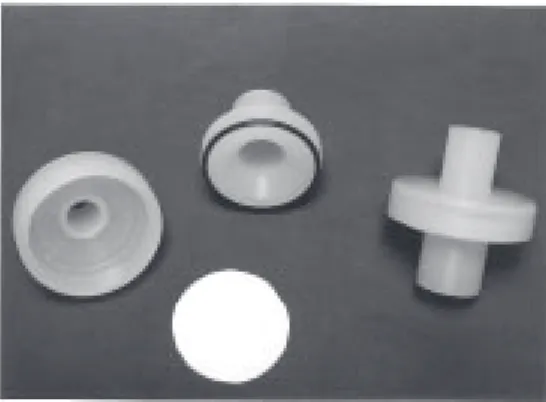
Seventeen asthmatic and 17 healthy non-asthmatic volunteers were invited to partici-pate in the study by providing exhaled air samples in order to compare ENO collected by the recommended off-line technique us-ing two different devices (Figure 1): 1) the Sievers mouthpiece with a built-in 0.3-µm bacterial filter (A), and 2) a mouthpiece containing a 0.3-µm bacterial HEPA filter (Trox Technik, Curitiba, PR, Brazil) (B). Subjects were required to inhale orally up to their total lung capacity first through mouth-piece A and then through mouthmouth-piece B, both attached to a Sievers sampling kit. This kit contains a pressure gauge and an inspira-tory filter that reduces the NO level from the inhaled air to a very low concentration.
Once the subject had inhaled to total lung capacity, a gentle exhalation maneuver into the Mylar bag (Sievers) was performed through the sampling kit without any breath-holding(mean oral NO). The volunteer us-ing the A mouthpiece was instructed to achieve a breathing pressure of 18 cmH2O monitored by the pressure gauge, which gave a flow rate of 250 ml/s. During this expira-tory time, he was instructed to push in a stainless steel valve of the sampling kit after 3 s of exhalation and to continue for about 2 s, producing a collected volume larger than 50 ml (duplicate samples). This procedure was repeated using the B mouthpiece with the volunteer reaching a breathing pressure of 12 cmH2O, which gave a flow rate of 200 ml/s. The breathing sample was collected into an NO-impermeable reservoir bag (Mylar bag) with a volume capacity of 1.5 liters. The bags were sealed and subsequently analyzed for ENO by chemiluminescence (Sievers, model NOA 280).
The resistance of the Sievers sampling kit with the A or B mouthpiece was deter-mined using an Inter 5 ventilator (Intermed, São Paulo, SP, Brazil) with the application of a quadratic constant flow.
Statistical analysis
Statistical analysis was performed using the SigmaStat 2.0 software (SigmaStat for Windows version 2.03, SPSS Inc.). All data are reported as means ± SEM. ENO values were compared by two-way repeated meas-ures analysis of variance for one factor of repetition followed by the Tukey test for multiple comparisons, with the level of sig-nificance set at a P<0.05.The Pearson corre-lation coefficient was used in order to com-pare the devices. Agreement of the results obtained with the two mouthpieces was de-termined by the Bland-Altman method cal-culated as the mean difference and the stan-dard deviation of the differences between A and B NO values. This mean added or sub-tracted to doubled standard deviation gives the “limits of agreement” (15).
Re sults
The measurements of ENO using mouth-pieces A and B for asthmatic patients (42.9 ± 6.9 vs 43.3 ± 6.6 ppb) or for non-asthmatic
subjects (13.3 ± 1.3 vs 13.7 ± 1.1 ppb) were
the same (Figure 2). ENO from asthmatics was higher than ENO from non-asthmatics using either device A (42.9 ± 6.9 vs 13.3 ±
1.3 ppb, P<0.001) or device B (43.3 ± 6.6 vs
13.7 ± 1.1 ppb, P<0.001).
There was a strong positive correlation between the results obtained with filters A and B for both groups (Figure 3).
The Bland-Altman diagrams plot the dif-ference in the exhaled nitric oxide measured between techniques (Figure 4). The agree-ment between techniques is demonstrated by a plot of differences against mean values of exhaled nitric oxide. In this plot the solid bar represents the mean difference and bro-ken lines indicate ± 2 SD from the mean. The figure shows the various measures to be reproduced because the individual points on the Bland-Altman plot are randomly scat-tered around the overall average difference
D e v ic e A 120 100 80 60 40 20 0
0 20 40 60 80 100 120
Device B
Figure 3. Correlation curve of exhaled nitric oxide (ppb) ob-t ained f rom non-asob-t hm aob-t ic (open circles) (r = 0.508) and asthmatic subjects (filled circles) (r = 0.930). There w as a positive correlation betw een the differ-ent devices for both non-asth-m atic and asthnon-asth-m atic subject data.
Figure 4. Bland-Altman diagram comparing exhaled nitric oxide (ENO) m easured w it h t he Sievers mouthpiece (A) and the mouthpiece containing a HEPA filter (B) in asthmatic patients (top) and non-asthmatic subjects (bottom). The mean difference w as 0.49 ppb and the limits of agreem ent w ere 18.74 and -17.75 for ENO from asthmatic patients. These limits are ac-ceptable and pertain to the 2 SD range of B-A analyses.
D if fe re n c e b e tw e e n m o u th p ie c e s A a n d B ( p p b ) 5 -5 15 -15 10 0 -10
5 7 9 11 13 15 17 19 21 23 25
M ean of mouthpieces A and B (ppb) -20 10 0 -10 -20 -30 - - -
-10 20 30 40 50 60 70 80 90 -100 1-10 M ean of mouthpieces A and B (ppb)
and most points fall within 2 SD of the overall difference. A random scatter with several points outside the 2 SD would indi-cate a weak agreement.
E N O ( p p b ) 60 40 20 0
A B A B
Non-asthmatics Asthmatics
Mouthpiece resistance was checked by applying quadratic constant flow. Mouth-piece A under a constant flow of 16 l/min (260 ml/s) produced a sampling kit pressure of 18 cmH2O and in the Inter 5 ventilator a system pressure of 21 cmH2O. Mouthpiece B under a constant flow of 12 l/min (200 ml/s) produced an equal Inter 5 ventilator pressure of 21 cmH2O and a pressure of 12 cmH2O in the sampling kit.
D iscussio n
The two mouthpieces, i.e., the Sievers device and the device containing a HEPA filter, were the same in their capacity to correctly collect ENO in higher or lower concentrations from asthmatic patients or healthy volunteers, respectively.
The main rationale behind our study was to compare the efficacy of the Sievers mouth-piece with a prototype manufactured in Brazil which costs approximately six times less than the imported mouthpiece. A sig-nificant part of the savings is that the mouth-piece of the HEPA filter apparatus is reus-able.
The use of standardized ENO collecting methods has been recommended in order to avoid bias in the measurement (14). We have replaced the standardized piece that holds a built-in filter with a new one without chang-ing the characteristics of the measurements. The pressure inside the sampling kit that provides the breathing flow to be redirected to the Mylar collection bag is different (12 cmH2O vs 18 cmH
2O). However, this differ-ence did not change the final amount of ENO measured. We tested its filtering performance in two situations: with asthmatic subjects, who might exhale higher levels of NO, and with healthy volunteers, from whom a lower ENO concentration is expected. Asthmatics may also not feel comfortable blowing into an apparatus with high airflow resistance, a situation probably well tolerated by non-asthmatics.
The pressure inside the mouth did not exceed 21 cmH2O for the two mouthpieces, as measured by tests performed in our labo-ratory using an Inter 5 ventilator. This limita-tion probably reflects the respiratory system charge imposed by these maneuvers. Al-though no other lower or higher pressure was tested, this pressure seems to be a good standard to reach 21 cmH2O in the mouth during the expiratory maneuver. None of the patients or volunteers complained about such effort.
The modified HEPA filter used instead of the original Sievers mouthpiece has a filtering capacity of less than 0.3 µm. This capacity was tested with heated dioctyl phthalate which creates a smoke averaging 0.3 µm. According to the Lydall Group tech-nical support (www.lydall.com), this smoke is used to challenge the filter media at a flow rate of 5.33 cm per second with the penetra-tion recorded. The HEPA filter media has a maximum efficiency of 99.97%, meaning that only 0.03% of the smoke within 0.3 µm penetrates the filter area. For this reason, our device can be considered to have the recom-mended antibacterial capacity (14).
both subject groups. For asthmatics the lim-its are wider than for non-asthmatics, prob-ably because of the heterogeneity of the asthmatic group. However, it must be noted that there are large confidence intervals in the measurements with both filters.
Re fe re nce s
1. Nathan C & Xie QW (1994). Regulation of biosynthesis of nitric oxide. Journal of Bio-logical Chemistry, 269: 13725-13728. 2. M oncada S, Palm er RM & Higgs EA
(1991). Nitric oxide: physiology, patho-physiology, and pharmacology. Pharma-cological Review s, 43: 109-142. 3. Sandford A, Weir T & Pare P (1996). The
genetics of asthma. American Journal of Respiratory and Critical Care M edicine, 153: 1749-1765.
4. National Heart, Lung, and Blood Institute (1997). Expert Panel Report 2: Guidelines for the Diagnosis and M anagement of Asthma. National Institutes of Health, Be-thesda, M D, USA.
5. Barnes PJ & Belvisi M G (1993). Nitric ox-ide and lung disease. Thorax, 48: 1034-1043.
6. Gaston B, Drazen JM , Loscalzo J & Stamler JS (1994). The biology of nitro-gen oxides in the airw ays. American Jour-nal of Respiratory and Critical Care M edi-cine, 149 (Part 1): 538-551.
7. Alving K, Weitzberg E & Lundberg JM
(1993). Increased amount of nitric oxide in exhaled air of asthmatics. European Respiratory Journal, 6: 1368-1370. 8. Persson M G, Zetterstrom O, Agrenius V,
Ihre E & Gustafsson LE (1994). Single-breath nitric oxide measurements in asth-matic patients and smokers. Lancet, 343: 146-147.
9. Kharit onov SA, Chung KF, Evans D, O’Connor BJ & Barnes PJ (1996). In-creased exhaled nitric oxide in asthma is mainly derived from the low er respiratory tract. American Journal of Respiratory and Critical Care M edicine, 153 (Part 1): 1773-1780.
10. M assaro AF, M ehta S, Lilly CM , Kobzik L, Reilly JJ & Drazen JM (1996). Elevated nitric oxide concentrations in isolated low er airw ay gas of asthmatic subjects.
American Journal of Respiratory and Criti-cal Care M edicine, 153: 1510-1514. 11. Jatakanon A, Lim S, Kharitonov SA, Chung
KF & Barnes PJ (1998). Correlation be-t w een exhaled nibe-t ric oxide, spube-t um eosinophils, and methacholine
respon-siveness in patients w ith mild asthma.
Thorax, 53: 91-95.
12. Kharitonov SA, O’Connor BJ, Evans DJ & Barnes PJ (1995). Allergen-induced late asthmatic reactions are associated w ith elevation of exhaled nitric oxide. Ameri-can Journal of Respiratory and Critical Care M edicine, 151: 1894-1899. 13. Kharitonov SA, Yates D, Robbins RA,
Logan-Sinclair R, Shinebourne EA & Barnes PJ (1994). Increased nitric oxide in exhaled air of asthmatic patients. Lancet, 343: 133-135.
14. American Thoracic Society (1999). Rec-ommendations for standardized proce-dures for the online and off-line measure-ment of exhaled low er respiratory nitric oxide and nasal nitric oxide in adults and children. American Journal of Respiratory and Critical Care M edicine, 160: 2104-2117.
15. Bland JM & Altman DG (1986). Statistical methods for assessing agreement be-tw een be-tw o methods of clinical measure-ment. Lancet, 1: 307-310.
Ackno wle dgm e nts