INTRODUCTION
Maintenance in apparent and underwater hydraulic surfaces of concrete structures of dams must be performed combining characteristics of cost, performance, durability, workability of
use, application time of the involved materials and compatibility between them and the substrate, slab concrete or reference-concrete (RefC). Also, it is of fundamental importance to evaluate the local and the environmental conditions, such as: solar radiation, temperature, humidity and
Study of the performance of four repairing material systems for
hydraulic structures of concrete dams
(Estudo do desempenho de quatro sistemas de materiais de reparo para
estruturas hidráulicas de concreto de barragens)
A. C. M. Kormann
1, K. F. Portella
2, P. N. Pereira
3, R. P. Santos
31Universidade Federal do Paraná, PPGCC
Centro Politécnico da UFPR, Jd. das Américas, Curitiba, PR, 81531-990
2Instituto de Tecnologia para o Desenvolvimento, LACTEC
Centro Politécnico da UFPR, Jd. das Américas, Curitiba, PR, 81531-990
3Duke-Energy International -Geração Paranapanema
Rod. Chavantes, Ribeirão Claro, km 10, Chavantes, SP, 18970-000 [email protected]
Abstract
Four types of repairing materials are studied as function of either a conventional concrete or a reference-concrete (RefC), these are: polymer-modified cement mortar (PMor), steel fiber concrete (SFco), epoxy mortar (EMor) and silica fume mortar (SFmo), to be applied in hydraulic structures surfaces subjected to a high velocity water flow. Besides the mechanical requests and wearing resistance of hydraulic concrete dam structures, especially the spillway surfaces, the high solar radiation, the environmental temperature and wet and dry cycles, contribute significantly to the reduction of their lifespan. RefC and the SFco were developed based on a usual concrete mixture used in slabs of spillways. The average RefC mixture used was 1: 1.61: 2.99: 0.376, with Pozzolan-modified Portland cement consumption of 425 kg/m3. EMor and PMor mixtures followed the information given by the manufacturers and lab experience. Tests on concrete samples were carried out in laboratory simulating normally found environmental situations in order to control the mechanical resistance and the aging imposed conditions, such as solar radiation and humidity. Also, physicochemical characterizing tests were made for all used materials. From the analyzed results, two of them presented a higher performance: the EMor and SFmo. SFco presented good adherence to the RefC and good mechanical performance. However, it also presented apparent metal corrosion in humidity tests, being indicated for use, with caution, as an intermediate layer in underwater repairs. In a general classification, considering all tests, including their field applications, the better performance material systems were EMor– SFmo> SFco> PMor.
Keywords: concrete repair, mortar, abrasion, dam, spillway, epoxy mortar, silica fume, steel fiber, concrete modified polymer.
Resumo
Quatro tipos de materiais de reparo são estudados em função de um concreto convencional ou concreto-referência (RefC), sendo: argamassa de cimento Portland modificado com polímero (PMor), concreto com fibra de aço (SFco), argamassa epoxídica (EMor) e argamassa com sílica ativa (SFmo), para aplicações em estruturas hidráulicas sujeitas a um fluxo de água de alta velocidade. Junto com as necessidades de suportar esforços mecânicos e de resistência ao desgaste, as estruturas hidráulicas de concreto de barragens, principalmente na região superficial dos vertedores, a radiação solar, os ciclos secagem-molhagem e as diferenças de temperatura contribuem significativamente para a redução de sua vida útil. No estudo foi utilizado um concreto de referência (RefC) com cimento Portland classe CP II-Z 32 e fck28 de 40 MPa, e consumo de cimento de 425 kg/m3. O RefC foi dosado em traço médio de lajes de vertedor
comumente encontrado em barragens. O traço médio utilizado foi 1: 1,61: 2,99: 0,376. Os outros dois materiais de reparo EMor e PMor foram dosados segundo recomendações do fabricante e experiências práticas de laboratório. Para a seleção do melhor sistema em laboratório, foram realizados ensaios de resistência à abrasão, resistência de aderência, resistência à compressão axial simples, resistência à tração na flexão, módulo de deformação estática, ensaios de permeabilidade, envelhecimento acelerado em câmara de raios UV e de intemperismo weather-o-meter e, ensaios físico-químicos dos materiais. Considerando-se todas as propriedades medidas, inclusive de aplicação prática em campo a classificação dos materiais de reparo, segundo o melhor desempenho foi: EMor – SFmo > SFco > PMor. Palavras-chave: reparos de concreto, argamassa, abrasão, erosão, barragem, vertedor, resina epóxi,
corrosive agents, as well as the best mechanism of protection [1-4]. Considering the concrete structures of hydroelectric power plants, it is essential to select materials which are compatible with the available time for making the repairs. In this sense, indirect and direct costs associated to the turned off generating machines, for the repairing procedures, must be considered [5].
The present work focuses some hydraulic surfaces of concrete structures of hydroelectric power plants in operation in Brazil. Technical reports, together with carried out inspections, showed that the main deteriorations in the concrete surfaces are due to abrasion-erosion actions caused by the water flow from the reservoir onto the hydraulic surfaces. Normally spillway, the upstream faces of the sustaining pillars of the floodgates and the water strained ducts are the most affected areas [6-8].
Usually, admixtures which stand out in the technical literature for making the concrete and mortar contain silica fume, metallic fibers and polymeric materials such as the epoxy type, methylmetacrilate, among others [1, 7-10].
EXPERIMENTAL
Four repairing materials were studied: epoxy mortar (EMor), cement based mortars of polymer (PMor) and silica fume (SFmo) types, and concrete with steel fibers (SFco). All tests were based on standardizations and from the technical literature [1-14].
The RefC was developed based on the concrete mixture using CP II – Z 32 (Pozzolan-modified Portland cement) with fck 40 MPa in 28 days. The average mixture used was 1: 1.61: 2.99: 0.376, with cement consumption of 425 kg/m3.
SFmo. Small aggregate was replaced by silica fume, sf. The quantity was defined as 10% of the weight of the cement amount. The studied average mixture was 1: 4: 0.45: 0.1 (cement: sand: w/(c+sf): silica fume).
EMor. Initially, a ready-made product was used where the base material consisted of resin, hardener and quartz sand. Since the final product was fit to be applied on sloping surfaces, such as spillway slabs, quartz sand on different quantities (up to 50%) was used in the final mixture, even though loss of mechanical resistance to compression, was expected.
PMor. A ready-made product with an initial water content of 18% was used in accordance with the manufacturer’s recommendation. After the tests, the optimized water content was altered to 11%.
SFco. This admixture was based on the RefC composition. The inclusion of steel fibers corresponded to 12% of the cement weight and they replaced part of large aggregates, resulting the composition 1: 1.61: 2.94: 0.45: 0.2. Due to lack of homogeneity in the mixture it was necessary to work with an extra 10% of small aggregates, which resulted in the following mixture: 1: 1.98: 2.77: 0.45: 0.11.
Methods.Tests were carried out in laboratory on concrete samples (CSs) in order to simulate the environmental conditions which are usually found. Among other reasons, the
main objective was to control the mechanical resistance (abrasion-erosion resistance) and the imposed aging conditions, such as solar radiation and humidity.
Physicochemical characterization of the raw material. All the materials, including cement and aggregates (large and small ones) and the repairing materials were characterized by physicochemical analysis, such as: chemical composition, Fourier transformed infrared, X-ray diffraction (XRD), optical and scanning electron microscopy (OM and SEM) with energy dispersive system (EDS) and dilatometric analyses (DIL), previous to the mixtures.
Compressive strength. Tests were carried out according to recommended methodology by ASTM C39/C39M standards [13]. Abrasion-erosion resistance test. The abrasion-erosion underwater tests on the repairing material systems were performed differently from the ASTM C 1138/97 [14], on the CSs. A (φ20 x 5) cm void was left in the center of the concrete sample, (φ30 x 10) cm, in order to put the repairing materials and to simulate a border effect generated by the several water flow spillway condition.
Flexural tensile strength. The test was carried out on 60-day-year-old (10 x 10 x 35) cm beams in accordance with the ASTM C78-94 standards [15].
Accelerated-ageing tests. The CSs with the repairing systems (RefC|repairing materials) were tested for 1,600 hours in UV ray chambers and for 400 hours in chambers of the Weather-O-meter type. The mechanical resistance variation under a flexural strength test was used to verify the ageing effects on the materials in a foreseen period. Substrate beams 1. 5 cm x 3 cm x 10 cm, 1.5 cm high, were prepared for the application of the SFmo, the PMor and the EMor. For the repairing with the RefC and SFco, beams 2 cm x 4 cm x 10 cm, 2 cm high, were employed.
RESULTS AND DISCUSSION
The physicochemical analyses from the raw materials shown that they were in accordance with the standardization limits and manufacturer’s specification. Fig. 1 shows the XRD patterns from the cement material as obtained. These results are in agreement with the ICDD data for the cement compounds.
As specified, FTIR patterns from the polymer based materials showed the presence of the epoxy and polyvinyl ester chemical compositions in the EMor and PMor mortars, respectively.
Average values from the compressive strength tests are presented in Table I. For the application of any system on hydraulic surfaces without boundary problems it is ideal that all used materials have similar resistance. If the resistance of the repairing material, compared to the RefC or substrate, is higher such as the case of EMor, boundary problems will generate border effects causing loss of adhesion and possible detachment from RefC. On the other hand, resistance values much lower than the ones from the RefC, such as the case from PMor, contribute to a higher abrasion-erosion phenomena, mainly in the PMor|RefC system interface. Both materials, SFmo and SFco were fully compatible. These criterions are defined in Table I, as the system compatibility.
Relative abrasion-erosion mass loss from the repairing material systems were compatible with their resistance to compression (presented in Table I), as it can be seen in Fig. 2 to Fig. 5.
Materials Age Compressive System compatibility
used (days) strength (MPa) (RefC|repairing materials)
RefC 28 44 ————
SFco 28 38 high
EMor 28 91 poor
PMor 28 22 poor
SFmo 28 44 high
Table I - Average values of the compressive resistance of the concrete and mortar. [Tabela I - Valores médios da resistência à compressão dos concretos e argamassas.] Figure 2: Relative abrasion-erosion underwater mass loss of the
RefC|repairing material systems.
[Figura 2: Perda de massa relativa à abrasão submersa dos sistemas RefC|materiais de reparo.]
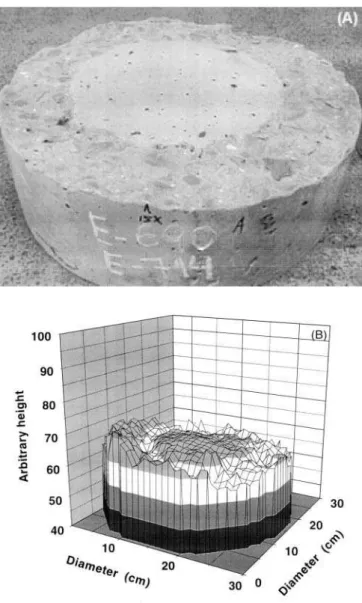
Figure 3: Abrasion-erosion underwater mass loss of the RefC|EMor system: (A) EMor sample photograph after abrasion-erosion; (B) EMor sample schematic 3-D abrasion-erosion mass loss.
SFco resulted as the best material, followed by EMor. Both of them presented a relative homogeneity surface abrasion-erosion mass loss, and the properly mass loss was lower than the RefC sample. In the RefC|EMor system, the mass loss was more detected in the RefC region, while in the RefC|SFco, the loss was distributed in whole sample surface. The difference between them is best viewed in Fig. 3 and Fig. 4.
The SFmo and PMor presented a visible border abrasion-erosion effect. The PMor presented the worse mass loss and it was necessary to study new water consumption. The final reached composition was 11%. Even in this case, the abrasion-erosion results were not good. Both of RefC|Repairing material systems interfaces eroded, as depicted in Fig. 5.
Besides the good abrasion-erosion resistance, SFco presented intensive metal fibers corrosion, after humidity test.
This may be considered a disadvantage to its use in hydraulic surfaces. Metal corrosion in the concrete mass is followed by abnormal volume expansion and tends to crack the mortar or concrete in service. A continuous surface corrosion mechanism will facilitate the abrasion-erosion process. A detailed photo from the SFco|RefC system surface after humidity exposition is shown in Fig. 6. All the RefC|repairing materials passed in this test.
Fig. 7 shows the DIL curves from the repairing materials. Except from EMor, for temperatures greater than 40 oC, all of
them are fully compatible with the RefC.
EMor must be used with care in large areas subjected to high temperature variations due to the risk of loss of adherence and concrete detachment. Another verified disadvantage was its lower viscosity which makes its application in non-Figure 4: Abrasion-erosion underwater mass loss of the RefC|SFco
system: (A) SFco sample photograph after abrasion-erosion; (B) SFco sample schematic 3-D abrasion-erosion mass loss.
[Figura 4: Perda de massa por abrasão submersa do sistema RefC|SFco: (A) corpo-de-prova de SFco após o ensaio de abrasão ; (B) esquema tridimensional da perda de massa por abrasão do corpo-de-prova de SFco.]
horizontal surfaces, the case of the majority of spillway slabs of concrete dams, more difficult.
From these results one could classify the RefC|repairing materials as shown in Table II.
The tests of resistance to pulling by direct tensile resulted, with no exceptions, in the breaking of the superior layer of the CS (about 3 mm of the average thickness), and in none of the worked systems fractures were observed. Their performance in a decreasing order, follows: EMor > SFco > SFmo > PMor. The average corresponding values were 3.0; 2.0; 1.5 and 0.95 MPa, respectively. Therefore, the adherence or the compatibility between the RefC and the repairing material can be considered good.
The RefC|repairing materials flexural tensile strength values are plotted in Fig. 8. The test was performed placing the aged sample surface in a tension mode position. In the first 800 hours under UV light, all the aged repairing materials increased Figure 6: Metal fiber corrosion in RefC|SFco system surface, after humidity exposition.
[Figura 6: Corrosão da fibra de aço na superfície do sistema RefC|SFco, após exposição em ambiente úmido.]
Materials Abrasion- Humidity DIL Field
Systems erosion ageing test application as
mass loss spillway slabs
RefC|SFco High Poor High High
RefC|EMor High High Poor Poor
RefC|SFmo Moderate High High High
RefC|PMor Poor High High High
Table II - Resistance classification of RefC|Repairing material systems after tests.
[Tabela II - Classificação dos sistemas RefC|materiais de reparo após os ensaios.]
Figure 7: Dilatometric curves from the repairing materials. [Figura 7: Análise dilatométrica dos materiais de reparo.]
their resistance between 30% to 60%, which is normal for cementitious materials. In other words, the exposing time to radiation was not large enough to cause irreversible damage, especially on the organic structures (polymeric materials), which are more susceptible to this kind of deterioration. The temperature in the chamber (up to the ambient due to the presence of the UV-light) may contribute to these results. The best resistance performance during the ageing process was from the RefC|EMor system, followed by the RefC|SFmo and RefC|SFco systems. The RefC|PMor system presented a lower performance.
Between 800 and 2,000 hours all the RefC|repairing material systems were aged in a Weather-O-meter chamber with controlled temperature, UV radiation and humidity cycles. The RefC|EMor system presented an inferior quality in the flexural tensile strength, compared to the RefC|PMor system. Both of them are more susceptible to this type of ageing process due their organic nature and presented cracking in the interface RefC|repairing materials. SEM images in Fig. 9 shows micrographies alterations during the test, including a
Figure 8: Flexural tensile strength of the RefC|Repairing materials before and during UV light ageing and weather-O-meter chamber tests.
Figure 9: SEM images of the epoxy resin: (A) new sample; (B) under 800 h UV radiation; (C) and (D) after 2000 h in weather-O-meter chamber ageing. [Figura 9: Imagens por MEV da argamassa epoxídica: (A) sem envelhecimento; (B) após 800 h de radiação UV; (C) e (D) após 2000 h em câmara de intemperismo.]
Tests RefC|Repairing material systems *
Emor SFmo SFco Pmor
Abrasion resistance ↑ ↓ ↔ ↓
Adhesion by direct tensile tests ↑ ↔ ↔ ↓
Direct tensile tests ↑ ↔ ↔ ↓
Compressive strength ↑ ↔ ↔ ↔
Flexural tensile strength ↑ ↔ ↔ ↓
Time curing – high early strength ↑ ↓ ↓ ↓
UV resistance ↓ ↔ ↔ ↓
Tangent elasticity modulus ↓ ↔ ↔ ↔
Permeability n.e. ↑ ↔ n.e.
Dilatometric coefficient ↓ ↑ ↑ ↔
Table III - General classification of RefC|Repairing materials systems for abrasion-erosion repairs of hydraulic concrete structures.
[Tabela III - Classificação geral de desempenho dos sistemas RefC|Materiais de reparo frente aos diversos ensaios]
detachment between the epoxy resin paste and the quartz sand. SFmo and SFco had good performance in this test due their Portland cement based constitution.
Considering all the obtained results from the studied repairing systems and others developed by Kormann, A. C. M. [4], it is possible to classify them in a decreasing order according to performance quality: EMor> SFmo> SFco> PMor, as schematic viewed in Table III.
In this work, the performance of four repairing material systems applied on concrete was analyzed using pozzolan-modified Portland in a consumption rate of 425 kg/m3. Among
the studied materials, and considering the analyzed properties, one concludes that the performance sequence is as follows: EMor - SFmo > SFco > PMor.
However, it is necessary to highlight the following: • the EMor in the mixture recommended by the manufacturer, despite the good performance under abrasion, presented certain difficulties during application due to its self-leveling properties. Therefore, it is not recommended for sloping surfaces. To minimize this problem, it was necessary to increase the quantity of quartz sand. The greater advantage of this material is its high initial resistance, which is desirable for an emergency repair;
• the SFco presented a high corrosion rate on the exposed surface metal fibers when subjected to ageing in the humidity exposition. This fact represents a disadvantage and will contribute to accelerate abrasion effects;
• the SFmo showed itself an excellent repairing material, presenting compatible mechanical performance along with the RefC and also being easy to handle and apply. The only restriction is that a longer period is necessary for its complete hardening;
• facing the PMor unsatisfactory performance and considering the 18% of added water, further studies are necessary to try on diminishing the content of water from 11% to 8%.
ACKNOWLEDGEMENTS
The authors would like to thank DUKE ENERGY INTERNATIONAL, GERAÇÃO PARANAPANEMA, LACTEC and ANEEL for the cooperation and infrastructure for the accomplishment of this work.
REFERENCES
[1] International Concrete Repair Institute, 1999 – Concrete Repair Manual, ACI International (1999).
[2] A. M. Neville, Propriedades do concreto. Translation: S.
E. Giammusso. 2ª. edição, Editora PINI Ltda., S. Paulo (1997). [3] I. Biczok, “Corrosión y protección del hormigón”. Tradución: E. J. D. Asensi. Urmo S.A. de Ediciones, Bilbao (1981).
[4] A. C. M. Kormann, “Estudo do desempenho de quatro tipos de materiais para reparo a serem utilizados em superfícies erodidas de concreto de barragens”. Dissertação de Mestrado, UFPR, PPGCC (2002).
[5] A. C. M. Kormann, K. F. Portella, J. R. G. Nogueira, P. N. Pereira, R. P. Santos, “Comparative study of the mechanical properties and performance, under accelerated aging, of four repairing systems for hydraulic structures of concrete dams”, ACI 5th International Conference – Cancun, Mexico (2002).
[6] R. C. A. de P. Leite, A. R. Abbud, “Considerações sobre o método construtivo e a durabilidade da estrutura em concreto do vertedouro da UHE Capivara, da CESP”, Anais da 38a
Reibrac, Ibracon. Ribeirão Preto, SP, 1996, vol. 1, p. 507-514 . [7] E. F. Carneiro, J. R. A. Andrade, W. Almeida Júnior, “Avaliação do desempenho dos reparos executados na soleira do vertedouro da UHE de Porto Primavera”, Anais da 38a
Reibrac, Ibracon. Ribeirão Preto, SP, 1996, vol. 1, p. 393-395 . [8] A. A. B. Galletti, N. Caproni Júnior, P. Coreixas Júnior, W. P. de Andrade, “Manutenção e recuperação de usinas hidroelétricas. A política de Furnas Centrais Elétricas S. A.“, Anais da 38a Reibrac, Ibracon. Ribeirão Preto, SP, 1996 vol.
1, p. 321-328 .
[9] J. E. McDonald, T. C. Liu, “Repair of concrete surfaces subjected to abrasion erosion damage”, AIC Annual Convention, Milwaukee, Wisconsin (1979).
[10] N. Ghafoori, H. Diawara, “Abrasion resistance of fine aggregate replaced silica fume concrete”, ACI Mater. J. 96, 5 (1999) 555-567.
[11] G. Cabrera, A. s. Al-Hasan, “Performance properties of concrete repair materials”, Constr. Build. Mater. 11, 5-6 (1997) 283-290.
[12] H. Abdel-Fattah, M. M. El-Hawary, “Flexural behavior of polymer concrete”, Constr. Build. Mater. 13, 5 (1999) 253-262.
[13] ASTM. Standard Test Method for “Compressive Strength of Cylindrical Concrete Specimens”, ASTM C39/C39M (1999) 5.
[14] ASTM. Standard Test Method for “Abrasion resistance of concrete (underwater method)”, ASTM C 1138 (1997) 4. [15] ASTM. Standard Test Method for “Flexural Strength of Concrete (Using Simple Beam with Third-Point Loading)”, ASTM C78 (1994) 3.
[16] ASTM. Standard Test Method for “Static Modulus of Elasticity and Poisson’s Ratio of Concrete in Compression”, ASTM C39/C39M (1999) 5.