MCM-41 Ordered Mesoporous Molecular Sieves Synthesis
and Characterization
Rogério A.A. Melo
a, Marcus V. Giotto
a, João Rocha
b,
Ernesto A. Urquieta-González
aaDepartamento de Engenharia Química, Universidade Federal de São Carlos,
C.P. 676, 13565-905 São Carlos - SP, Brazil
b Departamento de Química, Universidade de Aveiro, 3810 Aveiro, Portugal
Received: August 15, 1998; Revised: March 30, 1999
The aim of this work was to study the hydrothermal synthesis of Si and SiAlMCM-41 performed under both autogenic pressure and refluxing conditions. XRD data showed that the MCM-41 phase may be formed by both processes and that the synthesized material in the presence of Al and/or under reflux presents the hexagonally arrangement of less ordered mesopores. However, as verified by XRD and physisorption data, the order was improved with higher synthesis times. 29Si and 1H -29
Si C/P MAS NMR spectra showed that a great part of the Si atoms exists as silanol groups which originate resonance peaks at -110, -100 and -91 ppm. The presence of Al atoms may generate Si(3Si, Al) and Si(2Si, 2Al) environments which might be contributing to resonance peaks at -100 and -91 ppm. The 27Al MAS NMR spectrum of the as synthesized AlSiMCM-41 showed a resonance peak of tetrahedral framework aluminum close to 53 ppm and two others, one close to 14 ppm attributed to Al(H2O)6+3 species and the other a weak signal close to 32 ppm attributed to pentacoordinated Al. 27Al MAS NMR spectra of the calcined sample showed a peak at 0 ppm corresponding to an hexacoordinated extra-framework aluminum formed during calcination.
Keywords:MCM-41, synthesis, characterization
1. Introduction
Molecular sieves with a zeolite structure and pore di-ameter < 15 Å exhibit a shape selectivity that enables them to be used as adsorbents or catalysts in a variety of proc-esses. However, reactions involving bulky molecules re-quire structures with channel diameters at mesopore scale. In the early nineties1,2, scientists from Mobil Oil Corpora-tion synthesized ordered mesoporous materials of the M41S type, family to which MCM-41 belongs. This mate-rial possesses a porous system consisting of hexagonally arranged channels with diameters varying from 15 to 100 Å. MCM-41 has attracted the attention of scientists due to its elevated specific surface area, high thermal and hydrothermal stability, possibility of controlling its pore size and its hydrophobicity and acidity. These charac-teristics have made MCM-41 a promising material as cata-lyst and/or support3 and to be used in industrial processes of adsorption4, ion exchange5 and environmental control6.
The scope of the current work was to investigate the hydrothermal synthesis of SiMCM-41 and AlSiMCM-41 performed under both autogenic pressure and refluxing conditions. The solids obtained were characterized by XRD, SEM, nitrogen physisorption TGA/DTG, 29Si MAS NMR; 1H - 29Si CP/MAS NMR and 27Al MAS NMR.
2. Materials and Methods
2.1. Synthesis of MCM-41
tem-perature under refluxing conditions. After the synthesis the solids were separated from the reaction mixture through centrifugation, washed and dried at 110 °C. Removal of the organic material occurred by calcination at 550 °C under nitrogen flow (100 cm3/min g) for 1 h and subsequently under synthetic air flow (100 cm3/min g) for 6 h. The samples were designated as SiMCM-41(X/Y) and Al-SiMCM-41(X/Y), where X = P presents the samples ob-tained under autogenic pressure and X = R under refluxing conditions; Y corresponds to the synthesis time in hours.
2.2. Characterization
X-ray powder diffraction patterns were recorded on a Siemens D500 diffractometer using a monochromated CuΚα radiation in the angular range from 1 to 10° (2θ); the 2θ scanning speed was 0.6°/min. The scanning electron micro-analysis was performed on a Zeiss DSM 960 Scan-ning Electron Microscope operated at 30 kV. Thermo-gravimetric analysis was carried out on a Thermal Analyst 2100 TA Instruments equipment in the temperature range from 30 to 900°C (heating rate 3 °C/min) in O2 flow (30
cm3/min). Nitrogen physisorption measurement at -196 °C was conducted on a NOVA 1200 TGA Quantachrome Corporation analyzer. Solid state 29Si MAS NMR spectra were recorded on a Varian 400 MHz spectrometer at 79.5 MHz with 50° pulses (4.3 µs) and 5 kHz spinning rates. The recycle delay was 100 s. The 1H - 29Si C/P MAS NMR spectrum was recorded with 4.5 µs 1H (90°) pulses with a
contact time of 5 ms and 5 s of recycle delay. The 27Al MAS NMR spectra were recorded on a Bruker MSL 400P spec-trometer operating at 104.2 MHz with 0.6 s (π/18) pulses and a recycle delay of 0.8 s.
3. Results and Discussion
3.1. X-ray powder diffraction
XRD analysis of the as synthesized samples indicated that the mesoporous MCM-41 molecular sieve may be obtained by both processes and allowed identification of the peaks relative to the (100), (110), (200) and (210) planes corresponding to an hexagonal structure with symmetry P6 for the reflection planes (hk0), indicating that there are no planes for l ≠ 01,2. The values of the parameter a
o of the
hexagonal pore arrangement for different samples are
sum-marized in Table 2. These values are seen to be very representative compared to those presented by other authors who used the same surfactant8. The parameter ao is
also seen to show a tendency to increase with synthesis time for both processes, which has been attributed to the increase in the wall thickness of the mesopores9.
Figure 1 shows X-ray diffraction patterns for samples SiMCM-41 and AlSiMCM-41 synthesized in 48 h. The diffraction peak related to the (100) plane is seen to be more Table 1. Molar compositions and synthesis time.
Samples Composition Reflux
Y(h)
Aut Pres Y(h)
SiMCM-41 SiO2:0.07Na2O:0.27CTMA:0.14TMAOH:100H2O 24; 108 48; 288
AlSiMCM-41 SiO2:0.025Al2O3:0.07Na2O:0.27CTMA:0.14TMAOH:100H2O 24; 108 48; 288
intense for samples obtained under autogenic pressure when compared to those obtained under reflux, which can be interpreted as an indication of higher ordering of the mesopore channels10. The materials synthesized in the presence of aluminum exhibit broader and slightly less intense diffraction peaks, indicating that within 48 h syn-thesis, the hexagonal arrangement of the mesopores in these materials is less ordered compared to SiMCM-41
3.2. Nitrogen physisorption
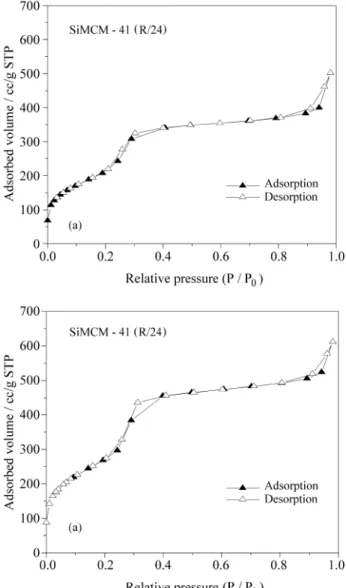
The adsorption/desorption isotherms of N2 (Fig. 2) and
the values of specific surface area (SBET), mean diameter
of the mesopores (dmp), total volume of pores (Vt) and wall
thickness (ε) obtained for calcined SiMCM-41 (Table 3) are in agreement with those published by other authors11. Curves in Fig. 2 and data from Table 3 show an increase in the adsorption capacity of N2 with time for the SiMCM-41
samples synthesized under reflux, indicating an improve-ment in the order of the mesopore phase, already observed by the increase in the XRD peak intensity (Fig. 3). How-ever, as it has been observed from the data in Fig. 1, the MCM-41 phase is formed more readily under autogenic pressure, showing a small dependence with synthesis time, as it can be seen in Fig. 4 and from the data in Table 3.
3.3. TG/DTG analysis
Thermogravimetric analysis of the as synthesized Al-SiMCM-41(P/288) sample presented a DTG curve typical of MCM-41 (Fig. 5). The as synthesized material presents approximately 50 wt% of the MCM-41 phase. The remain-ing part corresponds to organic material whose mass loss is related to three exothermal stages: (a) between 100-285 °C: decomposition of the surfactant2; (b) between 285-400 °C: breaking of the hydrocarbon chain, and (c) between 500-700 °C: combustion of the surfactant and water loss associated with condensation of silanol groups12.
Figure 2. Adsorption/desorption isotherms of N2 for calcined SiMCM-41 samples.
Figure 3. XRD of the as synthesized SiMCM-41(R/Y) samples. Table 2. Parameter a0 for SiMCM-41 and AlSiMCM-41 samples.
Samples a0 (Å)
SiMCM-41(R/24) 45.85
SiMCM-41(R/108) 46.07
SiMCM-41(P/48) 45.54
SiMCM-41(P/288) 47.59
AlSiMCM-41(R/24) 45.75
AlSiMCM-41(R/108) 45.32
AlSiMCM-41(P/48) 45.95
3.4. NMR spectra
The 29Si MAS NMR spectra of the as synthesized and calcined AlSiMCM-41(R/108) samples, shown in Fig. 6 bears much resemblance to that of amorphous silica,
indi-cating that the local arrangement of the Si-O-Si bonds at the pore walls is irregular and that the angle between these bonds vary over a wide range. The 1H - 29Si CP/MAS NMR spectrum (Fig. 7) of the calcined sample, shows that, simi-lar to amorphous silica, part of the Si atoms exist as silanol groups which originate resonance peaks at -110, -100 and -91 ppm. These shifts have been attributed to the Si(4SiO), Si(OSi)3OH and Si(OSi)2(OH)2 environments. Chemical
analysis of this sample supplied a ratio Si/Al = 9. The presence of Al atoms in the MCM-41 network may gener-ate Si(3Si, Al) and Si(2Si, 2Al) environments, which might be contributing to the resonance peak intensities at -100 and -91 ppm13.
The 27Al MAS NMR spectra of the as synthesized and calcined AlSiMCM-41(R/108) samples (Fig. 8), present a resonance peak close to 53 ppm which is attributed to structural tetrahedral coordinated aluminum. The as syn-thesized sample shows one peak close to 14 ppm and a weak signal at 32 ppm, which have been attributed to hexacoordinated aluminum, possibly forming Al(H2O)63+
species within the pores and pentacoordinated species, respectively. These resonances were not detected in the calcinated sample13. For the calcined sample the peak
Table 3. Textural characteristics of the calcined SiMCM-41 samples.
Sample Average diameter of the mesopores
dmp (Å)
Wall thickness ε* (Å)
Area SBET
(m2/g)
Total pore volume (Vt) (cm3/g)
SiMCM-41(R/24) 35.34 10.51 876 0.77
SiMCM-41(R/108) 34.74 11.33 1087 0.94
SiMCM-41(P/48) 36.48 9.08 941 0.86
SiMCM-41(P/288) 34.90 12.69 978 0.85
ε = a0-dmp.
Figure 5. TGA-DTG analysis of the as synthesized AlSiMCM-41 (P/288) sample.
around 0 ppm is representative of hexacoordinated alumi-num belonging to extra-structural species formed during calcination13,14.
3.5. SEM micrographs
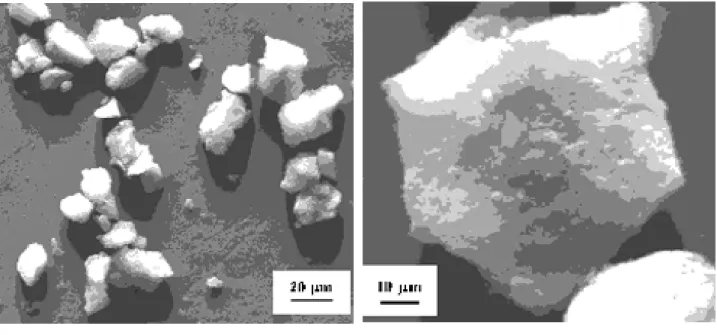
Figure 9 presents typical micrographs of the calcined SiMCM-41(R/108) and SiMCM-41(P/48) samples. For-mation of the SiMCM-41 phase at hydrothermal conditions under autogenic pressure is seen to result, in shorter time, in a solid consisting of small agglomerates (Fig. 9a). The SiMCM-41 obtained under autogenic pressure, synthe-sized under reflux conditions (Fig. 9b) presents
agglomer-ates, similar to those obtained under autogenic pressure, and worm-like particles; this morphology practically did not change with synthesis time. The AlSiMCM-41 samples exhibit agglomerates with sizes between 3 and 200 µm, independent of the used synthesis method (Fig. 10). These samples did not show a tendency to form particles with a particular morphology.
4. Conclusion
XRD analysis of SiMCM-41 and AlSiMCM-41 sam-ples showed that the MCM-41 phase may be formed by both processes and that the synthesized material in the presence of aluminum and/or under refluxing conditions Figure 7. 1H-29Si CP/MAS NMR spectrum of the AlSiMCM-41 (R/108)
sample.
Figure 8. 27Al MAS RMN spectra of the AlSiMCM-41(R/108) samples.
presents a hexagonal arrangement of less ordered mesopores. However, in the latter case, as verified by XRD and physisorption data, improvement in order was ob-served with higher synthesis times.
29Si MAS NMR and 1H - 29Si C/P MAS NMR spectra
showed that a great part of the Si atoms exist as silanol groups which originate resonance peaks at -110, -100 and -91 ppm. The presence of Al atoms may generate Si(3Si,Al) and Si(2Si, 2Al) environments which might be contributing to resonance peaks at -100 and -91 ppm. The 27Al MAS NMR spectra of the as synthesized AlSiMCM-41(R/108) confirm a strong resonance peak of tetrahedral framework aluminum close to 53 ppm and two others resonances, one close to 14 ppm attributed to Al(H2O)6+3 species within the
pores and the other, a weak signal close to 32 ppm attributed to pentacoordinated aluminum species. 27Al MAS NMR spectra of the calcined sample showed the peak at 53 ppm and another at 0 ppm corresponding to an hexacoordinated extra-framework aluminum species formed during the cal-cination process.
Acknowledgments
The authors thankfully acknowledge the financial sup-port for this study provided by FAPESP (grant n. 97/0317-0) and for the Doctor’s scholarship granted by CAPES to Rogério A.A. de Melo.
References
1. Kresge, C.T.; Leonowicz, M.E.; Roth, W.J.; Vartuli, J.C.; Beck, J. S. Nature, n. 359, p. 710, 1992.
2. Beck, J.S.; Vartuli, J.C.; Leonowicz, M.E.; Kresge, C.T.; Schmitt, K.D.; Chu, C.T.W.; Olson, D.H.; Shep-pard, E.W.; McCullen, S.B.; Higgins, J.B.; Schlenker, J.L. J. Am. Chem. Soc., n. 114, p. 10834, 1992. 3. Corma, A.; Martínez, A.; Martínez-Soria, V.; Montón,
J.B. J. Catal., n. 153, p. 25, 1995.
4. Rathousky, J.; Zukai, A.; Franke, O.; Schulz-Ekloff, G. J. Chem. Soc., Faraday Trans., n. 91, p. 937, 1995. 5. Kim, M.J.; Kwak, J.H.; Shinae, J.; Shinae, Ryong, R.
J. Phys. Chem., n. 99, p. 16742, 1995.
6. Feng, X.; Fryxell, G.E.; Wang, L. -Q.; Kilm. A.Y.; Liu, J.; Kemner, K.M. Science, n. 276, p. 923, 1997. 7. Monnier, A.; Schüth, F.; Huo, Q.; Kumar, D.;
Mar-golese, D.; Maxwel, R.S.; Stucky, G.D.; Krishna-murty, M.; Petroff, P.; Firouzi, A.; Janicke, M.; Chmelka, B.F. Science., n. 261, p. 1299, 1993. 8. Carvalho, W.A.; Varaldo, P.B.; Wallau, M. Zeolites,
n. 18, p. 408, 1997.
9. Cheng. C. -F.; Zhou, W.; et al.J. Am. Chem. Soc., Faraday Trans., n. 93, p. 359, 1997.
10. Beck, J.S.; Vartuli, J.C. Current Opinion in Solid State and Mat. Science, n. 1, p. 76, 1996.
11. Cui, J.; Yue, J.; Sun, Y.H.; Dong, W.Y.; Gao, Z.
Progress in Zeolite and Microporous Materials, Chon, H.; Ihm, H.K.; Uh, Y.S., eds., Stud. Surf. Sci. Catal., Elsevier, The Netherlans, v. 105, p. 687, 1997. 12. Montes, A.; Cosenza, E.; Giannetto, G.; Urquieta, E.; Melo, R.A.; Gnep, N.S.; Guisnet, M. Mesoporous Molecular Sieves, Bonneviot, L.; Béland, F.; Danu-mah, C.; Giasson, S.; Kaliaguine, S., eds., Stud. Surf.
Sci. Catal., Elsevier, The Netherlans, v. 117, p. 237, 1998.
13. Rocha, J.; Liepold, A.; Roos, K.; Reschetilowski, W.; Esculcas, A.P.; Philippou, A.; Anderson, M.W. J.
Chem. Soc., Faraday Trans., v. 92, n. 22, p. 4623, 1996.