ANTIMICROBIALAGENTS ANDCHEMOTHERAPY, Sept. 2010, p. 3978–3979 Vol. 54, No. 9
0066-4804/10/$12.00 doi:10.1128/AAC.00793-10
Copyright © 2010, American Society for Microbiology. All Rights Reserved.
In Vitro
Effect of Sulfamethoxazole-Trimethoprim against
Histoplasma capsulatum
var.
capsulatum
䌤
Raimunda Saˆmia Nogueira Brilhante,
1,2* Maria Auxiliadora Bezerra Fechine,
2Rossana de Aguiar Cordeiro,
1,2Marcos Fa´bio Gadelha Rocha,
1,3Joyce Fonteles Ribeiro,
1Andre´ Jalles Monteiro,
4Rita Amanda Chaves de Lima,
1Jaco
´ Ricarte Lima Mesquita,
6Zoilo Pires de Camargo,
5and Jose´ Ju
´lio Costa Sidrim
1,2Specialized Medical Mycology Center, Postgraduate Program in Medical Microbiology, Federal University of Ceara´, Fortaleza, Ceara´, Brazil1; Postgraduate Program in Medical Sciences, Federal University of Ceara´, Fortaleza, Ceara´, Brazil2;
Postgraduate Program in Veterinary Science, State University of Ceara´, Fortaleza, Ceara´, Brazil3; Department of
Statistics and Applied Mathematics, Federal University of Ceara´, Fortaleza-CE, Brazil4; Department of
Microbiology, Immunology and Parasitology, Federal University of Sa˜o Paulo, Sa˜o Paulo, Brazil5;
and Sa˜o Jose´ Hospital, Ceara´, Brazil6
Received 9 June 2010/Accepted 12 June 2010
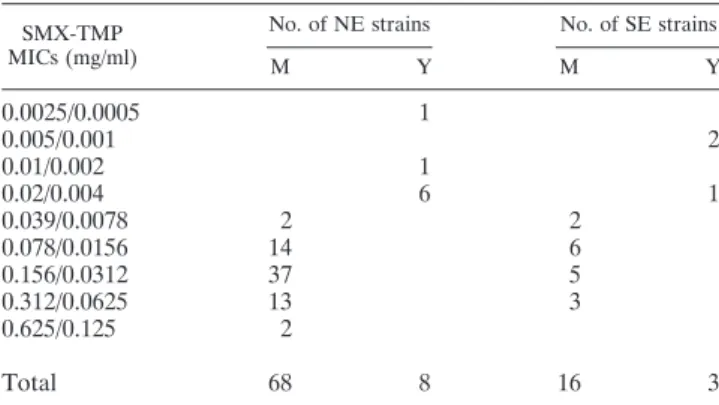
This study evaluated thein vitroeffect of sulfamethoxazole-trimethoprim againstHistoplasma capsulatumvar. capsulatumisolated from HIV-positive patients. The drugs were tested by microdilution testing in accordance with the CLSI guidelines. All of the strains were inhibited by sulfamethoxazole-trimethoprim, with MIC ranges of 0.039 (sulfamethoxazole)/0.0078 (trimethoprim) mg/ml to 0.625/0.125 mg/ml for mycelial forms and 0.0025/ 0.0005 to 0.02/0.004 mg/ml for yeast-like forms. However, in vivo studies are necessary to evaluate the significance of these results.
Histoplasmosis is an infection caused by the dimorphic fun-gusHistoplasma capsulatum.It is endemic in the Americas (3) and is currently one of the most important systemic infections in Brazil (6). In a retrospective study carried out in Ceara´ state (northeastern Brazil) from 1995 to 2004, 164 histoplasmosis cases were found in HIV-positive patients (4).
The treatment of histoplasmosis depends on the infection’s severity and clinical manifestation, along with individual risk factors (9, 13). Because of the increase in histoplasmosis, par-ticularly in HIV-positive patients, as well as the development of antifungal resistance associated with refractory and re-peated infections (13), there is a need for seeking new thera-peutic options for this mycosis. Therefore, this study aimed at testing thein vitro activity of sulfamethoxazole-trimethoprim (SMX-TMP) against H. capsulatum var. capsulatum strains isolated from AIDS patients.
A total of 84 clinical strains ofH. capsulatumisolated from two different biogeographic regions in Brazil were included in this study. Of them, 68 came from Ceara´ (northeastern semi-arid region) and 16 from southeastern states (a subtropical region). The strains were obtained from the collection of the Specialized Medical Mycology Center of Ceara´ Federal Uni-versity and were handled in our level 3 biosecurity laboratory. For each strain, a combined solution of SMX-TMP (Roche, Brazil) was used at a concentration range of 0.0025 mg/ml SMX/0.0005 mg/ml TMP and 20/4 mg/ml. The inocula were prepared as described by Li et al. (10), with some modifica-tions. Briefly,H. capsulatumstrains were cultured in the my-celial phase onto brain heart infusion (BHI) agar for 7 days at
28°C, and then 2 ml of sterile saline was added to each culture. The surfaces of the mycelia were harvested with a swab. To obtain yeast cells, isolates were cultured on agar BHI with sheep blood (10%) at 35°C and were maintained through weekly passages (7). The supernatant was read in a spectro-photometer at 530 nm, and the transmittance was adjusted to 90 to 95%. The suspensions then were diluted to obtain an inoculum of 0.5⫻103to 2.5⫻104CFU/ml, as demonstrated by quantitative colony counts on Sabouraud dextrose agar (10). Susceptibility tests were carried out as described by Nakai et al. (11), except that the readings were performed after 7 or 4 days for mycelial and yeast growth, respectively. For SMX-TMP, the MIC was defined as the lowest concentration at which no visible growth was observed (14). The differences in the MICs between northeastern and southeastern strains were evaluated by Student’sttest (P⬍0.05). Susceptibility control tests were performed with amphotericin B (AMB) against 84 and 7H. capsulatum strains in mycelial and yeast-like forms, respec-tively. SMX-TMP quality control was carried out with Esche-richia coli ATCC 25922 andPseudomonas aeruginosaATCC 27853.
AllH. capsulatumstrains were inhibited by SMX-TMP, with MICs ranging from 0.039/0.0078 to 0.625/0.125 mg/ml for the mycelial forms and 0.0025/0.0005 to 0.02/0.004 mg/ml for the yeast-like forms. The SMX-TMP MICs for strains from north-eastern Brazil presented geometric means of 0.1544 mg/ml for sulfamethoxazole and 0.0309 mg/ml for trimethoprim for the mycelial forms and 0.0141 mg/ml for sulfamethoxazole and 0.0028 mg/ml for trimethoprim for yeast-like forms. The geo-metric means for the strains from southeast Brazil were 0.1152 mg/ml for sulfamethoxazole and 0.0230 mg/ml for tri-methoprim for the mycelial forms and 0.0079 mg/ml for sulfa-methoxazole and 0.0016 mg/ml for trimethoprim for yeast-like forms (Table 1).
* Corresponding author. Mailing address: Rua Bara˜o de Caninde´, 210, Montese. CEP: 60.425-540, Fortaleza CE, Brazil. Phone: 55 (85) 3214-2853. Fax: 55 (85) 3295-1736. E-mail: [email protected].
䌤Published ahead of print on 21 June 2010.
Susceptibility control tests showed MICs (geometric means) of 0.1168 and 0.0762g/ml for AMB againstH. capsulatumfor mycelial and for yeast-like forms, respectively. E. coliATCC 25922 was sensitive andP. aeruginosaATCC 27853 was resis-tant to SMX-TMP.
Previous studies have described the effect of sulfamethox-azole or SMX-TMP against other pathogenic fungi, such as
Cryptococcus neoformans(8) andAspergillus fumigatus(1). The results of this study demonstrated for the first time the inhib-itory effect of SMX-TMP againstH. capsulatum. They show that the MICs for strains from northeastern Brazil were higher than those from the southeast. These findings can be related to population profile and/or geoclimatic differences, but further investigation is necessary to explain these hypotheses. The medium composition also may alter the drug effect.H. capsu-latum strains were inhibited by SMX-TMP diluted in RPMI medium. Yeast nitrogen base (YNB) was not used because no growth ofH. capsulatumwas obtained in this medium (data not shown). If H. capsulatum had grown in YNB medium, the MICs of SMX-TMP probably would have been lower than those observed. Afeltra et al. (1) studied the effectiveness of sulfonamides against Aspergillus spp. and demonstrated the influence of the composition of the medium in susceptibility tests with SMX-TMP, observing that RPMI, despite being rec-ommended by the CLSI (12), contains four times more p -aminobenzoic acid (PABA) than YNB medium according to the manufacturer. Based on Hanafy et al. (8), in a study using sulfamethoxazole against strains of Cryptococcus spp., MICs varied from 0.125 to 0.250 mg/ml in RPMI medium, while in media not containing PABA (such as YNB) or compounds related to PABA, the MICs declined to 0.031 to 0.062 mg/ml (8). MICs forH. capsulatumyeast-like forms were lower than those for mycelial forms for both northeastern (P⫽ 0.0000) and southeastern (P⫽0.0001) strains.
SMX-TMP has shown good results in the treatment of para-coccidioidomycosis as a supportive therapy after the
adminis-tration of amphotericin B and when there is an involvement of the central nervous system. The sulfonamides remain the drugs of choice to treat paracoccidioidomycosis in developing coun-tries with substandard socioeconomic conditions. SMX-TMP also is used to treat fungal infections caused byPneumocystis jiroveciin HIV-positive patients in our region, but this combi-nation, with or without antifungals, has never been used to treat histoplasmosis.
Until this study, there had been no reports of the efficacy of SMX-TMP againstH. capsulatumvar.capsulatum. However, there are reports of histoplasmosis caused byHistoplasma cap-sulatumvar.duboisiiin Africa being successfully treated with SMX-TMP (2, 5). Therefore, despite the evidence in this study,
in vivo studies are necessary to evaluate the significance of these results.
This work was supported by the National Scientific and Technolog-ical Research Council (CNPq), Process 475652/2008-8, the Coordena-c¸a˜o de Aperfeic¸oamento de Pessoal de Nivel Superior (CAPES), and the Sa˜o Paulo Research Foundation (FAPESP).
REFERENCES
1.Afeltra, J., J. F. Meis, R. G. Vitale, J. W. Mouton, and P. E. Verweij.2002. In vitroactivities of pentamidine, pyrimethamine, trimethoprim, and sulfon-amides againstAspergillusspecies. Antimicrob. Agents Chemother.46:2029– 2031.
2.Ajayi, B. G., B. Osuntokun, O. Olurin, O. O. Kale, and T. A. Junaida.1986. Orbital histoplasmosis due toHistoplasma capsulatumvar. duboisii: success-ful treatment with septrin. J. Trop. Med. Hyg.89:179–187.
3.Baddley, J. W., I. R. Sankara, J. M. Rodriquez, P. G. Pappas, and W. J. Many, Jr.2008. Histoplasmosis in HIV-infected patients in a southern re-gional medical center: poor prognosis in the era of highly active antiretro-viral therapy. Diagn. Microbiol. Infect. Dis.62:151–156.
4.Daher, E. F., G. B. Silva, Jr., F. A. Barros, C. F. Takeda, R. M. Mota, M. T. Ferreira, S. A. Oliveira, J. C. Martins, S. M. Arau´jo, and O. A. Gutie ´rrez-Adrianze´n.2007. Clinical and laboratory features of disseminated histoplas-mosis in HIV patients from Brazil. Trop. Med. Int. Health12:1108–1115. 5.Egere, J. U., H. C. Gugnani, A. N. Okoro, and A. V. Suseelan.1978. African
histoplasmosis in Eastern Nigeria: report of two culturally proven cases treated with septrin and amphotericin B. J. Trop. Med. Hyg.81:225–229. 6.Ferreira, M. S., and A. S. Borges.2009. Histoplasmose. Rev. Soc. Bras. Med.
Trop.42:192–198.
7.Fressatti, R., V. L. Dias-Siqueira, I. E. Svidzinski, F. Herrero, and C. Kem-melmeier.1992. A medium for inducing conversion ofHistoplasma capsula-tum var.capsulatum into its yeast-like form. Mem. Inst. Oswaldo Cruz
87:53–58.
8.Hanafy, A., J. Uno, H. Mitani, Y. Kang, and Y. Mikami.2007.In vitro antifungal activities of sulfa drugs against clinical isolates ofAspergillusand Cryptococcusspecies. Jpn. J. Med. Mycol.48:47–50.
9.Kauffman, C. A.2007. Histoplasmosis: a clinical and laboratory update. Clin. Microbiol. Rev.20:115–132.
10.Li, R., M. A. Ciblak, N. Nordoff, L. Pasarell, D. W. Warnock, and M. R. McGinnis.2000.In vitroactivities of voriconazole, itraconazole, and ampho-tericin B againstBlastomyces dermatitidis,Coccidioides immitis, and His-toplasma capsulatum. Antimicrob. Agents Chemother.44:1734–1736. 11.Nakai, T., J. Uno, F. Ikeda, S. Tawara, K. Nishimura, and M. Miyaji.2003.
In vitro antifungal activity of micafungin (FK463) against dimorphic fungi: comparison of yeast-like and mycelial forms. Antimicrob. Agents Che-mother.47:1376–1381.
12.National Committee for Clinical Laboratory Standards.1997. Reference method for broth dilution antifungal susceptibility testing of yeasts. Ap-proved standard. Document M27-A. National Committee for Clinical Lab-oratory Standards, Wayne, PA.
13.Wheat, L. J., A. G. Freifeld, M. B. Kleiman, J. W. Baddley, D. S. McKinsey, J. E. Loyd, and C. A. Kauffman.2007. Clinical practice guidelines for the management of patients with histoplasmosis: 2007 update by the Infectious Diseases Society of America. Clin. Infect. Dis.45:807–825.
14.Yekutiel, A., I. Shalit, Y. Shadkchan, and N. Osherov.2004. In vitro activity of caspofungin combined with sulfamethoxazole against clinical isolates of Aspergillusspp. Antimicrob. Agents Chemother.48:3279–3283.
TABLE 1. MICs of SMX/TMP against strains ofH. capsulatumvar.
capsulatumin yeast-like and mycelial forms from northeastern and southeastern Brazila
SMX-TMP MICs (mg/ml)
No. of NE strains No. of SE strains
M Y M Y
0.0025/0.0005 1
0.005/0.001 2
0.01/0.002 1
0.02/0.004 6 1
0.039/0.0078 2 2
0.078/0.0156 14 6
0.156/0.0312 37 5
0.312/0.0625 13 3
0.625/0.125 2
Total 68 8 16 3
aGeometric mean MICs for mycelial (M) and yeast-like (Y) forms of strains
from northeastern (NE) Brazil were 0.1544/0.0309 and 0.0141/0.0028 mg/ml, respectively. Geometric mean MICs for mycelial and yeast-like forms of strains from southeastern (SE) Brazil were 0.1152/0.0230 and 0.0079/0.0016, respec-tively.