Validation of the Brazilian version of the
Gaudenz-Fragebogen
:
used in the differential diagnosis of female urinary incontinence
Validação da versão brasileira do Gaudenz-Fragebogen: utilizado para o diagnóstico diferencial da
incontinência urinária feminina
Validación de la versión brasileña del Gaudenz-Fragebogen: utilizado en el diagnóstico diferencial de la
incontinencia urinaria femenina
Léa Dolores Reganhan de Oliveira1 Maria Helena Baena de Moraes Lopes1
1. Universidade Estadual de Campinas -
UNICAMP. Campinas, SP, Brazil.
Corresponding author: Léa Dolores Reganhan de Oliveira. E-mail: [email protected]
Submited on 05/05/2015. Accepted on 01/13/2016.
DOI: 10.5935/1414-8145.20160045
A
bstrActObjective: To validate the Brazilian version of the Gaudenz-Fragebogen questionnaire, used in the diferential diagnosis of female
stress and urge urinary incontinence. Methods: Reliability was validated through the application of test-retest in 60 women. For the evaluation of the concurrent validity criterion, the diagnoses-based on the questionnaire's adapted scores-were compared to the urodynamic study (gold standard) in 116 women with urinary incontinence. Results: The questionnaire was found to be reliable and showed stability. The sensitivity and speciicity for the diagnosis of stress urinary incontinence were 9.0% and 96.7%, and for urge urinary incontinence, 44.7% and 70% respectively. Conclusion: The questionnaire is reliable and stable, and it is suitable to be included in the phases that precede the inal diagnosis. However, its use is not recommended as a single resource to determine the diferential diagnosis of female urinary incontinence.
Keywords: Urinary incontinence; Diagnosis, diferential; Validation studies; Women's health.
r
esumoObjetivo: Validar a versão brasileira do Gaudenz-Fragebogen, utilizado no diagnóstico diferencial da incontinência urinária
feminina de esforço e de urgência. Métodos: A coniabilidade foi conferida por meio da aplicação do teste-reteste em 60 mulheres. Para a avaliação da validade de critério concorrente os diagnósticos, baseados nos escores do questionário adaptado, foram comparados com o estudo urodinâmico (padrão-ouro), em 116 mulheres com incontinência urinária. Resultados: O questionário demonstrou ser coniável e apresentou estabilidade. A sensibilidade e especiicidade para o diagnóstico da incontinência urinária de esforço foram 9,0% e 96,7%, e para a de urgência de 44,7% e 70%, respectivamente. Conclusão: O questionário é coniável e estável, e pode ser indicado para compor as fases que antecedem o diagnóstico inal. Entretanto, não é recomendável a sua utilização como único recurso para determinar o diagnóstico diferencial da incontinência urinária feminina.
Palavras-chave: Incontinência urinária; Diagnóstico diferencial; Estudos de validação; Saúde da mulher.
r
esumenObjetivo: Validar la versión brasileña del Gaudenz-Fragebogen, utilizado en el diagnóstico diferencial de incontinencia urinaria femenina de esfuerzo y urgencia. Métodos: La iabilidad fue validada a través de la aplicación de teste-reteste en 60 mujeres. Para la evaluación del criterio de validez concurrente, los diagnósticos basados en puntajes del cuestionario adaptado, fueron comparados con el estudio urodinámico (patrón oro) en 116 mujeres con incontinencia urinaria. Resultados: El cuestionario
demostró ser coniable y presentó estabilidad. La sensibilidad y especiicidad para el diagnóstico de incontinencia urinaria de esfuerzo fueron 9,0% y 96,7%, y para la incontinencia urinaria de urgencia fueron 44,7% y 70%, respectivamente. Conclusión: El cuestionario es iable y estable, y es adecuado para ser incluido en las fases que preceden diagnóstico inal. Sin embargo, su uso no se recomienda como un único recurso para determinar el diagnóstico diferencial de la incontinencia urinaria femenina.
INTRODUCTION
Urinary incontinence (UI) is a condition that afects women's quality of life negatively and it is deined as involuntary loss of
urine1. In the female population, the three main types of UI are:
stress urinary incontinence (SUI), urge urinary incontinence (UUI) and mixed urinary incontinence (MUI)1. Worldwide, prevalences of this health condition range from 10% to 55%, depending on the population studied and criterion used for the diagnosis, a fact that deines UI as a public health problem and, in this sense, deserving of greater attention2.
Regarding the diferential UI diagnosis, urodynamic testing (UDT) is considered to be the gold standard for the objective assessment of the lower urinary tract function, as it is regarded as the most eicient resource at present for the diferential diagnosis of UI3,4. It is a set of tests that includes the following:
analysis of free urinary low, illing cystometry, pressure-low analysis and urethral function assessment5. Although UDT is considered to be ideal for the objective assessment of the lower urinary tract function, it should not be recommended to all women with incontinence, especially in less complicated cases of UI5.
Additionally, there are other factors that may prevent a greater availability of this test which should be taken into consideration. Urodynamic testing is restricted to specialized centers and it is a relatively expensive test, as it requires special equipment, trained professionals to perform and interpret it adequately5. A survey conducted by the City of São Paulo Court of Auditors showed that patients seeking the city's health care system wait for months or even years to schedule a test6. In the case of UDT, the waiting list is approximately 41 months and this has been the case for more than three years6.
Due to several implications involved with the UDT implemen
-tation, especially in the Brazilian Uniied Health System, known as SUS, it could be assumed that the use of speciic instruments may subsidize the diagnostic process of UI7. A literature review found a speciic instrument known as Gaudenz-Fragebogen,
originally developed in German and validated to support the diferential diagnosis of female SUI and UUI. This instrument was translated and adapted to the Brazilian culture and it was found to be easy to understand and be applied7. Furthermore, until now, it has been widely used by the scientiic population
in general and served to support clinical practice, mainly in European countries8-10.
However, it is understood that the irst stage of the study conducted with the Brazilian female population must be completed and, consequently, it is essential to submit the Portuguese version of Gaudenz-Fragebogen to the remaining
stages of psychometric evaluation, after the translation and cultural adaptation of this instrument.
Thus, the present study aimed to assess the reliability and validity of the Gaudenz-Fragebogen version for the Brazilian
context, so as to verify its performance as an instrument to measure the diferential diagnosis of UI.
METHODS
A methodological study with a quantitative approach was conducted, aiming to validate a speciic instrument. This research project was approved by a Research Ethics Committee under oicial opinion 616/08.
Data were collected in the urodynamic assessment services of two outpatient clinics of the public health care network. One of these clinics belonged to a teaching hospital in the countryside of São Paulo state, aimed at caring for the community in general; the other belonged to a hospital that cared for women exclusively, located in the capital city of this state.
Women who went to the outpatient clinics to have UDT were invited to participate in this study. The research objectives, the right to withdraw one's consent of participation and the right to anonymity were explained to those who accepted to participate in this study. The informed consent form was described to them in detail and, upon their acceptance, this form was signed and they were subsequently interviewed. They completed the questionnaire so that social, demographic, clinical and obstetric characteristics could be obtained. Next, they received the
Gaudenz-Fragebogen questionnaire and were informed about
the fact that this instrument is self-administered, i.e. it would be read and completed by participants themselves. However, if they had any questions, they could ask the interviewer to answer any questions about this instrument. In addition to the researcher responsible for the study, two undergraduate students enrolled in the last semester of the nursing course were trained to help with data collection.
The Gaudenz-Fragebogen questionnaire is a measuring
instrument comprised of 16 items, enabling two inal scores: the Urge-score (U-S) for UUI; and the Stress score (S-S) for SUI. Each item has two alternatives, the irst one corresponding to the S-S and the second to the U-S, while both score from zero to three for UUI or SUI. To achieve this, participants must select only one of the alternatives, i.e. that which best describes their current situation. The instrument's inal score ranges from zero to 26 points both for the U-S and S-S7.
conditions and those who, during interview, had symptoms suggestive of urinary tract infection (UTI) or were undergoing UTI treatment were excluded from this study.
Sample size was calculated following this instrument's rec -ommendation of ten participants per item11. Thus, the estimated
sample totaled 160 women or more, as the Gaudenz-Fragebogen
is comprised of 16 items.
In the irst stage of veriication of psychometric properties, a test-retest was performed aiming to observe the stability of the adapted instrument. The irst 60 women who agreed to participate in this stage completed the Gaudenz-Fragebogen questionnaire
two times, with an interval of seven days between the irst and second application.
Women who participated in this stage were invited and informed that their participation was voluntary and, in case they changed their decision, this would not result in any changes to their treatment. Moreover, those who agreed to participate in the test-retest had their transport and food paid for in the second meeting.
Before responding to the questionnaire for the second time, participants were asked about the possibility of their having any UTI symptoms or using any drugs that they had not been using at the time of the irst test. Only those who reported that neither of the situations applied to them were included in the test-retest. The adapted instrument was submitted to concurrent criterion validity to verify the psychometric properties. For this stage, the medical reports on UDT were taken into consideration for the analysis, the gold standard for the present study whose diagnoses were UUI or SUI, as this instrument distinguishes between these two types of UI diagnosis. UDT was made available by the outpatient clinics and medical reports were transcribed by the researcher in charge on a ile identiied by the initials of participants' name and a control number, which were also found in both instruments previously completed.
Concurrent criterion validity was analyzed through the correlation coeicient between the type of UI identiied by the
Gaudenz-Fragebogen scores and the diagnosis described in
the UDT medical report.
Data analysis
The data obtained were analyzed using the SAS software, 9.1.3 version (SAS Institute Inc., Cary, NC, USA, 2002-2003). An analysis was performed with the description of the absolute and relative frequencies for the categorical variables and the description of the mean, standard deviation, median and maximum and minimum values for continuous variables, aiming to describe the sample proile.
The reliability of the Brazilian version of the Gaudenz-Fragebogen was assessed for its stability through the test-retest,
considering the total scores of the irst and second applications. To achieve this, the paired T-test and the Intraclass Correlation Coef
-icient (ICC) were performed to compare the means of scores.
Accuracy, sensitivity, speciicity and the positive and negative predictive values of the Brazilian version of the Gaudenz-Fragebogen were determined through multiple comparisons
among the UI groups identiied by UDT and the instrument's scores, using analysis of variance (ANOVA).
The signiicance level adopted for the statistical tests was 5%, i.e. a p value < 0.05 was taken into consideration.
RESULTS
Sample characteristics
A total of 168 women with complaints about involuntary loss of urine participated in the present study and they had a mean age of 53.6 years, ranging from 21 to 87 years of age. Participants' mean level of education was 6 years and that of family income was 2.4 monthly minimum wages. The majority of women, 161 (95.8%), had been pregnant and the number of pregnancies per woman varied from one to 24. There was a total of 700 births among participants, of which 627 (89.6%) were vaginal deliveries and 73 (10.4%) were Cesarean sections. A total of 65 women (38.7%) were found in the stage between menarche and menopause and 103 (61.3%) were in the post-menopausal stage, of which only eight (7.8%) were undergoing hormone replacement therapy. With regard to morbidities, systemic arterial hypertension stood out, as 40.5% of the sample had a chronic condition and 85% of them were using a certain type of diuretic.
Reliability
The test-retest was applied to 60 women aged between 22 and 65 years and with a mean level of education of 5.8 years.
The stability of the adapted instrument had an Intraclass Cor
-relation Coeicient (ICC) of 0.99 and a respective Conidence In
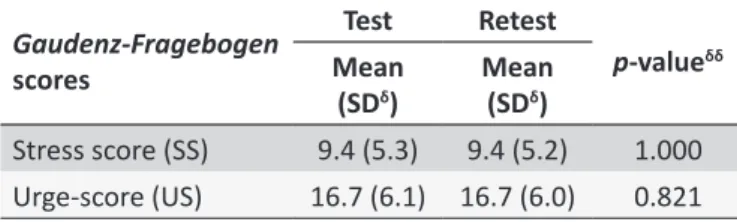
-terval (CI) of 0.95 for both scores. The means of both applications of the Gaudenz-Fragebogen questionnaire are shown in Table 1.
Validity
A total of 116 medical reports of UDT, 78 cases of SUI (46.4%) and 38 of UUI (22.6%) were used for the adapted in
-strument's concurrent criterion validity. At this stage of the study, 34 cases (20.3%) of MUI and 18 (10.7%) without alterations, conirmed by the UDT, were ignored.
Table 1.
Descripive analysis of means of the Portuguese
version of the
Gaudenz-Fragebogen
quesionnaire in the
test-retest (n = 60). Campinas, Brazil, 2010
Gaudenz-Fragebogen
scores
Test
Retest
p
-value
δδMean
(SD
δ)
Mean
(SD
δ)
Stress score (SS)
9.4 (5.3)
9.4 (5.2)
1.000
Urge-score (US)
16.7 (6.1) 16.7 (6.0)
0.821
Table 2.
Distribuion of women with urinary inconi
-nence, according to
Gaudenz-Fragebogen
scores and
medical reports of UDT for the presence or absence of
stress and urge urinary inconinence (n = 168). Campinas,
Brazil, 2010
Gaudenz-Fragebogen
UDT (Gold standard)
With SUI
Without SUI
With SUI
7
3
Without SUI
71
87
Total
78
90
With UUI
Without UUI
With UUI
17
39
Without UUI
21
91
Total
38
130
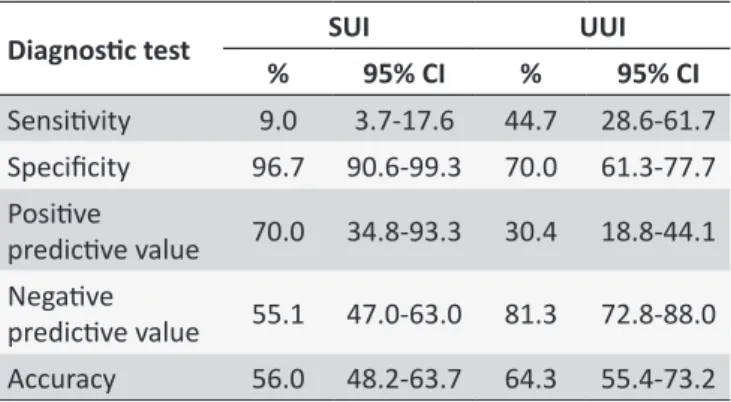
Table 3.
Performance of the
Gaudenz-Fragebogen
quesionnaire for the diagnosis of stress and urge urinary
inconinence (n = 116). Campinas, Brazil, 2010
Diagnosic test
SUI
UUI
%
95% CI
%
95% CI
Sensiivity
9.0
3.7-17.6
44.7
28.6-61.7
Speciicity
96.7
90.6-99.3
70.0
61.3-77.7
Posiive
predicive value
70.0
34.8-93.3
30.4
18.8-44.1
Negaive
predicive value
55.1
47.0-63.0
81.3
72.8-88.0
Accuracy
56.0
48.2-63.7
64.3
55.4-73.2
Currently, the use of speciic questionnaires is an increas
-ingly recurrent practice in the screening process of diagnoses and, consequently, it supports decision-making in health. However, this needs to take place in a safe way and, conse
-quently, a measuring instrument has to perform well in terms of reproducibility in diferent situations and eiciency to measure that which is designed to measure.
Regarding reliability, it can be airmed that the Brazilian version showed good reproducibility as a result of the test-retest; moreover, that a general or speciic instrument with an ICC above 0.90 is reliable12, as it led to similar results, even when applied under diferent circumstances13.
A certain instrument can be considered as valid, even with low reliability; nonetheless, it can have high reliability without any
validity12. Consequently, it will be regarded as valid in the sense that
it measures that which it is designed to measure12. Thus, a speciic questionnaire such as the Gaudenz-Fragebogen has more value if
it allows for more sensitivity rather than speciicity, when compared to the gold standard. For this reason, the Brazilian version of the
Gaudenz-Fragebogen questionnaire was expected to show more
sensitivity, so that a diferential diagnosis could be determined. A study conducted with Polish women had its original instrument validated with other speciic questionnaires and although it allowed for high sensitivity, it did not show good speciicity, as it did not provide suicient information for the diferential diagnosis between SUI and UUI14. In other words, the scores identiied UI, but did not adequately distinguish the type when submitted to concurrent criterion validity.
Although results similar to those from the Polish study have been observed in the validity of the adapted version of this instrument, it should be emphasized that all participants reported their involuntary loss of urine and the resulting negative impact on their quality of life. Additionally, although 18 cases without alterations were found through UDT, this does not necessarily imply the unconditional absence of UI. Although UDT is the most accurate test available to identify and diferentiate UI at present, it is safe to consider these 18 cases to be normal as, objectively, no loss of urine due to stress or uninhibited contractions of the detrusor muscle were observed during testing, conditions that guide the diagnosis of SUI and UUI, respectively.
It should also be emphasized that UDT is recommended in more complex cases of UI in Brazil, as it is restricted to specialized centers and relatively expensive5. Additionally, there is the fact that even in areas where socioeconomic conditions are better, the waiting list for women to have UDT in the public health system can be longer than three years6. Nonetheless, UI is regarded as relevant in epidemiological terms, although ignored by public policies, professional educational organizations and, consequently, clinical evaluation and interventions15.
In view of what has been described, it is worth noting that the Gaudenz-Fragebogen questionnaire has been widely used
since its creation in German-speaking countries and health professionals consider it to be a benchmark in the screening The distribution of women who allegedly had urinary inconti
-nence is shown in Table 2, indicating positive and negative cases of SUI and UUI, according to Gaudenz-Fragebogen scores and
results of medical reports of UDT.
In the process of assessment of performance of the adapted instrument, the percentages of true-positive cases (sensitivity) was found to be 9.0% for SUI and 44.7% for UUI, whereas these percentages were 96.7% for SUI and 70% for UUI for true-negative cases (speciicity) (Table 3).
DISCUSSION
this instrument is associated with its practicality, enabling it to be used at the moment of anamnesis, and its ability to detect the characteristics of patients' complaints and sufering in detail8. Moreover, this instrument is useful to qualitatively distinguish between SUI, which is supposedly present, and UUI8. Thus, its use is recommended as part of the stages followed before the inal diagnosis8.
Safe levels of agreement between the Brazilian version of the Gaudenz-Fragebogen and UDT are expected to be found
in the present study, so that its use can be recommended in the diferential diagnosis of UI of Brazilian women, thus providing quantitative and qualitative support in the current context. However, in order to guarantee the legitimacy of the results measured with a diagnostic validity instrument, it is essential that its performance be similar to the gold standard.
Although the results obtained in the present validation study were not completely satisfactory, it is agreed that the original or adapted instruments must be used by other researchers in new groups and situations, as this enables the performance of such instruments to be observed and compared in diferent contexts.
CONCLUSION
The Portuguese version of the Gaudenz-Fragebogen ques
-tionnaire was found to be reliable and it showed stability. However, based on the way this instrument performed in the present study, it is not recommended as the only resource for the conclusive validation of diferential diagnosis between SUI and UUI.
ACKNOWLEDGMENTS
This research was funded by the São Paulo Research Founda
-tion (FAPESP) and the Support Fund for Educa-tion, Research and Extension (FAEPEX) of the University of Campinas (UNICAMP).
REFERENCES
1. Haylen BT, Ridder D, Freeman RM, Swift SE, Berghmans B, Lee J, et al. An International Urogynecological Association (IUGA)/International Continence Society (ICS) Joint Report on the Terminology for Female Pelvic Floor Dysfunction. Neurourol Urodyn. 2010 jan; 29(1):4-20.
2. Abrams P, Cardozo L, Fall M, Griiths D, Rosier P, Ulmsten U et al. The standardization of terminology of lower urinary tract function: report from the standardisation sub-committee of the International Continence Society. Neurourol Urodyn 2003; 61:37-49.
3. Rosier PF. The evidence for urodynamic investigation of patients with symptoms of urinary incontinence. F1000Prime Rep. 2013 mar; 5: 8. 4. Monteiro MVC, Fonseca AMR, Silva Filho AL. Valor do estudo
urodinâmico no tratamento da incontinência urinária. Femina. 2012 maio/jun; 40(3):135-9.
5. Hosker G, Rosier P, Gajewski J, Sand P, Szabo L, Capewell A. Dynamic testing. In: Abrams P, Cardozo L, Khoury S, Wein A (eds). Incontinence. 4th ed. Plymouth: Health Publications Ltd; 2009.
6. Granato F. Exame demora mais de 6 meses no município. Diário de São Paulo (São Paulo). 2013 jul 22.
7. Oliveira LDR, Guirardello EB, Lopes MHBM. Tradução e adaptação para a cultura brasileira do Gaudenz-Fragebogen. Rev. esc. enferm. USP. 2012 jun; 46(3): 565-572.
8. Hennicke S. Untersuchungen zur Validität des Gaudenzfragebogens in der Diagnostik der weiblichen Harninkontinenz [dissertação]. Berlin (BRB): Medizinischen Fakultät Charité - Universitäts medizin Berlin; 2011.
9. Zovko-Backhaus K. Etablierung und Implementierung eines Qualitäts
-managementsystems zur Einführung des Galileo-Vibrationstrainings in den Klinikalltag mit Fokus auf die Patientenzufriedenheit [dis
-sertação]. Göttingen (NI): Medizinischen Fakultät der Georg-August-Universität zu Göttingen; 2012. Disponível: http://d-nb. info/1044414790/34
10. Ronneburger JC. Untersuchung zur Ergebnisqualität von Inkontinenz
-behandlungen nach urodynamischer Diagnostik [dissertação]. Berlin (BRB): Medizinischen Fakultät Charité - Universitätsmedizin Berlin; 2013.
11. Kerlinger FN. Foundations of behavioral research. 4ª ed.: New York; 1999. 415 p.
12. Gilbody S, Morley S, Snaith P. Principles of psychological assessment. In: Freeman C, Tyrer P (eds). Research Methods in Psychiatry. London: Gaskell; 2006.
13. Pasquali L. Psicometria: teoria dos testes na psicologia e na educação. 5ª ed. Petrópolis: Vozes; 2013.
14. Kieres P, Rokita W, Stanislawska M, Rechberger T, Galezia M. The diagnostic value of chosen questionnaires (UDI 6SF, Gaudenz, MESA, ICIQ-SF and King's Health Questionnaire) in diagnosis of diferent types of women's urinary incontinence. Ginekol Pol. 2008 may; 70(5): 338-41. 15. Hofmann R, Wagner U. Inkontinenz- und Deszensuschirurgie der Frau
(Gebundene Ausgabe). 2ª ed. Berlin: Springer; 2014.