Stability of anti-HIV antibodies in serum samples
stored for two to eighteen years periods
Estabilidade dos anticorpos anti-HIV em amostras de soro armazenadas
por períodos de dois a dezoito anos
Marcia Jorge Castejon1; Rosemeire Yamashiro2; Camila Cardoso de Oliveira3; Carmem Aparecida de Freitas Oliveira4; Mirthes Ueda5
ABSTRACT
Introduction: The antibodies have an important role in the serodiagnosis, constituting the most widely used biomarkers to detect and conirm various diseases. Objective: To investigate the reproducibility of anti-human immunodeiciency virus (HIV) antibodies reactivity, to assess the stability of the sera samples stored at -20ºC for two to eighteen years. Method:Sera were collected in the period 1988-2004 for routine anti-HIV antibodies diagnostic testing. The remaining samples stored at -20ºC, were analyzed in this study. Serum sample stability was assessed by enzyme-linked immunosorbent assay/enzyme immunoassay (ELISA/EIA), indirect immunoluorescence assay (IFA), and Western blot (WB) for detecting anti-HIV antibodies. The previously found results (1988-2004) and those obtained in 2006 were subjected to Kappa index analysis. Result: In the period 1988-to 2004, the degree of concordance of the ELISA/EIA, IFA and WB results were considered, good (k = 0.80), regular (k = 0.35), and good (k = 0.63), respectively. Conclusion: Regarding HIV serologic test, the serum samples were stable for 18 years in ELISA/EIA and for 4 years in IFA technique, however, for the WB methodology it was not possible to determine the time of stability of the anti-HIV antibodies.
Key words: serum; anti-HIV antibodies; storage; serum bank; time.
INTRODUCTION
Laboratory tests to diagnose infection with the human immunodeiciency virus (HIV) have been used for three decades and, up to now, they are still an important tool in the diagnosis
and the quality of blood evaluation in haemotherapy units(7).
Therefore, the results of serological tests must be accurate and be correctly taken, because the medical and social importance of a positive HIV test(5).
The enzyme immunoassay (ELISA/EIA) technique has been worldwide used as initial serological screening for detection of anti-HIV antibodies, and the samples with positive reactivity in these tests have been conirmed by Western blot (WB) and
indirect immunoluorescence (IFI) techniques(14).
The antibodies have an essential role in serodiagnosis and
represent the most widespread biomarkers used for detection and conirmation of various diseases. Given its speciic afinity
for the antigen, the integrity of the three-dimensional chemical
structure of these molecules is crucial for this interaction.
Structural changes or molecular aggregation, depending on storage conditions, lead to a decrease in the antibodies activity,
which may lead to false negative results(17).
The degradation of stored biological material is an important factor to be investigated. When the samples are retested after stored for long time, this evaluation became
complex. When results were not reproduced, it is dificult to verify
if material degradation occurred in fact, or if the difference is results is due to the use of more sensitive laboratory tests
developed over time(18).
For many years, the excess of material of biological specimens collected to perform diagnostic procedures has been stored, in order to conirm a diagnosis later or for potential use in future research(16). In this context, the maintenance of serum sample stored frozen and held for future studies has been extremely
First submission on 21/10/13; last submission on 10/07/14; accepted for publication on 12/07/14; published on 20/08/14
1. MSc in Genetics and Evolution-Universidade Federal de São Carlos (UFSCar); scientiic researcher III at Instituto Adolfo Lutz (IAL), São Paulo. 2. Bachelors degree in Biology-Universidade de Mogi das Cruzes (UMC); scientiic researcher II at IAL, São Paulo.
3. MSc in Statistics-Universidade de São Paulo (USP); scientiic researcher I at IAL, São Paulo.
4. MSc-Coordenadoria de Controle de Doenças da Secretaria de Estado da Saúde de São Paulo (CCD-SES/SP); scientiic researcher VI at IAL, São Paulo. 5. Post-doctoral in Immunology-Universidade da Califórnia; scientiic researcher VI at IAL, São Paulo.
useful in assessing the transmission of various pathogens. Moreover, the availability of viable stored material enables making inquiries about health problems in the past, with the use of current and advanced technological resources. Some of the beneits resulting from the use of stored biological samples
in research proved to be of great social relevance(11).
The access to biological materials of biobanks associated with detailed clinical information are of inestimable value, not only for research purposes but also in ield service, with obvious
beneits to society(2). Thus, a quality management plan, with
the appropriate standard operating procedure, is essential in
technical operations involving biospecimens(19).
Stability studies on biomolecules stored for long periods under controlled conditions are rare and restricted to a limited
number of proteins and analytes(8). Due to scarcity of available
data on which adverse effect the long-term storage may cause in the antibodies coniguration, protein structures that are inclined to denaturation, it is particularly relevant to conduct a research through implementation of sensitive and speciic assays. The concern with the storage time of the serum is related to various factors, such as temperature and samples freezing and thawing processes, which may cause occasional changes in the results of a particular test due to physical decay and, consequently, the biochemical modiications of antibodies of interest(3, 4, 9, 10, 15).
OBJECTIVE
With the availability of serum samples with known reactivity regarding the anti-HIV antibodies and because the lack of an established norm in relation to the storage time of clinical and biological samples, this retrospective study was proposed to investigate the stability of sera stored for periods of two to eighteen years. The stability of speciic antibodies was evaluated by the reproducibility of anti-HIV results, using sensitive and speciic assays used in the routine of Laboratory of the Center of Immunology at Instituto Adolfo Lutz (IAL), São Paulo-SP, Brazil.
METHOD
The study was approved by the Human Research Ethics Committee-IAL (document nº 017/2011).
The sera used were from the remaining samples of routine diagnostic detection for anti-HIV antibodies, for the period
1988-2004, which were stored and frozen at -20ºC in the Laboratory of HIV/Aids of the Center of Immunology-IAL.
Aspects relating to conidentiality and privacy of clinical and laboratorial information and patients identiication were considered essential, so we used the not linked anonymous study. Serological tests performed in serum samples, stored for this retrospective study, did not diverge from the scope in which they were intended, i.e., detection of anti-HIV antibodies.
In this retrospective study, serum samples stores during the period 1988-2004 were analyzed in 2006. The selection criteria to establish the number of serum samples (n = 1,000) was according to availability of laboratory reagents, which were intended for routine diagnosis. The selection of samples to perform the proposed evaluation was performed randomly, using the Microsoft Ofice Excel tools (Microsoft Corp., Redmont, WA, USA).
In 2006, to perform stability analysis of the sera by ELISA/EIA reproducibility of results were grouped by length of storage time, in order to ascertain the presence of adverse effects on serum over the years. Groups were set/established so that the number of samples in each block was higher than 100, as following described: 1988-1990 (n = 227); 1991-1993 (n = 101); 1994-1996 (n = 136); 1997-1999 (n = 116); 2000-2002 (n = 159); and 2003-2004
(n = 106), total 845 sera. Therefore, for the indicated periods, the
storage time of these sera were 18-16 years, 15-13 years, 12-10 years, 9-7 years, 6-4 years, and 3-2 years, respectively.
In IFI assay, the classiication of serum samples groups per time period was different from that established for ELISA/ EIA, according to the number of samples analyzed by the irst methodology. Thus, to a more homogenous sample distribution in the evaluation of reproducibility of IFI tests results, the following periods were established: 1988-1992 (n = 106); 1993-1997 (n = 103); 1998-2002 (n = 79); 2003-2004 (n = 38).
According to the criteria established in this study, the number of serum samples analyzed in WB test was much lower than those in ELISA/EIA and IFI methodologies. Thus, to evaluate the reproducibility of the results, we adopted the recommendation of the International Organization for
Standardization/Technical report (ISO/TR) 14468/2010(13),
where sera were divided in groups of, at least, 20 samples per time period. Thus, two groups were formed: 1988-1997 and 1998-2004, with 26 sera in each.
Serum samples were initially subjected to ELISA/EIA
(Vironostika HIV Uni-Form Plus O(Biomérieux SA, France) or
according to test reactivity threshold or cut-off, according to calculations determined by manufacturers of each set of diagnostic reagents used.
IFI tests (IFI-HIV-1 [BioManguinhos-Fundação Oswaldo
Cruz {FIOCRUZ}], Brazil) and WB tests (HIV blot 2.2 [Genelabs
Diagnostics], Singapore) were used as conirmatory, and results were expressed as positive, negative, and indeterminate, in compliance with the reactivity patterns recommended by manufacturers of the respective reagents.
The reactive or indeterminate results in ELISA/EIA
were initially evaluated by IFI-HIV-technique, and whether
indeterminate or negative results, they were analyzed by WB. The diagnostic reagents sets underwent evaluation procedures through commercial seroconversion and performance panels (Boston Biomedica, Inc - Cambridge, MA, USA).
Statistical analysis
Results were analyzed in Microsoft Ofice Excel (Microsoft Corp., Redmont, WA, USA) and STATISTICA software (version 11 Tulsa, OK, USA).
The agreement between results of HIV tests performed in 1988-2004 and in 2006 was assessed using kappa statistics (Cohen, 1960)(6), according to the period of time established for each
technique used.
The interpretation of agreement levels, according to kappa
values (k), was performed based on the method proposed by Altman (1999)(1), adapted to Landis and Koch (1977), which k < 0.20
value represents poor reproducibility; 0.21-0.40 regular; 0.41-0.60 moderate; 0.61-0.80 good; and 0.81-1.00 very good agreement.
RESULTS
From 1.000 randomly selected samples, 155 (15.5%) sera could not be included in the study for the following reasons: sample was not found, insuficient volume of sample, or sample with gelatinous aspect. The 845 serum samples that could be evaluated showed, in its irst analysis, the following results: 376 (44.5%) HIV non-reactive, 431 (51%) HIV reactive, and 38 (4.5%) indeterminate samples.
In the evaluation performed in 2006, from 845 samples that were subjected to ELISA/EIA, 385 (45.6%) showed non-reactive, 425 (50.3%) reactive, and 35 (4.1%) indeterminate results.
The 460 (54.4%) sera with reactive (425) and indeterminate (35) results in ELISA/EIA were analyzed by IFI assay for
conirmatory stage. However, only 326 (70.9%) samples could be analyzed to assess the reproducibility once they presented previous results in this methodology. The remaining 134 (29.1%) samples were not evaluated. In 326 sera analyzed in IFI, in 2006, the following results were found: 28 (8.6%) negative, 225 (69%) positive, and 73 (22.4%) indeterminate.
Following the criteria described in this study methodology, sera with negative (n = 28) and indeterminate (n = 73) results in IFI assay would be analyzed in WB. However, from 101 sera, 49 (48.5%) were not evaluated for reproducibility because they had not been previously analyzed by WB technique; the remaining 52 sera (51.5%) showed the following results in this assay: two (3.8%) negative, 20 (38.5%) positive, and 30 (57.7%)
indeterminate.
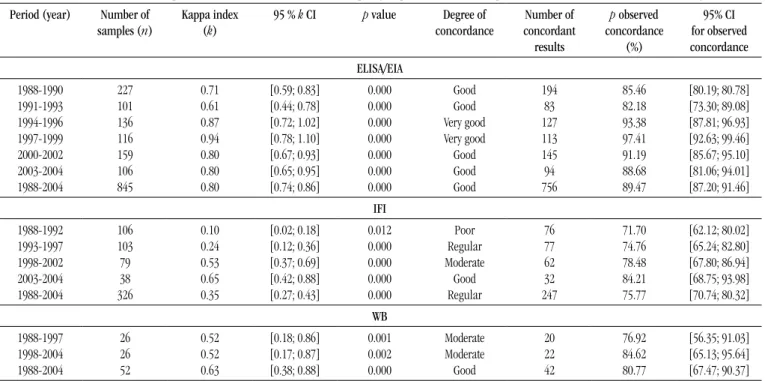
Data concerning sample reproducibility in each methodology are shown in Table 1. It is observed that, according to the criteria established for interpretation of index k, the degree of agreement to ELISA/EIA − period 1988-2004 −, therefore referring to 18 years of storage at -20ºC, was considered good, and about 90% of agreement was observed. If stricter evaluation criteria were used for this methodology, we consider only the periods when index k value was equal or greater than 0.8 and, thus, ensuring the highest level of sera stability, the optimal storage time to detect anti-HIV antibodies was 12 years (i.e., after 1994), with about 93%
of agreement average observed.
The IFI assays results reproducibility, evaluated in the same period (1988-2004), was regular (k = 0.35), with agreement about 76%, but kappa values were low, especially in periods before 2003. Through the technique features for visualizing the reaction, fungal contamination was detected in some sera analyzed. This, besides impairing test performance, indicates inadequate monitoring of these samples. So, results were more reproducible
(k = 0.65) in samples collected after 2003, therefore, the stability was kept for four years
In the analysis of results of 52 serum samples, using WB methodology, during 1988-2004 period, the reproducibility was considered good (k = 0.63). However, when divided in two periods − 1988-1997 and 1998-2004 –, this index decreased signiicantly (k = 0.52), and reproducibility was classiied as moderate. Because of this, it was not possible to establish the exact time of storage in which serum samples showed good
stability level.
Table 2, shows the number of samples with original results and those detected in 2006. The Figure shows these respective data in their percentage. It is also noticed that the instability of the sera was much more pronounced in IFI assay, when compared to
TABLE 2 – Number of samples with reactive/positive, non-reactive/negative
and indeterminate results previously detected and those obtained 2006. According to the methodology used
Result (categorical)
Number of samples (n)
ELISA/EIA* IFI WB
Previous 2006 Previous 2006 Previous 2006 Non-reactive*/
negative 376 385 12 28 01 02
Reactive*/
positive 431 425 286 225 23 20
Indeterminate 38 35 28 73 28 30
Total 845 326 52
ELISA/EIA*: reactive and non-reactive result.
ELISA/EIA: enzyme-linked immunosorbent assay/enzyme immunoassay; IFI: indirect immunofluorescence; WB: Western blot.
TABLE 1 – Evaluation of reproducibility of the results of serum samples grouped in different time periods in ELISA/EIA, IFI and WB methodologies
Period (year) Number of
samples (n)
Kappa index (k)
95 % k CI p value Degree of
concordance Number of concordant results p observed concordance (%) 95% CI for observed concordance ELISA/EIA 1988-1990 1991-1993 1994-1996 1997-1999 2000-2002 2003-2004 1988-2004 227 101 136 116 159 106 845 0.71 0.61 0.87 0.94 0.80 0.80 0.80 [0.59; 0.83] [0.44; 0.78] [0.72; 1.02] [0.78; 1.10] [0.67; 0.93] [0.65; 0.95] [0.74; 0.86] 0.000 0.000 0.000 0.000 0.000 0.000 0.000 Good Good Very good Very good Good Good Good 194 83 127 113 145 94 756 85.46 82.18 93.38 97.41 91.19 88.68 89.47 [80.19; 80.78] [73.30; 89.08] [87.81; 96.93] [92.63; 99.46] [85.67; 95.10] [81.06; 94.01] [87.20; 91.46] IFI 1988-1992 1993-1997 1998-2002 2003-2004 1988-2004 106 103 79 38 326 0.10 0.24 0.53 0.65 0.35 [0.02; 0.18] [0.12; 0.36] [0.37; 0.69] [0.42; 0.88] [0.27; 0.43] 0.012 0.000 0.000 0.000 0.000 Poor Regular Moderate Good Regular 76 77 62 32 247 71.70 74.76 78.48 84.21 75.77 [62.12; 80.02] [65.24; 82.80] [67.80; 86.94] [68.75; 93.98] [70.74; 80.32] WB 1988-1997 1998-2004 1988-2004 26 26 52 0.52 0.52 0.63 [0.18; 0.86] [0.17; 0.87] [0.38; 0.88] 0.001 0.002 0.000 Moderate Moderate Good 20 22 42 76.92 84.62 80.77 [56.35; 91.03] [65.13; 95.64] [67.47; 90.37]
ELISA/EIA: enzyme-linked immunosorbent assay/enzyme immunoassay; IFI: indirect immunofluorescence; WB: Western blot; CI: Confidence Intervals.
DISCUSSION
Conducting this work was of great importance, due to scarcity of data available in the literature, and numerous inquires received by researches and specialized technicians, working in the HIV/Aids area in several research and teaching institutions, regarding the reactivity and durability of serum antibodies produced against different pathogens, particularly HIV. Although this study did not performed measurement of
immunoglobulins(15) and avidity tests for analyzed samples,
index k values detected showed that depending on the methodology used, the storage time of serum sample affects the anti-HIV antibodies detection.
In this study, it was observed that samples showed reproducible results for 18 years in ELISA/EIA methodology, and for four years in IFI technique. However, during analysis of results reproducibility in WB methodology, it was not feasible to determine the stability time of sera, due to index kappa value (k = 0.52) obtained in the two established periods. Even following the criteria recommended by ISO/TR 14468(13), i.e., preparing groups of at least 20 samples for
FIGURE – Percentage of reactive/positive, non-reactive/negative and indeterminate results previously detected and those obtained 2006 in ELISA/EIA, IFI, and WB methods for anti-HIV antibody
ELISA/EIA: enzyme-linked immunosorbent assay/enzyme immunoassay; IFI: indirect immunofluorescence; WB: Western blot; HIV: human immunodeficiency virus.
Previous result – ELISA/EIA 2006 Result– ELISA/EIA
Previous result – IFI 2006 Result – IFI
Previous result – WB 2006 Result – WB
Indeterminate 4%
Reactive 51% Non-reactive 45%
Indeterminate 4%
Reactive 50% Non-reactive 46%
Indeterminate 8% Negative 4%
Positive 88%
Indeterminate 22% Negative 9%
Positive 69%
Indeterminate 54% Negative 2%
Positive 44% Indeterminate 58% Negative 4%
each time period, when sera were subdivided into two periods (1988-1997 and 1998-2004), the index kappa was only moderate. Perhaps, this change occurred because of the small number of samples in each period, and may not necessarily be a relection of the reproducibility of these 52 samples in the period of 1988-2004, when there was a signiicant increase in index kvalue. Thus, this evaluation was impaired by the inability to determine the exact period of stability for WB. It is necessary, in further studies, to evaluate a larger number of samples in order to establish a more accurate period of time.
In 61 serum samples (21.3%), with previously positive results by IFI, it was found that positivity was not kept, when evaluated in 2006. Conirmatory tests are designed to achieve more speciicity and loss of serum stability may produce false negative results, since sensitivity is generally lower than screening tests. Results reproducibility of laboratory assays is critical, whether in research or diagnostic laboratories. Given this, it is recommended that the researcher have knowledge about the inluence of long-term storage of the antibody of interest in serum sample and the type of assay used.
Other cares are fully advisable, such as planning the biological sample storage in ideal conditions, allowing the use of the material in future investigations. Since the moment of the material collection, it is necessary to deine necessary to deine the sampling, transport, and storage procedures, as well as monitoring equipments to ensure sample integrity. Strict control of these conditions provides an added value to the samples, allowing to ensure quality, traceability, and reproducibility of results(16). Although constant monitoring of
storage equipments are part of quality control management at IAL, we detected fungal contamination in some serum analyzed in this investigation by IFI technique, which reveals evidence of irregular storage of these samples. Regarding to pre-analytical stage, the process control was not feasible due to the blood collection had been performed in different healthcare units.
More and more, there is a demand in actualize systems that ensure the quality of sera, such as the implementation of institutional biobanks. Quality control of stored biological materials is a prerequisite for the success of research studies, since it constitutes an important indicative parameter of sample degree of conservation and, thereby, ensuring the results reproducibility.
According to Gislefoss (2010) studies(12), storage conditions may
be crucial for the quality of the samples. When this happens, the robustness of analytical methods may change regarding sample variations and, therefore, component instability may invalidate the results of investigation. This data conirms that the knowledge on the stability of sera stored at -20ºC for long periods is essential to maintain the good quality of a serum bank, and to meet the demands of service provision requirements and to achieve reliable results in different laboratory tests, for research or assistance purposes.
In addition to concerns with the extension of storage process of biological materials, many researchers(4, 9, 15) are interested in
checking the effect of multiple consecutive cycles of freezing and thawing on antibody reactivity, since this procedure may cause occasional change in results of a particular test. In this study it was not possible to have evidence of the number of freezing and thawing cycles of analyzed samples, but the relevance of this aspect may be decreased, as found in Castejon et al. (2012)
study(4), which did not observed adverse effects on the reactivity
of positive samples for detection of anti-HIV antibodies, without false-negative occurrence reaction, either false-positive results in negative samples for HIV, after multiple cycles of sera freezing and thawing.
In this context there are several parameters that must be taken into account to ensure the stability of the sera. Among them, as described by Souza (2012)(17), there is evidence that
the sample volume must not be lower than 10 µl during serum storage once this may interfere with the results of reactions, since the evaporation process and antibodies adsorption on the surface of the storage vial modify sample concentrations. The IAL study was outlined to select samples with enough volume (minimum 150 µl) to perform the serological tests, therefore, samples with low volume were not part of the scope of this work.
The pre-analytical process, the mechanisms of sample degradation during storage, and the analytical methodologies used are factors directly associated with the quality of the serum samples. Thus, the combined knowledge on stability of component, the appropriate study design, and the choice of test methodology are essential for understanding the limitations which may occur, when using these samples for future studies.
According to the methodology of serological tests used, the storage time of serum sample interfered with the stability of detected anti-HIV antibodies. Kappa values show that serum samples stored for 18 years, when analyzed in ELISA/EIA methodologies, showed good reproducibility of the results, however, when evaluated in the IFI assay, a signiicant drop was observed in this index, and the reproducibility was classiied as regular.
CONCLUSION
The present study showed that in relation to HIV tests, the serum samples were stable for 18 years in ELISA/EIA, and for four years with IFI technique. However, it was not possible to determine the time stability of the samples with WB methodology.
ACKNOWLEDGEMENTS
RESUMO
Introdução: Os anticorpos possuem papel fundamental no sorodiagnóstico e constituem os mais difundidos biomarcadores empregados na detecção e na confirmação de diversas doenças. Objetivo: Verificar a reprodutibilidade dos resultados de anticorpos contra o vírus da imunodeficiência humana (HIV) para avaliar a estabilidade dos soros armazenados a -20ºC durante período de dois a dezoito anos. Método: Os soros utilizados foram provenientes de amostras remanescentes da rotina diagnóstica para detecção de anticorpos anti-HIV, no período de 1988 a 2004, os quais estavam armazenados em freezer a -20ºC. A estabilidade das amostras de soro foi avaliada por meio de enzyme-linked immunosorbent assay/enzyme immunoassay (ELISA/EIA), imunofluorescência indireta (IFI) e Western blot (WB) para detecção de anticorpos anti-HIV, e os resultados dos testes realizados anteriormente (1988-2004) e os obtidos em 2006 foram submetidos à análise do índice Kappa. Resultado: No período de 1988-2004, os graus de concordância dos resultados do ELISA/EIA, IFI e WB foram considerados, respectivamente, bom (k = 0,80), regular (k = 0,35) e bom (k = 0,63). Conclusão: No que diz respeito à sorologia para HIV, as amostras de soro foram estáveis por 18 anos no ELISA/EIA e por quatro anos na técnica de IFI, no entanto, para a metodologia de WB, não foi possível determinar o tempo de estabilidade dos anticorpos anti-HIV.
Unitermos: soro; anticorpos anti-HIV; armazenamento; soroteca; tempo.
MAILING ADDRESS
Marcia Jorge Castejon
Instituto Adolfo Lutz; Av. Dr. Arnaldo, 351, 10º andar; Cerqueira César; CEP: 01246-000; São Paulo-SP, Brasil; e-mail: [email protected].
REFERENCES
1. ALTMAN, D.G. Practical statistics for medical research. Inter-rather Agreement. 8. ed. London: Chapman & Hall, 1999. p. 403-9.
2. ASHTON-PROLLA, P. et al. Biobanco do Hospital de Porto Alegre: aspectos técnicos, éticos, jurídicos e sociais. Rev HCPA, v. 29, n.1, p. 74-9, 2009. 3. CAO, E. et al. Effect of freezing and thawing rates on denaturation of proteins in aqueous solutions. Biotechnol Bioeng, v. 83, n. 6, p. 684-90, 2003. 4. CASTEJON, M. J. et al. Avaliação dos múltiplos ciclos de congelamento e descongelamento na estabilidade dos soros para a detecção de anticorpos anti-HIV. Rev Inst Adolfo Lutz, v. 71, n. 3, p. 573-81, 2012.
5. CENTERS FOR DISEASE CONTROL. Current trends update: Serologic testing for antibody to human immunodeiciency virus. MMWR, v. 36, n. 52, p. 833-45, 1988.
6. COHEN, J. A. Coeicient of agreement for nominal scales. Educ Psychol Meas, v. 20, n. 1, p. 37-46, 1960.
7. CONSTANTINE, N. T.; ZINK, H. HIV testing technologies after two decades of evolution. Indian J Med Res, v. 121, n. 4, p. 519-38, 2005. 8. ELLIOTT, P.; PEAKMAN, T. C.; UK Biobank. The UK Biobank sample handling and storage protocol for the collection, processing and archiving of human blood and urine. Int J Epidemiol, v. 37, n. 2, p. 234-44. 2008. 9. FIPPS, D. R. et al. Efects of multiple freeze thaws and various temperatures on the reactivity of human immunodeiciency virus antibody using three detection assays. J Virol Methods, v. 20, n. 2, p. 127-32, 1988.
10. FRANKS, F. Protein stability: the value of ‘old literature’. Biophys Chem, v. 96, n. 2-3, p. 117-27, 2002.
11. GAZE, R. et al. Relexões éticas acerca dos estudos de soroprevalência de hepatites virais. Rev Assoc Med Bras, v. 52, n. 3, p. 162-9, 2006. 12. GISLEFOSS, R. E. Quality aspects of long-term stored samples studies in the janus serum bank of norway. Oslo, 2010. 40 f. Teses (Doctoral dissertation) − University of Oslo.
13. ISO. International Organization for Standardization -ISO/TR 14468 (E): selected illustrations of attribute agreement analysis. Geneva, Switzerland, 2010.
14. KIPTOO, M. K.; MPOKE, S. S.; NG’ANG’A, Z.W. New indirect immunoluorescence assay as a conirmatory test for human immunodeiciency virus type 1. East Afr Med J, v. 81, n. 5, p. 222-5, 2004. 15. PINSKY, N. A. Effect of multiple freezer-thaw cycles on detection of measles, mumps, and rubella virus antibodies. Clin Diagn Lab Immunol, v. 10, n. 1, p. 19-21, 2003.
16. SOMOZA, N.; TORÀ, M. Biological safety in the storage and transport of biological specimens from patients with respiratory diseases used in research settings. Arch Bronconeumol, v. 45, n. 4, p. 187-95, 2009. 17. SOUZA, A. P. A. et al. Inluência de diferentes condições de armazenamento sob congelamento na reatividade de anticorpos séricos. RBAC, v. 44, n. 1, p. 39-43, 2012.