Predicting outcomes in partial nephrectomy: is the renal
score useful?
_______________________________________________
André Costa Matos
1, Marcos F. Dall´Oglio
2, José Roberto Colombo Jr.
2, 3, Alexandre Crippa
4, João A. Q.
Juveniz
2, Felipe Coelho Argolo
11 Hospital São Rafael, Salvador, BA, Brasil; 2 Departamento de Urologia, Faculdade de Medicina da
Universidade de São Paulo, SP, Brasil; 3 Departamento de Uro-Oncologia,Instituto do Câncer do Estado
de São Paulo, SP, Brasil; 4 Serviço de Urologia, Hospital do Servidor Público Municipal de São Paulo -
HSPM, SP, Brasil
ABSTRACT
ARTICLE
INFO
______________________________________________________________ ______________________ Introduction and Objective: The R.E.N.A.L. nephrometry system (RNS) has been validated
in multiple open, laparoscopic and robotic partial nephrectomy series. The aim of this study was to test the accuracy of R.E.N.A.L. nephrometry system in predicting periop-erative outcomes in surgical treatment of kidney tumors <7.0cm in a prospective model.
Materials and Methods: Seventy-one patients were selected and included in this pro-spective study. We evaluate the accuracy of RNS in predicting perioperative outcomes (WIT, OT, EBL, LOS, conversion, complications and surgical margins) in partial nephrec-tomy using ROC curves, univariate and multivariate analyses. R.E.N.A.L. was divided in 3 groups: low complexity (LC), medium complexity (MC) and high complexity (HC).
Results: No patients in LC group had WIT >20 min, versus 41.4% and 64.3% MC and HC groups respectively (p=0.03); AUC=0.643 (p=0.07). RNS was associated with conver-tion rate (LC:28.6% ; MC:47.6%; HC:77.3%, p=0.02). Patients with RNS <8 were most often subjected to partial nephrectomy (93% x 72%, p=0.03) and laparoscopic partial nephrectomy (56.8% x 28%, p=0.02), AUC=0.715 (p=0.002). The RNS was also as-sociated with operative time. Patients with a score >8 had 6.06 times greater chance of having a surgery duration >180 min. (p=0.017), AUC=0.63 (p=0.059). R.E.N.A.L. score did not correlate with EBL, complications (Clavien >3), LOS or positive surgical margin.
Conclusion: R.E.N.A.L. score was a good method in predicting surgical access route and type of nephrectomy. Also was associated with OT and WIT, but with weak accuracy. Al-though, RNS was not associated with Clavien >3, EBL, LOS or positive surgical margin.
Keywords:
Nephrectomy; Operative Time; Patients
Int Braz J Urol. 2017; 43: 422-31
_____________________
Submitted for publication: June 07, 2016
_____________________
Accepted after revision: October 01, 2016
_____________________
Published as Ahead of Print: February 13, 2017
INTRODUCTION
The widespread use of imaging modalities has increased the incidence of renal tumors, which are mostly identified from smaller and incidental renal masses. Thus, at present, more than 60% of such patients are diagnosed with T1 tumors (1). The literature supports that partial nephrectomy (PN) is
To standardize tumor assessment, minimize bias and improve clinical outcomes, the R.E.N.A.L. nephrometry system (RNS) was proposed in 2009 (7), based on five tumor characteristics (radius, exo-phytic extent, nearness to the renal sinus, anterior/ posterior location and location relative to the polar lines). Since then, this tool has been validated in multiple retrospective open, laparoscopic and ro-botic partial nephrectomy series (8-12).
However, the authors did not use any statistical model to build the score and their variables won the same weight. We believe that, some anatomical features presented in R.E.N.A.L. score are more important than the others and should, specially in laparoscopic surgery, influence perioperative outcomes.
The aim of this study was to test the accura-cy of R.E.N.A.L. score system in predicting perioper-ative outcomes in laparoscopic partial nephrectomy of kidney tumors ≤7.0cm, in a prospective model.
MATERIALS AND METHODS
Between January 2010 and June 2012, 320 patients underwent radical or partial nephrecto-mies at our institution for the treatment of renal cancer. Of these, 173 patients had tumors ≤7cm. Patients with chronic renal failure, solitary kid-neys, renal tuberculosis, previous renal or upper abdomen surgeries or nephrolithiasis were ex-cluded. We had also excluded patients without multiplanar CT scan that could disrupt R.E.N.A.L. interpretation. Seventy-one patients were selected and prospectively followed up.
The R.E.N.A.L. score was determined by the same observer based on criteria proposed by Uzzo (7). This system considers tumor size, the degree to which the tumor is endophytic, the proximity to the collecting system, the posterior or anterior location of the mass and its polarized location. Awarded for each component are 1 to 3 points, except for the anterior or posterior location, which receives a letter “A” or “P”. Additionally, a suffix “h” is given to lesions that touch the main artery or vein. Thus, 3 groups were formed, according to tumor complexity: low (LC: patients with score 4-6), medium (MC: patients with score 7-9) and high (HC: patients with score 10-12).
All patients were initially indicated for partial laparoscopic nephrectomy, considered herein as a gold standard. The procedures were performed using the laparoscopic standard tech-nique, briefly described as follows: Mobiliza-tion of the colon, dissecMobiliza-tion of the renal vascular pedicle and removal of the Gerota’s fascia. Warm ischemia was achieved using a vascular clamp. Mannitol was administered 5 min before and af-ter the vascular occlusion. The tumor was located and excised, along with its perinephric fat, using scissors. No frozen section analysis of the tumor bed was routinely performed. Hemostasis and clo-sure of the calices were applied whenever neces-sary using figure-of-eight 2-0 Vicryl® SH needle sutures (Johnson & Johnson New Brunswick, NJ, USA). An approximation of the renal trauma was performed using 0 Vicryl® CT needle ‘U’ sutures anchored with the Hem-o-lok® Ligation System (Teleflex Incorporated, Limerick, PA USA). No ure-teric stent was placed in any case. Patient baseline and tumor characteristics are depicted in Table-1.
We analyzed intra operative outcomes (oper-ative time - OT, warm ischemia time - WIT, estimated blood loss - EBL, conversion to open approach, con-version to total nephrectomy) and complicationrates recorded during the first 90 days after surgery and classified them according to the Clavien-Dindo clas-sification system (13). The operative time was con-sidered long when >180 minutes (14-16), WIT when >20 minutes (17-19) and EBL when ≥1000mL (20). The pathological margin status of the specimens was also analysed.
Further, we divided the results into groups according to the ASA (American Society of Anesthe-siologists), Charlson comorbidity index (21) to verify the association of comorbidities on the results.
Table 1 - Clinicopathological data and surgical approaches.
Gender
Male 39 (55%)
Female 32 (45%)
Age 60±12.7 (22-88)
IMC 27.6±4.5 (17.9-88)
ASA
I 5 (7%)
II 60 (84.5%)
III 6 (8.5%)
Hypertension 32 (45.1%)
DM 9 (12.7%)
Smokers 19 (26.8%)
Charlson
≤3 40 (56.3%)
>3 31 (44.3%)
Incidental 54 (76.1%)
Tumor size 4,1 (1,3 – 7,0)
Histological subtype
Clear cells 34 (48%)
Others malignant 28 (39%)
Benign 9 (13%)
Patological Stage
T1a 39 (55%)
T1b 21 (30%)
T2 6 (8%)
T3a 5 (7%)
Margin status
Negative 67 (94%)
Positive 4 (6%)
Surgical intervention
Laparoscopic partial nephrectomy 32 (45.1%)
Open partial nephrectomy 28 (39,4%)
Laparoscopic total nephrectomy 8 (11.3%)
Open total nephrectomy 3 (4.2%)
Pre-operative creatinine 0.9±0.18
Post-operative creatinine 1.0+0,24
Pre-operative hemoglobin 13.7±1.3
Post-operative hemoglobin 11,3±2,6
threshold values and Youden index method for the prediction of outcomes. Relative risk was calculated using Mantel-Haenszel analysis. The Fisher’s exact test and chi-square test were used to compare pro-portions. We also performed univariate Cox regres-sion analysis to select variables that showed sig-nificant associations with the dependent variables. Only these were included in the multivariate Cox proportional-hazards model in a stepwise method. Two-tailed p <0.05 was considered to indicate sta-tistical significance. The analyses were conducted using SPSS statistical software (version 17.0).
RESULTS
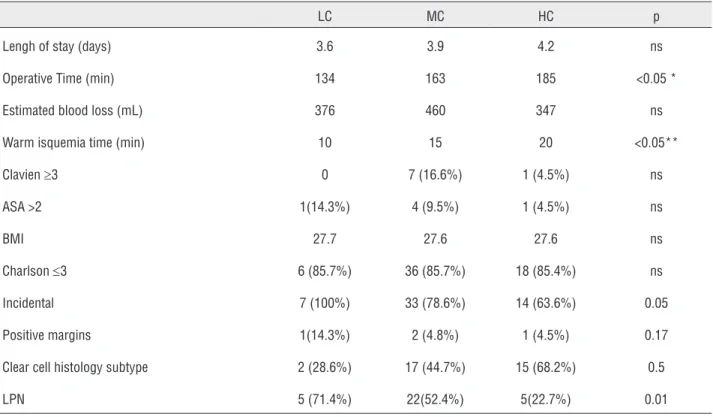
Seventy-one patients were included in a intention to treat partial nephrectomy analysis. Clinical and pathological features are exposed in Table-1. No statistical difference was found in RNS groups regarding to age, BMI, ASA and Charlson score (Table-2).
SURGICAL OUTCOMES
Conversion rate
Of the 71 patients included, 26 had pre-emptive open conversion (2 total and 24 partial). Forty-five subjects initially underwent laparo-scopic procedure, 8 were converted to laparoscop-ic total and 5 to open nephrectomy (4 partial and 1 total) (Figure-1).
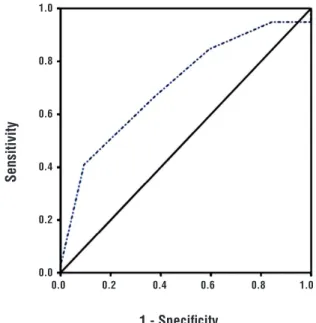
ROC curve was performed to test the ac-curacy of RNS to predict conversion rate. The AUC was 0.715 (0.595-0.836) (p=0.002) (Figure-2). The best specificity cut-off was RENAL ≥9. Patients with RNS<9 were most often subjected to PN (93% x 72%, p=0.03) and LPN (56.8% x 28%, p 0.02) (Table-3).
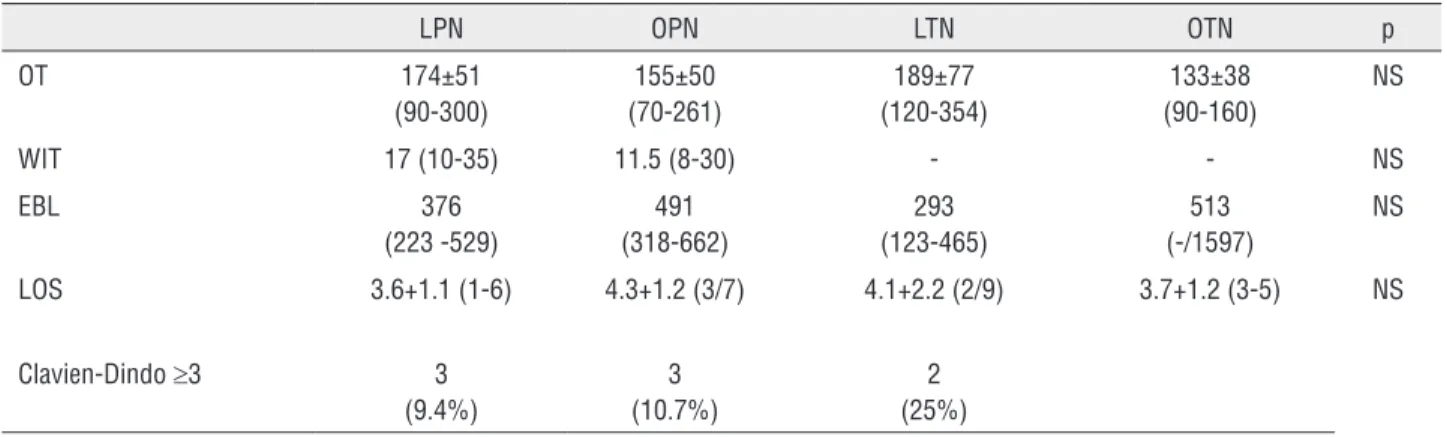
Perioperative outcomes were not different in distinct surgical access. (Table-4)
Warm ischemia time
Table 2 - Distribution of variables according to renal score.
LC MC HC p
Lengh of stay (days) 3.6 3.9 4.2 ns
Operative Time (min) 134 163 185 <0.05 *
Estimated blood loss (mL) 376 460 347 ns
Warm isquemia time (min) 10 15 20 <0.05**
Clavien ≥3 0 7 (16.6%) 1 (4.5%) ns
ASA >2 1(14.3%) 4 (9.5%) 1 (4.5%) ns
BMI 27.7 27.6 27.6 ns
Charlson ≤3 6 (85.7%) 36 (85.7%) 18 (85.4%) ns
Incidental 7 (100%) 33 (78.6%) 14 (63.6%) 0.05
Positive margins 1(14.3%) 2 (4.8%) 1 (4.5%) 0.17
Clear cell histology subtype 2 (28.6%) 17 (44.7%) 15 (68.2%) 0.5
LPN 5 (71.4%) 22(52.4%) 5(22.7%) 0.01
We performed a ROC curve analysis and found an AUC=0.598, which was not signifi-cant (p=0.252); this finding demonstrates that there is no cutoff score of RNS that is able to predict a clamping time <20 or ≥20.
Operative time
The mean operative time was longer in HC (185 min) than in MC (163 min) or LC (134 min) p<0.05. The ROC curve demonstrated that the RNS could predict a prolonged surgery time, with an area under the curve of 0.63 (p=0.05) (Graph-1). Using the Youden index to predict the best cutoff point, we found R.E.N.A.L. ≥8 as a predictor of surgical time ≥180 minutes, with a sensitivity of 89.3% and specificity of 37.2%. The odds of hav-ing surgery time >180 min. was 4.94 times greater in patients with a score ≥8 (p=0.020).
Estimated blood loss
The average EBL in the groups were, re-spectively, 376, 460 and 347mL for LC, MC, HC.
These values lacked both clinical and statisti-cal difference. Seven patients had ≥1000mLof bleeding and 1 was transfused (2000mL of bleeding). There were no association with R.E.N.A.L. complexity groups: 1LC; 5MC; 1HC.
Margin status
No TN patients had positive surgical margins, although 4PN patients (4/60) had pos-itive surgical margins, 3LPN and 1 OPN.
Post-operative complications
No patients presented with post-operative bleeding, urinary fistulas, pseudoaneurysms with clinical symptoms or deaths during the follow-up time. Eight (11.3%) patients had major complica-tions (Clavien≥3). However, none of these compli-cations were observed in LC group, instead occur-ring in 7 (16.6%) and 1 (4.5%) individuals in MC and HC groups, respectively.
Figure 1 - Conversion rate.
Figure 2- ROC curve: RENAL x conversion rate.
Sensitivity
1 - Specificity 45 71
32 (45%)
8 4 PN - 1TN
26 (24 PN - 2TN)
Total patients enroled
Open preemptive surgery approach
Total laparoscopic nephrectomy
Laparoscopic partial nephrectomy
Intraoperative conversion to open approach
TN = Total nephrectomy PN = Partial nephrectomy
AUC: 0.715 (0.595 - 0.836) (p=0.002)
1.0
0.8
0.6
0.4
0.2
0.0
Table 3 - Conversion rate according to RENAL ≥9.
RENAL LPN Others p
<9 25 (54.3%) 21 (45.7%) 0.02
≥9 7 (28%) 18 (72%)
Table 4 - Perioperative outcomes and surgical approach.
LPN OPN LTN OTN p
OT 174±51
(90-300)
155±50 (70-261)
189±77 (120-354)
133±38 (90-160)
NS
WIT 17 (10-35) 11.5 (8-30) - - NS
EBL 376
(223 -529)
491 (318-662)
293 (123-465)
513 (-/1597)
NS
LOS 3.6+1.1 (1-6) 4.3+1.2 (3/7) 4.1+2.2 (2/9) 3.7+1.2 (3-5) NS
Clavien-Dindo ≥3 3
(9.4%)
3 (10.7%)
2 (25%)
OT = Operative time - mean (95%IC) WIT = Warm ischemia time - median (95%IC) EBL = Estimated blood loss - mean (95%IC) LOS = Length of stay - mean (min - max)
LPN = Laparoscopic partial nephrectomy OPN = Open partial nephrectomy LTN = Laparoscopic total nephrectomy OTN = Open total nephrectomy
operative time were not related to Clavien ≥3 (Table-5).
We found that the addition of each unit to the ASA score increased the chance of having Cla-vien ≥3 by 11.48 times (p=0.008). The ROC curve analysis got an AUC of 0.69 (p=0.084). The best number given by the Youden index was 3, with a sensitivity of 37.5% and specificity of 95.2%. From this value, we applied logistic regression with ASA categorizations, and the odds of having Clavien ≥3 were 12 times greater for individuals with an ASA >3 (95%CI=2-69; p=0.008).
Furthermore, age was significantly asso-ciated with major complications. We found that each additionalyear of age increased the chance of having Clavien ≥3 by 1.08 times (p=0.043). The AUC for this was 0.72 (p=0.043), demonstrat-ing that age is a predictive variable for Clavien
≥3. Searching for the best cutoff according to the
Youden method, we found that age ≥66 years had a sensitivity of 75.0% and a specificity of 68.3%. From this value, we applied logistic regression with age categorization and found that those with age ≥66 were 6.45 times more likely to have Cla-vien ≥3 (95%CI=1.2-34.8; p=0.030).
DISCUSSION
Table 5 - Predictors of Clavien≥3.
OR 95% CI p
RENAL 0.95 0.6-1.5 0.84
RENAL-L 0.76 0.5-1.2 0.82
ASA 11.48 1.9-69.5 0.008
Age ≥65 6.45 1.2-24.8 0.043
Surgical approach 0.9 0.8-1.3 0.783
Operative time 1.01 0.99-1.0 0.1
the power of our analysis. In the present study, we evaluate the accuracy of R.E.N.A.L. nephrometry system in predicting outcomes in partial nephrec-tomies for <7cm kidney cancers because we don’t have literature to support routine elective partial nephrectomy in >7cm tumors.
From a technical point of view, the choice between partial or total nephrectomy is still very subjective and even experienced surgeons often are in doubt whether the tumor can be extirpated in order to preserve functional renal parenchyma and in a minimally invasive approach.With neph-rometry scores using, one can obtain objective pa-rameters to predict conversion rates.In our sample, we can identify patients with greater chances of conversion. Individuals with RNS≥9 are at high risk, and perhaps would be better approached by open surgery.
Funahashi et al. (22) retrospectively evalu-ated anatomical data of renal tumor associevalu-ated with the access route to partial nephrectomy and found that the tumor’s relationship to the renal surface (endophytic character) and the distance from the renal sinus affected the surgeon’s deci-sion to open access route or minimally invasive, and tumor size did not influence that decision.Gill et al. (23) in a similar analysis with 771 LPN and 1029 OPN reported that tumor size (2.6cm LPN vs. 3.3cm OPN) and endophytic character (34.4% LPN vs. 53.3% OPN) were significantly different between the two access routes (17).Naya et al. (8) evaluated factors that influence the frequency of LTN (68 patients) vs. LPN (74 patients). They found that the RNS up to 8 was the best cut off for patients selection for LPN.As these data are be-ing validated by larger studies, it will allow better
predict the chances of conversion, improving the anesthetic and surgical planning and patient prep-aration for this possibility. Moreover, technically favorable tumors should be most operated by LPN.
A systematic review from American So-ciety of Anesthesiologists defines as prolonged surgery intervals from 2.5 hours to 4 hours (14). Also others references confirm these information based on increasing post operative complications (15, 16). Ng et al. (24) reported an OT of 3.5 hours in LPN. Marszalek et al. (25) had an average time of 139 min. We had a mean OT of 174 minutes in LPN and RNS was significantly associated with a prolonged surgery time. Data showed that RNS≥8 was a predictor of surgical time ≥180 minutes, with a sensitivity of 89.3%. This indicates that, in cases of a CT scan showing a renal mass with RNS <8, the surgeon could predict that rarely OT will exceed 3 hours.
studies have demonstrated a correlation between RNS and WIT. Hayn et al. (27) found, in a series with 141 laparoscopic partial nephrectomies, WITs of 16, 23 and 31 minutes for the low, medium and high complexity groups, p<0.001.
The hemorrhagic shock scale proposed by ATLS (Advanced Trauma Life Support) con-sider bloodloss between 15-30% of body volume or 750 to 1500mL (Class II) a significant clini-cal bleeding, because patients experiment tachy-cardia, tachypnea and elevates plasma levels of catecholamins (20).RNS was not good predictors of EBL. In our series and in a recently published paper, intraoperative bleeding was not clinically different among RNS groups (LC: 135mL; MC: 210mL; HC: 314mL) (11). These results could be explained by a good intra-operative vascular control of the hilum and a good suture repair of the kidney parenchyma, achieved using open, laparoscopic or robotic techniques.
The overall incidence of urological com-plications after LPN has been reported at 9.0% (12). Simmons and Gill (28) found no correla-tion between tumor size and centrality with the incidence of complications after LPN, on either the univariate or multivariate analyses. Accord-ing to a recently published paper (12), a higher RNS was significantly associated with an in-creased incidence of Clavien grade III. In our series, RNS did not show any relation to post-operative complications. On the other hand, the ASA score and patient’s age were significantly associated with Clavien ≥3. In our sample, base-line patient characteristics were more important that anatomical tumor characteristics in pre-dicting complications.
Turna et al. (29) reported a 2.4% incidence of postoperative urinary fistula after LPN, but no independent predictors of this outcome were found. Recently, another group (30) reported that each unit of increase in RNS was associated with an increased likelihood of a postoperative urine leak. We did not encounter any urinary leaks postoperatively, and no patients had to use a ure-teral catheter. A first line suture performed with 2.0 Vicryl SH needle in all patients with a deep defect in the renal parenchyma may be sufficient to include the collecting system effectively.
From now, we have in literature 10 scores that use anatomic features involved in complexi-ty of partial nephrectomies. Although some stud-ies have been showing association between them and surgical outcomes, no one have accuracy strongly tested and validated (31).
CONCLUSIONS
There is a growing need to objectively measure the complexity of kidney tumors due to the use of minimally invasive procedures that re-quire greater operative skill. In respect to ≤7cm tumors,R.E.N.A.L. score, in this data, was a good method in predicting surgical access route and type of nephrectomy. Also was associated with OT and WIT, but with weak accuracy. On the oth-er hand, RNS was not associated with Clavien >3, EBL, LOS or positive surgical margin. These observations must be tested by other groups in a major population.
ABBREVIATIONS
ASA = American Society of Anesthesiologists
AUC = area under the curve
BMI = body mass index
EBL = estimated blood loss
HC = high complexity
LC = low complexity
LOS = length of stay
LPN = laparoscopic partial nephrectomy MC = medium complexity
OPN = open partial nephrectomy
OT = operative time
PN = partial nephrectomy
RNS = R.E.N.A.L. nephrometry system
ROC curve = receiver operating characteristic curve
RTs = Renal Tumors
TN = total nephrectomy
WIT = warm ischemia time
CONFLICT OF INTEREST
REFERENCES
1. Fergany AF, Hafez KS, Novick AC. Long-term results of nephron sparing surgery for localized renal cell carcinoma: 10-year followup. J Urol. 2000;163:442-5.
2. Lesage K, Joniau S, Fransis K, Van Poppel H. Comparison between open partial and radical nephrectomy for renal tumours: perioperative outcome and health-related quality of life. Eur Urol. 2007;51:614-20.
3. Huang WC, Elkin EB, Levey AS, Jang TL, Russo P. Partial nephrectomy versus radical nephrectomy in patients with small renal tumors--is there a difference in mortality and cardiovascular outcomes? J Urol. 2009;181:55-61.
4. Hollenbeck BK, Taub DA, Miller DC, Dunn RL, Wei JT. National utilization trends of partial nephrectomy for renal cell carcinoma: a case of underutilization? Urology. 2006;67:254-9.
5. Nuttall M, Cathcart P, van der Meulen J, Gillatt D, McIntosh G, Emberton M. A description of radical nephrectomy practice and outcomes in England: 1995-2002. BJU Int. 2005;96:58-61. 6. Patel SG, Penson DF, Pabla B, Clark PE, Cookson MS,
Chang SS, et al. National trends in the use of partial nephrectomy: a rising tide that has not lifted all boats. J Urol. 2012;187:816-21.
7. Kutikov A, Uzzo RG. The R.E.N.A.L. nephrometry score: a comprehensive standardized system for quantitating renal tumor size, location and depth. J Urol. 2009;182:844-53. 8. Naya Y, Kawauchi A, Oishi M, Ueda T, Fujihara A, Naito Y, et al.
Comparison of diameter-axial-polar nephrometry and RENAL nephrometry score for treatment decision-making in patients with small renal mass. Int J Clin Oncol. 2015;20:358-61. 9. Altunrende F, Laydner H, Hernandez AV, Autorino R, Khanna
R, White MA, et al. Correlation of the RENAL nephrometry score with warm ischemia time after robotic partial nephrectomy. World J Urol. 2013;31:1165-9.
10. Mayer WA, Godoy G, Choi JM, Goh AC, Bian SX, Link RE. Higher RENAL Nephrometry Score is predictive of longer warm ischemia time and collecting system entry during laparoscopic and robotic-assisted partial nephrectomy. Urology. 2012;79:1052-6.
11. Simhan J, Smaldone MC, Tsai KJ, Canter DJ, Li T, Kutikov A, et al. Objective measures of renal mass anatomic complexity predict rates of major complications following partial nephrectomy. Eur Urol. 2011;60:724-30.
12. Liu ZW, Olweny EO, Yin G, Faddegon S, Tan YK, Han WK, et al. Prediction of perioperative outcomes following minimally invasive partial nephrectomy: role of the R.E.N.A.L nephrometry score. World J Urol. 2013;31:1183-9.
13. Dindo D, Demartines N, Clavien PA. Classification of surgical complications: a new proposal with evaluation in a cohort of 6336 patients and results of a survey. Ann Surg. 2004;240:205-13.
14. Smetana GW, Lawrence VA, Cornell JE. Annals of Internal Medicine Clinical Guidelines Preoperative Pulmonary Risk Stratification for Noncardiothoracic Surgery : Systematic Review for the American College of Physicians. 2006. Available at. <http://annals.org/aim/article/722320/preoperative- pulmonary-risk-stratification-noncardiothoracic-surgery-systematic-review-american-college>
15. Fleisher L. Risk of Anesthesia. In: Miller R, editor. Anesthesia. 7th ed. Philadelphia: Churchil Livingstone; 2010; pp. 969-99. 16. Pires CP CE. Complicações respiratórias. In: SAESP, editor.
Tratado de Anestesiologia. 7th ed. São Paulo: Atheneu; 2010; pp. 2703–15.
17. Marberger M. Renal ischaemia: not a problem in laparoscopic partial nephrectomy? BJU Int. 2007;99:3-4.
18. Thompson RH, Blute ML. At what point does warm ischemia cause permanent renal damage during partial nephrectomy? Eur Urol. 2007;52:961-3.
19. Funahashi Y, Hattori R, Yamamoto T, Kamihira O, Kato K, Gotoh M. Ischemic renal damage after nephron-sparing surgery in patients with normal contralateral kidney. Eur Urol. 2009;55:209-15.
20. American College of Surgeons. Advanced Trauma Life Support for Doctors: Student Course Manual. 8th ed. Chicago: American College of Surgeons; 2008.
21. Charlson ME, Pompei P, Ales KL, MacKenzie CR. A new method of classifying prognostic comorbidity in longitudinal studies: development and validation. J Chronic Dis. 1987;40:373-83.
22. Funahashi Y, Murotani K, Yoshino Y, Sassa N, Ishida S, Gotoh M. The renal tumor morphological characteristics that affect surgical planning for laparoscopic or open partial nephrectomy. Nagoya J Med Sci. 2015;77:229-35.
23. Gill IS, Kavoussi LR, Lane BR, Blute ML, Babineau D, Colombo JR Jr, et al. Comparison of 1,800 laparoscopic and open partial nephrectomies for single renal tumors. J Urol. 2007;178:41-6.
24. Ng CS, Gill IS, Ramani AP, Steinberg AP, Spaliviero M, Abreu SC, et al. Transperitoneal versus retroperitoneal laparoscopic partial nephrectomy: patient selection and perioperative outcomes. J Urol. 2005;174:846-9.
25. Marszalek M, Chromecki T, Al-Ali BM, Meixl H, Madersbacher S, Jeschke K, et al. Laparoscopic partial nephrectomy: a matched-pair comparison of the transperitoneal versus the retroperitoneal approach. Urology. 2011;77:109-13.
26. Thompson RH, Frank I, Lohse CM, Saad IR, Fergany A, Zincke H, et al. The impact of ischemia time during open nephron sparing surgery on solitary kidneys: a multi-institutional study. J Urol. 2007;177:471-6.
28. Simmons MN, Ching CB, Samplaski MK, Park CH, Gill IS. Kidney tumor location measurement using the C index method. J Urol. 2010;183:1708-13.
29. Turna B, Frota R, Kamoi K, Lin YC, Aron M, Desai MM, et al. Risk factor analysis of postoperative complications in laparoscopic partial nephrectomy. J Urol. 2008;179:1289-94.
30. Bruner B, Breau RH, Lohse CM, Leibovich BC, Blute ML. Renal nephrometry score is associated with urine leak after partial nephrectomy. BJU Int. 2011;108:67-72. 31. Hou W, Yan W, Ji Z. Anatomic features involved in
technical complexity of partial nephrectomy. Urology. 2015;85:1-7.