Relationship between functional fitness, medication costs and
mood in elderly people
MICHELLI LUCIANA MASSOLINI LAUREANO1*, RAUL AGOSTINHO MARTINS2, NUNO M. SOUSA2, ARISTIDES M. MACHADO-RODRIGUES2,
JOÃO VALENTE-SANTOS2, MANOEL JOÃO COELHO-E-SILVA2
1Institute of Social Sciences, Education and Zootechnics (ICSEZ), Federal University of Amazonas, Parintins, AM, Brazil
2Faculty of Sports Science and Physical Education (FCDEF), University of Coimbra, Coimbra, Portugal
S
UMMARYStudy conducted by the Faculty of Sports Science and Physical Education at the University of Coimbra, Portugal
Article received: 01/08/2013
Accepted for publication: 10/12/2013
*Correspondence
Universidade Federal do Amazonas Address: Estrada Parintins/Macurany, n°
1805 – Jacareacanga Parintins – AM – Brazil ZIP Code: 69.152-240 Phone/Fax: +55 92 3533-1884 [email protected]
http://dx.doi.org/10.1590/1806-9282.60.03.007
Conflict of interest: none
Objective: to verify if functional itness (FF) is associated with the annual cost
of medication consumption and mood states (MSt) in elderly people.
Methods: a cross-sectional study with 229 elderly people aged 65 years or more
at Santa Casa de Misericórdia de Coimbra, Portugal. Seniors with physical and
psycho-logical limitations were excluded, as well as those using medication that limits performance on the tests. The Senior Fitness Test was used to evaluate FF, and the Proile of Mood States – Short Form to evaluate the MSt. The statistical analysis was based on Mancova, with adjustment for age, for comparison between men and women, and adjustment for sex, for comparison between cardiorespi-ratory itness quintiles. The association between the variables under study was made with partial correlation, controlling for the effects of age, sex and body mass index.
Results: an inverse correlation between cardiorespiratory itness and the annual
cost of medication consumption was found (p < 0.01). FF is also inversely asso-ciated with MSt (p < 0.05). Comparisons between cardiorespiratory itness quin-tiles showed higher medication consumption costs in seniors with lower aero-bic endurance, as well as higher deterioration in MSt (p < 0.01).
Conclusion: elderly people with better FF and, speciically, better
cardiorespi-ratory itness present lower medication consumption costs and a more positive MSt.
Uniterms: physical functional itness, medication, mood states, elderly.
I
NTRODUCTIONThe World Health Organization (WHO) estimates a 22% increase in the prevalence of people aged over 60 years by 20501. This growth has been attributed to technological
advancements in the area of health, healthier behaviors2
and a reduction in birth rates.3, 4, 5
Physical functional itness (FF), generally dimen-sioned in terms of the ability and independence to safe-ly carry out day-to-day activities,6 has a direct impact on
the quality of life7 of elderly people, and is one of the
rep-resentative factors for the evaluation of health, directly related to physical activity levels. On the other hand, some authors have demonstrated that levels of physical activ-ity are inversely related to the number of medications used by the elderly.8
The quality of life of the elderly is inluenced by phys-ical and functional aspects, as well as sociologphys-ical and psychological aspects, with mood interpreted as the set of emotional states experienced by each person in their daily lives.9 The emotional dimension is connected to
var-ious feelings, whether negative (tension, anger, fatigue and depression) or positive (self-esteem, vigor and well-being) and is therefore associated with the individual’s health and quality of life.10
All of these aspects have an impact on the health and qual-ity of life of this population, therefore, understanding the type of associations established between FF, the med-ication consumption costs and mood states (MSt) is of major relevance.
The evaluation of physical itness should focus on the capacity of the musculoskeletal, cardiorespiratory and neurological systems through characterization of pa-rameters such as aerobic itness, muscular endurance, lexibility, agility and bodily composition.12 The Senior
Fitness Test,12 used in the present study was translated
and validated for the Portuguese population, and is eas-ily applied and understood, with normative values that enable results to be compared.13, 14
The evaluation of mood states was conducted using the Proile of Mood States – Short Form (POMS-SF) where six mood states are used: tension, depression, anger, vig-or, fatigue and confusion. This questionnaire is composed of a ive point Likert scale that describes different levels of feelings and was translated and validated for the Por-tuguese population.15, 16
Given that presented above, the intention of this study was to verify if physical itness is associated with the cost of medication consumption and mood in elder-ly people.
M
ETHODSStudy design and participants
A cross-sectional study was conducted with the partici-pation of 229 seniors aged between 65 and 95 years, in-cluding 169 women (75 ± 8 years) and 60 men (74 ± 7 years) originating from the long-term residential institu-tion Santa Casa de Misericórdia de Coimbra, Portugal. The
participants were kept on similar diets in terms of calor-ic and nutritional intake, controlled by a nutritionist, and any medication dosages, including salicylate and statins, remained unchanged during the study.
The investigation exclusion criteria were considered as all physical or psychological conditions that could in-terfere in the capacity to undertake the tests requested and the use of medication that might inluence function-al performance or the interpretation of the results.
The data was collected in ive sessions, with the irst used to collect anthropometric data the second for appli-cation of the POMS-SF and the measurement of hemo-dynamic variables, the third for application of the Senior Fitness Test in the form of a circuit, with the exception of the “6 minute walk” test, which was held in the fourth session. In the last session the data relating to medica-tion consumpmedica-tion was collected.
All of the participants gave their free and clariied consent after being informed of the potential risks and/ or discomfort associated with the tests. The study is in accordance with the laws of Portugal and was approved by the scientiic council at the University of Coimbra.
Anthropometric evaluation
The anthropometric measurements were conducted in a separate room in order to guarantee the privacy of the participants. Body mass (BM) was determined using por-table scales (Seca ®, model 770, Germany) with a preci-sion of 0.1 kg. The waist circumference (WC) was mea-sured on the narrowest part of the trunk, above the navel and below the xiphoid process using a retractable iber-glass measuring tape (Hoechstmass-Rollix ®, Germany) with a precision of 0.1 centimeters. Height was determined using a portable stadiometer (Seca Bodymeter ®, model 208, Germany) with a precision of 0.1 centimeters. The Body Mass Index (BMI) was calculated using the BM and height.
Physical itness evaluation
Physical itness was evaluated using the Senior Fitness Test,7, 12 translated and validated for the Portuguese
pop-ulation13 and constituted by the following tests:
i) the chair stand test, to evaluated the strength and
endurance of the lower limbs;
ii) the arm curl test, to evaluate the strength and
en-durance of the upper limbs;
iii) the chair sit-and-reach test, to evaluate the
lexibi-lity of the lower limbs;
iv) the back scratch test, to evaluate the lexibility of
the upper limbs;
v) the 8-foot up-and-go test, to evaluate agility, speed
and dynamic balance and;
vi) the 6-minute walk test, to evaluate aerobic
endu-rance.
Evaluation of hemodynamic variables
Resting systolic blood pressure (SBP) and diastolic blood pressure (DBP) were determined using the auscultatory method with the use of a sphygmomanometer (brand HICO, model HM 1001, Germany) and stethoscope (brand HICO, model HM-3005, Germany). The participants were placed in a seated position in accordance with the proce-dures recommended by the American College of Sports Medicine (ACSM) for the evaluation of resting blood pres-sure and pulse,17 with the latter evaluated using
Mood evaluation
Mood states were determined using the POMS-SF,16 which
is composed of 22 items grouped into 6 dimensions or subscales: tension-anxiety (4 items), depression (5 items), irritation-hostility (3 items), vigor-activity (4 items), fa-tigue-inertia (4 items) and confusion (2 items). The total mood disturbance (TMD) was calculated from the differ-ence between the positive dimension (vigor) and the neg-ative ones (tension, depression, irritation, confusion and fatigue). The participants completed the questionnaires in a quiet room and the researcher was available during application in order to help with any queries in relation to completion of the instrument.
Medication consumption evaluation
Medication consumption was assessed by consulting the computerized records of each of the participant’s family physicians. It is obligatory for the individual records of each patient to state all of the medication prescribed by the family physician. Only medication consumed regu-larly was considered, such as that for chronic diseases. Self-medication was not considered in this study. The amount of medication consumed annually was calcula-ted using the prescribed dosage. The annual cost for each medication and the sum of the annual cost of all medi-cation for each participant was calculated using the sel-ling price to the public in Portugal in 2011.
Statistical analysis of the data
The data is presented as average values and standard varia-tions and the variavaria-tions in relation to normality and homo-geneity were tested using the Kolmogorov-Smirnov test. The comparison between males and females was undertaken using the Mancova, adjusted for age. The comparison between the quintiles of the distanced covered in the 6-minute walk test was also undertaken using the Mancova, adjusted for the effects of sex. The association between the variables un-der study was unun-dertaken with a particle correlation adjus-ted for age, sex and BMI. Data analysis was obtained using SPSS V. 19.0 (SPSS Inc, Chicago, IL, USA). Statistical signi-icance was established to the level of p < 0.05.
R
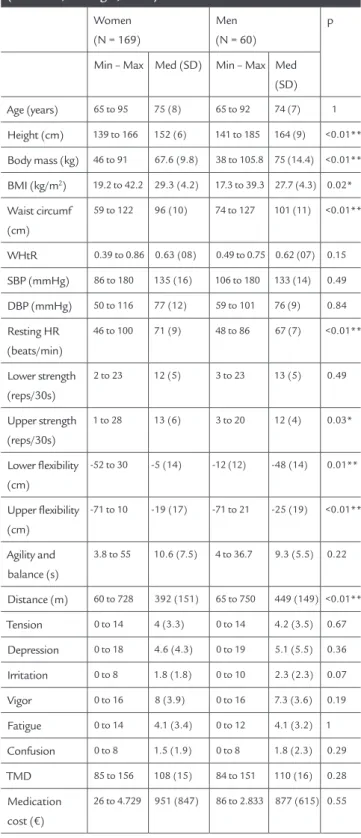
ESULTSAll of the participants fulilled the eligibility requirements. As pert Table 1, in the simple anthropometric variables – height, body mass and waist circumference – men presen-ted higher average values than women (p < 0.01), while the waist-to-height ratio (WHtR) was similar in gender, as well as the SBP and DBP (p > 0.05). Conversely, the BMI (p < 0.05) and HRrep (p < 0.01) were higher in women.
TABLE 1 Description of the participants in terms of
anthropometric and hemodynamic variables and functional fitness, mood states and annual medication consumption costs, adjusted for age for comparison between sexes (Coimbra, Portugal, 2012)
Women (N = 169)
Men (N = 60)
p
Min – Max Med (SD) Min – Max Med (SD)
Age (years) 65 to 95 75 (8) 65 to 92 74 (7) 1
Height (cm) 139 to 166 152 (6) 141 to 185 164 (9) <0.01**
Body mass (kg) 46 to 91 67.6 (9.8) 38 to 105.8 75 (14.4) <0.01**
BMI (kg/m2) 19.2 to 42.2 29.3 (4.2) 17.3 to 39.3 27.7 (4.3) 0.02*
Waist circumf (cm)
59 to 122 96 (10) 74 to 127 101 (11) <0.01**
WHtR 0.39 to 0.86 0.63 (08) 0.49 to 0.75 0.62 (07) 0.15
SBP (mmHg) 86 to 180 135 (16) 106 to 180 133 (14) 0.49
DBP (mmHg) 50 to 116 77 (12) 59 to 101 76 (9) 0.84
Resting HR (beats/min)
46 to 100 71 (9) 48 to 86 67 (7) <0.01**
Lower strength (reps/30s)
2 to 23 12 (5) 3 to 23 13 (5) 0.49
Upper strength (reps/30s)
1 to 28 13 (6) 3 to 20 12 (4) 0.03*
Lower lexibility (cm)
-52 to 30 -5 (14) -12 (12) -48 (14) 0.01**
Upper lexibility (cm)
-71 to 10 -19 (17) -71 to 21 -25 (19) <0.01**
Agility and balance (s)
3.8 to 55 10.6 (7.5) 4 to 36.7 9.3 (5.5) 0.22
Distance (m) 60 to 728 392 (151) 65 to 750 449 (149) <0.01**
Tension 0 to 14 4 (3.3) 0 to 14 4.2 (3.5) 0.67
Depression 0 to 18 4.6 (4.3) 0 to 19 5.1 (5.5) 0.36
Irritation 0 to 8 1.8 (1.8) 0 to 10 2.3 (2.3) 0.07
Vigor 0 to 16 8 (3.9) 0 to 16 7.3 (3.6) 0.19
Fatigue 0 to 14 4.1 (3.4) 0 to 12 4.1 (3.2) 1
Confusion 0 to 8 1.5 (1.9) 0 to 8 1.8 (2.3) 0.29
TMD 85 to 156 108 (15) 84 to 151 110 (16) 0.28
Medication cost (€)
26 to 4.729 951 (847) 86 to 2.833 877 (615) 0.55
* Differences between sexes (p ≤ 0.05); ** Differences between sexes (p ≤ 0.01).
Reading Table 1 we can see that women presented grea-ter fitness in respect to upper strength (p < 0.05) and upper and lower flexibility (p < 0.01), while men pre-sented better cardiorespiratory fitness performance (p < 0.01). Lower strength and agility, speed and dynamic balance are similar in men and women (p > 0.05). Ta-ble 1 also shows that men and women obtained simi-lar mood states – tension, depression, irritation, con-fusion, vigor, fatigue and TMD – and similar annual medication costs (p > 0.05).
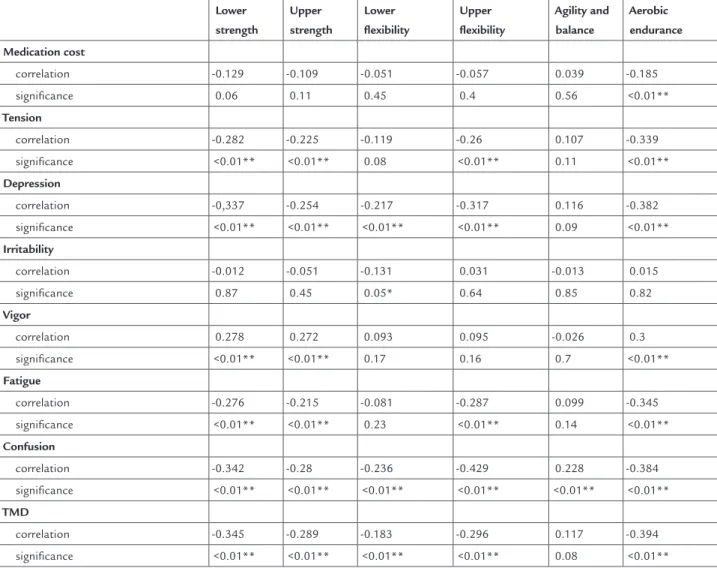
In the study of the association between physical it-ness and the annual cost of medication consumption (Table 2), a negative correlation was found between car-diorespiratory itness and medication costs (r = -0.185;
p < 0.01). The other physical itness components did not present signiicant correlations although there was a tendency toward an inverse association.
In Table 2 we can note that cardiovascular itness is inversely associated with tension (r = -0.339; p < 0.01), de-pression (r = -0.382; p < 0.01), fatigue (r = -0.345; p < 0.01), confusion (r = -0.384; p < 0.01) and TMD (r = -0.394; p < 0.01) and directly associated with vigor (r = 0.300; p < 0.01). The remaining physical itness components also present a similar tendency toward an association with the mood states analyzed, enabling it to be afirmed that, in general, negative mood states are inversely as-sociated with FF and positive mood states are directly associated with FF.
TABLE 2 Partial correlation between variables adjusted for the effects of sex, age and BMI (Coimbra, Portugal, 2012)
Lower strength
Upper strength
Lower flexibility
Upper flexibility
Agility and balance
Aerobic endurance
Medication cost
correlation -0.129 -0.109 -0.051 -0.057 0.039 -0.185
signiicance 0.06 0.11 0.45 0.4 0.56 <0.01**
Tension
correlation -0.282 -0.225 -0.119 -0.26 0.107 -0.339
signiicance <0.01** <0.01** 0.08 <0.01** 0.11 <0.01**
Depression
correlation -0,337 -0.254 -0.217 -0.317 0.116 -0.382
signiicance <0.01** <0.01** <0.01** <0.01** 0.09 <0.01**
Irritability
correlation -0.012 -0.051 -0.131 0.031 -0.013 0.015
signiicance 0.87 0.45 0.05* 0.64 0.85 0.82
Vigor
correlation 0.278 0.272 0.093 0.095 -0.026 0.3
signiicance <0.01** <0.01** 0.17 0.16 0.7 <0.01**
Fatigue
correlation -0.276 -0.215 -0.081 -0.287 0.099 -0.345
signiicance <0.01** <0.01** 0.23 <0.01** 0.14 <0.01**
Confusion
correlation -0.342 -0.28 -0.236 -0.429 0.228 -0.384
signiicance <0.01** <0.01** <0.01** <0.01** <0.01** <0.01**
TMD
correlation -0.345 -0.289 -0.183 -0.296 0.117 -0.394
signiicance <0.01** <0.01** <0.01** <0.01** 0.08 <0.01**
Quintile 1
(176 m) (597 m) Distance (m)
(325 m) Quintile 2
(439 m) Quintile 3
(501 m) Quintile 4 Quintile 5 0
20 40 60 80 100 120 140
0
1.600
1.400
1.200
1.000
800
600
400
200
Total mood disturbance (TMD)
Medication cost (€)
* †
† ‡
‡ §
§ Medication PTH
FIGURE 1 Annual cost of medication consumption (€) and tot al
mood disturbance in r elation to dist ance tr aveled in the 6-minut e walk t est (Coimbr a, Portugal, 2012).
* Differences between quintile 1 and quintile 2 (p ≤ 0.01); † differences between quintile 1 and quintile 3 (p ≤ 0.01); ‡ differences between quintile 1 and quintile 4 (p ≤ 0.01); § differences between quintile 1 and quintile 5 and between quintile 2 and quintile 5 (p ≤ 0.01).
Figure 1 illustrates the TMD and annual medication cost in each of the quintiles of the distance traveled in the 6-mi-nute walk test. The participants in quintile 1, who only walked 176 m on average, presented a higher TMD and higher medication consumption cost, and a progressive reduction was veriied as the distance traveled increased, so that participants in quintile 5, who walked 597 m on average, had the lowest TMD and lowest medication costs. In terms of TMD, differences were signiicant (p < 0.01) between quintile 1 and quintile 2, between quintile 1 and quintile 3, between quintile 1 and quintile 4, between quintile 1 and quintile 5 and between quintile 2 and quin-tile 5. For the cost of medication, differences were signi-icant (p < 0.01) between quintile 1 and quintile 3, between quintile 1 and quintile 4, between quintile 1 and quinti-le 5 and between quintiquinti-le 2 and quintiquinti-le 5. Taking the par-ticipants from quintile 1 as a reference, those from quin-tile 2 spent 9% less on medication, those from quinquin-tile 3 spent 28% less, those from quintile 4 spent 33% less and those from quintile 5 spent 46% less.
D
ISCUSSIONThe description of the participants is similar to that found in other studies, where seniors practicing physical activity or not presented a BMI value classiied as overweight.7, 8, 18, 19 This
fact is predictable in this age range, given that over the years there is a decrease in lean mass and an increase in fat mass,19
but is not acceptable, given that this is associated with an increase in the number of comorbidities.20 Furthermore,
the values found for the waist circumference are high com-pared to the cut-off values of the International Diabetes
Federation (IDF)21 and the NIH (National Institutes of
Health)22 revealing central obesity. This situation is a
pre-dictor of health complications in seniors19 and an
increa-sed risk of cardiovascular diseases, indicated as the major cause of mortality and morbidity.23
HRrep is a cardiac conditioning indicator and showed
high values for females. Despite the SBP and DBP having similar values between men and women, the participants in this study are pre-hypertensive according to the classi-ication given by the JCN-VII24 (The Seventh Report of the
Joint National Committee on Prevention, Detection, Eval-uation and Treatment of High Blood Pressure) for SBP.
All of these variables show the need to improve anthro-pometric and hemodynamic aspects in the participants, reducing the incidence of diseases and, consequently, low-ering the use of medication. Various studies have investi-gated the effects of physical activity on the elderly and dem-onstrated it to be beneicial for reducing heart rate,25, 26 and
adjuvant in chronic diseases such as congestive heart fail-ure and chronic pulmonary disorder,23 as well as reducing
the risk of developing hypertension.8, 20, 26, 27
In addition to chronic and degenerative diseases, at-tention should be given to functional incapacity, which may reduce socialization and affect the sense of wellbe-ing,28 as well as the emotional state of seniors, given that
in this age range human beings encounter a series of fac-tors that are emotionally overwhelming.23, 29, 30, 31 There
are studies proving that elements such as higher intake of medication, internal and external stress32 and eating
disorders24 contribute to making depression one of the
diseases with a growing prevalence among the elderly, compromising their quality of life.32, 33
In this study, the participants demonstrated similar physical itness and mood states in the general context presented, for men and women, as well as similar medi-cation consumption costs. However, when considering aerobic endurance, measured using the 6-minute walk test, it was veriied that men obtained better results, as well as lower medication costs, although this was not sta-tistically signiicant. We can highlight that aerobic capac-ity interferes in cardiac,34,35 pulmonary34 and blood
pres-sure35,36 functions and, as presented in Table 1, women
obtain inferior performance to men, with a concomitant tendency for higher medication costs.
that better performance in aerobic capacity is associated with lower expenditure on medication.37,38 Other studies
of the same kind but which associated speciic sports mo-dalities obtained positive results, with higher values in the physical and functional itness tests providing lower annual costs associated with the consumption of medi-cation.32, 39 Therefore, knowing that the increase incidence
of chronic health problems makes seniors large consum-ers of medication11 and that this may be an indicator of
their general state of health,9 reducing it is a question of
public health and is possible through encouraging the practice of physical activity,8, 32, 37, 38, 39 which is proven to
result in social and psychological beneits, as well as bio-logical/physiological ones.8, 23, 26, 27, 32, 37, 38, 39
In addition to the proven beneits, when associating physical activity with the consumption of medication, de-spite the literature being scarce, there is work such as that by Codogno et al.40 which, when comparing sedentary
and active groups of those with type 2 Diabetes Mellitus, veriied medication consumption 23% higher in the sed-entary group when considering only medication for the treatment of diabetes, and 128% higher when consider-ing medication for the treatment of other diseases. An-other study that proved the effectiveness of physical ac-tivity on reduction in the use of medication by Bertoldi et al.41 analyzed a sample of Brazilian adults and veriied
that the level of physical activity was inversely associated with the prevalence and number of medications used. They also veriied that the results were conirmed in those with chronic diseases and that even after the diseases be-came present, active individuals have a lower propensity to consume medication. The results of these studies in-dicated a need to incentivize the practice of physical ac-tivity as a mechanism for the reduction of medication consumption. These indings are in accordance with this research, given that the association between physical it-ness and the regular practice of physical activity has been well established. This practice also clearly contributes to improving mood, which ensures better socialization, min-imizes emotional disorders and contributes to increas-ing quality of life.
A strong point of this study is the fact that it is the irst to associate physical itness, medication consump-tion costs and mood states. Up to now, no publicaconsump-tion has been found in relation to this triple association. There are studies showing the association between mood states and medication consumption and, separately, physical itness and medication consumption.32, 37, 38, 39
Some studies were encountered showing an associ-ation between physical and functional itness and mood
states. In the work undertaken by Marques,38 which
eval-uated different groups (control versus physical exercise)
it was veriied that the group submitted to training ob-tained higher and statistically signiicant values in the vigor dimension when compared to the control group. The same work also indicated improvements in the phys-ical itness of the exercise group. The study published by Martins et al.,42 analyzed the effects of a sixteen-week
strength training and aerobic training program on the mood states of seniors using the same instruments in the present study, verifying that the two training groups improved in terms of physical itness and that this con-tributed to improvements in mood. Both articles cited presented results in accordance with the indings here-in. Likewise, Teixeira et al.43 veriied that nineteen weeks
of exercise reduced the levels of depression, tension, fa-tigue and irritation and increased the level of vigor, while in the same period the control group recorded a reduc-tion in vigor and increase in the level of confusion. Sim-ilar to these indings, another study by Martins et al.,44
also with an experimental group submitted to physical exercise and a control group, veriied that the exercise group recorded a statistically signiicant reduction in depression, tension, fatigue and irritation levels, and an increase in vigor levels. Despite not being statistically signiicant, the confusion levels also presented a tenden-cy to decrease. It is worth reiterating that despite the studies encountered relating to research with control and experimental groups, all report improvements in physical itness owing to physical exercise and correlate this mood states, and are therefore have compatible pa-rameters with the present study.
In this analysis, aerobic endurance was selected from the triple association between the annual cost of medica-tion consumpmedica-tion, total mood disturbance and physical itness, represented as the distance traveled in the 6-min-ute walk test, as this variable was highlighted in previous tests. Similarly, the TMD was used for mood states, with results consistent with previous correlations. The results encountered are unique and have no comparisons in the current literature, relecting the need to direct public health policies to consider multidisciplinary issues in monitoring and treating seniors, given that in developed countries every dollar applied to prevention results in sav-ings of 100 dollars in hospitalizations, which are always longer and have a higher cost for elderly patients.45
and the presence of diseases may negatively inluence the quality of life of the elderly.46
Some limitations of this study should also be taken in account. Firstly, the sample was composed by seniors that are long-term residents of institutions (or care homes), and different results may be presented for other samples. Lastly, the POMS-SF was considered as being responded to sincerely by the participants, as despite being recog-nized as effective for the measurements proposed and presented herein, it is a subjective assessment tool.
C
ONCLUSIONBetter physical itness, with an emphasis on aerobic en-durance, was signiicantly associated with lower medica-tion consumpmedica-tion costs and better mood states in elderly people residing in long-term residential institutions. The-se indings suggest that one of the ways to reduce the cost of medication consumption, whether at the personal, fa-mily or State level, would be the regular practice of phy-sical activity, capable of improving phyphy-sical and functio-nal itness, social relationships and mood states in the elderly, and providing them with more quality of life.
A
CKNOWLEDGMENTSThe authors wish to thank for the Foundation for Scien-ce and Technology (FCT) for inancing this study (Pro-ject Ref. PTDC/DES/111620/2009).
R
ESUMORelações entre aptidão física funcional, custos com con-sumo de medicamentos e estados de humor em pessoas idosas
Objetivo: veriicar se a aptidão física funcional (AFF) tem
associação com o custo anual de consumo de medicamen-tos e com os estados de humor (EH) em pessoas idosas.
Métodos: estudo transversal com 229 idosos de 65 anos
de idade ou mais da Instituição Santa Casa de Misericór-dia de Coimbra, Portugal. Foram excluídos os idosos com limitações físicas e psicológicas e os que usavam medica-mentos que condicionariam a realização dos testes. Fo-ram utilizados a bateria Senior Fitness Test e o questio-nário Profile of Mood States – Short Form como instrumentos de coleta de dados. A análise estatística re-correu à Mancova, com ajuste de idade, para comparação entre homens e mulheres, e ajustada também para o sexo, para comparação entre quintis da aptidão cardiorrespi-ratória. A associação entre as variáveis de interesse foi
fei-ta com a correlação parcial, corrigindo o efeito da idade, do sexo e do índice de massa corpórea.
Resultados: veriicou-se a existência de correlação
inver-sa entre a aptidão cardiorrespiratória e o custo anual de consumo de medicamentos (p < 0,01). A AFF associou-se também inversamente com os EH (p < 0,05). As compa-rações entre os quintis da aptidão cardiorrespiratória re-velaram maior consumo de medicamentos em idosos com menor resistência aeróbia, assim como maior deteriora-ção dos EH (p < 0,01).
Conclusão: idosos com melhor AFF e, particularmente,
melhor aptidão cardiorrespiratória apresentam menores custos com consumo de medicamentos e EH mais posi-tivos.
Unitermos: aptidão física funcional; medicamentos;
es-tados de humor; idoso.
R
EFERENCES1. Organização Mundial de Saúde (OMS) Guia Global das cidades amigas das pessoas idosas. Portugal: Fundação Calouste Gulbenkian; 2009 [cited 14 May 2012]. Available at: http://www.gulbenkian.pt/media/iles/FTP_iles/ pdfs/PGDesenvolvimentoHumano/ProjIdosos_GuiaCidades2009.pdf. 2. Organização Mundial de Saúde (OMS). Envelhecimento ativo: uma política
de saúde. Trad. Suzana Gontijo. Brasília (DF): Organização Pan-Americana de Saúde; 2005. 60p.
3. INE I.P. Censos 2011. Resultados provisórios [Internet]. Lisboa: Instituto Nacional de Estatística; 2011 [cited 15 May 2012]. Available at: http://www. ine.pt/xportal/xmain?xpid=INE&xpgid=ine_destaques&DESTAQUESdest_ boui=129675729&DESTAQUESmodo=2.
4. Instituto Brasileiro de Geograia e Estatística. População brasileira envelhece em ritmo acelerado. 2008. [cited 17 Sept 2012]. Available at: http://www. ibge.gov.br/home/presidencia/noticias/noticia_impressao.php?id_ noticia=1272.
5. Minayo MCS. O envelhecimento da população brasileira e os desaios para o setor saúde. Cad Saúde Pública. 2012;28(2):208-9.
6. Lima-Costa MF, Barreto SM, Giatti L. Condições de saúde, capacidade funcional, uso de serviços de saúde e gastos com medicamentos da população idosa brasileira: um estudo descritivo baseado na Pesquisa Nacional por Amostra de Domicílios. Cad Saúde Pública. 2003;19(3):735-43.
7. Rikli RE, Jones CJ. Senior itness test manual. Champaign (Illinois): Human Kinetics Books; 2001. 176p.
8. Silva LJ, Azevedo MR, Matsudo S, Lopes GS. Associação entre níveis de atividade física e o uso de medicação entre mulheres idosas. Cad Saúde Pública. 2012;28(3): 463-71.
9. Biddle SJH. Emotion, mood and physical activity. In: Biddle SJH, Fox KF, Boutcher SH, editors. Physical activity and psychological well-being. London: Routledge; 2000. p.63-87.
10. Cavallini GM, Fagundes AP, Martins A, Miranda JK, Rodrigues M, Krug MR, Martins ES, Callegaro CC, Panda MDJ. A inluência de um programa de exercícios físicos no estado de humor dos indivíduos cadastrados no esf/ primavera. In: XVI Seminário Interinstitucional de Ensino, Pesquisa e Extensão. XVI Mostra de Iniciação Cientíica e IX Mostra de Extensão; 2011. Cruz Alta (RS), Brasil.
11. Loyola Filho AI, Uchoa E, Lima-Costa MF. Estudo epidemiológico de base populacional sobre uso de medicamentos entre idosos na Região Metropolitana de Belo Horizonte, Minas Gerais, Brasil. Cad Saúde Pública. 2006;22(12):2657-67.
12. Rikli RE, Jones CJ. Development and validation of a functional itness test for comunnity–residing older adults. J Aging Phys Act. 1999;7(2):129-61. 13. Sardinha L, Martins T. Uma nova bateria para a avaliação da aptidão física
Simpósio envelhecer melhor com a atividade física. Lisboa: FMH Edições, 1999. p.209-19.
14. Baptista F, Sardinha LB. Avaliação de aptidão física e do equilíbbrio de pessoas idosas – baterias de Fullerton. Cruz Quebrada: FMT Edições; 2005. 15. Viana MF, Almeida PL, Santos RC. Adaptação portuguesa da versão reduzida do Peril de Estados de Humor – POMS. Análise Psicológica. 2001;1(19):77-92.
16. Cruz J, Mota M. Adaptação e características psicométricas do “POMS-Proile of Mood States” e do ”STAI – State Trait Anxiety Inventory”. In: Gonçalves M, Ribeiro I, Araújo S, Machado C, Almeida L, Simões M, editors. Avaliação psicológica: formas e contextos. Braga: APPORT; 1997. v.5, p. 539-45. 17. ACSM (American College of Sports Medicine). ACSM’s Guidelines for
Exercising Testing and Prescription. Philadelphia: Lippincott Wiliams & Wilkins; 2010.
18. Farinea N, Ricalde SR, Sivieri, J. Peril nutricional e antropométrico de idosos participantes de um grupo de ginástica no município de Antônio Prado – RS. RBCEH. 2010;7(3):393-04.
19. Santos DM, Sichieri R. Índice de massa corporal e indicadores antropométricos de adiposidade em idosos. Rev Saúde Pública. 2005;39(2):163-8.
20. Manuretti DB, Barbosa AR, Marucci MFN, Lebrão ML. Hipertensão arterial referida e indicadores antropométricos de gordura em idosos. Rev Assoc Med Bras. 2011;57(1):25-30.
21. International Diabetes Federation. The IDF Consensus Worldwide Deinition of the Metabolic Syndrome. [cited 2012 Jul 31]. Available at: http://www. idf.org/webdata/docs/MetSyndrome _FINAL.pdf.
22. National Institutes of Health. Clinical Guidelines on the Identiication, evaluation, and Treatment of Overweight and Obesity in Adults: The Evidence Report. c1998. National Heart, Lung, and Blood Institute, Bethesda; 1998. 23. Zaslavsky C, Gus I. Idoso. Doença cardíaca e comorbidades. Arq Bras Cardiol.
2002;79(6):635-9.
24. Joint National Committee on Prevention, Detection, Evaluation and Treatment of Hight Blood Pressure. The Seventh Report of the Joint National Committeen on Prevention, Detection, Evaluation And Treatment Of Hight Blood Pressure. National Institutes of Health; 2003. Publication n.03-5233. Available at: http:// www.nhlbi.nih.gov/guidelines/hypertension/express.pdf.
25. Menezes-Cabral RL, Silva-Dantas PM, Montenegro-Neto AN, Knackfuss MI. Efeitos de diferentes treinamentos e estilos de vida nos indicadores antropométricos e cardiocirculatórios no envelhecimento. Rev Salud Pública. 2009;11(3):359-69.
26. Martins RA, Veríssimo MT, Coelho e Silva MJ, Cumming SP, Teixeira AM. Effects of aerobic and strength-based training on metabolic health indicators in older adults. Lipids Health Dis. 2010;9:76.
27. Pinto VLM, Meirelles LR, Farinatti PTV. Inluência de programas não-formais de exercícios (doméstico e comunitário) sobre a aptidão física, pressão arterial e variáveis bioquímicas em pacientes hipertensos. Rev Bras Med Esporte. 2003;9(5):99-104.
28. Anjos DMC, Araujo IL, Barros VM, Pereira DAG, Pereira DS. Avaliação da capacidade funcional em idosos diabéticos. Fisioter Pesq. 2012;19(1):73-8. 29. Fechine BRA, Trompieri N. O processo de envelhecimento: as principais alterações que acontecem com o idoso com o passar dos anos. Rev Cient Int. 2012;20(1):106-32
30. Figueiredo VLM. Estilo de vida como indicador de saúde na velhice. Cienc Cog. 2007;12:156-64.
31. Mendes MRSSB, Gusmão JL, Faro ACM, Leite RCBO. A situação social do idoso no Brasil: uma breve consideração. Acta Paul Enferm. 2005;18(4):422-6. 32. Ferreira EEDBA. Gestão de custos com medicamentos, hidroginástica e
qualidade de vida em pessoas idosas de Santarém [tese de mestrado]. Coimbra: Universidade de Coimbra; 2011. 112p.
33. Sass A, Gravena AAF, Pilger C, Mathias TAF, Marcon SS. Depressão em idosos inscritos no programa de controle de hipertensão arterial e diabetes mellitus. Acta Paul Enferm. 2012;25(1):80-5.
34. Hollemberg M, Yang J, Haight TJ, Tager IB. Longitudinal Changes in aerobic capacity: implications for concepts of aging. J Gerontol A Biol Sci Med Sci. 2006;61(8):851-8.
35. Pinto VLM, Meirelles LR, Farinatti PTV. Inluência de programas não-formais de exercícios (domésticos e comunitários) sobre a aptidão física, pressão arterial e variáveis bioquímicas em pacientes hipertensos. Rev Bras Med Esporte. 2003;9(5):267-74.
36. Moraes WM, Souza PRM, Pinheiro MHNP, Irigoyen MC, Medeiros A, Koike MK. Programas de exercícios físicos baseado em frequência semanal mínima: efeitos na pressão arterial e aptidão física em idosos hipertensos. Rev Bras Fisioter. 2011;16(2):114-21. [cited 18 Sept 2012]. Available at: http://www. scielo.br/pdf/rbis/2012nahead/pt_aop009_12_sci1040.pdf.
37. Biel JNG. Gestão de custos com medicamentos, aptidão física funcional e qualidade de vida em idosos institucionalizados do Concelho de Leiria [masters thesis]. [Coimbra (PT)]: Universidade de Coimbra; 2011. 134p. 38. Marques, J.M. Organização e gestão de um programa de exercício físico
multicomponente: Efeitos no custo com medicação, aptidão física, imunidade, peril metabólico, estado de humor e qualidade de vida em idosos [tese de mestrado]. [Coimbra (PT)]: Universidade de Coimbra; 2011. 148p. 39. Cruz ACM. Gestão de custos com medicamentos, natação e qualidade de
vida em pessoas idosas de Santarém [tese de mestrado]. [Coimbra (PT)]: Universidade de Coimbra; 2011. 148p.
40. Codogno JS, Fernandes RA, Monteiro HL. Práticas de atividade física e custo do tratamento ambulatorial de diabéticos tipo 2 atendidos e Unidades Básicas de Saúde. Arq Bras Endocrinol Metab. 2012;56(1):6-11.
41. Bertoldi AD, Hallal PC, Barros AJ. Physical activity and medicine use: evidence from a population-based study. BMC Public Health. 2006; 6:224. 42. Martins R, Coelho e Silva M, Pindus D, Cumming S, Teixeira A, Veríssimo
M. Effects of strength and aerobic based training on functional itness, mood and the relationship between fatiness and mood in older adults. J Sports Med Phys Fitness. 2011;51(3):489-96.
43. Teixeira AM, Martins R, Martins M, Cunha MR. Changes in functional itness, mood states and salivar IgA levels after exercise training for 19 weeks in ederly. Int J Applied Sports Sci. 2008;20(2):16-26.
44. Martins R, Rosado F, Cunha MR, Martins M, Teixeira AM. Exercício físico, IgA salivar e estados emocionais em pessoas idosas. Motricidade. 2008;4(1):5-11. 45. Del Pozzo O. Políticas públicas de saúde para idosos no Brasil.. Brasil: Revista
Portal de Divulgação. 2012;9. [cited 31 Jul 2012]. Available at: http://www. portaldoenvelhecimento.org.br/revista/index. php.