Arquivos Brasileiros de Cardiologia - Volume 87, Nº 2, August 2006
Original Article
Original Article
Serum NT-proBNP Levels are a Prognostic Predictor in Patients
with Advanced Heart Failure
Antonio Carlos Pereira-Barretto, Mucio Tavares de Oliveira Junior, Célia Cassaro Strunz, Carlos Henrique Del Carlo, Airton Roberto Scipioni, José Antonio Franchini Ramires
Instituto do Coração do Hospital das Clínicas – FMUSP - São Paulo, SP - Brazil
M a i l i n g A d d r e s s : A n t o n i o C a r l o s P e r e i r a B a r r e t t o • R u a P i a v e , 1 0 3 - 0 5 6 2 0 - 0 1 0 – S ã o P a u l o , S P - B r a z i l
E-mail: [email protected] Received on 08/05/05 • Accepted on 03/17/06
O
BJECTIVETo verify if the determination of NT-proBNP values would help predict the prognosis in advanced heart failure (HF) patients.
M
ETHODSOne hundred and five subjects with average age of 52.4 years were evaluated, 66.6% of them males. Thirty-three (32.0%) subjects were outpatients and 70 (67.9%) were inpatients (functional class III/IV) admitted to the hospital for cardiac compensation. All patients had left ventricular systolic dysfunction and a mean ejection fraction of 0.29. The NT-proBNP levels were measured in all patients and they were followed-up over a period ranging from 2 to 90 days (average 77 days). A ROC curve was drawn to determine the best cut-off point, as well as the corresponding Kaplan-Meyer survival curves.
R
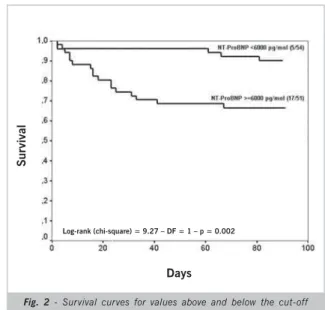
ESULTSDuring the follow-up period, 22 patients died. The average NT-proBNP value of the patients who remained alive was 6,443.67±6,071.62 pg/ml, whereas that of those who died was 14,609.66±12,165.15 pg/ml (p=0.001). The ROC curve identifi ed a cut-off point at 6,000 pg/ml with 77.3% sensitivity (area under the curve: 0.74). The survival curve for values below and above 6,000 pg/ml was signifi cantly different (p=0.002): patients with values below 6,000 pg/ml had a 90.2% 90-day survival, and those patients with values above, a 66% survival.
C
ONCLUSIONPatients with advanced HF, especially those admitted to the hospital for cardiac compensation, had much higher NT-proBNP values, with a two-fold increase among those who died during the follow-up period. Values above 6,000 pg/ml identify the patients most likely to die within 90 days after hospital discharge.
K
EY WORDSArquivos Brasileiros de Cardiologia - Volume 87, Nº 2, August 2006
Heart failure is known as an impairing condition with a poor prognosis, especially during the advanced stage when patients progress with shorter survival rates and mortality rates higher than 50% during the fi rst year of follow-up1-4. Early identifi cation of those patients who
might experience the worst progression or premature death is vital, as this would allow intervention in an attempt to change the natural course of their disease.
In evaluating heart failure populations the magnitude of clinical manifestations has proved to be a valuable tool for prognosis stratification5-9. Several studies
have reported that less symptomatic patients (NYHA functional classes I and II) have a better course of the disease than those who are more symptomatic (FC III and IV)4-10. Although symptoms may help stratify
prognosis, they are not useful when more homogeneous groups are evaluated, such as FC IV patients admitted for cardiac compensation, since their clinical states are very similar5,6,8. Because of their symptoms, these
patients need hospitalization and form a poor prognosis population, although tests may help identify which ones will have the worst clinical progression.
Several variables have shown this capacity for selection4-10, such as the degree of heart remodeling, the
intensity of neurohormonal stimulation through plasma concentrations of noradrenalin and sodium, and the level of kidney dysfunction.
Recently, the measurement of B-type natriuretic peptide was added to this list of variables because of comparison studies that identifi ed it as the best laboratory variable for the stratifi cation of prognosis11-14.
In this article, we report on our experience with NT-proBNP measurement in a population consisting mostly of advanced HF patients. Our objective was to verify its role in stratifying these patients regarding the identifi cation of who would be at risk for early death.
M
ETHODSOne hundred and five patients with congestive heart failure and an ejection fraction under 40% were enrolled in the study. One third of the patients were referred from the hospital’s cardiac outpatient unit, and two thirds were patients who had been admitted for cardiac compensation. Most of them were classifi ed as III/IV patients (68.6%). Outpatients were compensated cardiac subjects. Criteria for hospital admission were hypotension, evident anasarca, indication for inotropic therapy, and lack of compensation after having received intravenous medication in the emergency room, which are all characteristics of the advanced form of the disease.
Blood samples were drawn from all patients, either at hospital admission or at the outpatient unit, to determine NT-proBNP concentrations by commercially available immunoassays (Roche Diagnostics, Mannheim, Germany). Patients were treated by their physicians and
followed as to the risk of mortality during an average period of 77 days (2 to 91 days).
Statistical Analysis - Continuous variables are
presented as means ± standard deviations, whereas categorical variables are presented as rates and percentages. T-Student orU-Mann-Whitney tests were used to compare the continuous variables. A ROC (“Receiver Operating Characteristic”) curve was drawn to estimate the cut-off point for the natriuretic peptide value (NT-proBNP) as a predictor of mortality. The likelihood of death was estimated by computing the relative risk and a 95% confi dence interval for the variables studied. All tests used were two-tailed and the p<0.05 value was considered statistically signifi cant.
R
ESULTSTable 1 displays the main clinical characteristics of the study population.
Table 1 - Main clinical characteristics of the study population
Variable
Age (years) 52.44 ± 11.98
Gender (males) 70 (66.6%)
Ischemic cardiomyopathy 34 (32.3%)
Idiopathic cardiomyopathy 27 (25.7%)
Chagasic cardiomyopathy 24 (22.8%)
Hypertensive cardiomyopathy 15 (14.2%)
Functional class I/II 33 (31.4%)
Functional class III/IV 72 (68.6%)
Ejection fraction 0.29 + 0.09
LV diastolic diameter (cm) 6.33 + 1.96
LV- left ventricle.
Ischemic cardiomyopathy was the most frequent etiology observed, followed by the Chagasic and idiopathic forms of the disease.
Patient ages ranged from 18 to 89 years (mean age 52.44+11.98 years); 70 (66.6%) were males and 35 (33.3%) were females. The average left ventricular ejection fraction was 0.29, and the left ventricular diastolic diameter was 6.33 cm.
The NT-proBNP concentration ranged from 70.19 pg/ml to 48,001.93 pg/ml (8,187.86 ± 8,407.90 pg/ml).
During the follow-up period, the 22 (20.9%) patients who died had an average NT-proBNP concentration of 14,609.66±12,165.15 pg/ml, whereas those who were still alive had an average value of 6,443.67±6,071.62 pg/ml (p = 0.001).
The ROC curve identifi ed the 6,000 pg/ml value as the best cut-off point to stratify the population as to risk of mortality. Area under the curve was 0.74 (fi gure 1).
Patients with NT-proBNP values above 6,000 pg/ml were
Arquivos Brasileiros de Cardiologia - Volume 87, Nº 2, August 2006
3.6 times more likely to die (CI 95 %: 1.4 – 9.0; p=0.003) than those with values below this level (fi gure 2).
No patient with NT-proBNP values under 2,000 pg/ml (21 patients) died during the 90-day follow-up period.
D
ISCUSSIONHeart failure is considered an increasingly prevalent modern epidemic despite the new drugs and procedures currently available1-3. In spite of the advances in recent
years, HF patients still are at a higher risk of mortality than patients with some types of cancer1.
The severe symptomatology of FC III or IV patients, added to the presence of cardiogenic shock and the need for hospitalization for cardiac compensation, all identify those who will have the worst disease progression and the highest mortality risk4. However, even in a population of
patients with the most severe form of the disease, not all of them will die; hence, the early identifi cation of those with the worst clinical progression would allow early referrals to special treatments or transplantation and, hopefully, change the bleak outlook of the disease9 .
The search for markers of the worst prognosis is universal, especially by health units that treat heart failure. Cardiac impairment identifi ed by an ejection fraction of less than 25% (measured by radioisotopic ventriculography) and oxygen uptake lower than 12 ml/ kg/min, along with being symptomatic, represent criteria used by HF units to indicate heart transplantation15.
BNP determination should soon be added to these variables, since several studies have documented its value for prognostic stratifi cation.(11-14) The high levels
detected at the fi rst measurement indicate that patients are decompensated, and the maintenance of high levels identifi es which patients have a very poor prognosis11.
The introduction of BNP among the variables that
indicate prognosis is based on comparison studies conducted with other variables that have shown that this measurement is superior to the evaluation of symptoms, ejection fractions, and even oxygen uptake12.
The values that predict the worst course of the disease vary according to the severity of the cases in the study population and the measurement method used. Levels of B-type natriuretic peptide can be evaluated by measuring BNP or NT-proBNP. Studies comparing techniques have shown that there is a good equivalence between both methods, although NT-proBNP values in pg/ml are approximately 8-fold higher than those of BNP16.
For FC III or IV patients, the values identifi ed as mortality predictors are always over 1,000 pg/ml. Bittencourt found 4,137 pg/ml, Logeart 1,015 pg/ml, Hartman 1,767 pg/ml, and Gardner, 1,490 pg/ml (mean values)11-14.
We analyzed a population with advanced HF and found average values of 7,433.70 pg/ml, characterizing a population with a very severe form of the disease.
By analyzing the values of patients who died, we found results of up to 14,609.66 pg/ml, i.e., approximately twice as high as those of patients who were still alive at the end of the follow-up. This result was similar to that reported by Gardner, who also found values twice as high as those of patients with the worst course of the disease, although the levels he found were lower than ours since he studied a population of less severe cases (3,052 pg/ml for those who died and 1,222 pg/ml for those who lived)12.
Using the ROC curve, we identifi ed 6,000 pg/ml as the best cut-off point for stratifying the population as to the risk of death. Ninety point-three percent of the patients with values below this level were alive after one year of follow-up, against 72.1% of those with higher values.
We also observed that no patient with NT-proBNP values below 2,000 pg/ml died over the 90-day follow-up period.
Fig. 2 - Survival curves for values above and below the cut-off point.
Fig. 1 – ROC curve drawn to determine the best cut-off point
Barretto et al
SERUM NT-PROBNP LEVELS ARE A PROGNOSTIC PREDICTOR IN PATIENTS WITH ADVANCED HEART FAILURE
Sensitivity
1 - Specifi city
Area=0.74
Days
Sur
vival
Arquivos Brasileiros de Cardiologia - Volume 87, Nº 2, August 2006
Literature data document the usefulness of BNP determination for prognosis stratifi cation. The cut-off point varies according to the severity of the cases in the population studied. The cut-off point in our study was quite high, since our population consisted of patients with extremely severe conditions in whom cardiac compensation was diffi cult to achieve. This is a population that merits attention, with many potential candidates for cardiac transplantation. We consider values above 6,000 pg/ml strong indicators of the need to ponder this possibility.
Knowledge of NT-proBNP levels allowed us to foresee which patients would have the worst disease progression. NT-proBNP determination is an easily performed test that proved to be an excellent prognosis marker for advanced HF patients.
Potencial Confl ict of Interest
No potential confl ict of interest relevant to this article was reported.
1. McMurray JJV, Stewart S. The burden of heart failure. Eur Heart J. 2002; 4 (suppl D): 50-8.
2. Fonarow GC, Adams KF, Abraham WT, et al. Risk stratifi cation for
in-hospital mortality in acutely decompensated heart failure. Classifi cation and regression tree analysis. JAMA. 2005; 293: 572-80.
3. Shahar E, Lee S, Kim J, et al. Hospitalized heart failure: rates and long-term mortality. J Cardiac Fail. 2004; 10: 374-8.
4. Wong PS, Davidsson GK, Timeyin J, et al. Heart failure in patients admittd to hospital: mortality is still high. Eur J Intern Med. 2002; 13: 304-10.
5. Kearney MT, Foxx KAA, Lee AJ, et al. Predicting death due to progressive heart failure in patients with mild to moderate chronic heart failure. J Am Coll Cardiol. 2002; 40: 1801-8.
6. Brophy JM, Dagenais GR, McSherry F, et al. A multivariate model for predicting mortality in patients with heart failure and systolic dysfunction. Am J Med. 2004; 116: 300-304.
7. Felker GM, Leiberger JD, Califf RM, et al. Risk stratifi cation after hospitalization for decompensated heart failure. J Cardiac Fail. 2004; 10: 460-6.
8. VillaCorta H, Mesquita ET, Cardoso R, et al. Preditores de sobrevida obtidos na unidade de emergência em pacientes atendidos por
R
EFERENCESinsufi ciência cardíaca descompensada. Rev Port Cardiol. 2003; 22: 495-507.
9. Oliveira Jr MT, Canesin MF, Munhoz RT, et al. Principais características clínicas de pacientes que sobrevivem 24 meses ou mais após uma hospitalização devido a descompensação cardíaca. Arq Bras Cardiol. 2005; 84 (2): 161-6
10. Bettencourt P, Azevedo A, Pimenta J, et al. N-Terminal-ProBrain Natriuretic peptide predicts outcome after hospital discharge in heart failure patients. Circulation. 2004; 110: 2168-74.
11. Gardner RS, Ozalp F, Murday AJ, et al. N-Terminal pro-brain natriuretic peptide. A new gold standard in predicting mortality in patients with advanced heart failure. Eur Heart J. 2003; 24: 1735-43.
12. Hartmann F, Packer M, Coats AJS, et al. Prognostic impact of plasma N-Terminal pro-brain natriuretic peptide in severe chronic congestive heart failure. A sub study of the carvedilol prospective randomized cumulative survival (COPERNICUS) trial. Circulation. 2004; 110: 1780-6.
13. Logeart D, Thabut G, Jourdain P, et al. Predischarge B-type natriuretic peptide assay for identifying patients at high risk of re-admission after decompensated heart failure. J Am Coll Cardiol. 2004; 43: 635-41.
14. II Diretrizes da Sociedade Brasileira de Cardiologia para o diagnóstico e tratamento da insufi ciência cardíaca. Arq Bras Cardiol. 1999; 72: 1-30.