Universidade do Estado do Rio de Janeiro - UERJ
Mailing address: Antonio L. da Silva Brasileiro Av. Marechal Henrique Lott -270/107 - 22631-370 – Rio de Janeiro, RJ – Brazil - E-mail: [email protected]
Objective - To evaluate the use of thrombolytic and acetylsalicylic acid therapies in acute myocardial infarct patients as well as the availability of technical and hu-man resources for the care of these patients in the emergen-cy units of the city of Rio de Janeiro. Additional objectives were the evaluation of the use of primary angioplasty and the level of acceptance of SBC /RJ as an entity responsible for programs of continued medical education.
Methods - Interviews with physicians at 46 emergen-cy units in the city of Rio de Janeiro.
Results - Of the 46 emergency units inspected, a poli-cy of encouragement to use thrombolytic therapy was only prescribed in 6.5%. In 1/3 of the public wards no thrombo-lytic agents were available, and in none of them was ac-cess to primary angioplasty regularly available; 45.9% did not offer the minimal conditions required for the han-dling of cases of acute myocardial infarction; 60% of the physicians on-call (at both public and private emergency units), appeared not to know the importance of the use of acetylsalicylic acid in acute myocardial infarct patients; all physicians interviewed would participate in programs of continued medical education organized by the SBC/RJ.
Conclusion - The study suggests there was: 1) the low probability of the use of thrombolytic therapy in the majority of the emergency units in of the city of Rio de Ja-neiro due to the inadequate policy of waiting for the trans-fer of the patient to coronary or intensive care unit; 2) a low awareness to the importance of early use of acetylsalic acid in acute myocardial infarct; 3) half of the emergency units of the public net do not have the minimal conditions required for the handling of cases of acute myocardial infarction; 4) a high level of credibility exists that would enable the SBC/RJ to set up programs for continued medical education to change the mentality regarding the use of thrombolytic therapy and of acetylsalicylic acid.
Key words: myocardial infarct, thrombolysis, emergencies
Arq Bras Cardiol, volume 75 (nº 3), 230-234, 2000
Antonio Luiz da Silva Brasileiro (on beharff of the study partipants)
Rio de Janeiro, RJ - Brazil
The Bussola Study. Final Results, Conclusions and Proposals
Ever since the advent of coronary units in 1962 1, no other fact has left a stronger impression on the cardiology community than the publication in 1986 of the GISSI study 2, demonstrating a reduction in acute myocardial infarct mor-tality of up to 47% and contributing to the division of this specialty into pre- and postthrombolytic therapy eras.
“Time is muscle” became the new paradigm. Since then, all efforts have been directed towards increased awa-reness by physicians in emergency units of the necessity for rapid transfer of acute myocardial infarct patients to a coronary unit for initiation of thrombolytic therapy. This ini-tial strategy, based on the prudance to a new drug, soon showed itself to be inadequate, because the drug’s time-de-pendent benefits were delayed until after the patient’s arri-val at the coronary unit or center for intensive therapy. This amounted in many instances to denying the patient his or her main chance for survival. It was furthermore found that its excellent risk/benefit ratio eliminated the need for an in-tensive therapy environment for the drug’s prescription. Thus, a new challenge set in: to make physicians aware of the importance of the initiation of thrombolytic therapy in the emergency unit itself 3-10, so the decisive place for the acute myocardial infarct patient moved from the coronary unit to the emergency unit. All over the world, campaigns aimed at stimulating the use of thrombolytic therapy as precociously as possible have been initiated. The best-known program, the National Heart Attack Alert Program (NHAAP) coordinated by the National Heart, Lung and Blood Institute in the United States of America, was laun-ched in 1991 10 with the participation of 39 organizations in-cluding the major medical societies of that country. It was however recommended by NHAAP that campaigns fos-tering awareness in the population (to look for hospitaliza-tion as rapidly as possible) should only be started following adequate training and awareness of the physicians who would be rendering the first assistance to these patients.
between 1989 and 1997, we observed that the majority of their acute myocardial infarct inpatients had not received thrombolytic therapy at the emergency units. As these pa-tients usually arrived very late to the coronary unit, the use of the drug had frequently become inadequate (fig. 1). We also noted that 95.6% of these patients arrived at the place where they received their initial attention within 12 h 11. A study by Xavier et al 12 showed that patients hospitalized for acute myocardial infarction at the Clementino Fraga Hospital of the University of Rio de Janeiro also did not re-ceive thrombolytic therapy at the emergency units where they went for medical help in spite of frequently being wi-thin first 2h of symptoms. Some epidemiological studies 13-14 have shown a dramatic situation in Rio de Janeiro, which, in a survey from 1980 to 1997, reveals itself to be the national leader in deaths by acute myocardial infarct (fig. 2). Such a situation will only be reversed by political will and a partner-ship between the Brazilian Society of Cardiology/Rio de Ja-neiro (SBC/RJ) and the Regional Council of Medicine of the State of Rio de Janeiro, aimed at the implementation of objec-tive measures. Aiming at obtaining wider information about what is being offered to the bearers of acute myocardial in-farction in the emergency units, the BÚSSOLA study (the
portuguese word for compass) was conceived to look, with the support of the SBC/RJ, for solutions to the problem of the underuse of thrombolytic therapy in cardiology emer-gencies in the city of Rio de Janeiro.
The objectives of this study were: evaluate the proba-bility that acute myocardial infarct patents would have pre-cociously administered reperfusion therapy (thrombolytic or primary angioplasty) in emergency units in the city; to evaluate the quality of such attention; to evaluate the de-gree of use of acetylsalicylic acid as part of the treatment of the infarct; and to evaluate the acceptance of SBC/RJ as the promoter of a program for continuous medical educati-on of health professieducati-onals active in emergency units.
Methods
A questionnaire predefined in a pilot study was used to interview the head physicians of 46 emergency units (24 public, 22 private) in the city of Rio de Janeiro. The choice of these units was based on information obtained from the Health Office of the Municipality of Rio de Janeiro concer-ning the number of cases attended in these emergency rooms. At least one on-call physician (randomly chosen from those in attendance at emergency units to treat patients suspected of having an acute myocardial infarction) was al-so interviewed. Interviews were made in April and May of 1998 by 21 participants (11 residents and 10 last year medical probationers) in the study, who had a letter of introduction signed by the President of the SBC/RJ and by the coordina-tor/author of the study.
The evaluation of the probability of the performance of some form of precocious reperfusion therapy (objective 1) was based on answers of the head physicians to the question: “Which is the general policy for the use of throm-bolytic therapy in your emergency unit?”. The following answers were given: a) we do not have the drug; b) we do not use it because we do not have an adequate setup for this; c) we do not use it because our physicians have not yet demonstrated an interest in this therapy; d) our policy is to Fig. 1 - Relation between patients hospitalized at the Coronary Unit (CU) of the
Cardiology Hospital of Laranjeiras for acute myocardial infarct between 1989 and 1997, distinguished by having or not received thrombolytic therapy (TT) and where received. The figure shows the low use, also after arrival, in general due to delayed removal.
Fig. 2 - Acute myocardial infarct mortality index in the eight largest Brazilian state capitals evaluated in years when official data (demographic and mortality) were available. Note that Rio de Janeiro has the largest mortality index over all the years. Sources: Brazilian Institute of Geography and Statistics (IBGE) and Datasus (Ministry of Health/National Health Foundation).
Fig. 3 - Geographical distribution of the emergencies studied. Map by the Health Municipality of Rio de Janeiro. Localization of the 46 emergency units visited. There exists a correspondence of these sites with demographic density.
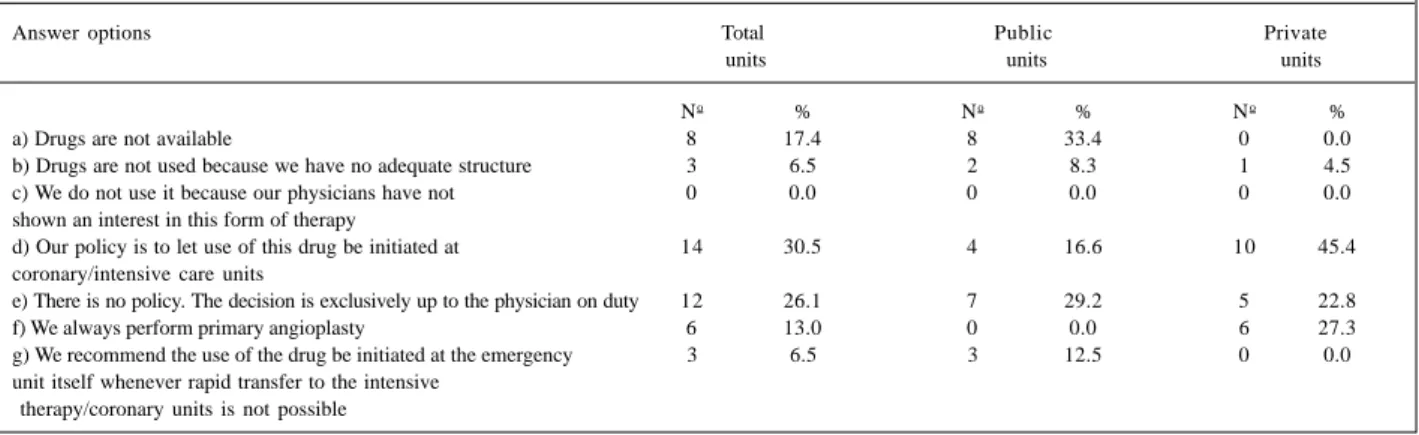
have the use of this drug initiated in the intensive therapy unit or the coronary unit; e) we have no policy; the decision is exclusively up to the physician on duty; f) we always per-form primary angioplasty; g) we recommend that the use of the drug be initiated in the emergency unit itself when no rapid transportation to the coronary/intensive therapy unit is possible.
We felt that there would by a low probability for the performance of some form of reperfusion therapy in the emergency units if answers were a, b, c, or d; a moderate probability if the answer was e; and a high probability if it had been f or g.
To evaluate the quality of the medical attention rende-red (objective 2), we classified the emergency units into ca-tegories according to their available resources. Minimal conditions for treatment of patients with a picture of acute myocardial infarct would be: availability for use of an elec-trocardiograph, a defibrillator, and a thrombolytic agent; presence of a cardiologist on duty during the majority of the period, or the existence of an intensive therapy center. The availability for use of additional resources placed the emer-gency units in higher categories, ranging up to excellent. The following resources were taken into consideration: 1) a policy of the local head officials to provide a moderate to high probability for the performance of precocious throm-bolytic reperfusion therapy (see criteria above); 2) the pos-session of at least seven of the following nine requisites: a cardiac monitor, possibility of measurement of CKMB, myoglobin, troponin, echocardiography, thoracic teleradio-graphy, MA1 or a higher respirator, temporary pacemaker, a strategy of prioritization of attention to patients with thora-cic pain; 3) a coronary unit; 4) the possibility of quick ac-cess to interventional procedures; 5) the possibility of a 24 h/day access to such interventions; 6) the possibility of emergent cardiac surgery; 7) the possibility of this access 24 h/day.
Results
Table I shows that, although lack of availability of thrombolytics was a problem in only 17.4% of the emergency
units visited, the absence of an implementation policy on part of the head officials would probably impede the perfor-mance of a precocious reperfusion therapy in the majority of them. Only 6.5% of the head physicians adopted the pre-sently advocated policy of initiation of thrombolytic thera-py right at the emergency unit when quick transfer to a coro-nary or intensive therapy unit proved impossible.
Using criteria of high, moderate, or low probability, we verified that in only 12.5% of the public and in 27.3% of the private emergency units would patients with an acute myo-cardial infarct have a high probability of being given some form of precocious reperfusion therapy to obtain a signifi-cant reduction in the risk of death (table II).
Table III shows a numerical view of the situation, sho-wing that 45.9% of the public emergency units did not offer even minimal conditions for such attention. Among the private institutions, only 4.5% did not meet such minimal conditions.
The answers to the question shown in table IV sug-gest that the majority of the professionals active in the emer-gency units did not have an adequate degree of awareness of the importance of the use of acetylsalicylic acid in a patient with acute myocardial infarction. This was observed both in public and private emergency units.
All 97 physicians interviewed answered favorably re-garding the future presence of the SBC/RJ in their emergen-cy units to promote programs of continued medical educa-tion (table V).
Discussion
The high level of cardiology practiced in many public and private centers of the city of Rio de Janeiro is well known. Yet, the high mortality rate due to acute myocardial infarct in this city 13 seems to indicate that the greatest part of the population does not have access to this good quality of service, a fact that can be confirmed by some of the re-sults found in this study, showing that nearly half of the pu-blic emergency units (which treat the largest part of the po-pulation) did not have even minimal conditions for mana-ging acute myocardial infarct patients. Paradoxically, the
Table I – Interviews with head officials of emergency units: “What is the general policy for the use of thrombolytic therapy in this emergency unit?”
Answer options Total Public Private
units units units
No % No % No %
a) Drugs are not available 8 17.4 8 33.4 0 0.0
b) Drugs are not used because we have no adequate structure 3 6.5 2 8.3 1 4.5
c) We do not use it because our physicians have not 0 0.0 0 0.0 0 0.0
shown an interest in this form of therapy
d) Our policy is to let use of this drug be initiated at 14 30.5 4 16.6 10 45.4 coronary/intensive care units
e) There is no policy. The decision is exclusively up to the physician on duty 12 26.1 7 29.2 5 22.8
f) We always perform primary angioplasty 6 13.0 0 0.0 6 27.3
g) We recommend the use of the drug be initiated at the emergency 3 6.5 3 12.5 0 0.0 unit itself whenever rapid transfer to the intensive
best equipped public hospitals, for reasons justifiable or not, do not accept emergency cases. Thus, the population does not have access to an up to date form of medicine pre-cisely at the moment of its greatest need. This occurs at University Hospitals Clementino Fraga and Pedro Ernesto and at the Cardiology Hospital of Laranjeiras (Health Minis-try), the cardiology referral center for the State. Another important factor is the lack of clear and necessary position-ing of the head officials of emergency units in favor of the use of a thrombolytic agent as soon as possible in the emergency unit, thus loosing an excellent opportunity to reduce the high mortality rates found. Furthermore, a lack of awareness is evident on the part of the physicians about the importance of the use of acetylsalicylic acid in acute myocardial infarction, as suggested by this study, which shows the deficiencies of all the main pillars sustaining the structure of emergency service in the city, be they au-thorities, head physicians, or physicians in attendance.
Based on the results found, we present initial, simple proposals that can be put into practice immediately (some already ongoing) by the SBC/RJ: 1) setting up a minimal protocol to perform thrombolytic therapy in emergencies; 2) promoting lectures at emergency units about the
im-portance and safety of the use of thrombolytic therapy (ongoing); 3) promoting a public awareness campaign about the importance of the use of aspirin in patients with suspected acute myocardial infarction; 4) increasing awareness of public health authorities about the need to supply all their emergency units with thrombolytic drugs as well as with technical and human resources adequate for emergency management of bearers of acute myocardial infarcts; 5) periodically awarding official certificates of quality to emergency units; 6) disseminating notices about the importance of adopting a philosophy of prioritization of the attention to be given to patients complaining of thora-cic pain 15; 7) establishing central agencies to support de-cisions (ongoing); 8) setting up of an official course for trai-ning in first aid of patients with acute myocardial infarction; 9) establishing a permanent commission to study, discuss, amplify, divulge, and supervise the implementation of these and other measures that may result in the improvement of conditions for the emergency treatment of acute myocardial infarct patients; 10) raising funds for the financing of the measures proposed by partnerships with local entreprene-urs sensitized to participating in a project that is highly rele-vant for the population of the city of Rio de Janeiro (on-going).
The study concludes that: 1) a low probability exists that thrombolytic therapy will be performed in the majority of the emergency units both public and private in the city of Rio de Janeiro; 2) a lack of awareness also exists on part of physicians about the importance of the use of acetylsali-cylic acid in patients with acute myocardial infarcts; 3) a lar-ge number (45.9%) of the public emerlar-gency wards do not have conditions considered minimal for the attendance of patients with acute myocardial infarction; 4) the high degree of credibility granted the SBC/RJ by directors of emergency units as well as by physicians on-call should enable the Society to lead programs of continued medical education, initiating a general change in mentality relative to the use of thrombolytic therapy.
Final comments – This study is not intended to be taken as a definitive report about the quality of the care offered to acute myocardial infarct patients in the emergen-cy units of Rio de Janeiro. Our major objective in planning it was to arouse attention to the already known deficiencies of public emergency assistance available to the population of the lower economic classes of this city, planting a seed from which a partnership between the SBC/RJ, CREMERJ,
Table II – Probability of reperfusion therapy to be administered in cases of acute myocardial infarct in the emergency units studied
Probability Total Public Private units units units
No % No % No %
High 9 19.5 3 12.5 6 27.3
Moderate 12 26.1 7 29.1 5 22.7
Low 25 54.4 14 58.4 11 50.0
Table III - Results regarding the quality of the care offered at the emergency units of Rio de Janeiro
Quality Total Units Public Units Private Units
No % No % No %
Excellent 4 8.7 0 0.0 4 18.2
Very good 4 8.7 0 0.0 4 18.2
Good 4 8.7 2 8.3 2 9.0
Satisfactory 11 24.0 6 25.1 5 22.9
Reasonable 8 17.3 4 16.6 4 18.2
Minimal 3 6.5 1 4.1 2 9.0
Inadequate 12 26.1 11 45.9 1 4.5
Table IV - In the interviews with physicians on-call, the following situation was presented: “you have just attended in this emergency unit a 40-year-old patient with precordial pain that began less than 1h ago. The electrocardiogram is typical for extensive acute anterior infarction. Transfer to a coronary
or an intensive care unit will only be possible within 60min. Which drugs would you initiate while waiting for the transfer of the patient?” The majority of the physicians on-call interviewed did not mention acetylsalicylic acid (AAS).
In answering: Total Public Private
Yes No Yes No Yes No
No % No % No % No % No % No %
and public health authorities might emerge. This would give life to a consistent project aimed at modifying, in the not too distant future, this worrisome situation by more favorable statistical data, capable of further raising the reputation of cardiology in Rio de Janeiro. It would also serve as an example to some other major Brazilian cities like Porto Alegre and São Paulo, which present similar pictures (fig. 2). Simple measures like programs for continued medical education as well as greater and better use of the few existing resources giving emergency units means for at least minimal case attendance will, within a short period, provide solutions for this serious problem.
Acknowledgements
To the University of the State of Rio de Janeiro, in the person of Professor Dr. Francisco Manes Albanesi Fº. To the Society of Cardiology of the State of Rio de Janeiro in the person of Dr. Denílson Campos de Albuquerque (President, 1996-1998). To the Technical Chamber of Cardiology of the Regional Council of Medicine in the person of Dr. Cantídio Drummond Netto. To the participants of the Study: Adriana Casaes Passos, Adriana de Oliveira
Campos, Adriana José Soares, Andréia Cristina de Oliveira Frade, Carlos José Rodrigues Coelho, Danielle Zaher Deseta, Fabio de Souza Paolino, Fernanda Barbosa de Almeida Sampaio, Francisco Carlos Lourenço Jr, Isabela Di Puglia de Magalhães Carvalho, João Luiz Fernandes Petriz, Leoni da Silva Carvalho, Luiz Gustavo Teixeira Pinto, Maria Elizabeth Ferreira, Martha Valéria Tavares Pinheiro, Patrícia Elizabeth de Sá Finni, Renato Marano Rocha, Rose Filguei-ras, Vanessa Henriques Carvalho, Jamila Costa Ribeiro e Walter Homen Jr.
To the 46 head physicians and 51 on-call physicians of the emergency units, who collaborated with this Study, by supplying valuable information: Hospital Hospital do Andaraí, Hospital Salgado Fº, Hospital Carmela Dutra, Hos-pital Carlos Chagas, HosHos-pital Albert Schweitzer, PAM Del Castilho, PAM Irajá, PAM Madureira, Hospital Prontocor Tijuca, Hospital Tijucor, Hospital Evangélico, Casa de Saú-de Brasil Portugal, Hospital São Vicente Saú-de Paula, Hospital Souza Aguiar, Hospital dos Servidores do Estado, Hospital Central do IASERJ, Hospital de Bonsucesso, Hospital Getú-lio Vargas, Hospital Paulino Werneck, Hospital Santa Maria Madalena, Hospital Centrocor, Hospital Procor, Hospital Silvestre, Hospital IV Centenário, PAM Ramos, PAM Pe-nha, Hospital Cardoso Fontes, Hospital Lourenço Jorge, Clínica São Bernardo, Hospital Cardiobarra, Hospital Rio Mar, Hospital Riocor, Hospital de Clínicas de Jacarepaguá, Clínica Três Rios, Hospital Renaud Lambert, Hospital Barra D’Or, Hospital Miguel Couto, Hospital Rocha Maia, tal da Lagoa, Hospital de Cardiologia de Laranjeiras, Hospi-tal Rocha Faria, HospiHospi-tal Pedro II, HospiHospi-tal Pró-Cardíaco, Clínica São Vicente da Gávea, Hospital Prontocor Lagoa, Hospital São Lucas and Hospital Galeão of Braziliam Air Force (Pilot study)
1. Day HW. An intensive coronary care area. Dis Chest 1963; 44: 423-7. 2. Gruppo Italiano per lo Studio della Streptochinasi Nell’Infarto Miocardico
(GISSI). Effetiveness of intravenous thrombolytic treatment in acute myocardial infarction. Lancet 1986; i: 397-402.
3. Sharkey SW, Bruneete DD, Ruiz E, et al. An analysis of time delays proceding thrombolysis for acute myocardial infarction. JAMA 1989; 262: 3171-4. 4. Ornato JP. Role of the emergency department in decreasing the time to
thromboly-tic therapy in acute myocardial infarction. Clin Cardiol 1990; 5(suppl V): V48-V52.
5. Birkhead JS. Time delays in provision of thrombolytic treatment in six district hospitals. Joint Audit Committee of Royal College of Physicians of London. Br Med J 1992; 305: 445-8.
6. Gonzalez ER, Jones LA, Ornato JP, et al. Hospital delays and problems with thrombolytic administration in patients receiving thrombolytic therapy: a mul-ticenter prospective assessment. Virginia Thrombolytic Study Group. Ann Emerg Med 1992; 21: 1215-21.
7. Cummings P. Improving the time to thrombolytic therapy for myocardial infarc-tion by using a quality assurance audit. Ann Emerg Med 1992; 21: 1107-10. 8. PorterG, Doughty R, Gamble G, Sharpe N. Thrombolysis in acute myocardial
in-farction: reducing in hospital treatment delay. N Z Med J 1995; 108: 253-4.
References
9. Letovsky E, Allen T. Initiating thrombolytic therapy for acute myocardial infarc-tion: Whose job is it anyway? Can Med Assoc J 1996; 154: 509-11. 10. National Heart Attack Alert Program (NHAAP) Coordinating Comittee 60
Mi-nutes to Treatment Working Group. U.S. Department of Health and Human Servi-ces, Public Health ServiServi-ces, National Institutes of Health, National Heart, Lung and Blood Institute. NIH Publication 1993; 3278.
11. Brasileiro ALS, Paris DS, Ramalho HP. A sub-utilização da terapia trombolítica na cidade do Rio de Janeiro. Buscando as causas. Revista da SOCERJ 1996; 9: 171-7.
12. Xavier SS. Trombólise primária na rede pública. Experiência inicial do Projeto piloto de ampliação do uso de trombolítico no infarto agudo do miocárdio. Revis-ta da SOCERJ 1997; 10(supl A): 7.
13. Lotufo PA. Mortalidade precoce por doenças do coração no Brasil. Comparação com outros países. Arq Bras Cardiol 1998; 70: 321-5.
14. Lolio CA, Lotufo PA, Lira AC, Zanetta DMT, Massad E. Tendência da mortalidade por doença isquêmica do coração nas capitais de regiões metropolitanas do Brasil, 1979-89. Arq Bras Cardiol 1995; 64: 213-6.
15. Bahr R Growth. Chest Pain Emergency Departments through out United States: cardiologists spin on solving the heart attack problem. Coron Art Dis 1995; 6: 827-30.
Table V - Interviews with on-call doctors. “Would the idea of the Brazilian Society of Cardiology/RJ promoting updating talks on
management of cardiology emergencies and precordial pain in this unit be well received by you “?
Answers No. of physicians %
Yes 97 100%
No 0 0%