Arq Neuropsiquiatr 2008;66(1):30-33
30
STROKE IN PATIENTS WITH SICKLE CELL DISEASE
Clinical and neurological aspects
Carolina Camargo de Oliveira
1, Sylvia Maria Ciasca
2, M. Valeriana L. Moura-Ribeiro
3Abstract – The aim of this study was to characterize a group of patients (n=8) with sickle cell disease (SCD) and ischemic stroke concerning the clinical, neurological, imaging and progressive aspects. Data were collected from records and completed with an interview of patients and their parents. In this study there were 8 patients with ages ranging from 10 to 23 years old; SCD diagnosis was given between one and two years of age with clinical features of fatigue and anemia. The stroke was ischemic in all individuals and the first cerebrovascular event occurred before 6 years of age; 3 patients had recurrence of stroke despite prophylactic blood transfusion therapy and both cerebral hemispheres were affected in 4 patients. Clinical and neurological current features observed were: acute pain crises, sialorrhea, mouth breathing, motor, and neuropsychological impairments resulting from cortical-subcortical structure lesions.
KEY WORDS: stroke, sickle cell anemia, neurological manifestations.
Acidente cerebrovascular em pacientes com anemia falciforme: aspectos clínicos e neurológicos
Resumo – O objetivo deste estudo foi caracterizar um grupo de sujeitos (n=8) com antecedentes de anemia falciforme (AF) e acidente vascular cerebral (AVC) isquêmico, dos pontos de vista clínico, neurológico, radiológico e evolutivo, reavaliados através de exame neurológico e neuropsicológico. A partir de prontuários dos sujeitos com diagnóstico comprovado de AF e AVC, coletamos dados, complementados por entrevista com pacientes e responsáveis. Foram avaliados 8 pacientes; atualmente com idades entre 10 e 23 anos; diagnóstico da AF entre um e dois anos; quadro clínico de fraqueza e anemia. Em todos, o AVC foi isquêmico e o primeiro evento na maioria ocorreu antes dos 6 anos de idade; houve recorrência do AVC em 3, apesar da profilaxia com transfusão sanguínea; ambos os hemisférios afetados em 4; no quadro clínico e neurológico atual constatamos crises dolorosas, sialorréia, respiração oral e importante comprometimento motor e neuropsicológico, resultantes de lesões estruturais cortico-subcorticais.
PALAVRAS-CHAVE: acidente cerebrovascular, anemia falciforme, manifestações neurológicas.
Disciplina de Neurologia Infantil, Departamento de Neurologia, Faculdade de Ciências Médicas da Universidade Estadual da Campinas (FCM/UNICAMP) Campinas SP, Brasil: 1Mestranda em Ciências Biomédicas; 2Livre Docente; 3Professor Titular.
Received 29 May 2007, received in inal form 25 September 2007. Accepted 12 November 2007.
Dra. Carolina Camargo de Oliveira – Departamento de Neurologia / FCM/UNICAMP - Caixa postal 6111 - 13083-970 Campinas SP - Brasil. E-mail: [email protected]
Stroke is 221 to 300 times more frequent in patients with sickle cell disease (SCD) when compared to healthy children1,2, occurring in approximately 11% of homozygote
individuals (SS) under the age of 203, with a prevailing
inci-dence between four and 15 years of age2,4. The
cerebrovas-cular event may be devastating in 7% of the children with SCD, with a possibility of new episodes (0,7% per year) during the irst twenty years of life. The episodes appear isolated or associated with infection, dehydration, acute pain crisis, aplastic crises, priapism, among others3,5. A
re-search involving 42 children with asymptomatic SCD and normal neurological clinical exam revealed that, among all hematimetric parameters and clinical indicators, the mean corpuscular volume was signiicantly risk predictive, and
the magnetic resonance image (MRI) was an important re-source of image, detecting cerebrovascular abnormalities in asymptomatic patients caused by ischemia in territory of the middle cerebral artery and perforating branches6.
A study with 146 patients found that in older ages it is usual the involvement of large vessels by stenosis or occlusion with consequent encephalomalacia. In young-er ages, small vessels impairment predominates, with cys-tic ibrosis probably of embolic cause. In decrescent or-der, effects were more evident in the white matter, cau-date, putamen, and thalamus particularly involving the re-gion of lenticulostriate arteries7. In a retrospective study,
Arq Neuropsiquiatr 2008;66(1)
31
Stroke: sickle cell disease Oliveira et al.
cerebrovascular event. In order to highlight the physical and cognitive effects of the vascular events, the individ-uals were evaluated with Motor Assessment Scale, Barthel Index, WISC, California Test of Personality and Test of Lan-guage Development. Patients of the experimental group were physically independent, with a slight or no motor deicit of postural acquisitions; however, they presented moderate to severe dysfunction in hand motor function (42%); intellectual deicits; severely impaired speech; dis-orders in psychosocial adjustment8.
The aim of this study was to characterize a group of patients (n=8) with SCD and ischemic stroke, concerning the clinical, neurological, imaging and progressive (neuro-logical and neuropsycho(neuro-logical) aspects. This study is part of a larger project involving a prospective evaluation of SCD patients with and without cerebrovascular events.
METHOD
After the project approval by the Ethical Committee on Re-search of FCM/UNICAMP, 22 patients with SCD and age ranging from 5 to 25, who receive speciic clinical and hematological at-tendance at Ambulatories of HC/UNICAMP, were pre-selected. After analysis of the records, 8 patients with SCD and clinical stroke validated by hematological tests and neurological imag-ing were selected. These patients attended the Ambulatory for Research of Cerebrovascular Disease of the Faculdade de Ciên-cias Médicas (FCM/UNICAMP).
Patients and their parents were informed about the research objectives and procedures and agreed to participate by signing a Free Consent Agreement Form. A protocol was organized in-cluding identiication data, neurological clinical exam, neuro-psychological assessment, laboratorial and neurological imag-ing screenimag-ing; data were collected from records and completed with an interview of patients and their parents.
RESULTS
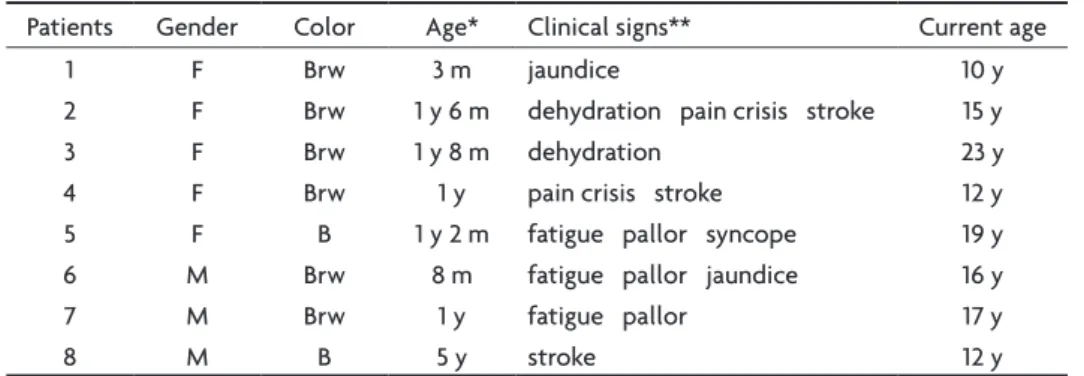
Table 1 presents the identiication data (gender, col-or, age when SCD was diagnosed, SCD initial clinical signs and age at present study).
Five patients were female; six patients had brown skin color and two were black; the SCD diagnosis was screened before the irst year of age in two patients, between one and two years in ive patients and at ive years in one. The initial clinical signs were fatigue, pallor and the irst stroke in three patients; jaundice, dehydration and acute pain cri-sis in two; syncope in one patient. The age of the patients during the present study ranged from 10 to 23 years old.
Table 2 presents data related to cerebrovascular event (age at stroke; type; number of events; impaired brain hemi-sphere; arterial territory; and neurological imaging exam). It was observed that the irst stroke occurred before two years of age in three children, patient 4 presented a second stroke during the evolution; between two and six years of age, stroke occurred in two; between seven and 10 years of age it occurred in two patients, with recurrence for case 3; and above 10 years of age, in one. The cerebro-vascular events were ischemic in all patients; two patients presented clinical evidences of transient ischemic attacks (TIA) with radiological and therapeutical procedures. Both brain hemispheres were affected in six patients; the left hemisphere in one, and the right hemisphere in another. The arterial territory affected was that of the middle rebral artery (MCA) and perforating branches, anterior ce-rebral artery (ACA), posterior cece-rebral artery (PCA), and superior cerebral artery (SCA).
Table 3 depicts data relating to the treatment of the patients; to their general clinical signs at present study; the neurological exam of the acute stroke period (I) and the neurological exam at the present study (II) conducted be-tween 2 and 13 years after the last cerebrovascular event. Seven patients maintain a chronic transfusion thera-py for secondary prophylaxy and use of desferrioxamine. The clinical features observed at present study were: he-mosiderosis in eight patients; snores and pain crises in three; sialorrhea in two; jaundice in one and cardiac mur-mur in another patient. Mouth breathing was found in sev-en patisev-ents (except on case 6). During the acute period after stroke the neurological exam revealed hemiparesis
Table 1. Identiication data of and related to SCD diagnosis.
Patients Gender Color Age* Clinical signs** Current age
1 F Brw 3 m jaundice 10 y
2 F Brw 1 y 6 m dehydration pain crisis stroke 15 y
3 F Brw 1 y 8 m dehydration 23 y
4 F Brw 1 y pain crisis stroke 12 y
5 F B 1 y 2 m fatigue pallor syncope 19 y
6 M Brw 8 m fatigue pallor jaundice 16 y
7 M Brw 1 y fatigue pallor 17 y
8 M B 5 y stroke 12 y
Arq Neuropsiquiatr 2008;66(1)
32
Stroke: sickle cell disease Oliveira et al.
in seven patients; neuropsychomotor delay, visual deicit and seizure in two; each of the following symptoms was found in one patient: paresthesia; rhyme deviation; apha-sia and dysphagia. In the present neurological exam it was assessed spastic hemiparesis in six patients (two with bi-lateral assimetric hypertonia), mental deiciency in four and visual deicit in two. Mental deiciency was detected by previously applied neuropsychologic test (WISC) and present clinical neurologic exam.
All patients received therapeutic orientation except for patient 2; hemosiderosis was found in eight patients
in addition to other events such as acute pain crises, snore and sialorrhea, among others. Neurological exam I dem-onstrated hemiparesis in seven patients and neuropsycho-motor delay in two patients. The neurological exam of the present research indicates that the uni or bilateral struc-ture lesions in frontal, parietal, occipital, and cerebellum areas persist, according to the analysis of Tables 2 and 3.
DISCUSSION
In a study with 3647 patients with SCD it was found a predominance of ischemic cerebral events in
individu-Table 2. SCD and stroke, general data and neurological imaging.
Patient Age * Type N Hemisphere Arterial region Neuro-imaging (ed)
1 9m I stroke 1 L R SCA PCA bilat CT (11/95)
CT (7/97)
2 1y 6m I stroke 1 L MCA L CT (2/91)
3 8y 12y
13y
I stroke 4 L R MCA ACA bilat
PCA R
CT (89) CT (9/94) CT (95)
4 1y 8y
10y
I stroke (TIA) **
2 (1)
L R ACA MCA bilat
PB R
CT (4/00) SPECT (1/01)
5 11y I stroke 1 L R MCA PCA L
ACA R
CT (7/97)
6 4y I stroke 1 R MCA L CT (5/93)
7 7y
8y
I stroke (TIA) **
1 (1)
L R MCA ACA L
PB bilat
CT (8/94) CT (2/00)
8 5y I stroke 1 L R MCA ACA PCA
BN L ACA R
CT (12/98)
SCD, sickle cell disease; *at stroke; **clinical evidence; I stroke, ischemic cerebrovascular event; TIA, transient ischemic attack; L, left; R, right; SCA, superior cerebellar artery; PCA, posterior cerebral artery; bilat., bilateral; MCA, middle cerebral artery; ACA, anterior cerebral artery; PB, perforating branches; BN, basal nucleus; ed, exam date; CT, cranial tomography; SPECT, single pho-ton emission computed tomography.
Table 3. SCD and stroke, clinical sign and neurological exams I and II.
Patients Treatment Clinical Sign Neurol Exam I Neurol Exam II
1 Blood transf
desferrioxamine
HMS NPMR Hp R
VD
global hypot VD MD
2 ___ HMS pain crisis
jaundice
NPMR Hp R VD
Hp R hypert R > L VD
3 Blood transf
desferrioxamine
HMS sialorrhea Hp L S aphasia Hp L aphasia
MD
4 Blood transf
desferrioxamine
HMS snore Hp L Hp L MD
5 Blood transf
desferrioxamine
HMS pain crisis snore heart murmur
Hp R Hp R
6 Blood transf
desferrioxamine
HMS pain paresth L
hand rhyme deviation
Hp R hypert R > L
7 Blood transf
desferrioxamine
HMS pain crisis snore
Hp R dysphagia hypot L
8 Blood transf
desferrioxamine
HMS sialorrhea Hp R S Hp R aphasia
MD
Arq Neuropsiquiatr 2008;66(1)
33
Stroke: sickle cell disease Oliveira et al.
als under 20 and above 29 years old and of hemorrhagic events in the group between 20 and 29 years of age, which determined a larger number of deaths (26%) in the latter2.
In the present study, it was observed a predominance of brown skin female and SCD diagnosis under two years of age. Despite the low number of individuals evaluated, indings are in accordance with data of references, evi-dencing patients with SCD and stroke in early age, all with ischemic event. There was bilateral hemisphere involve-ment by stroke in six patients, with recurrence in two and a single event in four patients.
Neuropsychomotor development in SCD children was considered normal until three years of age with progres-sive performance decay in neuropsychological and motor function tests due to ischemic cerebral insults and/or si-lent infarct9. Similar indings was observed in this present
study. The psychomotor function was intact and an early decay of cognitive functions was detected in SCD children between 12 and 24 months of age10. Children with SCD
and ischemic stroke usually present motor deicits, apha-sia, learning dificulties and cognitive impairment, and it seems that silent infarcts are the main cause of cerebral insults causing learning disorders, low intelligence quo-tient and other neurocognitive deicits6,11.
Most of our patients presented vascular event after four years of age and had apparently adequate neuro-psychomotor development until the stroke. The present neurological exam evidenced important neurological se-quelae: motor deicit in eight patients; mental deiciency in four; aphasia and visual deicit in two patients. Through-out the assessment, we observed lack of initiative, dif-iculty to understand the clinical neurologic assessment and slowness in motor and speech responses.
Chronic transfusion therapy has been indicated as pro-phylaxis for the cerebrovascular event recurrence since 1976 by Lusher et al.12.Unfortunately, stroke risk returns
once the transfusion scheme is interrupted. Recent stud-ies revealed that such practice may decrease but does not eliminate totally the risk13. In a retrospective study,
44 patients were evaluated in blood transfusion therapy after ischemic stroke. A high index of recurrence (41%) was observed and detected the presence of collaterals Moyamoya like (43%)14.
In this study, patients 3 and 4 presented stroke recur-rence, even under prophylactic blood transfusion therapy. Both presented important motor and cognitive impair-ments; patient 4 also presented TIA. Even though not being an objective of the study, mental deiciency was detected in quantitative tests in patients 1, 4 and 8, and qualitative mental deiciency was observed in patient 3. Among these cases, 3 and 8 presented higher impairment in the current neurological exam, suggesting a
possibil-ity of silent infarcts determining motor sequelae, mental deiciency and aphasia.
In summary, from the eight patients, seven received prophylactic blood transfusion therapy for stroke recur-rence during at least ive years. Three of them had no ben-eit, progressing with stroke recurrence and neurological signs aggravation. The cases also revealed cerebrovascular event in younger ages and higher neurological impairment compared to literature data. Although not quantitatively analyzed, we observed important social-economic difi-culties, as well as family members low level of understand-ing about SCD, its management and possible co-morbities. Such condition may have favored a lower adherence to treatment, thus increasing the probability of cerebrovas-cular events and highly impairing sequelae.
In conclusion, the present study detected the SCD di-agnostic in early age with ischemic stroke identiied as the initial sign in three patients; high occurrence of isch-emic cerebral event in children above four years of age; stroke and TIA recurrence in spite of secondary prophy-lactic blood transfusion therapy; neuropsychological im-pairment in our patients, identiied by speciic tests; and it was possible to ind motor impairments resulting from cortical-subcortical structure lesions involving one brain hemisphere or both.
REFERENCES
1. Earley CJ, Kittner SJ, Feeser BR, et al. Stroke in children and sickle-cell disease: Baltimore-Washington Cooperative Young Stroke Study. Neu-rology 1998;51:169-176.
2. Ohene-Frempong K, Weiner SJ, Sleeper LA, et al. Cerebrovascular acci-dents in sickle cell disease: rates and risk factors. Blood 1998;91:288-294. 3. Balkaram B, Char G, Morris JS, Thomas PW, Serjeant BE, Serjeant GR.
Stroke in a cohort of patients with homozygous sickle cell disease. J Pe-diatr 1992;120:360.
4. Ohene-Frempong K. Stroke in sickle cell disease: demographic, clinical and therapeutic considerations. Semen Hematol 1991;28:213. 5. Powars D, Wilson B, Imbus C, Pegelow CH, Allen J. The natural
histo-ry of stroke in sickle cell disease. Am J Med 1978;65:461-471. 6. Arita FN. Acidente vascular cerebral em crianças com doença
falci-forme. Tese de Doutorado Faculdade de Ciências Médicas da Santa Casa de São Paulo. São Paulo, 1998.
7. Steen RG, Xiong X, Langston MD, Helton KJ. Brain injury in chil-dren with sickle cell disease: prevalence and etiology. Ann Neurol 2003;54:564-572.
8. Harriman LMF, Grifith ER, Hurtig AL, Keehn MT. Functional outcomes
of children with sickle-cell disease affected by stroke. Arch Phys Med Rehabil 1991;72:498-502.
9. Wang WC, Grover R, Gallagher D, Espeland M, Fandal A. Developmen-tal screening in young children with sickle cell disease: results of a co-operative study. Am J Pediatr Hematol Oncol 1993;15:87-91. 10. Thompson RJ Jr, Gustafson KE, Bonner MJ, Ware RE. Neurocognitive
development of young children with sickle cell disease through three years of age. J Pediatr Psychol 2002;27:235-244.
11. Armstrong FD, Thompson RJ, Jr, Wang W, et al. Cognitive functioning and brain magnetic resonance imaging in children with sickle cell dis-ease. Pediatrics 1996;97:864-870.
12. Adams RJ, McKie VC, Hsu L, et al. Prevention of a irst stroke by trans
-fusions in children with sickle cell anemia and abnormal results on transcranial Doppler ultrasonography. N Engl J Med 1998;339:5-11. 13. Wang WC, Kavaar EH, Tonkin IC. High risk of recurrent stroke after
discontinuance of ive to twelve years of transfusion therapy in patients
with sickle cell disease. J Pediatr 1991;96:205-208.