188
Arq Gastroenterol v. 40 – no. 3 – jul./set. 2003ARQGA / 1081
REL
AT
O
DE
CA
SO
/
CA
SE
REPO
RT
UPPER GASTROINTESTINAL
HEMORRHAGE DUE TO
DUODENAL STROMAL TUMOR
José Gustavo
PARREIRA
, Wilson de
FREITAS
and Samir
RASSLAN
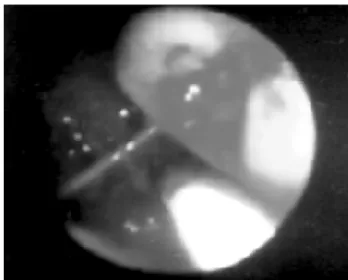
ABSTRACT – Background – Gastrointestinal stromal tumor represents a rare neoplasm that originates in the muscular wall of the hollow viscera. Aim – To report gastrointestinal stromal tumor as a source of upper gastrointestinal bleeding, which required urgent surgical control. Patient/Method – A man with 61 years old was admitted to the emergency service sustaining hematemesis and melena. Endoscopy showed active bleeding from a tumor in the second portion of the duodenum, which was controlled by heater probe cauterization. Surgery was performed through a median laparotomy. A local resection of a 4 cm tumor in the second portion of the duodenum was carried out, together with a primary end-to-end anastomosis and a duodenal diverticulization. No complications happened during the post-operative period. Morphologic examination showed gastrointestinal stromal tumor with no atypical mitosis and a preserved capsule.
Conclusion: Albeit not being common, gastrointestinal stromal tumors can represent a source of substantial gastrointestinal hemorrhage.
HEADINGS – Gastrointestinal, hemorrhage. Duodenal neoplasms. Smooth muscle tumor. Stromal cells.
From Emergency Service, Department of Surgery, “Santa Casa” School of Medicine, São Paulo, SP, Brazil.
Address for correspondence: Dr. José Gustavo Parreira - Rua Dona Veridiana, 167 – ap. 83 – 01238-010 –São Paulo, SP, Brazil. E-mail: [email protected]
INTRODUCTION
Gastrointestinal stromal tumors (GIST) are defined as mesenchymal neoplasms originating in the muscular wall of hollow viscera. Their first description as leiomyomas or leiomyosarcomas happened by reason of the histological
appearance, resembling uterine tumors(7). Nowadays there is
compelling ultrastructural and immunohistochemical evidence demonstrating that these lesions can exhibit neural ganglionic
and neural-myoid histological features(7).
Characteristically rare, these neoplasms account for nearly
0.01% of hospital admissions(3). The peak incidence occurs in
patients older than 50 years old, and stomach is the most
frequent organ involved(5). Benign lesions seldom present
significant clinical signs, and gastrointestinal bleeding might
be the only symptom(2). Ten year survival ranges between 50%
and 70%, depending on specific prognostic factors(5).
The authors report a duodenal stromal tumor as source of upper gastrointestinal bleeding, which required urgent surgical control.
CASE REPORT
A 61 years old man was admitted at Emergency Service of the “Santa Casa”, São Paulo, SP, Brazil, transferred from another hospital, sustaining hematemesis and melena. He had been taking acetylsalicylic acid because of a previous deep venous thrombosis and chronic venous edema. There were no other associated diseases. He had already been admitted previously due to gastrointestinal hemorrhage, but there was no diagnostic investigation. Physical examination showed tachycardia, cutaneomucosal pallor and blood pressure reached 110/60 mm Hg.
v. 40 – no. 3 – jul./set. 2003 Arq Gastroenterol
189
Parreira JG, Freitas W, Rasslan S. Upper gastrointestinal hemorrhage due to duodenal stromal tumor
2). During diagnostic investigation, patient became hemo-dynamically unstable despite volume replacement and the operation was indicated.
Operative treatment was carried out through a midline longitudinal laparotomy. During the intraoperative assessment, there were no signs of advanced malignancy. An extended Kocher maneuver exposed the well limited, apparently encapsulated 4 cm tumor, exactly in the
transition of the 2nd and 3rd duodenal portions (Figure 3). Considering
that pancreas and major papilla were not involved, a local resection
was performed, with a 1 cm disease free margin. Bearing in mind the identification and preservation of the major papilla, duodenum was primary anastomosed (Figure 4). In order to divert gastric contents away from the duodenum, a partial gastrectomy with Billroth II gastrojejunostomy was carried out. A small 0.5 cm nodule in the jejunal serosa, approximately 100 cm from Treitz’s ligament, was also resected. Duodenal suture was widely drained. By the end of operation, nine units of packed red blood cells had been transfused, and patient sustained hemodynamic stability.
FIGURE 1 – Endoscopy view of the duodenal tumor and active bleeding FIGURE 3 – Intraoperative view: duodenal tumor
FIGURE 2 – Computed tomography showing 4 cm duodenal tumor anterior to the right kidney
190
Arq Gastroenterol v. 40 – no. 3 – jul./set. 2003An uneventful recovery followed through postoperative period.
Drains were retrieved on the 6th postoperative day (POD), oral feeding
started on the 7th POD, and the patient was discharged home on the
9th POD. Histological exam confirmed a 4.0 vs. 3.5 vs. 2 cm GIST,
free from atypical mitosis figures and rounded by an intact fibrous capsule. Immunohistochemical assessment was positive for vimentine, actin 1 and 4 and S100 protein, while negative for ceratin and desmin. This suggests a smooth muscle and neural differentiation. Curiously, the small jejunal nodule was characterized as a synchronous GIST.
DISCUSSION
Normally, gastrointestinal bleeding secondary to small bowel tumors arises like a progressive process, determining chronic anemia and bringing
up diagnostic difficulties(12). Only 44% to 50% of leiomyomas present
symptoms, and another considerable number are identified at autopsy or
unrelated surgery(2, 10, 11). However, specifically in this case, endoscopy
could locate the source of bleeding and diagnosis was easily established. The severity of the hemorrhage, which required urgent surgical control, might also be considered unusual for this sort of tumor.
Surgery remains the standard of care for GISTs. Regarding periampullary duodenal tumors, the treatment of choice for malignant lesions consists of pancreaticoduodenectomy, which should be
performed only if physiologic conditions permit(2). Segmental resection
is generally preferred for benign neoplasms sparing major papilla. In critical circumstances, morbidity and mortality increase, and major
surgical procedures should be avoided(2). Fortunately, in our case the
neoplasm was deemed to be benign and spared major papilla, which allowed a local resection.
In this setting, suture dehiscence and duodenal fistula may be a serious complication. Sometimes, this sort of fistula is difficult to manage and reoperation might be necessary, which would definitely worsen prognosis. In order to divert gastric contents away from duodenal anastomosis, “diverticulization” of the duodenum through gastrectomy and gastrojejunostomy (Billroth II reconstruction) was performed.
Duodenal diverticulization was first reported by DONOVAN and
HAGEN(4), in 1966, and subsequently updated by BERNE et al.(1), in
1968. This technique has been utilized for the treatment of complex pancreatoduodenal injuries. Nowadays, this procedure includes the suture of duodenal wound, together with a gastric resection and reconstruction through a gastrojejunostomy (Billroth II). As a consequence, gastric contents would be diverted away from the duodenum, decreasing pancreatic secretions. Therefore, it would protect an eventual anastomotic fistula, permitting oral intake and contributing
to an earlier healing(3). Nevertheless, no consensus exists about its use
for non-traumatic purposes. Certainly, a duodenal wound with high chance of dehiscence represents an indication for duodenal diverticulization. Under our judgment, this is the exact situation in the
case discussed. This old patient experienced a period of arterial hypotension, underwent an operation in a critical circumstance, received nine units of packed red blood cells and sustained a wound of great magnitude in the proximity of the major papilla. Thus, considering the high possibility of a subsequent fistula, duodenal diverticulization was carried out. However, the benefits of this surgical procedure must be weighed against the well known undesirable consequences of a gastric resection. Complications as anastomotic dehiscence, bleeding, and
dumping syndrome have been reported(3).
A lacking of correlation between histological exam and prognosis
has already been described for GISTs(5). Sometimes, the identification
of malign features is troublesome and might result in misleading
conclusions. Concerning duodenal GIST, LEWIN et al.(8) suggest that
lesions bigger than 4 cm or presenting atypical mitosis figures should
be considered malignant. EVANS’(6) criteria for malignancy might be
employed, which are: increased cell size, increased irregularity of cell size and shape, lack of complete cell differentiation, presence of plump cells with oval nuclei, and presence of cells with hyperchromic and
multiple nuclei with variable staining reactions. EMORY et al.(5)
analyzed 1,004 cases of stromal tumors, stating that site in gastrointestinal system, patient’s age, tumor diameter, and presence of atypical mitosis remain the most important prognostic factors. Some investigators believe that the presence of more than two mitotic figures
in 10 high power fields correlates to malignancy and worse prognosis(2).
Immunohistochemical methods have emerged to help in the differential diagnosis. Although GISTs encompasses most tumors previously classified as smooth muscle neoplasms, some express markers of neural origin. These kinds of lesions typically express CD 117, often are positive for CD 34, and occasionally carry alpha smooth
muscle actin(9). Nonetheless, these markers commonly have irregular
behavior, varying in occurrence depending on the position in the
gastrointestinal tract(9).
In the case reported, histological analysis confirmed GIST with smooth muscle and neural differentiation. Neither histological nor clinical evidences of malignancy were found. Surgical margins showed no signs of neoplasm. Therefore, we considered it as a benign lesion and suggested no other therapy.
Finally, in spite of representing an unusual neoplasm, GIST should be remembered as a cause of gastrointestinal hemorrhage. During operation, surgeon must be prepared to recognize malignant lesions with the purpose of managing them correctly. The appropriate operation depends on factors as general conditions of the patient, urgent situation, size and location of the tumor as well as suspicion of malignancy.
ACKNOWLEDGEMENT
The authors would like to thank Carlos Puglia for helping in the literature review about the subject.
v. 40 – no. 3 – jul./set. 2003 Arq Gastroenterol
191
Parreira JG, Freitas W, Rasslan S. Hemorragia digestiva alta por tumor estromal do duodeno. Arq Gastroenterol 2003;40(3):188-191.
RESUMO – Racional – Tumores estromais gastrointestinais são neoplasias raras que se originam na túnica muscular das vísceras ocas. Objetivo – Descrição de um caso de hemorragia digestiva alta causada por um tumor estromal duodenal que necessitou tratamento cirúrgico de urgência. Paciente/Método – Paciente com 61 anos de idade foi admitido no Serviço de Emergência da Santa Casa de São Paulo com hematêmese e melena. A endoscopia digestiva alta demonstrou um tumor na segunda porção duodenal com sangramento ativo, que foi controlado com cauterização por “heater probe”. A operação foi indicada por instabilidade hemodinâmica persistente, sendo realizada por laparotomia mediana supra-umbilical. O tumor da segunda porção duodenal de aproximadamente 4 cm foi ressecado com margens de 1 cm. A anastomose primária duodenal término-terminal foi possível, sendo também indicada diverticulização duodenal através de gastrectomia parcial com reconstrução a Billroth II. O período pós-operatório transcorreu sem problemas. Exame anatomopatológico demonstrou um tumor estromal sem atipias e envolto por cápsula fibrosa íntegra. Conclusão – Mesmo não sendo sua apresentação mais comum, tumores estromais gastrointestinais podem ser causa de grave hemorragia digestiva alta.
DESCRITORES – Hemorragia gastrointestinal. Neoplasias duodenais. Tumor de músculo liso. Células estromais.
REFERENCES
1. Berne CJ, Donovan AJ, Hagen WE. Combined duodenal pancreatic trauma. The role of end-to-end gastrojejunostomy. Arch Surg 1968;96:712-22.
2. Blanchard DK, Budde JM, Hatch GF, Wertheimer-Hatch L, Hatch KF, Davis GB, Foster RS, Skandalakis JE. Tumors of small intestine. World J Surg 2000;24:421-9.
3. Carrillo EH, Richardson JD, Miller FB. Evolution in the management of duodenal injuries. J Trauma 1996;40:1037-45.
4. Donovan AJ, Hagen WE. Traumatic perforation of duodenum. Am J. Surg 1966;111:341-50.
5. Emory TS, Sobin LH, Lukes L, Lee DH, O´Leary TJ. Prognosis of gastrointestinal smooth-muscle (stromal) tumors: dependence on anatomic site. Am J Surg Pathol 1999;23:82-7.
6. Evans RW. Histological appearances of tumors with a consideration of their histogenesis and certain aspects of their clinical features and behavior. Edinburgh, UK: Livingstone; 1956. p. 773.
7. Lev D, Kariv JI, Issakov J, Merhav H, Berger E, Merimsky J, Klausner JM, Gutman M. Gastrointestinal stromal sarcomas. Br J Surg 1999;86:545-9.
8. Lewin KJ, Riddell RH, Weinstein WM. Mesenchyman tumors. In: Levin KJ, Ridell RH, Weinstein WM. Gastrointestinal pathology and its clinical implications. New York: Igaku-Shoin; 1992. p. 284-339.
9. Miettinen M, Sobin LH, Salormo-Rikala M. Immunohistochemical spectrum of GISTs at different sites and their differential diagnosis with a reference to CD 117. Mod Pathol 2000;13:1134-42.
10. Moertel CG, Sauer WG, Dockerty MB, Baggenstoss AH. Life story of the carcinoid tumor of the small intestine. Cancer 1961;14:901.
11. Morgan BK, Compton C, Talbert M, Gallagher WJ, Wood WC. Benign smooth muscle tumors of the gastrointestinal tract. Ann Surg 1990;211:63.
12. Naef M, Buhlmann M, Baer HU. Small bowel tumors: diagnosis therapy and prognostic factors. Langenbeck Arch Surg 1999;384:176-80.
Recebido em 6/8/2002. Aprovado em 23/1/2003.