Original Article
40
Warfarin and Phenprocoumon: Experience of an Outpatient
Anticoagulation Clinic
Tiago Luiz Luz Leiria, Lucia Pellanda, Marcelo Haertel Miglioranza, Roberto Tofani Sant’Anna, Lucas S. Becker, Eros
Magalhães, Gustavo Glotz de Lima
Instituto de Cardiologia do Rio Grande do Sul / FUC, Porto Alegre, RS, Brazil
Abstract
Background: Oral anticoagulants are broadly used in cardiology. However, it is still necessary to evaluate their use in clinical practice.
Objectives: To describe the differences in the maintenance of anticoagulation control, as well as the incidence of hemorrhagic and thromboembolic events among users of warfarin and phenprocoumon.
Methods: Non-concurrent cohort study of 7 patients using oral anticoagulation.
Results: Phenprocoumon was the most frequently used anticoagulant in 60% of the patients. The prevalence of RNI< at the last medical appointment was higher among warfarin users (46% vs. 9.5%; p<0.00). During the follow-up, phenprocoumon users were within the therapeutic range during 60.7% of the period, in comparison with 45.6% of Warfarin users (OR:.84; 95%CI:.59-.; p<0.00). The incidence of bleeding was 5./00 patients/year in the phenprocoumon group versus 8.8/00 patients/year in the warfarin group (RR: .5; 95%CI: .87-6.48; p<0.00).
Conclusion: Patients that used warfarin remained at subtherapeutic levels for a longer period; however, they also presented more hemorrhagic events. Phenprocoumon users were younger and had been using oral anticoagulation for longer periods, presenting fewer drug-related adverse events. (Arq Bras Cardiol 00; 94() : 40-4)
Key Words: warfarin; phenprocumon; anticoagulants; hemorrhage; anticoagulants/administration & dosage.
Mailing Address: Marcelo Haertel Miglioranza •
Unidade de Pesquisa, Instituto de Cardiologia do Rio Grande do Sul/Funda-ção Universitária de Cardiologia (IC/FUC) - Av. Princesa Isabel, 370 – 90620-001 - Santana - Porto Alegre, RS, Brazil
E-mail: [email protected]
Manuscript received July 09, 2008; revised manuscript received January 22, 2009; accepted May 13, 2009
Introduction
In recent years, oral anticoagulant (OAC) use has had its indication validated in several different clinical studies and guidelines1-3. Conditions such as atrial fibrillation, deep
vein thrombosis, pulmonary embolism, thrombophilias, and prosthetic heart valves are the main indications for the use of OAC4.
The commonest OAC in clinical use are the vitamin K antagonists warfarin and phenprocoumon. Both have been used in medical practice for more than fifty years5. Warfarin
is the only OAC drug that is FDA-approved for prescription in the United States of America. Phenprocoumon has been broadly used in several countries such as Germany, Holland, Italy and Brazil6.
The main pharmacological difference between coumarins is their half-lives, which is shorter for warfarin, approximately
30 hours, versus 216 hours for phenprocoumon7. Literature
on studies comparing these medications is scarce. Moreover, the main differences between users of warfarin and phenprocoumon regarding the rate of target prothrombin time (INR) during follow-up and incidence of adverse events (both embolic and hemorrhagic) have not been described yet.
In our institution, the Instituto de Cardiologia do Rio Grande do Sul, in Brazil, approximately 50 patients/day are followed up for OAC use at a specialized outpatient clinic. The aim of this study is to describe a cohort of patients using OAC, comparing the main differences in steadiness of prothrombin levels and event rates among warfarin and phenprocoumon users.
Patients and Methods
Patients and study design
Original Article
4
Table 1 - Patients’ clinical characteristics and OAC indication
Characteristics Phenprocoumon n=77
Warfarin
n=50 P
Gender / Male 56% 54% 0.96
Age (years) 56 ± 13 61±15 0.04
Caucasian 92% 86% 0.43
Rheumatic heart disease 34% 7.5% 0.0004
Indication of OAC
Atrial ibrillation
Prosthetic heart valve
46.2% 44.2%
54%
26% 0.059
CHADS 2
(only in patients with atrial
ibrillation)
1.56 ± 0,8 1.33 ± 1 0.33
INR at last visit
Atrial ibrillation
Prosthetic heart valve
2.44 ± 0.76 3.11 ± 1.47
2.45±0.07 2.54 ± 1.33
0.92 0.02
Median duration of OAC, months 70±60 23±28 0.0001
the last outpatient visit for INR adjustments. We recovered a total of 3485 clinic visits and INR values.
The study protocol was approved by the Institution Ethics Committee. All patients agreed to participate and a written informed consent was obtained prior to their inclusion.
Statistical analysis
Sample size was calculated assuming that an adequate anticoagulation would result in at least 60% of the clinical visits with a therapeutic INR (2-3 for atrial fibrillation and other minor indications, and 2.5-3.5 for prosthetic heart valve) and the worst result would lead to only 35% of the visits within the therapeutic range. Based on this, it would be necessary to have 98 patients to achieve a power of 80% with an alpha error of 5%. We chose to include 130 patients to compensate for any lost data. Three patients were excluded from the study for having incomplete hospital records.
Continuous data, such as INR, months of follow-up, age, total weekly dose of OAC, time spent within the therapeutic range and differences between event rates, were expressed as mean ± standard deviation and analyzed with Student’s t-test or Wilcoxon-Mann-Whitney test for non-parametric values. For categorical variables, expressed as absolute numbers and percentages, we used Chi-square tests as appropriate. Cumulative frequency of major and minor bleeding and embolic events were analyzed separately and altogether with Cox proportional hazard regression.
Outcome deinitions
Major bleeding was defined as one needing blood transfusion, hospital admission, any medical intervention to stop the hemorrhage, or death. All other bleedings were
classified as minor. Embolic events were defined as stroke, transient ischemic attack (TIA) and peripheral emboli.
Results
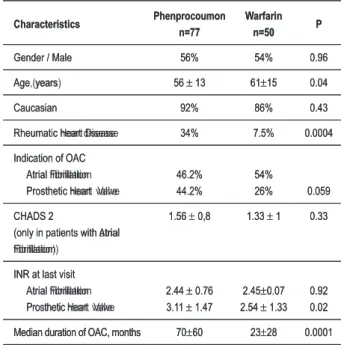
Among the 127 consecutive patients studied, 55% were male and mean age was 58 ± 14 years. The most common indication for OAC was atrial fibrillation. Thirty seven percent had a prosthetic heart valve. Median duration of OAC therapy was 36 months (1 to 240 months). Patients’ characteristics and main differences between patients taking phenprocoumon and those taking warfarin are shown in Table 1.
Patients who were taking phenprocoumon for prosthetic heart valve had a higher mean INR than those on warfarin (3.11 ± 1.47 versus 2.54 ± 1.33; p= 0.02). For other OAC indications, there was no significant difference of mean INR values between groups.
In the last follow-up visit, more patients on warfarin had an INR value < 2 (as a critical value for INR), 46% versus 19.5% of those using phenprocoumon (95%CI= 10-48%; p<0.001). During follow-up, patients taking phenprocoumon were within the therapeutic INR range in 60.7% of clinic visits compared to only 45.6% of clinic visits among those on warfarin (OR:1.84; 95%CI: 1.59-2.13; p=0.001).
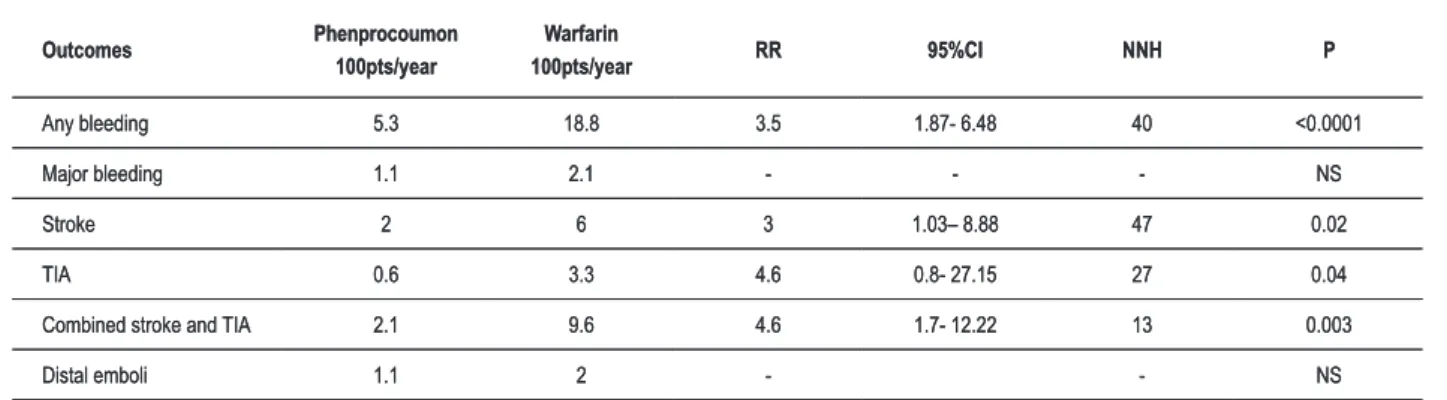
Bleeding occurred in 29.1% of all patients. The total incidence of hemorrhagic events was 15.4 events/100 patients/year. The main cause of major bleeding was active peptic ulcer. Seventeen patients (5.5%) of the cohort presented an embolic event, so the incidence was 2.57 events/100 patients/year. Table 2 demonstrates the incidence of adverse events and the relative risk for their occurrence in both groups of medication users. Although fewer patients on phenprocoumon had hemorrhagic events when compared to warfarin (p<0.001), this difference was attributed to a lower incidence of minor bleeding events among phenprocoumon users. The incidence of stroke was higher among those taking warfarin (p=0.02), as was the occurrence of transient ischemic attack (p=0.04). Other embolic events had similar incidence rates in both studied groups.
Analyzing only patients in whom Atrial Fibrillation was the anticoagulation indication, no difference was found in the total incidence of embolic events when comparing CHADS 2 score in both groups (95%CI= -0,064-1,75; p=0,068).
Two patients in the warfarin group were taking aspirin during the bleeding episode and one patient from the phenprocoumon group was using aspirin and clopidogrel during the hemorrhagic event (P=ns). There was no reported use of non-steroidal anti-inflammatory drugs (NSAIDS).
After adjusting for age, rheumatic heart disease, indication and time on OAC therapy, there was still a significant difference in the incidence of bleeding events between phenprocoumon and warfarin groups (Table 3). Figure 1 represents the cumulative event rate for bleeding between the studied medications. None of the cases with bleeding peptic ulcers were taking aspirin, clopidogrel or NSAIDS.
Arq Bras Cardiol 2010; 94(1) : 40-43
Table 1 - Patients’ clinical characteristics and OAC indication.
Characteristics Phenprocoumon n=77
Warfarin
n=50 P
Gender / Male 56% 54% 0.96
Age, years 56 ± 13 61±15 0.04
Caucasian 92% 86% 0.43
Rheumatic Heart Disease 34% 7.5% 0.0004
Indication of OAC Atrial Fibrillation Prosthetic Heart Valve
46.2% 44.2%
54%
26% 0.059
CHADS 2
(only in patients with Atrial Fibrillation)
1.56 ± 0,8 1.33 ± 1 0.33
INR at last visit Atrial Fibrillation Prosthetic Heart Valve
2.44 ± 0.76 3.11 ± 1.47
2.45±0.07 2.54 ± 1.33
0.92 0.02
Original Article
4
Table 2 - Estimated incidence* and relative risk of outcomes among OAC users.
Outcomes Phenprocoumon
100pts/year
Warfarin
100pts/year RR 95%CI NNH P
Any bleeding 5.3 18.8 3.5 1.87- 6.48 40 <0.0001
Major bleeding 1.1 2.1 - - - NS
Stroke 2 6 3 1.03– 8.88 47 0.02
TIA 0.6 3.3 4.6 0.8- 27.15 27 0.04
Combined stroke and TIA 2.1 9.6 4.6 1.7- 12.22 13 0.003
Distal emboli 1.1 2 - - NS
*adjusted by follow-up time. Pts - patients, RR - relative risk; 95%CI - conidence interval; NNH - number needed to harm; NS - non-signiicant; TIA - transient ischemic
attack
Table 3 - Comparison of hemorrhagic and embolic outcomes between phenprocoumon (reference group) versus warfarin users.
Outcomes No. events HR* 95%CI P
Any bleeding 37 2.4 1.1 – 5.1 0.027
Stroke 15 1.3 0.4 – 4.0 0.7
TIA 6 3.7 0.5 – 25.1 0.188
Combined stroke and TIA 17 1.8 0.6 – 5.2 0.298
n=127 patients.
*Hazard ratio (HR) obtained in a proportional hazard model adjusted by age, indication and presence of rheumatic fever/heart disease. 95%CI - conidence
interval; TIA - Transient ischemic attack.
Figure 1 – Cumulative survival free of hemorrhagic events between
phenprocoumon and warfarin users using a proportion hazard model adjusted
by age, indication and presence of rheumatic fever.
Discussion
Vitamin K antagonists are the main class of oral anticoagulation drugs used throughout the world. Their mechanism of action occurs by the inhibition, in the liver, of enzymatic systems that lead to the formation of coagulation factors (II, VII, IX and X)5.
The anticoagulation level control is achieved by measuring the prothrombin time (PT)7. The international normalized ratio (INR)
is used to monitor OAC therapy, compensating for different reagents used to measure the PT7.
Currently, in Brazil, the two main types of vitamin K antagonists approved for clinical use are warfarin and phenprocoumon8. Acenocoumarol, the OAC that has the
shortest half-life, is not available for use in our country. Warfarin differs from phenprocoumon mainly in its half-life of 36 to 42 hours, which is shorter than that of phenprocoumon9.
The anticoagulant effect of both drugs is influenced by genetic and environmental factors9.
Phenprocoumon is used in approximately 75% of the patients using OAC therapy in Holland10. This prevalence is
similar to that found in our study cohort, where 60% of the patients were taking this drug.
There are no recent studies comparing warfarin and phenprocoumon11-12. A historical cohort13 of 22.178 patients
followed in an anticoagulation clinic, comparing acenocoumarol and phenprocoumon showed that 50% of the patients treated with phenprocoumon, versus 43% those using acenocoumarol, were within a therapeutic INR interval (OR 1.32; CI95%: 1.24-1.41). This result is similar to that observed in our study: users of phenprocoumon were within therapeutic INR values in 60.7% of the clinic visits, which was statistically higher than 45.6% of those using warfarin. In our Institution, phenprocoumon is frequently prescribed, and there is no specific protocol that recommends any preferential indication for the use of one type of anticoagulant over the other. The main indication for anticoagulant use in our study was atrial fibrillation, and that is in accordance with other publications13-15.
The pharmacokinetic properties of phenprocoumon, longer half-live when compared to warfarin, generating more steady levels of the drug in blood10, could be one of the possible
mechanisms responsible for the maintenance of therapeutic
Arq Bras Cardiol 2010; 94(1) : 40-43
Table 2 - Estimated incidence* and relative risk of outcomes among OAC users.
Outcomes Phenprocoumon
100pts/year
Warfarin
100pts/year RR 95%CI NNH P
Any bleeding 5.3 18.8 3.5 1.87- 6.48 40 <0.0001
Major bleeding 1.1 2.1 - - - NS
Stroke 2 6 3 1.03– 8.88 47 0.02
TIA 0.6 3.3 4.6 0.8- 27.15 27 0.04
Combined stroke and TIA 2.1 9.6 4.6 1.7- 12.22 13 0.003
Distal emboli 1.1 2 - - NS
*adjusted by follow-up time. Pts - patients, RR - relative risk; 95%CI - conidence interval; NNH - number needed to harm; NS - non-signiicant; TIA - transient ischemic
attack
Table 3 - Comparison of hemorrhagic and embolic outcomes between phenprocoumon (reference group) versus warfarin users.
Outcomes No. events HR* 95%CI P
Any bleeding 37 2.4 1.1 – 5.1 0.027
Stroke 15 1.3 0.4 – 4.0 0.7
TIA 6 3.7 0.5 – 25.1 0.188
Combined stroke and TIA 17 1.8 0.6 – 5.2 0.298
n=127 patients.
*Hazard ratio (HR) obtained in a proportional hazard model adjusted by age, indication and presence of rheumatic fever/heart disease. 95%CI - conidence
interval; TIA - Transient ischemic attack.
Figure 1 – Cumulative survival free of hemorrhagic events between
phenprocoumon and warfarin users using a proportion hazard model adjusted
Original Article
4
References
1. Stroke Prevention in Atrial Fibrillation Study: final results. Circulation. 1991; 84: 527-39.
2. Gohlke-Barwolf C, Acar J, Oakley C, Butcgart E, Burckhart D, Bodnar E, et al. Guidelines for prevention of thromboembolic events in valvular heart disease: Study Group of the Working Group on Valvular Heart Disease of the European Society of Cardiology. Eur Heart J. 1995; 16: 1320-30. 3. Hurlen M, Abdelnoor M, Smith P, Erikssen J, Arnesen H. Warfarin, aspirin, or
both after myocardial infarction. N Engl J Med. 2002; 347: 969-74. 4. Ansell J, Hirsh J, Poller L, Bussey H, Jacobson A, Hylek E. The pharmacology
and management of the vitamin K antagonists -the Seventh ACCP Conference on Antithrombotic and Thrombolytic Therapy. Chest. 2004; 126: 204S-233S.
5. Prandoni A, Wright I. The anticoagulants: heparin and the Dicoumarin 3,3’-Methylene-Bis-(4-Hydroxycoumarin). Bull NY Acad Med. 1942; 18: 433-58.
6. Ufer M. Comparative pharmacokinetics of vitamin K antagonists: warfarin, phenprocoumon and acenocoumarol. Clin Pharmacokinet. 2005; 44 (12): 1227-46.
7. Fairweather RB, Ansell J, van den Besselaar AM, Brandt JT, Bussey HI, Poller L, et al. Laboratory monitoring of oral anticoagulant therapy: College of American Pathologists Conference XXXI on laboratory monitoring of anticoagulant therapy. Arch Pathol Lab Med. 1998; 122: 768-81. 8. Takahashi H, Echizen H. Pharmacogenetics of warfarin elimination and its
clinical implications. Clin Pharmacokinet. 2001; 40: 587-603.
9. Ufer M. Comparative pharmacokinetics of vitamin K antagonists: warfarin, phenprocoumon and acenocoumarol. Clin Pharmacokinet. 2005; 44 (12): 1227-46.
10. Gadisseur PA, van der Meer FJ, Adriaansen HJ, Fihn SD, Rosendaal FR. Therapeutic quality control of oral anticoagulant therapy comparing the short-acting acenocoumarol and the long-short-acting phenprocoumon. Br J Haematol. 2002; 117: 940-6.
11. Breed WP, Hooff JP, Haanen C. A comparative study concerning the stability of the anticoagulant effect of acenocoumarol and phenprocoumon. Acta Med Scand. 1969; 186: 283-8.
12. Fekkes N, Jonge HD, Veltkamp JJ, Biege R, Loeliger EA. Comparative study of the clinical effect of acenocoumarol (Sintrom) and phenprocoumon (Marcoumar) in myocardial infarction and angina pectoris. Acta Med Scand. 1971; 190: 535-40.
13. Fihn SD, Gadisseur AA, Pasterkamp E, Van Der Meer FJM, Breukink-Engbers WG, Geven-Boere LM, et al. Comparison of control and stability of oral anticoagulant therapy using acenocoumarol versus phenprocoumon.. Thromb Haemost. 2003; 90 (2): 260-6.
14. Munschauer FE, Priore RL, Hens M, Castilone A. Thromboembolism prophylaxis in chronic atrial fibrillation: practice patterns in community and tertiary-care hospitals. Stroke. 1997; 28 (1): 72-6.
15. Salem DN, Stein PD, Al-Ahmad A, Bussey HI, Horstkotte D, Miller N, et al. Antithrombotic therapy in valvular heart disease — native and prosthetic: the Seventh ACCP Conference on Antithrombotic and Thrombolytic Therapy. Chest. 2004; 126: (3 Suppl.): 457S-482S.
16. Sherman DG, Kim SG, Boop BS, Corley SD, DiMarco JP. National Heart, Lung, and Blood Institute AFFIRM Investigators. Occurrence and characteristics of stroke events in the atrial fibrillation follow-up investigation of sinus rhythm management (AFFIRM) Study. Arch Intern Med. 2005; 165: 1185-91. 17. Evans A, Kalra L. Are results of randomized controlled trials on anticoagulation
in patients with atrial fibrillation generalizable in clinical practice? Arch Intern Med. 2001; 161 (11): 1443-7.
18. Connolly SJ, Laupacis A, Gent M, Roberts RS, Cairns JA, Joyner C. Canadian Atrial Fibrillation Anticoagulation (CAFA) Study. J Am Coll Cardiol. 1991; 18: 349-55.
19. The Boston Area Anticoagulation Trial for Atrial Fibrillation Investigators. The effect of low-dose warfarin on the risk of stroke in patients with nonrheumatic atrial fibrillation. N Engl J Med. 1990; 323: 1505-11.
stability and fewer adverse events (mainly fewer bleeding episodes) among phenprocoumon users.
Even though they were receiving sub-therapeutic levels of anticoagulation, patients using warfarin had more hemorrhagic events (Figure 1), although there was no difference in peripheral embolic phenomena. However, not surprisingly, the incidence of stroke and TIA was higher among warfarin users. This difference was probably due to a greater oscillation in INR levels in the latter group. The incidence of (both ischemic and hemorrhagic) neurological events was similar to the rates observed in patients enrolled in the AFFIRM trial16. The
incidence of adverse events such as minor bleeding, major bleeding and embolic phenomena was similar to other studies published in the literature, which compared the occurrence of adverse events in a non-selected population to those included in clinical trials of anticoagulation17-19.
Conclusion
We reported an increased risk of adverse events among warfarin users when compared to phenprocoumon users. Furthermore, this study demonstrated that patients taking warfarin had an inferior quality of anticoagulation control as compared to those on phenprocoumon. Patients who used
phenprocoumon presented a more steady anticoagulation state throughout follow-up and the incidence of adverse events seemed to be consistently lower in this group. This is a cohort study and it is subject to inherent observational study bias, but the results of coagulation control stability and adverse event rates depict a real life scenario in outpatient care. These data emphasize the need for double-blind randomized trials comparing phenprocoumon and warfarin to answer the question of which drug is more effective and safer for use in patients who require long-term anticoagulation therapy.
Potential Conflict of Interest
No potential conflict of interest relevant to this article was reported.
Sources of Funding
There were no external funding sources for this study.
Study Association
This article is part of the thesis of master submitted by Tiago Luiz Luz Leiria, from Instituto de Cardiologia do Rio Grande do Sul / FUC.
Arq Bras Cardiol 2010; 94(1) : 40-43
1. Stroke Prevention in Atrial Fibrillation Study: final results. Circulation. 1991; 84: 527-39.
2. Gohlke-Barwolf C, Acar J, Oakley C, Butcgart E, Burckhart D, Bodnar E, et al. Guidelines for prevention of thromboembolic events in valvular heart disease: Study Group of the Working Group on Valvular Heart Disease of the European Society of Cardiology. Eur Heart J. 1995; 16: 1320-30. 3. Hurlen M, Abdelnoor M, Smith P, Erikssen J, Arnesen H. Warfarin, aspirin, or
both after myocardial infarction. N Engl J Med. 2002; 347: 969-74. 4. Ansell J, Hirsh J, Poller L, Bussey H, Jacobson A, Hylek E. The pharmacology
and management of the vitamin K antagonists -the Seventh ACCP Conference on Antithrombotic and Thrombolytic Therapy. Chest. 2004; 126: 204S-233S.
5. Prandoni A, Wright I. The anticoagulants: heparin and the Dicoumarin 3,3’-Methylene-Bis-(4-Hydroxycoumarin). Bull NY Acad Med. 1942; 18: 433-58.
6. Ufer M. Comparative pharmacokinetics of vitamin K antagonists: warfarin, phenprocoumon and acenocoumarol. Clin Pharmacokinet. 2005; 44 (12): 1227-46.
7. Fairweather RB, Ansell J, van den Besselaar AM, Brandt JT, Bussey HI, Poller L, et al. Laboratory monitoring of oral anticoagulant therapy: College of American Pathologists Conference XXXI on laboratory monitoring of anticoagulant therapy. Arch Pathol Lab Med. 1998; 122: 768-81. 8. Takahashi H, Echizen H. Pharmacogenetics of warfarin elimination and its
clinical implications. Clin Pharmacokinet. 2001; 40: 587-603.
9. Ufer M. Comparative pharmacokinetics of vitamin K antagonists: warfarin, phenprocoumon and acenocoumarol. Clin Pharmacokinet. 2005; 44 (12): 1227-46.
10. Gadisseur PA, van der Meer FJ, Adriaansen HJ, Fihn SD, Rosendaal FR. Therapeutic quality control of oral anticoagulant therapy comparing the short-acting acenocoumarol and the long-short-acting phenprocoumon. Br J Haematol. 2002; 117: 940-6.
11. Breed WP, Hooff JP, Haanen C. A comparative study concerning the stability of the anticoagulant effect of acenocoumarol and phenprocoumon. Acta Med Scand. 1969; 186: 283-8.
12. Fekkes N, Jonge HD, Veltkamp JJ, Biege R, Loeliger EA. Comparative study of the clinical effect of acenocoumarol (Sintrom) and phenprocoumon (Marcoumar) in myocardial infarction and angina pectoris. Acta Med Scand. 1971; 190: 535-40.
13. Fihn SD, Gadisseur AA, Pasterkamp E, Van Der Meer FJM, Breukink-Engbers WG, Geven-Boere LM, et al. Comparison of control and stability of oral anticoagulant therapy using acenocoumarol versus phenprocoumon.. Thromb Haemost. 2003; 90 (2): 260-6.
14. Munschauer FE, Priore RL, Hens M, Castilone A. Thromboembolism prophylaxis in chronic atrial fibrillation: practice patterns in community and tertiary-care hospitals. Stroke. 1997; 28 (1): 72-6.
15. Salem DN, Stein PD, Al-Ahmad A, Bussey HI, Horstkotte D, Miller N, et al. Antithrombotic therapy in valvular heart disease — native and prosthetic: the Seventh ACCP Conference on Antithrombotic and Thrombolytic Therapy. Chest. 2004; 126: (3 Suppl.): 457S-482S.
16. Sherman DG, Kim SG, Boop BS, Corley SD, DiMarco JP. National Heart, Lung, and Blood Institute AFFIRM Investigators. Occurrence and characteristics of stroke events in the atrial fibrillation follow-up investigation of sinus rhythm management (AFFIRM) Study. Arch Intern Med. 2005; 165: 1185-91. 17. Evans A, Kalra L. Are results of randomized controlled trials on anticoagulation
in patients with atrial fibrillation generalizable in clinical practice? Arch Intern Med. 2001; 161 (11): 1443-7.
18. Connolly SJ, Laupacis A, Gent M, Roberts RS, Cairns JA, Joyner C. Canadian Atrial Fibrillation Anticoagulation (CAFA) Study. J Am Coll Cardiol. 1991; 18: 349-55.