1
M
ESTRADO EM
F
INANÇAS
T
RABALHO
F
INAL DE
M
ESTRADO
D
ISSERTAÇÃO
B
USINESS
A
NGELS
F
INANCING IN
P
ORTUGAL
D
ÚNIA
M
ONIZ
D
ELGADO
2
M
ESTRADO EM
F
INANÇAS
T
RABALHO
F
INAL DE
M
ESTRADO
D
ISSERTAÇÃO
B
USINESS
A
NGELS
F
INANCING IN
P
ORTUGAL
D
ÚNIA
M
ONIZ
D
ELGADO
O
RIENTAÇÃO:
P
ROFESSORAA
NAI
SABELO
RTEGAV
ENÂNCIOP
ROFESSORF
RANCISCOM
ANUELE
SPINGARDEIROB
ANHA3
Abstract
This dissertation analyzes the business angels activity in Portugal and the impact of the COMPETE Program on firm entry and job creation. This program, created in 2010, includes a co-investment fund for business angels to support the creation of new ventures with innovative potential. There is strong evidence that this financing line has stimulated entrepreneurial activity in Portugal. Using a mandatory database which includes all private firms in Portugal, we select two cross-sectional datasets, collected before and after the COMPETE Program. Through a difference-in-differences approach, we observe that this program is associated with an increase of eleven new firms, primarily among small firms, and an increase of four employees per start-up, although the later effect is not significant. Additionally using data collected through a questionnaire, we analyze Portuguese business angels’ main characteristics and evaluate their propensity to invest. We found that Portuguese business angels are predominantly middle-aged male with university education, usually in the fields of business sciences and economy. They also have entrepreneurial, managerial and consulting prior experience. Regarding their propensity to invest, we find that Portuguese business angels have a positive probability to invest up to 50,000 euros/year and they often invest semiannually or annually.
4
Resumo
Esta dissertação analisa a actividade dos business angels em Portugal e o impacto do Programa COMPETE na criação de novas empresas e de novos postos de trabalho. Este programa, criado em 2010, inclui uma linha de co-investimento aos business angels, destinado ao apoio e criação de novas empresas com elevado potencial tecnológico. Neste estudo, encontramos fortes evidências de que esta linha de financiamento estimulou a actividade empreendedora em Portugal. Usando uma base de dados, de preenchimento obrigatório, que inclui todas as empresas privadas em Portugal, seleccionamos dois conjuntos de dados transversais, colhidos antes e depois do Programa COMPETE. Usando o método das diferenças-em-diferenças, observamos que o programa está associado a um aumento de onze novas empresas, principalmente entre as pequenas empresas, e também a um aumento de quatro novos postos de trabalho em start-ups, embora este último efeito não seja significativo. Adicionalmente, através da recolha de dados sobre a forma de um questionário, analisamos as principais características dos business angels Portugueses e avaliamos a sua propensão a investir. Observamos que os business angels portugueses são predominantemente indivíduos do sexo masculino, com idade compreendida entre os 40 e 60 anos, com formação universitária, geralmente nas áreas de ciências empresariais e da economia. Também observamos que apresentam experiência empreendedora, na gestão e em consultoria. Em relação à propensão a investir, observamos que os business angels portugueses têm uma probabilidade positiva para investir acima dos 50.000 euros/ano e investem com uma frequência semestral ou anual.
5
Acknowledgments
I dedicate this dissertation to my parents Edna Loide F. T. Moniz Delgado and António Luís da Conceição Santos Delgado. A special feeling of gratitude to my parents who have supported me since the beginning of my studies and whose words of encouragement has been a great source of motivation and inspiration.
I thank my supervisor, Prof. Ana Venâncio, for all the support, recommendations and for being always available and contribute for the success of this dissertation.
We thank all the business angels that responded to the questionnaire, which allowed us to conduct our study. In particular we thank the Presidents of various associations of business angels who sent and released the questionnaire to their members. We thank the following institution FNABA, APBA, COMPETE and the Investment Vehicle Entity, namely A2B SGPS, SA; Adventure2life; Berço de Ideias SGPS, SA; Blue Early Investments SGPS, SA; Brain2Market Participações SGPS, SA; BrainCapital SGPS, Lda; BrainInvest SGPS, Lda; Busy Angels SCR, SA; Civil Risco SGPS, SA; Creative Wings SGPS, SA; Eggnest SGPS, SA; Embrasse II, Lda; Ensaiolucro SGPS, Lda; EV TecSaúde SGPS, SA; First Angels SGPS, SA; FourWingsFund - Sociedade de Investimentos SGPS, SA; FuturCritério Investimentos Empresariais SGPS, SA; GalaxyBoard SGPS, SA; Go Big or Go Home, SA ; Green Capital SGPS, SA; Green Swan SGPS, SA; IA FCI Agro-Industria SGPS, SA; IA FCI Ciências da Vida SGPS, SA; IA FCI Energia & Ambiente SGPS, SA; IA FCI Habitat Sustentável SGPS, SA; IA FCI Indústrias Criativas SGPS, SA; IA FCI Nanotecnologias SGPS, SA; IA FCI Saúde SGPS, SA; IA FCI TICE SGPS, SA; Idea Capital SGPS, SA; Indextalent, Lda; Iniciativa Nobre, Lda; IZone SGPS, SA; Lisbon Angels SGPS, SA; Momentum SGPS, SA; New Ventures SGPS, SA; No Trouble Gestão Empresarial, Lda; PNV Capital SGPS, SA; Red Star, SA; Rotunda Investmentos, SA; Sail Away, Lda; Seed Capital SGPS, SA; Sequoia Retalho e Industria Alimentar Investimentos SGPS, SA; Sequoia Saúde e Tecnologia Investimentos SGPS, SA; Shilling Capital Partners, Lda; Smart Ventures Business Angels SGPS, SA; Tagus Innovation for growth SGPS, S.A; TEX Risco SGPS, SA; TIC Risco SGPS, SA; Viva Edge Power SGPS, SA; Yellow Swan SGPS, SA.
I also thank Prof. Francisco Banha, for all the support in collecting data on business angels in Portugal.
6
Finally, I also thank all my family and closest friends, especially Wilson Melim, Elaine de Lima, Eliane Vaz and Carla Gomes, who have contributed in some way for this dissertation.
7
List of Figures
Figure 1: The Amount Invested by BAs in Portugal (2003-2010, million euros) ... 18 Figure 2: The Number of Investee Companies (2003-2007) ... 19
8
List of Tables
Table 1: Descriptive Statistics on Firm Entry and Job Creation by Year ... 24
Table 2: Descriptive Statistics on Firm Entry by Region and Industry ... 24
Table 3: Descriptive Statistics on Job Creation by Region and Industry ... 25
Table 4: Business Angels Main Characteristics ... 27
Table 5: Portuguese Business Angels Investment Criteria ... 28
Table 6: The Impact of COMPETE Program in Firm Formation ... 30
Table 7: The Impact of COMPETE Program in Firm Size ... 31
Table 8: The Impact of COMPETE Program in Job Creation ... 32
Table 9: Determinants of Business Angels Investments Frequency ... 33
Table 10: Marginal Effects for Investment Frequency ... 34
Table 11: Determinants of Business Angels Investments Amount ... 35
9
List of Abbreviations and Acronyms
APBA - Associação Portuguesa de Business Angels
APCRI - Associação Portuguesa de Capital de Risco e Desenvolvimento BAs - Business Angels
CAE - Classificação Portuguesa das Actividades Económicas
COMPETE - Programa Operacional Factores de Competitividade do QREN
FINICIA - Programa do INOFIN para favorecer o processo de criação de empresas FNABA - Federação Nacional de Associações de Business Angels
IAPMEI – Agência para a competitividade e inovação
INOFIN - Programa-Quadro de Inovação Financeira para o Mercado de PME do IAPMEI NUT II - Nomenclatura das Unidades Territoriais para Fins Estatísticos de Nível 2 (Norte,
Centro, Lisboa, Alentejo e Algarve)
QREN - Quadro de Referência Estratégico Nacional SCIE - Simplified Corporate Information
SME - Small and Medium Enterprises VCs - Venture Capitalist
10 Index
1. Introduction ... 11
2. Literature review ... 13
2.1 Business angels – definition, characteristics and taxonomy ... 13
2.2 Business angels and information asymmetry ... 15
2.3 Determinants of business angel investments ... 16
3. Business angels activity in Portugal ... 18
4. Theory and Hypotheses ... 21
5. Data and Descriptive Statistics ... 23
6. Empirical Methodology, Variables, and Results ... 29
6.1 Impact of the COMPETE Program in Firm Formation and Job Creation ... 29
6.2 Determinants of Business Angels investment ... 32
7. Conclusion ... 37
11 1. Introduction
Financing is a critical component for start-ups formation, particularly for the establishment of technology-based and growth-oriented ventures. Commonly, entrepreneurial ventures with high growth potential require funding far beyond that supplied by the founders (Freear, Sohl, and Wetzel, 2002). Because of the risk involved in these technological projects, the traditional sources of funding such as debt are often not available (Wong, 2002, Freear et. al., 2002). In this context, business angels1 (BAs) play an important role by providing capital and thus supporting the formation and growth of new ventures.
Funding from BAs comes earlier than others sources of financing (Wong, 2002) and it allows early stage companies to accomplish a variety of objectives, until they are ready to receive funding from other traditional sources. In fact, both venture capitalists (VCs) and BAs are the main sources of outside equity that most new ventures can count with (Wong, 2002; Denis, 2004; Fairchild, 2009), specially at a very early stage (Sohl and Sommer, 2002) and for firms with no access to others sources of funding (Wong, 2002).
Generally, BAs are wealthy, predominantly affluent, self-made men investors in their forties or older, with graduate degree (Freear et al., 2002) and usually have experience in starting a venture. BAs prefer to invest in start-up-stage or early-stage enterprises (Ramadani, 2012; Van Osnabrugge and Robinson, 2000). They look for high rate of return, but they are also interested in being part of an innovative project they believe and understand (Freear et al., 2002). BAs invest their own money, directly or via a co-investor,2 and commonly they take an active involvement in the business, for example, as an advisor or board member (Mason and Harrison, 2008). Because BAs operate on early-stage ventures, they face several risks. Early-stage ventures operate in an environment characterized by uncertainty, information asymmetry, and agency costs, making monitoring one of their most valuable tasks (Gompers and Lerner, 2001).
Despite their importance on start-ups’ survival and growth, angel financing is one of the least studied subjects in the entrepreneurial finance literature, partly due to the invisible nature of the process and lack of data (Wong, 2002).
1
Business Angels are also known as angel, angel investors, informal investor or private investors. The term “angel investor” was first introduced in Broadway during the early 20th century. Wealthy investors provide sources to finance the production of new musicals and plays, motivated to earn both financial returns and gain status in the community (Roach, 2008).
2
Co-investors are other investors (as bank, venture capital fund, and other angels) who contribute alongside the lead investor (Mason and Harrison, 2008).
12
In this study we aim to contribute to this literature by evaluating the introduction of the program COMPETE in Portugal. More specifically, we evaluate if the introduction of this program had a significant impact in firm formation and job creation. During the last twenty years, the business angel market has suffered from shortage of investments. However, in 2010, it was created a Co-investment Fund for business angels funded by European Funds (COMPETE - Fundo de Co-investimento com Angel Investors), which allowed BAs to share the risk, capital and know-how and at same provide additional funding money to provide in start-ups.
Additionally, we analyze the main characteristics of Portuguese business angels and evaluate their propensity to invest. This topic is particularly relevant because we can learn more about these agents and how to create more financial opportunities to investors and entrepreneurs. In this study, we identify the main historic milestones of angels’ activity in Portugal, focusing on the Compete Program. Then, we collect data on firm formation and job creation through a mandatory database (SCIE – Sistema de Contas Integradas da Empresa). We supplement these data with information from other sources. Information on the Compete Program and the Investment Vehicle Entity is available at http://www.pofc.qren.pt/. Additionally, we contact each Investment Vehicle Entity to gather more information and reports. To collect unique and comprehensive information on business angels’ characteristics and their activity we use an online questionnaire.
Our results corroborate previous literature. The COMPETE Program is associated with an increase of eleven new firms, primarily among small firms, and an increase of four employees per start-up, although the later effect is not significant. We find that Portuguese business angels are predominantly middle-aged male with university education, usually in the fields of business sciences and economy. They tend to have entrepreneurial, managerial and consulting prior experience and invest primarily in technology-based ventures. They also are predominantly businessmen/employers with full-time work-status and present a stable income. Regarding their propensity to invest, we find that Portuguese business angels have a positive probability to invest up to 50,000 euros/year and they often invest semiannually or annually.
The remaining sections of this study are organized as follows. Section II reviews the main theories and empirical studies on business angels’ activity. The main historic milestones of angels’ activity in Portugal are presented in section III. Then, in section IV we exhibit our
13
theory and hypotheses. In section V, we describe the dataset and the main variables. The empirical methodology and results are described in section VI. Finally, we present our conclusions in section VII.
2. Literature review
The literature on business angels is scarce (Wong, 2002) and the majority of studies are typically descriptive, focusing on attitudes, behaviors and characteristics of business angel (Freear et al., 1994; Harrison and Mason, 1992). In this section, we summarize the main theories and empirical work on the main BAs characteristics and also, on the determinants of BAs investments. We start by analyzing the definition of BAs and their main characteristics and taxonomies, then we analyze how BAs solve the problems caused by information asymmetry and finally we analyze the main empirical evidence on determinants of BAs investments.
2.1 Business angels – definition, characteristics and taxonomy
According to Eurostat, business angels can be defined as “a knowledgeable private individual, usually with business experience, who directly invests part of his or her personal assets in a new and growing unquoted business. Besides capital, business angels provide business management experience for the entrepreneur”.3
Although there is no single settled definition of a business angel, several aspects are emphasized by previous studies. For example, Freear et al., (2002) observe that angels are predominantly affluent, self-made men in their forties or older, with graduate degrees and usually with experience in starting a venture, who tend to exhibit a clear preference for technology-based ventures. Mason and Harrison (2008) mention that BAs are private individuals, who invest their own money, directly or through a co-investor, and take an active involvement in the business. Ramadani (2012) observe that they prefer to invest in seed-stage and start-up-stage ventures4. Van Osnabrugge and Robinson (2000) state that BAs prefer to
3
For further information on business angels definitions see DG Enterprise available at
http://ec.europa.eu/enterprise/policies/finance/glossary/index_en.htm#b
4
According to Ramadani (2012) the basic stages through which start-up passes are:
1) Seed-stage: an idea or a concept of a potentially profitable business is developed and usually it’s funded by the founders.
2) Start-up stage: funding is needed to help the development of products and support its initial efforts to market penetration. Usually business angels’ capital can be uses as financing sources.
14
invest on innovative products and they may be willing to take a risk with a start-up that has not yet proved its competitive standings. Freear et al., (2002) refer that BAs look for high rate of return, but they are also interested in being part of an innovative project they believe and understand.
Nevertheless, business angels’ population is very heterogeneous. To account for such differences, several taxonomies have been developed5.
The main taxonomy defines angels as active - investors who have great experience in investment and continue to seek investments permanently, or as latent - passive investors who have not invested in the past three years, or as virgin - individuals who want and seek to invest, but have not made their first investment yet (Mason, 2006; Ramadani, 2009).
Angel funding play a significant role in entrepreneurial activity. Besides affecting new venture survival and growth (Kerr, 2010), angel funding is the primary source of external equity financing for high-risk, early stage new venture6. Jeffrey and Sohl (2003) indicate that business angels provide close to 80% of the seed and start-up capital for high tech entrepreneurial ventures.
Although BA and VC sources present some similarities, they differ in some aspects. VCs typically provide later stage financing, usually after the angels’ round of investment (Wong, 2002; Sudeck, 2007). Freear and Sohl (2001) add that BAs and VCs direct their investments in different stages of development, mostly serving as complementary rather than competitive functions. VCs are formal investors who use institutional money to obtain high rate of return (Mason and Harrison, 2008). Additionally, VCs invest larger amounts of capital and their contracts are comparatively more protective of the investors (Ibrahim, 2008). Relatively to BAs, VCs are less involved with the companies in which they invest (Fairchild, 2009; Sudek, 2007) and often have little or no operating experience (Van Osnabrugge & Robinson, 2000).
3) Early-stage: after the development of the product or service funding is needed to production and distribution.
The venture capital appears as the funding sources.
4) Later-stage: with the company is in a phase of maturity, funding is needed to support its growth and provide goals as the increase of production capacity, the developing of new products, and the international expansion of the company. The company can make use of the Initial public offering to generate additional funds. 5
For example angels can be characterized as active, virgin, latent, entrepreneur, income-seeking, wealth-maximizing, lotto, trader, analyst or real. See Freear et al., 1994, 2002, Harrison and Mason 1992, Coveney and Moore, 1998, Sorheim and Landström, 2001.
6
See Freear et al., 2002; Reynolds, Bygrave, Autio, Cox and Hay, 2002; Mason and Harrison, 2000a; Mason and Harrison, 2000b; Bygrave, Hay and Reynolds, 2003
15
VCs also prefer to invest in firms that have proven its competitive standing – they are less likely to pursue risky investments (Van Osnabrugge & Robinson, 2000).
2.2 Business angels and information asymmetry
Technological start-ups by their nature are associated with significant levels of uncertainty and information asymmetry7, which consequently affect the sources and the probability of receiving external funds (Gompers and Lerner 1999, Szerb et al., 2007).
To solve the problems caused by information asymmetry, VCs use several mechanisms such as: monitoring, allocation of contractual rights, staging capital infusion and risk-sharing.8 Nevertheless, these mechanisms are not adequate to overcome information asymmetry in very early stage start-ups (Shane and Cable 2002). In fact, Wong (2002) reports that traditional control rights, staging infusion and the use of contractual clauses are not frequently used by angels.
Angel investment contracts are less protective of the investor than venture capital contracts. For example, Ibrahim (2008) reports that traditional angel investment contracts employ none of the economic mechanisms of traditional monitoring, which appears to be inconsistent with what financial contracting theory would predict, suggesting that angels prefer simple contracts. As angels invest smaller amount of capital and for short duration, it is simply not cost-effective to design, write, monitor, and enforce detailed contracts. Casamatta (2000) develops a model that suggests that the optimal choice of security is a function of the size of investment. Thereby smaller investments by business angels should use common equity and straight preferred stock while larger investments by venture capitalists should use more complicated securities.
7
Information asymmetry occurs because entrepreneur knows more about the company´s prospects than investors, suppliers, or strategic partner (Gompers and Lerner 1999). Asymmetric information can lead to potential agency costs such as adverse selection problems and moral hazard.
Adverse selection (the problem of choosing the most able and willing candidates) refers to the misrepresentation by the agent as to his/her abilities. The agent may falsely claim to have certain skills when he or she is hired (Van Osnabrugge, 2010).
A moral hazard problem it’s a direct effect of the conflict of interests between the parties which means that parties act in their self-interest, regardless of the effect it has on the other parties involved. . Moral hazard occurs when the agent does not put forth the effort originally agreed upon in the contract (Fama and Jensen 1983).
8
The literature suggests that VC use different mechanisms to solve these problems. Venture capital contracts allocate cash flow rights, voting rights, board rights, liquidation rights, and other control rights (Kaplan and Strömberg, 2000). Staged capital infusion is a potent control mechanism that allows VC to gather information and monitor the progress of firms (Gompers and Lerner, 1999). By syndicating risky investments, each VC firm can invest in more projects and diversify away firm-specific risk minimizing the losses for any single investor (Wong, 2002).
16
To monitor their investments, angels prefer alternative mechanisms of control, namely give larger ownership shares to the entrepreneur, syndicate risky investments and invest in ventures in close geographical proximity. Angels force entrepreneurs to hold a larger share of company to align their interests with the firms’ outcome and so, reduce expected agency costs (Wong, 2002). Angels syndicate risky investments to share the risk and minimize the losses for any single investor (Wong, 2002). Geographical proximity of the investors is a substitute for many of the formal control mechanisms and a compliment to other mechanisms such as syndication (Wong, 2002). Few other authors support this view. For example, Sorenson and Stuart (2001) report that geographical proximity increases the likelihood of funding and makes easier to monitor the investments. According to Ibrahim (2008), angels economize on screening through investments that are highly local and relationship-driven.
2.3 Determinants of business angel investments
Two theoretical frameworks are used to explain the determinants of BAs investment propensity. First, the social psychological theory of planned action (Ajzen, 1991) that explains the influence of (a) individuals attitudes towards behavior, (b) perceived social norms, and (c) perceived behavioral control. Second, the economic theory on household portfolios (Guiso et al., 2002) that explains the determinants of demand for risky assets in household portfolios (as investing in early-stage venture can be classified as risky asset). Based on these two theoretical frameworks Maula et al., (2005) tested several hypotheses on the determinants of BAs propensity to invest. Empirically, prior entrepreneurial experience is a key determinant (Maula et al., 2005; Wong et al., 2004). In line with the theory on planned behavior (Ajzen, 1991), as business angels often offer support in many critical areas, having prior experience in those fields helps individuals to make better investments decisions and contributes to start-up’s performance. Previous studies find that angels have typically managerial or entrepreneurial experience (Freear et al., 1994; Mason and Harrison, 2000; Maula et al., 2005; Duxbury et al., 1996). In fact, BAs contribute with their personal skills to help young businesses in the early-stage processes. According to the theory of planned behavior, having start-up skills gives the investor a stronger sense of belief in his ability to contribute to a new venture.
Additionally, Maula et al., (2005) also find that knowing an entrepreneur is the single most determinant to receive angel funding. Echoing the notions of the theory on planned behavior (Ajzen, 1991) knowing personally entrepreneurs, improves the perceived behavioral control
17
over investments and increases the belief in the capability to make successful investments. Prior research on business angels finds that personal familiarity with entrepreneurs is a key important to make angels investments (Mason and Harrison, 2002a). In the same way, Reynolds et al., (2002) suggest that many business angels invest in ventures where they have some pre-existing ties.
Gender is also found to be a key determinant of the propensity to make angels investments (Maula et al., 2005). In a male dominated environment (BAs are predominantly male) investments done by female BAs are socially unusual, if not actually unacceptable (Wong et al., 2004; Harrison and Mason, 1992).
Other demographic characteristics such as age, education and income also predict the likelihood of angels’ investment, although they are not highlighted as very important (Maula et al., 2005, Wong et al. 2004). In summary, BAs are typically middle-aged, between 40 to 60 years of age (Freear et al., 1994; Harrison and Mason, 1992). In line with the theory of planned behavior (Ajzen, 1991) very young and very old individuals have less belief in their capacity to make business angels investments and contribute to the success of a start-up by making appropriate investment’s decisions. This prediction is corroborated by the results on household portfolio theory (Guiso et al., 2003, 2002), which predicts and empirically demonstrates an inverted U shaped relationship between age and ownership of risky assets. In terms of education, BAs are predominantly highly educated (Freear et al., 1994; Mason and Harrison, 2000a). According to the theory of planned behavior (Ajzen, 1991) there is a positive relationship between the level of education and the likelihood of angel investing. Higher levels of education are positively related with perceived behavioral control and higher levels of self-efficacy. In the same way the household portfolio theory (Guiso et al., 2003) predicts that the level of education is positively associated with household investments in risky assets such as stocks.
The income level is usually associated with perception of risk. According to the household portfolios theory income contributes to the household’s general wealth and is associated with higher propensity to make risky investments (Gollier, 2002, Guiso et al., 2003). In line with this prediction prior research finds that BAs are typically high net worth individuals with high income levels (Freear et al., 1994; Harrison and Mason, 1992).
18
The most important investment criteria that BAs take into consideration are the market and products, followed by the entrepreneur and management team characteristics, and then the financial return of the project (Van Osnabrugge & Robinson, 2000). When making investment decisions BAs look at product and market criteria. BAs prefer investing in innovative product which lies in a profitable niche market. More specifically they look at the sales potential of the product, growth potential of the market, quality of the product, niche market and informal competitive protection of the product (know-how). Regarding entrepreneur and management team, BAs look at factors like enthusiasm, trust and expertise of the entrepreneur. Financial variables are also important in the day-to-day operations. When making investment decisions BAs look into overheads costs, ability to break even without further funding, initial capital expenses needed (on assets), size of the investments (desired), and cost to test the market.
3. Business angels activity in Portugal
The activity of business angels in Portugal is very recent and it dates back to the year 2000. Figure 1 presents the evolution of business angels industry. It includes the evolution of the amount invested by BAs in each year on seed and start-up stages. Figure 2 shows the evolution, per year, of the total number of investee companies that received Bas investments.9 Unfortunately, we could not collect information on number of BAs active in each year.
Figure 1: The Amount Invested by BAs in Portugal (2003-2010, million euros)
Note: All data was retrieved from APCRI, FNABA and Gesventure. The amounted invested includes investment in the seed and start-ups phase.
9
Since 2008 the number of investee companies is not disclosed. 13 24 31 24 28 8 31 5 2003 2004 2005 2006 2007 2008 2009 2010
19
During the period of analysis, we can distinguish four phases:
In the first phase (2000 - 2006), the business angel concept is introduced for the first time in Portugal by the entrepreneur Francisco Banha. He establishes the first Portuguese business angels’ network – the Business Angels Club10
- an online platform with the goal of lining up the interests of the entrepreneurs and the investors. In the end of 2003, there was a total of 13 million euros invested by these agents in 34 companies (see Figure 2). The activity of BAs continued to develop and in 2004 the amount invested totaled 24 million euros invested in 39 companies (see Figure 2).
Figure 2: The Number of Investee Companies (2003-2007)
Note: Since 2008 the number of investee companies is not disclosed. All data was retrieved from APCRI, FNABA and Gesventure. The amounted investee companies includes investment in the seed and start-ups phase.
During the year of 2005, the number of investee companies increased considerably. It was invested 31 million euros distributed by 66 companies (see Figure 2). After the creation of Business Angels Club, the number of business angels’ associations started to grow. In 2006, the FNABA - Federação Nacional de Associações de Business Angels was established with the goal of representing the BAs interest. The FNABA has encouraged business angels’ activity and contributed to the disclosure of information about BAs activity in Portugal. FNABA founding members were: Algarve Business Angels, Business Angels Club, Clube de Cascais, Invicta Angels, and Business Angels Association of Covilhã. Currently, the federation counts with the additional members: Vima Angels, Alenbiz - Business Angels Association of Alentejo, Centro Business Angels, Business Angels Association of Santarém,
10
The Business Angels Club is an associate member of the European Business Angels Network and a member founder of FNABA (Federação Nacional de Associações de Business Angels).
34 38
66 69
49
20
and Open Business Angels. During the year 2006, it was invested 24 million euros in a total of 69 companies (see Figure 2).
The next phase starts in the end of 2007, with the enacting of the Decree-Law No 375/2007. This legislation established the legal regime applicable to VCs and BAs. With this regulation, the business angels’ activity was officially recognized, ensuring the safety of business angels’ investments. This change led to an increase in the number of associations and in the amount invested by BAs (approximately 28 million euros distributed among 49 companies - see Figure 2).
The year of 2008 is another important milestone in the business angels industry. With the global financial crisis and the difficulties of raising funding, the amount invested by BAs decreased considerably to 8 million euros. But in 2009, the amount invested by BAs increased significantly to 31 million euros. Unfortunately, we could not identify the reasoning behind these grow.
Nevertheless, the main change occurred in the end of 2010 with the introduction of the program Linha de Financiamento a Investidores em Capital de Risco - Business Angels.11 This program was created by entity COMPETE12, in association with FINOVA13 and several business angels associations. The program includes a line of credit to BAs to support the creation of new ventures with innovative potential. In addition, the program allows BAs to share their risk with the creation of the Investment Vehicle Entities (EVs)14 making the potential loss of each investor to become smaller, which leads to potential BAs to become active, encouraging entrepreneurial activity in Portugal.
This program, inspired by Technopartners from the Dutch Government,15 includes non-interest loans to the EVs. The BAs have also no personal liability to pay back the loans. These
11
Under the rules of procedure of SAFPRI, the tender to select the Business Angels that would form the financing line – Concurso nº 5/SAFPRI/2009 – “Business Angels” – was launched on 31-08-2009 and the deadline for submission of applications on 30-10-2009.
12
COMPETE in the entity responsible for the management and execution of the Programa Operacional Temático
Factores de Competitividade.
13
FINOVA (Fundo de Apoio ao Financiamento à Inovação) is an autonomous fund, established by Decree-Law n. º 175/2008, of August 26th with the goal of providing better financing conditions for Portuguese’ SMEs. It was created under QREN (Quadro de Referência Estratégico Nacional) as an instrument for achieving the goals set by SAFPRI. 14
Investment Vehicle Entities (EVs - Entidade Veículo) are societies owned by BAs that invest in the start-ups. The list of the EVs is presented in the appendix of this paper (Appendix 1: Investment Vehicle Entity and COMPETE Fund).
15
TechnoPartner is a program that fosters technology-based start-ups (“technostarters”) by:
giving access to capital, knowledge, experience and equipment;
motivating institutes and investors to invest money and knowledge;
21
loans are limited to 65% of the EVs’ funds with a maximum of 500,000 euros. The start-ups eligible to these loans have to be (i) less than 3 years of life, (ii) certified as SMEs by IAPMEI,16 (iii) with industry codes (CAE – Código de Actividade Economica) covered by SAFPRI17 (Industry, Energy, Construction, Retail, Tourism, Transport/ Logistics, Services), (iv) located in the regions of Alentejo, Center and North (Lisbon and Algarve are out of this program) and (v) with a viable business plan.18
Also in 2010, the business angels certified by IAPMEI under the Program FINICIA19 and the business angels under the Compete Program started to deduce from its income tax collection, an amount equal to 20% of the amount invested, up to 15% of the tax, which further strengthened the benefits to BAs activity. In 2010, 5 million euros were invested by BAs in Portugal.
During the first quarters of 2011, 4.3 million euros were invested in 18 start-ups.
Currently, there are about 500 BAs distributed by 12 associations and were made 121 investments, totaling 15.3 million euros invested in 85 companies.
4. Theory and Hypotheses
As we mentioned before, the COMPETE Program has a financing line for BAs. Working as a loan from the entity COMPETE to the EVs, this program increased the funds available for BAs. In line with this, we expect COMPETE Program to stimulate the activity developed by BAs in Portugal and support the creation and development of new businesses by reducing start-ups entry costs. Studies on firm entry and job creation suggest that heavy entry regulation and high entry costs reduce job creation and firm entry (Branstetter, Lima, Venâncio, and Taylor, 2013; Klapper, Laeven and Rajan, 2006; Djankov, La Porta, Lopez-de Silanes, and Shleifer, 2002). Studies evaluating the consequences of entry costs suggest that
TechnoPartner informs entrepreneurs and starting business angels (virgin angels) about the possibilities of informal investment. For more information see,
http://erawatch.jrc.ec.europa.eu/erawatch/opencms/information/country_pages/nl/supportmeasure/support_mig_0035 16
IAPMEI (Agência para a Competitividade e Inovação) is an government agency whose mission is to promote the competitiveness and business growth, strengthen innovation, entrepreneurship and business investment particularly in small-and medium-sized firms that operate in specific areas.
17
SAFPRI (Sistema de apoio ao financiamento e partilha de risco da inovação) includes different funding instruments to companies, through the fund FINOVA.
18
For further information on COMPETE Program see, http://www.pofc.qren.pt/ 19
FINICIA – A program that helps seed or start-ups companies with potential for growth, to have access to financing and technical assistance.
22
increase entry costs introduce inefficiency and reduce entrepreneurship (Branstetter et al., 2013).
Hypothesis 1: Increasing the amount of funding available to new start-ups should lead to firm
formation and job creation.
Theories on BAs suggest factors that predict the likelihood of angels’ investment.
According to the theory of planned behavior (Ajzen, 1991) there is a positive relationship between individual’s prior entrepreneurial and managerial experience and individual’s propensity to make informal investments. Having prior experience in these fields contributes to make better decisions in many critical areas and contributes to the start-up’s performance.
Hypothesis 2: BAs with prior entrepreneurial, managerial and consulting experience are more
likely to invest more.
In line with the theory of planned behavior (Ajzen, 1991) younger and older individuals have less belief in their capacity to make business angels investments and to contribute to the success of a start-up. In the same way, the household portfolio theory (Guiso et al., 2003, 2002), suggests there is an inverted U shaped relationship between age and the ownership of risky assets.
Hypothesis 3: Middle-aged BAs should be more likely to invest more.
According to the theory of planned behavior (Ajzen, 1991) there is a positive relationship between the level of education and the likelihood of angel investing as higher levels of education are associated with higher levels of self-efficacy. Also the household portfolio theory (Guiso et al., 2003) predicts that the level of education is positively associated with household investments in risky assets.
Hypothesis 4: BAs with higher levels of education should be more likely to invest more.
In line with the household portfolio theory (Guiso et al., 2003) income contributes to the household’s general wealth and is associated with higher propensity to make risky investments as it is associated with security and reduces the perception of risk.
23 5. Data and Descriptive Statistics
To conduct our empirical analysis we use a financial mandatory database, the SCIE – “Sistema de Contas Integradas das Empresas” (Simplified Corporate Information) which resulted from an integration process of information from several public entities to collect detailed information on private firms in Portugal. The SCIE is available from 2004 to 2011, and it collects year-end information of the balance sheet and income statement. It has detailed information on approximately 600 variables and evaluates all private firms and self-employment individuals in Portugal. SCIE results from institutional cooperation of four distinct public entities, namely the Ministry of Justice, the Ministry of Finance and Public Administration, Statistics Institute of Portugal and The Portuguese Central Bank. This database is an integrated system that meets different disclosure needs, as trade registers and provision of notarial services, accounting statements and tax returns, production of statistics and economic analysis of corporations and activity sectors.
From the SCIE, we select all start-ups established between 2008 and 2011 to study the impact of the COMPETE Program on firm formation and job creation.
Information on the COMPETE Program and the Investment Vehicle Entity characteristics were obtained from the website: http://www.pofc.qren.pt/. Further information was retrieved by contacting each Investment Vehicle Entities (VEs) by phone and email. We collect macroeconomic data from the National Institute of Statistics (INE).
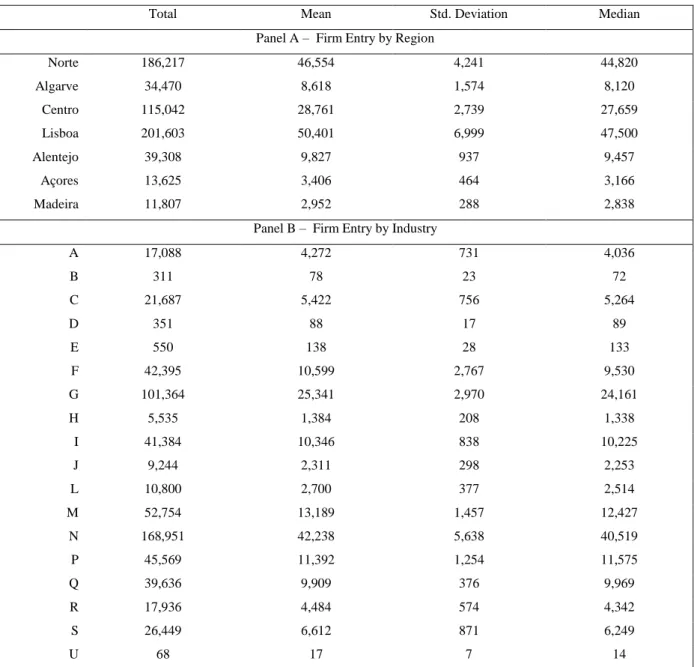
Tables 1, 2 and 3 summarize the descriptive statistics of our sample. Between 2008 and 2011 there was a total of 602,072 new firms created. In 2008 there was a total of 179,144 new firms, which is the highest value occurred during the period on analyze. In contrast, in 2009 and 2010 firms’ entry reduces to 148,456 and 136,664, respectively. Of total firm entry, approximately 84% are located in the regions North, Center and Lisbon. The region with the highest number of new firms is Lisbon (33 percent), followed by the region North (31 percent) and Center (19 percent). The region Alentejo appears in fourth place (7 percent), followed by the region Algarve (6 percent). The regions Açores and Madeira appear at the end of the list, presenting each one 2 percent of the total amount of firms entry.
24
Table 1: Descriptive Statistics on Firm Entry and Job Creation by Year
Panel C - Firm Entry Panel D - Job Creation 2008 179,144 230,087 2009 148,456 189,109 2010 136,664 173,596 2011 137,808 175,452 Total 602,072 768,244 Mean 150,518 192,061 Std. Deviation 17,155 22,757 Median 143,132 182,281
Note: This table reports descriptive statistics for firms’ entry and job creation by year between 2008 and 2011available on SCIE – Simplified Corporate Information.
Table 2: Descriptive Statistics on Firm Entry by Region and Industry
Total Mean Std. Deviation Median Panel A – Firm Entry by Region
Norte 186,217 46,554 4,241 44,820 Algarve 34,470 8,618 1,574 8,120 Centro 115,042 28,761 2,739 27,659 Lisboa 201,603 50,401 6,999 47,500 Alentejo 39,308 9,827 937 9,457 Açores 13,625 3,406 464 3,166 Madeira 11,807 2,952 288 2,838
Panel B – Firm Entry by Industry
A 17,088 4,272 731 4,036 B 311 78 23 72 C 21,687 5,422 756 5,264 D 351 88 17 89 E 550 138 28 133 F 42,395 10,599 2,767 9,530 G 101,364 25,341 2,970 24,161 H 5,535 1,384 208 1,338 I 41,384 10,346 838 10,225 J 9,244 2,311 298 2,253 L 10,800 2,700 377 2,514 M 52,754 13,189 1,457 12,427 N 168,951 42,238 5,638 40,519 P 45,569 11,392 1,254 11,575 Q 39,636 9,909 376 9,969 R 17,936 4,484 574 4,342 S 26,449 6,612 871 6,249 U 68 17 7 14
This table reports descriptive statistics for firms’ entry by region between and industry 2008 and 2011. All data was retrieved from the database SCIE – Simplified Corporate Information.
25
Additionally, the industries with the highest number of new firms are the administrative activities and support services activities (with the section of CAE N) which recorded a total of 168,951 new firms. The industries wholesale and retail and repair of motor vehicles and motorcycles (with the section of CAE G) are the second activities registering the highest number of new firms (101,364), followed by consulting scientific and technical activities (with the section of CAE M) which recorded a total of 52,754 new firms.
Table 3: Descriptive Statistics on Job Creation by Region and Industry
Total Mean Std. Deviation Median Panel A – Job Creation by Region
Norte 252,684 63,171 6,083 60,354 Algarve 43,701 10,925 2,060 10,047 Centro 143,731 35,933 3,457 34,490 Lisboa 248,514 62,129 8,855 58,881 Alentejo 48,377 12,094 1,360 11,554 Açores 15,964 3,991 594 3,691 Madeira 15,273 3,818 539 3,616
Panel B – Job Creation by Industry
A 21,917 5,479 1,027 5,289 B 663 166 95 130 C 50,027 12,507 1,877 11,602 D 437 109 27 106 E 971 243 46 243 F 79,633 19,908 5,107 17,840 G 133,564 33,391 3,281 32,272 H 8,547 2,137 324 2,042 I 63,843 15,961 1,065 15,828 J 12,639 3,160 405 3,030 K 0 0 0 0 L 12,586 3,147 506 2,929 M 62,751 15,688 1,745 14,947 N 179,130 44,783 6,014 43,175 O 0 0 0 0 P 47,270 11,818 1,306 12,067 Q 43,698 10,925 510 10,994 R 19,281 4,820 634 4,634 S 31,198 7,800 965 7,413 T 0 0 0 0 U 89 22 7 21
This table reports descriptive statistics for job creation by region and industry between 2008 and 2011. All data was retrieved from the database SCIE – Simplified Corporate Information.
26
Regarding job creation, between 2008 and 2011 there was a total of 768,244 initial employees of start-ups. In 2008 was recorded the higher number of job creation totalizing 230,087 initial employees. In contrast, in 2009 and 2010 job creation reduces to 189,109 and 173,596, respectively. The regions that present highest initial number of employees are North (33 percent) and Lisbon (32 percent), followed by the region Center (19 percent). The remaining 16 percent is distributed by the regions Algarve (6 percent), Alentejo (6 percent), Açores (2 percent) and Madeira (about 2 percent). Regarding initial number of employees by activity sector, on the top three of industries identified with highest number of job creation we have administrative support services activities (with the section of CAE N), wholesale and retail and repair of motor vehicles and motorcycles (with the section of CAE G) and construction (with the section of CAE F), with total job creation of 179,130, 133,564 and 79,633, respectively.
Additionally, we gather unique data on business angels’ activity in Portugal. Data was gathered between June and July 2013 through a survey that was administered to several BAs associations. In the absence of a complete list of all BAs associations in Portugal, we follow the subsequent approach to get our answers: we used several secondary data sources to construct an initial list of all BAs associations. Relevant sources included 1) the membership list of the industry associations in FNABA and APBA; 2) the Investment Vehicle Entities (EVs) involved in the COMPETE program. In total this search yielded 52 entities. We contact these entities to send the questionnaire to all their BAs. The complete questionnaire is presented in Appendix 2.
We first pre-tested the questionnaire on one BA. We followed several suggestions by Dillman (2000) in order to maximize response rates. Entities were sent an email stating the purpose and importance of the research project, followed by a phone call in which they were requested to send the questionnaire. In total we received 22 individual responses from 13 entities, representing an overall participation rate of about 25 percent in terms of entities. Unfortunately, we were unable to test for nonresponse bias because we could not compare key attributes of respondents to those of non-respondents.
Table 4 presents the main characteristics of business angels in our sample. Business angels in our sample are predominantly middle-aged (approximately 82 percent have between 40 to 60 years of age) male (approximately 86 percent) with university education (approximately 55 percent have graduate degrees, master's or PhD and 45 percent have degree), usually in the
27
fields of business sciences and economy (about 86 percent). All have entrepreneurial and managerial experience (100 percent) and the great majority has consulting experience (approximately 89 percent). The business angels in our sample are predominantly businessmen/employers with full-time work-status (77 percent) and tend to invest on technology-based ventures (73 percent). Regarding financial wealth, they present a stable income, with capacity to invest, on average, more than 50,000 euros per year (about 59 percent) and often invest with a semiannual and annual frequency.
Table 4: Business Angels Main Characteristics
Characteristics Total Percent
Gender Female 3 14 Male 19 86 Age 31 to 40 years 3 14 41 to 50 years 9 41 51 to 60 years 9 41 61 to 70 years 1 5 Years of Schooling Higher Education - Degree 10 45
Higher Education - Graduate Degrees, Master's or PhD 12 55 Training Area Business Science ( Economics and Management ) 19 86 Engineering 4 18 Computer 1 5 law degree 1 5 architecture 1 5 geography 1 5 Work Status Worker for others a full-time 2 9 Worker for others a part-time 2 9 Self-employed a full-time 4 18 Self-employed Part-time 1 5 Entrepreneur / Employer 17 77 Entrepreneurial Experience 22 100 Managing Experience 22 100 Consulting Experience 15 68 Industries Invested Life Sciences, health and wellness 6 27 Information Technology 16 73 Energy and Renewables 9 41 Environment, Ecology and Sustainability 6 27 Services 9 41 Tourism 6 27 Education 1 5 Construction 1 5
28
Characteristics Total Percent Investment Frequency Regular, monthly 1 5
Regular, quarterly 2 9 Regular, semi-annually 6 27
Regular, annual 4 18 Irregular 9 41 Investment Amount Under 25,000 Euros 4 18 25,000 to 50,000 Euros 5 23 50,000 to 75,000 Euros 5 23 75,000 to 100,000 Euros 4 18 100,000 to 250,000 Euros 1 5
Over 250,000 Euros 3 14 Note that: i) characteristics with total 0 (zero) were omitted; ii) for training area, work Status and industries invested, each business angels who responded to the survey could select more than one option, therefore the sum of the percentage is greater than 100. All data was retrieved from the questionnaire.
Table 5 presents the descriptive statistics on several criteria that affect BAs decision to invest. At the top five criteria selected, the most important criteria are concern to the entrepreneur, namely its credibility and reputation, the second most important criteria relates to the market and product, namely the market potential of the business (market rate). Enthusiasm and empathy of the entrepreneur appear next, followed by the value requested as well as a detailed business plan.
Table 5: Portuguese Business Angels Investment Criteria
Investment Criteria Rank Mean Std. Deviation
Median Mode
Credibility and reputation of the entrepreneur 1 5.82 1.15350 6 6 Market potential 2 5.73 1.17480 6 7 Enthusiasm and empathy of the entrepreneur 3 5.64 1.46304 6 6 Investment amount 4 5.27 1.21287 5 6 Business Plan detailed and well structured 5 5.27 1.51302 5.5 6 Quality of product 6 5.14 1.32443 5 4 Experience of the entrepreneur in the industry 7 5.14 1.25391 5 5 Professional experience of the entrepreneur 8 4.95 1.22390 5 5 Attractive financial indicators 9 4.68 1.42657 5 4 Competitive protection of product 10 4.55 1.69832 5 5 Academic training of the entrepreneur 11 4.09 1.27597 5 5 know personally the entrepreneur 12 4.00 1.93061 4 5 Firm size (initial number of employees) 13 3.68 1.39435 4 2 All data was retrieved from the questionnaire. This table reports the main investment criteria on Portuguese business angels’ segment. Each criteria was scored from 1 to 7 where 1 means “not relevant” and 7 “very relevant.”
29
6. Empirical Methodology, Variables, and Results
6.1 Impact of the COMPETE Program in Firm Formation and Job Creation
We start by estimating the impact of the COMPETE Program on firm entry and job creation using a difference-in-differences approach. The difference-in-differences estimation provides a way to subtract out the other events that may influence the firm creation by comparing the before-after changes in the treatment group (the group that is thought to be affected by the policy change) to those in a control group. The basic idea is compare the outcomes for firm entry and job creation in specific regions and industries after the introduction of the program and the outcomes for firm creation and job creation in the same condition before the introduction of this program. More precisely we use data on firm entry and job creation between 2008 and 2010 - before the COMPETE Program - and another sample in 2011 - after the COMPETE Program. Using the data pooled over both period we estimate our regression model for firm entry, for region r and industry i, at the year y:
Where, our dependent variable is the number of new firms established per year; is a year dummy variable that equals to one when the data refer to the second period, post-change (2011), and zero if the data refer to the period pre-change (2008-2010); is a dummy
variable equaling to one if the regions are Alentejo, Center and North and the 173 industries at 3 digits (CAE Rev.3)20 covered by the COMPETE Program, and, is our key
variable of interest – a dummy that equals one starting at 2011 simultaneously for the regions and industries covered by the COMPETE Program, and zero otherwise. are additional
controls. We control for the economic activity with a measure of GDP. Additionally, we also use as control variables the population, the volume of sales and the number of existing companies per year and by region and industry.
We expect that the COMPETE Program creates more financial opportunities to investors and entrepreneurs and therefore to increase firm entry.
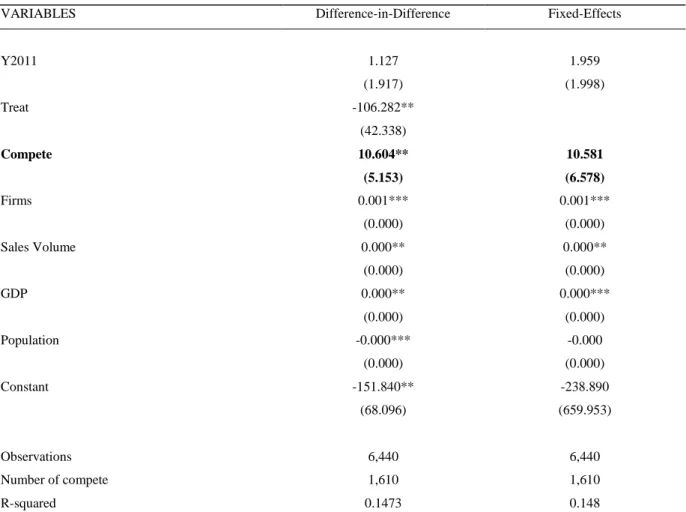
The results for the specification (1) are presented in Table 6. Column 1 provides the difference-in-difference results, while Column 2 shows the results under a fixed effects (industry and region fixed effects) specification. Under the difference-in-difference approach,
20
For further information on the list of industries covered by the COMPETE Program see
http://www.pofc.qren.pt/ResourcesUser/Legislacao/2010/20100512_Alteracao%20SAFPRI_Deliberacao_CMCP OFC_CMCPOR.pdf
30
we find that the introduction of the COMPETE Program is associated with an increase of eleven new firms. This result is statistically significant at 5 percent level. For the estimation under fixed-effects, although not statistically significant, our result also indicates increases in the number of firms created.
Table 6: The Impact of COMPETE Program in Firm Formation
VARIABLES Difference-in-Difference Fixed-Effects
Y2011 1.127 1.959 (1.917) (1.998) Treat -106.282** (42.338) Compete 10.604** 10.581 (5.153) (6.578) Firms 0.001*** 0.001*** (0.000) (0.000) Sales Volume 0.000** 0.000** (0.000) (0.000) GDP 0.000** 0.000*** (0.000) (0.000) Population -0.000*** -0.000 (0.000) (0.000) Constant -151.840** -238.890 (68.096) (659.953) Observations 6,440 6,440 Number of compete R-squared 1,610 0.1473 1,610 0.148
This table uses data on all new firms created between 2008 and 2011 retrieved from the database Sistema de Contas
Integradas das Empresas. The dependent variable - Firm Entry - is the number of new firms established per year and our key
variable of interest – Compete - is a dummy that equals one starting at 2011, simultaneously for the regions and industries covered by the COMPETE Program. stands for Robust standard errors in parentheses. *** p<0.01, ** p<0.05, * p<0.1 Number of compete are the number of firms created under the COMPETE Program.
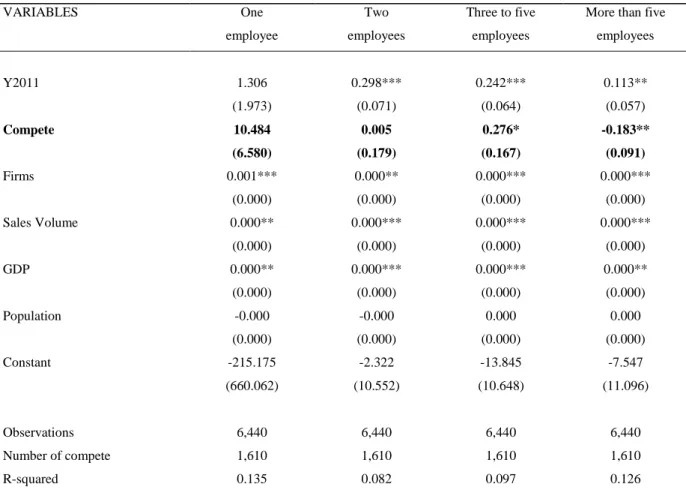
Additionally, using the same specifications in (1), we estimate the impact of the COMPETE Program on firm size. In this case our dependent variable is the number of new firms established per year categorized by the firm’s initial size. Results are presented in Table 7, where Columns (1) - (4) report the coefficient when we consider the number of newly established firms with one, two, three to five and more than five employees, respectively. Our estimates indicate increases in the number of firms with three to five employees by a magnitude of 0.3 and decreases in the number of firms with more than five employees by a magnitude of 0.2. These results are statistically significant at the 10 percent level and 5
31
percent level, respectively. Additionally, our results indicate increases in the number of firms with one employee, although this result is not statistically significant.
Table 7: The Impact of COMPETE Program in Firm Size
VARIABLES One employee Two employees Three to five employees
More than five employees Y2011 1.306 0.298*** 0.242*** 0.113** (1.973) (0.071) (0.064) (0.057) Compete 10.484 0.005 0.276* -0.183** (6.580) (0.179) (0.167) (0.091) Firms 0.001*** 0.000** 0.000*** 0.000*** (0.000) (0.000) (0.000) (0.000) Sales Volume 0.000** 0.000*** 0.000*** 0.000*** (0.000) (0.000) (0.000) (0.000) GDP 0.000** 0.000*** 0.000*** 0.000** (0.000) (0.000) (0.000) (0.000) Population -0.000 -0.000 0.000 0.000 (0.000) (0.000) (0.000) (0.000) Constant -215.175 -2.322 -13.845 -7.547 (660.062) (10.552) (10.648) (11.096) Observations 6,440 6,440 6,440 6,440 Number of compete 1,610 1,610 1,610 1,610 R-squared 0.135 0.082 0.097 0.126 This table uses data on all new firms created between 2008 and 2011 retrieved from the database Sistema de Contas
Integradas das Empresas. The dependent variable – Firm Size - is the number of new firms established per year categorized
by the firm’s initial size and our key variable of interest - Compete - is a dummy that equals one starting at 2010, simultaneously for the regions and industries covered by the COMPETE Program. Includes Fixed Effects. Robust standard errors in parentheses. *** p<0.01, ** p<0.05, * p<0.1
Number of compete are the number of firms created under the COMPETE Program.
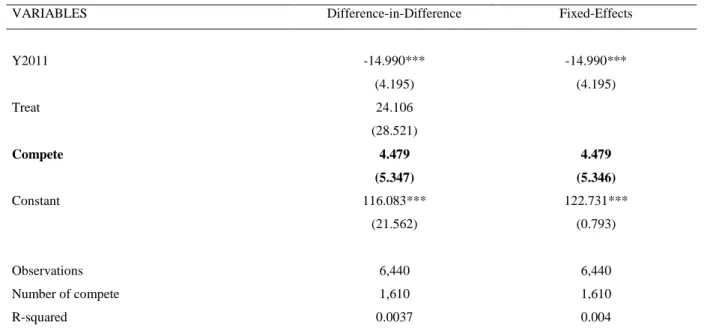
Using the same specifications in (1), we also estimate the impact of this policy on job creation (initial employment) in the newly formed firms. In this case our dependent variable is the initial number of employees of start-ups. We expect that this policy leads to an increase in the initial number of employees in the newly formed firms. The results of this estimation are presented in Table 8. Although we observe an increase of four employees per start-up the results are not statistically significant due the dispersion of the values in our dependent variable.
32
Table 8: The Impact of COMPETE Program in Job Creation
VARIABLES Difference-in-Difference Fixed-Effects
Y2011 -14.990*** -14.990*** (4.195) (4.195) Treat 24.106 (28.521) Compete 4.479 4.479 (5.347) (5.346) Constant 116.083*** 122.731*** (21.562) (0.793) Observations 6,440 6,440 Number of compete 1,610 1,610 R-squared 0.0037 0.004
This table uses data on all new firms created between 2008 and 2011 retrieved from the database Sistema de
Contas Integradas das Empresas. The dependent variable – Firm Size - is the number of new firms established
per year categorized by the firm’s initial size and our key variable of interest - Compete - is a dummy that equals one starting at 2011, simultaneously for the regions and industries covered by the COMPETE Program. Robust standard errors in parentheses. *** p<0.01, ** p<0.05, * p<0.1
Number of compete are the number of Jobs created under the COMPETE Program.
6.2 Determinants of Business Angels investment
We turn now to empirically test the predictions on the impact of several BAs characteristics on their propensity to make investments. Due to the nature of our dependent variable, we use the ordered probit/logit modeling methodology to analyze the effect of BAs main characteristics on the propensity to invest. Using data collected through the questionnaire, we estimate:
Where, our dependent variable is a dummy variable, representing the frequency of BAs investment, based on a response to the following question: “How often do you usually invest?” The measure takes value 1, if the answer is “regular, monthly,” value 2, if the answer is “regular, quarterly,” value 3, if the answer is “regular, semi-annually,” value 4, if the answer is “regular, annual,” and value 5, if the answer is “irregular;” is a dummy variable that was assigned value 1 if the respondent was male and zero if the respondent was female; is a dummy variable that was assigned value 1 if the respondent is middle-aged (40 – 60 years old) and zero otherwise; is a dummy variable that was
33
given value 1 if the respondent had received university education and zero otherwise; is a dummy variable that was given value 1 if the respondent agreed to invest, per year over the next five years, 50.000 euros or more, and zero otherwise. Note that an approximation was used in this measure, because it would be difficult to obtain the angel´s income; finally,
Entrepreneurial, Managerial and Consulting Experience are dummy variables that was given
value 1 if the respondent had prior experience in these areas and zero otherwise.
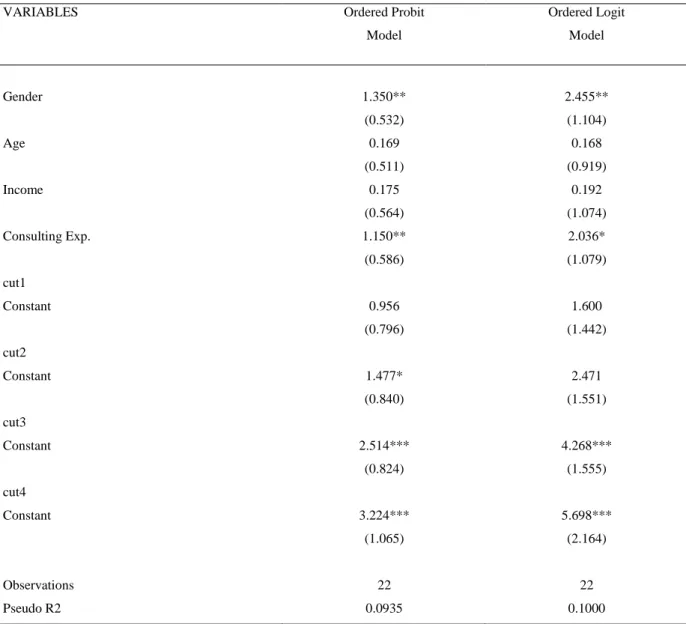
Table 9: Determinants of Business Angels Investments Frequency
VARIABLES Ordered Probit Model Ordered Logit Model Gender 1.350** 2.455** (0.532) (1.104) Age 0.169 0.168 (0.511) (0.919) Income 0.175 0.192 (0.564) (1.074) Consulting Exp. 1.150** 2.036* (0.586) (1.079) cut1 Constant 0.956 1.600 (0.796) (1.442) cut2 Constant 1.477* 2.471 (0.840) (1.551) cut3 Constant 2.514*** 4.268*** (0.824) (1.555) cut4 Constant 3.224*** 5.698*** (1.065) (2.164) Observations Pseudo R2 22 0.0935 22 0.1000
This table uses data on all Business Angels collected through a questionnaire. Ordered Probit and Logit Models are used. Robust standard errors in parentheses. *** p<0.01, ** p<0.05, * p<0.1
The results for the specification (2) are presented in Table 9. Column 1 provides the results under the ordered probit model, while Column 2 shows the results under the ordered logit model. For both estimations the parameters were estimated by maximum likelihood estimation and the results show that Gender has a positive coefficient suggesting that being male increases the likelihood of our dependent variable fit in to the higher category, that is,
34
increases the likelihood of making “irregular” investments, in contrast, decreases the likelihood of our dependent variable fit in to lower category, that is, decreases the likelihood of the making “regular, monthly” investments. In the same way having prior consulting experience increases the likelihood of making “irregular” investments and decreases the likelihood of making “regular, monthly” investments. These results are statistically significant. In contrast, Age and Income are not statistically significant, suggesting that there are not differences on the probability of making BAs with different frequencies due variation on these variables. Finally, the remaining variables tested were omitted because of collinearity (BAs in our sample present all, university education and prior entrepreneurial and managerial experience).
Table 10 presents the marginal effects using the probit and the logit model. The results suggest that being male is associated with a negative probability of making monthly and quarterly investments. In contrast, is associated with a positive probability of making semiannual, annual and irregular investments. In the same way having consulting experience is associated with a negative probability of making monthly investments and is associated with a positive probability of making quarterly, semiannual, annual and irregular investments.
Table 10: Marginal Effects for Investment Frequency
Marginal
Effects Regular, monthly Regular, quarterly
Regular,
semiannual Regular, annual Irregular Probability .400 (a) .408 (b) .206 (a) .214 (b) .299 (a) .287 (b) .074 (a) .068 (b) .022 (a) .024 (b) Gender* -.394 (a) -.414 (b) -.095 (a) -.118 (b) .113 (a) .143 (b) .192 (a) .239 (b) .184 (a) .150 (b) Age* -.066 (a) -.041(b) .002 (a) .002 (b) .037 (a) .026 (b) .019 (a) .010 (b) .008 (a) .004 (b) Income* -.068 (a) -.046 (b) .001 (a) .002 (b) .038 (a) .029 (b) .020 (a) .011 (b) .009 (a) .004 (b) Consulting Exp.* -.434 (a) -.469 (b) .041 (a) .063 b) .237 (a) .269 (b) .108 (a) .099 (b) .047 (a) .038 (b)
(*) dy/dx is for discrete change of dummy variable from 0 to 1 (a) using probit model; (b) using logit model.
Using the same specifications in (2), we also test the probability of a BA investing higher values, based on a response to the following question: “How much money are you willing to invest on average per year over the next five years?” The dependent variable takes the value one, if the answer is “under 25,000 euros,” value two, if the answer is “25,000 to 50,000
35
euros,” value three, if the answer is “50,000 to 75,000 euros,” value four, if the answer is “75,000 to 100,000 euros,” value five, if the answer is “100,000 to 250,000 euros,” and value six, if the answer is “more than 250,000 euros.” Results are presented in Table 11.
Table 11: Determinants of Business Angels Investments Amount
VARIABLES Ordered Probit Model Ordered Logit Model Gender 1.726*** 2.723*** (0.449) (0.763) Age 0.310 0.548 (0.408) (0.737) Consulting Exp. 1.151** 1.859* (0.530) (0.949) cut1 Constant 0.215 0.295 (0.585) (1.001) cut2 Constant 0.961* 1.556 (0.575) (1.008) cut3 Constant 1.640*** 2.657*** (0.566) (1.012) cut4 Constant 2.338*** 3.824*** (0.647) (1.163) cut5 Constant 2.577*** 4.250*** (0.703) (1.269) Observations Pseudo R2 22 0.0894 22 0.0847
This table uses data on all Business Angels collected through a questionnaire. Robust standard errors in parentheses. *** p<0.01, ** p<0.05, * p<0.1
Column 1 provides the results under the ordered probit model, while Column 2 shows the results under the ordered logit model. The results show Gender and Consulting Experience have positive coefficients suggesting that being male and having prior consulting experience increases the likelihood of our dependent variable fit in to the higher category, that is, increases the likelihood of investing bigger amounts of capital, in contrast, decreases the likelihood of investing smaller amounts of capital. These results are statistically significant. In contrast, Age is not statistically significant suggesting that variation in this variable does not