Understanding games
as ParticiPation: an
analytical model
Marcelo SiMão de VaSconcelloS
1 /FláVia Garcia
de carValho
2 /ineSita SoareS de araujo
3ABSTRACT: Public health communication in Brazil has difficulties in reaching different groups of the population, as well as fostering their participation for building better health policies. Digital games could help in this regard, but there is a need of detailed models that account for social and participa-tory aspects of games and game playing. In order to provide such model, this study combined theo-retical concepts from Game Studies, namely, the concept of games as participation and the Gaming Dispositif-model, with the Model of Communication as a Symbolic Market, from Latin American Com-munication Studies, creating a game model describing the socially inscribed relations among player, game and other players, based on participation. This article explains the mentioned concepts and the analytical model in detail, concluding with remarks on its possible uses.
KEYWORDS: Participation; Health Communication; Digital Games; Serious Games; Game Model. RESUMO: A comunicação em saúde no Brasil tem dificuldades em atingir diferentes grupos na popu-lação e incentivar a sua participação na construção de melhores políticas de saúde. Jogos digitais podem ajudar a respeito disso, mas nós carecemos de modelos detalhados que levem em conta os aspectos sociais e participatórios dos games e do acto de jogar. Para prover tal modelo, nós com-binamos conceitos teóricos dos Game Studies, a saber, o conceito de jogos como participação e o modelo Gaming Dispositif, com o Modelo de Comunicação como Mercado Simbólico, dos estudos de Comunicação Latino-americanos, criando um modelo de jogo descrevendo as relações socialmente inscritas entre jogador, jogo e outros jogadores, baseadas em participação. Neste artigo, nós explica-mos os conceitos mencionados e então apresentaexplica-mos nosso modelo em detalhes, concluindo com observações sobre possíveis usos de tal modelo.
PALAVRAS-CHAVE: Participação; Comunicação em saúde; Jogos digitais; Serious Games; Modelo de jogo.
1 Oswaldo Cruz Foundation. E-mail: [email protected] 2 Oswaldo Cruz Foundation. E-mail: [email protected] 3 Oswaldo Cruz Foundation. E-mail: [email protected]
107
Revista CibeRtextualidades n.8 [2017] - issn: 1646-4435 107 - 118
participatory-aspects of games, which makes de-signing such games much more difficult.
The understanding of games as participation could be a crucial advance to fully employing the medium for collective health. Therefore, this study focused on understanding the relation-ship among player, game and other players, which led to the development of a conceptual model of such relationship. The objective of this article is presenting such model.
Due to the focus on collective health, it makes sense to consider games not only as isolated ob-jects, but also as cultural productions of a given society. As such, the model presented in this text, the Model for Relational Analysis of Games:
Contexts, Participation and Apparatus (MoRAG),
considers games as objects socially situated, ex-perienced by subjects socially situated as well, focusing on participation as the defining way of interaction between both.
Its construction was grounded on concepts from Game Studies, namely Raessen’s concept of game as participation and game culture as a participatory media culture (Raessens, 2005). In addition, MoRAG incorporates ideas from the Gaming Dispositif model (Raessens, 2009) and concepts from the Model of Communication as a Symbolic Market, from the Latin American Com-munications field, which understand production of meaning as intrinsically social (Araujo, 2002). In order to adequately present MoRAG, this ar-ticle will begin presenting some relevant con-cepts from the field of Game Studies, in order to highlight digital games’ peculiarities. Then, each theoretical aspect that grounded the creation of MoRAG will be detailed, followed by an explana-tion of MoRAG’s inner components, concluding with considerations about its possibilities of use.
1. Introduction
Games have been used for health initiatives for some time, be it professional training, therapy or health communication. However, games for health tend to direct their messages to the indi-vidual rather than the community, typically be-ing playable by only one person.
On the other hand, the field of Collective Health deals with populations. In Brazil, collective health communication is of crucial importance, employing different media to reach the popula-tion (Victora et al., 2011). However, often health communication initiatives rely on old communi-cation practices, with unidirectional and central-ized production, impersonal style and focusing on diffusion of norms for people’s adoption, which alienates several groups in society (Araujo and Cardoso, 2007). Even when they employ new media like digital games, they tend to fol-low this pattern, which proved itself inadequate to a country as diversified as Brazil.
Such approaches do not allow for a dialogue between health managers and the popula-tion, which is unfortunate, since one important objective of collective health in Brazil is to pro-mote population’s participation for building bet-ter public health policies, understanding such participation as a necessary condition for both health and citizenship.
Digital games, particularly those played collec-tively, can contribute in this regard, engaging the population for learning about health not only by presenting content in an attractive for-mat, but also by fostering their participation in society.
However, digital games’ potential is not auto-matic, requiring great care and attention in their design for actually benefit society. Unfortunately, there is a lack of research about applications of digital games for public policies (Barrientos-Gutiérrez et al., 2012). Particularly, there is not any analytic model accounting for the collective and
meaning of a game to its rules disregards the narrative elements that contextualize them (Fer-rari, 2010). In addition, it reduces the game to an instrument, constrained by rigid objectives, disregarding players’ creative potential as co-creators of the playful experience (Sicart, 2012). It could imply that there is a “right way” to expe-rience a game, defined by the authority of the game designer, originating games with strict paths, assuming that adequate reception of the game message supposedly would result in a per-fect transfer of knowledge (Vasconcellos, 2013). Instead, any theory for production of meaning in games must necessarily involve the intervention of the player, since the experience of playing a video game results from the interrelationship between rules, players and culture. Thus, when thinking about games it is necessary to consider participation.
2.3. Participation
Raessens (2005) understands games as a kind of participation and the culture around them as a participatory media culture, facilitating and promoting players’ participation in three domains: interpretation, reconfiguration and construction. In its broadest aspect, participa-tion describes citizens and consumers exerting influence in political organizations, consump-tion and producconsump-tion. In the media, participa-tion means the public’s ability to contribute and influence the media production apparatus (Schäfer, 2008). Therefore, understanding games as participation emphasizes their potential to be a meaningful media in society, including the public communications context.
Participation’s interpretation domain refers to the player’s apprehension of game media, similar to previous media like literature and film (Raessens, 2005). It encompasses the three reading strategies described by Hall (2005): the dominant/hegemonic position, the oppositional position and the negotiated position. Respec-tively, such positions describe the ways to
de-2. Production of Meaning
in Digital Games
2.1. Serious games
Many researchers and educators claim that video games foster a more active learning in students, able to simulating workplace situations and en-hancing their performance (Prensky, 2004, Gee and Shaffer, 2005). In the field of Health, there are many examples of the use of digital games, employed from self-care to health promotion and several other areas (Papastergiou, 2009). Games that have other purposes beyond enter-tainment are called serious games (Michael and Chen, 2006). Serious games can be understood as games that, while presenting entertainment value, deal with relevant themes for society, aim-ing to braim-ing some effect to the world outside the game (Raessens, 2010). Health games are a subset of serious games and, similarly, intent to cause changes in the real world. This intention makes important to understand how the player produces meaning from playing such games and what the specific contributions of game me-dia to build such meaning (Raessens, 2005).
2.2. Procedural rhetoric
Procedural rhetoric was proposed by Ian Bo-gost (2007) in order to explain the production of meaning in games, claiming that their unique ability is communicating through processes codified in game rules and mechanics, creating dynamic metaphors for real world processes. The meaning of a game would emerge in this moment of player’s interaction with the rules created by the game designer. By reconstructing the meaning embedded in the rules, the player would “solve” or “win” the game and be persuad-ed. Therefore, procedural rhetoric states that the meaning of a game is contained in its rules (Bo-gost, 2007).
Procedural rhetoric rightfully emphasizes the rules’ importance for games, but confining the
109
Understanding games as ParticiPation: an analytical model
code a text (in this case, a game) accordingly with the dominant ideology (of the text’s au-thors), opposing such ideology and negotiating with it, accepting some elements while rejecting others.
Reconfiguration describes player’s actions over the elements that constitute the game. It en-compasses the free exploration of a game, like walking or flying and the manipulation of ele-ments of the game, like picking a box or building a farm. Despite player’s intervention, reconfigu-ration happens within a space of fixed possibili-ties programmed by the game designers in the code that shapes the digital game (Raessens, 2005).
Construction refers to the insertion of new ele-ments in the game by the players. According to Raessens (2005), construction relies on program-ming skills for intervening in the code structure of a game, which makes it less common than in-terpretation and reconfiguration. Construction encompasses a range of activities, like changing or creating new narratives for a game, balanc-ing rules or creatbalanc-ing new ones, includbalanc-ing more advanced graphics, making interface improve-ments, inserting characters of other IPs in a given game and even reusing parts of a game as foun-dation for new kinds of games (Raessens, 2005). A typical example of construction is the creation of mods, which are programs that alter com-mercial games, from small rule modifications to completely transforming images, sounds, music and rules (Postigo, 2007).
2.4. The Gaming Dispositif
Another element that grounds the present work is the model Gaming Dispositif, aiming to de-scribe digital games, particularly serious games, under a humanist perspective. Assuming that every media has different kinds of apparatus and configurations for their technological ele-ments and forms of use, the Gaming Dispositif describes the meaning of a digital game emerg-ing from its technological base, which shapes
specific player positioning, which itself is based in his or her unconscious desires, which translate themselves in different ways and game texts and its correspondent formats in different situations, institutional and cultural contexts. These last three elements would bring their own cultural and ideological influences, intentionally or not (Raessens, 2009).
The Gaming Dispositif highlights the effect of player’s individuality on the act of playing, con-sidering that each player presents different reac-tions to the virtual world portrayed by the game, be it uncritical acceptance, rejection, acceptance as an extension of the real world and finally ac-ceptance of the virtual world while understand-ing the hidden rules that structure the game play. This last reaction would be an indication of a player’s progress on both critical reasoning and empowerment (Raessens, 2009). Thus, despite not exhibiting explicit participation among its elements, the Gaming Dispositif combines ad-equately with the concept of participation.
2.5. Communication as a Symbolic Market
Since health communication is such a relevant aspect for this study, the two previous con-cepts were combined with a communication theory that emphasizes the social production of meaning.
Thus, a third element that grounded MoRAG comes from the field of Latin American Commu-nication. The Model of Communication as a Sym-bolic Market (MCSM) was conceived for analysis of public communication and it is grounded on the principles of the theory of social production of meaning. It assumes that communication operates like a market, where meanings are so-cially produced, circulated and appropriated by individuals and groups, which try to spread their own worldviews in the process (Araujo, 2002). MCSM presents useful concepts for understand-ing participation, like its tenet that communica-tion is never restricted to the direccommunica-tion from top
to bottom, but each individual who receives messages actively works to create their own meaning for them (Araujo and Cardoso, 2007). Four main contexts condition such production of meaning, constituted in a dynamic and continu-ous process: 1) existential context refers to the individuality of the individual, his background and personal history; 2) situational context, also called place of interlocution, concerns the indi-vidual’s position in society in a given moment; 3) textual context refers to individual’s statements, written, spoken, or any other form; 4) intertextual context includes references to other texts, previ-ously collected by each individual (Araujo, 2002). Thus, MCSM highlights the varied personal and social influences that affect each individual on the communication process, the fact that they do not only “receive” messages, but also change and spread them back to circulation, creating culture in the process. Finally, MCSM’s contexts allow understanding in more detail this personal aspect of communication.
3. Model for Relational Analysis
of Games: Contexts, Participation
and Apparatus (MoRAG )
The Model for Relational Analysis of Games: Contexts, Participation and Apparatus (MoRAG), depicted in figure 1, describes relations between the game as an object, its connections with the player and through her, with other players, under a participatory view. It understands the game as a socially inserted process that in turn reverber-ates in society. The model has four parts: Player’s Contexts, which details the player; Game’s Ap-paratus, which details the game itself, including its technical, aesthetic and cultural aspects; the Domains of Participation between player and game, organized in Interpretation, Reconfigura-tion and ConstrucReconfigura-tion; and finally the influence of Other Players, represented by the gray “lens” that crosses the participation lines. Each part will appear in more detail below.
111
Understanding games as ParticiPation: an analytical model
3.1. Player’s Contexts
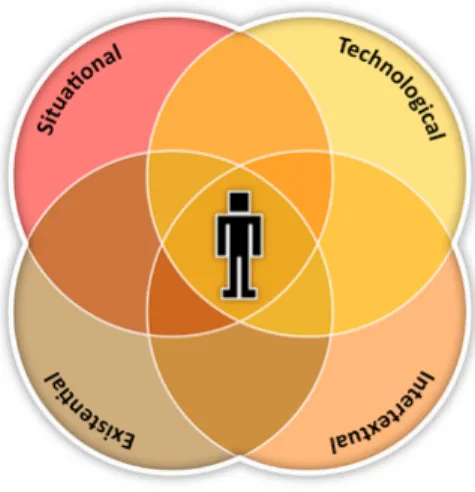
No player “enters” a game in a blank slate, but car-ries her specific personalities and previous expe-riences that will influence her perception of the game. MoRAG organizes such player’s qualities in four main contexts, adapted from the Model of Communication as Symbolic Market (MCSM). Figure 2 depicts Player’s Contexts (Situational, Technological, Existential and Intertextual). The superposition in the center represents the fact that, despite separated for analysis, such con-texts are never isolated, but instead they dynam-ically and continuously influence one another. Thus, Existential Context refers to the player’s individuality, her desires, personal preferences, biography, social and cultural aspects and the way she understands and faces the virtual. The Situational Context refers to the way the player approaches the game, encompassing her on-line reputation, the way she uses the game (as mere entertainment, social space, competition, escapism, etc.) and the ways the physical world interferes with her experience inside the game in terms of game session’s frequency, time and duration and the interrelations between game and daily life. The Intertextual Context refers to the player’s previous knowledge, including her experience with previous games, knowledge about rules and interfaces, her game literacy and even her general culture and familiarity with other media that could influence the game. Fi-nally, there is the Technological Context. This context departs from the contexts present in the MCSM and it is necessary for describing all the technological aspects that surround and influ-ence the participation of the player in the game. It encompasses technological competence, lim-its of the computer or console in use, internet connection capacity and stability, hardware for controlling the game (gamepad, mouse, key-board, etc.), even technological abuse, as the use of unauthorized programs for cheating in game. These factors are not only static elements that interfere with player experience, but contribute decisively to shape player’s behavior in a game, influencing even her social interactions.
Figure 2. Player’s Contexts
3.2. Game Apparatus
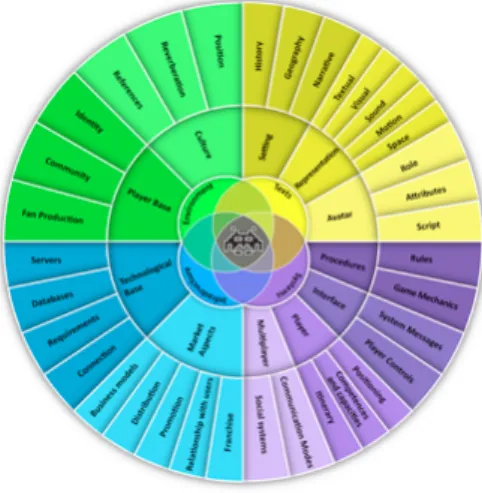
The Game Apparatus (figure 3) is the other ex-treme of MoRAG. Its categories draw inspiration from Gaming Dispositif’s elements, but refined and combined in a new configuration. The Game Apparatus organizes the experiential aspects of games in four major categories: Texts, Systems, Infrastructure and Environment. Each major category branches in second level categories, which in turn branches in third level categories (hereafter, such categories will appear italicized and in capitalized form). In case of need, it is pos-sible to carry out analysis with more detail since the Game Apparatus is flexible enough to allow levels of increasingly specific categories (fourth level, fifth level and so on).
Figure 3. Game’s Apparatus
Like in the Player’s Contexts, these categories are interconnected and dynamically influence each other, composing a whole with specific tech-nological, aesthetic, ludic, social and cultural characteristics. Each moment a given player is playing a game, she experiences elements from these categories in different intensities. Finally, the Game Apparatus assumes that its different categories are results both of creative and tech-nical choices and commercial, ideological, and cultural influences that affect game designers, be they conscious of such influences or not.
3.2.1. Texts
We use Texts here in its broadest sense, going beyond written text and potentially including all kinds of symbolic representation (Verón, 1980). Thus, this category encompasses image, music, video, animation and other formats that usu-ally are considered as the “content” of the game.
Texts branches into three subcategories: Setting, Representation and Avatar. Of course, it is
im-portant to highlight that not every element will have the same importance for every game. For example, most abstract games usually will have few elements in Setting and far more elements in
Representation and Avatar.
Setting describes the “world” where the game
happens, whether a RPG fantasy world or a chessboard. It branches in History, the histori-cal background for the actions of the player;
Geography, describing maps, regions or levels of
the game, including their specific narrative par-ticularities; and Narrative, the main story that the player will experience.
Representation describes as the game is
per-ceived to the player’s senses, including both the
Textual, Visual and Sound aspects and the ways
of placing the player in the virtual world (Space) and to traverse it (Motion). Representation is the main responsible for the immersion that players experience sense when inside the game.
Avatar encompasses everything related to the
player inside the game’s fictional reality. It is im-portant both for player’s engagement and for the bidirectional influences between the player (in the physical world) and his narrative coun-terpart inside the game, the character. These influences are particularly visible on MMORPG players, described by Yee e Bailenson (2007) as examples of the “Proteus Effect”. Avatar branch-es in Role, dbranch-escribing the position of the player character in the game world; Attributes, his dis-tinctive characteristics and Script, the path de-signed for him in the game.
3.2.2. Systems
Systems encompasses the functioning structure
of the game, in the ludic, procedural and com-putational senses. It is possible to argue that
Sys-tems is the most distinctive category of games.
It branches in Procedures, Interface, Player and
Multiplayer.
Procedures are codified in algorithms that
en-able both the game’s virtual world and the game rules per se. It branches in Rules, that defines the maintenance of the game world and the dynam-ic structure of the game, including conditions for victory and failure; and Game Mechanics that encompasses the actions available to the player
113
Understanding games as ParticiPation: an analytical model
and other in-game agents, like non-player char-acters (NPCs), in order to alter the game state. While the game mechanics are a space for play-ers’ agency and creativity, game rules guide and condition players’ actions, setting up their many different consequences (as victory or failure) as well (Sicart, 2008).
Interface describes the ways of direct
relation-ship between player and game. It encompasses both Player Controls, the means by which the player controls the game (keyboard, mouse, etc. and their correspondent effects in game); and
System Messages, the ways the game presents
in-formation to the player whether in text, images and audio (score numbers, sounds of enemies steps, audio effects for finishing a level, etc.). While Avatar describes fictional aspects, Player describes the procedural aspects regarding the game player. It branches in Positioning, the point of view of the player in game (first person, third person, isometric, etc.); Competences and
Capaci-ties, describing the ways the game
acknowledg-es and rewards the player’s performance; and
Itinerary, the chain of choices and pathways the
player effectively takes inside the set of alterna-tives provided by the game.
Finally, Multiplayer describes the ways of interac-tion with other players when inside the game. It is an important category to online games like MMORPGs and MOBAS, but also applies to games played in local servers, in split screen (when the screen is divided in sections, each showing the point of view of one player, com-mon in consoles) and even hot seat modes (com-mon in turn-based games, where more than one person plays on the same device taking turns, i.e. changing seats). It branches in Communication
Modes, describing the many ways for direct
in-teraction with other players (including forms of cooperation, competition and opposition) and
Social Systems, which tend to take the form of
guilds, groups and associations, trading spaces and collective events.
3.2.3. Infrastructure
Infrastructure enables the game as a tangible,
technological product, encompassing distribu-tion and maintenance aspects and controlling access and permanence of the players. It branch-es in Technological Base and Market Aspects.
Technological Base describes the structure that
supports the game. It encompasses the Servers, where the game is stored for download and/ or execution; the Databases that store informa-tion about players, matches and (in the case of RPGs) characters; the technical Requirements or specifications for properly running the game; and Connection, describing how the game uses the internet and/or local connections. Despite
Connection being more important to multiplayer
games, each day more and more single-player games demand internet connection, making this subcategory a relevant element for game analysis.
Market Aspects branches in Business Models,
deal-ing with characteristics like subscription, mon-etization (commercial modes like open source, free, free-to-play - F2P, freemium, microtransac-tions, etc.) and similar aspects of the game as product; Distribution forms and channels (physi-cal media, online stores like Steam, download through official websites, etc.); Promotion strat-egies (website ads, big market campaigns, part-nerships with other games or products and even questionable actions like payments for favorable reviews); Relationship with Users, describing the channels of communication with the players/ clients; and Franchise, describing other franchise products and transmedia productions (like com-ics, board games, novels, etc.).
3.2.4. Environment
Environment is everything that surrounds the
game, but is located (at least in part) outside of it. It includes the Culture where the game exists and its Player Base.
Culture describes not only the culture of the
soci-ety where the game exists, but also the game cul-ture of that particular game. It encompasses the
Position of the game in relation to similar games,
other games in general and even in relation to other forms of entertainment; the References that the game presents about other elements of such culture, adapting itself to the contempo-rary media themes and styles; and the
Reverbera-tion of such game in the larger society, the forms
by which game influences culture back. Exam-ples of such Reverberation include the extensive vocabulary rooted in game practices that often overflows into the real world situations, the mi-gration of game memes from small niches to the internet at large and the emergence of practices like gamification (Deterding et al., 2011).
Player Base describes the players of a given
game. It branches in Community, which can be more or less cohesive, and include several sub-groups, organizing spontaneous gatherings online or in physical space; Identity, which refers the way the players understand themselves re-garding the game (hobbyists, competitors in e-sports, strategists, etc.); and Fan Production inspired by the game, encompassing all kind of media created by players, like writing fan fiction, producing comics, animations, videos or even other games, typical activities of participatory culture (Jenkins et al., 2006). While Community deals with relations between players, Identity describes players assuming specific labels or categories in the gaming culture, even without direct contact among themselves.
3.3. Domains of Participation
The relation between the two extremes of MoR-AG, Player’s Contexts and Game’s Apparatus, happens through participation that, like de-scribed by Raessens (2005), is organized in three domains: Interpretation, Reconfiguration and
Construction. However, while Raessens confined Construction to changing code, it is possible to
find examples of players making additions to games without programming. A kind of
Cons-truction that adds to the game without
neces-sarily relying on programming is socially agreed rules and procedures, common in MMORPGs and other games played collectively. It includes social and role-playing events in general, like reenactments, parties, marriages, guild politics and even bigger player-created events like wars, truces and faction rivalries (Copier, 2007). In such events, players collectively add another layer of rules over the original game rules defined by the game designers. Such rules are socially enforced and sometimes they change significantly the game experience. Even in single-player games, it is possible to see a similar layering of new rules when, for example, players define stricter victory conditions for themselves, like finishing a game using only a specific weapon or without killing anyone (Vasconcellos, 2013).
Other kind of Construction happens outside the game, while still inspired by it, encompassing fo-rums and groups in social media, websites with references and news, fanfic, drawings, cartoons, comics, videos, machinima, cosplay contests and many other social event in the real world (Low-ood, 2006). Such Construction extrapolates the limits of the game into the real world, creating an ecosystem of participation around a particu-lar game, greatly widening its area of influence, reaching even non-players.
This way, the Interpretation is when the player apprehends the game, through either Texts,
Systems, Infrastructure or the Environment that
surrounds it. The Reconfiguration arises from the player operations on the elements of the game, allowing an exploratory attitude that goes from reposition an avatar to change the virtual world-view to changing elements of that world, like carrying out missions or fighting enemies. Fi-nally, Construction occurs when the player adds something to the game, both creating modifica-tions and addimodifica-tions to the programming code, creating alternative forms of playing the game or through creating media products inspired by the game. These three modes continuously pro-vide feedback to each other: Interpretation is a first step to understand the virtual world,
Recon-115
Understanding games as ParticiPation: an analytical model
figuration and Construction foster new
opportu-nities for Interpretation. Construction happens through Reconfiguration events, and so on. Finally, MoRAG accounts for the influence of other players in the game experience. In MMOR-PGs and other online games, such influence pro-vides content for the player, when other players become cooperators, competitors or opponents inside the game. However, because playing a game is a social process, even in single player games there is always some level of influence from other players. In this case, other players be-come mentors, imitators or simply fellows who share a passion. Since this influence is multiple and highly variable, it is represented in a more abstractly way as a semi-transparent lens half-way between Player’s Contexts and the Game’s Apparatus, superimposing the lines of Interpre-tation, Reconfiguration and Construction. This represents the mediation of the other players (in groups or individually, inside the game or out-side of it) in the relationship between player and game. This influence may be subtle, but is always present.
4. Conclusions
The MoRAG allows better descriptions of the flow of communications between player and game, taking into account cultural and social as-pects and the influence of other players. It does not intent to describe in a Cartesian fashion the complex human reactions that happen around the play experience, but help to identify the main routes of participation.
As a participatory media, digital games allows and rewards the participation of their players. Perhaps if properly fostered, such participa-tion could reach other areas of life, including the public sphere, enhancing citizenship and promoting a more active instance in discussing and demanding better health policies for soci-ety, therefore, contributing to improve the life of the population. This endeavor is not an easy task, though, and developing such games for
promoting health requires careful planning and constant evaluations. Consequently, there is a need for game models detailing such aspects of the game experience.
The MoRAG helps in this regard, since it was de-veloped specifically for analysis of digital games, seeking to integrate content, procedures and the technical, commercial / industrial, social and cultural aspects surrounding such games. It also details the particularities surrounding the player and his relations with culture and other players, understanding the game as a dynamic process socially inscribed. The experience of the game, in turn, is a process of participation and as such empower players, first as agents of change in the game and later, hopefully, as assertive citizens in society.
An advantage of the MoRAG is supporting re-finements in order to detail internal components of each subcategory of the Game’s Apparatus. Thus, if it is useful for a given analysis a more detailed focus on some aspect, it is possible to continue branching the Game’s Apparatus’s categories into deeper levels. For example, in a study about communication between players on MMORPGs, it could be useful to branch the category Social Systems (Systems > Multiplayer >
Social Systems) into Text Chat, In-game E-mail and Voice Chat, etc.
Finally, despite arising from a conceptual need on the field of Health Communication, the MoRAG fits a wide range of applications, allowing analy-sis of games under varied perspectives and dis-ciplines. Not only analysis, but also it potentially allows evaluating projects in development and even helping to design new games focused on player participation, possibly contributing to suggest innovative ways for using digital games in the fields of research, production and public policies.
Acknowledgements
The authors would like to express their grati-tude to professor Joost Raessens, chair of Media Theory at the Faculty of Humanities of Utre-cht University, for his generosity in sharing his knowledge with one of the authors, Marcelo de Vasconcellos, during his research period in the Netherlands.
References
ARAUJO, I. S. (2002). Mercado simbólico:
interlocu-ção, luta, poder - um modelo de comunicação para políticas públicas. Doutorado PhD dissertation,
Universidade Federal do Rio de Janeiro. ARAUJO, I. S.; CARDOSO, J. M. (2007).
Comunica-ção e Saúde, Rio de Janeiro, Editora Fiocruz.
GUTIÉRREZ, T.; BARRIENTOS-GUTIÉRREZ, I.; REYNALES-SHIGEMATSU, L. M.; THRASHER, J. F.; LAZCANO-PONCE, E. (2012). Se busca mercado adolescente: internet y videojuegos, las nuevas estrategias de la in-dustria tabacalera. Salud Pública de México, 54, pp. 303-314. <http://www.scielo.org.mx/ scielo.php?script=sci_arttext&pid=S0036-36342012000300013&nrm=iso> [Accessed on June 7, 2016].
BOGOST, I. (2007). Persuasive Games: The
Expres-sive Power of Videogames, Cambridge, The MIT
Press.
COPIER, M. (2007). Beyond the Magic Circle:
Ne-twork Perspective on Role-Play in Online Games.
Tese de doutorado, University of Utrecht. DETERDING, S.; DIXON, D.; KHALED, R.; NACKE, L. (2011). From Game Design Elements to Gameful-ness: Defining “Gamification”. MindTrek ‘11, 2011 Tampere, Finlândia.
FERRARI, S. (2010). The Judgement of Procedural
Rhetoric. Dissertação de mestrado, Georgia
Insti-tute of Technology.
GEE, J. P.; SHAFFER, D. W. (2005). Before Every
Child Is Left Behind: How Epistemic Games Can Sol-ve the Coming Crisis in Education. Madison (WI),
EUA: Wisconsin Center for Education Research. HALL, S. (2005). Encoding/decoding. In: HALL, S.; HOBSON, D.; LOWE, A.; WILLIS, P. (eds.) Culture,
Media, Language: Working Papers in Cultural Stu-dies, 1972–79. London: Routledge.
JENKINS, H.; CLINTON, K.; PURUSHOTMA, R.; ROBISON, A. J.; WEIGEL, M. (2006). Confronting the challenges of participatory culture: me-dia education for the 21st century. MacArthur Foundation.
LOWOOD, H. (2006). Storyline, Dance/Music, or PvP?: Game Movies and Community Play-ers in World of Warcraft. Games and Culture, 1, 4, pp. 362-382. <http://gac.sagepub.com/con-tent/1/4/362.abstract> [Accessed on October 1, 2006].
MICHAEL, D.; CHEN, S. (2006). Serious Games:
Games That Educate, Train, and Inform, Boston,
Thomson Course Technology.
PAPASTERGIOU, M. (2009). Exploring the poten-tial of computer and video games for health and physical education: A literature review.
Compu-ters & Education, 53, 3, pp. 603-622. <http://www.
sciencedirect.com/science/article/B6VCJ-4W7H- NWH-1/2/b4cad0a437eabb6158f7419b76e-50de3> [Accessed on June 7, 2016].
POSTIGO, H. (2007). Of Mods and Modders: Chas-ing Down the Value of Fan-Based Digital Game Modifications. Games and Culture, 2, 4, pp. 300-313. <http://gac.sagepub.com/content/2/4/300. abstract> [Accessed on October 1, 2007]. PRENSKY, M. (2004). Digital Game-Based
Lear-ning, New York, McGraw-Hill
RAESSENS, J. (2005). Computer games as par-ticipatory media culture. In: RAESSENS, J.; GOLD-STEIN, J. (eds.) Handbook of Computer Game
Studies. Cambridge, MA: The Mit Press.
RAESSENS, J. (2009). The gaming dispositif. An analysis of serious games from a humanities perspective. In: RITTERFELD, U.; CODY, M.; VOR-DERER, P. (eds.) Serious games. Mechanisms and
effects. New York: Routledge.
RAESSENS, J. (2010). A Taste of Life as a Refugee: How Serious Games Frame Refugee Issues. In: SKARTVEIT, H.-L.; GOODNOW, K. (eds.) Changes in
Museum Practice: New Media, Refugees and Parti-cipation. New York / Oxford: Berghahn Books.
SCHÄFER, M. T. (2008). Bastard Culture! User
par-ticipation and the extension of cultural industries.
117
Understanding games as ParticiPation: an analytical model
SICART, M. (2008). Defining Game Mechanics.
Game Studies, 8, 2, pp. <http://gamestudies.
org/0802/articles/sicart. (Archived by WebCite® at http://www.webcitation.org/6ZdDGe0O4)> [Accessed on June 7, 2016].
SICART, M. (2012). Against Procedurality. Game
Studies, 11, 3, pp.
<gamestudies.org/1103/arti-cles/sicart_ap> [Accessed on June 7, 2016]. VASCONCELLOS, M. S. (2013). Comunicação e
Saúde em Jogo: os video games como estraté-gia de promoção da saúde. Tese de Doutorado,
Fundação Oswaldo Cruz.
VERÓN, E. (1980). A Produção do Sentido, São Paulo, Cultrix / USP.
VICTORA, C. G.; Barreto, M. L.; DO CARMO LEAL, M.; MONTEIRO, C. A.; SCHMIDT, M. I.; PAIM, J.; BASTOS, F. I.; ALMEIDA, C.; BAHIA, L.; TRAVAS-SOS, C.; REICHENHEIM, M.; BARROS, F. (2011). Health conditions and health-policy innovations in Brazil: the way forward. The Lancet, 377, 9782, pp. 2042-2053. <http://linkinghub.elsevier.com/ retrieve/pii/S014067361160055X> [Accessed on June 7, 2016].
YEE, N.; BAILENSON, J. (2007). The Proteus Effect: The Effect of Transformed Self-Representation on Behavior. Human Communication Research, 33, pp. 271-290.