Journal of Ecology 2009, 97, 675– 684 doi: 10.1111/j.1365-2745.2009.01501.x Blackwell Publishing Ltd
Which demographic traits determine population growth
in the invasive brown seaweed
Sargassum muticum?
Aschwin Engelen* and Rui Santos
ALGAE, Marine Plant Ecology Research Group, CCMAR Centro de Ciências do Mar, CIMAR-Laboratório Associado, FCMA, Universidade do Algarve, Campus de Gambelas, 8005-139 Faro, Portugal
Summary
1.
Life-history traits commonly associated with plant invasiveness are vegetative reproduction or
r
-selected traits such as short generation times and high rates of reproduction and individual
growth.
2.
We used matrix modelling to assess which demographic traits are important for the population
growth of an invasive seaweed lacking vegetative reproduction and whether demographic and
life-history strategies shift with increased dominance of the invader. The vital rates of one of the
most successful invading seaweeds,
Sargassum muticum
, were investigated monthly for 2 years in
intertidal pools dominated by the native brown seaweed
Cystoseira humilis
and by
S. muticum
,
respectively. In order to speculate about the demographic mechanisms that determine invasiveness
of
S. muticum
, and as the study sites were recently colonized, we assumed that
C. humilis
and
S. muticum
pools are proxies for early and late phases of invasion, respectively.
3.
Both deterministic and stochastic matrix models showed positive rates of population growth,
and rates were significantly higher in the pools dominated by
S. muticum
than in the ones dominated
by
C. humilis
, indicating demographic changes with invader dominance. The variability of population
growth rates and of reproductive and elasticity values of
S. muticum
was higher in the pools
dominated by
C. humilis
, suggesting invader-driven stabilization of environmental conditions.
Generation times of the species increased with invader dominance, supporting invader-stabilized
environmental conditions.
4.
Elasticity analyses revealed that the most important demographic trait for population growth
rate at both levels of invader dominance was the persistence of the non-fertile adult fronds rather
than reproduction or growth. No major shifts in the life-history strategy of
S. muticum
between
levels of invader dominance were detected.
5.
Synthesis.
This study suggests that the invasiveness of
S. muticum
, a perennial invader without
vegetative reproduction, relies on
K
- rather than
r
-selected traits and without drastic changes in
life-history strategy between phases of invasion.
Key-words:
biological invasion,
Cystoseira humilis
, elasticity, life-history traits, matrix models,
population dynamics, population growth,
Sargassum muticum
, seaweeds, stochasticity
Introduction
The environmental and economic impacts of biological invasions are estimated to be USD 1.4 trillion per year or about 5% of the world economy (Pimentel 2002; IMF 2006). However, impacts are not limited to strong negative con-sequences for biodiversity, but have more profound effects. For example, invader species may displace native species (Parker et al. 1999; Mack et al. 2000; Alvarez & Cushman 2002)
and alter ecosystem-level properties, such as nutrient cycling, fire regime, hydrologic cycles, sediment deposition and erosion (Vitousek et al. 1987; Vitousek 1990; Richardson et al. 2000; D’Antonio & Kark 2002; Knight et al. 2007; Liao et al. 2007). Since the early works of Fisher (1937) and Baker (1965), invasion theory has attempted to identify which life-history traits best explain the successful establishment of invaders outside their native ranges. Traits examined include the ability to reproduce sexually and asexually, rate of growth from seedl-ing to sexual maturity, phenotypic plasticity and high tol-erance to environmental heterogeneity (Baker 1974). While many invasive plants tend to reproduce vegetatively, have a low
676 A. Engelen & R. Santos
variability of seed crop and have short juvenile periods (Kolar & Lodge 2001), others have essentially the same growth rates and fecundity as natives (Daehler 2003). Daehler (2003) noted that there appeared to be few cases of ‘super invaders’ or species with universal performance advantages over co-occurring natives, as it was the increased resource availability and altered disturbance regimes associated with human activities that often differentially increased the performance of invaders over that of natives. More recently, Sutherland (2004) identified that invasive exotic weeds were more likely to be perennial, monoecious and self-incompatible than non-invasive exotics. In contrast, Muth & Pigliucci (2006) did not detect phenology differences of introduced invasive species when compared to introduced non-invasives, in two closely related genera of Asteraceae. The ontogenetic develop-ment of an invasive Crepis or Centaurea was not faster than that of a non-invasive congener, neither size nor architecture was related to invasiveness.
A key problem in defining which traits are associated with invasive species is that decisive traits may change as the invasion process proceeds. Phenotypic plasticity has often been cited as a life-history trait needed for colonization of new areas because colonists must be able to cope with a range of environmental conditions, but the establishment of viable, self-sustaining populations may depend on other traits (Sakai et al. 2001). The importance of lag phases in their rate of invasion is controversial. In general, invading species show initial phases of slow population growth, followed by more rapid population growth, but the extent of lag phases is widely dependent on the life strategy of the species (Kowarik 1995). For example, only 6% of the 184 species examined by Kowarik (1995) had spread within 50 years of their first introduction to the area, 25% required up to 100 years, 51% required 200 years, 14% required 300 years and 4% required > 300 years. Life form also significantly influenced lag phase, with trees (170 years) > woody Australian ornamentals (149 years) > shrubs (131 years) (Kowarik 1995; Caley et al. 2008). Lag phases also may be impeded by that the nature of exponential population growth can be imperceptible in small populations (Parker 2004). Clearly, the success of invasive species does not require a specific set of life-history traits.
Understanding population attributes of species invasions is essential for a proper invasion model and management. Demographic tools such as stage-structured matrix projection models (Caswell 2001) can be used to analyse life-history strategies. These models use probabilities of vital rates (e.g. fecundity, survival and growth) of each life-history stage to estimate the asymptotic population growth rate, stable stage distribution, and stage-specific reproductive values under particular environmental conditions (Caswell 2001). Traits that have the greatest effect in population growth rates, that is, the largest elasticity value, should be associated with local invasiveness (Shea & Kelly 1998; McEvoy & Coomb 1999). Although matrix models are increasingly applied to conserva-tion issues (Kaye et al. 2001; Griffith & Forseth 2005), they are still rare in studies of marine invasive species (but see McEvoy & Coomb 1999; Engelen et al. 2005).
The aim of the present study was to assess the underlying demographic traits that determined the population growth of the brown invasive seaweed Sargassum muticum (Yendo) Fensholt (Fucaceae) in two conditions of dominance over the native competitor, Cystoseira humilis in intertidal pools dominated by the native and the invader species, respectively. A detailed demographic analysis of the species was performed at its southern distribution limit in the east Atlantic, on the south-west coast of Portugal, where the expansion of the species range has been recorded. In order to speculate about the demographic mechanisms that determine the invasiveness of S. muticum, we assumed that C. humilis pools were a proxy for an early phase of invasion (only a few S. muticum individuals present), whereas S. muticum pools were a proxy for a late phase of invasion (dominated by an almost monospecific stand of the invader). Specifically, we asked: (i) does the popu-lation growth rate of S. muticum vary with dominance level? (ii) what are the demographic traits that contribute most to the invader’s population growth rate? and (iii) does the relative importance of those traits shift between C. humilis- and S. muticum-dominated pools? To address the first question, both the invader’s population growth rate and its reproductive value, that is, the contribution of each life cycle stage to the next generation, were compared between pool types. The second and third questions were addressed through elasticity analysis of the demographic traits in both pool types.
Methods
T H E S P E C I E S
:
S A R G A S S U M M U T I C U MThe invasive brown seaweed S. muticum is native to East Asia around the Japanese archipelago, where it is one of many Sargassum species present. Outside this area, the species was first introduced in British Columbia (Canada) and subsequently spread both northwards and southwards, into wave-protected waters. In the early 1970s, S. muticum was introduced to the English and French coasts (Druehl 1973; Critchley et al. 1983) and now ranges from Norway to Portugal (Engelen et al. 2008). A separate introduction occurred in the Mediterranean (Critchley et al. 1990). The invading S. muticum has displaced native species through over-growing and shading underlying species (Critchley et al. 1986; Givernaud et al. 1991; Stæhr et al. 2000; Britton-Simmons 2004). The species is considered a pest and fouling species, which interferes with recreational and commercial use of waterways (Critchley et al. 1986), particularly when it becomes detached from holdfasts and forms large floating masses (Farnham et al. 1981). It is also considered a pest species on oyster beds and a general nuisance to commercial fishermen (fouling of nets; Critchley 1981), although these have never been properly quan-tified. In Portugal, S. muticum was first observed on the northern coast of the country in 1989 (Lluch et al. 1994) where it continues to be abundant in certain sheltered sites. At the time of this study, the southern distribution limit was the exposed south-west coast of Portugal, specifically in sheltered intertidal pools. It is likely that S. muticum finds a refugium in wave-protected tide-pools and that it cannot develop under the high hydrodynamic conditions characteristic of this coast.
The invasive success of S. muticum has been attributed to a combination of perennial and opportunistic characteristics (Norton
Demographic traits of Sargassum muticum 677
1976). The species has a monophasic pseudo-perennial life cycle consisting of perennial basal holdfasts from which main axes and annual lateral branches grow. Reproductive structures (receptacles) develop on lateral branches in spring and deteriorate at the end of summer or early autumn. They are produced in high numbers and bear both male and female conceptacles, thus self-fertilization is common. Expulsion of gametes occurs twice each lunar cycle (Engelen et al. 2008). After expulsion from the conceptacles within the receptacle, oogonia remain attached to the surface of the receptacle, where they are fertilized and develop tiny rhizoids, possibly increasing the probability of survival. Additionally, gas-vesicles that maintain the thallus in an upright position in the water column, also enable detached thalli (and attached embryos) to ‘raft’ or disperse many kilometres along a shore (Critchley et al. 1983).
S T U D Y S I T E S
Three locations along the Atlantic south-west coast of Portugal, separated by approximately 10 km (Praia do Queimado, Almograve and Zambujeira do Mar), were visited monthly from April 2002 to August 2004. At each site, S. muticum individuals were tagged in at least three pools dominated by C. humilis, and three additional pools dominated by S. muticum (with 100% cover). Prior to 1989, most intertidal pools were dominated by the native brown alga C. humilis Schousboe ex Kützing. Sargassum muticum is now present in many pools, but dominates only a few pools. Both species were mainly distributed along the rocky edges of the pools and while S. muticum was present in fewer pools, its floating thalli sometimes created 100% cover.
The study sites are located within a natural park (PNCVSA, Parque Natural da Costa Vicentina e Sudoeste Alentejano). The area is characterized by a littoral climate, with primarily north and north-west winds and the average rainfall is c. 600 mm year–1
with peaks occurring in winter and spring. In the summer dry season, rainfall rarely exceeds 10 mm. The average annual temperature is 16.5 °C, with summer highs of c. 32 °C. The main wave direction is from NW and occasionally from SW (Ramalho et al. 1998). The longitudinal sediment transport is southwards, mainly in shallow waters. The rocky coast consists of schists (praia Queimado) or greywackes (Almograve and Zambujeira) from the Paleozoic, covered with a thin layer of sand (Balbino et al. 2004). Rocky reefs provide protection against wave exposure for some of the intertidal pools.
Intertidal rock pools ranged in volume from 0.002 to 0.320 m3
, with maximum depths of 0.14–1.20 m. The substratum consisted of black schist or greywackes with sand and or pebbles/boulders in the central portion of the pools. The temperature at the surface layer (30 mm) of pools could reach 30 °C during mid-day low tide in summer, which is 10 °C higher than the bottom water (Engelen et al. 2008).
M O D E L S T R U C T U R E
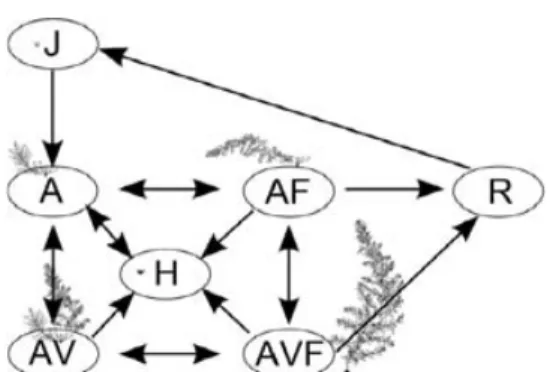
Our matrix model was structured into stage classes defined by bio-logical criteria (Horvitz & Schemske 1995; Pascarella & Horvitz 1998). The stages were defined using a combination of developmental characteristics of S. muticum, such as the presence of a visible holdfast disc, upright thallus, gas vesicles and reproductive structures (Engelen et al. 2005). Six macroscopic life-history stages were distinguished (Fig. 1): (i) juveniles with small rosettes of leafs without conspicuous holdfast and uprights (J); (ii) non-fertile adults without gas vesicles (A); (iii) non-fertile adults bearing gas vesicles (AV); (iv) fertile adults without gas vesicles (AF); (v) fertile adults bearing gas
vesicles (AVF); and (vi) individuals consisting only of a basal holdfast with or without main axis, but without laterals (H). Individuals were considered fertile when receptacles were present. Since the develop-ment of gas vesicles and reproductive structures only occurs in larger thalli, the stages J, A, AV and AVF also reflected a size classification in which J was the smallest and AVF the largest. The AF stage occurred towards the end of the reproductive season, when individuals shed the gas vesicles and begin to decay. A seventh stage consisting of micro-recruits (< 5 mm) was also included in the model (R). As a micro-recruit needs c. 6 months to become a juvenile (Engelen and Santos, unpubl. data) and the time step considered in the population model was 1 month, the R stage was age-classified in six 1-month stages.
E S T I M A T I O N O F T R A N S I T I O N R A T E S
Fertility, or the probability of an individual to give rise to a micro-recruit, was estimated as the proportion of the total number of embryos released (fecundity) that settled and developed into new recruits. Fecundity of each tagged plant was estimated using the relationship between the thallus volume, thallus dry weight, the number of receptacles per thallus and the number of embryos extruded per receptacle. During the reproductive season, 31 fertile plants were randomly sampled and their maximum length and maximum circumference were measured to estimate individual volume, assuming the volume of a cylinder as described elsewhere (Åberg 1990; Engelen 2004). Volume estimates (Vol) were non-destructive, easily measured in the field and significantly correlated with dry weight (log DW = 0.975 log Vol–2.204, n = 323, r = 0.967, P < 0.001). Dry weight (DW) was used to estimate the number of receptacles per thallus (Rec = 57.96 + 88.70 DW, n = 31, r = 0.627, P < 0.001).
The fecundity of each tagged individual was estimated as: Fecundity = Rec × Oo, where Oo is the average number of oogonia released by a single receptacle per month. Release numbers were estimated in the laboratory using 19 receptacles incubated separately in Petri dishes. The average number of oogonia released per receptacle was 462 ± 18.2 (SE). No correlation was detected between receptacle size and number of oogonia released (Pearson Product Moment Correlation, P = 0.616).
Fig. 1. Conceptual model of the life cycle of Sargassum muticum.
Arrows show transitions from one stage to another. R, micro-recruit; J, juveniles; A, adult without gas vesicles; AV, adult with gas vesicles; AVF, fertile with gas vesicles; AF, fertile without gas vesicles; H, basal holdfast. All stages also have a transition to the same stage (stasis) indicating the probability of persisting in the same stage (not shown for clarity).
678 A. Engelen & R. Santos
The transition rate from an embryo to a recruit was estimated as the number of recruits present on high rugosity resin discs (6 cm2
) (described in Ladah et al. 2003) that were incubated for one month in the field, relative to the sum of all embryos that settled on discs that were replaced daily during a month (16.17%). Data were obtained daily during 3 months (June–August 2004) in three pools dominated by S. muticum, at Praia do Queimado (Engelen et al. 2008). In each of the pools, a set of three discs was fixed in two ran-dom positions (daily n = 18). We assumed that all embryos produced within a pool settled in that same pool, a realistic assumption as 98% of S. spinuligerum propagules settled within 1 m from parent thalli (Kendrick & Walker 1991). We also assumed that all brown seaweed embryos present on the artificial substrates were S. muticum, as no other large brown seaweed species were present in these pools.
Micro-recruit survival was estimated from 256 discs that were seeded in the laboratory in various months of the year and incubated in the field either in S. muticum- or C. humilis-dominated pools at all three study sites. Field incubations were performed in May (n = 14), June (n = 32), July (n = 49), August (n = 49), October (n = 23) and November (n = 11) of 2003 and January (n = 47), February (n = 10), March (n = 6), April (n = 6), May (n = 7) and June (n = 2) of 2004. Micro-recruit densities on discs averaged 29 recruits cm–2
and ranged from 1 to 256 recruits cm–2. The mean survival probability
was 0.1796 month–1 and no significant differences (α = 0.05) in
sur-vival probability among recruits of different ages or in different months were detected. Thus, this survival rate was used for all micro-recruit stages in all months. Bare artificial substrates were incubated together with the seeded substrates (one bare substrate for every two seeded substrates) to correct for the interference of new settlement on the estimation of recruit survival.
At each location, approximately 25 individuals of each stage class were tagged with two labels: a coded Dymo-tape fixed with a cable-tie around the main axis and another coded tape fixed with a nail into the adjacent substrate. The stage, length and maximum circum-ference of each individual were determined monthly. During each census, new individuals were tagged so that each stage was repre-sented by at least 25 individuals. More than 2200 individuals were monitored during the 2-year study period. Transition probabilities among macroscopic stage classes were estimated by calculating the proportion of individuals of each stage that transited to another stage from one census to the next.
A N A L Y S E S O F M O D E L S
The dynamics of each type of population were described by the non-linear projection matrix A, where the elements aij represent the
probability of transition from stage j to stage i over one census period (one month). The growth of each population was projected by multiplying the transition matrix with a column vector n(t), which includes the number of individuals in each stage class at time t:
nt+1 = An * n(t) eqn 1
The dynamics of each population over a cycle of 1 year can be described by the periodic matrix produced by multiplying all matrices (B) of a year, sequentially (Caswell 2001):
n(t+1) = [B(m)B(m−1) ... B(h)]n(t)
n(t+1) = A(h)n(t) eqn 2
where the periodic cycle starts at census period h and ends at period m.
For each invasion phase, a stochastic model was created which consisted of two data sets (one for each year) containing monthly transitions. The 12 random monthly matrices of each data set were constructed by randomly sampling from the available transition data of that specific month. In model simulations, the sequence of years was generated by a stochastic process, that is, a first-order finite-state ergodic Markov chain. We assumed that both years were equally common and so each year was assigned a probability of occurrence of 0.5. Mean yearly matrices were calculated as the weighted mean using the probabilities of occurrence (Åberg 1992a; Caswell 2001).
Yearly growth rates were calculated as the dominant eigen value (λ) of the product of each set of monthly matrices. Due to the cyclic arrangement λ is the same for all months.
ln λs(i ) = ln n(i + 1) ... ln n(i),
eqn 3 We estimated the mean population growth rate of S. muticum in each pool type in each year. The average stochastic population growth rate (ln λs) for each pool type was estimated by averaging yearly
esti-mates of ln λs Bover t time units (Cohen et al. 1986) . In our model
simulations t was set to 10 000, but to avoid transients, only the last 9000 steps were used in the calculation of ln λs. Uncertainties in the
population growth rate were estimated from bootstrap confidence intervals (95%) by using the percentiles of the distribution of 10 000 bootstrap estimates. No bias adjustments or bias estimations were implemented, because these were only able to reduce certain kinds of bias and greatly reduce the precision of the resulting estimates (Efron & Tibshirani 1993). Significant differences between pairwise combinations of pool type and year were tested using two-tailed t-test with unequal variances using the last 100 λ estimates from the 10 000 bootstrap estimates. Reproductive values were calculated from the mean population matrices as described in Caswell (2001). Generation times were calculated as the average age (μ1) of the par-ents of the offspring produced by a cohort over its lifetime (Caswell 2001, p. 128).
E L A S T I C I T Y A N A L Y S I S
Elasticities identify the most vulnerable or important transitions of a species’ life history which have a greater effect on the population growth rate (De Kroon et al. 1986; Mills et al. 1999). The elasticity values of each month were estimated by calculating 12 periodic
AP(h)P matrices, for cycles of 1 year beginning in each month of the
year (Caswell & Trevisan 1994). Since elasticities sum to one, each elasticity value may also be interpreted as the contribution of each matrix element to the population growth rate (De Kroon et al. 1986; Caswell 2001). Thus, elasticities may be summed across selected regions of a matrix, corresponding to different demographic processes to compare the relative importance of S. muticum survival (stasis, meaning individuals that remain in the same stage class over the census interval, and retrogression), growth and fertility of early (within Cystoseira pools) vs. late (within Sargassum pools) phases of invasion.
Results
M O D E L O U T P U T S
The population growth rates of S. muticum in both C. humilis-and S. muticum-dominated pools revealed increasing population
ln ( ) ln ( ) λ λ s s t i = −
∑
1 1Demographic traits of Sargassum muticum 679
sizes (λ > 1), except during the second year in C. humilis pools (Fig. 2). The population growth rates of the invader were sig-nificantly lower and more variable in C. humilis-compared to S. muticum-dominated pools. Large differences were detected between the yearly population growth rates in C. humilis-dominated (two-tailed t-test, P < 0.001) and small differences between growth rates in S. muticum-dominated pools (two-tailed t-test, P = 0.024) (Fig. 2). Overall, the stochastic population growth rates were significantly lower in the C. humilis-compared to the S. muticum-dominated pools (two-tailed t-test, P < 0.001). When reproduction was not included in the models, the overall pattern observed was similar to that of the models
with reproduction: the S. muticum population growth rates were lower and more variable in the C. humilis-dominated (0.571 ± 0.154, year 1 and 0.732 ± 0.174, year 2) relative to S. muticum-dominated pools (0.813 ± 0.090, year 1 and 0.806 ± 0.088, year 2). The contribution of reproduction to population growth rates was always small, but varied more in C. humilis-dominated (5.22%, year 1 and 0.00 %, year 2) than in S. muticum-dominated pools (2.51%, year 1 and 0.73%, year 2).
As the reproductive values showed identical patterns between years, data from the 2 years were pooled by month. In general, the contribution of each S. muticum stage to the next generation showed more temporal variation in C. humilis-dominated pools than in S. muticum-humilis-dominated pools (Fig. 3). In the latter, the reproductive values peaked in May and were low during the rest of the year (Fig. 3). In the C. humilis-dominated pools, the reproductive values peaked 1 month earlier, in April, but juveniles (J), adults (A), adults with gas vesicles (AV) and the holdfasts (H) showed high values during November to January. In both pool types, the stage with the highest reproductive values was AVF (the fertile individuals with gas vesicles) and the stage with the lowest reproductive values was AF (the fertile individuals without gas vesicles) (Fig. 3). This latter stage is, in fact, the starting phase of the senescence of the upright fertile thallus, as thalli without gas vesicles and buoyancy sink to the substrate. The average generation time in the C. humilis-dominated pools was 4.10 ± 0.44 years, whereas in the S. muticum-dominated pools it was 6.16 ± 0.86 years.
E L A S T I C I T Y A N A L Y S I S
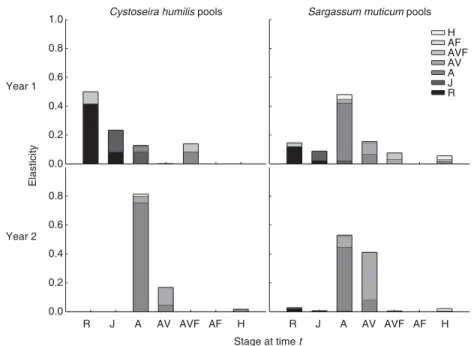
The population growth rate of S. muticum in both pool types was more sensitive to the probability of surviving and staying in the adult stage (stasis of the A stage) (Fig. 4). The survival of micro-recruits and the persistence of individuals with gas
Fig. 2. Population growth rates (λ) of Sargassum muticum in
Cystoseira humilis- and S. muticum-dominated pools in the 2 years of the study. Stoch is a stochastic simulation of population growth rates (see text). Populations with growth rates below 1 are declining and with larger than 1 are increasing; population sizet+1 = (population
size t)λ.
Fig. 3. Mean reproductive values of Sargassum muticum stage classes in Cystoseira humilis- and S. muticum-dominated pools in each month
680 A. Engelen & R. Santos
vesicles were also important in C. humilis-dominated pools in year 1, and in S. muticum-dominated pools in year 2, respectively (Fig. 4). Fertile stages and their fertilities were only relevant, in year 1 in both pool types, even though elasticity values were low (Fig. 4). The population growth rate of S. muticum was more sensitive to fertility in C. humilis-dominated pools. As previously observed for population growth and reproductive values, the variability of elasticity values was higher in the C. humilis-dominated pools.
Periodic elasticity values showed strong temporal variation (Fig. 5). The stasis of stage A (non-fertile adults without gas vesicles) had the highest elasticity values, peaking from March to April in C. humilis-dominated pools and from April to July in S. muticum-dominated pools. Whereas the stasis of stage A was always the vital rate with the highest value in C. humilis-dominated pools, the stasis of non-fertile adults with gas vesicles (stage AV) in S. muticum-dominated pools were higher from September to January than the stasis of non-fertile adults without gas vesicles (stage A; Fig. 5). The population growth rate of S. muticum in the C. humilis-dominated pools was also sensitive to recruit (stage R) survival, particularly from July to January (Fig. 5). The population growth rate of S. muticum was not sensitive to other transitions except from juveniles (stage J) to non-fertile adults without gas vesicles (A stage) in February and from non-fertile adults without gas vesicles (A stage) to fertile adults with gas vesicles (AVF stage) in May in C. humilis-dominated pools. The triangular plot of the relative contributions of stasis, growth and fertility to population growth rates highlights that per-sistence was the main contributor to population growth, particularly in the S. muticum-dominated pools (Fig. 6). Growth was more important in the C. humilis-dominated pools and fertility played a smaller role in these pools only in March and April.
Fig. 4. Mean transition elasticities of
Sargassum muticum in Cystoseira humilis-and S. muticum-dominated pools. Stages as in Fig. 1.
Fig. 5. Mean monthly periodic elasticity values of Sargassum
muticum populations in Cystoseira humilis- and S. muticum-dominated pools. Only transitions with elasticity value of at least 0.05 in at least one of the months are shown; R→R (closed circle), J→A (open circle), A→A (closed triangle), A→AVF (open triangle), AV→A (closed square) and AV→AV (open square). Stages as in Fig. 1.
Demographic traits of Sargassum muticum 681
Discussion
It is generally accepted that most invasions start with slow ‘lag phases’ of population growth, even though supporting evidence has been mostly anecdotal (Sakai et al. 2001; Parker 2004). Our results support the general observation of a lag phase in the S. muticum invasion of the intertidal pools along the south-west coast of Portugal. Significantly lower popula-tion growth rates were found in the pools where the native species C. humilis was dominant (a putative early phase of invasion), than when S. muticum is the dominant species (a later phase of invasion). Lag times are considered to be caused by the exponential growth process, the stochastic extinction of propagules and evolutionary effects, lack of suitable local habitat or inclement environmental conditions (Pysek & Hulme 2005). Evolutionary effects may cause lag times either through adaptive evolution after a single colonization event or by sorting of adaptive genotypes following multiple colonization events (Sakai et al. 2001). In the case of S. muticum, however, evolutionary effects are unlikely because the studied populations have existed for < 10 years. The first occurrence of the species in northern Portugal was reported in 1989, the estimated rate of spread in the north-east Atlantic is c. 70 km year–1 (F. Mineur, unpubl. data), and the length of the
Portuguese west coast is c. 700 km. Lag phases can also result from fertilization limitation due to the lack of sexual partners (Allee effect, Davis et al. 2004). It also is unlikely that an Allee
effect played a major role in the S. muticum lag phase, as the elasticity of population growth rate to fertility is low and self fertilization is possible (Engelen, unpubl. data) as it is in other species of Fucales (Perrin et al. 2007). No genetic tools are yet available to determine the relative importance of self and cross fertilization in S. muticum.
Projected growth rates of the invader were lower (1.25) when co-occurring (initial stages of invasion) with C. humilis than when in monoculture (last stage of invasion; 1.83). Growth rates during the initial phase were similar to estimates for seaweeds in their natural habitats (c. 1.0) (brown seaweeds, Ang & De Wreede 1990; Åberg 1992a,b; Engelen et al. 2005; red seaweeds, Ang et al. 1990; Santos 1993; Engel et al. 2001). In contrast, growth rates in the late stage of invasion were similar to those estimated using similar matrix model approaches for highly successive invasive weeds, such as the nodding thistle (Carduus nutans) in New Zealand (2.21 and 1.44, Shea & Kelly 1998) and the Scotch or Scot’s broom (Cytisus scoparius) in Washington State, USA (0.88 to 1.93, Parker 2000).
The much higher variability of S. muticum population growth rates (and of reproductive and elasticity values) in the early stage of invasion (with C. humilis) than in the late stage suggests that the growth conditions in the pools are more stable when the invader dominates the pools. That is, the progression of the S. muticum invasion ‘modulates’ the environment to its own requirements, especially during spring and early summer, when S. muticum fronds eventually occupy all the available
Fig. 6. Triangular ordination of the relative contribution of the Sargassum muticum vital rates stasis, growth and fertility to population growth
in Cystoseira humilis-dominated (open circles) and S. muticum-dominated (closed circles) pools for each month of the year averaged over 2 years. Three letter abbreviations identify months.
682 A. Engelen & R. Santos
surface space within the pools. This coincides with the period of highest sensitivity of population growth rate to the persistence of the adult fronds. Reproduction did not contribute to the variability observed in the early phase of invasion, because the elasticity values of population growth rate to the transitions from fertile stages to recruits are very low and when reproduc-tion was excluded from the models, the variability pattern was similar to that with reproduction. The observed differences in growth rate variability between early and late phases of invasion suggest that the likelihood of S. muticum disappearing from a local pool decreases with time. Using life-table analysis of several plant species, Menges (1992) demonstrated by sys-tematically varying environmental stochasticity in a series of simulations that populations with deterministic growth rates near 1.0 are much more likely to go extinct when exposed to moderate environmental stochasticity than populations with higher growth rates.
The generation times estimated for S. muticum increased from early (4.2 years) to late (7.0 years) invasion phases, further supporting the hypothesis that the species modulates the environmental conditions. Longevity estimates of S. muticum in Portugal are comparable to those estimated for S. polyceratium in the Caribbean (2.8–8.4 years), also using a matrix model (Engelen et al. 2005). In contrast, generation times of the red seaweed Gracilaria gracilis ranged from 20 to 42 years (Engel et al. 2001). Compared with terrestrial plants, the generation times of S. muticum correspond to those of herbs. The giant Hogweed Heracleum mantegazzianum, a species native to the north-western Great Caucasus that has invaded large parts of Europe has estimated generation times from 2.99 to 6.23 years (Hüls et al. 2007). Another example is the invasive large-flower evening-primrose (Oenothera glazioviana), a hybrid from garden origin, with generation times of 4.7 years (Rees & Rose 2002). The potential for an invader to modify the environment to suit its requirements has not been considered when analysing species traits that determine invasiveness. The demographic traits that have been considered to promote invasiveness in terrestrial plants are generally those of r-selected life histories such as short generation time, high fecundity and high growth rates (Elton 1958; Baker 1974; Sakai et al. 2001). In algae, the successful traits include vegetative reproduction by propagules and fragmentation, a ruderal growth strategy and chemical defences or other specific strategies to avoid herbivory (Nyberg & Wallentinus 2005). However, few studies compared quantita-tively the traits of introduced species to distinguish invaders and non-invaders. Kolar & Lodge (2001) analysed the available quantitative data concluding that the only demographic traits of plants that were significantly related to invasiveness were the ability to reproduce vegetatively and the low variability in seed crops. Some of their findings are contrary to the pre-viously commonly hypothesized traits. For example, the length of flowering period or whether the species is an annual or a perennial was not related to plant establishment or invasiveness.
We showed here that rather than reproduction or individual growth, the most important demographic trait for the popula-tion growth rate of S. muticum in south-western Portugal was,
for both dominance levels, the stasis of the non-fertile adult stage, that is, the persistence of adult fronds and, to a lesser degree, the persistence of micro-recruits. A strong dependence of population growth rate on persistence of adult individuals has also been found for other brown algal species similar to S. muticum, such as S. polyceratium (Engelen et al. 2005) and Ascophyllum nodosum (Åberg 1992b). However, habitats differ in many aspects and no single strategy or set of traits of invasive species can be expected to result in success everywhere. Invasion success depends on the match between the traits of the invader and the habitat it invades, in particular with the native species with whom the invader will have to compete for resources (Shea & Chesson 2002).
The combination of K-selected traits and an increase in population growth rate when S. muticum became more dominant suggested that competition with the native species C. humilis was an important biotic filter for the establishment phase of S. muticum invasion. Three non-exclusive patterns of competition are defined: (i) suppression by species that are morphologically, phenologically and physiologically similar, (ii) suppression by a single dominant species and (iii) suppression by an assemblage of species with different traits, which can compete more strongly with an invader than any one species alone (Theoharides & Dukes 2007). The first two processes probably occur in the pools of the south-west coast of Portugal as the closely related C. humilis has a similar morphology and is the dominant species of the pool habitat. However, C. humilis, like Halidrys siliquosa in Denmark, has a perennial rather than the pseudo-perennial life history of S. muticum (Wernberg et al. 2001; Pedersen et al. 2005). The K-selected traits of S. muticum, therefore, are most important to its invasive success. A recent study of invader fruit flies in La Réunion, also revealed that the key traits for invasion in this system were K-selected ones that favoured competition rather than r-selected traits that favour colonization (Duyck et al. 2007). The hypothesis that strong invaders are r-strategists (Lodge 1993; Rejmanek & Richardson 1996) must rely on the assumption that competition is not a limiting filter for invasion. In this case, the most successful invaders are those whose niche requirements differ most from those of the species of the native communities as Stachowicz & Tilman (2005) observed for grassland plants and marine invertebrates.
Our observations found that successful S. muticum invasion relies on K-selected traits should not be generalized to other habitats or latitudes, particularly to those with different dis-turbance regimes. For example, S. polyceratium has a very flexible life history, which enables the species to shift between several optional strategies that rely entirely on persistence, fertility or vegetative regeneration for survival during episodic winter storms and hurricanes (Engelen et al. 2005). Variable environmental conditions were not encountered during this study and so it remains uncertain which, if any, life-history stage of S. muticum is flexible. Some flexibility was apparent, as S. muticum holdfasts that were buried under sand for periods as long as one year rapidly regenerated when the sand was removed and became the dominant pool species in the following spring (Engelen, unpubl. data).
Demographic traits of Sargassum muticum 683 In conclusion, we have shown that higher population
growth rates in the late phase of invasion, relative to the early phase, were crucial to invasion success of S. muticum in Portuguese tidal pools. In contrast to many other studies of invasive species (animals and plants), our results also suggest that the invasiveness of S. muticum, relies on K- rather than r-selected traits and that no drastic shifts in life-history strategy were present between invasion phases.
Acknowledgements
We thank Catarina Alves and Carla Monteiro for their dedicated fieldwork, as well as two anonymous referees and J. Coyer for their valuable comments and suggestions on the manuscript. The study was funded by the EU project ALIENS EVK3-CT-2001-00062 and FCT project POCI/MAR/55377/2004. AE was supported by FCT scholarship SFRH/BPD/7153/2001.
References
Åberg, P. (1990) Measuring size and choosing category size for a transition matrix study of the seaweed Ascophyllum nodosum. Marine Ecology Progress
Series, 63, 281–288.
Åberg, P. (1992a) Size-based demography of the seaweed Ascophyllum nodosum in stochastic environments. Ecology, 73, 1488–1501.
Åberg, P. (1992b) A demographic study of two populations of the seaweed
Ascophyllum nodosum. Ecology, 73, 1473–1487.
Alvarez, M.E. & Cushman, J.H. (2002) Community-level consequences of a plant invasion: effects on three habitats in coastal California. Ecological
Applications, 12, 1434–1444.
Ang, P., De Wreede, R.E., Shaughnessy, F. & Dyck, L. (1990) A simulation model for an Iridaea splendens (Gigartinales, Rhodophyta) population in Vancouver, Canada. Hydrobiologia, 204/205, 191–196.
Ang, P.O. Jr. & De Wreede, R.E. (1990) Matrix models for algal life history stages. Marine Ecology Progress Series, 59, 171–181.
Baker, H.G. (1965) Characteristics and modes of origin of weeds. The Genetics
of Colonizing Species (eds H.G. Baker & G.L. Stebbins), pp. 147–169.
Academic Press, New York.
Baker, H.G. (1974) The evolution of weeds. Annual Reviews of Ecology and
Systematics, 5, 1–24.
Balbino, R., Pimentel, N. & Brilha, J. (2004) Geological heritage and high-school students: sedimentary aspects from SW Portugal. 23rd IAS Meeting
of Sedimentology. Coimbra-Portugal, 15–17 September 2004, Abstracts book
(eds R. Pena dos Reis, P. Callapez & P. Dinis), p. 53. Coimbra.
Britton-Simmons, K. (2004) Direct and indirect effects of the introduced alga
Sargassum muticum on benthic, subtidal communities of Washington State,
USA. Marine Ecology Progress Series, 277, 61–78.
Caley, P., Groves, R.H. & Barker, R. (2008) Estimating the invasion success of introduced plants. Diversity and Distributions, 14, 196–203.
Caswell, H. (2001) Matrix Population Models. 2nd ed. Sinauer, Sunderland. Caswell, H. & Trevisan, M.C. (1994) The sensitivity analysis of periodic matrix
models. Ecology, 75, 1299–1303.
Cohen, J.E., Kesten, H. & Newman, C.M. (1986) Random Matrices and Their
Applications. American Mathematical Society, Providence.
Critchley, A. (1981) Age determination of Sargassum muticum (Yendo) Fensholt.
British Phycological Journal, 16, 134.
Critchley, A.T., Farnham, W.F. & Morrell, S.L. (1983) A chronology of new European sites of attachment for the invasive brown alga, Sargassum muticum, 1973–1981. Journal of the Marine Biological Association of the UK, 63, 799–811. Critchley, A.T., Farnham, W.F. & Morrell, S.L. (1986) An account of the attempted control of an introduced marine alga, Sargassum muticum, in Southern England. Biological Conservation, 35, 313–332.
Critchley, A.T., Farnham, W.F., Yoshida, T. & Norton, T.A. (1990) A bibliography of the invasive alga Sargassum muticum (Yendo) Fensholt (Fucales; Sar-gassaceae). Botanica Marina, 33, 551–562.
D’Antonio, C.M. & Kark, S. (2002) Impacts and extent of biotic invasions in terrestrial ecosystems. Trends in Ecology and Evolution, 17, 202–204. Daehler, C.C. (2003) Performance comparisons of co-occurring native and
alien plants: implications for conservation and restoration. Annual Review in
Ecology and Systematics, 34, 183–211.
Davis, H.G., Taylor, C.M., Lambrinos, J.G. & Strong, D.R. (2004) Pollen limitation causes an Allee effect in a wind-pollinated invasive grass (Spartina
alterniflora). Proceedings of the National Academy of Sciences USA, 101,
13804–13807.
De Kroon, H., Plaisier, A., van Groenendael, J. & Caswell, H. (1986) Elasticity: the relative contribution of demographic parameters to population growth rate. Ecology, 67, 1427–1431.
Druehl, L. (1973) Marine transplantations. Science, 179, 12.
Duyck, P.-F., David, P. & Quilici, S. (2007) Can more K-selected species be better invaders? A case study of fruit flies in La Réunion. Diversity and
Distributions, 13, 535–543.
Efron, B. & Tibshirani, R. (1993) Bootstrap methods for standard errors, confidence intervals, and other measures of statistical accuracy. Statistical
Science, 1, 54–77.
Elton C.S. (1958) The Ecology of Invasions by Animals and Plants. Methuen, London.
Engel, C., Åberg, P., Gaggiotti, O.E., Destombe, C. & Valero, M. (2001) Popula-tion dynamics and stage structure in a haploid–diploid red seaweed,
Gracilaria gracilis. Journal of Ecology, 89, 436–450.
Engelen, A.H. (2004) Flexibility without compromise. The population biology of
the brown seaweed Sargassum polyceratium around Curaçao. PhD thesis,
University of Groningen, Groningen.
Engelen, A.H., Breeman, A.M., Olsen, J.L., Stam, W.T. & Åberg, P. (2005) Life history flexibility allows Sargassum polyceratium to persist in different environments subjected to stochastic disturbance events. Coral Reefs, 24, 670–680.
Engelen, A.H., Espirito-Santo, C., Simões, T., Monteiro, C., Santos, R., Serrão, E. & Pearson, G. (2008). Periodicity of egg expulsion and germling release in the competing native brown seaweed Cystoseira humilis and the invader Sargassum muticum, in Portugal. European Journal of Phycology, 43, 275–282.
Farnham, W., Murfin, C., Critchley, A. & Morrell, S. (1981) Distribution and control of the brown alga Sargassum muticum. Proceedings of the Xth
International Seaweed Symposium, Göteborg, Sweden (ed. T. Levring),
pp. 277–282. Academic Press, Berlin.
Fisher, R.A. (1937) The wave of advance of advantageous genes. Annals of
Eugenics, 7, 353–369.
Givernaud, T., Cosson, J. & Givernaud-Mouradi, A. (1991) Etude des populations de Sargassum muticum (Yendo) Fensholt sur les côtes de Basse-Normandie (France). Estuaries and coasts: spatial and temporal
intercomparisons. (eds M. Elliott & J.P. Ducrotoy), pp. 129–132. Olsen &
Olsen, Fredensborg, for Estuarine and Coastal Sciences Association, Caen.
Griffith, A.B. & Forseth, I.N. (2005) Population matrix models of
Aeschyno-mene virginica, a rare annual plant: implications for conservation. Ecological
Applications, 15, 222–233.
Horvitz, C.C. & Schemske, D.W. (1995) Spatiotemporal variation in demo-graphic transitions of a tropical understorey herb: projection matrix analysis.
Ecological Monographs, 65, 155–192.
Hüls, J., Otte, A. & Eckstein, R.L. (2007) Population life-cycle and stand structure in dense and open stands of the introduced tall herb Heracleum
mantegazzianum. Biological Invasions, 9, 799–811.
IMF (International Monetary Fund) (2003) World Economic Outlook Database. Retrieved from www.imf.org/external/pubs/ft/weo/2003/01/data on 29 November 2006.
Kaye, T.N., Pendergrass, K.L., Finley, K. & Kauffman, J.B. (2001) The effect of fire on the population viability of an endangered prairie plant. Ecological
Applications, 11, 1366–1380.
Kendrick, G.A. & Walker, D.I. (1991) Dispersal distances for propagules of
Sargassum spinuligerum (Sargassaceae, Phaeophyta) measured directly by
vital staining and venturi suction sampling. Marine Ecology Progress Series,
79, 133–138.
Knight, K.S., Kurylo, J.S., Endress, A.G., Stewart, J.R. & Reich, P.B. (2007) Ecology and ecosystem impacts of common buckthorn (Rhamnus cathartica): a review. Biological Invasions, 9, 925–937.
Kolar, C.S. & Lodge, D.M. (2001) Progress in invasion biology: predicting invaders. Trends in Ecology and Evolution, 16, 199–204.
Kowarik, I. (1995) Time lags in biological invasions with regard to the success and failure of alien species. Plant Invasions: General Aspects and Special
Problems (eds P. Pysek, K. Prach, M. Rejmánek & M. Wade), pp. 15–38. SPB
Academic Publishing, The Hague.
Ladah, L., Bermudez, R., Pearson, G. & Serrão, E. (2003) Fertilization success and recruitment of dioecious and hermaphroditic fucoid seaweeds with contrasting distributions near their southern limit. Marine Ecology Progress
Series, 262, 173–183.
Liao, C., Liu, Y., Jiang, L., Zhou, X., Wu, X., Fang, C., Chen, J. & Li, B. (2007) Invasion of Spartina alterniflora enhanced ecosystem carbon and nitrogen stocks in the Yangtze Estuary, China. Ecosystems, 10, 1351–1361.
684 A. Engelen & R. Santos
Lluch, R.J., Gómez Garreta, A., Barceló, M.C. & Ribera, M.A. (1994) Mapas de distribución de algas marinas de la Península Ibérica e Islas Baleares. VII.
Cystoseira C. Agardh (Grupo C. baccata) y Sargassum C. Agardh (S. muticum
y S. vulgare). Botanica Complutenses, 19, 131–138.
Lodge, D.M. (1993) Biological invasions: lessons for ecology. Trends in Ecology
and Evolution, 8, 133–137.
Mack, R.N., Simberloff, D., Lonsdale, W.M., Evans, H., Clout, M. & Bazzaz, F.A. (2000) Biotic invasions: causes, epidemiology, global consequences, and control. Ecological Applications, 10, 689–710.
McEvoy, P.B. & Coombs, E.M. (1999) Biological control of plant invaders: regional patterns, field experiments, and structured population models.
Ecological Applications, 9, 387–401.
Menges, E. (1992) Stochastic modeling of extinction in plant populations.
Conservation Biology (eds P.L. Fiedler & S.K. Jain), pp. 253–275. Oxford
University Press, New York.
Mills, L.S., Doak, D.F. & Wisdom, M.J. (1999) Reliability of conservation actions based on elasticity analysis of matrix models. Conservation Biology,
13, 815–829.
Muth, N.Z. & Pigliucci, M. (2006) Traits of invasives reconsidered: phenotypic comparisons of introduced invasive and introduced noninvasive plant species within two closely related clades. American Journal of Botany, 93, 188–196.
Norton, T.A. (1976) Why is Sargassum muticum so invasive? British Phycological
Journal, 11, 197–198.
Nyberg, C.D. & Wallentinus, I. (2005) Can species traits be used to predict marine macroalgal introductions? Biological Invasions, 7, 265–279. Parker, I.M. (2000) Invasion dynamics of Cystisus scoparius: a matrix model
approach. Ecological Applications, 10, 726–743.
Parker, I.M. (2004) Mating patterns and rates of biological invasion. Proceedings
of the National Academy of Sciences USA, 101, 13695–13696.
Parker, I.M., Simberloff, D., Lonsdale, W.M., Goodell, K., Wonham, M., Kareiva, P.M., Williamson, M.H., Von Holle, B., Moyle, P.B., Byers, B.E. & Goldwasser, L. (1999) Impact: towards a framework for understanding the ecological effect of invaders. Biological Invasions, 1, 3–9.
Pascarella, J.B. & Horvitz, C.C. (1998) Hurricane disturbance and the population dynamics of a tropical understory shrub: megamatrix elasticity analysis. Ecology, 79, 547–563.
Pedersen, M.F., Stæhr, P.A., Wernberg, T. & Thomsen, M. (2005) Biomass dynamics of exotic Sargassum muticum and native Halidrys siliquosa in Limfjorden, Denmark: implications of species replacements on turnover rates. Aquatic Botany, 83, 31–47.
Perrin, C., Daguin, C.M., Engel, C.R., Pearson, G.A. & Serrao, E.A. (2007) Implications of mating system for genetic diversity of sister algal species:
Fucus spiralis and Fucus vesiculosus (Heterokontophyta, Phaeophyceae).
European Journal of Phycology, 42, 219–230.
Pimentel, D. (2002) Biological Invasions: Economic and Environmental Costs of
Alien Plant, Animal, and Microbe Species. CRC Press, Boca Raton.
Pysek, P. & Hulme, P.E. (2005) Spatio-temporal dynamics of plant invasions: linking pattern to process. Ecoscience, 12, 302–315.
Ramalho, M., Fidalgo, L. & Pinheiro, I. (1998) Carta Verde do Litoral Alentejano.
Direcção Regional do Ambiente, Alentejo. (in Portuguese.)
Rees, M. & Rose, K.E. (2002) Evolution of flowering strategies in Oenothera
glazioviana: an integral projection model approach. Proceedings of the Royal
Society, 269, 1509–1515.
Rejmánek, M. & Richardson, D.M. (1996) What attributes make some plant species more invasive? Ecology, 77, 1655–1661.
Richardson, D.M., Pysek, P., Rejmánek, M., Barbour, M.G., Panetta, F.D. & West, C.J. (2000) Naturalization and invasion of alien plants: concepts and definitions. Diversity and Distributions, 6, 93–107.
Sakai, A.K., Allendorf, F.W., Holt, J.S., Lodge, D.M., Molofsky, J., With, K.A., Baughman, S., Cabin, R.J., Cohen, J.E., Ellstrand, N.C., McCauley, D.E., O’Neil, P., Parker, I.M., Thompson, J.N. & Weller, S.G. (2001) Population biology of invasive species. Annual Reviews of Ecology and
Systematics, 32, 305–332.
Santos, R. (1993) Plucking or cutting Gelidium sesquipedale? A demographic simulation of harvest impact using a population projection matrix model.
Hydrobiologia, 260/261, 269–276.
Shea, K. & Chesson, P. (2002) Community ecology theory as a framework for biological invasions. Trends in Ecology and Evolution, 17, 170–176. Shea, K. & Kelly, D. (1998) Estimating biocontrol agent impact with matrix
models: Carduus nutans in New Zealand. Ecological Applications, 8, 824– 832.
Stachowicz, J.J. & Tilman, D. (2005) Species invasions and the relation-ships between species diversity, community saturation, and ecosystem functioning. Species Invasions: Insights into Ecology, Evolution, and
Biogeography. (eds D.F. Sax, J.J. Stachowicz & S.D. Gaines), pp. 41–64.
Sinauer, Sunderland.
Stæhr, P., Pedersen, M.F., Thomsen, M.S., Wernberg, T. & Krause-Jensen, D. (2000) Invasion of Sargassum muticum in Limfjorden (Denmark) and its possible impact on the indigenous macroalgal community. Marine Ecology
Progress Series, 207, 79–88.
Sutherland, S. (2004) What makes a weed a weed: life history traits of native and exotic plants in the USA. Oecologia, 141, 24–39.
Theoharides, K.A. & Dukes, J.S. (2007) Plant invasion across space and time: factors affecting nonindigenous species success during four stages of inva-sion. New Phytologist, 176, 256–273.
Vitousek, PM. (1990) Biological invasions and ecosystem processes: toward an integration of population biology and ecosystem studies. Oikos, 57, 7– 13.
Vitousek, P.M., Walker, L.R., Whiteaker, L.D., Mueller-Bombois, D. & Matson, P.A. (1987) Biological invasions by Myrica faya alters ecosystem development in Hawaii. Science, 238, 802–804.
Wernberg, T., Thomsen, M.S., Stæhr, P.A. & Pedersen, M.F. (2001) Comparative phenology of Sargassum muticum and Halidrys siliquosa (Phaeophyceae: Fucales) in Limfjorden, Denmark. Botanica Marina, 44, 31–39.
Received 18 June 2008; accepted 9 March 2009 Handling Editor: Christer Nilsson