ORIGIN
AL RESEAR
CH
¹Professor of the course of Physical therapy at Universidade do Vale do Sapucaí (Univás) – Pouso Alegre (MG), Brazil. ²Physical therapist from Universidade Federal de Alfenas (Unifal-MG) – Alfenas (MG), Brazil.
³Professor of the course of Physical therapy at the Motion Analysis Laboratory (LAM) of Universidade Federal de Alfenas (Unifal-MG) – Alfenas (MG), Brazil.
ABSTRACT | For optimal postural control, the
center of mass (COM) of the body is a variable that is projected vertically between the legs, over a support base. This study had as aim assessing the inter- and intra-rater reliability of the projection of the COM over the support base, measured with the aid of the Postural Evaluation Software (SAPO). Fifty-seven volunteers were evaluated and all were subjected to photographic records taken from the anterior, left and right lateral views, at the same time. The pictures were handed over to two raters, who then used SAPO to analyze them. For the statistical analysis, the intra-class correlation coefficient (ICC) was used, and to estimate the minimum detectable change (MDC), the standard error (SE) was used. The results showed excellent levels of inter and intra-rater reliability for asymmetries in the frontal and sagittal planes, and for the projection of the center of gravity in the frontal and lateral planes (ICC>0.90; 95%CI>0.95; MDC between 2.16 – 4.87). The results of the study showed that the analysis of the COM obtained with SAPO had good inter- and intra-rater reliability.
Keywords | Photogrammetry; Postural Balance; Posture; Rehabilitation.
RESUMO | Para o ótimo controle postural, o centro
de massa (COM) do corpo é uma variável que se projeta verticalmente entre os pés, dentro de uma
349
base de suporte. Este estudo teve por objetivo avaliar a confiabilidade inter e intra-avaliadores da projeção do COM na base de sustentação, mensurada com auxílio do Software de Avaliação Postural (SAPO). Cinquenta e sete voluntárias foram avaliadas e todas foram submetidas ao registro fotográfico nas vistas anterior, lateral direita e esquerda, no mesmo instante temporal. As imagens foram entregues a dois examinadores, os quais utilizaram o SAPO. Para a análise estatística, foi utilizado o coeficiente de correlação intraclasse (ICC) e, para estimar a mínima mudança detectável (MMD), foi utilizado o erro padrão (EP). Os resultados demonstraram excelentes níveis de confiabilidade interexaminador e intraexaminador para assimetrias nos planos frontal, sagital e para a projeção do centro de gravidade no plano frontal e lateral (ICC>0,90; 95%IC>0,95; MDD entre 2,16 – 4,87). Os resultados do estudo demonstraram que a análise do COM obtida por meio do SAPO apresentou boa confiabilidade nas análises inter e intra-avaliadores.
Descritores | Fotogrametria; Equilíbrio Postural; Postura; Reabilitação.
RESUMEN | Para el óptimo control postural, el
centro de masa (COM) del cuerpo es una variable que se proyecta verticalmente entre los pies, dentro de una base de soporte. Este estudio tuvo por objetivo evaluar la confiabilidad inter e intraevaluadores de la proyección del COM en la base de sostenimiento,
Intra and inter-rater reliability of the projection of the
body’s center of mass obtained via photogrammetry
Análise intra e interavaliadores da projeção do centro de massa do corpo obtido por
fotogrametria
Análisis intra e interevaluadores de la proyección del centro de masa del cuerpo obtenido por
fotogrametría
Ricardo da Silva Alves1, Isabela Carvalho Pereira2, Denise Hollanda Iunes3,
Carmélia Bomfim Jacó Rocha3, Simone Botelho3, Leonardo César Carvalho3
medida con apoyo del Software de Evaluación Postural (SAPO). Se evaluaron cincuenta y siete voluntarias y todas han sido sometidas al registro fotográfico en las vistas anterior, lateral derecha e izquierda, en el mismo instante temporal. Las imágenes han sido entregadas a dos examinadores, que utilizaron SAPO. Para el análisis estadístico, se utilizó el coeficiente de correlación intraclase (ICC) y, para estimar el mínimo cambio detectable (MMD), se utilizó el error estándar (EP). Los resultados demostraron excelentes
niveles de confiabilidad interexaminador e intraexaminador para asimetrías en los planos frontal y sagital y para la proyección del centro de gravedad en el plano frontal y lateral (ICC>0.90, 95% IC>0.95, MDD entre 2.16 – 4.87). Los resultados del estudio demostraron que el análisis del COM obtenido a través de SAPO presentó buena confiabilidad en los análisis inter e intraevaluadores.
Palabras clave | Fotogrametría; Equilibrio Postural; Postura; Rehabilitación.
INTRODUCTION
Human posture can be described as the positioning
in equilibrium of all body segments in a given moment1,2.
In this sense, the search for the correct posture is
important for maintaining good health conditions3.
Postural evaluation in the orthostatic position has been widely used both in clinical practice and in researches, as a diagnostic tool for planning and monitoring
physiotherapeutic treatment4,5. Various methods have
been used to evaluate upright posture with the body’s
natural oscillation6. Stabilometry is a method that allows
registering the natural oscillation of the human body and
estimating possible postural changes7. Other methods
have been described to quantify posture, such as the
inclinometer, video cameras and radiography8. However,
it is not common to use these methods in clinical practice due to the unavailability of such equipment to
professionals4, in addition to problems related to radiation
exposure for this last method9.
Another resource used for postural evaluation is
computerized photogrammetry10. This technique is a
useful tool, with low cost, good reliability for postural
evaluation4,11,12 and is accessible to the majority of
physical therapists.
In clinical practice, the method of postural
evaluations is part of a physical examination’s routine13.
Commonly these evaluations and interpretations are conducted in the form of visual and subjective
inspection8,12. In the quantitative assessments performed
by health professionals and researchers it is not only the measurement of postural changes that occurs, but
also the improvement in the monitoring of patients12.
Thus, new studies aimed at validating and estimating the reliability of the different postural and static balance evaluation systems in clinical environments are needed.
The use of photogrammetry has good reliability for postural evaluation as a method of analysis of body
angles4,12. However, there are several tools that result in
partial validations for specific regions of the body or that
analyze a small sample12. A study conducted by Ferreira
et al.12 demonstrates that SAPO exhibits good intra-
and inter-rater reliability for all measures carried out with regard to the analysis of body angles and distances. However, the same study did not assess the other tool available in the software which allows the static analysis of the COM.
The COM is a variable that can be measured via
computerized photogrammetry14, its trajectory being a
measure used to understand the mechanisms of postural
control in different motor actions6. The COM is defined
as the point of application of the resulting gravitational
force on the body15 that acts over the base of support, the
area delimited by the lateral sides of the feet. This base of support provides a stability threshold, over which several tasks and movements may be performed without the loss of balance, expressing thus the individual’s base
of functional support15.
Therefore, this study had as aim assessing the inter- and intra-rater reliability of the projection of the COM on the support base, via photographic records measured with SAPO.
METHODOLOGY
Casuistry
Fifty-seven volunteers participated in the study, aged 23.38±2.96 years old, with 1.64±0.06 m in height
and BMI: 22.27±4.51 Kg/m2. The criteria for inclusion
cognitive disorders; serious infectious and contagious diseases; neuromuscular abnormalities; history of abdominopelvic surgery; changes in the visual, vestibular and somatosensory systems limiting the maintenance of orthostatic position.
Projection of the COM via photogrammetry
The projection of the COM was measured via photogrammetry, with the aid of three professional
Nikon cameras®, with 14.1 megapixels each, positioned
around the volunteer and synchronized for a single shot. Markings with 30 mm in diameter were used on the tragus of the ear; the acromion; the anterior superior iliac spine; the greater trochanter of the femur; the joint line of the knee; the lateral malleolus and the region between the head of the second and third metatarsals, bilaterally. All markings of the anatomical landmarks were carried out by the same rater.
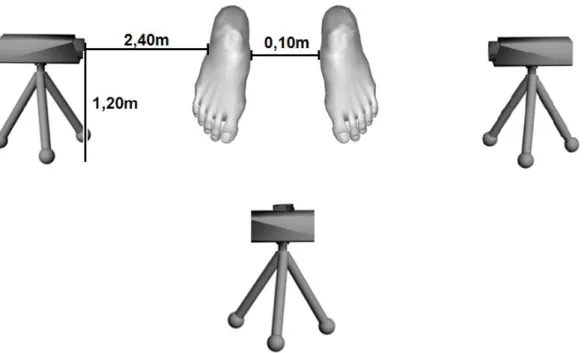
The collection of the photographic images was held in a calm and appropriate environment. In the picture plane, a 1-m-long plumb line with a 0.10 m marking was used (Figure 1).
Each volunteer was placed in orthostatism beforehand for 20s on an ethylene-vinyl acetate (EVA) mat with the tibial malleoli positioned in parallel at a 0.10m distance. The photos were taken with eyes open
and directed towards a white wall. The cameras were positioned at a 2.40 m distance from the volunteer, perpendicularly, at a 1.20 m height from the ground. Each camera obtained an image corresponding to the anterior, right and left lateral views.
After the acquisition of the photographic records, the images were stored on a computer and handed over to two raters acquainted with SAPO v. 0.68. The guidelines given to the raters were: Open SAPO > Create new project > Open image (anterior view initially) > ok > vertical calibration and scaling of the image (according to the plumb line in the photo) > draw a line above the marking on the plumb line > Apply > Calibration of this line: 0.10 m > Calibrate > Verify calibration and image rotation > yes > ok > Leave > Analyses > Marking of landmarks on the image in accordance with the protocol.
After performing the markings on the anterior, right and left lateral views, the analysis report was generated, including: COM, asymmetry in the frontal and sagittal planes, and the projection of the position of the COM in relation to the average position of the malleoli in the frontal and lateral planes. The photographic analysis was collected after a week; rater 1 was responsible for repeating the analysis of the pictures. The marking of the anatomical landmarks on the software followed the criteria established by SAPO, as shown in Figure 2, always held by the same rater.
Ethical considerations
The study was approved by the Research Ethics Committee at Universidade Federal de Alfenas (CAAE: 08317312.5.0000.5142). All volunteers were informed about the purpose of the study and of the procedures to be carried out; after agreeing, they all signed an Informed Consent Form.
Statistical analysis
For the statistical analysis, the software Statistical Package for the Social Sciences (SPSS v.20.0) for Windows was used. Intra-and inter-rater reliability was analyzed using the Intraclass Correlation Coefficient – type 1.1 and type 1.2 – (ICC). The interpretation of
the ICC was carried out in accordance with Lexell16,
with reliability <0.40 being deemed as poor; 0.40-0.75 as good, and >0.75 as excellent. The 95% Confidence
Interval (95%) was calculated, values above 0.7017 being
considered as excellent. The calculation of the Standard Error of Measurement (SE) was carried out using the formula: SE=Standard Deviation×√(1-ICC). The minimum detectable change (MDC) was calculated using the formula: MDC=1.96×Highest Standard
Deviation×√(2[1-test-retest])16. A 0.05% significance
level (α) was used in all tests.
RESULTS
In Table 1, the mean values and standard deviation of the variables obtained with the two raters’ analysis of the photogrammetry and the retest performed by rater 1 are shown.
Table 1. Values of mean and standard deviation of the analyses obtained with SAPO by raters 1 (test-retest) and 2
Means (SD)
Rater 1 Rater 2 Retest 1
AFP (%) 7.60 (16.39) 8.12 (16.91) 7.95 (16.47)
ASP (%) 31.07 (10.44) 31.36 (10.17) 31.29 (10.10)
PCOMFP (cm) 6.15 (14.19) 6.05 (13.93) 6.46 (14.20)
PCOMLP (cm) 33.28 (11.85) 31.97 (11.24) 33.48 (11.46)
AFP: asymmetry in the frontal plane; ASP: asymmetry in the sagittal plane; PCOMFP: projection of the center of mass in the frontal plane; PCOMLP: projection of the center of mass in the lateral plane
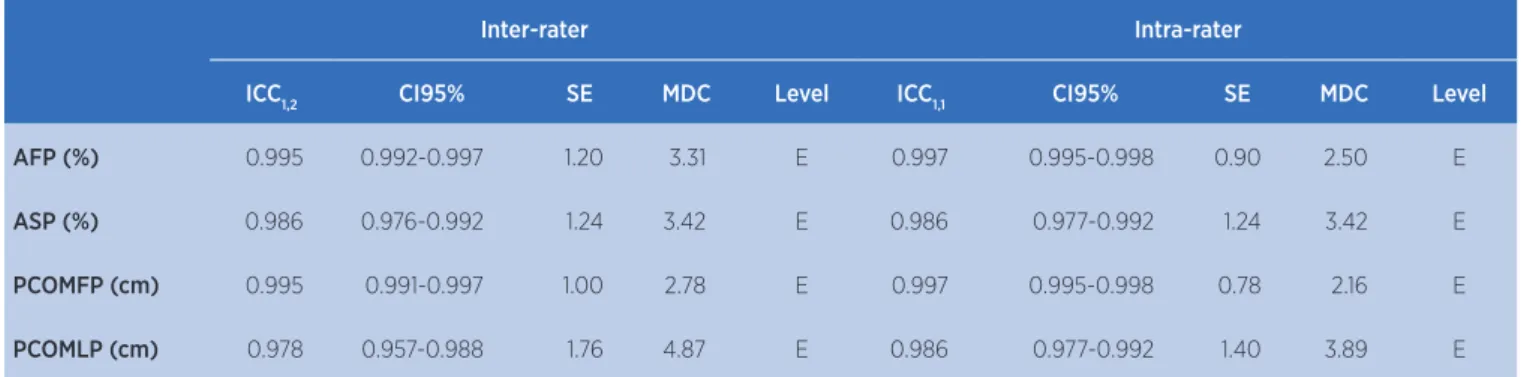
The analyses demonstrate that inter- and intra-rater reliability (Table 2) was excellent for all the variables obtained, with (p<0.01).
DISCUSSION
Initially, an extensive literature search was performed and no references were found about the reliability of the use of SAPO for estimating the projection of the COM. Some studies show that the use of photogrammetry
produces satisfactory results for postural evaluation4,11,12,
when compared to other techniques, such as the use of
radiological examinations18.
The use of external markings shows correlation
when compared to radiographic measures21-23. A study
conducted with 766 teenagers compared the angles and curves of the spine, measured via radiography and photogrammetry, having concluded that the use of photogrammetry is feasible for the assessment of body alignment, in addition to avoiding the exposure
of the volunteers to radiation9. A prerequisite to ensure
better results in the evaluations of the projection of the COM is the choice of anatomical landmarks to be used in the research and the correct positioning of the
markings4,12,18-20. Commonly, it is recommended that a
single previously trained rater performs the procedure
for fixing the markings18.
With the use of photogrammetry for evaluating specific angles in the human body, low reliability for 15 out of the 22 angles measured was demonstrated, suggesting possible errors inherent to the repetition of the analyses. It is believed that these errors are related to the experimental procedure, which involves the environment’s conditions, the placement of the tripod, camera and volunteer, the placement of the markings and the digital photographic record being of
suboptimal quality4. All these aspects were considered
in the present study, in an attempt to minimize possible errors concerning the technique used.
The results demonstrate that the proposed method to quantify the projection of the COM via photogrammetry had excellent intra- and inter-rater reliability levels in the analyses with SAPO, with low minimally detectable difference, less than 0.5 of the
standard deviation24. SAPO proves itself to be a reliable
tool, with the possibility of obtaining similar results after repeating the analyses, small variations of a single
variable being accepted25.
In this study, we chose to standardize the distance between the medial malleoli to validate the technique for obtaining the COM via photogrammetry. This standardization requires an extensive and reflective
discussion26, as it may be able to induce postural
changes12, as well as reduce the support base and increase
body oscillation15. The projection of the support base of
individuals must be measured in a position regarded as the most natural and comfortable, to reflect the
actual body alignment27. Thus, we stress that in static
equilibrium analyses obtained with this method, the support base must be measured in the natural alignment position of the feet.
In orthostatic resting position, even if the individual tries to stay as still as possible, oscillations of the body still happen, which is called postural
balance6. The variable responsible for measuring
this condition is the projection of the COM, as it may assist in the understanding of the mechanisms
involved in postural control28. The oscillation of the
COM is a value that indicates the body’s balance. However, the use of photogrammetry may undervalue the analysis of postural balance conditions. Despite the results obtained, we stress that photogrammetry is a complementary technique for postural assessment, simple to perform and, when accompanied by scientific
Table 2. Values of intra-raters and inter-raters intraclass correlation (ICC) according to the measurements obtained
Inter-rater Intra-rater
ICC1,2 CI95% SE MDC Level ICC1,1 CI95% SE MDC Level
AFP (%) 0.995 0.992-0.997 1.20 3.31 E 0.997 0.995-0.998 0.90 2.50 E
ASP (%) 0.986 0.976-0.992 1.24 3.42 E 0.986 0.977-0.992 1.24 3.42 E
PCOMFP (cm) 0.995 0.991-0.997 1.00 2.78 E 0.997 0.995-0.998 0.78 2.16 E
PCOMLP (cm) 0.978 0.957-0.988 1.76 4.87 E 0.986 0.977-0.992 1.40 3.89 E
tutorials, it can be used in clinical practice, as well as
in researches12.
SAPO includes other parameters associated with the projection of the COM, displayed in the software as the projection of the center of mass in the frontal (PCOMPF) and lateral (PCOMPL) planes. Both projections take into account the average position of the COM in relation to the medial malleoli. The measure in the frontal plane demonstrates the anteroposterior dislocation, and the measure in the lateral plan demonstrates the mediolateral dislocation of the COM. A study without the validation of this technique demonstrated that the projections of the COM are correlated with plantar dorsiflexor and flexor
isometric force in young adults29. In our study, young
volunteers were evaluated, who could naturally exhibit a lower value of oscillation, but such data were not associated in the sagittal and frontal planes. Future studies with different age groups are essential for a better contribution of the technique to the evaluation of static equilibrium, for the identification of the risks of falls, to prevent the
emergence of secondary lesions and other comorbidities30,
as in older adults, balance corrections occur in the regions of the hip, adductors and abductors, which may influence
the mediolateral projection of the COM31.
Study limitations
This study has some limitations that may be related to the number of raters used, which could allow that new studies find different results than ours.
In this research, the moment of projection of the COM was assessed in orthostatic position only, in a specific population. Therefore, it creates the possibility for the development of new studies that estimate the time of projection of the COM for different health conditions, age groups and genders. We stress the need to correlate this technique with data pertaining to force platforms for evaluating the projection of the COM in different situations, to ensure greater validity of the technique for obtaining the COM.
CONCLUSIONS
Based on the results of the time of projection of the COM, determined with SAPO, intra and inter-rater reliability was excellent for all variables evaluated in the study.
AKNOWLEDGEMENTS
Programa de Educação Tutorial MEC/Sesu – Physical therapy Course and Fundação de Apoio à Pesquisa do Estado de Minas Gerais – Fapemig (APQ-03239-12).
REFERENCES
1. Gangnet N, Pomero V, Dumas R, Skalli W, Vital JM. Variability of the spine and pelvis location with respect to the gravity line: a three-dimensional stereoradiographic study using a force platform. Surg Radiol Anat. 2003;25(5-6):424-33. doi: 10.1007/s00276-003-0154-6
2. McEvoy MP, Grimmer K. Reliability of upright posture measurements in primary school children. BMC Musculoskelet Disord. 2005;29:6-35. doi: 10.1186/1471-2474-6-35
3. Bister D, Edler RJ, Tom BDM, Prevost AT. Natural head posture considerations of reproducibility. Eur J Orthod. 2002;24(5):457-70. doi: 10.1093/ejo/24.5.457
4. Iunes DH, Castro FA, Salgado HS, Moura IC, Oliveira AS, Bevilaqua-Grossi D. Confiabilidade intra e interexaminadores e repetibilidade da avaliação postural pela fotogrametria. Rev Bras Fisioter. 2005;9(3):327-34.
5. Ferreira EA, Duarte M, Maldonado EP, Bersanetti AA., Marques AP. Quantitative assessment of postural alignment in young adults based on photographs of anterior, posterior, and lateral views. J Manipulative Physiol Ther. 2011;34(6):371-80. doi: 10.1016/j.jmpt.2011.05.018
6. Mochizuki L, Amadio AC. Aspectos biomecânicos da postura ereta: a relação entre o centro de massa e o centro de pressão. Rev Port Cienc Desp. 2003;3(3):77-83. doi: 10.5628/ rpcd.03.03.77
7. Viguier M, Dupui P, Montoya R. Posture analysis on young women before and after 60 days of -6 degrees head down bed rest (Wise 2005). Gait Posture. 2009;29(2):188-93. doi: 10.1016/j.gaitpost.2008.08.001
8. Van Maanen, CJ, Zonnenberg AJ, Elvers JW, Oostendorp RA. Intra/interrater reliability of measurements on body posture photographs. Cranio. 1996;14(4):326-31. doi: 10.10180/08869 634.1996.117445985
9. Smith, A, O’Sullivan, PB, Straker, L. Classification of sagittal thoraco-lumbo-pelvic alignment of the adolescent spine in standing and its relationship to low back pain. Spine. 2008;33(19):2101-7. doi: 10.1097/BRS.0b013e31817ec3b0 10. Tommaselli AMG, Silva JFC, Hasegawa JK, Galo M, Dal Poz AP.
Fotogrametria: aplicações a curta distância. In: Meneguete Junior M, Alves N (org.). FCT 40 anos: perfil científico-educacional. Presidente Prudente: Unesp;1999. p. 147-59. 11. Sacco ICN, Alibert S, Queiroz BWC, Pripas D, Kieling I,
12. Ferreira EAG, Duarte M, Maldonado EP, Burke TN, Marques AP. Postural assessment software (PAS/SAPO): validation and reliability. Clinics. 2010;65(7):675-81. doi: 10.1590/ S1807-59322010000700005
13. Cocchiarella L, Anderson GBJ. Guides to the evaluation of permanent impairment. Chicago: AMA Press; 2001. p. 375-422.
14. SAPO – Software para Avaliação Postural. BMClab – Laboratório de Biomecânica e Controle Motor, São Bernardo do Campo [Internet]. [cited 2017 Dez 4]. Available from: <http://demotu.org/sapo/>
15. Duarte M, Freitas SMSF. Revisão sobre posturografia baseada em plataforma de força para avaliação do equilíbrio. Rev Bras Fisioter. 2010;14(3):183-92. doi: 10.1590/ S1413-35552010000300003
16. Lexell JE, Downham DY. How to assess the reliability of measurements in rehabilitation. Am J Phys Med Rehabil. 2005;84(9):719-23. doi: 10.1097/01.phm.0000176452.17771.20 17. Haley SM, Fragala-Pinkham MA. Interpreting change scores
of tests and measures used in physical therapy. Phys Ther. 2006;86(5):735-43. doi: 10.2522/ptj.20080113
18. Rosário JL. Photographic analysis of human posture: a literature review. J Bodyw Mov Ther. 2014:18(1):56-61. doi: 10.1016/j.jbmt.2013.05.008
19. Billis EV, Foster NE, Wright CC. Reproducibility and repeatability: errors of three groups of physiotherapists in locating spinal levels by palpation. Man Ther. 2003;8(4):223-32. doi: 10.1016S1356-689X(03)00017-1
20. Fedorak C, Ashwoth N, Marshall J, Paull H. Reliability of the visual assessment of cervical and lumbar lordosis: how good are we? Spine. 2003;28(16):1857-9. doi: 10.1097/01. BRS.0000083281.48923.BD
21. Hunt MA, Birmingham TB, Jenkyn TR, Giffin, JR, Jones, IC. Measures of frontal plane lower limb alignment obtained from static radiographs and dynamic gait analysis. Gait Posture. 2008;27(4):635-40. doi: 10.1016/j.gaitpost.2007.08.011 22. Mündermann A, Dyrby CO, Andriacchi TP. A comparison of
measuring mechanical axis alignment using three-dimensional
position capture with skin markers and radiographic measurements in patients with bilateral medial compartment knee osteoarthritis. Knee. 2008;15(6):480-5. doi: 10.1016/j. knee.2008.07.002
23. Vanwanseele B, Parker D, Coolican M. Frontal knee alignment: three-dimensional marker positions and clinical assessment. Clin Orthop Relat Res. 2009;467(2):504-9. doi: 10.1007/ s11999-008-0545-4
24. Norman GR, Sloan JA, Wyrwich KW. Interpretation of changes in health-related quality of life: the remarkable universality of half a standard deviation. Med Care. 2003;41(5):582-92. doi: 10.1097/01.MLR.0000062554.74615.4C
25. Souza JA, Pasinato F, Basso D, Corrêa EOR, Silva AMT. Biofotogrametria confiabilidade das medidas do protocolo do software para avaliação postural (SAPO). Rev Bras Cineantropom Desempenho Hum. 2011;13(4):299-305. doi: 10.5007/1980-0037.2011v13n4p299
26. Ferreira EAG. Postura e controle postural: desenvolvimento e aplicação de método quantitativo de avaliação postural [tese de doutorado]. [São Paulo]: Faculdade de Medicina da Universidade de São Paulo; 2005.
27. Bullock-Saxton J: Postural alignment in standing: a repeatability study. Aust J Physiother. 1993;39(1):25-9. doi: 10.1016/S0004-9514(14)60466-9
28. Winter DA. Biomechanics and motor control of human movement. 3rd ed. Hoboken: Wiley; 2005.
29. Alves RS, Pereira IC, Rocha CBJ, Pereira SB, Iunes DH, Carvalho LC. Relação entre a força isométrica dos músculos da perna e um momento do centro de massa mensurado por fotogrametria. Saúde. 2015;5(1):9-23.
30. Perracini MR. Prevenção e manejo de quedas no idoso. In: Ramos LR, Cendoroglo MS. Guias de Medicina Ambulatorial e hospitalar da Unifesp: geriatria e gerontologia. São Paulo: Manole; 2005.