
Department of Computer Architecture
Ph.D. Disserta]on
iDRM – Interoperability Mechanisms for Open Rights
Management PlaPorms
Author: Carlos José Corredoura Serrão
Advisor: Professor Jaime Delgado
Co‐Advisor: Professor Miguel Dias
December 2008 A disserta]on submi^ed to the Department of Computer Architecture and the Commi^ee on Graduate Studies of Universitat Politècnica de Catalunya in par]al fulfilment of the requirements for the degree of Doctor.Catedrà]c d'Universitat Jaime Delgado Mercé Professor José Miguel Dias Carlos José Corredoura Serrão
iDRM – Interoperability Mechanisms for Open Rights Management
PlaPorms
Abstract
Today’s technology is raising important challenges in the Intellectual Property (IP) field in general and to Copyright in par]cular [Arkenbout et al., 2004]. The same technology that has made possible the access to content in a ubiquitous manner, available to everyone in a simple and fast way, is also the main responsible for the challenges affec]ng the digital content IP of our days [Chiariglione, 2000]. Technological solu]ons and legal frameworks were created to meet these new challenges. From the technological point of view, Rights Management Systems (RMS) and Copy Protec]on Systems (CPS) have been developed and deployed to try to cope with them. At first, they seemed to work however, their closed and non‐interoperable nature and a growing number of wrong strategic business decisions, soon lead to a strong opposi]on. One of the strongest nega]ve points is the lack of rights management interoperability [Geer, 2004]. The work presented on this thesis primarily addresses the RMS interoperability problems. The objec]ve of the thesis is to present some possible mechanisms to improve the interoperability between the different exis]ng and emerging rights management pla\orms [Guth, 2003a]. Several different possible direc]ons to rights management interoperability are pointed in this thesis. One of the most important is openness. Interoperability between different rights management mechanisms can only be achieved if they are open up to a certain level. Based on this concept, an open rights management pla\orm is designed and presented in this thesis. Also, some of the interoperability mechanisms are presented and explained. Thisdistributed rights management services.
Rights management solu]ons rely heavily on the establishment of authen]cated and trust environments between its different elements. While considering different RMS, the establishment of such trust environments can be somehow complex. This thesis provides a contribu]on to the establishment of interoperable RMS trust environments through the usage of Public‐Key Infrastructure (PKI) mechanisms. Modern rights management systems have to handle with both keying material and licenses which are used mostly to define how content is governed by the system. Managing this is a complex and hard task when different rights management solu]ons are considered. This thesis presents and describes a generic model to handle the key and license management life cycle, that can be used to establish a global interoperable management solu]on between different RMS.
Acknowledgements
Becoming a Ph.D. student and being able to complete it with success has always been one of my very personal dreams. Concluding it was not an easy task, and without the help and the support of many key‐persons I am sure that I would not reach the end. Therefore, I will use this opportunity to publicly thank to all of them. First, I would like to thank my family for their unlimited support and their spirit of sacrifice. To my wife, Fá]ma, who has always supported and encouraged me to keep on going, even if that would mean having to spent almost a year away from home and far from her. As hard as it may seem, it was easy when compared to leaving her with the sole responsibility of taking care of our two beloved children. To both of them, David and Dinis, I apologise for my long absence. Please also apologise for the ]me we did not spend together and some]mes for my bad humour and stress. To my parents, because they have provided me the opportunity and the financial support carry with my studies. Also, because they always stood beside me providing me the moral support to never give up even when things went a li^le darker. To my parents in law, not only by their unques]onable support but also for their immense support in the educa]on of their grandchildren, while I was not around. A very special thank to both of my Ph.D. advisors, Professor Miguel Dias and Professor Jaime Delgado. Without them this would not have been possible.Professor Miguel Dias is a highly energe]c person that has the capability to mo]vate everyone around them. Thank you for your vision, advice and support. To Professor Jaime Delgado, for the opportunity that he provided me to integrate his own successful research group in the beau]ful city of Barcelona for a year. This was a crucial success factor for the conclusion of this work. Thank you very much for all the support, advice and commitment. Indeed, this was deeply appreciated. I sincerely wish that this is not the end of our collabora]on. To my former MSc. advisor, Professor José Cordeiro Gomes, for its uncondi]onal support and advise on what concerned my Master thesis (one of the grounds of this work) and also for its
To Dr. Panos Kudumakis, a friend, colleague and project manager of a European R&D Project (MOSES) and a very enthusias]c and posi]ve person. As a very dedicated professional in this field, the ideas exchanged with him were quite helpful for this work.
To the memory of Eng. José Guimarães, that unfortunately is not among us any more. He was the main responsible for my decision to remain in the academy world and to start my R&D and lecturing career. He is also responsible for part of my professional training and to introduce me with the Interna]onal R&D projects work. Wherever you are, thank you very much.
To ADETTI, in special to the NetMuST lab, who has provided me the opportunity to learn more and to work on Interna]onal co‐opera]ve R&D since 1995.
To everyone else whose name is not men]on here, but which were decisive for the conclusion of this work.
Table of Contents
Terms and DefiniQons...17
NotaQon and ConvenQons...23
Part I. IntroducQon...25
Chapter 1. IntroducQon...27
1 Introduc]on...27 2 Objec]ves...30 3 Document Structure ...32Part II. State of the Art...
Chapter 1. DRM Architectures...37
1 Introduc]on...37 2 Open Mobile Alliance (OMA) DRM...37 2.1 OMA Rights Object...42 2.2 OMA DRM Protocols...44 2.2.1 Registra]on Protocol...45 2.2.2 RO Acquisi]on Protocol...46 2.2.3 Other protocols...48 3 DReaM...48 4 Marlin...52 5 AXMEDIS...55 6 Windows Media Rights Manager...59 6.1 Coding/protec]on and content distribu]on...62 6.2 Header signing...63 6.3 Playing protected content...64 6.4 License issuing/genera]on...64 6.5 How licenses work...65 7 Apple FairPlay ...66 8 DMAG MIPAMS...67 8.1 Content server ...68 8.2 Adapta]on Server...69 8.3 Protec]on Server...69 8.4 Governance Server...70 8.5 Cer]fica]on Server...70 8.6 Cer]fica]on Authority...71 8.7 Registra]on Server...71 8.8 Supervision Server...72 8.9 Trusted client...72 8.10 Intermediary...729 OpenIPMP ...73 9.1 User Management...75 9.2 License Management ...75 9.3 Cryptography...75 9.4 Streaming...76 9.5 Architecture/Infrastructure ...77
Chapter 2. DRM interoperability frameworks...79
1 Introduc]on...79 2 MPEG‐21...79 2.1 MPEG‐21 Rights Expression Language and Rights Data Dic]onary...81 2.2 MPEG‐21 Intellectual Property Management Protec]on...82 2.3 MPEG‐21 Event Repor]ng...83 3 Coral...84 4 Digital Media Project...87Part III. ContribuQons...
Chapter 1. IntroducQon to ContribuQons...95
1 Introduc]on...95 2 Specific contribu]ons of this work...103Chapter 2. Rights Management interoperability and Service‐oriented
Architectures...107
1 Introduc]on...107 2 Generic DRM framework...109 3 Rights Management Services as Web Services...112 4 DRM interoperability using a service oriented architecture...115 5 Conclusions...119Chapter 3. Using Public‐Key Infrastructures towards Rights Management
interoperability...121
1 Introduc]on...121 2 Rights Management and Trust...123 3 PKI and DRM Interoperability...126 4 DRM interoperability and PKI authen]ca]on mechanisms...131 4.1 OpenSDRM – Open and Secure Digital Rights Management...132 4.1.1 Components Registra]on...132 4.1.2 Components Mutual Authen]ca]on...133 4.1.3 Actors and components registra]on...134 4.1.4 Components and Actors Authen]ca]on...137 4.2 MIPAMS – Mul]media Informa]on Protec]on and Management System...139 4.2.1 Component Cer]fica]on...140 4.2.2 User registra]on and authen]ca]on...140 4.2.3 Tool Registra]on...141 4.2.4 Tool cer]fica]on...142 4.2.5 Actors and Client components authen]ca]on...143 4.3 Comparing both open Rights Management Systems...1445.1 Registra]on Interoperability...147 5.2 Authen]ca]on Interoperability...149 6 Conclusions...152
Chapter 4. Open Rights Management plaPorms towards interoperability
...153
1 Introduc]on...153 2 Openness and Interoperability...154 3 Open DRM pla\orms...156 3.1 Open‐source DRM pla\orms...157 3.1.1 Media‐S...157 3.1.2 OpenIPMP...158 3.1.3 DReaM...159 3.1.4 DMP Chillout...161 3.1.5 OpenSDRM...162 3.1.6 Comparing different Open‐Source DRM pla\orms...163 3.2 Open‐specifica]on DRM pla\orms...168 3.2.1 MIPAMS (Mul]media Informa]on Protec]on and Management System)169 3.2.2 OMA‐DRM (Open Mobile Alliance DRM)...170 4 Open DRM pla\orms compared...172 5 Open DRM solu]ons SWOT analysis...174 5.1.1 Open Rights Management solu]ons Strengths...179 5.1.2 Open Rights Management solu]ons Weaknesses...180 5.1.3 Open Rights Management solu]ons Opportuni]es...181 5.1.4 Open Rights Management solu]ons Threats...182 6 Interoperability Solu]on for Open Systems...183 7 Conclusions...189Chapter 5. Secure Key and License Management for open DRM plaPorms
...191
1 Introduc]on...191 2 Licenses and Rights Expression Languages...192 3 The generic license management life cycle...193 3.1 Rights management typology...193 3.2 License management life cycle...195 4 Security in the license management life cycle...198 5 Open DRM Secure key management...204 5.1 Key management in open rights management systems...204 5.2 Key management and key management life cycle...205 5.3 Analysis of key management life cycle on open rights management pla\orms ...208 6 Conclusions...214Chapter 6. The OpenSDRM open DRM architecture...217
1 Introduc]on...217 2 OpenSDRM Architecture...218 3 Introduc]on to OpenSDRM...220 4 External components and actors...2224.2 Protec]on Tools Provider...224 4.3 Content Provider...225 4.4 Payment/Financial Infrastructure...226 4.5 Cer]fica]on Authority...227 5 Internal Services & Interfaces...228 5.1 Content Rendering Applica]on...230 5.2 Wallet Rights Management Interoperability Middle‐ware...232 5.3 E‐Commerce service...234 5.4 Content Produc]on service...236 5.5 Media Distribu]on service...238 5.6 Registra]on service...240 5.7 Payment Gateway service...241 5.8 Authen]ca]on service...243 5.9 License service...245 5.10 Protec]on Tools service...247 5.11 Configura]on service...248 6 OpenSDRM specific security mechanisms...249 6.1 OpenSDRM security bootstrapping/ini]alisa]on...250 6.2 Services and systems registra]on on OpenSDRM...251 6.3 Users registra]on on OpenSDRM...252 6.4 Domain Management...255 6.5 Services message exchange...259 6.6 Payment Informa]on...261 6.7 Paying services with OpenSDRM...262 6.8 License Produc]on...263 6.9 License Download...265 6.10 License Expiry...267 7 Conclusions...267
Chapter 7. Wallet RM interoperability Middle‐ware and License Templates
...269
1 Introduc]on...269 2 Digital Content Rendering Applica]ons DRM interoperability...272 3 Wallet Rights Management interoperability Middle‐ware...273 4 WRMiM modules...274 4.1 Secure Storage...276 4.2 Applica]on Registra]on...277 4.3 Applica]on Authorisa]on...278 4.4 Applica]on Authen]cator...279 4.5 DRM secure communica]ons...279 4.6 User registra]on and valida]on...280 4.7 Rights Expression Interpreter...280 4.8 Protec]on Tools manager...281 5 Establishing a DRM middle‐ware layer...282 6 Registering content rendering applica]ons on WRMiM...284 7 Reques]ng CRA authorisa]ons from the WRMiM...286 7.1 Common Command Opera]on Language...287 7.2 Authorisa]on Request protocol...2909 Conclusions...298
Chapter 8. OpenSDRM use cases and deployment scenarios...301
1 Introduc]on...301 2 Music‐4You, Digital music e‐commerce...302 2.1 Users func]onali]es...303 2.1.1 Users registra]on...304 2.1.2 License nego]a]on...304 2.1.3 License download...305 2.2 Content providers func]onali]es...306 2.2.1 Content uploading and management...307 2.2.2 Band informa]on registra]on and management...308 3 Controlled access to video‐surveillance data...308 3.1 OpenSDRM in WCAM context...309 3.1.1 WCAM content prepara]on...309 3.1.2 Select and access content...310 3.1.3 Delivering content to the user...311 3.1.4 Content registra]on...311 3.1.5 Users iden]fica]on and authen]ca]on...311 3.1.6 Defining and using licenses in WCAM...312 3.2 WCAM JPEG 2000 integrated DRM content protec]on...312 4 Controlled access to large Earth observa]on products...314 4.1 JPEG2000 EO products coding and decoding...316 4.2 JPEG2000 EO products protec]on...317 4.3 Integra]on with ESA portal...318 5 Home network music jukebox...320 5.1 Integra]on between OpenSDRM and the MediaNet SEP...321 6 Conclusions...324Part IV. Conclusions and Future Work...
Chapter 1. Conclusions...327
1 Introduc]on...327 2 Conclusions...329 3 Publica]ons...335 3.1 Refereed Publica]ons...335 3.2 Contribu]ons to Standardisa]on ac]vi]es...340 3.3 Resume...342Chapter 2. Future Work...343
1 Introduc]on...343 2 Future research and development topics...343 2.1 Interoperable rights management brokerage...343 2.2 Economic impact of OpenSDRM disintermedia]on...344 2.3 Key and license management on super‐distribu]on ...345 2.4 OpenSDRM development and improvement...345Annex A. OpenSDRM WSDL interfaces...347
2 Configura]on Server...352 3 Protec]on Tools Server...353 4 License Server...355 5 Media Delivery Server...358 6 Payment Gateway Server...360 7 Registra]on Server...362
References...365
Images Index
Figure II.1.1: OMA‐DRM generic architecture...39 Figure II.1.2: Rights Object graphic representa]on...42 Figure II.1.3: ROAP – Registra]on Protocol...45 Figure II.1.4: ROAP – Acquisi]on Protocol...47 Figure II.1.5: The DReaM DRM disintermedia]on system...49 Figure II.1.6: Octopus DRM Client System Elements...53 Figure II.1.7: AXMEDIS architecture: protec]on, rights management and accoun]ng func]onali]es...56 Figure II.1.8: The MicrosoL DRM Process...60 Figure II.1.9: Apple FairPlay system architecture...67 Figure II.1.10: DMAG‐MIPAMS architecture...68 Figure II.1.11: OpenIPMP architecture...74 Figure II.2.1: The different parts that compose MPEG‐21...81 Figure II.2.2: The REL data model...82 Figure II.2.3: Coral interoperability Core and Ecosystems...84 Figure II.2.4: General case of a Value‐Chain...88 Figure III.1.1: Ver]cal DRM versus Horizontal DRM...97 Figure III.1.2: The three different DRM layers...100 Figure III.1.3: Non‐Interoperable rights management systems and layers...101 Figure III.1.4: DRM interoperability scenario, with all three interoperable layers...102 Figure III.2.1: Generic DRM framework...110 Figure III.2.2: Different services, by different providers, integrated in a common rights management solu]on...111 Figure III.2.3: Implementa]on of a generic DRM service...113 Figure III.2.4: Defining a generic WSDL interface, common to all proprietary DRM services is important because it allows the coexistence of several non‐ver]cal applica]ons...114 Figure III.2.5: DRM services registra]on and descrip]on on a registra]on server. When DRM services are requested, the registra]on server can provide to the client both the descrip]on of the service and the service creden]als...115 Figure III.2.6: A scenario with interoperable DRM services using the service‐oriented approach (SOA) and Web‐services...117 Figure III.2.7: A scenario with interoperable DRM services using the service‐oriented approach (SOA) and Web‐services...117 Figure III.3.1: A single PKI solu]on for mul]ple DRM pla\orms. A way to allow all the actors, devices and soLware components to rely on a single PKI solu]on to provide security and trust between all of them...127 Figure III.3.2: DRM providers select their own PKI solu]on. An intermediary broker PKI will be necessary to handle trust requests from one DRM solu]on to another. This intermediary broker will have to know some details about the trust providing PKI in order to be able to carry its func]ons...128 Figure III.3.3: Opera]on sequence while contac]ng the PKI broker to establish trust between two different elements governed by different DRM pla\orms. The PKI broker will beother...131 Figure III.3.4: Establishing a SAC between different DRM components...134 Figure III.3.5: Establishing a SAC between mul]ple different DRM components...138 Figure III.3.6: Actor’s authen]ca]on through the AUS...139 Figure III.3.7: MIPAMS client tool cer]fica]on process...143 Figure III.3.8: MIPAMS Content consump]on Use Case...144 Figure III.3.9: Scenarios for CA registra]on interopera]on...147 Figure III.3.10: Bridge between the X.509 and XML cer]ficates...149 Figure III.3.11: Interoperability in the Actors authen]ca]on...151 Figure III.4.1: Media‐S architectural elements...158 Figure III.4.2: OpenIPMP architecture...159 Figure III.4.3: Sun DReaM architecture...160 Figure III.4.4: DMP Chillout reference architecture...161 Figure III.4.5: MIPAMS generic architecture...169 Figure III.4.6: Open DRM systems SWOT analysis...179 Figure III.4.7: Establish connectors between the different rights management systems to promote interoperability...185 Figure III.4.8: Interoperability mechanism for rights management systems using a broker. .186 Figure III.4.9: Interoperability example between different open rights management solu]ons ...188 Figure III.5.1: The typology of the different types of license expression...194 Figure III.5.2: The digital object license life cycle. This life cycle starts with the crea]on of the digital object and the specifica]on of the condi]ons under which the digital object can be used...196 Figure III.5.3: Process to generate the license for governed digital items...200 Figure III.5.4: The digital object license license acquisi]on and usage to enforce rights on the digital object at the end‐user side...201 Figure III.5.5: Key management life cycle...208 Figure III.5.6: Comparison between open DRM pla\orms in key management aspects (X ‐ fully covered, * ‐ partly covered)...213 Figure III.6.1: Digital content value chain – from digital crea]on to consump]on. Protec]on and management of rights through this chain is one of the major func]ons of DRM...220 Figure III.6.2: Different service providers using a common OpenSDRM architecture and middle‐ware func]onali]es...221 Figure III.6.3: Different service providers, providing the same service, using OpenSDRM....222 Figure III.6.4: Interac]on between OpenSDRM and external actors and systems...223 Figure III.6.5: Interface between the End‐User and OpenSDRM...224 Figure III.6.6: Interface between the Protec]on Tools Provider and OpenSDRM...225 Figure III.6.7: Interface between the Content Provider and OpenSDRM...226 Figure III.6.8: Interface between the Payment/Financial Infrastructure and OpenSDRM...227 Figure III.6.9: Interface between the Cer]fica]on Authority and OpenSDRM...228 Figure III.6.10: OpenSDRM detailed architecture...229 Figure III.6.11: Interface between the CRA and OpenSDRM services...231 Figure III.6.12: Different CRA interac]ng with the Wallet Rights Management Interoperability Middle‐ware...232 Figure III.6.13: Interface between the WRMiM and OpenSDRM...233 Figure III.6.14: Interfaces between the COS and the OpenSDRM...235
Figure III.6.16: Interfaces between the MDS and the OpenSDRM services...239 Figure III.6.17: RGS interfaces with the remaining OpenSDRM services...240 Figure III.6.18: Interfaces between the PGW and the different OpenSDRM services...242 Figure III.6.19: The AUS interfaces with the remaining OpenSDRM services...243 Figure III.6.20: Devices that belong to single or mul]ple domains...244 Figure III.6.21: Interac]on between LIS and the other OpenSDRM services...246 Figure III.6.22: Interfaces between the PTS and the other OpenSDRM services...248 Figure III.6.23: Two security levels in OpenSDRM...249 Figure III.6.24: Sequence to register a soLware server component...251 Figure III.6.25: Services registra]on in AUS...252 Figure III.6.26: User registra]on on the services, through AUS...253 Figure III.6.27: End‐User registra]on through the WRMiM...254 Figure III.6.28: Domain crea]on on OpenSDRM...256 Figure III.6.29: Adding a new device to a User created domain...257 Figure III.6.30: Adding a device to a domain by invita]on...259 Figure III.6.31: Exchange of messages between services...260 Figure III.6.32: PGW subscrip]on...261 Figure III.6.33: Payment of digital content using OpenSDRM services...263 Figure III.6.34: Crea]ng a license on OpenSDRM...265 Figure III.6.35: Access to license, when license is already in the end‐user side...266 Figure III.6.36: Download a license from a remote License Server...267 Figure III.7.1: Different types of protected and governed content used in mul]‐CRA environment...274 Figure III.7.2: Internal modules that compose the WRMiM...275 Figure III.7.3: Different interfaces with different storage sources...277 Figure III.7.4: The WRMiM using the Rights Expression Interpreter module...281 Figure III.7.5: Ini]al boot‐up (first ]me run) sequence for the WRMiM...283 Figure III.7.6: WRMiM ini]alisa]on...283 Figure III.7.7: CRA registra]on using a cer]ficate...285 Figure III.7.8: CRA registra]on without having a previous cer]ficate...286 Figure III.7.9: DRM‐governed content life cycle...288 Figure III.7.10: Full authorisa]on protocol...292 Figure III.7.11: License rights produc]on and distribu]on schema...294 Figure III.7.12: Process to define the license templates...295 Figure III.7.13: From license templates to license rights...298 Figure III.8.1: Music‐4You portal main web‐page...303 Figure III.8.2: User registra]on on the Music‐4You portal...304 Figure III.8.3: License condi]ons nego]a]on at the Music‐4You site...305 Figure III.8.4: License download...306 Figure III.8.5: Content uploading and registra]on...307 Figure III.8.6: Content uploading and registra]on at the Music‐4You portal...308 Figure III.8.7: Content prepara]on and protec]on...310 Figure III.8.8: Player interac]on while reques]ng the content...311 Figure III.8.9: Encrypted image at all resolu]on levels...314 Figure III.8.10: Par]ally encrypted image – only the face is encrypted...314 Figure III.8.11: Architecture of the HICOD2000 black‐box (H2KBB)...315 Figure III.8.12: HICOD2000 integrated architecture...319
Figure III.8.14: MediaNet Music‐Box, integra]ng the Services Enabling Pla\orm and
Terms and Deeinitions
AES Advanced Encryp]on Standard AUS Authen]ca]on service AXCS AXMEDIS Cer]fier and Supervisor AXCV AXMEDIS Cer]fica]on and Verifica]on AXMEDIS Automa]ng Produc]on of Cross Media Content for Mul]‐ channel Distribu]on AXS AXMEDIS Supervisor B2B Business to Business B2C Business to Consumer C/P Copy‐Protec]on CA Cer]fica]on Authority CAMART Core Accoun]ng Manager and Repor]ng Tool CAS Condi]onal Access System CCOL Common Command Opera]on Language CERN European Organisa]on for Nuclear Research CEK Content Encryp]on Key CFS Configura]on service CI Content Issuer CMS Content Management System CO Copyright Owner CODEC Coding/Decoding CORBA Common Object Request Broker ArchitectureCOS E‐Commerce Service CPS Content Prepara]on Service CRA Content Rendering Applica]on CSR Cer]ficate Signing Request DCB DMP Content Broadcast DCF (OMA) Digital Rights Management Content Format DCF (DMP) DMP Content File DCI DMP Content Informa]on DCOM Distributed Component Object Model DCS DMP Content Streaming DI Digital Item DID Digital Item Declara]on DIDL Digital Item Declara]on Language DII Digital Item Iden]fica]on DMAG Distributed Mul]media Applica]ons Group DMP Digital Media Project DOD Digital Object Distributor DOI Digital Object Iden]fier DOPS Digital Object Provider Service DORD Digital Object Rendering Device DORS Digital Object Registra]on Service DOUI Digital Object Unique Iden]fier DRM Digital Rights Management DRM‐A Digital Rights Management Agent DVB‐CP Digital Video Broadcast, Copy Protec]on e‐IPR Electronic Intellectual Property Rights EAI Enterprise Applica]on Integra]on EC European Commission EJBCA Enterprise Java Beans Cer]fica]on Authority EKCS Encryp]on Key Crea]on Service ENVISAT Environmental Satellite EO Earth Observa]on EPG Electronic Program Guide ER Event Repor]ng ERR Event Report Request ESA European Space Agency FSF Free SoLware Founda]on GPL GNU Public License GUI Graphical User Interface
H2KBB HICOD2000 Black‐Box hDRM Horizontal Digital Rights Management HICOD2000 High‐Performance Coding, Protec]on and Trading of Satellite Images, Using JPEG2000 HTML Hypertext Markup Language HTTP Hypertext Transfer Protocol INDICARE Informed Dialogue about Consumer Acceptability of DRM Solu]ons in Europe IP Intellectual Property IPMP Intellectual Property Management and Protec]on ISMA Internet Streaming Media Alliance KEK Key Encryp]on Key LIS License service MAC Message Authen]ca]on Code MDS Media Distribu]on Service MIME Mul]purpose Internet Mail Extensions MIPAMS Mul]media Informa]on Protec]on and Management System MMI Mother‐May‐I MMS Mul]media Messaging Service MOM Message Oriented Middle‐ware MOSES MPEG Open Security for Embedded Systems MPL Mozilla Public License NAVSHP Networked Audio Visual Systems and Home Pla\orms NEMO Network Environment for Media Orchestra]on OBEX Object Exchange OCP OpenSDRM Capability Proxy OCSP Online Cer]ficate Status Protocol ODRL Open Digital Rights Language OFB Output Feedback OMA Open Mobile Alliance OMA‐DRM Open Mobile Alliance Digital Rights Management OSI Open‐Source Ini]a]ve OSS Open‐Source SoLware P2P Peer to Peer PAV Portable Audio‐Visual device PDA Personal Data Assistant PDCF Protected DCF PDS Payload Data Segment PGW Payment Gateway service
PKCS Public Key Cryptography Standards PKI Public‐Key Infrastructures PKIX Public Key Infrastructure (X.509) PMS Protec]on Manager Support PTS Protec]on Tools service RDD Rights Data Dic]onary REK Rights Encryp]on Key REL Rights Expression Language RGS Registra]on service RI Rights Issuer RMI Remote Method Invoca]on RMS Rights Management Systems RO Rights Object ROAP Rights Object Access Protocol RSA Rivest, Shamir, Adleman RTP Real Time Protocol RTCP Real Time Control Protocol RTSP Real Time Streaming Protocol SAC Secure Authen]cated Channel SAML Security Asser]on Markup Language SAV Sta]onary Audio‐Visual device SDK SoLware Development Kit SDMI Secure Digital Music Ini]a]ve SEP Service Enabling Pla\orm SKSS Secure Key Storage Service SLS/TLS Secure License Service/ Transport Layer Security SOA Service Oriented Architecture SOAP Simple Object Access Protocol SPKI Subject Public‐Key Info SSL Secure Sockets Layer SWOT Strengths, Weaknesses, Opportuni]es and Threats UDDI Universal Descrip]on Discovery and Integra]on URI Uniform Resource Iden]fier URL Uniform Resource Locator vDRM Ver]cal Digital Rights Management WAP Wireless Applica]on Protocol WMA Windows Media Audio WMDRM Windows Media DRM WMDRM‐ND Windows Media DRM for Network Devices
WMDRM‐PD Windows Media DRM for Portable Devices WMF Windows Media Format WMRM Windows Media Rights Manager WMV Windows Media Video WRMiM Wallet Rights Management interoperability Middle‐ware WS Web Services WS‐BPEL Web Services Business Process Execu]on Language WSDL Web Services Descrip]on Language WSP Wireless Session Protocol WWW World Wide Web XML Extensible Markup Language XrML Extensible Rights Management Language
Notation and
Conventions
This part contains some of the conven]ons and nota]on format that is used in this document. This is par]cularly important to understand some of the protocols and methods described in the document. KpubA: the public‐key of en]ty A; KprivA: the private‐key of en]ty A; CertA B: indicates that a digital cer]ficate, issued by en]ty A, that cer]fies the en]ty (the public‐key) of en]ty B; KAES: an AES cryptographic secret key; KAES[info]: represents some informa]on ciphered with an AES secret key; MD5(info): represents some informa]on hashed with an hashing algorithm (in this case is MD5); KpubA{info}: represents some informa]on ciphered with the public‐key of an en]ty A;
KprivA[info]: represents some informa]on signed (digital signature) with the
Chapter 1. Introduction
1 Introduction
Upholding intellectual proprietary (IP) in a growing global digital World is a daun]ng task. What seems to be effec]ve in the analogue World is not adequate for the digital World [Duhl and Keroskian, 2003]. One of the major problems of this digital World is bits. Bits can be easily moved, copied, transferred, distributed and deleted [Schneier, 2001]. This raises important challenges in the IP management arena, because author rights, inherited from the old analogue age, cannot be properly safeguarded or enforced [Duhl and Keroskian, 2003]. Digital makes part of everyone's live especially on what concerns content. Users are constantly bombarded from different sources and with the most diverse types of s]mulus to acquire different types of objects, in par]cular in digital format (digital objects), or devices to handle those digital objects. Companies are launching new types of devices everyday, capable of handling more advanced digital objects. More and more devices are appearing on the market, with more capabili]es, connec]vity and processing power [Weber, 2007]. Also new mobile open development kits are appearing, promo]ng the development growth of new and interes]ng applica]ons [OHA, 2007]. This powerful combina]on presents an opportunity for digital content producers and providers but at the same ]me, an enormous challenge [IFPI, 2004][IFPI, 2005].
At the same ]me, end‐users give a new meaning to the word “end”. In the digital content value‐chain, the role of the end‐users is less and less, a passive one. They use content to create new content, and at a glimpse of an eye they suddenly change their role from passive
end‐users to ac]ve content producers and providers [Kelly et al., 2002].
This is an opportunity because digital content producers and providers have new and a^rac]ve distribu]on channels for pushing their digital products to a wider range of poten]al users and customers eager for content to be available on their devices. This digital era offers innova]ve digital technologies to content producers, leading to the improvement and provision of more interes]ng and interac]ve content. Also, providers are able to distribute digital content in a much faster and reliable manner. However, at the same ]me, it is also an important challenge. Digital content can be easily copied and illegally distributed without proper authorisa]on. In the old analogue age this was also a problem (vinyl discs, casse^es and video‐tapes could also be copied) however, digital has aggravated this problem [Michael and Rosenbla^, 2005]. Digital makes possible the produc]on of unlimited illegal copies without any quality loss (exact bit by bit copies can be easily obtained at low cost). More, with high availability of digital networks and new distribu]on architectures (such as P2P) [White, 2000], the illegal distribu]on of content is facilitated. To make digital content distribu]on and commercialisa]on business models work, specific technological measures have been put in place, by the content industry to prevent the prolifera]on of uncontrolled illegal copying, usage and distribu]on. These technological measures have the capability to protect the digital object, manage the rights, both associated to it and to users, and prevent illegal usage and distribu]on [Bechtold, 2006]. The behind the scenes technology that is capable of providing the necessary means to uphold digital object governance business models is called Digital Rights Management (DRM). DRM is composed of a Rights Management System (RMS) and are oLen used together with Copy‐Protec]on (C/P) mechanisms also to try to prevent illegal copying. Both, used individually or together, have the means to provide a way to make digital content business models viable. The most well known example of how these business models work is the iTunes content store. Currently, iTunes is a worldwide leader in digital music, audio books, TV series and movies trading. The Apple iTunes on‐line store applies copy‐protec]on measures to the digital objects and uses a built‐in DRM technology to ensure the proper rights management [Lenzi et al., 2003].
These two concepts of C/P and RMS are most of the ]mes confused. However, it is possible to have rights management without C/P, the same way it is possible to have C/P without any management of rights. The work presented in this thesis will only address the rights management issue and not C/P. DRM is a technology that involves the descrip]on, layering, analysis, valua]on, trading and monitoring of rights over an individual or organisa]on's digital assets. DRM covers the digital management of rights [Duhl and Keroskian, 2003]. DRM is composed by a chain of hardware and soLware services and technologies governing the authorised use of digital objects and managing any consequences of that use throughout the en]re digital object life cycle. The copyright environment consists of three main aspects: rights (what can be protected by copyright) and excep]ons (e.g. copies for private use or for public libraries); enforcement of rights; and management of rights (exploi]ng the rights). In the on‐line World, management of rights may be facilitated by the use of these DRM systems [Rosenbla^ et al., 2001]. Currently, digital rights management technologies are facing an enormous challenge. They are being confronted by a strong opposi]on from many sources. DRM, as it exists today, limits the end‐user freedom to use legally acquired content [Groenenboom et al., 2006]. Some]mes it is even easier to illegally obtain content than through a legal content business establishment – not only because content is free but because it does not impose any restric]ons on the way they use the content [Russinovich, 2005]. One other example of user lower sa]sfac]on is the fact that DRM‐governed content acquired on a digital content store will only play on the specific content rendering applica]ons and/or devices that were designed to support such DRM. If the user wishes to acquire content on any other store that uses some different DRM technology, the user will be unable to render the content on the very same applica]ons and/or devices [Seki and Kameyama, 2003]. This is truly a problem for modern digital content users, but at the same ]me it is also a huge problem for content providers. With this current model, content producers and providers will either need to make their digital content available for a different set of pla\orms and systems or to make technological choices and provide their content for just a single pla\orm [Geer, 2004]. For digital content users this obtrusive situa]on limits the user’s adherence to
just one of the available content stores and to one of the available content rendering applica]ons and/or devices. This represents one of the hardest barriers in current DRM deployment – interoperability [Schmidt et al., 2004].
Interoperability is currently one of the most debated problems in the DRM field. In par]cular, there is a lack of interoperability between the currently commercially available DRM solu]ons. The actual trend are the one‐to‐one DRM systems, in which a ver]cal integra]on exists in the digital content value chain around a single DRM system. This old‐fashioned business strategy tries to raise entry barriers [Porter, 2004] to new players in the same field and at the same ]me are quite penalising for end‐users [Russinovich, 2005]. These DRM interoperability issues affect DRM in general, and will be addressed later on this document. The work presented in this document will focus on the interoperability issues that RMS will have to address. As presented before, this is s]ll one of the biggest issues that DRM technology will have to solve, and therefore this work will address the specific open RMS interoperability problems and it will draw some approaches to solve partly the ques]on of the rights management layer interoperability on in the context of RMS pla\orms. The author is aware that his contribu]ons, presented in this document, are like a drop of water in an ocean, and that many issues will s]ll remain open and unsolved, towards the existence of truly and complete interoperability between RMS solu]ons.
2 Objectives
The overall objec]ve of the work presented in this thesis is to study the RMS interoperability problems and to provide contribu]ons towards the par]al solu]on of this problem. The RMS interoperability problem is a vast and broad problem. Therefore the work has been focused on some specific are relevant areas which are described next. First, the iden]fica]on and descrip]on of the most significant DRM architectures and other ini]a]ves that deals with RMS interoperability problems and the iden]fica]on of the basic func]ons and processes of those RMS solu]ons. This first step will involve a study of several DRM ini]a]ves, related to RMS interoperability, such as MPEG‐21 [Bormans and Hill, 2002], the Digital Media Project (DMP) [Chiariglione, 2005], the Coral Consor]um [Kalker et al.,2007], Sun DReaM [SunLabs, 2007] and others. Second, study the applicability of service‐oriented architectures and web‐services on the design of interoperable services for rights management processes. This is important, because the different components of the different rights management systems can interface with each other through a common interface and therefore improve the overall interoperability between the different services. Third, study the complexity of the different rights management systems in the establishment of authen]ca]on and trust environments, and designing and defining a method, based on Public‐Key Infra‐structures (PKI) and brokerage mechanisms to create trust environments between different rights management solu]ons, therefore increasing the interoperability among them [Lee et al., 2004]. Fourth, the iden]fica]on of the specific DRM processes that handle key management and license management. During this phase a generic for secure license and key management process for DRM will be defined. During this stage, the necessary requirements for secure license and key management will be iden]fied and will be taken into account in the defini]on of this model.
FiLh, design and develop an open‐source distributed service‐based rights management pla\orm that will enable interoperability between the different services of the content value‐ chain. This pla\orm is content agnos]c and business model independent, and can be used to test and deploy different governed digital content business scenarios. Moreover, this is an open pla\orm that provides public open interfaces for interopera]ng with other exis]ng rights management pla\orms, one of the approaches uphold in this thesis
Sixth, create an interoperability system that will enable the different content rendering applica]ons to interoperate through a common interoperable rights management middle‐ ware. This will enable the different content rendering mechanisms to abstract from the complexi]es of the rights management processes, while using digital governed content. This system will allow a de‐coupling between the content rendering applica]on and the rights management system, through an abstrac]on layer capable of handling the rights clearance on behalf of the rendering applica]on.
The major overall objec]ve of this work is to provide a set of mechanisms that will provide some solu]ons to solve part of the interoperability problems that affect most of the exis]ng ver]cal DRM solu]ons.
3 Document Structure
The work presented in this thesis is organised in four different parts composed by a set different chapters. This first part introduces this work, providing a contextual overview and the descrip]on of the problem that it will address. It provides also an overall overview of the work objec]ves and describes the following document structure, in par]cular, the contribu]ons part. The second part of the document is devoted to the analysis and descrip]on of the state of the art. The state of the art part is composed by two chapters, one that presents and describes the different exis]ng DRM pla\orms, its architectures and mechanisms, and a second chapter that presents and describes the RMS ini]a]ves that handle directly with the DRM interoperability problems, assuming themselves as interoperability frameworks. The following part of the document contains the different contribu]ons of this thesis. Each of the contribu]ons is detailed on a separated chapter. The first chapter on the contribu]ons part, introduces the problems that are addressed by this thesis, and provides an overview of the different contribu]ons proposed to face the stated problems. The next chapter presents a contribu]on about how web‐services and service‐oriented architectures can be used to create de‐coupled rights management services, establishing a favourable environment for rights management interoperability. The third chapter in the contribu]ons part contains a contribu]on on how to the handle the non‐interoperable trust mechanisms present on current rights management. This chapter provides contribu]ons on how to use the well‐established PKI to establish a common and interoperable trust environment between different rights management solu]ons. The next chapter presents contribu]ons on how an open model should be used to promote interoperability between the different rights management solu]ons. This open model,proposes that the different rights management solu]ons provide a way, based on open‐ source implementa]ons, open and public specifica]ons or public interfaces, for their interoperability. The following chapter of this part, contains a contribu]on on key and license management on rights management systems. The objec]ve of this contribu]on is to derive a common model for managing the management of rights management systems keying material and licenses, and therefore contribute to the interoperability and security of different rights governance systems. The sixth chapter presents a contribu]on on the specifica]on, design and implementa]on of an open rights management system. This system implements the mechanisms presented on the previous chapters and aims to be an example of a truly open rights management pla\orm and an interoperability promoter.
The following chapter of this contribu]ons part, presents the specifica]on, design and implementa]on of client‐side middle‐ware that provides an abstrac]on rights management layer between content rendering applica]on and the rights management systems. This promotes interoperability ad the client‐side between the different devices. Another contribu]on presented in this chapter refers to the defini]on and establishment of license templates, to allow an abstrac]on from the rights expression mechanisms used by the different rights management systems. Finally, the last chapter on this part, presents a list of governed content use‐cases that demonstrate the usage of the open rights management system developed and the remaining contribu]on on this thesis. The final part of this document contains the major conclusions of this work. This part also contains some direc]ons for future work and further research in this field, that emerged from the work conducted in this thesis.
Chapter 1. DRM Architectures
1 Introduction
In this chapter, an overview of the most relevant exis]ng DRM architectures is presented. The presented DRM architectures are the result of interna]onal standardisa]on commi^ees (ISO MPEG‐21) [Bormans and Hill, 2002], interna]onal non‐profit ini]a]ves (Digital Media Project (DMP)1 [Chiariglione, 2005], Sun DReaM [SunLabs, 2007], Open Mobile Alliance DRM(OMA‐DRM)2 [OMA, 2006b], AXMEDIS [Torres et al., 2006], OpenIPMP3 [OpenIPMP, 2003],
Coral4 [Kalker et al., 2007], Marlin5 [Marlin, 2006a]) and some commercial systems (MicrosoL
Windows Media Rights Management [MicrosoL, 2004a] and Apple FairPlay [Venkataramu, 2007]).
The following sec]ons on this chapter provide a small descrip]on of each of the DRM systems, with emphasis on the architectural and component organisa]on and interac]on aspects.
2 Open Mobile Alliance (OMA) DRM
This is the DRM system defined by the Open Mobile Alliance (OMA), a forum of more than 200 industry partners leading ac]vi]es on the mobile communica]ons environment. This system is implemented by mobile devices provided by the different manufacturers and has to 1 h^p://www.dmpf.org 2 h^p://www.openmobilealliance.org 3 h^p://objectlab.com/clients/openipmp/ 4 h^p://www.coral‐interop.org/ 5 h^p://www.marlin‐community.com/be interoperable among them [OMA, 2007].
The scope of OMA DRM (Open Mobile Alliance DRM) is to enable the controlled consump]on of digital media objects by allowing content providers the ability, for example, to manage previews of DRM Content, to enable superdistribu]on [Chong and Deng, 2006] of DRM Content, and to enable transfer of content between DRM Agents. The OMA DRM specifica]ons [OMA, 2006a] [OMA, 2006b] [OMA, 2006c] [OMA, 2006d] provide mechanisms for secure authen]ca]on of trusted DRM Agents, and for secure packaging and transfer of usage rights and DRM Content to trusted DRM Agents. OMA DRM defines a set of Actors and Components in its reference architecture. The most relevant are the DRM Agent (DRM‐A), Content Issuer (CI), Rights Issuer (RI), User and Off‐ device Storage. The DRM Agent represents a trusted en]ty in a device. This en]ty enforces permissions and constraints associated with DRM content, controlling the access and usage of DRM content [OMA, 2006b]. The Content Issuer delivers DRM content. OMA DRM defines the DRM content format to be delivered to DRM‐A, and also defines the way the content can be transported from a CI to a DRM‐A using alterna]ve transport mechanisms [OMA, 2006c]. The DRM content packaging may be handled directly by the CI or it may receive it from an external source. The Rights Issuer is the OMA DRM en]ty that assigns permissions and constraints to DRM content, and generates Rights Objects (RO) [OMA, 2006c]. The RO is represented in XML and expresses permissions and constraints associated with DRM content. A User is a human user of DRM content, which can only access DRM content through a trusted DRM Agent. The Off‐Device Storage allows DRM content to be stored off‐device, for backup purposes, to free memory on the device. RO with stateless permissions can also be off‐device stored. The OMA DRM system enables the CI to distribute Protected Content and RI to issue Rights Objects for the Protected Content. The DRM system is independent of media object formats, opera]ng systems and run]me environments. For User consump]on of the Content, Users
acquire Permissions to Protected Content by contac]ng RI. RI grants appropriate Permissions for the Protected Content to User Devices [OMA, 2006d]. The Content is cryptographically protected when distributed and therefore the Protected Content will not be usable without an associated Rights Object issued and cryptographically bound to the User's Device. The Protected Content can be delivered to the Device by any means. But the Rights Objects are ]ghtly controlled and distributed by the RI. The Protected Content and Rights Objects can be delivered to the Device together, or separately. The system does not imply any order or “bundling” of these two objects. It is not within the scope of the DRM system to address the specific payment methods employed by the RI [OMA, 2006d]. The OMA DRM specifica]ons define the format and the protec]on mechanism for DRM Content, the format and the protec]on mechanism for the Rights Object, and the security model for management of encryp]on keys. The OMA DRM specifica]ons also define how DRM Content and Rights Objects may be transported to devices using a range of transport mechanisms [OMA, 2006b]. Any interac]on between network en]]es is out of scope (Figure II.1.1). Figure II.1.1: OMA‐DRM generic architecture Before content is delivered, it is packaged to protect it from unauthorised access. A content issuer delivers DRM Content, and a RI generates a Rights Object. The CI and RI embody roles in the system. Depending on deployment they may be provided by the same or different
actors, and implemented by the same or different network nodes.
DRM Content cannot be used without an associated Rights Object, and may only be used according to the permissions and constraints specified in a Rights Object [OMA, 2006d]. Rights Objects are used to specify consump]on rules for DRM Content. The Rights Expression Language (REL) defined by OMA DRM specifies the syntax (XML) and seman]cs of permissions and constraints governing the usage of DRM Content [OMA, 2006d]. An instance of a rights document is called a Rights Object, and has its own MIME (Mul]purpose Internet Mail Extensions) content type. Rights Objects are made up of permissions (e.g. play, display and execute) and constraints (e.g. play for a month, display ten ]mes). Rights Objects may also include constraints that require a certain user (user iden]ty) to be present when the content is used [OMA, 2006d]. These permissions and constraints, along with other informa]on embodied in the Rights Object, (e.g. copyright informa]on) may be presented to the user. The Rights Object also governs access to DRM Content by including the Content Encryp]on Key (CEK) [OMA, 2006d].
Rights Objects associated with DRM Content have to be enforced at the point of consump]on, which is modelled in the OMA DRM specifica]ons by the DRM Agent [OMA, 2006b]. The DRM Agent embodies a trusted component of a device, responsible for enforcing permissions and constraints for DRM Content on the device, and controlling access to DRM Content on the device.
DRM Content can only be accessed with a valid Rights Object, and so can be freely distributed, as Rights Objects are cryptographically bound to DRM Agents. This enables super‐distribu]on, as users can freely transfer DRM Content between them. To access DRM Content on the new device, a new Rights Object has to be requested and delivered to a DRM Agent on that device. If rights issuers support it, a Rights Object may op]onally be bound to a group of DRM Agents. This is known in the OMA DRM specifica]ons as a Domain [OMA, 2006b]. DRM Content and Rights Objects distributed to a domain can be shared and accessed off‐line on all DRM Agents belonging to that domain. For example, a user may purchase DRM Content for use on both her phone and her PDA (Personal Data Assistant).
In order to show how the previous concepts are linked among them, the following summarises the basic steps for distribu]ng DRM Content [Pimenta and Serrão, 2006]:
1. Content packaging: Content is packaged in a secure content container (DRM Content Format or DCF). DRM Content is encrypted with a symmetric content encryp]on key. Content can be pre‐packaged, i.e. content packaging does not have to happen on the fly. Although not required by the OMA DRM specifica]ons or the OMA DRM architecture, it is recommended that the same CEK is not used for all instances of a piece of content. Using the same CEK for all content instances would pose a greater risk if a single device were to be hacked and a CEK stored on that device exposed. Using a different CEK for different deliveries or different devices will limit this risk; 2. DRM Agent authen]ca]on: All DRM Agents have a unique private/public key pair and a cer]ficate. The cer]ficate includes addi]onal informa]on, such as maker, device type, soLware version, serial numbers, and others. This allows the content and rights issuers to securely authen]cate a DRM Agent. Any privacy aspects with releasing such informa]on are addressed in the technical specifica]ons [OMA, 2006b];
3. Rights Object genera]on: A Rights Object is an XML document, expressing the permissions and constraints associated with the content. The Rights Object also contains the CEK – this ensures that DRM Content cannot be used without an associated Rights Object.;
4. Rights Object protec]on: Before delivering the Rights Object, sensi]ve parts are encrypted (e.g. the CEK), and the Rights Object is then cryptographically bound to the target DRM Agent. This ensures that only the target DRM Agent can access the Rights Object and thus the DRM Content In addi]on, the RI digitally signs the RO;
5. Delivery: The RO and DCF can now be delivered to the target DRM Agent. Since both are inherently secure, they can be delivered using any transport mechanism (e.g. HTTP/WSP, WAP Push, MMS). They can be delivered together, e.g. in a MIME mul]part response, or they can be delivered separately.
![Figure
II.1.4:
ROAP
–
Acquisi]on
Protocol The
message
exchange
for
this
protocol
is
simpler
than
for
the
Registra]on
protocol
as
this
is
a
2‐pass
protocol
(Figure
II.1.4).
There
is
also
a
1‐pass
RO
Acquisi]on
Protocol
defined
by
OMA
[OMA,
2006b],
which
is](https://thumb-eu.123doks.com/thumbv2/123dok_br/18692616.915295/47.892.151.788.118.471/acquisi-protocol-exchange-protocol-registra-protocol-protocol-protocol.webp)
![Figure
II.1.9:
Apple
FairPlay
system
architecture The
protected,
purchased
content
is
locked
within
iTunes.
The
content
is
not
scrambled
on
Apple's
server.
This
speeds
and
simplifies
the
transac]on
by
delega]ng
that
work
to
iTunes
on
the
local
computer.
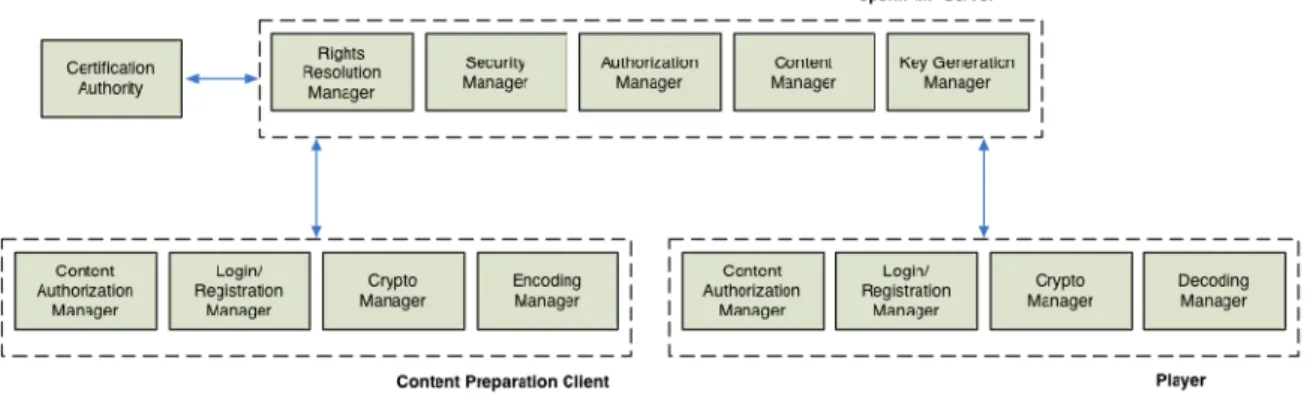
T](https://thumb-eu.123doks.com/thumbv2/123dok_br/18692616.915295/67.892.221.719.121.333/figure-fairplay-architecture-protected-purchased-scrambled-simplifies-computer.webp)

![Figure
II.2.1:
The
different
parts
that
compose
MPEG‐21 2.1 MPEG21
Rights
Expression
Language
and
Rights
Data
Dictionary Parts
5
and
6
of
MPEG‐21
describe
the
Rights
Expression
Language
(REL)
[MPEG‐21‐REL,
2004]
and
Rights
Data
Dic]onary
(RDD)
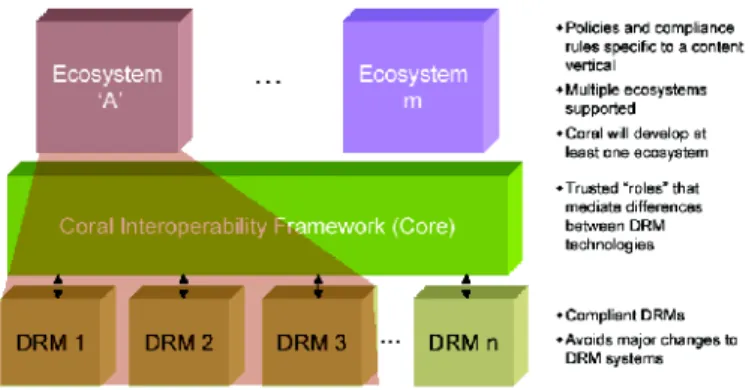
[MPEG‐21‐R](https://thumb-eu.123doks.com/thumbv2/123dok_br/18692616.915295/81.892.180.754.115.579/figure-different-expression-language-dictionary-describe-expression-language.webp)


![Figure
III.2.2:
Different
services,
by
different
providers,
integrated
in
a
common
rights
management
solu]on](https://thumb-eu.123doks.com/thumbv2/123dok_br/18692616.915295/111.892.240.691.584.977/figure-different-services-different-providers-integrated-common-management.webp)
![Figure
III.2.5:
DRM
services
registra]on
and
descrip]on
on
a
registra]on
server.
When
DRM
services
are
requested,
the
registra]on
server
can
provide
to
the
client
both
the
descrip]on
of
the
service
and
the
service
creden]als This
process
will
require
tha](https://thumb-eu.123doks.com/thumbv2/123dok_br/18692616.915295/115.892.162.780.118.506/figure-services-registra-descrip-registra-services-requested-registra.webp)
