Vol.54, n. 1: pp. 207-220, January-February 2011
ISSN 1516-8913 Printed in Brazil BRAZILIAN ARCHIVES OF
BIOLOGY AND TECHNOLOGY
A N I N T E R N A T I O N A L J O U R N A L
Nickel Adsorption by Variable Charge Soils: Effect of pH
and Ionic Strength
Marcio Roberto Soares
*, José Carlos Casagrande and Ernesto Rinaldi Mouta
Departamento de Recursos Naturais e Proteção Ambiental; Centro de Ciências Agrárias; Universidade Federal de São Carlos; C.P.: 153; 13600-970; Araras - SP - Brasil
ABSTRACT
The effects of pH and ionic strength (I) on Ni adsorption in variable charge soils were evaluated by laboratory batch experiments. Experimental results fitted the Langmuir model. Maximum adsorption (Adsmax) ranged from 260-2818 mg kg-1 (topsoil) to 532-1541 mg kg-1 (subsoil). Nickel affinity (KL) was higher in the subsoil samples (0.022-0.236 L kg-1) than in topsoil (0.003-0.049 L kg-1). Adsorption envelopes showed sharp increase in Ni adsorption (20-90%) in the 4.0-6.0 pH range. Nickel adsorption was affected by I and specific adsorption predominated in the 3.0-5.0 pH range, while above pH 3.0-5.0, it was adsorbed by electrostatic mechanisms. Negative values of free energy variation (∆G) and the separation factor KR<1 indicated that Ni adsorption reaction was favorable and occurred spontaneously, especially when pH increase. Chemical and mineralogical soil attributes should be considered as criteria for selecting the areas for disposal of residues containing Ni to minimize the impact on the environment.
Key words: adsorption isotherms; free energy; adsorption envelopes; adsorption edges; ionic strength
*Author for correspondence: [email protected]
INTRODUCTION
Nickel (Ni) is a heavy metal whose natural content in the soil can vary from very small proportions (< 5 mg kg-1), which qualify it as a trace element, to excessively high concentrations (5000 mg kg-1), found in the soils formed on ultrabasic igneous rocks (Rovers et al., 1983; Uren, 1992). Plants require Ni because the element acts as a urease activator, which breaks urea into carbonic gas and ammonia (Eskew et al., 1983). Over the years, the quantity of Ni released in the soil has increased due to the high production, processing and recycling of Ni and its byproducts and residues. Nickel is very important in the electronics sector, in the production of Ni-Cd batteries and in the galvanoplasty industry, where it is used to improve
mechanisms are known to be determinant in the control of metal availability and solubility in the soil (Sparks, 1999). Interest has grown recently in the phenomena of metallic ion adsorption by surfaces with pH-dependent charges to increase the understanding of the dynamic of these contaminants in the environments of tropical region. In these systems, dependence of adsorption in relation to the variations in the soil solution parameters, such as pH and ionic strength, is determinant for understanding the chemical performance of metals in the soil, from the agricultural, environmental and public health points of view (Uren, 1992).
The pH is the primary factor that controls heavy metal adsorption and their availability (Harter, 1983; Casagrande et al., 2008). However, residues and effluents applied to the soil may contain a series of specific chemicals in solution (Tamanini et al., 2008) and the electrolytic concentration is frequently higher than that found in the soil solution (Bowman et al., 1981). The dependence of adsorption with regard to ionic strength is used to distinguish the outer- and inner-sphere adsorption mechanisms, which informs the stability and intensity of the retention process (Petruzzelli et al., 1985; Kosmulski, 1997; Criscenti and Sverjensky, 1999). This aspect is of particular interest for Ni adsorption, because there is no consensus yet on its retention mechanism by the soil.
Nickel adsorption has been studied in pure systems, such as Fe, Al and Mn hydrated oxides (McKenzie, 1980; Beukes et al., 2000), clay minerals (Mattigod et al., 1979; Echeverría et al., 2003; Sen Gupta and Bhattacharyya, 2006) and organic matter (Mellis et al., 2004), and in complex systems such as the soil, under natural and agricultural conditions or with residue application (Camargo et al., 1989; Pombo et al., 1989; Mellis et al., 2004; Iglesias et al., 2007). However, sufficient data have not yet been gathered on Ni adsorption by weathered soils of the wet tropics to assure the implementation of efficient prevention techniques and remediation of soil contamination.
Reactions between the heavy metals and soil have been described mathematically by adsorption isotherm equations that describe the ratio between the adsorbed and in solution metal concentration. This approach gives quantitative parameters of the adsorption reaction, supplying important data on the retention capacity and the force by which the
metal is retained by the soil (Morera et al., 2001). The Langmuir isotherm, fitted by nonlinear models, was successfully applied in the study of metals in Oxisols, including Ni (Camargo et al., 1989; Pombo et al., 1989). However, metal adsorption modeling in tropical soils is rarely accompanied by a more detailed description, based on thermodynamics concepts (Silveira et al., 1999; Dias et al., 2003; Soares et al., 2005; Iglesias et al., 2007; Casagrande et al., 2008; Mouta et al., 2008; Soares et al., 2009). Some information has been obtained on thermodynamic modeling for the adsorption reaction of some metallic ions by homogeneous surfaces, such as kaolinite and oxidic interfaces (James and Healy, 1972; Angove et al., 1999; Trivedi and Axe, 2000), but there are few data on the thermodynamics of the Ni adsorption reaction in the soils (Sen Gupta and Bhattacharyya, 2006). As metal distribution among the liquid and solid phases is a measure of the position of equilibrium in the adsorption process, the state of this system can be defined by a set of thermodynamic properties that can serve as measures of the extension and spontaneity of the adsorption reaction (Soares et al., 2005; Casagrande et al., 2008).
The objectives of this study were to investigate the parameters of the Ni adsorption reaction by the soils with predominantly Fe and Al (oxy)hydroxides in their mineralogy and to assess the directional force of this reaction by studying the thermodynamic parameters in function of the variation in soil solution pH and ionic strength.
MATERIALS AND METHODS
Soils
In order to study Ni adsorption, topsoil (0-0.2 m) and subsoil samples (the greatest expression of the B horizon diagnostic) of two Oxisols [heavy clayey-textured Anionic “Rhodic” Acrudox (RA); medium-textured Anionic “Xanthic” Acrudox (XA)] and one Alfisol [heavy clayey-textured Rhodic Hapludalf (RH)] (Soil Survey Staff, 1999) derived from basalt and collected in locations in São Paulo State, Brazil (Ribeirão Preto – 21°10’S, 47°48´W; Guaíra – 20°19’S, 48°18’W; Araras – 22º20’S, 47°27’W) were used.
Soil characterization
in fine air-dried soil samples, sieved through 2 mm mesh, according to well established methods described in Camargo et al. (1986) and Raij et al. (2001). pH was determined by potenciometry in H2O and in 1 mol L-1 KCl suspensions with 1:2.5
soil:solution ratio, and the difference ∆pH = pHKCl
– pHH2O was used as estimate of the net charge
balance (Mekaru and Uehara, 1972). The zero point of salt effect (ZPSE) represented the pH value at the point of intersection of the titration curves with H+ and with OH-, at three KCl concentrations (0.1; 0.01 and 0.001 mol L-1) (Alleoni and Camargo, 1994). Samples were also investigated using the cesium (Cs+) adsorption method, which measured the structural permanent and variable charges and was based on the preference of Cs+ over Li+ in the siloxane surface sites and the lower selectivity of ionizable surface group for the Cs ion (Weber et al., 2005). The BET N2 adsorption method was used to measure
the specific surface area (SSA) (Feller et al., 1992). Kaolinite and gibbsite contents were semi-quantified by differential termal analysis (DTA) of the deferrified clay fraction without organic matter of the soil samples (Tan et al., 1986).
Batch mode adsorption studies
Laboratory batch mode adsorption experiments were carried out according to Soares and Casagrande (2009), after adding 20 mL of Ca(NO3)2 electrolytic solution containing Ni in the
form of hydrated nitrate salt [Ni(NO3)2.6H2O] at 2
g of fine air-dried soil samples, maintaining the 1:10 soil:solution ratio. The set was placed in polyethylene flasks under agitation (150 rpm) for 24 h at 24 ± 2oC. After equilibration, suspensions were then centrifuged twice, at 2500 g, and Ni concentration in the supernatant was determined by atomic absorption spectrophotometry. Adsorption isotherms were elaborated for soil samples at natural pH from the experiments with increasing Ni concentrations (5.0 to 80.0 mg L-1), with Ca(NO3)2 0.01 mol L
-1
as electrolytic support. Under similar experimental conditions, adsorption envelopes were constructed by the %Niads vs pH
plot, after adjusting the pH, by adding HCl or NaOH 4 mol L-1, in the suspensions containing 5 mg L-1 Ni in Ca(NO3)2 0.01, 0.1 and 1.0 mol L
-1
electrolyte support, for the simultaneous verification of the pH and ionic strength effects on the Ni adsorption reaction. Previous trials were carried out to verify the volume of 0.04, 0.4 and
4.0 mol L-1 HCl and NaOH solutions to be added to reach the desired pH variation (3.0 to 8.0), so as not to exceed 2% of the volume of the electrolyte support. All the procedures were performed in triplicate.
The quantity of adsorbed Ni, [Ni]ads, and the
adsorption percentage, %Niads, were calculated by
the ratios:
M
V
Ni
Ni
Ni
]
ads([
]
[
]
eq)
[
=
0−
[Eq.1]100
]
[
)
]
[
]
([
%
0 0
x
Ni
Ni
Ni
Ni
ads eq−
=
[Eq.2]where [Ni]ads was the quantity of Ni adsorbed after
equilibrium (mg kg-1); [Ni]0 and [Ni]eq were the
added initial and equilibrium concentration (mg L-1 ), respectively; V = solution volume (mL); and M = mass of the soil sample (g). The Ni quantities originally present in the soil samples were subtracted from the quantity of Ni adsorbed.
Adsorption isotherms ([Ni]ads vs [Ni]eq) were
constructed from the experimental results, and the Ni adsorption (Adseq) was compared with that
estimated by the nonlinear form of the Langmuir isotherm:
eq L eq L eq
C K
Ads C K Ads
+ =
1
max
[Eq.3]
where KL was the parameter related to the soil affinity for Ni (L kg-1); Ceq was equilibrium
concentration; and Adsmax was the maximum Ni
adsorption capacity (mg kg-1). The Langmuir isotherm was fitted to the Ni adsorption results by the Fitfunc and Fitfun.bas softwares (Barrow, 1987), which used the nonlinear optimization of the least squares and did not require the linearization of the isotherm. This procedure avoided the introduction of changes in the error distribution and acquisition of influenced parameters (KL and Adsmax) (Goldberg et al.,
1993).
Thermodynamic parameters of adsorption reaction
Gibbs free energy (Silveira et al., 1999; Dias et al., 2003; Soares et al., 2005; Casagrande et al., 2008; Mouta et al., 2008; Soares et al., 2009):
∆G = RT (logCeq – log C0) [Eq.4]
where ∆G was the variation in the free energy (J mol-1); R was the universal constant of the gases = 8.314 J mol-1 K-1; T was the absolute temperature (K); and C0 was added initial concentration.
The characteristics of the Langmuir isotherm could be expressed in terms of the separation factor or equilibrium parameter, KR, a
dimensionless constant that indicated whether the adsorption reaction was favorable by the equation (Ho et al., 2002; Mahramanliouglu et al., 2002; Singh and Pant, 2004; Soares et al., 2005; Casagrande et al., 2008; Mouta et al., 2008; Soares et al., 2009):
0
1 1
C K K
L
R = + [Eq.5]
where KL was the affinity constant estimated by
the Langmuir equation (Eq. 3).
RESULTS AND DISCUSSION
Soil attributes
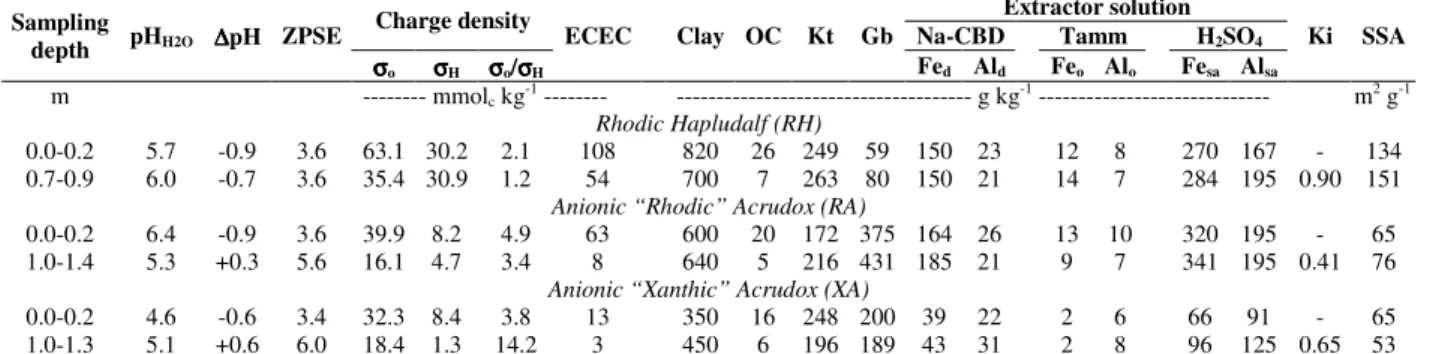
Table 1 shows some chemical, physical and mineralogical attributes of the soils. Oxisols
subsoil samples presented ZPSE values higher than soil pH and this resulted in a positive equilibrium charge, as confirmed by the ∆pH values. In the first 125 cm of depth, Oxisols also presented effective cation exchange capacity (ECEC) less than 15 mmolc kg
-1
of clay and pHKCl
≥ 5.0, meeting the requirements for the manifestation of acric properties (Soil Survey Staff, 1999). These soils were close to the end of their pedogenetic development cycle. They had undergone intense desilicatization because of the prolonged weathering action that was reflected by the low Ki values (Table 1). High σH/σo ratios
showed also the predominance of variable charges in the acric Oxisols. This condition was expected, because the main constituents of the solid phase of these soils were organic matter, kaolinite and the Fe and Al (oxy)hydroxides, whose surface charge varied according to the pH and ionic strength of the system. Rhodic Acrudox presented the highest Fe and Al contents extracted by sulfuric acid and by the Na-DCB solution, which corresponded to the contents present in the structure of the secondary minerals and to those regarding the crystalline forms, respectively. Rhodic Acrudox, when compared to Xanthic Acrudox and Rhodic Hapludalf, presented higher and similar contents of poorly crystalline iron oxides, respectively. This fraction corresponded to the more reactive oxide species with greater specific surface.
Table 1 - Chemical, physical and mineralogical attributes of the soils.
ZPSE = zero point of salt effect; σo = variable charge; σH = permanent charge; ECEC = effective cation exchange capacity; SSA = specific surface area; OC = organic carbon; Kt = Kaolinite; Gb = gibbsite; Fed and Ald = iron and aluminum extracted by sodium citrate-bicarbonate-ditionite (Na-CBD); Feo and Alo = iron and aluminum extracted by Tamm´s solution [(COOH)2.2H2O+(NH4)2C2O4.H2O]; Feas and Alas = iron and aluminum extracted by H2SO4 9 mol L-1; Ki = wheathering index = SiO2/Al2O3.
Extractor solution Charge density
Na-CBD Tamm H2SO4
Sampling
depth pHH2O ∆∆∆∆pH ZPSE
σσσσo σσσσH σσσσo/σσσσH
ECEC Clay OC Kt Gb
Fed Ald Feo Alo Fesa Alsa
Ki SSA
m --- mmolc kg-1 --- --- g kg-1 --- m2 g-1
Rhodic Hapludalf (RH)
0.0-0.2 5.7 -0.9 3.6 63.1 30.2 2.1 108 820 26 249 59 150 23 12 8 270 167 - 134 0.7-0.9 6.0 -0.7 3.6 35.4 30.9 1.2 54 700 7 263 80 150 21 14 7 284 195 0.90 151
Anionic “Rhodic” Acrudox (RA)
0.0-0.2 6.4 -0.9 3.6 39.9 8.2 4.9 63 600 20 172 375 164 26 13 10 320 195 - 65 1.0-1.4 5.3 +0.3 5.6 16.1 4.7 3.4 8 640 5 216 431 185 21 9 7 341 195 0.41 76
Anionic “Xanthic” Acrudox (XA)
0 10 20 30 40 50 0
100 200 300 400 500 600 700 800
A
d
s
o
rb
e
d
N
i
(m
g
k
g
-1)
C
e (mg L -1
)
Sample Adsmax KL
Topsoil mg kg-1 L kg-1
XA 2818.11 0.003 RA 260.08 0.021 RH 1687.29 0.049
0 10 20 30 40 50
0 100 200 300 400 500 600 700 800
Sample Adsmax KL
Subsoil mg kg-1
L kg-1
XA 759.52 0.022 RA 532.44 0.236 RH 1541.97 0.067
A
d
s
o
rb
e
d
N
i
(m
g
k
g
-1)
C
e (mg L -1
) The decrease in the σH values with depth was
attributed to the decrease in organic matter content, the main supplier of variable negative charges in wet tropical soils. In the absence of organic matter, Fe and Al (oxy)hydroxides were responsible for maintaining about 50% of the reversible charges. High permanent and variable charge values were found in RH, which conferred greater charge density. This occurred in consequence of the less advanced weathering stage of RH, whose Ki value indicated less intense silica loss, justifying both its greater kaolinite contents and the occurrence of clay minerals of the 2:1 type [interstratified chloride/vermicullite and vermicullite (results not shown)], responsible not only for the manifestation of permanent charges (σH) but also for the increase in the specific
surface area (SSA). Gibbsite contents were particularly high in the Oxisols, and the occurrence of this mineral has implications on the magnitude of the electric charges, especially in the deeper horizons, where the CO contents were small. Regarding the clay fraction of the soils, Rhodic Acrudox, because it was the most weathered, presented greater crystalline (Fed) and
amorphous (Feo) Fe oxide contents, followed by
the Alfisol.
Adsorption isotherms at natural pH
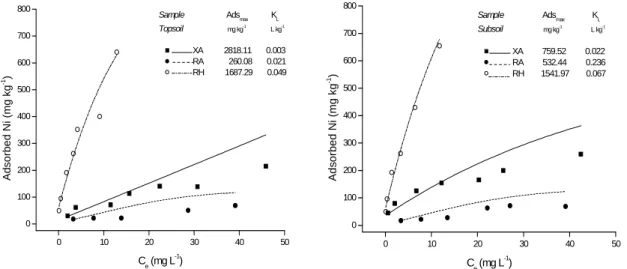
Figure 1 shows the typical Ni adsorption isotherms by the weathered soils at natural pH and constant 0.01 mol L-1 Ca(NO3)2 ionic strength. Nickel
adsorption increased as more concentrated solutions of the metal were added (Fig. 1).
Figure 1 - Isotherms and parameters of nickel adsorption (Adsmax = maximum adsorption; KL =
affinity constant) obtained from the adjustment of the Langmuir equation (curves) to the experimental results (points); XA = Anionic “Xanthic” Acrudox; RA= Anionic “Rhodic” Acrudox; RH = Rhodic Hapludalf.
Adsorption curve slope obtained for RH indicated the more expressive increase in adsorption at lower Ni concentrations initially added. Isotherms fitted to the Oxisols, regardless of depth, were C-type, characterized by a small initial slope which remained constant and was not related to the equilibrium concentration (Sposito, 1989). The high initial slope in the H-type isotherms shown by RH suggested high affinity of the soil for Ni, as a result of inner-sphere type surface complexing mechanisms, or to significant adsorption processes mediated by van der Waals interactions (Sposito,
1989), or to the predominance of hydrolyzed metallic species (James and Healy, 1972; Echeverría et al., 2003).
Langmuir equation, whose original derivation considered only the forces involved between the adsorbate and the adsorbent surface, leading to the formation of a monolayer of metal over the active sites of a homogeneous surface, simulated adequately the experimental results of Ni adsorption (Fig. 1).
attributes similar to those in this study (Table 1). Experimental results obtained for RH showed higher adherence to the Langmuir isotherm compared to those of the Oxisols, which showed small deviations between the observed and simulated results with the increase in the Ni concentrations added (Fig. 1). The appropriate fit of the Ni adsorption results by Oxisols, and even by less weathered soils to the Langmuir isotherm had been reported previously (Camargo et al., 1989; Pombo et al., 1989). The parameters derived from the isotherms fit were convenient for comparative assessment of different soils and elements. The adsorption parameters, Adsmax and
KL, indicated that Ni adsorption varied according
to the soil and sampling depth (Fig. 1). Practically in all the cases, isotherms did not become asymptotic and the maximum adsorption was estimated by the fit of the least squares of the Langmuir equation. The Ni Adsmax ranged from
260 (RA) to 2818 mg kg-1 (XA) in the topsoil layer. This more than tenfold variation was associated to the soil type, especially to the mineralogy. The soils with similar Fe (oxy)hydroxide contents may differ appreciably in their ability to retain heavy metals. Xanthic Acrudox had lower clay and free iron oxide contents (Table 1), but because of its coloring, its mineralogical composition was probably dominated by goethite. Iron oxides such as hematite (α-FeO3) have two thirds of their
octahedric sites filled, while hydrated oxides, such as goethite (α-FeOOH), had only half their octahedric sites filled (Cornell and Schwertmann, 1996). This mean higher density of hydroxylic surface sites available for adsorption. In the subsoil, RH presented the highest Ni adsorption capacity (1541 mg kg-1) and maintained practically the same capacity shown by the topsoil sample. This result indicated that organic matter could not have such a decisive effect on Ni adsorption by RH, since this soil still had permanent charge sites (σH) for adsorption as a result of its less advanced
weathering condition (see Ki in Table 1). On the other hand, higher Adsmax values were detected in
the samples from the Oxisols topsoil horizons and should be correlated with the organic carbon
content, ratifying results of other studies with metal adsorption by highly weathered soils (Silveira and Alleoni, 2003; Casagrande et al., 2008; Mouta et al., 2008; Soares et al., 2009). Mellis et al. (2004) reported decrease in Ni adsorption after eliminating the organic matter in the weathered soils. According to Soares and Alleoni (2008), soil organic matter was responsible for 50 to 95% of the cation exchange capacity (CEC) in Brazilian Oxisols, whose inorganic fraction was composed by low reactive minerals. The authors estimated that the contribution of organic matter to soil CEC was more than 60 times higher than the one of clay fraction. Although organic matter favors the adsorption of a greater quantity of Ni, KL constants
estimated by the Langmuir model (Fig. 1), which represents the combined effect of all the reactions that occurred on the solid/liquid interface (Angove et al., 1999), suggested that Ni was more strongly adsorbed in the subsoil horizons.
In this soil layer, the organic matter has less influence and permits higher exposure of the mineral colloid surfaces that are hidden in the topsoil layers because of the direct association between Fe and Al (oxy)hydroxides, gibbsite and kaolinite with organic compounds.
Adsorption envelopes: influence of soil pH on Ni adsorption
There is a critical pH interval for the solid/solution interfaces, generally smaller than two units, where the metal adsorption percentage may increase sharply from extremely low pH value to 100% at high pH values (Sposito, 1989; Soares and Casagrande, 2009). This critical interval, known as the adsorption edge, is related to the hydrolysis constant of the metallic ion. The degree to which the metals are hydrolyzed is probably the main factor that determines the quantity of metal retained at a given pH (James and Healy, 1972; Harter, 1983). Adsorption envelopes (Fig. 2), represented graphically by %ads vs pH plot, showed the relative proportion of Ni removal from the solution, for a constant ionic strength of 0.01 mol L-1 Ca(NO3)2 and at fixed
2 3 4 5 6 7 8 9 10 0
20 40 60 80 100
A
d
s
o
rb
e
d
N
i
(%
)
Anionic "Xanthic" Acrudox Anionic "Rhodic" Acrudox Rhodic Kandiudalf
topsoil
pH
2 3 4 5 6 7 8 9 10
0 20 40 60 80 100
A
d
s
o
rb
e
d
N
i
(%
)
pH subsoil
Figure 2 - Nickel adsorption envelopes for topsoil and subsoil samples from highly weathered
tropical soils after addition of 5 mg L-1 Ni.
Nickel adsorption depended greatly on the pH, regardless of soil or sampling depth, and increased sharply with the increase in pH from 4.0 to 6.0, an interval when 20-90% Ni adsorption occurred (Fig. 2). Many adsorption studies with mineral soils have shown increase in Ni adsorption with increase in pH (Harter, 1983; Elzinga and Sparks, 2001). Harter (1983) and Beukes et al. (2000) reported that metal adsorption was pH-dependent and that the intensity of the phenomenon increased drastically above pH 7.0. Practically all the Ni added (5 mg L-1) disappeared from the soil solution when the pH was over 7.0, regardless of soil or sampling depth. This occurred at high pH values because the Ni pKa1 was around 9.6, above
the pKa1 values for other metals such as Pb, Cu
and Zn (Mellis et al., 2004). Thus, even at the highest pH values reached in this study, the possibility of the presence of Ni(OH)20 was very
small (James and Healy, 1972). Even so, rapid increase in Ni adsorption above pH 8.0 may also be associated to the start of the hydroxide precipitation reactions with the Ni2+ and NiOH+ species (Sen Gupta and Bhattacharyya, 2006). It is expected that Ni(H2O)62+ form be found at low pH
values and that the complexes with OH- and organic ligands start to predominate as the pH increases (Uren, 1992).
The proportion of adsorbed metallic ions increased uniformly and continually with the increase in pH, but the shape of the curve and its position depended on the soil identity, especially regarding its mineralogical constitution (Fig. 2). The adsorption pattern was very similar for the Oxisols
samples, as the shape and positioning of the adsorption edges showed, even as overlapping in the cases of the subsoil Oxisols samples (Fig. 2). The adsorption edges for Ni adsorption by the Oxisols presented the typical sigmoidal shape, mainly in relation to their positioning (Fig. 2). In these soils, Ni retention was characterized initially by a small slope at the 2.0-3.5 pH range, where about 25% of the Ni added to the topsoil samples was adsorbed, and 3.0-4-5 in the samples collected in the subsoil, where approximately 15-20% of Ni was removed from the solution (Fig. 2). Harter (1983) observed similar gentle initial slope for Cu and Zn adsorption curve in an Alfisol, which was attributed to the intense competition between the metal and the H+ and Al3+ ions for exchange sites. According to the author, the slope of the adsorption curve tended to increase as the Al3+ was removed from the exchange complex by hydrolysis reaction, which was enhanced with increasing pH.
0 10 20 30 40 50 60 70 80 90 0.0
0.1 0.2 0.3 0.4 0.5 0.6 0.7 0.8 0.9 1.0
KR
C0 (mg L -1
)
topsoil
0 10 20 30 40 50 60 70 80 90
0.0 0.1 0.2 0.3 0.4 0.5 0.6 0.7 0.8 0.9
1.0 subsoil
KR
C0 (mg L-1)
Anionic "Xanthic" Acrudox Anionic "Rhodic" Acrudox Rhodic Kandiudalf
charges (σH), which did not depend on the pH
variation (Table 1). Results from envelopes suggested that soil pH management was a promising, efficient and cheap technique as a remediation action in areas contaminated by Ni.
Thermodynamic parameters of Ni adsorption reaction
Separation factor (KR)
Preliminary information regarding the degree of development and spontaneity of the adsorption reaction could be obtained from assessing the equilibrium parameter or the KR separation factor
(Eq. 5), calculated from the KL Langmuir constant
(Eq. 3). Following a more simplified approach, adsorption is favorable and spontaneous when KR
< 1, while values of KR > 1 indicate the absence of
spontaneity in the reaction (Mahramanliouglu et al., 2002; Singh and Pant, 2004; Soares et al., 2005). The KR coefficient can further indicate
whether the adsorption isotherm is unfavorable to the process (KR > 1), linear (KR = 1), favorable (0
< KR < 1) or irreversible (KR = 0) (Ho et al., 2002).
The KR values for Ni adsorption reaction
decreased with the increase in the initial Ni
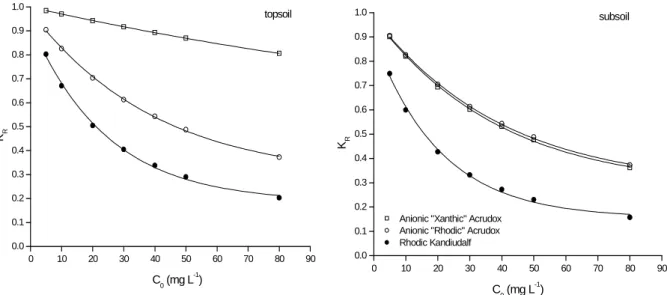
concentration and were always higher than 1 (Fig. 3), confirming some results obtained for metallic cation reactions (Ho et al., 2002; Casagrande et al., 2008). This indicated that the adsorption reaction was more favorable and spontaneous for high initial Ni concentrations, further showing that all the soils were good systems for Ni retention, ranking RH > RA > XA (Fig. 3). Except for XA, for the other soils the separation factor was a parameter not very sensitive to the depth. For XA, the KR values were lower for the subsoil samples,
indicating that Ni adsorption developed more spontaneously in the absence of organic matter and validating the indications of the affinity constant KL (Fig. 1).
The KR parameter was sensitive to the ion
hydrated radii (Soares et al., 2005) and under the conditions in which the adsorption experiments for isotherm construction were developed, that is, at the natural pH of the samples (pH between 4.0 and 5.5), higher KR values were expected, because the
hydrated ions of hexaquonickel [Ni(H2O)6 2+
] was the most stable form and most found in soil solution at low pH values (Bowman et al., 1981; Uren, 1992).
Figure 3 - Separation factor (KR), at natural pH, as affected by initial concentration of Ni (C0); XA
These two factors were arguments to consider the occurrence of specific Ni adsorption mechanisms, because inner-sphere type complex formation did not permit the interposition of water molecules on the solid/solution interface and justifies the adsorption of ions with smaller hydrated radii, quantitatively characterized by low KR values (Fig.
3).
Free energy variation in Ni adsorption (∆∆∆∆G)
Nickel adsorption was reflected by the values of the variation in free energy ( G), whose negative sign indicated the exergonic nature of the reaction, with energy release for conversion of the less stable Ni forms in solution in adsorbed forms with greater stability. The adsorption reaction of metallic elements by the organic and inorganic surfaces of pure or isolated systems is usually spontaneous. The spontaneity of the Cd (Dias et al., 2003; Soares et al., 2009),Cu (Silveira et al., 1999; Mouta et al., 2008), Ni (Iglesias et al., 2007), and Zn (Casagrande et al., 2008) adsorption reaction by weathered soils was also characterized by negative free energy values.
Negative ∆G values (Fig. 4) were in line with KR
values (Fig. 3) and confirmed the feasibility and spontaneous nature of Ni adsorption reaction. When increased element content added to the soil is considered, ∆G value may reveal the magnitude of the extension of the reaction between the element and the adsorption surface (Soares et al., 2005, Mouta et al., 2008; Soares and Casagrande, 2009). Thus, negative ∆G values imply that the reaction must be occurring in the direction of product formation, that is, in the direction of adsorption occurrence. The more negative the ∆G values, the greater the motrice force needed for adsorption to occur.
The ∆G values decreased with the increase in the quantity of Ni added. The decrease in the free energy of the Cu (Silveira et al., 1999), Cd (Dias et al., 2003), Ni (Iglesias et al., 2007) and B (Soares et al., 2005) adsorption reaction by highly weathered soils with the increase in the concentration led to the conclusion that the elements were less strongly adsorbed in more concentrated solutions, contrary to that shown by the separation factor (KR) (Fig. 3). As C-type
isotherm showed (Fig. 1), lower concentrations added initially might not have been able to saturate
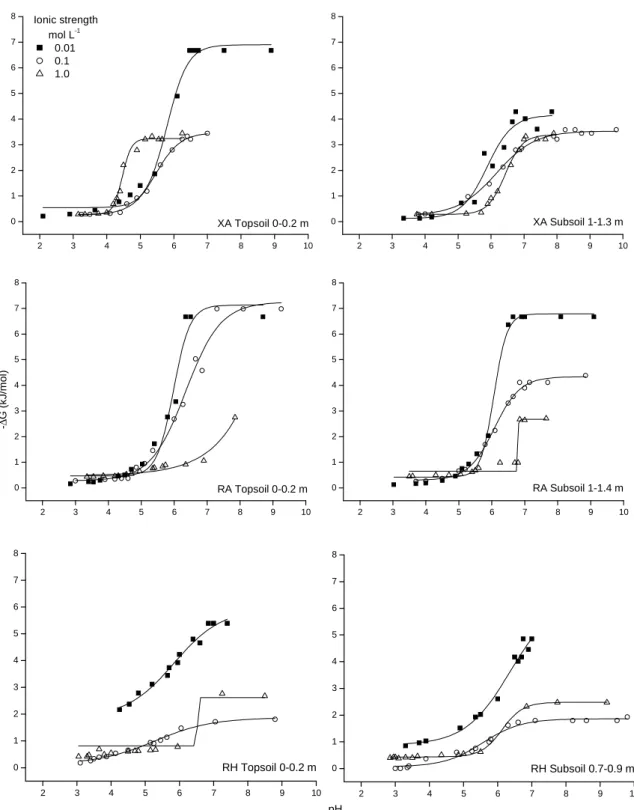
the adsorption sites. However, ∆G values were negative for all the concentration range and, in addition to the spontaneity of the reaction, this again indicated that the sorbed forms were more stable than those in solution (Soares et al., 2009). When compared under the standard 0.01 mol L-1 ionic strength condition, which best reproduced the natural conditions of the soil solution, the maximum ∆G values was -4850 J mol-1 for subsoil sample from RH at pH 7.0. The maximum ∆G values for the acric oxisol samples did not vary with depth and occurred at 6.0 pH. Oxisols presented higher ∆G values than the Alfisol, and indicated that Ni adsorption was more favored in the more weathered soils.
Figure 4 illustrates the influence of the pH on the spontaneity of adsorption reaction after adding 5 mg L-1 og Ni. In all the samples, ∆G increased with the increase in the pH, showing not only that Ni adsorption increased with the increase in pH (Fig. 2), but also that the reaction was favored by the decrease in the hydrogen ion concentration. In summary, as the pH increased, G became more negative as the result of the increase in the motrice force needed for adsorption reaction.
Influence of soil solution ionic strength (I) on Ni adsorption
Figure 4 - Effect of soil solution parameters (pH and ionic strength) on free energy of Ni adsorption reaction by highly weathered soils; XA = Anionic “Xanthic” Acrudox; RA = Anionic “Rhodic” Acrudox; RH = Rhodic Hapludalf.
2 3 4 5 6 7 8 9 10
0 1 2 3 4 5 6 7
8 Ionic strength
mol L-1 0.01 0.1 1.0
XA Topsoil 0-0.2 m
2 3 4 5 6 7 8 9 10
0 1 2 3 4 5 6 7 8
XA Subsoil 1-1.3 m
2 3 4 5 6 7 8 9 10
0 1 2 3 4 5 6 7 8
-∆
G
(
k
J
/m
o
l)
RA Topsoil 0-0.2 m
2 3 4 5 6 7 8 9 10
0 1 2 3 4 5 6 7 8
RA Subsoil 1-1.4 m
2 3 4 5 6 7 8 9 10
0 1 2 3 4 5 6 7 8
pH RH Topsoil 0-0.2 m
2 3 4 5 6 7 8 9 10
0 1 2 3 4 5 6 7 8
Starting at pH 5.0, higher dependence of Ni adsorption was identified in relation to the ionic strength in the Oxisols (Fig. 4), which implied the manifestation of nonspecific adsorption mechanisms under these conditions. Although the essential mechanism for metal adsorption by Fe, Al and Mn (oxy)hydroxides is specific and pH dependent, increasing with the pH, heavy metals can be adsorbed by the electrostatic attraction in the diffuse double layer by ion exchange (Mesquita and Vieira e Silva, 2002). According to Uren (1992), Ni adsorption in the soils is particularly governed by the formation of outer-sphere type complexes and, because of this, Ni cation species (Ni2+e NiOH+) are the preferential adsorbed forms.
The intensity of the effect of the ionic strength on specific metallic cation adsorption depends greatly on the surface charge signal and on the determined pH (Kosmulski, 1997). For the Alfisol, the adsorption dependence on the ionic strength was observed throughout the pH range (Fig. 4), because the manifestation of electrostatic adsorption mechanisms did not depend on the pH, due to the higher quantity of permanent charges (Table 1). Considering the simultaneous effect of the pH and ionic strength on Ni adsorption, Scheidegger et al. (1996) differentiated two pH levels more sensitive to the changes in the electrolytic concentration of the solution. The authors observed that in the region with lower pH values, that is, below neutrality, Ni adsorption increased with the decrease in the ionic strength, while at the values of pH > 7.0, Ni adsorption seemed to have been affected by the ionic strength. Contrary to the pH, the increase in ionic strength decreased the intensity and spontaneity of the Ni adsorption reaction, because the ∆G values decreased sharply when the support electrolyte concentration increased ten fold and one hundred fold (Fig. 4). Echeverría et al. (2003) reported the same effect for Ni adsorption by illite. The decrease in metallic ion adsorption with the increase in the ionic strength are attributed to: (i) the type of metal; (ii) changes in the free ion activity and MOH+ species; (iii) the type of surface, surface charge effect and alterations in the electrostatic potential on the adsorption plane and; (iv) the increase in competition for adsorption sites among the cation index and the metallic ions (Boekhold et al., 1993; Naidu et al., 1997; Criscenty and Sverjensky, 1999).
For practical purposes, the increase in the soil solution ionic strength by the excessive discharge of residues and effluents may cause increase in Ni mobility in the soil, especially if the pollutant contains competitive cations in its composition. In these cases of high Ni polluting charge, the increase in Ni mobility by the high eletrolytic concentration of the solution might be reduced again by the rise in pH (Fig. 4).
The Ni2+ cation is known to form complexes with various organic and inorganic ligands (Bowman et al., 1981). Many studies have considered the effect of cations and anions that constitute the electrolyte support on metal adsorption, principally regarding to the competitive effect of Ca2+ for adsorption sites and by the action of Cl- in the formation of chloride complexes with less affinity for the surface (Mattigod et al., 1979; Bowman et al., 1981; Wang et al., 1997; Echeverría et al., 2003). Considering the nature of electrolyte support, the effect of the competition between Ca2+ and Ni2+ for the same adsorption sites probably justified the decrease in Ni adsorption with the increase in ionic strength, rather than the probable formation of complexes between Ni and the anion because NO3
-
has much less affinity than Cl- for this type of reaction in solution (Criscenty and Sverjensky, 1999). Boekhold et al. (1993) observed that the competition with the Ca of the electrolytic support for adsorption sites reduced Cd adsorption by about 80% in an acid soil. In practice, this increase of ionic strength in the soil solution may be caused by the excessive discharge of residues and effluents, especially if the pollutant contains competitive cations in its composition (Soares et al., 2009). Tamanini et al. (2008) observed a linear increase between total Ca and sewage sludge application rate due to rapid release of calcium hydroxide.
mechanism, it seems reasonable to accept the hypothesis that, in the case of Ni adsorption, the effect of the pH is more critical in determining the adsorbent surface charge and not the metal species in solution due to their action in hydrolysis. Positive charges of the Ni ions are less repulsed when the pH reaches values close to the zero point of salt effect of oxide minerals such as goethite (8.5) and hematite (9.2) (Beukes et al., 2000). As general concluding remarks, chemical and mineralogical soil attributes should always be considered as criteria for selecting the areas for disposal or application of residues containing Ni to minimize soil contamination and impact on the environment.
ACKNOWLEDGMENTS
This work was supported by grants from FAPESP (process n. 04/00445-3)
REFERENCES
Alleoni, L.R.F., Camargo, O.A. (1994), Pontos de efeito salino nulo de latossolos ácricos. Rev. Bras. Cienc. Solo, 18, 175-180.
Angove, M.J., Wells, J.D., Johnson, B.B. (1999), The influence of temperature on the adsorption of cadmium (II) and cobalt (II) on goethite. J. Colloid Interf. Sci., 211, 281-290.
Barrow, N.J. (1987), Reactions with variable-charge soils. Martinus Nijhoff Publishers, Dordrecth. Basta, N.T., Ryan, J.A., Chaney, R.L. (2005), Trace
elements chemistry in residual-treated soil: key concepts and metal bioavailability. J. Environ. Qual.,
34, 49-63.
Beukes, J.P., Giesekke, E.W., Elliot, W. (2000), Nickel retention by goethite and hematite. Miner. Eng., 13, 1573-1579.
Boekhold, A.E., Temminghoff, E.J.M., Van der Zee, S.E.A.T.M. (1993), Influence of electrolyte composition and pH on cadmium sorption by an acid sandy soil. J. Soil Sci., 44, 85-96.
Bowman, R.S., Essington, M.E., O´Connor, G.A. (1981), Soil sorption of nickel: influence of solution composition. Soil Sci. Soc. Am. J., 45, 860-865.
Camargo, O.A., Moniz, A.C., Jorge, J.A., Valadares, J.M.A.S. (1986), Métodos de análise química, mineralógica e física de solos do Instituto Agronômico de Campinas. Instituto Agronômico de Campinas, Boletim Técnico n.106, Campinas. Camargo, O.A., Rovers, H., Valadares, J.M.A.S.
(1989), Adsorção de níquel em Latossolos paulistas.
Rev. Bras. Cienc. Solo, 13, 125-129.
Casagrande, J.C., Soares, M.R., Mouta, E.R., (2008), Zinc adsorption in highly weathered soils. Pesqui. Agropecu. Bras., 43, 131-139.
Cornell, R.M., Schwertmann, U. (1996), The iron oxides: structure, properties, reactions, occurrences and uses. VHC, Weinheim.
Criscenti, L.J., Sverjensky, D.A. (1999), The role of electrolyte anions (ClO4-, NO3-, and Cl-) in divalent metal (M2+) adsorption on oxide and hydroxide surfaces in salt solutions. Am. J. Sci., 299, 828-899. Davies, J.A., Leckie, J.O. (1978), Effect of adsorbed
complexing ligands on trace metals uptake by hydrous oxides. Environ. Sci. Technol., 12, 1309-1315.
Denkhaus, E., Salnikow, K. (2002), Nickel essenciality, toxicity, and carcinogenicity. Crit. Rev. Oncol. Hemat.,42, 35-56.
Dias, N.M.P., Alleoni, L.R.F., Casagrande, J.C., Camargo, O.A. (2003), Energia livre da adsorção de cádmio em latossolos ácricos. Cienc. Rural, 33, 829-834.
Echeverría, J., Indurain, J., Churio, E., Garrido, J. (2003), Simultaneous effect of pH, temperature, ionic strength, and initial concentration on the retention of Ni on illite. Colloid Surface A, 218, 175-187.
Elzinga, E.J., Sparks, D.L. (2001), Reaction condition effects on nickel sorption mechanisms in illite-water suspensions. Soil Sci. Soc. Am. J., 65, 94-101. Eskew, D.L., Welch, R.M., Cary, E.E. (1983), Nickel:
an essential micronutrient for legumes and possibly all higher plants. Science, 222, 621-623.
Feller, C., Schouller, E., Thomas, F., Rouiller, J., Herbillon, A.J. (1992), N2-BET specific surface-areas of some low activity clay soils and their relationships with secondary constituents and organic-matter contents. Soil Sci., 153:293-299.
Goldberg, S., Forster, H.S., Heick, E.L. (1993), Boron adsorption mechanisms on oxides, clay-minerals, and soils inferred from ionic-strength effects. Soil Sci. Soc. Am. J., 57, 704-708.
Harter, R.D. (1983), Effect of soil pH on adsorption of lead, copper, zinc, and nickel. Soil Sci. Soc. Am. J.,
Ho, Y.S., Huang, C.T., Huang, H.W. (2002), Equilibrium sorption isotherm for metal ions on tree fern. Process Biochem., 37, 1421-1430.
Iglesias, C.S.M., Casagrande, J.C., Alleoni, L.R. (2007), Efeito da natureza do eletrólito e da força iônica na energia livre da reação de adsorção de níquel em solos. Rev. Bras. Cienc. Solo, 31, 897-903. James, R.O., Healy, T.W. (1972), Adsorption of
hydrolysable metal ions at the oxide-water interface. III. A thermodynamic model of adsorption. J. Colloid Interf. Sci.,40, 65-81.
Kosmulski, M. (1997), The effect of the ionic strength on the adsorption isotherms of nickel on silica. J. Colloid Interf. Sci.,190, 212-223.
Mahramanliouglu, M.; Kizilcikli, I.; Bicer, I.O. (2002), Adsorption of fluoride aqueous solution by acid treated spent bleaching earth. J. Fluorine Chem., 115, 41-47.
Mattigod, S.V., Gibali, A.S., Page, A.L. (1979), Effect of ionic strength and ion-pair formation on the adsorption of nickel by kaolinite. Clay. Clay Miner.,
27, 411-416.
McKenzie, R.M. (1980), Adsorption of lead and other heavy-metals on oxides of manganese and iron. Aust. J. Soil Res., 18, 61-73.
Mekaru, T., Uehara, G. (1972), Anion adsorption in ferrugineous tropical soils. Soil Sci. Soc. Am. Pro.,
36, 296-300.
Mellis, E.V., Cruz, M.C.P., Casagrande, J.C. (2004), Nickel adsorption by soils in relation to pH, organic matter, and iron oxides. Sci. Agric. (Piracicaba, Braz.), 61, 190-195.
Mesquita, M.E., Vieira e Silva, J.M. (2002), Preliminary study of pH effect in the application of Langmuir and Freundlich isotherms to Cu-Zn competitive adsorption. Geoderma, 106, 219-234. Morera, M.T., Echeverría, J.C., Mazkiarán, C., Garrido,
J.J. (2001), Isotherms and sequential extraction procedures for evaluating sorption and distribution of heavy metals in soils. Environ. Pollut., 113, 135-144. Mouta, E.R., Soares, M.R., Casagrande, J.C. (2008),
Copper adsorption as a function of solutions parameters of variable charge soils. J. Brazil. Chem. Soc., 19, 996-1009.
Naidu, R., Kookana, R.S., Sumner, M.E. (1997), Cadmium sorption and transport in variable charge soils: A review. J. Environ. Qual., 26, 602-617. Petruzzelli, G., Guidi, G., Lubrano, L. (1985),
Ionic-strength effect on heavy-metal adsorption by soil.
Commun. Soil Sci. Plan., 16, 971-986.
Pombo, L., Salgado, V., Volkweiss, S., Klamt, E. (1989), Adsorção de níquel por dois solos: terra bruna estruturada similar e podzólico vermelho-amarelo.
Pesqui. Agropecu. Bras., 24, 593-598.
Raij, B. van., Andrade, J.C., Cantarella, H., Quaggio, J.A. (2001), Análise química para avaliação de fertilidade de solos tropicais. Instituto Agronômico: Campinas.
Rovers, H., Camargo, A.O., Valadares, J.M.A.S. (1983), Níquel total e solúvel em DTPA em solos do Estado de São Paulo. Rev. Bras. Cienc. Solo, 7, 217-220.
Scheidegger, A.M., Fendorf, M., Sparks, D. (1996), Mechanisms of nickel sorption on pyrophyllite: macrospcopic and microscopic approaches. Soil Soil Sci. Soc. Am. J., 60, 1763-1772.
Sen Gupta, S., Bhattacharyya, K.G. (2006), Adsorption of Ni(II) on clays. J. Colloid Interf. Sci., 295, 21-32. Silveira, M.L.A., Alleoni, L.R.F., Casagrande, J.C.,
Camargo, O.A. (1999), Energia livre da adsorção de cobre em Latossolos ácricos. Sci. Agric. (Piracicaba, Braz.), 56, 1117-1122.
Silveira, M.L.A.; Alleoni, L.R.F. (2003), Copper adsorption in tropical oxisols. Braz. Arch. Biol. Techn., 46, 529-536.
Singh, T.S., Pant, K.K. (2004), Equilibrium, kinetics and thermodynamic studies for adsorption of As(III) on activated alumina. Sep. Purif. Technol., 36, 139-147.
Soares M.R., Alleoni, L.R.F. (2008), Contribution of soil organic carbon to the ion exchange capacity of tropical soils. J. Sustain. Agr., 32, 439-462.
Soares, M.R., Alleoni, L.R.F., Casagrande, J.C. (2005), Parâmetros termodinâmicos da reação de adsorção de boro em solos altamente intemperizados. Quim. Nova, 28, 1014-1022.
Soares, M.R., Casagrande, J.C. (2009), Adsorção e modelos. In Tópicos em ciência do solo VI, ed. M.R., Ribeiro, C.W.A., Nascimento, J.R.B., Cantalice, M.R., Ribeiro Filho. SBCS, Viçosa, pp.71-201. Soares, M.R., Casagrande, J.C., Mouta, E.R. (2009),
Effects of soil solution parameters on cadmium adsorption by Brazilian variable charge soils.
Commun. Soil Sci. Plan., 40, 2132-2151.
Soil Survey Staff (1999), Soil Taxonomy: a basic system of soil classification for making and interpreting soil surveys. United States Department of Agriculture and Natural Resources Conservation Service (Agriculture Handbook n.436), U.S. Government Printing Office, Washington.
Sparks, D.L. (1999), Kinetics and mechanisms of chemical reactions at the soil mineral/water interface. In Soil physical chemistry, ed. D.L. Sparks. CRC Press, New York, pp. 135-191.
Sposito, G. (1989), The Chemistry of Soils. Oxford, New York.
Sunderman, F.W., Oskarson, A. (1991), Nickel. In
Metals and their compounds in the environment: occurrence, analysis and biological relevance,ed. E. Merian, VCH, Weinheim, pp. 1101-1126.
Tamanini, C.R., Motta, A.C.V., Andreoli, C.V., Doetzer, B.H. (2008), Land reclamation recovery with the sewage sludge use. Braz. Arch. Biol. Techn.,
51, 643-655.
Tan, K.H., Hajek, B.F., Barshad, I. (1986), Physical and mineralogical methods. In Methods of Soil Analysis, ed. A. Klute. SSSA, Madison, chapter 7.
Uren, N.C. (1992), Forms, reactions and availability of nickel in soils. Adv. Agron., 48, 141-203.
Wang, W.Z., Brusseau, M.L., Artiola, J.F. (1997), The use of calcium to facilitate desorption and removal of cadmium and nickel in subsurface soils. J. Contam. Hydrol.,25, 325-336.
Weber, O.L.S., Chitolina, J.C., Camargo, O.A., Alleoni, L.R.F. (2005), Cargas elétricas estruturais e variáveis de solos tropicais altamente intemperizados. Rev. Bras. Cienc. Solo, 29, 867-873.