André Filipe dos Santos Pinto Fidalgo
Licenciado em Engenharia InformáticaIPTV Data Reduction Strategy to Measure
Real Users’ Behaviours
Dissertação para obtenção do Grau de Mestre em Engenharia Informática
Orientador :
João Moura Pires, Professor Auxiliar,
Universidade Nova de Lisboa
Júri:
Presidente: Prof. Doutor Pedro Abílio Duarte de Medeiros
Arguente: Prof. Doutor Salvador Luís Bettencout Pinto de Abreu
iii
IPTV Data Reduction Strategy to Measure Real Users’ Behaviours
Copyright cAndré Filipe dos Santos Pinto Fidalgo, Faculdade de Ciências e Tecnologia, Universidade Nova de Lisboa
Acknowledgements
First, I would like to thank my dissertation supervisor, Prof. Dr. João Moura Pires, by the opportunity to work with him over the last year. It was intellectually rewarding and fulfilling. Every meetings and feedbacks, helped me to improve and enhance all the work done so far. I also thank to Novabase, in particular to Rui Pedro Alves and João Barateiro for all the support they gave me, mainly in earlier stages of my dissertation work. They provide me valuable contributions, regarding the provision of data and also, their insightful suggestions and expertise.
A special thanks go to Bruno Filipe Faustino whose friendship I deeply appreciate. To him, and all my colleagues, thank you not only for the support, but for all the great moments passed along this academic journey.
Abstract
The digital IPTV service has evolved in terms of features, technology and accessibility of their contents. However, the rapid evolution of features and services has brought a more complex offering to customers, which often are not enjoyed or even perceived.
Therefore, it is important to measure the real advantage of those features and un-derstand how they are used by customers. In this work, we present a strategy that deals directly with the real IPTV data, which result from the interaction actions with the set-top boxes by customers. But this data has a very low granularity level, which is complex and difficult to interpret. The approach is to transform the clicking actions to a more concep-tual and representative level of the running activities. Furthermore, there is a significant reduction in the data cardinality, enhanced in terms of information quality. More than a transformation, this approach aims to be iterative, where at each level, we achieve a more accurate information, in order to characterize a particular behaviour.
As experimental results, we present some application areas regarding the main of-fered features in this digital service. In particular, is made a study about zapping be-haviour, and also an evaluation about DVR service usage. It is also discussed the possi-bility to integrate the strategy devised in a particular carrier, aiming to analyse the con-sumption rate of their services, in order to adjust them to customer real usage profile, and also to study the feasibility of new services introduction.
Resumo
O serviço digital televisivo IPTV tem evoluído em termos de funcionalidades, tecno-logia e acessibilidade dos seus conteúdos. Contudo, a rápida evolução de funcionalida-des e serviços tem trazido uma oferta mais complexa aos clientes, as quais muitas vezes, nem são usufruídas ou mesmo percebidas.
Nesse sentido, é importante medir o real proveito das funcionalidades e compreen-der como essas são utilizadas pelos clientes. Neste trabalho, apresentamos uma estratégia que lida directamente com os dados reais de IPTV, que resultam das acções de interação com asset-top boxespor parte dos clientes. Mas, esses dados têm um nível de granula-ridade muito baixo, complexo e de difícil interpretação. A abordagem passa por trans-formar os eventos ao nível das acções declickpara um nível conceptual mais genérico e representativo das actividades a decorrer. Além disso, há uma redução significativa na cardinalidade de dados, acrescida dum ganho na qualidade de informação. Mais que uma transformação, esta abordagem pretende ser iterativa, ao ponto de a cada nível, se obter um maior rigor de informação e adequado à caracterização dum comportamento em particular.
Como resultados experimentais, apresentamos algumas áreas de aplicação referentes às principais funcionalidades digitais oferecidas neste serviço. Em particular, é feito um estudo do comportamento de zapping, e também uma avaliação de uso do serviço de DVR. É também discutida, a possibilidade de integração da estratégia idealizada numa operadora em particular, com o intuito de analisar a taxa de consumo dos seus serviços, de forma a ajustá-los ao real perfil de utilização do cliente, e também para estudo da viabilidade da introdução de novos serviços.
Contents
1 Introduction 1
1.1 Context and Motivation . . . 1
1.2 Problem . . . 5
1.3 Approach. . . 6
1.4 Contributions . . . 7
1.5 Document Layout . . . 7
2 Related Work 9 2.1 Telecom Data . . . 9
2.1.1 Call Detail Records . . . 10
2.1.2 IPTV . . . 12
2.2 Audiometry . . . 15
2.3 Data Stream Mining. . . 17
3 Click Stream to Activity Stream 19 3.1 Data Set. . . 19
3.2 Survey of Activities . . . 23
3.3 Transformation Process . . . 24
3.3.1 Complex Event Processing . . . 25
3.3.2 Esper . . . 26
3.3.3 CEP + ESPER + IPTV . . . 27
4 Application Areas 33 4.1 Zapping . . . 33
4.1.1 Zapping Definition . . . 34
4.1.2 Zapping Evaluation . . . 36
4.1.3 Zapping Remarks. . . 46
4.2 DVR. . . 48
xiv CONTENTS
4.2.2 DVR Evaluation. . . 50
4.2.3 DVR Remarks . . . 56
5 Conclusion 59 5.1 Summary. . . 59
5.2 Evaluation . . . 60
5.3 Future Work . . . 61
A Implementation Details 67 A.1 Event Type . . . 67
A.1.1 IPTV Record . . . 67
A.2 Statements . . . 68
A.2.1 Live Visualization . . . 68
A.2.2 DVR Visualization . . . 68
A.2.3 VOD Visualization . . . 69
A.2.4 DVR Start Operation . . . 70
A.2.5 DVR Delete Operation . . . 70
List of Figures
1.1 Satisfaction Indexes about Communication Services . . . 3
1.2 Mobile Billing System Architecture . . . 4
2.1 IPTV System Architecture . . . 12
2.2 IPTV Client Scenario . . . 13
2.3 Examples of Audiometry Analysis Tools . . . 16
3.1 IPTV Data Description . . . 21
3.2 IPTV Events Detected. . . 22
3.3 IPTV Data Model . . . 22
3.4 Event Underlying Java Objects . . . 27
3.5 Click Stream to Activity Stream Processing . . . 28
3.6 Click Stream to Activity Stream Transformation Result . . . 29
3.7 Click Stream to Activity Stream Transformation . . . 29
3.8 Summary of Live Broadcasting Iterative Transformation Process . . . 30
3.9 Click Stream to Activity Stream Iterative Transformation Process . . . 31
4.1 Parametrizations chosen to Evaluate Zapping Behaviour . . . 36
4.2 Percentual distribution of Visualization Sessions to different minVisualiza-tionTime . . . 37
4.3 Average Daily Distribution of Zapping Moments by Session . . . 37
4.4 Cumulative Distribution up to Five Zapping Moments by Session . . . 38
4.5 Statistical Comparison for Zapping Moments Distribution . . . 38
4.6 Average Zapping Time perSTBagainst Average Zapping Time per session for differentminVisualizationTimeinstantiations . . . 40
4.7 Average Zapping Time Distribution Analysis . . . 40
4.8 Daily Zapping Sessions Distribution . . . 41
xvi LIST OF FIGURES
4.11 Average Daily Moments of Non Zapping by Session . . . 43
4.12 Zapping behaviour by channel category . . . 44
4.13 Channel-by-Channel Visualization Hours versus Zapping Moments . . . 45
4.14 Average weight between zapping hops . . . 47
4.15 Users’ Behaviours regarding DVR actions . . . 49
4.16 Summary of DVR Tranformation Process . . . 49
4.17 Daily Average Number of DVR Recordings . . . 51
4.18 DVR Records Type distribution . . . 51
4.19 Balance between Dynamic Recordings Types . . . 52
4.20 Distribution of Hours Needed to Watch a DVR Recording. . . 53
4.21 Total of visualized DVR Recordings . . . 53
4.22 Ratio of DVR Visualizations . . . 54
4.23 Total of deleted DVR Recordings after have been watched . . . 55
4.24 Distribution of Hours Needed to Delete a Watched DVR Recording . . . . 55
4.25 Ratio of Deleted Records that have never been watched . . . 56
Listings
A.1 IPTV Record . . . 67
A.2 Live Visualization . . . 68
A.3 DVR Visualization . . . 68
A.4 VOD Visualization . . . 69
A.5 DVR Start . . . 70
A.6 DVR Delete . . . 70
Glossary
Activity Stream a stream of IPTV data representing the conceptual user activity level.7,
18,24,25,59
Audiometry is a tool that has a key role in the way of planning means of communication and extent the performance of it among consumers, with particular intent to inform the media the quantification and qualification of its audience.4,7,15,16,60
Base Transceiver Station is a piece of equipment that holds an antenna used to enable a wireless connection between a user equipment and a network. A geographical region is served by a set of BTSs, each characterized by the coordinates: latitude and longitude.10
Billing System is a solution in telecommunication industry that enables common man-agement of all users and all services for operators through a powerful process that collect usage service data to raise invoices for the customers.3,4
Business Intelligence is a set of methodologies, processes, architectures, and technolo-gies that transform raw data into meaningful and useful information used to enable more effective strategic, tactical, and operational insights and decision-making.4
Call Detail Record is the record produced by a telephone connection containing details of calls that used this connection.10
Click Recording an IPTV event record associated to a particular action performed by the user using a remote control, for instance, the channel tune action.5,13
Click Stream a stream of IPTV raw data regarding users click actions, i.e., the finest gran-ularity available.6,7,18,24,25,27,28,33,59
xx Glossary
Customer churn is a business term used to describe loss of clients or customers, for in-stance in switching to another company or service provider.11
Digital Video Recorder is a major IPTV functionality which allows the users to easily record their favourite show or series and watch them whenever they want as well as pause and rewind live TV.5,48
Domain Specific Language is a type of programming language or specification language in software development and domain engineering dedicated to a particular prob-lem domain, a particular probprob-lem representation technique, and/or a particular solution technique. 26
Esper is a component for Complex Event Processing (CEP), available for Java as Esper, and for .NET as NEsper.. 26,30,60
Event Correlation Engine is an engine able to process large number of events and pin-pointing the few events that are really important in that mass of information. 26
Event Driven Architecture is a software architecture pattern promoting the production, detection, consumption of, and reaction to events.26
Event Stream Processing is a related concept toComplex Event Processing, which deals with the task of processing multiple streams of event data with the goal of identi-fying the meaningful events within those streams, employing techniques such as detection of complex patterns of many events, event correlation and abstraction, event hierarchies, and relationships between events such as causality, membership, and timing, and event-driven processes.26
Interactive Channel a special channel that offers exclusive interactive contents, for in-stance, follow news contents organized by areas of interest. 2,5
Internet Protocol Television is a system through which television services are delivered using the Internet protocol suite over a packet-switched network such as the Inter-net, instead of being delivered through traditional terrestrial, satellite signal, and cable television formats. These services may include, for example, Live TV, Video On Demand and Interactive TV.2
JavaBean is a Plain Old Java Object that is serializable, has a no-argument constructor, and allows access to properties using getter and setter methods that follow a simple naming convention.27
Glossary xxi
Pay-per-View provides a service by which a television audience can purchase events to view via private telecast. The broadcaster shows the event at the same time to ev-eryone ordering it (as opposed to video-on-demand systems, which allow viewers to see recorded broadcasts at any time). Events can be purchased using an on-screen guide, an automated telephone system, or through a live customer service representative. Events often include feature films, sporting events and entertain-ment.20
Plain Old Java Object is a Java object not bound by any restriction other than those forced by the Java Language Specification.27
Remote Access an emerging feature which allows user to watch TV contents or schedule recording of contents anywhere, just using a mobile device such a tablet or smart phone.2
Remote Desktop Protocol enables subscribers to interact with applications with their remote control. Such applications can be in form of Web Applications or stand-alone Windows applications, that ultimately can interact with remote resources: web servers and databases.20
Services Management the ability to personalize subscription services such as paid chan-nels through a remote control.2,23,60
Set-top Box is an information appliance device that generally contains a tuner and con-nects to a television set and an external source of signal, turning the source signal into content in a form that can then be displayed on the television screen or other display device. It’s used in currently IPTV systems and users can interact with it through a specific remote control.4,12,59
Television Widgets an interactive application regarding a particular subject, such news, traffic, weather forecast, utilities and others.2,23
Triple Play is a service that combines voice, data and multimedia services under a single communication channel bandwidth.1,15
Video on Demand is a service which allows users to select watch/listen to video or au-dio content on demand. Those contents can be viewed in real time or downloaded into a Set-Top Box for viewing any time. The majority of Triple play providers offer the ability to rent contents (films from a digital catalogue), or to watch them freely (programs that have already been broadcasted).2,5
xxii Glossary
Visualization Moment is a particular period of visualization time. 30,34–36,38,39,41,
44,48
Visualization Session is a sequence of contiguous Visualization Moments.34,35,41,43,
44
Zapping is a TV user behaviour which is characterized by the practice of quickly scan-ning through different television channels within a short time interval, owing to the search of a channel or specific content with interest enough to fix the user to view it.7,8,14,15,23,31,33–39,41,43,44,46–48,60
Zapping Moment is a TV watching period in which the user only watch a particular content for a very short time.34–40,44–48
Acronyms
ADSL Asymmetric Digital Subscriber Line.20
BTS Base Transceiver Station.10,11
CDR Call Detail Record. 10,11
CEP Complex Event Processing.7,25,26,29,60,61
DBMS Database Management System.17
DVR Digital Video Recorder.6–8,13,20,23,24,28,29,31,33,48–52,54,56,57,60
EPL Event Processing Language.26,27
FTTH Fiber to the Home.20
IPTV Internet Protocol Television. 2,4–7, 9, 12–21,23–26, 28, 31,33, 48, 50, 52, 54, 56,
59–61,67
KDD Knowledge Discovery in Databases.17
QoS Quality of Service.11
STB Set-top box.5,6,12,13,18–20,22–24,28,33,36,39,41,50–52,56,59–61
1
Introduction
The hereto introductory chapter aims at presenting both the context and the motivation that have spurred the present work as well as the problem we will be focusing on. The approach to be followed and the expected outcome will also be briefly stated. Finally, the layout of this document will be presented.
1.1
Context and Motivation
1. INTRODUCTION 1.1. Context and Motivation
the other.
Along with the market offering developments, telecommunications services have be-come more functional, more accessible and user friendlier tools. Somehow, we can say that customers are aware of it, except for television service, where the technological fac-tor does not always meet customers’ interests, enjoyment needs and understanding. In the past, the analogical signal only allowed national television broadcasting; television signal was transmitted over the air by radio waves and received by a television antenna attached to a TV set. This scenario was rather limited in what concerned to channels offering and features: unidirectional and without users’ interaction. Then, cable televi-sion allowed televitelevi-sion programs to be broadcasted via radio frequency through coaxial cables signals. These cables not only carried bi-directional signals but allowed the trans-mission of large amounts of data as well, which paved the path to the appearance of other digital services such as cable internet and cable telephony. Furthermore, customers were able to receive multiple television channels, most of them international, which was a commercial turning point. However, users were still unable to interact with television contents. Recently, the digital television service Internet Protocol Television, which is based on the Internet as support, has been brought about and offers several digital ser-vices, that have allowed each operator to include in its offerings services like: Video on
Demand,Television Widgets, Services Management, Remote Accessand ability to
con-trol live broadcasts and hence allowing customers to be in full concon-trol and personalize the way they watch TV. These services gave rise to a deep change concerning to consumer-content relationship. Previously, customers depended on the consumer-content: a given consumer-content was broadcasted in a scheduled day, at a scheduled time. Nowadays, clients can watch the contents whenever they want. This means the Internet Protocol Television (IPTV)
service offers the customer the chance to pause live broadcasts, replay the current TV content from its beginning forward, rewind a program one has been watching, schedule recordings of programs, rent films, useInteractive Channel, among others. As a result, we can classify actual IPTV service as a particular case of complex service rendering, where the technological factor hasn’t caught up with the proper introduction of certain services in the market. Take for example the Mobile TV (Remote Access) service, which is still at a very disturbed phase because neither customers nor the operators themselves are adjusted to the turmoil within this service.
In a survey published by ANACOM1[ANA09] in 2009 about customer satisfaction
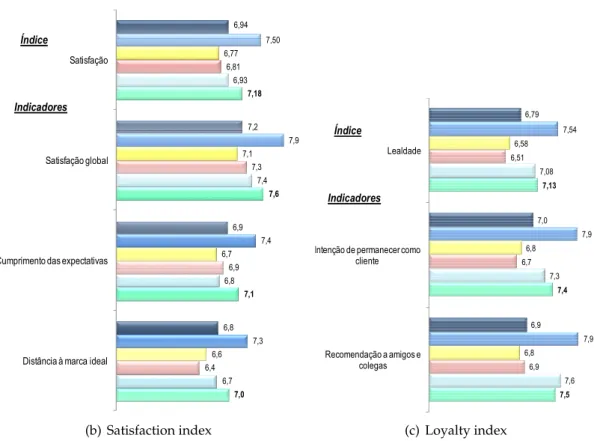
in the ECSI-Portugal model (European Customer Satisfaction Index - Portugal) in the telecommunications market (regarding several telecommunication services1.1(a)), seven customer satisfaction variables were identified: Image, Expectations, Perceived Quality, Perceived Value, Satisfaction, Complaints and Loyalty). The results showed that the tele-vision and Internet services are those with a general low index of satisfaction (in a 1 to 10 scale) compared to other services (see Figure1.1(b)). This satisfaction index is based
1Autoridade Nacional de Comunicações(ANACOM) regulates and supervises the electronic and postal
com-munications sector in Portugal, providing national representation at various international forums.
1. INTRODUCTION 1.1. Context and Motivation
on three indicators: overall satisfaction with the service, performance of expectations for the service provider, and the brand distance from the ideal service provider. In the same study, it was also pointed out that concerning the index of customer loyalty, subscription television and internet services are also the worse assessed ones in comparison with the other services (see Figure1.1(c)).
6 ' 7 .: " # $
(a) Telecommunications services
- ) + -D JC E D J D E B E J E C E < D EE E ; D E D D D ; E < D J D C D J< E C D D E 89"% 89; 89" 89$ " " % '
G
-' (b) Satisfaction index
D EJ E D J E BC E J E J D B D D D B; D E D J E E < E D 89"5 89= 89: L # % %
(c) Loyalty index
Figure 1.1: Satisfaction Indexes about Communication Services
Due to every business operator’s desire to be unique, the customer is placed in a po-sition where one purchases a set of services from which some might be barely used or
even known. According to a study published in 2011 by ANACOM[ANA11], 16% of
Portuguese households reported that having a package service subscription translates it-self into the provision of services that are not necessarily required. In the same study, and referring to the global satisfaction of TV subscription service comparing to the previous year (2010), the proportion of clients who gave a high positive grade decreased about 12 pp.
1. INTRODUCTION 1.1. Context and Motivation
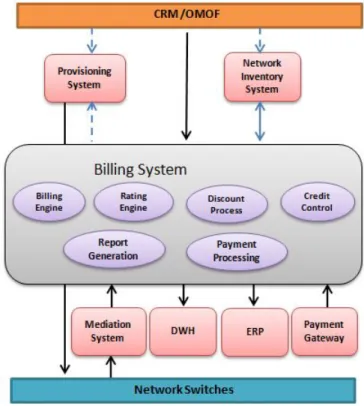
the customers. ThisBilling Systemdumps several customer’s information into the DWH system. This information includes service usage, invoices, payments, discounts, adjust-ments, etc. All this information is used to create different types of management reports,
for Business Intelligence and forecast. Thus, mobile billing systems enable a detailed
record of the consumption/usage of services either by billing needs or the need to know how the offerings reach customers. On this scope, it is an utterly discussed and explored domain.
Figure 1.2: Mobile Billing System Architecture
Yet, similar analyses are not currently possible in television service. In spite of the key role that Audiometryanalyses plays in means of communication planning and the range of its performance among consumers, it is very limited regarding to real usage. On the one hand, the analyses focus on a representative sample of population - called an audience panel, but the sample application to the universe does not depict neither the reality of a particular carrier, nor the reality of a particular customer, since it describes common general features. Furthermore, this kind of studies is strictly target to market share with an underlying intent to inform the media about the amount and quality of its audience. In this sense, we suggest a different way to deal with the existing operators need to measure the real usage of their television services. Current IPTV systems can generate amounts of information that are associated with user’s click events through remote control, such as on/off Set-top boxes, tune channels, watch live TV, schedule programs or menu navigation to just mention some examples. This clearly gives us a most exquisite level of detail, since we can trace all actions performed by user. Moreover, we are not constrained to live broadcast content analyses, due to the ability to recognize
1. INTRODUCTION 1.2. Problem
several actions regarding digital services such asDigital Video Recorder andVideo on
Demandactions, which meets our motivations to analyse the real usage of such features
offering.
In sight of the recent technological advances in the telecommunications market, the focus of this thesis is to work with realIPTVdata. This choice is due to several factors:
• TheIPTVservice is the one that has recently suffered major changes in the way it is introduced to the customer. It has even radically changed the way customers watch TV and how they interact with the service;
• The exclusive offerings of contents have fallen especially in this service, where for instance, there has been an increase of a wide range of services at the customer’s disposal: Video on Demand,Interactive Channels, stop live broadcasts, schedule recordings of contents, unique widgets, Mobile TV. However, there is currently no monitoring/detection of activities or behaviours on these features;
• Telecommunications companies providing this service have the ability to store in-formation that is associated to user events, particularly, all operations the customer performs using remote control, trigger event logs inSet-top box (STB). Actually, ac-cording to main PortugueseIPTVservice providers, the way they measure the use or entry of a particular service is through questionnaires, focus group or percentage of users adherence to campaigns, which results in its actual non usage for service monitoring;
• In addition, this work relies on the involvement of a major Portuguese market con-sultant (Novabase2), who have provided us not only the necessary support in terms
of some feedback prior to the devising scope of this thesis but the provision of data we will work with as well.
1.2
Problem
Besides the basic functionality of watching contents, theIPTVservice enables the intro-duction of other services, as a means of accessing to those contents, as previously de-scribed. The integration speed and volume of these services do not always have to do with the customer perception and need, leading to mismatches between what is needed and what is used. Following our motivations, the problem to face is then to work out
IPTVdata fromClick Recording, in order to findVisualizationand usage profiles to mea-sure the real advantage of those features and understand how they are used by cus-tomers.
Current IPTV systems can produce events associated to each click action by cus-tomers, so it is easy to imagine that thousands of scattered events are generated at the
2Novabase is a major ICT consultant in Portugal, and have specialized products and services for the
1. INTRODUCTION 1.3. Approach
same time, resulting in millions of events in a very short time. The problem we want to address is how to extract information from these records and thereby characterize activi-ties related to services usage.
Since the raw data has a very fine granularity level it does not allow an immediate identification of a particular activity as for instance: watching live TV, accessing to video club programming, scheduling a program, etc. In other words, so that we can say that a given user could have taken advantage of a particular service, we may have to look for data as a sequence of clicks which has denoted a recent particular activity. Therefore, the core challenge is then how to turn the information straightforward in order to make it more noticeable both in conceptual and representative way about activities taking place in aSTB. However, the activity level did not always allows an immediate behaviour anal-ysis. For instance, although we can detectDigital Video Recorder (DVR) activities that occur in a givenSTB(start record, delete record), they are not directly linked. So, if we want to recognize a particular users’ behaviour, such as whether users who scheduled a particular content really watched and deleted it later, we need another data transforma-tion that simplify the informatransforma-tion aiming at depicting such behaviour. In other words, we are talking about a iterative reduction process, where we could have the accurate information detail at each level.
Besides its very low granularity, this data is created at a high rate per second, which gives rise to millions of daily records. Thus, one problem is also to devise how to lower this amount of information. So, alongside the need to generalize the information in order to make it more perceptible, it will contribute to a substantial reduction in the volume of data and hence enriching the quality of information.
Of course, we have to deal with some problems relating the data. Although each activity can be represented in several distinct manners, there is no guarantee that the arrival order of those events it’s always the same. Last but not least, the errors in data may occur, such events that come loose without realizing their meaning since do not fit in the context of the current activity.
1.3
Approach
The main objective is to characterizeIPTVservices customers’ usage profiles, taking into account the customers’ usage behaviours. To reach this goal, we must examine each
STBavailable data as well as consider a framework that can transform the raw data into meaningful information related to currentIPTVservices, which could allow us to analyse them later.
The nature of this data enables us to consider it as a stream of complex events we calledClick Stream. A means to lower the amount of information and improve the abil-ity to understand the activities that occur in a given STBis to work with the notion of aggregates, take into account not the click activity but rather the user activity, which is
1. INTRODUCTION 1.4. Contributions
characterized at a higher conceptual level, reducing the cardinality and with a more rep-resentative meaning in terms of analysis. So, we suggest a transformation process that will be in charge of compressing information, turning the originalClick Streamto Ac-tivity Stream. Moreover, this transformation process intends to be as much iterative as
possible; each transformation level could by further applied, reducing data cardinality and enhancing information quality more and more. Each level will be the most suitable for the desired scope of analysis.
First, our approach focus on launching a comprehensive survey on the existingIPTV
services, targeting them into activities likely to be further analysed and detailed as much as possible. The second phase involves the integration of theComplex Event Processing (CEP)concept inIPTVcontext, which allows the activities extraction through aCEPtool
able to map the previous activities. This step could be repeated depending on the re-quired level of detail for analytical purposes. In particular, this iterative process resulted in some application areas, which focus on users’ behaviours analyses:ZappingandDVR
usage.
1.4
Contributions
The main expected contribution is to make a general overview about current issues re-lated to telecommunications market offerings, in particular ofIPTVservices. However, we do not intent to address matters relating to prices or specific offers, but instead create the basis for it. That overview is achieved based on the proposed framework which deals and transforms realIPTVdata into meaningful information regarding users’ behaviours. As we are talking about a framework, it allows its extensibility to otherIPTV features, being only necessary to make an accurate survey of sequences of events that characterize a given feature, and map it in theCEPtool used for that.
Driving our motivations ahead, we suggest models that define someIPTVusers’ key behaviours, particularlyZappingandDVRbehaviours. Based on the resulting data from our generalization strategy, those behaviours were instantiated and analysed.
The outcome of the hereto work intends to demonstrate the feasibility of using this data which enables a particular company to know how its customers are taking advan-tage from the services rendered.
1.5
Document Layout
The document will be organized as follows: Chapter 2 will be dealing with issues related to this thesis theme, starting with an overview about the Telecom data, especiallyIPTV. Some works done on this type of data will also be presented. Then, we will present
Audiometrywhich is the most used tool to measure customers’ preferences and trends
1. INTRODUCTION 1.5. Document Layout
Data Stream Mining, which is a concept that characterizes the nature of the data we have to deal with.
Chapter 3 presents the followed approach in as much detail as possible. We will start by mentioning some important aspects of the data set we will focus on, and then we drill down along the approach designed to achieve our objectives.
In chapter 4, we will describe some application areas where we have explored the information retrieved from the designed approach. We will start withZapping, which is an inherent behaviour to live viewing activity. Thereafter, we will present a detailed study aboutDVRfeature in terms of its usage.
To conclude, in chapter 5 we will summarize of the work done so far and hold a critical discussion of both the approach followed and the results obtained.
2
Related Work
In the first part we discuss a little about the Telecom data, explaining how they are gener-ated, with particular emphasis in theIPTVsubsection, where it is made a more detailed presentation of theIPTVsystem architecture, in order to better understand the informa-tion that we’ll work.
In the audiometry section is given an overview of what it is, its purpose and existing audience measurement studies about television service. Consequently, we’ll discuss its limitations and justify why it is inappropriate to deal withIPTV data, namely to study the customers usage behaviours.
Finally we present a Data Stream Mining section which covers some issues related to data we have to deal, starting with its occurrence method - as a stream, and also analytical problems with its monitoring: data reduction, outliers identification and anomalies.
2.1
Telecom Data
Today, telecommunications companies offer to their customers a wide range of services, being known asN-playersproviders. In addition to services offering, telecommunications companies have the ability to record the activity that is associated with each of the ser-vices they provide. The most common is the telephone bill, where it is discriminated the records of calls and voice services used by the customer.
However, there has been research work that attempts to analyse the information from the activity records and from there determine customers’ usage patterns, in order to un-derstand their behaviours and trends. Some of these works will be referenced in this chapter.
2. RELATEDWORK 2.1. Telecom Data
• Voice: records from the calls or services like SMS and MMS;
• Data: records from data traffic, associated to web access;
• Television: records from TV activity, as reported in previous chapter.
The following subsections are related to each of one of these types, with some impor-tant characteristics and references to works/approaches produced in those areas.
2.1.1 Call Detail Records
A Call Detail Record contains some basic attributes that characterize a call or service
(SMS, MMS):
• The number making the call;
• The number receiving the call;
• Identification ofBase Transceiver Stationboth origin and destination;
• Date and time;
• Duration;
• Type of service.
Besides these, the Call Detail Records (CDRs) may contain more attributes, which each telecommunication carrier shall adopt by whether or not according to their needs and characteristics.
There are several areas in witchCDRscould be used:
• Classification of urban areas
In [SF11] the authors proposed a technique to identify and classify city urban areas based on the call recordings. The records were grouped around theBase Transceiver
Stations (BTSs)and studied at several aggregation levels: total, weekday-weekend
and daily. Applying the k-means clustering algorithm, it was possible to classify the characteristics of each cluster and areas of its occurrence, giving rise to the fol-lowing urban areas: industrial parks & office; commercial; night-life; leisure and residential. This data mining approach overcomes the typical problems with ques-tionnaires and costs, leading to new capabilities like tracing the evolution land us-age and focus in a particular social background.
• Segmentation of customers
The growing interest in analysing the social context in which the users belong, al-lows to understand the structure and dynamics of social networks in order to rec-ognize patterns or trends in a given group. In this sense, in [DSV+08] is proposed
2. RELATEDWORK 2.1. Telecom Data
a model that is based on call records analysis, with intend to understand the role of social relations in the formation and growth of groups or communities in mobile networks. In particular, create graphs of connections through the call records, and forecast the probability of acustomer churn, when other clients to whom he relates, already done it before. In the same line, in [PXQ+11] the authors propose a
sys-tem that focuses on the mobility patterns analysis. In addition to detecting patterns within a cell, they intend to realize how people move between different cells. This type of analysis is beneficial not only in urban planning and traffic forecasting, but also in social behaviour.
• Fraud Detection
The analysis of usage patterns may also be useful for detecting subscription fraud1,
or superimposed fraud2. Both are important for telecommunications companies
because they are undesirable negative behaviours. The low occurrence rate of these behaviours, turns existing data mining algorithms to not perform well in its detec-tion, as reported in [Wei]. So, new techniques and methodologies are needed to make their detection efficiently.
• Qualification of services
In addition to analysing users behaviours, theCDRsalso have applications in areas of monitoring theQuality of Service (QoS). In this area, one example is the monitor-ing of network configuration, as exemplified in [CHD00]. The proposed framework takes advantage of the volume of calls recorded in theBTSsin order to: (i) maxi-mize nodes on the network; (ii) avoid traffic jams; (iii)find overloading reasons; and(iv)improveQoS.
As can be seen, there are several analysis areas in which the call records have direct application. The preceding examples are interesting so we can have an idea of what kind of applications we can obtain, which results can be expected, and not least, the current limitations. However, note that such applications are highly context dependent and designed to address a particular problem.
The CDRs also register the data traffic records, since they are captured in the same way as call services, because theBTSsalso give coverage to 3G network. Thus, their con-tent is similar, basically varying only the attribute that indicates the destination, which in this case is no more than the access point used, and the volume of information con-sumed, expressed in kilobytes (kB). Actually, there is currently no information that could support the analysis of the content that is passed over the network, and this is why we did not find related work regarding this topic. Nonetheless, it is important to point out that these analyses could be an interesting area. For instance, to study patterns related to the kind of applications used via mobile, and where they occur geographically.
1Clients who opens an account with intention of never paying it.
2. RELATEDWORK 2.1. Telecom Data
2.1.2 IPTV
The current television service provides the user with a unique television experience, re-garding the wide range of contents and quantity of available features. These features are supported by a digital service called IPTV differing from the traditional television for-mats because live TV streams are encoded in a series of IP packets and delivered to users through residential broadband access network.
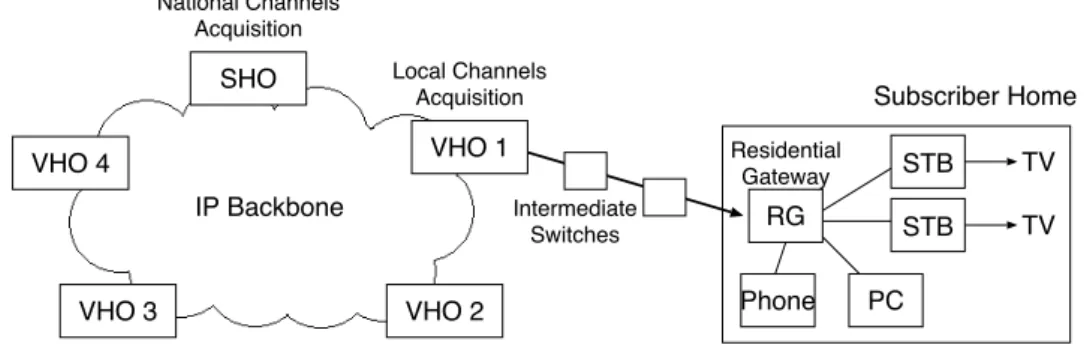
Basically, theIPTVsystem architecture is composed by:
• Super Head-end Office: primary source of television which digitally encodes satel-lite signal, encrypt it and transmits to several Video Head-end Offices (VHO);
• Video Head-end Office: Each VHO is allocated to a metropolitan area and adds some content like advertisement before transmit it to a residential home;
• Residential Gateway: Device hosted in client home that connects to a modem and one or moreSTBs;
• Set-top Box: The device that connects directly to a client TV. TheSTBis controlled
by a remote control, with several buttons to interact withIPTVservice.
VHO 2 VHO 1 SHO
VHO 4
VHO 3
National Channels Acquisition
Local Channels Acquisition
IP Backbone
Residential
Gateway STB TV
RG STB TV
PC Phone
Subscriber Home
Intermediate Switches
Figure 2.1: IPTV System Architecture
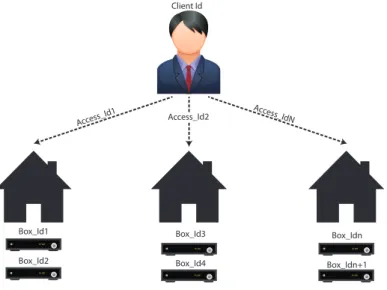
More precisely, one client can be assigned to more than one subscription plan (for instance an enterprise customer). Moreover, for each subscription there are one or more
STBsassigned. This representative scenario is depicted in Figure2.2.
Despite all advantages of theIPTVservice, a major challenge for this carriers is to re-alize the extent their customers take advantage of the wide range of contents and services available. TheIPTV service has the ability to generate volumes of information that are associated with events from the customers. Events such as: on/offSTBs; tune channels, watch live TV, watch recorded programs, browse the menu are just some examples.
Thus, anIPTVevent is characterized by several attributes, mainly:
• STBidentifier;
• Date and Time (moment);
2. RELATEDWORK 2.1. Telecom Data
Client Id
Access_Id1
Access_IdN
Access_Id2
Box_Id1
Box_Id2
Box_Id3
Box_Id4
Box_Idn
Box_Idn+1
Figure 2.2: IPTV Client Scenario
• Action (Click Recordingactivity such: a program being watched, a menu selection, aDVRplay, etc.);
• Content accessed.
In a simplistic way, when a user clicks on a command button of the remote control, triggers a new event and it is easy to imagine that thousands of scattered events are generated in the same temporal instance, resulting in millions of events in a very short time. So, there are conditions to measure the usage profile of clients over what is watched and used.
Recently approaches have emerged regarding the information usage from theIPTV
service, which can be grouped in the following application areas:
• Modelling User Activities
In [QGL+09a] is proposed a simulation tool of user activities, such as turningSTBs
2. RELATEDWORK 2.1. Telecom Data
• Modelling Channel Popularity
In [QGL+09b] it is made a detailed study about the popularity of TV channels on
their temporal distribution. Like the previous example, were created mathematical models that represent the system activity. In addition, a method is used to identify groups of users with different preferences, allowing to detect temporal patterns at different times and aggregation scales (ranging from minutes to days).
• Improving Channel Selection Problem
In [MC08] the authors argue that understanding the users’ channel selection be-haviour can be used to improve channel selection experience in liveIPTVsystems. Actual IPTV providers, offer several channels to users, where it is expected that people browse through a set of channels until they find something interesting ( Zap-ping). So, the authors evaluate this behaviour according to: (i)how long do people sample a channel before deciding whether to continue or stop watching; and (ii) how many channels do people sample prior to viewing. In this sense, they propose a system that reduces unnecessary sampling, by creating a "hotlist" based on the content real-time popularity and users’ past streaming history. The hotlist can be enhanced for each geographical location to reflect the users’ locality and viewing preferences. Besides the desired improvements in user experience, they believe this effort allows a better performance in networking perspective.
• Exploiting Social User Journeys
The social context in which the user is placed it may reveal more than what the records indicate. In this sense, in [JMR10] is proposed aIPTVsystem that integrates connections to social networks. Thus, they intend to explore the interaction client patterns, and realize how important it is, in order to understand his behaviours and trends. In addition to the metrics that contribute to the popularity of a program, others proposals have been associated with the social context of the client: total interface configurations, number of Facebook friends who are using the service, compare the list of favourites with friends, etc.
And with that, the aim is to determine correlations between the metrics to evaluate the relevance of social context. It turned out that these correlations may be useful, for instance, in predicting which programs would be most popular.
• Performance Diagnosis
Last but not least, in [MGS+09] it is proposed a diagnostic tool adapted to theIPTV
network structure analysis, in order to characterize performance problems, using information from error logs, activity logs, alerts and requests for troubleshooting.
Given the amount of information, it takes advantage of multi resolution techniques with spatial aggregations at various levels to expedite the process of identifying problems. One practical use it’s the correlations analysis to identify events that
2. RELATEDWORK 2.2. Audiometry
occurred at the same time and that may have significant impact on symptoms of the previous detected events.
It is clear the effort that has been made around the IPTV data. However, the first referenced approaches basically focus on the activities analyses with highly statistical purposes, a bit similar to theAudiometryanalyses2.2. On the other hand, [MC08] it is close to our motivations, by addressing a clear problem about users television experience. In fact, this approach will be further referenced in chapter4.1, where we present a more formal definition aboutZapping, detailing some interesting issues and discuss the results obtained in order to characterize the impact that this behaviour has onIPTVservice.
Another aspect that should be noted, is that the above approaches do not have as main objective to address otherIPTVfeatures. They analyse only the visualizing televi-sion context, where there is no approach made to the determine profiles based on users’ behaviours in terms of applications/features used, as was pointed out in our motiva-tion. Furthermore, actual Portuguese telecommunications carriers recognize their ability to generateIPTVrecords, but there are no usage of such data, coupled with little interest shown, which results in a closure and low prospect in the analysis of such data. Accord-ing to one of the topTriple Play provider, measuring the usage of provided features is actually done with online and phone surveys, and analyses of the clients adherence rate to campaigns.
2.2
Audiometry
Nowadays, the Audiometry is widely used as audience measurement to analyse data
on television audiences, in terms of watched channels, moment and duration. Also, it is used to manage television content and to schedule TV listings, in order to promote the hearings, as well as, to be used by media advertising to put its consumer products through the profiled target. For this analysis, a representative population sample (en-sured by the Census Data) is carefully selected, stratified by region, class socio economic and pay TV holding, which is called a audience panel3. Subsequently, the results are
ex-trapolated to the universe, where the pair universe/sample is a common denominator in audience measurement processes.
The data are obtained using a electronic meter system, placed at each panel viewer’s home, allowing the determination of what has been seen and for whom. The output of these tests are reports that include several indicators such as average audience, TV ratings, share, average time viewing, and some viewing indexes. These indicators have a statistical purpose only. Currently, there are some tools used to evaluate the audiometry
3Methodology usage by Marktest in the audience panel definition. They use a service called Audipanel
2. RELATEDWORK 2.2. Audiometry
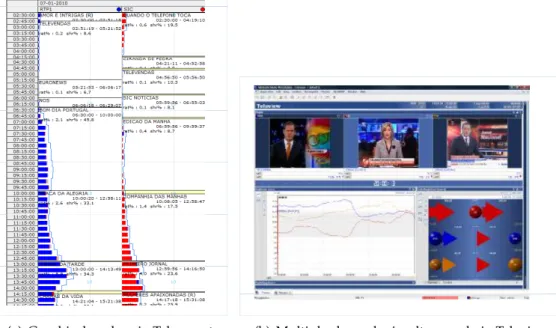
data about Portuguese television like Telereport4and Teleview5.
gr ogramação)
(a) Graphical analyse in Telereport. (b) Multiple channels simultaneously in Teleview.
Figure 2.3: Examples of Audiometry Analysis Tools
Some studies have been done on audience measurement processes, which innovate in an attempt to detect regular patterns in these data[DMPCP05], with emphasis in time and content terms, taking advantage of clustering techniques to determine weekday pat-terns. Other approaches have focused on modelling the viewrs’ behaviours in order to predict future audiences [DPL02]. More recently, [Dat06] addressed the contributions that traditional Online Analytical Processingand data mining techniques can bring to the audience measurement in Portugal, given the inherent characteristics ofAudiometry
information.
The Audiometry tools are actually quite important for audiences studies, with
rel-ative accuracy on defining several television watching indexes. But, technological ad-vancements in television service, particularly with the entrance of digital services such asIPTV, launched new challenges to these analysis tools, which currently are still evolv-ing and learnevolv-ing how to address this new type of information. Digital era overturned: what it’s seen, how it’s seen and how it’s measured. So, actuallyAudiometrysystems are outdated due to the new digital systems proliferation. Moreover, these tools are really intended for statistical purposes and are only based for broadcast content. In this sense,
Audiometry analyses are not enough to address the new coming challenges, and hence
we are suggesting a new approach to this emerging problem.
4Television audiences analysis tool (Fig. 2.3(a)), property of MediaMonitor, presented in tables, charts
and grids.
5Television audiences analysis tool (Fig.2.3(b)), property of MediaMonitor, that present in simultaneous
image, sound, charts and audience values of various channels.
2. RELATEDWORK 2.3. Data Stream Mining
2.3
Data Stream Mining
We can define Data Mining as the process of extracting knowledge from a set of informa-tion typically stored in a database. This phase is part of a complex process that has the
nameKnowledge Discovery in Databases (KDD)which also involves other phases such
as: selection, preprocessing, transformation, data mining and interpretation/evaluation
[FPsS96]. Actually the use ofKDDis spread over several business areas, such as
market-ing, finance, fraud detection, manufacturmarket-ing, internet agents and with special interest for us, telecommunications.
This thesis scope deals with large volumes of information, and its main objective is the detection ofVisualizationand usage profiles from IPTVactivity data. Current data are scattered and singular, not representing a particular behaviour. Thus, it is necessary to synthesize the large volume of data and transform scattered events into representative information, favouring what is generic and not what is specific.
Today, many applications have the ability to generate information that is associated with events occurring in a given system. These events have the particularity to be un-predictable when they occur, due to its pervasiveness. Given the increasing number of such applications and agents to act on them, we got to the point where the volume of information being generated is beyond the paradigm of the common database model6.
Naturally, the information occurs in a sequence of data, or also known as stream. More precisely, the data is modelled best not to persistent relations but rather the transient data streams. It is recognized that this type of information does not fit the conventionalDBMS
and the queries are not effective [GO03,BBD+02].
Several applications already deal with data stream notion in its information model, for example, financial applications, internet network monitoring, security, web applica-tions, sensor networks, and of course, telecommunications.
This information model has brought new problems in relation to its organization, as well as its analytical perception. Eamonn Keogh et al. [WKL+05] stated:
"Recent advancements in sensor technology have made it possible to collect enor-mous amounts of data in real-time. However, because of the sheer volume of data most of it will never be inspected by an algorithm, much less a human being."
The need to understand the enormous amount of data being generated every day in a timely fashion has given rise to a new data processing model - data stream mining. These data streams bring unique challenges that make them interesting from a data min-ing perspective: size, rate of accumulation and data transience. Hence, a wide variety of analytical problems associated with mining and monitoring data streams has emerged, such as: Data reduction; Characterizing constantly changing distributions and detecting
6Insertion, updates and deletions operations occurs less frequently than queries. Besides, traditional
2. RELATEDWORK 2.3. Data Stream Mining
changes in these distributions; Identifying outliers, tracking rare events and anomalies; “Correlating” multiple data streams; Building predictive models; Clustering and classi-fying data streams; and Visualization [DW08].
As already mentioned, the events resulting from theIPTVactivity have a high rate of occurrence per unit time. For instance, imagine the number of customers that are at once interacting with the service, resulting in large volumes of information in a short time. TheIPTVactivity is a concrete application example where information has a data stream model, given its continuous generation in multiple, rapid and time-varying intervals.
So it makes sense to refer this topic due to its information nature. However, the re-sulting data stream of television activity can not be used directly for behaviours deter-mination, because the data are too refined that makes it difficult to understand given its dispersion. So, we need to turn the information into a more generic level, that represents an activity running in the STB, i.e. we want to convert a Click Stream to an Activity
Stream.
3
Click Stream to Activity Stream
In this chapter we detail the approach presented in section 1.3. Initially, we mention some important aspects that characterize the data to be used, in terms of size, granularity and content. The initial phase focus on a comprehensive survey of the existingIPTV ser-vices, targeting them into activities liable to be analysed. Next, we present the approach designed to deal with that information and how to turn it into a higher conceptual level.
3.1
Data Set
We have access to realIPTVactivity information service from a Portuguese telecommu-nications carrier. In this subject we have the support of a market consultant (Novabase) which provided us the necessary support with regard to the provision of data. So far, we only have access to a sample of nine days of activity: 4 contiguous days from February 2012 and 5 contiguous days from April 2012. Regarding the volume of information at hand, those days of activity result in a data set of about 14 million records relating to ap-proximately 53.000STBs. There are situations where a client is assigned to more than one
STBand it is expected that the number of customers is relatively lower than the number ofSTBs.
Each record has 24 attributes, which are illustrated in the Figure3.1, grouped by types of information:
• Who-STBidentifier;
• When- the event occurrence moment;
3. CLICKSTREAM TOACTIVITYSTREAM 3.1. Data Set
• Content- what content was accessed;
• Action- identification of the action that triggered the event;
• Duration- event duration.
TheIPTVservice is based on Microsoft Mediaroom platform1, which provides a
frame-work that enables developers to build differentiated TV applications that extend and augment the Microsoft Mediaroom TV experience. So, it is expected that the kind of data available in this system we are working on it’s similar to other ones in different carriers. Apart from that, there are some differentSTBsversions currently in use in the same oper-ator, where it’s possible that data is generated quite different among them. In particular,
STBswithout some features (DVR), cannot generate the some events as aSTBwith that feature.
It is possible to highlight the presence of the basic attributes already mentioned in
2.1.2: Identifier of theSTBas CLIENT_ID; Date and Time as COD_DATE_GP; Action as
EVENT_TYPE (for instance: Box Power), which is detailed in ACTION as (On or Off); Content accessed as CONTENT_ID. The remainder attributes are particularities of this carrier.
The events detected in thisIPTVservice are: channel tune, box power, menu selection, program watched,DVRrecording operations (start, abort, playback, schedule, delete and cancel), andVideo on Demand (VOD) purchases. However, there are other events doc-umented by this operator that are not actually used: Remote Desktop Protocol (RDP)
andPay-per-View(PPV) purchase, which gives emphasis on the fact that our approach
should be generic and not limited to match a predefined set of feasible actions able to de-tect/analyse, in order to enable the integration of those future features. At this stage, the events considered are the ones highlighted in Figure3.2. Each event type is segmented in actions that detail a little more each one. For instance, the event type "Box Power" could have two actions associated: On and Off; the event type "DVR Playback" have several ac-tions associated as: Play, Pause, Fast Forward, Replay, Rewind, Skip and Stop. Another interesting attribute is the SERVICE_TYPE which defines the service being used (Live,
VODorDVR) as a promising indicator of the kind of activity occurring.
There are some attributes which denotes only the identifier, not bringing significant value, for example: CHANNEL_ID and CONTENT_ID. So, we need additional informa-tion to map those identifiers into something more meaningful. In this sense, we also have access to some external entities: Access (information about client access: Asymmetric
Digital Subscriber Line (ADSL)orFiber to the Home (FTTH), activation date, and some
commercial aspects); Asset (information about purchased contents - VOD operations); Channel (information related to a particular channel: name, number, type); and Content (here we just have content name). However, all the information that was provided were
1Microsoft Mediaroom is the world’s number oneIPTVplatform, used by several companies. More
details available at: http://www.microsoft.com/mediaroom/
3. CLICKSTREAM TOACTIVITYSTREAM 3.1. Data Set Who When Channel Content Action/Activity Duration Name CLlENT_ID CLlENT_TYPE COD_DATE COD_DATE_GP COD_START_GP SOURCE_TIMESTAMP EXPIRATION_DATE ACTION_TIMESTAMP FREQUENCY CHANNEL_ID CHANNEL_NBR CONTENT_ID EVENT_TYPE SERVICE_TYPE VIEW_MODE ACTION ACTION_STATE MENU_ID DYNAMIC RECURRING INSTANCE_OF_RECURRING MANUAL_DELETION TUNE_ID DURATION Description
Set-top box identifier
Set-top box model
Event source date in YYYYMMDD format
Event source date and time in YYYYMMDDHH24MI format
Event source time in HH24MI format
Event source timestamp
Date and time that the subscriber's access to the rented VoD asset expires
Date and universal time that the event occurred
Frequency of the recording
Channel ld for event type: Program Watched or DVRs events
Channel number
Id of the asset, program or channel depending on the event type
Mediaroom event type (Channel Tune, Box Power, VOD Purshace, Program Watched, etc.)
Service type ('LIVE', 'DVR', 'VOD', etc.)
Event type of stream (full-screen or PIP) and service type (primary or secondary) of the media session
Action invoked by the subscriber
State of the action (up or down)
Id of the menu
Value indicating a dynamic or a manual recording
Value indicating a one-time or a recurring recording
One (1) means that the subscriber canceled a single instance of a recurring program
Indication if the recording was deleted by the subscriber
Unique Id that links channel tune events with program transitions
Event duration in seconds
Figure 3.1: IPTV Data Description
3. CLICKSTREAM TOACTIVITYSTREAM 3.1. Data Set
Event type Description
100 Channel Tune
101 Box Power
102 VOD Purchase
103 RDP Purchase
104 Trick State
105 Browse Panel
106 Application 107 Menu Selection 108 RDP Application Launch 109 RDP Application Disconnect 110 RDP Application Navigate Away 111 RDP Application MCE Tune
113 PPV Purchase
114 Program Watched
115 DVR Start Recording 116 DVR Abort Recording 117 DVR Playback Recording 118 DVR Schedule Recording 119 DVR Delete Recording 120 DVR Cancel Recording
Figure 3.2: IPTV Events Detected
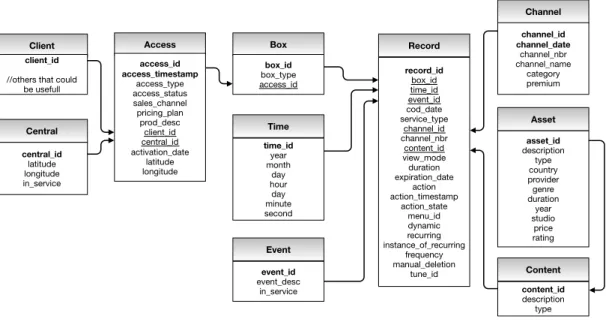
is associated to a singleSTB, eachSTBin turn relates to an access, which it is final related to a customer.
Client
client_id
//others that could be usefull
Central
Access Box Record
central_id latitude longitude in_service access_id access_timestamp access_type access_status sales_channel pricing_plan prod_desc client_id central_id activation_date latitude longitude box_id box_type access_id Time time_id year month day hour day minute second Event event_id event_desc in_service record_id box_id time_id event_id cod_date service_type channel_id channel_nbr content_id view_mode duration expiration_date action action_timestamp action_state menu_id dynamic recurring instance_of_recurring frequency manual_deletion
tune_id Content content_id description type Asset asset_id description type country provider genre duration year studio price rating Channel channel_id channel_date channel_nbr channel_name category premium
Figure 3.3: IPTV Data Model
One problem in the data is the existence of errors. As we are talking about a system that generates events for a data repository, there is no guarantee that the arrival order of those events is always the same. In particular, on activities characterized by a sequence of events (described in 3.2), they have an identical time of occurrence, influencing the
3. CLICKSTREAM TOACTIVITYSTREAM 3.2. Survey of Activities
definition of event patterns (3.3). For instance, the liveVisualizationactivity is character-ized by a sequence of two events: event id = 100 followed by a event id = 114. But it’s usual that those sequences arise in reverse order. Another recurrent situation is the lack of events, or events that come loose without realizing their meaning, because do not fit in the context of the activity taking place. Sometimes, some events occur like a menu se-lection (event id = 107), which we cannot ensure that are actually relevant to the activity taking place. A final issue is related with the temporal spectrum in which some of the activities take place, where only makes sense to consider an activity if it occurs within a certain time limit. Every time that a particular content ends, automatically a new record regarding the next one starting (when a user remains in the same channel) is generated. But sometimes, we catch Visualizations whose duration lasted for more than 8 hours, which is, at least, strange. For some reason the STBstopped to generate events, caus-ing these situations. For simplicity and consistency in the definition of activities, these situations were ignored.
3.2
Survey of Activities
Based on captured events by theIPTVsystem, we followed a top-down approach in order to make a collection of feasible activities. This approach is defined by the characteriza-tion of the expected activities from a TV user, based on the offered features. This way, we can incorporate activities into three main classes:(i)visualization;(ii)recording; and (iii)video on demand. With respect to other existing features such as interactive applica-tions (Television Widgets) orSTB Services Management, will not be considered because actually those events are not captured. In future, they can be easily incorporated.
3. CLICKSTREAM TOACTIVITYSTREAM 3.3. Transformation Process
Regarding the recording class, the identification of user actions is much simpler, since there is a corresponding event type associated to each ofDVRoperations (see Figure3.2 -events 115-120). In addition, these -events contain interesting attributes that allow to un-derstand: if theDVRrecording has started automatic or manual (DYNAMIC attribute); or for instance, if the scheduledDVRrecording is just for one episode or all season (RE-CURRING attribute). Although a start DVR recording activity is independent from a delete DVR recording activity, we can combine them with a playback DVR recording, and try to figure out some users’ behaviours. In particular, if we represent a DVR ac-tivity as a sequence (schedule-record-watch-delete, for instance), it is possible to analyse if the scheduledDVR recordings are effectively watched later, or even, if the users care aboutDVRrecording managements (delete after watched it). In section4.2we focus our attention on these behaviours analysis.
Finally, in the video on demand class there are two visible behaviours: (i)VOD pur-chase (event type: 102); and(ii)watch trailer (videoclub activity) - represented by a se-quence of events: tune to videoclub channel, followed by a menu action, ending with a program watch event (the content itself). Over this class, we could measure the usage rate of VOD, in terms of number of TV contents purchased, average amount spent on rentals, and so forth.
3.3
Transformation Process
The first problem that we faced was how to work the existing information inIPTVrecords. The information is generated at a very fine granularity, since each click in the command given by the customer leads to a new event. As you can imagine, this causes that many records have no meaning. What we are interested here is to recognize activities taking place in a given STB: watch a film, schedule a recording, accessing the video club, etc. And for each of these activities, there may be many events dispersed that in essence boil down to an activity taking place. For example, remember the watch trailer activity, which requires that customer follow some steps (clicks) inSTBcommand. And instead of hav-ing these events, we want somethhav-ing more generic and meanhav-ingful, which summarizes the activity: Watch trailer. This leads to the need to compress the information, general-izing it to a higher conceptual level, in order to capture activities that occur in a given
STB.
This need to transformClick Streamson Activity Streamsbrings some advantages
in analytical terms, standing out:
• First, as each customer click action gives rise to a new event, it is easy to imagine the sheer volume of data we have to work. And so, by aggregating information to activity level, we will substantially reduce the final data size. In the limit, a sequence ofNevents that characterize an activity, it’s reduced to just one event.
• Some of the events generated may not be relevant to the type of activities that we
3. CLICKSTREAM TOACTIVITYSTREAM 3.3. Transformation Process
want, so this transformation also allows filtering only data that in fact have interest;
• Singular events by itself may mean nothing, but when viewed in an sorted time sequence can be significant in the recognition of a given activity;
• A given event is only associated with the time of its occurrence, where is not pos-sible to infer anything about duration, i.e. to know how long a particular activity lasted;
• A certain activity can be characterized by distinct sequences, which in essence, rep-resent the same activity.
For these reasons, we believe that this transformation of clicks to activities is essential to have another notion and knowledge that the raw data can not give. Basically, we would like to turn data into information.
3.3.1 Complex Event Processing
The type of information that we are dealing, presents a characteristic very common in current systems, that is the ability to generate large volumes of data in a short time period, and in a continuous rate. This feature may be viewed as a scattered and complex data stream. Hence, the suitable way to handle this information is to interpret it inComplex
Event Processingconcept. Although this concept has a strong relation to a "real time"
component, its purpose is mostly to produce information in the "right time".
The main difference and advantage of theseCEPtools over relational databases is the ability to deal with information of temporal nature, since they require a specific query to return an information set. That is, store the data on which a query is executed. One the other hand, theCEPtools store queries where it is possible to specify a time window, over which the data is passed as the time progresses. This stream is submitted to filtering, typically by event pattern detection.
As you can imagine, the application of a CEP system is applicable to diverse areas such as Business Process Management, Financial Services Industry, Time Series Databases, among others. Therefore, it is easy to make the bridge between theCEPsystems for our need to transformClick StreamsintoActivity Streams, since we have a large volume of events assigned to the user clicks on a short unit of time (seconds) over which we want to extract information representative of user’s activity.
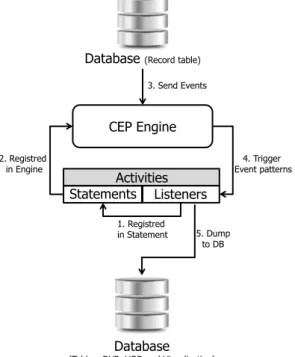
Although these tools have the main purpose of application in real time data and detect events, our approach takes advantage of theCEP concept from a slightly different way. Basically, currentIPTVsystems only dump the data at the end of a day, which prevent us to use it at real time. However, the approach designed is easily applicable to real time context, so that if the events logs delivery were instantaneous there would be no problem at all.