BJRS
RADIATION SCIENCES
07 (2019) 01-14ISSN: 2319-0612 Accepted 2018-09-11
Challenges facing the implementation of quality control
programme by radiographers in Tanzania
W. M. Ngoye (MTech)
a; J. A. Motto (MTech)
b; W. E. Muhogora (PhD)
aa
Tanzania Atomic Energy Commission, Block J, Plot No. 216, Njiro, P.O.Box 743, Arusha, Tanzania
b
University of Johannesburg, Faculty of Health Sciences, Doornfontein Campus, Johannesburg, South Africa Corresponding author Email: [email protected]
ABSTRACT
Quality control (QC) programme is vital for quality radiological services at low radiation dose and costs while maintaining adequate image quality. However, the QC implementation by radiographers in Tanzania is inadequate. This study aimed at investigating the challenges facing the implementation of the QC programme by radiographers in diagnostic radiography units in Tanzania and recommend strategies to mitigate the challenges. The study was conducted on a sample of 84 radiographers who have been trained on the QC programme, and who were practicing in 54 hospitals within Tanzania. Majority of respondents agreed that the lack of standard-ized test tools (98.8%) and lack of managerial support (51.8%) were hindering the QC programme. Also, the lack of care of equipment by radiographers and lack of motivation were identified. The strategies suggested to improve the programme include more enforcement (63.9%), assistance by the government (44.6%), motivation (33.7%) and improvement of the QC training (32.5%). Also, professional development activities and QC aware-ness to hospital management teams were suggested. It is crucial that the barriers to the QC programme are ad-dressed and the strategies identified and considered if comprehensive implementation of the QC programme is to be realized.
1. INTRODUCTION
The main goal of diagnostic radiology is to obtain images of sufficient quality to enable the diagnosis of disease or injury at minimum possible radiation dose to patients. In order to achieve this objective, the implementation of quality control (QC) programme in diagnostic radiology is therefore essential to achieve such optimal equipment performance and images of diagnostic qual-ity, taking also into account timely diagnosis [1-3]. Without the QC programme in place, the imaging equipment will eventually deviate from optimum performance limits and hence cause poor image quality. For example, failure of kV settings of the x-ray machine results in loss of contrast of the radiographic image. This may require a repeat examination which contribute to unnecessary or higher dose to patients and unreliable diagnosis [4-6]. Besides, lack of implementation of QC measures results in increased running costs. Equipment problems are observed at a serious stage requiring higher repair costs, interruptions of the radiological services as well as poor imaging ser-vices resulting in wastage of hospital resources such as films, wastage of patients’ time and missed diagnosis. Consequently, patients lose confidence in the facility; the facility’s image is tarnished, and loses clients [2, 3, 7, 8].
In the United Republic of Tanzania, the Atomic Energy Act No.7 of 2003 and the Protection
from Ionizing radiation Regulations, 2004, require radiological facilities to implement the QC
pro-gramme [9, 10]. This highlighted the need for Tanzania Atomic Energy Commission (TAEC) as a regulatory authority, to establish a QC training programme for radiographers with aim of having each radiological facility implement the programme. Majority of radiographers in the country, have attended the training programme. However, a previous study by the authors [2] has shown that the implementation of the QC by the radiographers is still inadequate. This implies that there are chal-lenges that need to be addressed if the QC programme is to be effectively implemented. There is scanty literature information on the challenges facing the QC implementation by radiographers in Tanzania. In the previous study, the authors [2] pointed to the lack of enforcement, lack of initia-tives by Radiographers and lack of QC awareness by hospital managers as factors contributing to the poor implementation of QC in the Country. They further suggested for further studies to
ascer-tain the challenges. The objectives of this paper are to study and discuss the challenges facing the implementation of the QC programme in diagnostic radiography departments in Tanzania and to identify possible solutions to overcome these challenges.
2. MATERIALS AND METHODS
The survey study using a questionnaire was conducted on a sample of 84 radiographers who have attended the QC training programme, and who were practicing as radiographers within Tanza-nia. The study was conducted in 54 hospitals representing the diversity of medical x-ray diagnostic facilities in Tanzania. The hospitals included the national hospital, referral hospitals, regional hospi-tals, district hospihospi-tals, other government organisations hospitals and private hospitals. The partici-pants were requested to provide the following information;
(a) Whether or not the QC programme barriers found in the literature existed in the x-ray depart-ments in Tanzania. These barriers included;
i. lack of time to implement QC measures, ii. lack of QC test tools,
iii. lack of managerial support,
iv. lack of authority to introduce the QC programme, v. resistance to change or try new ideas.
vi. whether the QC measures are relevant in the day to day work in the department,
vii. whether radiographers clearly know that they are responsible for implementation of the QC measures in the department.
(b) To identify other barriers, other than those listed in the questionnaire, which hinder radiogra-phers from implementing QC measures in their departments.
(c) To give suggestions/strategies on improving the implementation of QC measures in the depart-ments.
The data collected was representative of the situation of the practice of the QC programme in Tanzania. The questionnaire was administered by the researcher using a face to face approach to
ensure a higher response and reliability. The data obtained from the questionnaire were analysed using the IBM SPSS statistics (version SPSS No.21) in the form of tables and subjected to statistical tests. This software is comprehensive in data analysis by generating tabulated reports, charts and plots of distributions and trends. It offers a broad range of algorithms for comparing means, describing variables and predictive techniques. Similar applications of this software can be found elsewhere [2]. Descriptive statistics were also used in describing variables and their relationship with the challenges facing the QC implementation.
3. RESULTS
3.1. Participation of radiographers at investigated hospitals
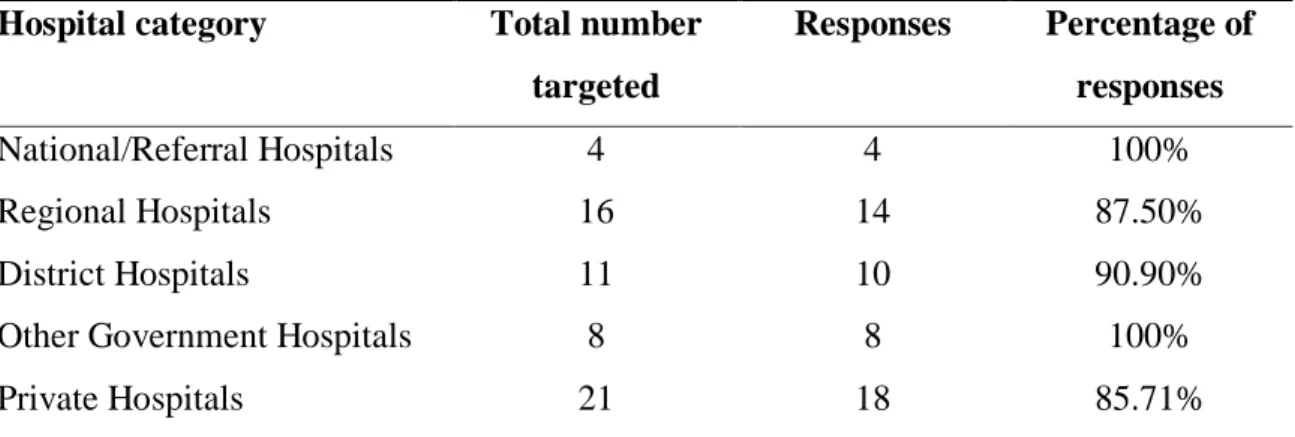
A response of 84 (93.33%) radiographers was obtained from the targeted sample size of 90 ra-diographers. The response was obtained from 54 (90%) of the targeted number of 60 hospitals. This demonstrates adequate representation of participants in the study thus validating related conclu-sions. Table 1 presents the hospital levels and categories in which the study was conducted.
Table 1: Information on response by different categories of hospitals
Hospital category Total number
targeted Responses Percentage of responses National/Referral Hospitals 4 4 100% Regional Hospitals 16 14 87.50% District Hospitals 11 10 90.90%
Other Government Hospitals 8 8 100%
Private Hospitals 21 18 85.71%
It can be seen from Table 1, which the participation of all hospital categories was above 85% and hence adequate response.
3.2. Barriers
The results on barriers hindering the respondents from implementing the QC programme are shown in Table 2 and 3.
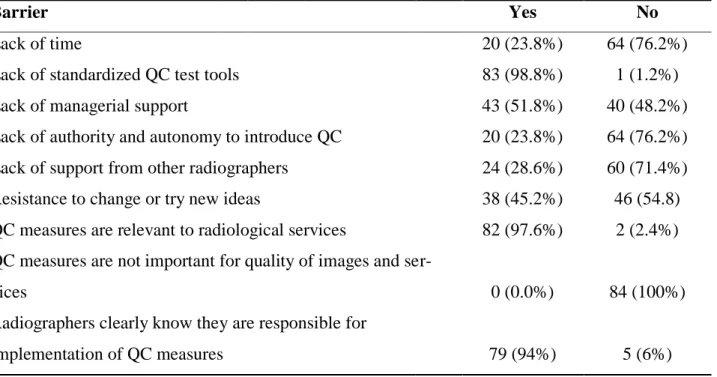
Table 2: Response on barriers that hinder implementation of QC programme as established by other studies (11, 12, 13, 14,19)
Barrier Yes No
Lack of time 20 (23.8%) 64 (76.2%)
Lack of standardized QC test tools 83 (98.8%) 1 (1.2%)
Lack of managerial support 43 (51.8%) 40 (48.2%)
Lack of authority and autonomy to introduce QC 20 (23.8%) 64 (76.2%)
Lack of support from other radiographers 24 (28.6%) 60 (71.4%)
Resistance to change or try new ideas 38 (45.2%) 46 (54.8)
QC measures are relevant to radiological services 82 (97.6%) 2 (2.4%) QC measures are not important for quality of images and
ser-vices 0 (0.0%) 84 (100%)
Radiographers clearly know they are responsible for
implementation of QC measures 79 (94%) 5 (6%)
The results indicate that the lack of QC test tools and lack of managerial support were agreed by 83 (98.8%) and 43 (51.8%) of the respondents respectively, hence ranking high among the known barriers hindering radiographers from implementing the QC programme.
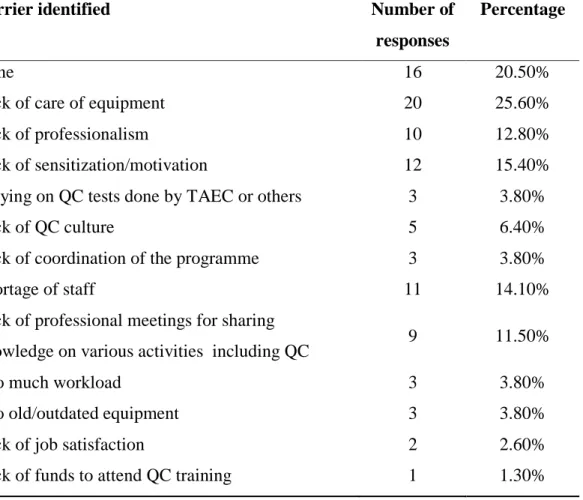
Table 3: Other barriers identified by respondents as hindering them from implementing the QC programme
Barrier identified Number of Percentage
responses
None 16 20.50%
Lack of care of equipment 20 25.60%
Lack of professionalism 10 12.80%
Lack of sensitization/motivation 12 15.40%
Relying on QC tests done by TAEC or others 3 3.80%
Lack of QC culture 5 6.40%
Lack of coordination of the programme 3 3.80%
Shortage of staff 11 14.10%
Lack of professional meetings for sharing
knowledge on various activities including QC 9 11.50%
Too much workload 3 3.80%
Too old/outdated equipment 3 3.80%
Lack of job satisfaction 2 2.60%
Lack of funds to attend QC training 1 1.30%
The results indicate that the leading hindrances identified by the respondents were lack of care of equipment by the radiographers (25.6%) and lack of motivation of radiographers (15.4%).
3.3. Strategies to improve implementation of QC measures
The results on participants’ suggestions on strategies to improve the implementation of the QC measures are presented in Table 4.
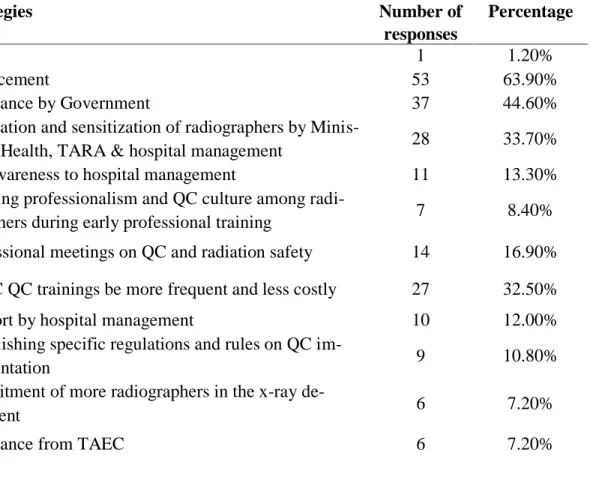
Table 4: Strategies suggested by respondents to improve the implementation of the QC programme
Strategies Number of Percentage
responses
None 1 1.20%
Enforcement 53 63.90%
Assistance by Government 37 44.60%
Motivation and sensitization of radiographers by
Minis-try of Health, TARA & hospital management 28 33.70%
QC awareness to hospital management 11 13.30%
Building professionalism and QC culture among
radi-ographers during early professional training 7 8.40%
Professional meetings on QC and radiation safety 14 16.90%
TAEC QC trainings be more frequent and less costly 27 32.50%
Support by hospital management 10 12.00%
Establishing specific regulations and rules on QC
im-plementation 9 10.80%
Recruitment of more radiographers in the x-ray
de-partment 6 7.20%
Assistance from TAEC 6 7.20%
It can be seen in Table 4, that the main strategies suggested were enforcement (63.9%), assis-tance by the Government (44.6%), and motivation and sensitization of radiographers (33.7%). The need for intervention and assistance by the Government through the ministry of health and the regu-latory body is apparent.
4. DISCUSSION
The primary objective of any diagnostic procedure is to obtain an image containing anatomical information to aid the diagnosis process before treatment. Poor image quality is known to result into repeated procedures and high false negative proportions both which diminishes good patient care. Therefore it is essential to apply the concept of optimization in diagnostic radiology, which entails
the balancing of image quality and radiation dose to patient. This implies that adequate image qual-ity should be obtained at minimum possible radiation dose to achieve optimized practice. In the present study, image quality is indirectly addressed in terms of QC test tools and QC measures as components of desirable QC program.
The findings of this study concur with previous studies [2, 11-14] on the barriers facing radiogra-phers in implementation of QC and various activities in the radiology department. Furthermore, the study established barriers specific to radiographers in Tanzania. The findings are discussed in three major aspects as follows;
4.1. Responses on barriers established by previous studies
When asked to respond on the barriers found elsewhere [11-14]that hindered the implementa-tion of the QC programme, a majority of the respondents appear to support the lack of QC test tools and lack of managerial support as leading hindrances (Table 2). Managerial support contributes a great deal to the success of an organisation, especially if workers are to be motivated. Also, budget issue such as procurement of equipment, repair and maintenance cannot be implemented if there is no support of the hospital management. Similarly, the lack of QC test tools hinders implementation of the programme. However, Lyoid [15] established that it is possible to perform most of QC tests by use of simple test tools which can be locally improvised. The previous study [2] revealed avail-ability of simple test tools. Hence, radiographers need to utilize the available simple test tools while involving the hospital management for acquisition of standardized test tools for a comprehensive QC programme.
It was encouraging to find that a large proportion (97.6%) of the respondents agreed with the importance of the QC programme in the quality of radiological services and that radiographers are responsible for implementing the programme (Table 2). This is in agreement with the emphasis by other works [1, 6, 16-18] that QC is important for improved quality of services, equipment durability, reduction of hospital running costs as well as reduced patient radiation dose. Similarly, the work by Burt [19] emphasized that radiographers should fully participate in the implementation of QC programme. However, it has been revealed elsewhere [20, 21] that radiographers did not perform most of the QC tests though they realized the importance of the QC programme. A compa-rable situation was found in this study. Despite the knowledge on QC most radiographers still do
not take it seriously enough to implement it. In their study, Periard and Charloner [22] warned that any programme lacking interest from its staff is unlikely to produce optimal results. These findings suggest that the QC culture is not yet imparted to the radiographers and hence need for initiatives to sensitize radiographers.
4.2. Barriers identified by the respondents
Among the barriers identified by the respondents, the lack of care of equipment by radiogra-phers was the main hindrance. One can assume that the lack of care was a result of the other barriers mentioned such as the lack of professionalism; lack of motivation; lack of the professional devel-opment activities and shortage of staff (Table 3). These factors were also found elsewhere [12, 19, and 23] as hindering radiographers from performing various activities in the x-ray department as well as in the profession. Lack of care of equipment impact negatively on the radiological protec-tion and quality of services in the department, as the equipment performance is compromised. The lack of enforcement was also notably mentioned. This view was also discussed by the previous study [2] that the QC progamme in Tanzania is not enforced and is not a prerequisite for license consideration. Other works [21, 24, and 25] have pointed that without adequately binding regula-tions and proper enforcement a QC programme cannot be implemented effectively.
4.3. Strategies to improve the implementation of QC
Enforcement was suggested by a large proportion of the respondents 53 (63.9%) as the useful strategy for improving implementation of the QC programme (Table 4). This view was also articu-lated by Chougule [11]and Gonzalez [14] who argued that in situations where compliance is rare, effective enforcement approaches are necessary. Some of respondents went on to suggest enforce-ment actions such as formulation of specific regulations and rules regarding the impleenforce-mentation of the QC programme. Specific rules on QC implementation has been supported by other works [26, 27]and are applied in South Africa [28].
The respondents further suggested for assistance from the Ministry of health, TAEC, the profes-sional association and hospital management especially in facilitating the acquisition of standardized test tools, trainings and continuous professional development activities (Table 4). During the study
it was evident that most of the respondents felt that it could be easy for them to acquire the test tools if there were suppliers in the country. Also, there was a feeling among respondents that the support to radiographers in terms of motivation, recognition as well as the professional development is not adequate. The Government, employers and the professional association itself would need to con-sider these findings as they have an impact on the performance level of the radiographers and the radiological services. The need to introduce continuous professional development (CPD) pro-grammes is apparent. It has been recognised that motivation is crucial in achieving the most produc-tivity from employees [29] and that the lack of professional and competence development activities after academic training caused a lack of hard work and lack of job satisfaction [23]. Furthermore, adequate collaboration between radiographers and hospital management teams is needed for initia-tives in solving the challenges that face the QC programme. This collaboration can be achieved when hospital managers are aware of radiation risks and the QC benefits [2]. There is also a need for the TAEC training to be conducted zone wise to allow more participation by radiographers.
5. CONCLUSION
From this study, the main challenges attributing to the poor implementation of the QC pro-gramme are the lack of enforcement, lack of standardised tools, lack of care of equipment and lack of motivation. Also the lack of initiatives by radiographers and the professional association is ap-parent. However, it is encouraging to find that the respondents agreed with the necessity of the QC programme implementation in realizing diagnostic quality images at minimum patient radiation dose received and costs, though they did not implement it. It is clear that the current TAEC QC training programme has not yet adequately imparted a QC culture among radiographers. Therefore, the strategies to improve the implementation of QC programme and maximize patient care in diag-nostic radiography needs to be implemented. All the stakeholders need to take heed that the lack of a QC programme in diagnostic radiology leads to poor image quality, high radiation dose to patient as well as high running costs to the hospital. This study provides a strategic direction of the implementation of quality control programme in the country.
ACKNOWLEDGEMENT
The authors would like to express sincere gratitude to the TAEC for the permission to perform this study and for some financial support, the Statistician Ms. Jaclyn de Klerk and the STATCON Department of the University of Johannesburg for helping with the statistical analysis of the data. Similarly, the hospital managements that allowed the collection of these data in their hospitals and the radiographers who participated in this study are highly appreciated. The authors are also indebted of thanks to Mokasi Medical systems & Electronics Services Ltd and Pacific Diagnostics Company Ltd for the support on transport costs during the data collection and analysis task.
REFERENCE
[1]. FARZANEH, K. J. M.; SHANDIZ, S. M.; VARDIAN, M.; DEEVBAND, M. R.; KAR-DAN, M. R. The quality control of diagnostic radiology devices in hospitals of Sistan and Baluchestan, Iran. Indian Journal of Science and Technology, v.4(11), p.1458-1459, 2011.
[2]. NGOYE, W.; MUHOGORA, W.; MOTTO, J. Quality Control Measures in Tanzania, Is it done?.
Journal of Medical Imaging and Radiation Sciences, v.46, p.23-30, 2015.
[3]. SUNGITA,Y. Y.; S. L. MDOE, S. L.; MSAKI, P. Diagnostic X-ray facilities as per
qual-ity control performances in Tanzania. Journal of Applied Clinical Medical Physics, v.7,
p.66-73, 2006.
[4]. KORIR, G. K.; WAMBANI, J.S.; OCHIENG, B. O. Optimization of the Radiological Pro-tection of Patients in Diagnostic Radiology Department at Kenyatta National Hospital in Kenya, Phase 1. THE SECOND ALL AFRICAN IRPA REGIONAL RADIATION CONGRESS, 2007, Ismailia, Egypt, p.161-171, 2007.
[5]. OZSUNAR, Y.; CETIN, M.; TASKIN, F.; YUCEL, A, CAN, S.; ARGIN, M.; ARKUN, R. The level of quality radiology services in Turkey: a sampling analysis, Diagnostic and Interventional Radiology, v.12, p.166-170, 2006.
[6]. HUTCHINSON, D. C.; COBB, B. J.; JACOB, C. S. A compliance testing for diagnostic x-ray equipment, Journal of Applied Radiation and Isotopes, p.237-245, 1999.
[7]. PAPP, J. Quality Management in Imaging Science, 4th Ed. St. Louis: Mosby Elsevier, 2011.
[8]. RAMANANDRAIBE, M. J.; ANDRIAMBOLOLONA, R.; RAKOTOSON, E.C.; TSAPAKI, V.; GFIRTNER, H. Survey of Image quality and Patient Dose in Simple Radio-graphic Examinations in Madagascar: Initial results. HEP-MAD 09, Antananarivo,
Madagascar. 2009.
Available at: <http://www.slac.stanford.edu/econf/C0908211/pdf/027.pdf>. Last accessed: 10 Nov. 2017
[9]. United Republic of Tanzania. Atomic Energy Act, No. 7. Dar es Salaam: Government Printer, 2003.
[10]. Tanzania Atomic Energy Commission. Atomic Energy (Protection from Ionizing Ra-diation) Regulations 2004, Arusha: TAEC, 2004.
[11]. CHOUGULE, A. Quality Assurance Survey of X-ray Installations in Southern Rajasthan, Journal of Medical Physics, v.29, p.80-83, 2004.
[12]. NIXON, S. Professionalism in radiography, Radiography, v.7, p.31-35, 2001.
[13]. HENWOOD, S. Managing quality in Diagnostic Imaging Departments, Radiography, v.2, p.111-117, 1996.
[14]. GONZALEZ, J. P. O. Establishing Priorities in Radiological Protection, Radiological Protection of Patients in Diagnostic and Interventional Radiology, Nuclear Medicine and Radiotherapy, PROCEEDINGS OF AN INTERNATIONAL CONFERENCE HELD IN MALAGA, SPAIN, 26-30 MARCH, 2001. Vienna: IAEA, 2001. p.426-431.
[15]. LLOYD, P. Quality Assurance Workbook for Radiographers & Radiological Tech-nologists, Geneva: WHO, 2001.
[16]. WHO - World Health Organisation. Global Initiative on Radiation Safety Health Care Settings. Technical Meeting Report, Geneva: WHO, 2008.
[17]. MUHOGORA, W. E.; AHMED, N. A.; ALMOSABIHI, A.; ALSUWAIDI, S. J.; BEGANOVIC, A.; CIRAJ-BJELAC, O.; KABUYA, K. F.; KRISANACHINDA, A.; MI-LAKOVIC, M.; MUKWADA, G.; RAMANANDRAIBE, M.; REHANI, M. M.;
ROUZI-TALAB, J.; SHANDORF, C. Patient Doses in Radiographic Examinations in 12 Countries in Asia, Africa, and Eastern Europe: Initial Results from IAEA Projects, American Journal of Radiology, v.190, p.1453-1461, 2008.
[18]. SAIA, D. A. Radiography, 2nd ed. London: Prentince Hall, 1999.
[19]. BURT, G. X-ray equipment QC-The Radiographer can do it, The Radiographer, v.45, p.35-36, 1998.
[20]. CHINAMALE, M, H. An Investigation into the Status of Quality Assurance and Quality Control Measures in Diagnostic X-ray Departments in Malawi, A dissertation submitted in fulfilment of the requirements of the Masters Degree in Radiography (Di-agnostics), Department of Radiography, Faculty of Health Sciences: University of Johan-nesburgy, 2010. Available at: http://ujdigispace.uj.ac.za/handle/10210/2589/search. Last ac-cessed 14 Jan.2018.
[21]. INYANG, S. O.; EGBE, N. O.; INYANG, I. S.; OSHI, D. O. Baseline survey of level of quality control in medical radiology in Cross River State, Nigeria, Polish Journal of Medical Physics Engineerin, v.2, p.97-106, 2010.
[22]. PERIARD, M. A.; CHARLONER, P. Diagnostic X-ray Imaging Quality Assurance: An overview, The Canadian Journal of Medical Radiation Technology, v.4, p.171-177,
1996. Available at:
www.hc-sc.gc.ca/ewh- semt/alt_formats/hecs_sesc/pdf/pubs/radiation/quality-assurance-art-qualite/assurance-eng.pdf. Last accessed 21 Dec. 2017.
[23]. HENWOOD, S. Managing quality in Diagnostic Imaging Departments, Radiography, v.2, p.111-117, 1996.
[24]. MIHIC, S.; MESTROVIC, T.; PRLIC, I; SURIC, D. Importance of Quality Assurance Programme implementation in Conventional Diagnostic Radiology, Coll. Antropol, v.32(2), p.181-184, 2008.
[25]. OLUWAFISOYE, P. A.; OLOWOOKERE, C. J.; OBED, R. I.; EFUNWOLE, H. O.; AKINPELU, J. A. Environmental Survey and Quality Control Tests of X-ray Diagnostic Facility of a Large Nigerian Hospital, International Journal of Research and Reviews in Applied Sciences, v.1(2), p.157-162, 2009.
[26]. LIPOTI, J. A. Exposure reduction through quality assurance for diagnostic x-ray proce-dures, Medical Physics, v.5, p.577-585, 2008.
[27]. REHANI, M. M. Protection of Patients in General Radiography. Radiological Protec-tion of Patients in Diagnostic and IntervenProtec-tional Radiology, Nuclear Medicine and Radio-therapy, PROCEEDINGS OF AN INTERNATIONAL CONFERENCE ON HELD IN MALAGA, SPAIN, 26-30 MARCH, 2001. Vienna: IAEA, 2001.
[28]. Department of Health. Requirements for License Holders with Respect to Quality Control Tests for Diagnostic X-ray Imaging Systems, Code: Diagnostic QC 2009-1 Version 6, Directorate: Radiation Control. Republic of South Africa, 2009. Available at:
http://www.doh.gov.za/department/radiation/01.html. Last accessed 14 Jan.2018.
[29]. ABORISADE, R.; OBIOHA, E. The Role of Motivation in Enhancing Job Commitment in Nigeria Industries: A Case Study of Energy Foods Company Limited, Ibadan. Journal of Social Science, v.19(2), p.149-154, 2009.