April, 2007 PROGRESS IN PHYSICS Volume 2
Effect from Hyperbolic Law in Periodic Table of Elements
Albert Khazan E-mail: [email protected]
Hyperbola curves Y=K/X and Y= (m x+n)/(p x+q) at determination of the upper limit of the Periodic System have been studied. Their interdependence is shown by the example of mathematical calculations in chemistry.
1 Introduction. Mathematical basis
Our previous article shows that theY content of any element
K in a chemical compound is decreasing in case molecular massX is increasing in the range from 1 up to any desired value in compliance with rectangular hyperbole lawY=K
X. Simultaneously, fraction(1−Y)is increasing in inverse pro-portion in compliance with formula1−Y=K
X or
Y =X−K
X . (1)
It is known that the function
y=ax+b
cx+d (2)
is called a linear-fractional function [2]. Ifc= 0andd6= 0, then we get linear dependencey=a
dx+ b
d. Ifc6= 0, then
y= a c +
b c−a d c2
x+d c
. (3)
Supposing thatX=x+d c,
b c−a d
c2 =k6= 0,Y=y− a c, we getY =K
X, i.e. rectangular hyperbole formula which center is shifted from coordinates origin to pointC(−d
c; a c). As we can see, formula (1) is a special case of the function (2), cause coeicient d= 0. Then, determinant
D(ad−bc)degenerates into−bc. There exists a rule: when
D <0, (K >0), real axis together with X axis (abscissa axis) makes an angle +45◦; and if D >0, then the angle is−45◦. In our caseD=a×0−(−K)×1 =K. Therefore, real axis, on which tops of all new hyperboles will be located, shall be in perpendicular position to the axisy=k
x. At that, the center is shifted from the coordinates origin C(0; 0) to the pointC(0; 1). That means, in our case, semi-axes
a=b=
r
2|D| c2 =
√
2K . (4)
Then the coordinates of the top of the other hyperbole Beryllium will be:X0=Y0=√K=√9.0122=3.00203 and
X′=60.9097,Y′= 1−Y = 1−0.14796=0.85204. In order to avoid possible mistakes let us use the follow-ing terminology: hyperbole of y=k
x kind is called straight, and linear-fractional — an adjoining one.
Figure 1 demonstrates these curves which represent ive elements from diferent groups: chlorine (No. 17), zirconium (No. 40), wolfram (No. 74), mendelevium (No. 101), and the last one (No. 155). Peculiarity of the diagrams is symmetry axis at content of elements equal to 0.5. It is clear that both hyperboles of the last element and ordinate axis limit the existence area of all chemical compounds related to one gram-atom.
Previously [1], we proved that all the elements of Period-ic System can be described by means of rectangular hyper-bole formulas. That is why, it is quite enough to present several diagrams in order to illustrate this or that depend-ence. The same is valid for linear-fractional functions which curves are directed bottom-up. If we put the picture up by symmetry axis, we shall see that they fully coincide with straight hyperboles. At the cross point of straight and adjoin-ing hyperboles on this line, abscissa is equal to doubled atomic mass of the element. Coordinates of another cross points for each pair of hyperboles have the following para-meters:X is equal to the sum of atomic mass of two ele-ments(K1+K2), andY has two values K1
K
1+K2 and K2 K
1+K2. Mentioned above is valid up to the upper bound of Periodic System inclusive.
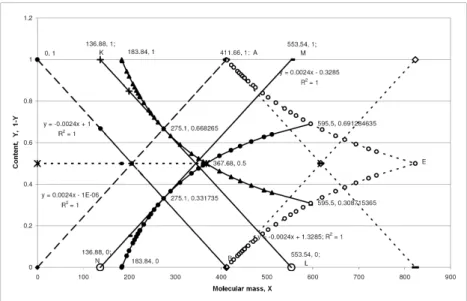
As we can see on Figure 2, (А00) and (В01) are real axes of straight and adjoining hyperboles accordingly; and, АС and BD, (00Е) and (01Е) are tangents to them. Real axes are perpendicular to each other and to tangents. And all of them are equal to each other. Diagonals (00D) and (01С) divide straights АЕ and ВЕ in halves.
There are formulas of mentioned lines. Cross points of these lines are also calculated. Abscissa of cross sections are values divisible by atomic mass of the last element: 0; 205.83; 274.44; 329.328; 411.66; 548.88; 617.49; 823.32 (0; 0.5; 0.667; 0.8; 1.0; 1.333; 1.5; 2.0).
For reference, Figure 3 demonstrates graphical construc-tion for tungsten.
We can see, that knowing real axes (normal to the top of hyperboles), it is very easy to build up tangents to any element, if required, in order to check accuracy of chosen tops. For that, it is necessary to calculate formula of the straight which passes through the point M1(x1;y1)and
pa-rallely=a x+b:
y−y1=a(x−x1). (5)
Volume 2 PROGRESS IN PHYSICS April, 2007
Fig. 1: Dependence of Y and 1−Y content from molecular mass in straight and adjoining hyperboles accordingly.
Fig. 2: Main lines of straight and adjoining hyperboles of the last element: real axes, tangents, diagonals etc.
Fig. 3: Hyperboles of the last element and tungsten, their cross points and tangents.
April, 2007 PROGRESS IN PHYSICS Volume 2
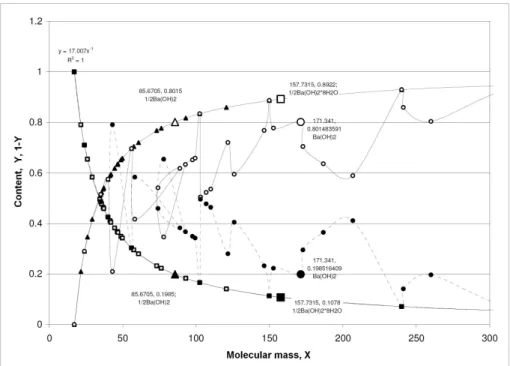
Fig. 4: Dependence of content of Y(OH) and1−Y in hydroxides from their molecular mass counting on 1 gram-mole ОН (of hyperbole). Broken curves are overall (summarized) content of ОН in a substance.
Fig. 5: Application of mathematic methods at calculating of the diagram containing hyperboles of sodium, chlorine and groups CO3, SO4. Building up of a new hyperbole based on these data.
Volume 2 PROGRESS IN PHYSICS April, 2007
2 Application of law of hyperboles for chemical com-pounds
As it has already been mentioned above, the law is based on the following: the content of the element we are determining in the substance should be referred to its gram-atom. It was shown in detail by the example of oxygen. In compliance with the formulay=k
xelement is a numerator, and any com-pound is a denominator. For example, in order to determine content of sodium (Na) in compounds with molecular mass NaOH (39.9967), Na2CO3 (105.9872), Na3PO4 (163.941),
NaCl (58.443), Na2SO4 (142.0406) it is necessary, before
the formula, to put coeicients, reducing amount of sodium in it to a unit: 1, 12,
1 3, 1,
1
2, accordingly. Then, numerically,
part of element (Y) will be: 0.5748, 0.4338, 0.4207, 0.3934, and 0.3237. I.e. it is in one range with decreasing, and value (1−Y) with increasing. Both these curves (in pairs) which are built based on these data are referred to one element.
Method of rectangular hyperboles is worked out in order to determine the last element of the Periodic System of D. I. Mendeleev. But its capabilities are much bigger.
Let us build straight and adjoining hyperboles for sod-ium, chlorine and also for groups CO3 and SO4, which
form, accordingly, carbonates and sulphates. As we can see in formula y=k
x they replace elements in a numerator. In our last work, we said that hyperboles can by formed by any numbers within location of their tops on a real axis. However, there is a rule for groups, similar to that of 1 gram-atom of the element: their quantity in calculated compounds should not exceed a unit. Otherwise we get a situation shown on Figure 4.
As we can see, it is necessary to put coeicient 1 2before
the formula of hydroxide at bivalent barium. Then, his com-pounds will be on hyperboles. In case of non-observance of this rule, their points will be on broken line (circle).
Now we can start to solve a problem of building up new hyperboles, based on existing ones (Figure 5).
Let’s mark on them several general points related to the known compounds. On sodium curves there are two points (on each curve) 12Na2CO3 and
1
2Na2SO4, which are also
located on respective hyperboles but without the coeicient
1
2(Na2CO3and Na2SO4). Thus, the point 1
2Na2SO4, located
on the straight hyperbole of sodium, and its cross points with hyperboles CO3and SO4form imaginary broken line located
between chlorine and СO3.
In a similar manner it works with adjoining hyperboles. Let’s build a formula (by three points)Y=63.257X−1.0658
of a power function (or lny=4.1472−1.0658lnx). With the help of mentioned formula we will ind some more co-ordinates, including (obligatory) their crossing center (93.85; 0.5). Then we divide the abscissa of this point by 2 (straight and adjoining hyperboles cross at doubled value of atomic mass) we getX, equal to 46.925, and that is a numerator in a formula of new hyperboles (y=46.925x ).
3 Conclusion
Method of rectangular hyperboles makes it possible to do the following:
• to create mathematical basis for using hyperboles of
the kindy= 1−k
x in chemistry;
• to determine existence area of the chemical
com-pounds;
• to calculate formulas of the main lines and cross points
of all the hyperboles, including the last element;
• to show the possibility of building up hyperboles
whose numerator is a group of elements, including the rule of 1 gram-atom (in this case it is 1 gram-mole);
• to calculate and to build unknown in advance
hyper-boles by several data of known chemical compounds located on respective curves;
• to control (with high accuracy) the content of
synthes-ized substances;
• to design chemical compounds.
Due to the fact that it is inconvenient to call each time the element 155 (that we calculated in this paper) “the last element” and by the right of the discoverer we decided to call itKHAZANIUM(Kh).
Submitted on February 13, 2007 Accepted on February 19, 2007
References
1. Khazan A. Upper limit in the Periodic System of Elements. Progress in Physics, 2007, v. 1, 38 – 41.
2. Vigotskiy М. Handbook on higher mathematics. Мoscow, Nauka, 2004, page 991.