www.ann-geophys.net/27/59/2009/
© Author(s) 2009. This work is distributed under the Creative Commons Attribution 3.0 License.
Annales
Geophysicae
Plasmoid formation for multiple onset substorms: observations of
the Japanese Lunar Mission “Kaguya”
T. Nagai1, H. Tsunakawa1, H. Shibuya2, F. Takahashi1, H. Shimizu3, M. Matsushima1, M. N. Nishino4, Y. Yokota4, K. Asamura4, T. Tanaka4, Y. Saito4, and O. Amm5
1Tokyo Institute of Technology, Tokyo, Japan 2Kumamoto University, Kumamoto, Japan 3University of Tokyo, Tokyo, Japan
4Institute of Space and Astronautical Science, Japan Aerospace Exploration Agency, Japan 5Finnish Meteorological Institute, Helsinki, Finland
Received: 1 September 2008 – Revised: 3 December 2008 – Accepted: 3 December 2008 – Published: 6 January 2009
Abstract. The Japanese Lunar Mission “Kaguya” car-ried out its first magnetic field and plasma measurements in the Earth’s magnetotail on 22 December 2007. For-tuitously, three well-defined multiple onset substoms took place. Kaguya was located in the premidnight magnetotail at radial distances of 56RE and observed plasmoids and/or traveling compression regions (TCRs). Although the present study is based on limited data sets, important issues on mul-tiple onset substorms can be examined. Each onset in a se-ries of onsets releases a plasmoid, and magnetic reconnection likely proceeds to tail lobe field lines for each onset. Since the duration of each plasmoid is less than 5 min, these ob-servations imply that magnetic reconnection for each onset can develop fully to the tail lobe field lines and be quenched within this timescale.
Keywords. Magnetospheric physics (Magnetotail; Storms and substorms) – Space plasma physics (Magnetic reconnec-tion)
1 Introduction
The Japanese Lunar Mission “Kaguya” was launched on 14 September 2007. The Kaguya spacecraft encircles the moon at an altitude of 100 km with an orbital period of 118 min. Its first plasma and magnetic field observations in the Earth’s magnetotail were carried out on 22 Decem-ber 2007. Kaguya traveled near the northern tail lobe/plasma sheet boundary from (−52, +21, +1REGSM) at 12:00 UT to
Correspondence to:T. Nagai ([email protected])
(−55, +13, +7REGSM) at 24:00 UT on 22 December 2007. Fortuitously, three multiple onset substorms took place and Kaguya observed plasmoids and traveling compression re-gions (TCRs) during these substorms.
Characteristics of plasmoids and TCRs have already been studied extensively (e.g. Hones et al., 1984; Slavin et al., 1984, 1989, 1993, 1998, 2002, 2003; Baker et al., 1987; Moldwin and Hughes, 1992a, b, 1993; Nagai et al., 1994; Ieda et al., 1998). Since formation of a plasmoid is thought to be a natural consequence of magnetic reconnection in the near-Earth magnetotail (e.g. Hones et al., 1984), we can in-vestigate development of magnetic reconnection during mul-tiple onset substorms. In this paper we address two ques-tions. One is whether or not each onset in a multiple onset substorm creates a plasmoid. Plasmoids and TCRs are of-ten observed successively during substorm activity. Slavin et al. (1992) examined ISEE 3 observations at radial dis-tances of 76–80RE during an extended interval of substorm activity and found that all of the substorms produced one or more plasmoids and/or TCRs. However, one-to-one corre-spondence between each onset and a plasmoid is not fully examined. The other is whether or not tail lobe open field lines are reconnected in the magnetic reconnection process for each onset. This question does not seem to be explored properly.
2 Observations
Kakioka 22/12/2007
H 1 div = 10 nT
dH/dtnT/s
0.05 nT/s
13:00 13:10 13:20 13:30 13:40 13:50 14:00
UT
Fig. 1. Ground magnetic field data at Kakioka (the H component anddH/dtfor Pi2) for the period 13:00–14:00 UT on 22 Decem-ber 2007.
13:40, and 13:45 UT. A mid-latitude positive bay starts with the first Pi2 burst. The second and fourth Pi2 bursts are ac-companied with clear positive changes in the H component of the magnetic field. The data from another mid-latitude station Urumqi (magnetic latitude is 34.2◦and magnetic lo-cal midnight is 18:00 UT) also show these four Pi2 bursts at the same times. Furthermore, the D variation is positive at Urumqi and negative at Kakioka, respectively, so that the central meridian of this substorm activity is located between these two stations. The geosynchronous spacecraft LANL-97A is located just west of the Kakioka meridian (local mid-night is 14:05 UT), so that the location of this spacecraft is the best for monitoring the substorm activity. Electron injec-tions are observed at 13:25, 13:32, 13:46, and 13:50 UT, and electron and proton fluxes do not show any variations for the period 12:00–13:25 UT (not shown). Hence, this substorm is identified as a multiple onset substorm with a sequence of four onsets (e.g. McPherron, 1991; Pytte et al., 1976a, b, Nagai et al., 1983), hereafter, called the first multiple onset substorm.
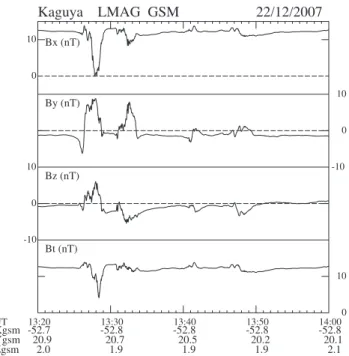
Figure 2 presents the magnetic field data from Kaguya for the period of 13:20–14:00 UT. The magnetometer on Kaguya is described by Shimizu et al. (2008). At 13:25 and 13:31 UT, two plasmoids are identified in the magnetic field data. The second plasmoid is a typical one, which has a bipolar (north-then-south) variation inBz. During a depression inBx,By becomes largely positive. The first plasmoid is rather atypi-cal. There is a small bipolar variation inBz initially, how-ever, a main body of this plasmoid has a largely positive variation in Bz. Furthermore, a largely positive deflection inByis observed inside this plasmoid. The spacecraft Geo-tail observes the interplanetary magnetic field (IMF) in the front of the magnetosphere at (29.0, 0.0, −7.0RE GSM). There is no large IMFBy(less than 3 nT) in this interval (not shown). Kaguya is located near the 125◦E longitude merid-ian in the Southern Hemisphere of the moon, and there is no strong magnetic anomaly in the moon’s surface in this re-gion. These atypical magnetic field behaviors are frequently observed for plasmoids in the Kaguya observations (for the period through August 2008). It is possible that they are
Kaguya LMAG GSM 22/12/2007
0 10
-10 0
10 -10
0 10
0 10
13:20 13:30 13:40 13:50 14:00 UT
Bx (nT)
By (nT)
Bz (nT)
Bt (nT)
-52.7 20.9 2.0
-52.8 20.7 1.9
-52.8 20.5 1.9
-52.8 20.2 1.9
-52.8 20.1 2.1 Xgsm
Ygsm Zgsm
Fig. 2.Kaguya magnetic field observations of a series of plasmoids and TCRs recorded for the period 13:20–14:00 UT on 22 Decem-ber 2007.
caused by the existence of the moon, however, origin of the atypical variations in the magnetic field is not identified at present. Two TCRs are identified in the magnetic field data at 13:41 and 13:46 UT. Hence, there are four plasmoid signa-tures which are well associated with the four onsets recorded on the ground and at synchronous orbit.
13:20 13:24 13:28 13:32 13:36
1 10000 1 100000 counts/sample
1 1 0.1 0.01
1 1 0.1 0.01
ESA1
Time (UT)
Kaguya MAP/PACE 22 Dec. 2007 13:20:00-13:36:00
Energy (keV)
Energy (keV) IEA
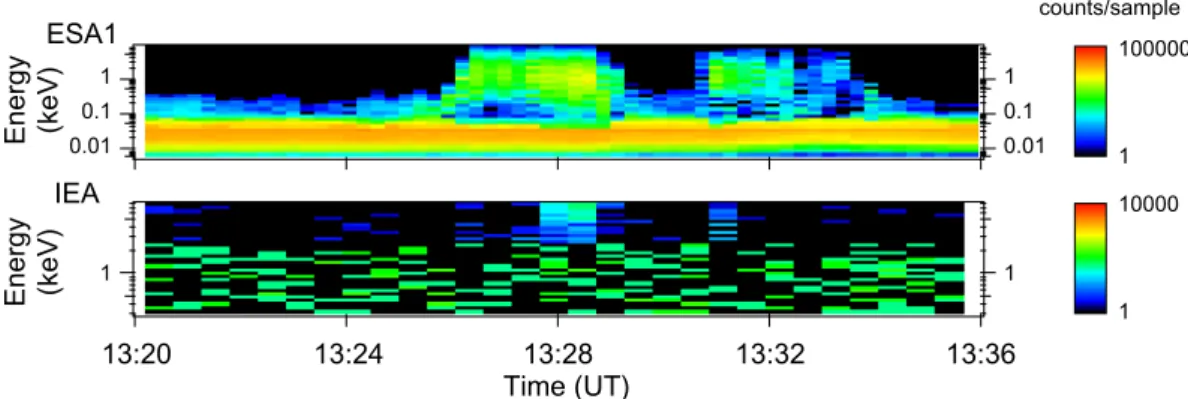
Fig. 3.Kaguya electron (the top panel) and ion (the bottom panel) measurements for the period 13:20–13:36 UT on 22 December 2007. Ion observations were made in a mode that were less sensitive to ions with energies<2.5 keV.
this plasma instrument. However, plasmas indicating the normal plasma sheet and its boundary region are not identi-fied with detailed examinations of the distribution functions for this interval. Hence, the plasma observations strongly in-dicate that Kaguya directly enters the plasmoid from the tail lobe. For the second plasmoid, energetic electrons appear at 13:31:52 UT, when the magnetic field data show an initial signature of the plasmoid. This also indicates that Kaguya directly enters the plasmoid from the tail lobe.
Figure 4 shows the magnetic field data from Kaguya for the second multiple onset substorm. Three Pi2 bursts are observed at 15:39, 15:45, and 15:49 UT at Kakioka and Urumqi (not shown). Unfortunately, there are no particle ob-servations near midnight at synchronous orbit and only one gradual increase in the electron flux is observed at LANL-97A (near 02:00 MLT). A plasmoid signature is observed at 15:39 UT, while two TCRs are observed at 15:45 and 15:49 UT. Energetic electrons appear at 15:39:08 UT (not shown). This plasmoid is another example that Kaguya di-rectly enters the plasmoid from the tail lobe.
Figure 5 shows the magnetic field data from Kaguya for the third multiple onset substorm. For this substorm, the magnetic field data from the IMAGE magnetometer network in Scandinavia are examined. There are at least five inten-sifications of the westward electrojet at 19:25, 19:32, 19:46, 19:58, and 20:10 UT. The spacecraft LANL-02A (local mid-night is 19:30 UT) observes electron injections at 19:25, 19:35, 19:48, 20:05, and 20:18 UT. Five TCR-like events at 19:28, 19:34, 19:48, 20:01, and 20:12 UT are identified in the Kaguya magnetic field data. The magnetic signatures of the first and second events (at 19:28 and 19:34 UT) are not typ-ical TCRs, and these are accompanied with appearances of high-energy (>1 keV) electrons. These seem to be classified as boundary layer plasmoids (Moldwin and Hughes, 1992b). The third, fourth, and fifth events are identified as TCRs.
In summary, the observations by Kaguya on 22 Decem-ber 2007 indicate that there is one-to-one correspondence
between each onset in a multiple onset substorm and a plas-moid. Furthermore, the plasma and magnetic field data show that the outer boundary of the plasmoid touches the tail lobe.
3 Discussion and conclusions
During the three multiple onset substorms on 22 December 2007, Kaguya is located at X=−52 to−55REand observes a plasmoid signature for each onset. The results from the Geo-tail observations show that magnetic reconnection in associa-tion with a substorm onset usually takes place in the premid-night plasma sheet at X=−20 to−30RE (e.g. Nagai et al., 1998a, 2005). It is difficult to station spacecraft continuously in the plasma sheet or near the plasma sheet/tail lobe bound-ary in the distant tail, because of large-amplitude motion of the distant tail. The moon is thought to be one of the best stations for monitoring plasmoids. Indeed, Kaguya did not miss any plasmoid that was released on this day. For the first substorm, the time delays relative to the Pi2 onsets are 2, 2, 1, and 1 min. For the second substorm, the time delays relative to the Pi2 onsets are−1, 1, and 0 min. The average time de-lay is 1 min. If we assume that magnetic reconnection takes place at X=−25REand its signals travel earthward and tail-ward at the same speed, the signal speed is 530 km s−1. This
Kaguya LMAG GSM 22/12/2007
0 10
-10 0
10 -10
0 10
0 10
15:30 15:40 15:50 16:00
UT
Bx (nT)
By (nT)
Bz (nT)
Bt (nT)
-53.1 19.3 3.8
-53.1 19.1 3.8
-53.1 18.9 3.8
-53.2 18.7 3.9 Xgsm
Ygsm Zgsm
Fig. 4.Kaguya magnetic field observations of a series of plasmoids and/or TCRs recorded for the period 15:30–16:00 UT on 22 Decem-ber 2007.
plasmoid arrival) by 4–5 min. This probably indicates that these particle injections at synchronous orbit take place far from the midnight meridian. This is already reported by Na-gai et al. (1983) and is consistent with the idea that the onset sector moves westward (e.g. Wiens and Rostoker, 1975).
The present study clearly shows that each onset in a mul-tiple onset substorm releases a plasmoid. If we assume that plasmoid speed is 500 km s−1 and its duration is 2 min, the size of a plasmoid is approximately 10RE at X=−50RE. Hence, a plasmoid created at each onset can develop well and its size is comparable to the average plasmoid size at this radial distance (Ieda et al., 1998). The Kaguya obser-vations provide evidence that the spacecraft directly enters a plasmoid from the tail lobe, at least, for the first plasmoid in the series of plasmoids. Since the outer envelope of a plas-moid extends to the tail lobe, it is reasonably interpreted that magnetic reconnection proceeds to tail lobe field lines. It is interesting to discuss the present results to the previous observations in the near-Earth magnetotail by Geotail. Na-gai et al. (1998a) reported three tailward plasma flow bursts with negative Bz, each of which is associated with a Pi2 burst, when Geotail continuously stayed inside the plasma sheet. Hence, this is an example of plasma flow observations in the near-Earth magnetotail for multiple onset substorms. The plasma sheet became stagnant in the intervals between a pair of Pi2 bursts. Probably, a multiple onset substorm is not caused by any modulation of the reconnection rate in a sin-gle magnetic reconnection process. It is likely that magnetic reconnection starts and ceases at several times at the same
Kaguya LMAG GSM 22/12/2007
0 10 20
-10 0
10 -10
0 10
0 10
19:20 19:30 19:40 19:50 20:00 20:10 20:20 UT
Bx (nT)
By (nT)
Bz (nT)
Bt (nT)
-53.9 16.3 6.9
-53.9 16.1 6.8
-53.9 15.9 6.8
-53.9 15.7 6.8
-53.9 15.5 7.0
-53.9 15.4 7.1
-54.0 15.4 7.2 Xgsm
Ygsm Zgsm
Fig. 5. Kaguya magnetic field observations of a series of TCRs recorded for the period 19:20–20:20 UT on 22 December 2007.
position or different sites for a multiple onset substorm and that each magnetic reconnection process can develop fully even for a short duration (the average time duration of the plasmoids is 3.5 min for the three multiple onset substorms). Nagai et al. (1998b) examined magnetic reconnection in the near-Earth plasma sheet for a pseudobreakup. Fast tailward plasma flows with negativeBzare embedded in the plasma sheet and the outer plasma sheet is stationary, so that mag-netic reconnection likely involves only closed plasma sheet flux tubes for a pseudobreakup (see also Ohtani et al., 2004). Whether or not open tail lobe flux tubes are reconnected seems to control development of substorm processes.
continue and the data are available. Atypical magnetic field signatures are frequently observed for plasmoids. Plasmoid signatures are observed when Kaguya stays in the plasma sheet, the plasma sheet/tail lobe boundary, and the tail lobe. The ion and electron signatures presented in this study are repeatedly observed. The results here are initial ones based on the limited data sets, however, the observations on 22 December 2007 can be judged to be representative. More comprehensive analyses will be needed using the data for the whole Kaguya operation period.
Acknowledgements. The authors thank the members of the Kaguya/PACE team. The ground magnetic field data were supplied by Kyoto University World Data Center. The Los Alamos space-craft data were examined at http://leadbelly.lanl.gov. The Geotail magnetic field data are available at http://www.darts.isas.jaxa.jp/stp/ cef/cef.cgi.
Topical Editor R. Nakamura thanks M. Moldwin and another anonymous referee for their help in evaluating this paper.
References
Baker, D. N., Anderson, R. C., Zwickl, R. D., and Slavin, J. A.: Average plasma and magnetic field variations in the distant mag-netotail associated with near-Earth substorm effects, J. Geophys. Res., 71–81, 1987.
Hones Jr., E. W., Baker, D. N., Bame, S. J., Feldman, W. C., Gosling, J. T., McComas, D. J., Zwickl, R. D., Slavin, J. A., Smith, E. J., and Tsurutani, B. T.: Structure of the magnetotail at 220REand its response to geomagnetic activity, Geophys. Res. Lett., 11, 5–7, 1984.
Ieda, A., Machida, S., Mukai, T., Saito, Y., Yamamoto, T., Nishida, A., Terasawa, T., and Kokubun, S.: Statistical analysis of the plasmoid evolution with Geotail observations, J. Geophys. Res., 103, 4453–4465, 1998.
McPherron, R. L.: Physical processes producing magnetospheric substorms and magnetic storms, in: Geomagnetism, vol. 4, edited by: Jacobs, J. A., 593–739, Academic Press, London, 1991.
Moldwin, M. B. and Hughes, W. J.: On the formation and evolution of plasmoids: A survey of ISEE 3 geotail data, J. Geophys. Res., 97, 19259–19282, 1992a.
Moldwin, M. B. and Hughes, W. J.: Plasmoid observations in the distant plasma sheet boundary layer, Geophys. Res. Lett., 19, 1911–1914, 1992b.
Moldwin, M. B. and Hughes, W. J.: Geomagnetic substorm associ-ation of plasmoids, J. Geophys. Res., 98, 81–88, 1993.
Nagai, T., Baker, D. N., and Higbie, P. R.: Development of sub-storm activity in multiple-onset subsub-storms at synchronous orbit, J. Geophys. Res., 88, 6994–7004, 1983.
Nagai, T., Takahashi, K., Kawano, H., Yamamoto, T., Kokubun, S., and Nishida, A.: Initial GEOTAIL survey of magnetic substorm signatures in the magnetotail, Geophys. Res. Lett., 21(25), 2991– 2994, 1994.
Nagai, T., Fujimoto, M., Saito, Y., Machida, S., Terasawa, T., Naka-mura, R., Yamamoto, T., Mukai, T., Nishida, A., and Kokubun, S.: Structure and dynamics of magnetic reconnection for
sub-storm onsets with Geotail observations, J. Geophys. Res., 103(3), 4419–4440, 1998a.
Nagai, T., Fujimoto, M., Nakamura, R., Saito, Y., Mukai, T., Ya-mamoto, T., Nishida, A., Kokubun, S., Reeves, G. D., and Lepping, R. P.: Geotail observations of a fast tailward flow at XGSM=−15RE, J. Geophys. Res., 103, 23543–23550, 1998b. Nagai, T., Fujimoto, M., Nakamura, R., Baumjohann, W., Ieda,
A., Shinohara, I., Machida, S., Saito, Y., and Mukai, T.: So-lar wind control of the radial distance of the magnetic recon-nection site in the magnetotail, J. Geophys. Res., 110, A09208, doi:10.1029/2005JA011207, 2005.
Ohtani, S., Ueno, G., Yamaguchi, R., Singer, H., Creutzberg, F., Yumoto, K., Kitamura, K., and Mukai, T.: Tail dynamics dur-ing the growth phase of the November 24, 1996, substorm event: Near-Earth reconnection confined in the plasma sheet, J. Geo-phys. Res., 109, A05211, doi:10.1029/2003JA010299, 2004. Pytte, T., McPherron, R. L., and Kokubun, S.: The ground
signa-tures of the expansion phase during multiple onset substorms, Planet. Space Sci., 24, 1115–1132, 1976a.
Pytte, T., McPherron, R. L., Kivelson, M. G., West Jr., H. I., and Hones Jr., E. W.: Multiple-satellite studies of magnetospheric substorms: Radial dynamics of the plasma sheet, J. Geophys. Res., 81, 5921–5933, 1976b.
Saito, Y., Yokota, S., Asamura, K., Tanaka, T., Akiba, R., Fujimoto, M., Hasegawa, H., Hayakawa, H., Hirahara, M., Hoshino, M., Machida, S., Mukai, T., Nagai, T., Nagatsuma, T., Nakamura, M., Oyama, K.-I., Sagawa, E., Sasaki, S., Seki, K., and Terasawa, T.: Low-energy charged particle measurement by MAP-PACE onboard SELENE, Earth, Planets Space, 60, 375–385, 2008. Shimizu, H., Takahashi, F., Horii, N., Matsuoka, A., Matsushima,
M., Shibuya, H., and Tsunakawa, H.: Ground calibration of the high-sensitivity SELENE lunar magnetometer LMAG, Earth Planets Space, 60, 353–363, 2008.
Slavin, J. A., Smith, E. J., Tsurutani, B. T., Sibeck, D. G., Singer, H. J., Baker, D. N., Gosling, J. T., Hones, E. W., and Scarf, F. L.: Substorm associated traveling compression regions in the distant tail: ISEE-3 geotail observations, Geophys. Res. Lett., 11, 657– 660, 1984.
Slavin, J. A., Baker, D. N., Craven, J. D., Elphic, R. C., Fairfield, D. H., Frank, L. A., Galvin, A. B., Hughes, W. J., Manka, R. H., Mitchell, D. G., Richardson, I. G., Sanderson, T. R., Sibeck, D. J., Smith, E. J., and Zwickl, R. D.: CDAW 8 observations of plasmoid signatures in the geomagnetic tail: An assessment, J. Geophys. Res., 94, 15153–15175, 1989.
Slavin, J. A., Smith, M. F., Mazur, E. L., Baker, D. N., Iyemori, T., Singer, H. J., and Greenstadt, E. W.: ISEE 3 plasmoid and TCR observations during an extended interval of substorm activ-ity, Geophys. Res. Lett., 19, 825–828, 1992.
Slavin, J. A., Smith, M. F., Mazur, E. L., Baker, D. N., Hones Jr., E. W., Iyemori, T., and Geenstadt, E. W.: ISEE 3 observations of traveling compression regions in the Earth’s magnetotail, J. Geophys. Res., 98, 15425–15446, 1993.
Slavin, J. A., Fairfield, D. H., Kuznetsova, M. M., Owen, C. J., Lepping, R. P., Taguchi, S., Mukai, T., Saito, Y., Yamamoto, T., Kokubun, S., Lui, A. T. Y., and Reeves, G. D.: ISTP observations of plasmoid ejection: IMP 8 and Geotail. J. Geophys. Res. 103, 119–133, 1998.
and Sutcliffe, P. R.: Simultaneous observations of earthward flow bursts and plasmoid ejection during magnetospheric substorms, J. Geophys. Res., 107(A7), 1015, doi:10.1029/2000JA003501, 2002.
Slavin, J. A., Lepping, R. P., Gjerloev, J., Fairfield, D. H., Hesse, M., Owen, C. J., Moldwin, M. B., Nagai, T., Ieda, A., and Mukai, T.: Geotail observations of magnetic flux ropes in the plasma sheet, J. Geophys. Res., 108(A1), 1015, doi:10.1029/2002JA009557, 2003.