SYNOPTIC CONDITIONS THAT TRIGGERED ABSOLUTE
MINIMUM TEMPERATURES IN THE PRAHOVA CORRIDOR
BETWEEN 1961-2007
LOREDANA-ELENA HAVRIŞ (MIC)1ABSTRACT. – Synoptic conditions that triggered absolute minimum temperatures in the Prahova Corridor between 1961-2007. In order to identify and describe the synoptic conditions which produced the waves of cold in the Prahova Corridor, the absolute minimum air temperatures in the cold semester of the year were analysed for the period 1961-2007 with homogenous data of the temperature values recorded at the Câmpina, Sinaia 1500, Predeal, Vârfu Omu şi Braşov stations. Based on these values, the negative termic singularities were determined and characterised as such type of climate hazard appears more evident in case of absolute minimum temperatures and the results obtained were synthetised in tabels and graphs. For illustratying these synoptic conditions that triggered the absolute minimum values of air temperatures the synoptic maps found in the Karten Archive of the Karlsruhe Meteorological Centre (Germany) have been resorted to. Considering the particular importance of this parameter, eventually we found useful also the computation of probability of occurence of values higher than those recorded during the refence period 1961-2007.
Keywords: Prahova Corridor, thermal hazards in winter, waves of cold, absolute minimum temperatures.
1. INTRODUCTION
Local air temperature extremes reflect in the lowest (absolute minimum values) ever recorded. Althrough momentous, these values have both a practical and theoretical importance as major characteristics of thermal hazards in winter.
In the same time, from a climate perspective, a region such Prohova Corridor is considered to be suitable for winter sports by way of absence of the extreme excessive negative temperatures (Bogdan, Mic, 2011).
For practical purposes, from a sustainable development perspective of the tourism in the region, the absolute minimum temperatures values are of a notable interest, representing a termic treshold which is likely to be reached at various time intervals.
2. DATA AND METHODS
In order to underscore thermal differences in the Prahova Corridor in relation to Romania’s position on the Globe and in Europe, a detailed analysis has
1
Romanian Academy, Institute of Geography, 023993, Bucharest, Romania, e-mail: [email protected]
Fig. 2. The thermal field at 850 hPa level, January the 14th, 1963
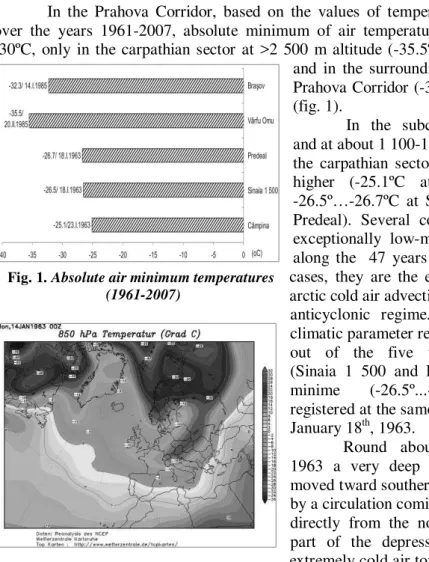
Fig. 1. Absolute air minimum temperatures (1961-2007)
been made of synoptic conditions engendering extreme temperatures recorded at five weather stations, in relation to pressure conditions on soil and the direction of incoming advections (500 hPa geopotential level).
Absolute air temperature values have been singled out from series of over 40 years of observations. The occurrence probability of absolute extreme temperatures was calculated by the Gumbel distribution function and assessed by looking at probability of 100%, 50%, 20%, 10%, 5%, 2% and 1% with recurrence periods of 1, 2, 5, 10, 20, 50 and 100 years.
3. RESULTS
In the Prahova Corridor, based on the values of temperatures registered over the years 1961-2007, absolute minimum of air temperature was very low -30ºC, only in the carpathian sector at >2 500 m altitude (-35.5ºC at Omu Peak)
and in the surrounding region of the
Prahova Corridor (-32.3ºC at Braşov)
(fig. 1).
In the subcarpathian sector and at about 1 100-1 600 m altitude in the carpathian sector, there are must
higher (-25.1ºC at Câmpina and -26.5º…-26.7ºC at Sinaia 1 500 and
Predeal). Several cooling phases of exceptionally low-minima did occur along the 47 years studied. In most cases, they are the effect of polar or arctic cold air advections in
anticyclonic regime. Analysing this climatic parameter resulted that at two
out of the five weather stations (Sinaia 1 500 and Predeal) absolute
minime (-26.5º...-26.7ºC) were registered at the same date, namely on January 18th, 1963.
Round about January 14th,
1963 a very deep polar depression moved tward southern latitudes driven by a circulation coming
directly from the north, the western part of the depression carrying an extremely cold air towards the Central and Central – East European countries (fig. 2).
As the atmospheric pressure over these regions kept rising and an anticyclonic belt formed between the Azore Ridge and the polar cap (from the Laptev Sea – the north of Eastern Siberia to the north of European Russia), an individual cyclonic nucleus, englobing the mass of air still extremely cold, was
isolated over Romania and Ukraine. With atmospheric pressure in the low layers of the troposhere rising inside the high pressure belt, a bigger mass of cold air was driven in by the general north-eastern circulation, dominating manily the southern periphery of the belt.
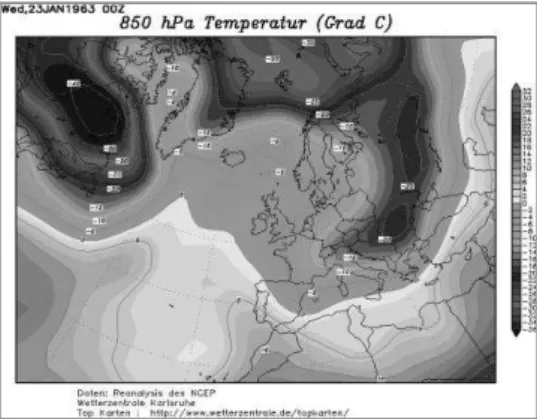
The map of air temperature at
850 hPa, time 00 hrs shows
temperatures of some -20ºC over Romania on January, the 18th (fig. 3).
Increasingly higher pressure significantly reduced nebulosity. In view of it, the intense nocturnal radiation, enhanced by a fresh snow layer (deposited probably as a result of recent cyclonic activity), led to an absolute record low temperature of -26.7ºC and -26.5ºC
at Predeal and Sinaia weather stations (January the 18th, 1963 in the morning).
Increasingly higher pressure significantly reduced nebulosity. In view of it, the intense nocturnal radiation, enhanced by a fresh snow layer (deposited probably as a result of recent cyclonic activity), led to an absolute record low temperature of
-26.7ºC and -26.5ºC at Predeal and Sinaia weather stations (January the 18th, 1963
in the morning).
In the Prahova Corridor Subcarpathian sector (Câmpina station), the absolute minimum temperature was registered on January 1963, but five days later (January, the 23rd) it fell to -25.1ºC.
Between January 19-23th, 1963
a strong Greenland Anticyclone (initial pressure in the centre 1 060 hPa over Greenland) drifted towards North-West and Central Europe over the North Sea and Germany, heading to Romania.
Here the ridge of high pressure gradually increased on the ground up to 1 035-1 037 mb (see maps of soil
pressure and geopotential at 500 hPa from January the 23rd) (fig. 4).
Fig. 3. The thermal field at 850 hPa level, January the 18th, 1963
Fig. 4. Ground Synopsis, Geoptential Field at 500 hPa Isobaric Area and Relative Topography RT 500/1 000 hPa on January
Fig. 5. The thermal field at 850 hPa level, January the 23rd, 1963
Simultaneously, at the forefront of the ridge (given the specific clockwise rotation of the air flow within an anticlyclone) entrained a very cold North Polar advection over Northern, Eastern and Central Europe, values of -22º…-20ºC being registered in Romania
on January the 23rd, at altitudes above 1
500 m (fig. 5).
High atmospheric pressure, favouring descendent movements reduced nebulosity, fact that enhanced nocturnal radiation, the soil becoming excesively cold, down to an absolute low of -25.1ºC (Câmpina Station, January the 23rd).
At Omu Peak and Braşov stations, the absolute minimum temperature was
recorded during year 1985, but at different dates (fig. 1, p. 2).
B
etween January 12-14th, 1985, pressure field variability at ground level inEurope seemed to be less common for a mid-cold season.
On January 12, 00 time, the Northern, Western and Central parts of the Continent stood under the influence of a high pressure area at over 1 025 hPa, isolated nuclei being at over 1 030 hPa; at the same time, in the eastern and southern parts of the Continent pressure was lower (<1 025-1 020 hPa). Romania’s eastern regions lay rather in a low pressure area covering over of the east of the Continent, whereas the Intracarpathians and the western regions were dominated by a pressure high area.
The median troposhere featured a cut-off nucleus, with values of
518-520 dmgp, that extended from Romania to the Baltic States, the January 545 dmgp isohypse in Romania suggesting mild cyclonic activity over Eastern
Europe (fig. 6, 7).
Fig. 6, 7. Ground Synopsis, Geoptential Field at 500 hPa Isobaric Area and Relative Topography RT 500/1 000 hPa on January 12-13, 1985
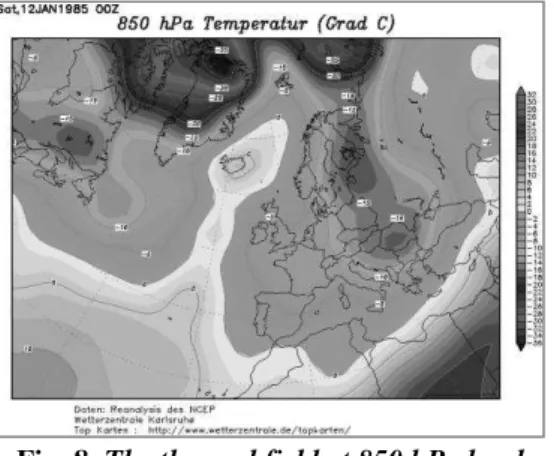
Fig. 8. The thermal field at 850 hPa level, January the 12th, 1985
The main pressure centres tending to swiftly reposition, engendered a vast high pressure arc over much of Europe, mostly in its northern half, January, the
14th, 00 time (restricting cyclonic activity to the Mediterranean, Arctic and Atlantic
basins) and blocking circulation at the level of Romania.
Atmospheric pressure over this country and its eastern regions in
particular, was significantly rising, from 1 022-1 023 mb on January the12th to
some 1 033 mb on January the14th.
In a first stage, the air temperature was dominated by an advection of cold air carried from polar latitudes by a predominantly northern circulation (fig. 8).
Subseguently, the previously mentioned northern arc disrupted the arctic air supply, isolating a cold air nucleus, basically the geopotential cut-off referred to before. As a result, the thermal regime over Romania continued to be marked by severe cold, with values of -13ºC at heights of 1 500 (January the 13th-14th).
Hovewer, since thermal inversions in the cold season are quite frequent in the conditions of anticyclonic activity and the evolution of atmospheric pressure on soil stabilises a high pressure field, there is no wonder that high temperature inversion is registered in the low layers of the troposphere, a situation that could have been favoured by the -16º...-17ºC nucleus pre-existing over the Southern
Carpathians on January the 12th.
It follows that temperatures on ground level can be much lower that at any altitude level up to the limit layer of thermal inversions. This would explain the
absolute low of -32.3ºC registered in Braşov on January, the 14th, in the morning
(fig. 9, 10).
Fig. 9, 10. The thermal field at 850 hPa level and Ground Synopsis, Geoptential Field at 500 hPa Isobaric Area and Relative Topography RT 500/1 000 hPa, January the 14th,
The configuration of the pressure field on ground level shows the presence of a high pressure area (February 19-20, 1985) over Northern, Western and Central Europe, and a dominantly low pressure area in the East of the Continent, tending to centre somewhere above the Black Sea (fig. 11, 12).
Romania lies just in the contact area between the high pressure fiel from the West of Europe and the low pressure field from the East of Europe, the isobar of 1 020 mb being of interest for this country at the time.
In view of it, typical snowstorm conditions, at least in the north-eastern part of Romania (the characteristic February isohypse of 545 dmgp) indicating a very deep cyclonic nucleus. A thermal field at 850 hPa, with values under -25ºC over Ukraine and -22ºC over Romania, sustains the cyclonic nucleus (fig. 13, 14).
This particularly cold mass of air and the deposition of a supposedly consistent snow layer associated with significant intensifications of wind, led to nocturnal temperatures in the high mountainous region dropping to an absolute low
of -35.5ºC (Omu Peak Station, February the 20 th, 1985 in the morning).
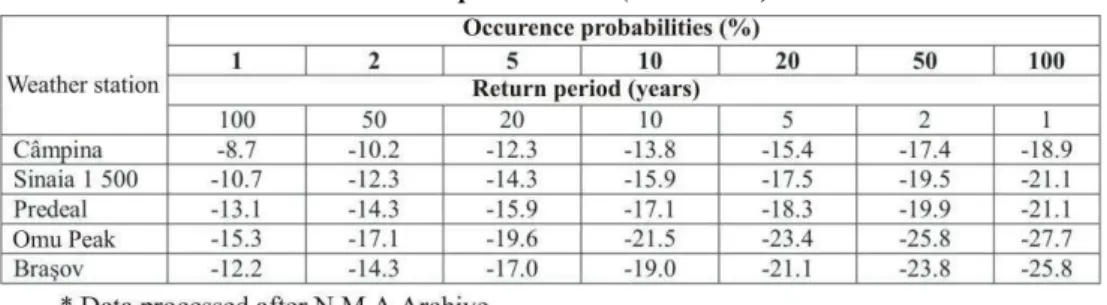
From analysing table no. 1, made to show the probability of occurence of values higher than those recorded in case of absolute minimum air temperatures, it Fig. 11, 12. Ground Synopsis, Geoptential Field at 500 hPa Isobaric Area and Relative
Topography RT 500/1 000 hPa level on February 19-20, 1985
Fig. 13, 14. The thermal field at 850 hPa level, February the 19-20th 1985
resulted that the data do not show values over the registered records, at none of the five analysed weather stations, considering that climate warming is maintained.
Table 1. Yearly absolute minimum air temperatues with different occurence probabilities (1961-2007)
This situation is due to the fact that the analysed period of 47 years is overlaping the time period in which climate warming is obvious.
It is worth mentioning that, before that period, under the conditions of a
severe winter, the minimum temperature recorded at Braşov was much lower.
Besides, it is known that at Bod, near Braşov were recorded -38.5ºC on 25 January
1942, under similar geographical depression conditions, which represent the Pole of Cold in Romania.
4. CONCLUSIONS
From the those presented before, it results that the most outstanding cold wave in the analysed region produced on February 20, 1985 and affected especially the high mountain regions in the Bucegi Massif, situated at altitudes >2 500 m, when the air temperature dropped down to a maximum value of -35.5ºC (Omu Peak).
The same year held the absolute record also for the bordering region of the
Prahova Corridor, where at Braşov, on January 14, 1985 values (-32.3ºC) close to
the absolute maximum recorded at Peak Omu station.
In the subcarpathic and carpatic sector, at about 1 100-1 600 m altitude, the polar and arctic waves of cold were recorded in the same period during winter time
of 1963: January 18th (Predeal and Sinaia 1 500) and January 23th (Câmpina) and
that is way one may call them natural climatic cold waves (Marinică, 2006).
It is obvious that excessive cooling periods cannot be explained simply by atmospheric dynamics. However, the synoptic condtions specific to these climatic hazards may still be useful for in-depth research of synoptic processes, the evaluation of which may lead to a temperature rise or fall, within the limits necessary for cold waves to develop.
Predeal and Omu Peak) and its limitrophe area (Braşov-Ghimbav), the action particularities of synoptic factors make us assume their validitity for a much wider
territory (Sfâcă, 2008).
Therefore, having weather forecasts as reliable as possible is of practical value for many economic branches, for tourism in particular.
REFERENCES
1. Bogdan, Octavia, Mic, Loredana-Elena (2011), Vocaţia turistică a Culoarului Prahovei pentru sporturile de iarnă, Geo-Carpathica, Edit. Univ. „Lucian Blaga”, Sibiu, Anul XI, nr. 11, p. 39-63, ISSN 1582-4950.
2. Gumbel, E.J. (1958), Statistic of extremes, Columbia University Press, New-York.
3. Marinică, I. (2006), Fenomene climatice de risc în Oltenia, Edit. Autograf MJM, 386 p.
4. Mic, Loredana-Elena (2010), Consideraţii privind hazardele termice din Culoarul Prahovei şi regiunea limitrofă, Rev. Geogr., T. XVII /2010 – Serie nouă, Bucureşti, pp. 29-40, ISSN: 1224-256 X.
5. Sfâcă, L. (2008), Synoptic conditions for the occurence of monthly extreme temperatures on Siret Corridor, Analele Ştiinţifice ale Universităţii „Al. I. Cuza”,
Iaşi, LIV, II-c, p. 49-58.
6. http://www.wetterzentrale.de.