CASE REPORT
Right coronary artery originating from the distal left
circumflex artery, evaluation using three imaging
techniques
Murat Turfan,ICemalettin Aydın,IIMehmet Ali Elbey,IIIErcan Erdog˘an,IEmin Asoglu,IHalil Basel,II O¨ mer Go¨ktekinI
IBezmialem University, Faculty of Medicine, Department of Cardiology, Istanbul/Turkey.IIBezmialem University, Faculty of Medicine, Department of
Cardiovascular Surgery, Istanbul/Turkey.IIIDicle University, Faculty of Medicine, Department of Cardiology, Adnan Menderes Bulvarı Fatih, Istanbul/ Turkey.
Email: [email protected] Tel.: 90 505 3197199
INTRODUCTION
An isolated single coronary artery is extremely rare, with an incidence of 0.024% to 0.066% in the general population (1), and many patients with coronary artery anomalies are asymptomatic. However, some of these anomalies can lead to sudden death. In this report, we describe a rare case using three different imaging methods.
CASE DESCRIPTION
A 58-year-old man presented with exertional dyspnea and chest pain. His physical examination was normal, except for an apical, third-degree systolic murmur. The ECG showed normal sinus rhythm without any ischemic changes. Transthoracic echocardiography showed severe mitral valve insufficiency, and the left ventricular chamber size was in the normal range. The patient was then evaluated using 64-slice multidetector computed tomogra-phy of the coronary arteries, which revealed an anomalous single coronary artery arising from the left sinus of Valsalva and the absence of the right coronary artery (RCA).
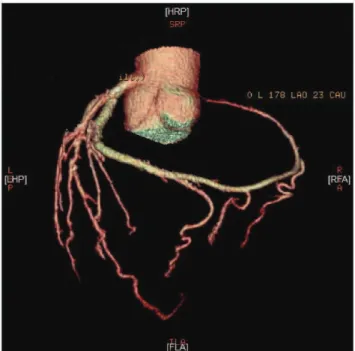
The left circumflex coronary artery (LCx) was the dominant vessel. It appeared to continue, without signifi-cant stenosis, beyond the atrioventricular groove up to the level normally occupied by the RCA (Figure 1). Mid-grade stenoses were observed in the middle segment of the left anterior descending coronary artery (LAD). The patient was symptomatic, and it was therefore decided that mitral valve surgery should be performed. Selective coronary angiogra-phy showed a normal left main coronary artery originating from the left sinus of Valsalva. Left coronary arteriography showed 90% stenosis in the mid portion of the LAD, and the left circumflex artery was a dominant vessel, with an aberrant branch from the distal left circumflex artery that crossed the crux and continued to the right atrioventricular
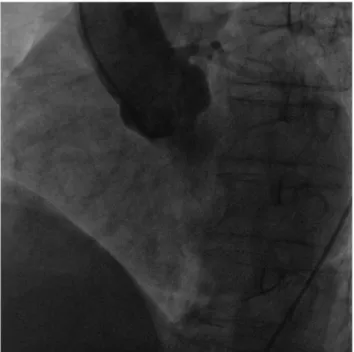
groove. The vessel terminated near the right sinus of Valsalva (Figure 2). Right coronary arteriography could not be performed because the right coronary ostium was not present, which was also confirmed by aortography (Figure 3). The patient underwent mitral valve surgery, and during surgery, the right coronary artery ostium was not observed (Figure 4).
DISCUSSION
Lipton et al. classified single coronary arteries into nine patterns according to the site of origin and the anatomical distribution of the branch of the coronary artery (2). Our
Copyrightß2012CLINICS– This is an Open Access article distributed under
the terms of the Creative Commons Attribution Non-Commercial License (http:// creativecommons.org/licenses/by-nc/3.0/) which permits unrestricted non-commercial use, distribution, and reproduction in any medium, provided the original work is properly cited.
No potential conflict of interest was reported.
Figure 1 -In the CT image, the LCx was the dominant vessel. It appeared to continue beyond the atrioventricular groove up to the level normally occupied by the RCA.
CLINICS 2012;67(12):1517-1518 DOI:10.6061/clinics/2012(12)28
case had an anomalous coronary artery (L-1 subtype) that originated from the left sinus of Valsalva, branched from the LCx in a normal fashion, and then continued in the atrioventricular groove up to the level of the RCA.
AUTHOR CONTRIBUTIONS
Turfan M was responsible for the manuscript writing and review. Aydin C, Elbey MA and Basel H were responsible for the patient diagnosis. Erdogan E was responsible for the data analysis. Asoglu E was responsible for the literature search and Goktekin O was responsible for the manuscript content and editing.
REFERENCES
1. Desmet W, Vanhaecke J, Vrolix M, Van de Werf F, Piessens J, Willems J, et al. Isolated single coronary artery: a review of 50,000 consecutive coronary angiographies. Eur Heart J. 1992;13(12):1637-40.
2. Lipton MJ, Barry WH, Obrez I, Silverman JF, Wexler L. Isolated single coronary artery: diagnosis, angiographic classification, and clinical significance. Radiology. 1979;130(1):39-47.
Figure 2 - The LCx was a dominant vessel, with an aberrant branch from the distal left circumflex artery that crossed the crux and continued to the right atrioventricular groove.
Figure 3 - No right coronary ostium was observed using aortography.
Figure 4 -During surgery, the right coronary artery ostium was not observed.
RCA originating from the distal left cx artery
Turfan M et al. CLINICS 2012;67(12):1517-1518