ÓBITOS INFANTIS INVESTIGADOS PELO COMITÊ DE PREVENÇÃO DA MORTALIDADE INFANTIL EM REGIÃO DO ESTADO DO PARANÁ
MUERTES DE INFANTES INVESTIGADAS POR EL COMITÉ DE PREVENCIÓN EN MORTALIDAD INFANTIL DEL ESTADO DE PARANÁ
Thais Aidar de Freitas Mathias1, Amanda Nolasco de Assunção2, Gisele Ferreira da Silva3
RESUMEN
Estudio que tuvo como objetivo analizar las muertes infantiles en la 15ª Región de Salud de Paraná basadas en los resultados de in-vestigaciones del Comité de Prevención en Mortalidad Infantil. Se trata de un estudio descriptivo exploratorio utilizando para ello el Sistema de Investigación de Mortalidad Infantil y el Sistema de Informaciones sobre los Nacidos Vivos durante el período de 2000 a 2006. El coeficiente de mortalidad infantil disminuyó de 13,2% para 11,6%. Del total de muertes encontradas (799), el comité investigó 74,5%, de las cuales 56,5% fueron durante el período neonatal precoz. Las a-fecciones durante el período perinatal y las malformaciones congénitas fueron las principales causas de muerte. El 70,1% de las muertes fueron consideradas como de-ducibles. De la misma forma, se dedujo que la mayor proporción de muertes fueron las de niños de madres adolescentes, recién naci-dos ≥ 2500g de peso, parto normal, raza/color negra, parda e indígena, así como aquellas madres que no tuvieron consulta prenatal. Análisis como estos, deben ser realizados de forma más visible para los equipos de salud de la familia, quienes conocen a las gestan-tes, de esta forma será posible mejorar la forma del trabajo y la calidad en las discusio-nes dentro del Comité.
DESCRIPTORES Mortalidad infantil. Comité de profesionales. Sistemas de información. Vigilancia epidemiológica. ABSTRACT
This study had the purpose to analyze infant deaths in the 15th Regional Health Center of
Paraná State, using the result of the inves-tigations of the Committee for the Preven-tion of Infant Mortality. It is a descriptive exploratory study based on the System of Investigation of Infant Mortality and on the Information System of Live Births in the period of 2000-2006. The infant mortality coefficient decreased from 13.2% to 11.6%. Of the 799 deaths, the Committee investi-gated 74.5%; 56.5% of which were in the early neonatal period. The diseases origi-nated in the perinatal period and the con-genital malformations were the main causes of death. Among them, 70.1% were considered reducible. The reducibility of death was greater among adolescent mothers’ babies, newborns of ≥ 2500g,
nor-mal childbirth, black, mulatto and indige-nous races, and on mothers without prena-tal care. The analyses of the deaths should be performed together with the family health teams, who know the pregnant women best, in order to improve the work and the quality of the analyses from the Committee.
KEY WORDS Infant mortality.
Professional staff committees. Information systems. Epidemiologic surveillance.
Infant deaths investigated by the Prevention
Committee of Infant Mortality in region
of Paraná State
RESUMO
Este estudo teve como objetivo analisar óbitos infantis na 15ª Regional de Saúde do Paraná utilizando o resultado das investi-gações do Comitê de Prevenção da Morta-lidade Infantil. Trata-se de um estudo descri-tivo exploratório, a partir do Sistema de Investigação de Mortalidade Infantil e Sis-tema de Informações sobre Nascidos Vivos no período de 2000 a 2006. O coeficiente de mortalidade infantil diminuiu de 13,2% para 11,6%. Dos 799 óbitos, o Comitê inves-tigou 74,5%; destes, 56,5% no período neo-natal precoce. As afecções originadas no pe-ríodo perinatal e as malformações congê-nitas foram causas principais de óbito. Foram considerados reduzíveis 70,1% dos óbi-tos. A redutibilidade foi maior para óbitos de mães adolescentes, recém-nascidos ≥ 2500g,
parto normal, raça/cor preta, parda e indí-gena e mães sem consulta de pré-natal. As análises dos óbitos devem ser efetuadas mais próximas das equipes de saúde da fmília, que conhecem as gestantes para a-primoramento do trabalho e qualidade nas análises do Comitê.
DESCRITORES Mortalidade infantil. Comitê de profissionais. Sistemas de informação. Vigilância epidemiológica.
Desinstitucionalização. Direitos humanos.
1 Nurse. PhD in Public Health. Nursing Department at State University of Maringá (UEM). Maringá, PR, Brazil. PR. [email protected] 2 Nursing graduate.
Nursing Department, State University of Maringá (UEM). Maringá, PR, Brazil [email protected] 3 Nurse at the University Hospital, State
O
RIGIANL
A
R
INTRODUCTION
The infant mortality rates have presented a continuous decline in Brazil, mainly due to basic sanitation actions, increased access and better pre-natal and labor quality(1). Besides being admittedly a classic health status indicator, since it reflects the socioeconomic and environmental con-ditions of the population, infant mortality is also considered an event indicating easy access and service quality(2).
The reduction of the number of deaths in children young-er than 1 year old still represents a challenge and one of the highest-priority public healthcare problems, mainly because a large part of these deaths are considered to be avoidable.
Infant mortality presents itself in variable magnitudes, being inversely proportional to the each region’s degree of development. In 2005, in Brazil, the southern region rep-resented the lower rates of infant mortality, with 14.5% per thousand born alive in relation to the other Brazilian regions: Southeast Region 14.8%, Central-West 16.3%, Northeast 20.4% and North 19.6%. In 2005, the state of Paraná was the state, which presented the higher infant mortality rate in the South Region, with 14.5%,
with Santa Catarina at 12.6% and Rio Gran-de do Sul at 13.7%(3). These values could still be reduced, considering the possibility of avoid-ing death especially duravoid-ing the perinatal and neonatal periods, which are critical to infant death.
According to each period, a difference in the internal distribution of the deaths related to the infant mortality components can be ob-served. In the neonatal period, a large share of the deaths occurs in the first days of the
children’s life, and about 40% occur in the first day of life (4). The deaths in the neonatal period have declined slowly,
indicating deaths that may possibly be decreased due to their close relation with the difficulty of access and use of healthcare services(2), besides the quality of prenatal, delivery and newborn healthcare, with mortality being higher in the lower-income social groups(5). The public interventions to improve access and quality of prenatal, labor and newborn healthcare have been considered complex and expensive(2) which contributes to delays and difficulties that the cities and healthcare services have found in decreasing the death rate in the neonatal period.
Literature has emphasized the necessity of constantly stimulating and monitoring deaths occurring in the first year of life, because most of them can be avoided. These avoid-able deaths are considered sentinel events to evaluate the quality of assistance(6) and are called unnecessary deaths(7) or even consensual deaths(8). Avoidable infant deaths can be classified as those that should not occur, if the science and technology available nowadays is considered(9). Therefore, failure in the services or healthcare attention in the case of infant deaths should be observed.
Among the strategies adopted to monitor and decrease infant mortality, the Ministry of Health (MS) created the Com-mittees for Prevention of Infant and Fetus Mortality, im-planted by resolution nº 1399 of the MS(4). The organization and work of the Committees for Prevention of Infant and Fetus Mortality have collaborated in the improvement of information about mortality and made possible the im-provement of the organization of healthcare assistance for reduction of preventable deaths(4).TheCommittee for prevention of infant mortality in the State of Paraná was implanted in 1994 with the nomination of members and the elaboration of internal regulations, and was legalized through state resolution in 1999(9).
The Committees have the purpose of elucidating the circumstances of infant deaths, identifying the risk factors and propose measures to improve of health assistance quality to reduce mortality(4). The regional and municipal Committees analyze the infant death in detail, looking at the mother’s and the child’s documents, as well as hospi-tal and ambulatory records, home interview data, Birth Certificate (DN) and death certificate (DO).
Recently, in March/2004, the Ministry of Health presented the National Pact for the Reduction of Maternal and Neonatal Mor-tality, with the objective of articulating the social actions to improve the quality of life of women and children, with a policy of grant-ing high priority privileges to health services(10). The federal government, the government of the state of Paraná and the State Health De-partment (SESA) have undertaken efforts with fortifying proposals and policies for monitor-ing basic healthcare actions with the pur-pose of incorporating and evaluating processes in the organizations and routine of the health services.
The reduction of maternal, neonatal and infant mor-tality are among the essential priority objectives of the Single Health System (SUS), developed in basic healthcare and the Family Health Program (FHP). In this perspective, the National Pact for the Reduction of Maternal and Neonatal Mortality in Paraná, which predicts a 10%-reduction in the maternal and infant mortalityindicators until 2007(10), the knowledge of morbidity and mortality profiles becomes necessary, consequently improvement of existing health service database in used as the basis for this description. Therefore, it is is essential to know the infant mortality in order to evaluate healthcare actions related to infant health that will be developed in the cities. Due to the soci-al relevancy of infant mortsoci-ality, mainly in the neonatsoci-al period, and to the constant necessity of keeping the visi-bility of the problem, is why this study was proposed. The purpose was to analyze the infant deaths, having the results of investigations accomplished by Committees for the Prevention of Infant Mortality (CRPMI) of 15th RS as its source.
Avoidable infant deaths can be classified as those that should not
occur, if the science and technology available nowadays is
METHOD
It is an exploratory descriptive study, which analyzes all infant deaths of residents in the cities of the 15th RS, inves-tigated by the CRPMI of 15th RS of the state of Paraná, which occurred from January 1st, 2000 to December 31st, 2006. The state of Paraná is divided in 22 Regional Health Units (RS). Maringá houses the headquarters of the 15th RS, which is constituted by 30 cities in the Northwestern region of the state.
Until 2004, the CRPMI of 15th RS investigated the deaths in liveborn children with weight equal or superior to 1000g. From 2005 on, all deaths were investigated, regardless of the baby’s weight at birth. The cities are requested to send the documents about infant death of its residents to the 15th RS for analysis, besides the home visit report – the moment when data is collected with the family, including: prenatal and birth data, life history and the circumstances of death, according to the information from the interview. The work of the CRPMI consists in analyzing all documents available, the investigation file and home interview; discussing cases; establishing an itinerary from the pre-natal exams to delivery; reconstituting the history, by an-alyzing the complications that led to death, determining the reducibility, the reducibility criteria, the casual deter-minants of death, the preventive measures; and also, es-tablishing the basic cause, which may or may not coinci-de with the coinci-death certificate. With this coinci-detailed analysis, it is possible to improve the knowledge of the circum-stances of death and identifying the risk factors. After a-nalysis and conclusion of the case, the data were trans-ferred to the Infant Mortality Investigation System (SIMI).
SIMI is a data and information storage system develop-ed by SESA in 2000 to store the main conclusions of the analysis of infant deaths through Regional Committees, which allows the of data to be obtained quickly through an intranet web at SESA(9). For this study, data was research-ed through SIMI, and infant deaths were analyzresearch-ed accord-ing to the periods: early neonatal (deaths occurred in the first 7 days from birth), late neonatal (deaths occurred from the 8th to the 27th day of life) and post-neonatal (from the 28th day to 11 months of life), according to basic cause, death reducibility, reducibility criteria and casual determinants.
In 2005 and 2006 a SINASC database was used for the reducibility analysis after linkage with SIMI, based on the DN number. The research project was analyzed and ap-proved by the Ethics Committee at State University of Maringá, following the regulations present in the Resolution 196/96 of the National Commission of Ethics (Report 130/2006).
RESULTS
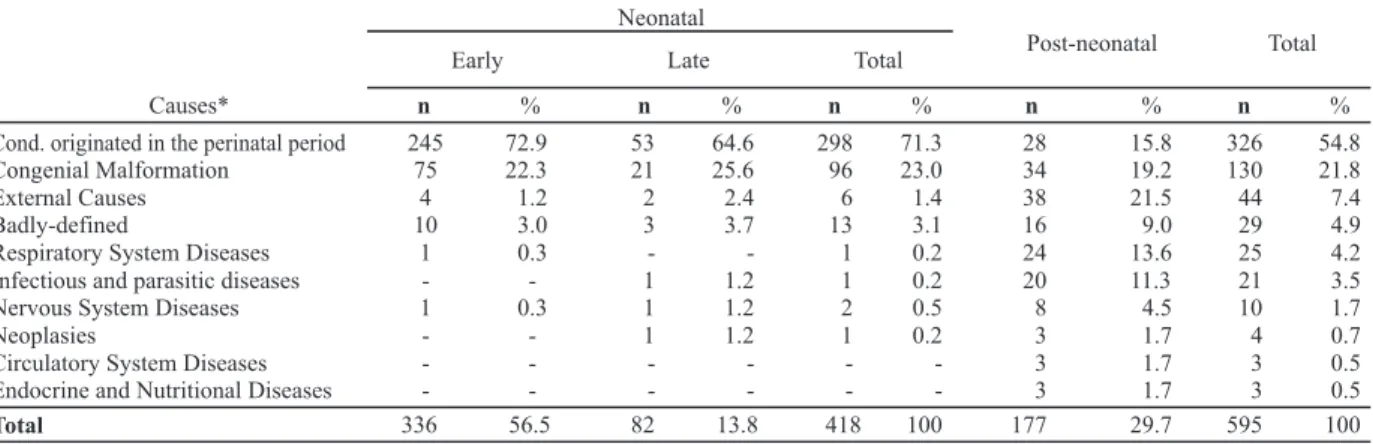
The infant mortality coefficient of the 15th RS decreased from 13.2% deaths in 2000 to 11.6% deaths in a thousand liveborns in 2006. Of the 799 infant deaths from 2000 to 2006 occurred in residents of the 15th RS, CRPMI investi-gated 595, of which 336 (56.5%) occurred in the early ne-onatal period, 82 (13.8%) in the late nene-onatal and 177 (29.7%) in the post-neonatal period (Table 1).
Most deaths occurred due to conditions originated in the perinatal period, representing 54.8%, and the congenial malformation, 21.8% (Table 1). These two basic causes were
Table 1 Table 1Table 1
Table 1Table 1 – Investigated infant deaths according to basic cause and period, 15th RS of Paraná - 2000 to 2006
also the most important causes of death in the early neo-natal period (72.9% and 22.3%, respectively) and the late neonatal period (64.6% and 25.6%, respectively). After the 28th day of life, external causes were the highest-rated, with 21.5%; after those, congenial malformation, 19.2%; conditions originated in the perinatal period, 15.8%,
dis-eases in the respiratory system, 13.6%; and infectious and parasitic diseases, with 11.3% of the total deaths in the period. Of the total deaths investigated in the 7 years of study, it was not possible to establish a definite basic cause in 29 cases (4.9%), even after investigation by the committee (Table 1).
* Chapters of International Classification Diseases, 10th Review (OMS, 1998).
Neonatal
Early Late Total Post-neonatal Total
Causes* n % n % n % n % n %
Cond. originated in the perinatal period 245 72.9 53 64.6 298 71.3 28 15.8 326 54.8
Congenial Malformation 75 22.3 21 25.6 96 23.0 34 19.2 130 21.8
External Causes 4 1.2 2 2.4 6 1.4 38 21.5 44 7.4
Badly-defined 10 3.0 3 3.7 13 3.1 16 9.0 29 4.9
Respiratory System Diseases 1 0.3 - - 1 0.2 24 13.6 25 4.2
Infectious and parasitic diseases - - 1 1.2 1 0.2 20 11.3 21 3.5
Nervous System Diseases 1 0.3 1 1.2 2 0.5 8 4.5 10 1.7
Neoplasies - - 1 1.2 1 0.2 3 1.7 4 0.7
Circulatory System Diseases - - - 3 1.7 3 0.5
Endocrine and Nutritional Diseases - - - 3 1.7 3 0.5
Still, considering the whole period, the most of the investigated infant deaths was considered to be reducible, with percentages between 60% and 70% (Table 2). Reducible deaths stood out by adequate attention to gestation, birth and to the newborn (52.4%), and death that could be re-duced by diagnosis, early treatment and healthcare edu-cation (9.2%) (Table 3), including sepsis and respiratory
infections, according to the classification used by the Com-mittees of Paraná. It was not possible to establish criterion of avoidability to 4.9%; 22.7% of these deaths were con-sidered difficult to reduce (Table 3). For deaths concon-sidered reducible, the main determinants pointed out by the Com-mittees were: hospital assistance, medical and ambulatory assistance.
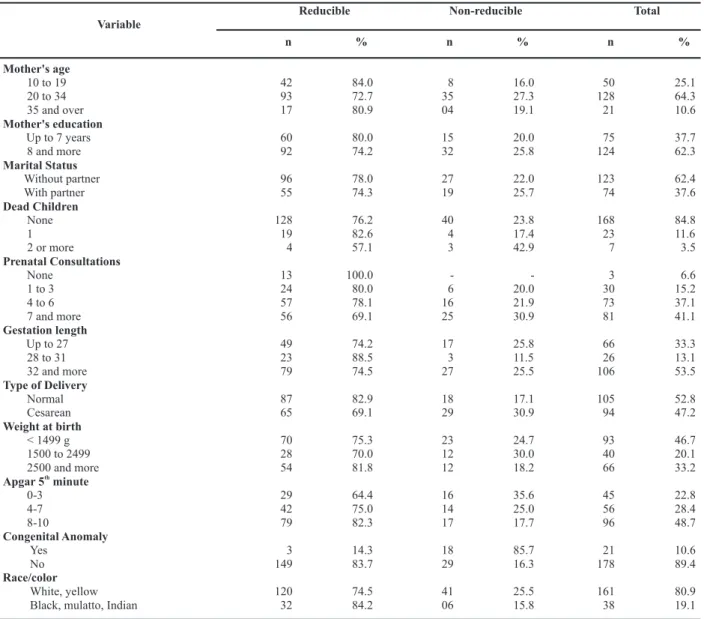
The reducibility analyzed in 2005 and 2006 was higher for infant deaths of adolescent mothers (84%) and mothers over 35 years old (80.9%). According to the number of pre-natal consultations, the reducibility was inversely pro-portional, reaching 100% for infant deaths of mothers that did not have any consultation. The deaths in babies who
were born with more than 2500g, in a normal delivery, with Apgar in the 5th minute out of 8-10, and black/mulatto/ indian race/color were those considered most frequently reducible by the Committee, resulting in 81.8%; 82.9%; 82.3%; 84.2%, respectively (Table 4).
Table 2 Table 2 Table 2 Table 2
Table 2 – Infant deaths investigated according to its reducibility, 15th RS of Paraná - 2000 to 2006
Table 3 – Table 3 – Table 3 – Table 3 –
Table 3 – Infant deaths investigated according to reducibility criteria, 15th RS of Paraná - 2000 to 2006 Year
2000
2001
2002
2003
2004
2005
2006
Total
Reducible
n %
43 60.6
53 63.1
54 65.9
61 77.2
52 70.3
80 77.7
74 72.5
417 70.1
Non-reducible
n %
16 22.5
22 26.2
24 29.3
16 20.2
20 27.0
23 22.3
25 24.5
146 24.5
Inconclusive
n %
12 16.9
9 10.7
4 4.9
2 2.5
2 2.7
-
-3 2.9
32 5.4
Total
71
84
82
79
74
103
102
595
Total Reducible criteria
n %
Adequate attention to gestation, birth and the newborn infant. 312 52.44
Difficult to reduce 135 22.69
Diagnosis and early treatment and healthcare education. 55 9.24
Adequate attention to trauma and urgencies. 47 7.90
Badly-defined causes. 29 4.87
Sanitation, oral rehydration therapy and breastfeeding. 11 1.85
Other death causes 5 0.84
Battling malnutrition, breastfeeding encouragement 1 0.17
DISCUSSION
The results of the present study point to a reality in agree-ment with what has been found in other regions of the country: a decreasing infant death rate coefficient, a higher percentage of infant death rates in the neonatal period with conditions started during the perinatal period as the main cause of death(2,5,11-12). In the RS studied, most deaths were considered reducible, with reducibility criteria focusing on the correct healthcare attention from gestation to birth, and also to the newborn.
Also in the national scene of declining infant mortality, it can be observed an increased percentage of deaths oc-curred in the neonatal period, with perinatal causes rank-ed highest. Although desirable, and considering that this fact occurs due to the decreasing of deaths occurred in the
post-neonatal period, which in turn are is associated to life conditions, almost two thirds of death causes in the neonatal period in the 15th RS occurred by conditions originated in the perinatal period, differently from what usually occurs in developed countries where the main cause of death in this period is the congenital malforma-tion(13).
The high proportion of death from perinatal conditions constitute a warning sign, because these deaths are asso-ciated to the early pregnancy interruption or the intrauterine growth retardation signaled to a deficitary prenatal assistance(14). Still, birth hypoxia or asphyxia in-dicates inadequate assistance at the hospitals at the mo-ment of delivery(5).
Table 4 Table 4Table 4
Table 4Table 4 – Infant deaths according to reducibility and variations of the mother, gestation, delivery and newborns, 15th RS of the state of Paraná - 2005 to 2006
Note: All the percentages disregard the ignored subjects.
Reducible Non-reducible Total
Variable
n % n % n %
Mother's age
10 to 19 42 84.0 8 16.0 50 25.1
20 to 34 93 72.7 35 27.3 128 64.3
35 and over 17 80.9 04 19.1 21 10.6
Mother's education
Up to 7 years 60 80.0 15 20.0 75 37.7
8 and more 92 74.2 32 25.8 124 62.3
Marital Status
Without partner 96 78.0 27 22.0 123 62.4
With partner 55 74.3 19 25.7 74 37.6
Dead Children
None 128 76.2 40 23.8 168 84.8
1 19 82.6 4 17.4 23 11.6
2 or more 4 57.1 3 42.9 7 3.5
Prenatal Consultations
None 13 100.0 - - 3 6.6
1 to 3 24 80.0 6 20.0 30 15.2
4 to 6 57 78.1 16 21.9 73 37.1
7 and more 56 69.1 25 30.9 81 41.1
Gestation length
Up to 27 49 74.2 17 25.8 66 33.3
28 to 31 23 88.5 3 11.5 26 13.1
32 and more 79 74.5 27 25.5 106 53.5
Type of Delivery
Normal 87 82.9 18 17.1 105 52.8
Cesarean 65 69.1 29 30.9 94 47.2
Weight at birth
< 1499 g 70 75.3 23 24.7 93 46.7
1500 to 2499 28 70.0 12 30.0 40 20.1
2500 and more 54 81.8 12 18.2 66 33.2
Apgar 5 minuteth
0-3 29 64.4 16 35.6 45 22.8
4-7 42 75.0 14 25.0 56 28.4
8-10 79 82.3 17 17.7 96 48.7
Congenital Anomaly
Yes 3 14.3 18 85.7 21 10.6
No 149 83.7 29 16.3 178 89.4
Race/color
White, yellow 120 74.5 41 25.5 161 80.9
Deaths due to conditions originated in the perinatal period still present a high percentage in the post-neonatal period show the survival of these babies, which often are hospitalized since their birth. The persistence of this group of death causes in the post-natal period was also identified in a study performed in Rio de Janeiro from 1999 to 2001, when it was suggested that there may be deficiencies in the specialized assistance in hospitals that would prolong newborn’s lives, but not avoiding death(15).
It was also observed that the congenital malformations were the second highest death cause in the neonatal period and were more frequent after the 7th day of life. Improve-ments on the attention given to healthcare may be exem-plified by this increase of congenital malformations, which are related to the development of the country(13).
In the 15th RS of the state of Paraná, in the post-neonatal period, deaths by respiratory system diseases and infec-tious and parasitic diseases were still observed in24.9% of the total deaths and only 0.5% in the other periods. The higher concentration of deaths by infectious parasitic diseases in Brazil from 1996 to 1999 was 50.7% in children under five years old. Among the infectious and parasitic diseases, acute diarrhea represents 53% of deaths in children younger than 1 year old(12). This decrease was due to several factors, such as: immunization programs made effective by the Ministry of Health, basic sanitation improvements with reduction of deaths by infectious in-testinal disease and educative actions focused on the population mainly for the use of homemade saline solu-tions to treat dehydration(1). The respiratory system dis-eases represent about 6% of the deaths in children younger than 1 year old. From 1996 to 2004, there was a reduction of approximately 30% in the country, with the southern region standing out due to reducing deaths by this cause in 48%(12).
The main external cause of death is in the post-natal period, which was surprising. Of the 44 deaths occurred by external causes from 2000 to 2006, six occurred until de 28th day of life, and the other 38 occurred in the post-neonatal period, mostly by other accidental respiratory risks or by inhalation of the gastric contents. The orienta-tion to mother and family about preventive measures re-lated to gastric content aspiration are coherent with the reducibility criteria attributed by the Committee. Almost 8% of the reducible criteria were related to adequate at-tention to trauma and urgency.
Concerning the deaths investigated by CRPMI in the 15th RS from 2000 to 2006, only 4.9% were due to badly defined causes, being more frequent in the post-natal pe-riod. Analyzing the badly defined causes of death, a de-crease can be observed, because in 2000 there were 12.7% cases and in 2006 they decreased to 3% (data not shown). This decrease can be due to the work of the Committee, besides the gradual improvement of the material received and analyzed in the investigations. Over the years, an im-provement of the information collected through the
health-care workers in home interviews has been seen, along with better comprehension and adherence to the work of the Committee, more complete documents being sent, prenatal attendance medical records, mother’s hospitalization for delivery and also the child’s hospitalization medical re-cord. However, there is still a resistance for the presentation of documents and medical records of pregnant and children by doctors in clinics and hospitals in prenatal cases and deliveries financed by healthcare plans and insurance companies. When that occurs, there is a lack of information, mainly of the clinical prenatal evolution. In these situations, the Committee concludes that the investigation material was not satisfactory. This lack of information can also in-fluence the amount of badly defined causes of death and in the attributions of reducibility.
The CRPMI has intensified the visits to cities belonging to the 15th RS with the objective of sensitizing the healthcare teams about the importance of quality assistance to pregnant woman in the prenatal and delivery periods, besides the quality of information notes in the medical records. The percentage of badly-defined causes that still persists could be reduced if the cities adopted a working process similar to the one adopted at Instituto Materno Infantil de Pernambuco (IMIP) located in the city of Recife, where all the DOs undergo a systematic review process, having the gold standard medical record, reducing the chance of badly-defined basic causes of death to nearly zero(2).
In the 15th RS, from 2000 to 2006, almost two-thirds of infant deaths were considered reducible. This result is similar to what was obtained in a study performed in São Luis – MA, from 1979 to 1996, which accomplished a re-ducibility of 70% in neonatal infant deaths, reducible by diagnosis and early treatment and partially reducible by adequate pregnancy control(11). Most deaths considered avoidable could be prevented with the improvement of prenatal, delivery and newborn assistance – not only by its clinical resolution, but also to the organization of health-care assistance in hierarchical and regional systems, assur-ing that the pregnant woman and the newborn can have ac-cess to quality services in time(5).
The reducible analysis for the last two years of the period (2005 to 2006) showed some variables indicate inequality in healthcare, vulnerability, risk or disadvan-tages for the population regarding morbidity and mortality. Therefore, the Committee for Mortality Prevention of the 15th RS of Paraná attributed a higher reducibility percent-age to infant deaths of adolescent mothers, mothers who did not do the prenatal routines, mothers with up to 7 years of education and of race/color black and mulatto.
infant deaths of race/color black were considered avoid-able against 81% of deaths in race/color white. The inequal-ity analysis in healthcare according to race/color is possible when birth, Sinasc and death data is used by the SIM. From these analyses, the social exclusion experienced by the black population puts its members in a highly disadvantageous position(16), in vulnerable conditions and exposed to major risks due to the accumulation of inequalities. It is necessary to sensitize the healthcare managers in order to perform actions that promote equity in healthcare and transform the studies and research into public policies(17).
Another result of this study was a greater reduction of newborn deaths in conditions that should represent a minor risk and higher survival probability for normal delivery newborns, weighing over 2500g, with Apgar in the fifth minute of 8 to 10 and without congenital anomalies. In this study, these variables were analyzed in an isolated way, but it is known that they must be observed under a determinate focus and in groups, because they decrease the differences in the social-demographic profile of the population in study.
Despite the scientific progress absorbed by hospitals, which represents real condi-tions of preventing morbidity and mortality in risky delivery assistance, it is evident that these occurrences are often caused by the indiscriminate use and abuse of the same scientific progress. The climax of intervention abuse is shown in the excessive amount of cesarean deliveries, because it is a profitable instrument for hospitals and doctors for being faster, favoring a higher number of procedures and being stimulated by the type of payment and unit of assistance(18).
In its wider dimension, mortality is determined by the social, economic and cultural conditions of the person and the population group that they belong to. In case of perinatal mortality, the participation of these determinants is still strong. The survival chances of the child are closely related to information access, healthcare services and the quality of prenatal attention that the mother receives. In the same way, the delivery assistance and the available technology for newborn care determinates their future quality of life(13).
The percentage of 24.5% of deaths attributed as non-reducible by the CRPMI of the 15th RS is in compliance with the 24% found in a study performed in 2000 in the reference hospital in Pernambuco, according to criteria of basic cause avoidability in infant deaths(2). In another study, comparing the infant mortality observed with the expected mortality, a 20% rate of non-avoidable infant mortality was found in two cities of the Brazilian northeast in 1990 and 1991(8).
Considering the precarious information system in developing countries, it was pretentious to discuss the
veracity of the information obtained from the avoidable infant mortality concept. Therefore, the conclusions of the avoidable death rate represent a minimum proportion estimator of deaths that could be avoided without further expenses(8).
With the result of this study, it was reinforced that adequate gestation, delivery and newborn attention are still the top criterion for infant death reducibility. Similar results were also found in Belo Horizonte, where 40% of the perinatal deaths could have been avoided with the organization of the assistance network and the improve-ment in the clinical service to pregnant women and new-borns(5). In São Luis-MA from 1979 to 1996, it was high-lighted the need for improvement of the prenatal, delivery and newborn quality programs including the reduction of cesareans and re-adequation of neonatal assistance, which was characterized by an insufficient number of intermediate units and by high-risk service(11).
The main causal determinants, previously named by those who were responsible for the death, identify if the death is linked to family, social, medical, hospital or ambulatory assistance responsibility or without criterion of responsibility in case such death is considered non-reducible.
Death classification concerning avoid-ability and responsibility often has subjec-tive aspects. To increase its validity, the Com-mittees must be multiprofessional. The multiplicity of opinions lowers subjectivity and reinforces the necessary decisions to de-crease the infant mortality rate. In the study about avoidable infant mortality executed in two Brazilian northeastern cities from 1990 to 1991(8), there was a clear necessity of knowing the profile of causality so as to avoid underestimating the proportion of preventable occurrences. The balance of re-ducible criteria as approximation of the cost-effectiveness to prevent deaths was shown to be coherent and relevant to strengthen the validity of measure construction.
The identification of avoidable deaths as the result of failures in the healthcare system and differences in the access and quality of assistance, and the recognition of high perinatal mortality rates are closely related to the healthcare performance, which calls the managers to action, in a way that they may provide the population with access to quality services. The regionalization and quali-fication of assistance and the universalization of access are, therefore, priority actions and effective interventions to lower the rates and the inequality of perinatal and infant mortality in Brazil(5).
Investigating the mortality causes means studying the society, which produces its own health, disease and death, an extreme example of deprivation of the citizen’s quality of life. It means investigating the effects of a developmental model, which produces life conditions, and the work which
The survival chances of the child are closely
related to information access, healthcare
services and the quality of prenatal
exposes, families and persons to risks or protections which may, in turn, either improve or fragilize their health (13). The number of deaths can be controlled, even in communities presenting precarious conditions of socioeconomic development, but this always depends on political decisions, organization of healthcare and social services and the adoption of permanent educational actions.
FINAL CONSIDERATIONS
The analysis result of the work of the CRPMI of the 15th RS of Paraná pointed firstly to the evolution of the per-centage of investigated deaths, which gradually increased in the period, considering that until 2004, the Committee analyzed only the deaths in children born with 1000g or more, and from 2005 onwards, all deaths were investi-gated. This variation in the amount of deaths analyzed in the research period may indicate the oscillation of the amount of deaths in children lighter than 1000g, and also the working capacity of the Committee of 15th RS. The causes of this variation in the investigated amount of deaths must be a permanent internal issue of the Committee for con-stant improvement of the working process, and also the quan-tity and quality of its analysis.
Due to the relevancy of infant mortality studies, some considerations related to information could be highlighted concerning the importance of its work, developed through the Committees of prevention of infant mortality in the investigation of death and the production of this information. Besides the task of keeping the infant mortality problem constantly visible, the results of the investigations of the Committees have added information and identified factors, which are not possible to analyze with official statistics, such as: establishing avoidability and reduci-bility of infant death criteria and contributing to adopting actions to promote reduction of avoidable infant mortality. The analysis and case studies of death also help in the improvement of oficial healthcare statistics, since, after in-vestigation, the Committees often attribute new basic cau-ses of infant death.
Therefore, regarding infant mortality, it was concluded that most deaths are avoidable after investigation by the Committees. Knowing and discriminating each weak spot of the healthcare system with attribution of responsibilities and causal determinants for each infant death analyzed, the adoption of improved working processes in the cities is urgent. There is also an urgent need for investment on capac-itating family healthcare teams and workers acting in spe-cialized delivery and birth reference services to revert this situation, which is very common in several cities and regions of the country. It is also necessary capacity. Developing the technical capacity of the whole healthcare team to detect
and assist gestational risks (mother-son); bringing the preg-nant woman to initiate prenatal early in the first trimester of gestation; guaranteeing the accomplishment of the pre-dicted laboratorial exams, attention in the results of these exams; monitoring and updating of the tetanus immuniza-tion; orientation on breastfeeding; controlling blood pres-sure and diabetes are some meapres-sures which must be start-ed and improvstart-ed at the local level to improve the service provided to the mother and the baby.
Concerning the organization of the healthcare services, the reference system should be promoted to improve the follow-up of the pregnant woman at a local level. The city managers must conduct dialogues with the State to establish and formalize the policies in the reference and counter-reference networks towards gestation and high-risk newborns.
In relation to the SUS, it is necessary to strengthen the strategies and action of the PSF, its role as the entry door to the healthcare system, as well as its responsibility for sheltering and managing prenatal assistance, the pregnant woman and the newborn who live within its sphere of in-fluence. It is necessary to discriminate and discuss the attribution of the PSF nursing teams with the objective of strengthening the integration among obstetricians, pedia-tricians, the nursing staff and other professionals of the Basic Healthcare Units.
In the history against infant mortality, it can be ob-served the inexistence of a single path, but several, which, if seriously adopted, lead to reduction. In this struggle, the role of the community, families, healthcare education pro-fessionals is a strategic condition for support and involve-ment since the children integrate said families and com-munities. Therefore, considering the close relation between quality of life and infant mortality, while social inequality persists, population groups are still exposed to risks of disease and death, and the responsibility of the healthcare services is more evident for these groups.
REFERENCES
1. Mello Jorge MH, Gotlieb SLD, Laurenti R. A saúde no Brasil: análise do período de 1996 a 1999. Brasília: OPAS/ OMS; 2001. Análise por grupo de população; p. 79-88.
2. Vidal AS, Frias PG, Barreto FMP, Vanderlei LCM, Felisberto E. Óbitos infantis evitáveis em hospital de referência estadual do Nordeste brasileiro. Rev Bras Saúde Matern Infant. 2003;3(3):281-9.
3. Brasil. Ministério da Saúde. DATASUS. Informações em Saúde: estatísticas vitais – mortalidade e nascidos vi-vos [texto na Internet]. Brasília; 2007 [citado 2007 set. 19]. Disponível em: http://w3.datasus.gov.br/datasus/ datasus.php?area=359A1B378C5D0E0F359G22HIJd 5L25M0N&VInclude=../site/infsaude.php
4. Brasil. Ministério da Saúde. Secretaria de Atenção a Saúde. Manual dos Comitês de Prevenção do Óbito In-fantil e Fetal. Brasília; 2005.
5. Lansky S, França E, Leal MC. Mortalidade perinatal e evi-tabilidade: revisão da literatura. Rev Saúde Pública. 2002;36(6):759-72.
6. Rutstein DD, Berenberg W, Chalmers TC, Child CG, Fishman AP, Perrin EB. Measuring the quality of medical care: a clinical method. N Engl J Med. 1976;294(11):582-8.
7. Leite AJM, Marcopito LF, Diniz RLP, Silva AVS, Souza LCB, Borges JC, et al. Mortes perinatais no município de For-taleza, Ceará: o quanto é possível evitar? J Pediatr. 1997;73(6):388-94.
8. Hartz ZMA, Chanpagne F, Leal MC, Contandriopoulos AP. Mortalidade infantil “evitável” em duas cidades do Nor-deste do Brasil: indicador de qualidade do sistema lo-cal de saúde. Rev Saúde Pública. 1996;30(4):310-18.
9. Mansano NH, Mazza VZ, Soares VMN, Araldi MAR, Cabral VLM. Comitês de prevenção da mortalidade infantil no Paraná, Brasil: implantação e operacionalização. Cad Saúde Pública. 2004;20(1):329-32.
10. Brasil. Ministério da Saúde. Secretaria de Atenção à Saúde. Pacto nacional pela redução da mortalidade materna e neonatal. Brasília; 2004.
11. Ribeiro VS, Silva AAM. Tendências da mortalidade neo-natal em São Luis, Maranhão, Brasil, de 1979 a 1996. Cad Saúde Pública. 2000;16(2):429-38.
12. Brasil. Ministério da Saúde. Secretaria de Vigilância em Saúde. Saúde Brasil 2006: uma análise da situação da saúde. Brasília; 2006.
13. Aerts DRGC. Investigação dos óbitos perinatais e infan-tis: seu uso no planejamento de políticas públicas de saúde. J Pediatr. 1997;73(6):364-6.
14. Caldeira AP, França E, Perpétuo IHO, Goulart EMA. Evo-lução da mortalidade infantil por causas evitáveis, Belo Horizonte, 1984-1998. Rev Saúde Pública. 2005; 39(1):67-74.
15. Pereira APE, Gama SGN, Leal MC. Mortalidade infantil em uma amostra de nascimentos do município do Rio de Janeiro, 1999-2001: “linkage” com o Sistema de In-formação de Mortalidade. Rev Bras Saúde Matern Infant. 2007;7(1):83-8.
16. Cunha EMGP. Mortalidade infantil por raça/cor. In: Ba-tista LE, Kalckmann S, organizadores. Seminário Saúde da População Negra: Estado de São Paulo 2004 [mono-grafia na Internet]. São Paulo: Instituto da Saúde; 2005 [citado 2008 mar. 16]. p. 103-15. Disponível em: http:// isaude.emdesenvolvimento.com.br/media/File/_li-vros/esp_seminario_saude_pop_negra_2004.pdf
17. Batista LE. Causas de óbito segundo raça/cor no Estado de São Paulo, 1999. Bol Epidemiol Paul [periódico na Internet]. 2005 [citado 2008 mar. 16];2(19):[cerca de 5 p.]. Disponível em: http://www.cve.saude.sp.gov.br/ agencia/bepa19_morte.htm
18. Sodré TM, Lacerda RA. O processo de trabalho na assis-tência ao parto em Londrina - PR. Rev Esc Enferm USP. 2007;41(1):82-9.
ACKNOWLEDGMENTS