A PERCEPÇÃO DO PACIENTE REFERENTE A SER PORTADOR DE UM CATETER DE LONGA PERMANÊNCIA
LA PERCEPCIÓN DEL PACIENTE RESPECTO A SER PORTADOR DE UN CATÉTER DE PERMANENCIA PROLONGADA
Fernanda Titareli Merizio Martins1, Emilia Campos de Carvalho2
RESUMEN
La finalidad del trabajo fue evaluar la per-cepción del paciente portador de un Catéter Totalmente Implantado (CTI). Se trata de un estudio descriptivo, que utiliza para el aná-lisis de los datos la Técnica de los Incidentes Críticos (IC). Fue desarrollado en un Hospi-tal Escuela del interior de Sao Paulo-Brasil, del cual participaron 15 porta-dores de CTI. Los datos fueron agrupados en 4 categorías:
Desempeño de Actividades (el 40% de los IC demostraron mayor inde-pendencia del pa-ciente, mientras que el 60% evidenció res-tricción de algún tipo de actividad debido al CTI); Alteración de la Imagen Corporal (el 57% evidenciaron insatisfacción post im-plante del CTI, el 14% mostró problemas pre-implante del CTI y el 28% de los IC mostró que el CTI favoreció la estética corporal);
Implantación del Catéter (el 75% de los IC mostraron que la implanta-ción del catéter es un procedimiento trau-matizante, mien-tras que el 25% de los IC mostró que el pa-ciente siguió tranquilo y seguro durante el procedimiento); Infusión de Quimioterapia
(100% de los IC evidenció el catéter como un facilitador del tratamiento quimioterápico). DESCRIPTORES
Cateterismo venoso central. Quimioterapia.
Autoimagen. ABSTRACT
This study aimed to evaluate patients’ perception regarding their use of a Totally Implanted Catheter (TIC). This descriptive study uses the Critical Incident Technique (CI) for data analysis. The study was per-formed at a Teaching Hospital in São Paulo State, Brazil. Study participants were 15 patients using TIC. Data were grouped into four categories: Activity Performance (40% of the CI showed that patients were more independent, while 60% revealed that some kind of activity was restricted due to the TIC); Altered Body Image (57% showed the patients’ dissatisfaction after the TIC implant, 14% of the CI revealed pre-implant problems, 28% of the CI showed that the TIC favored body esthetics); Catheter Implantation (75% of the CI revealed catheter implantation as a traumatizing procedure, while 25% of the CI revealed pa-tients remained calm and confident during the procedure); Chemotherapy Infusion
(100% of the CI showed that the catheter made chemotherapy easier).
KEY WORDS
Catheterization, central venous. Drug therapy.
Self concept.
Patients’ perception regarding the use
of a long-term catheter
*RESUMO
Este trabalho buscou avaliar a percepção do paciente portador de Cateter Totalmen-te Implantado (CTI). Trata-se de um estudo descritivo, que utiliza a Técnica dos Inciden-tes Críticos (IC) para análise dos dados. Foi desenvolvido em um Hospital Escola do in-terior paulista do qual participaram 15 por-tadores de CTI. Os dados foram agrupados em quatro categorias: Desempenho de Atividades (40% dos IC demonstraram maior independência do paciente e 60% eviden-ciaram restrição de algum tipo de atividade devido ao CTI); Alteração da Imagem Cor-poral (57% evidenciaram insatisfação do paciente pós-implante do CTI, 14% dos IC mostraram problemas pré-implante do CTI e 28% dos IC mostraram que o CTI favoreceu a estética corporal); Implantação do Cate-ter (75% dos IC mostraram a implantação do cateter como um procedimento trauma-tizante e 25% dos IC permaneceram tran-qüilos e seguros durante o procedimento);
Infusão de Quimioterapia (100% dos IC apontaram o cateter como um facilitador do trata-mento quimioterápico).
DESCRITORES
Cateterismo venoso central. Quimioterapia.
Auto-imagem.
* Research inserted in the Integrated Project “Comunicação e Enfermagem: as interfaces”, supported by CNPq. 1 Nurse. Laboratory Specialist at the University
of São Paulo at Ribeirão Preto College of Nursing (EERP-USP). Ribeirão Preto, SP, Brazil. [email protected] 2 Nurse. Full Professor at the Department
O
RIGINAL
A
R
INTRODUCTION
Long-term central venous catheters are widely used with cancer patients receiving chemotherapy treatment. The constant use of these patients’ veins to apply chemo-therapy drugs, serum, antibiotics, blood and byproducts, and the collections for laboratorial exams lead to severe problems with vein visualization and puncture.On the other hand, there are patients with good peripheral venous networks but with prolonged chemotherapy treatment. In all these cases, such catheters are recommended(1).
In the past decades, there have been several advances regarding long-term central venous access. In 1977, Hickm-man performed modifications in the catheter idealized by Broviac, making it double lumen with a thinner wall, am-plifying its indications. The Peripherally Inserted Central Catheters (PICC) have been available since 1970. It was not until recently that its applications were largely used and in 1982, on Neiderhuber’s initiative, the totally im-plantable catheters were created(2).
The latter type of catheter was an advance regarding support treatment of the cancer patient. The
advantages were the lower infection risk, when used continuously, lower interference in the patients’ daily activities, lower care with the insertion site, lower bodily self-image disorder due to the absence of external de-vices and few limitations of patients’ activi-ties. The disadvantages were the cost of in-sertion, postoperative care and the need of a minor surgery to remove the catheter(3).
The totally implanted catheters are
com-posed of a stainless steel or titanium reservoir, a silicone catheter and a central septum. This septum is covered with a self-sealing diaphragm capable of receiving between 1000 and 2000 needle punctures. The access is performed by puncture it with Huber-like needles, which have a resis-tant point(2-4). They ensure a practical and high quality
ve-nous access for the patient treatment and the frequency of complications is low(2,5-6).
Among the complications found in the implantation and use of the system, the most frequent complications are infectious; however, non-infectious complications may oc-cur, such as those related to puncture, catheter occlusion, deep venous thrombosis, post-implantation skin necro-sis, reservoir extrusion, catheter fracture, migration of the catheter’s extremity and leakage of medication due to er-roneous puncture.
The ability to obtain safe access to the vascular system is an important part of dealing with cancer patients. Evo-lutionary studies involving feelings of patients with totally implanted catheters were not found in the literature reviewed. Thus, this paper was concerned with identifying the perception of the patient with long-term totally
implant-ed catheter and aims at contributing to understanding the problems endured by this clientele.
OBJECTIVES
General objective - to evaluate the patient’s perception, regarding long-term totally implanted venous catheters.
Specific objective - to identify the critical incidents (sit-uation, behavior and consequence) reported by patients with totally implanted catheter.
METHODOLOGICAL APPROACH
The critical incident technique was proposed by John C. Flanagan in 1941, and consists of a set of procedures used to collect direct observations of human behavior to facilitate their potential to solve practical problems and to develop large psychological principles. This would help to outline procedures to collect observed incidents that show special meanings and to find criteria that are systematically defined. Any observed human activity that is complete enough to allow interferences and predictions regarding the performer of the action can be considered an incident. In order to be critical, an incident has to occur in a situation with a reasonably clear purpose or intention, from the observers’ standpoint, and its conse-quences have to be sufficiently defined, leav-ing few doubts regardleav-ing its effects(7).
In Brazil, the aforementioned technique was introduced in 1970 by Dela Coleta(8) and
has been widely used in several nursing-related research studies since then(7).
The use of the critical incident technique consists in asking the subjects involved in a given activity to report simple situations and facts, which are evaluated by the researchers. They can either agree or disagree, depending on the objective and situation to be studied. It is necessary to establish a set of procedures that allow the systematization and the analysis of the incidents reported(10-11).
In this study, the use of the critical incidents technique is justified in order to obtain data regarding the patients’ per-ception of carrying a totally implanted catheter. The technique allows for identifying real daily situations and their conse-quences by subjects who experience a given situation.
METHOD
This research was developed after being approved by the Research Ethics Committee of the institution where the study was carried out, and data collection occurred in compliance with resolution 196/96 of the National Health Council (CNS), and a consent form was employed (HCRP No. 2690/2002).
Evolutionary studies involving feelings of patients with totally implanted catheters were not found in the
This study sample was constituted by 15 patients with hematological pathologies who were hospitalized or being treated with ambulatory chemotherapy at a large hospital in the countryside of the State of São Paulo . Data collection was performed from May 1 through September 31, 2002.
The subjects who participated in the study met the inclusion criteria: they all agreed to participate in the study, were over 18 years old, had medical diagnosis of oncohema-tological disease, had a totally implanted catheter, and were able to maintain logical conversation.
A 2-part instrument was used to collect the data. The first part was used to identify the subject regarding gender, age, period with the catheter and base disease. The second part contained three guiding questions formulated with the critical incident methodological approach(7-8). The
questions were: 1) Consider the freedom and autonomy that you have to perform the activities you do or would like to. Think of how you feel and look at your body with the implanted catheter. Mention a situation that has occurred because you had a catheter. 2) Describe the behaviors or
actions involved in this situation. 3) Mention the conse-quences (feelings) of the situation.
The identification data were collected from the pa-tients’ hospital records, and the interview was performed by one of the authors who manually wrote the subjects’ verbal reports, in a calm setting, respecting their privacy, ensuring anonymity and data secrecy. In order to analyze the data, the steps proposed in a study(10) were followed
and the same methodological resource was used: reading and inserting critical incidents, identification of the 3 ele-ments that comprise the critical incident, i.e., situation, be-havior and consequence, grouping the reports and data cat-egorization.
RESULTS
There were 15 patients, 12 (80%) in the hospitalization unit and three (20%) in the hematology chemotherapy ambulatory. The age ranged from 20 to 45 years (average of 32.4 years and median of 30 years). There were eight (53.3%) males and seven (46.7%) females. Seven subjects (46.7%) had been diagnosed with leukemia, five (33.3%) with non-Hodgkin’s lymphoma, and three (20%) with Hodgkin’s lymphoma.
Concerning the time with the catheter, it ranged from eight to 990 days, with higher percentages between one and six months.
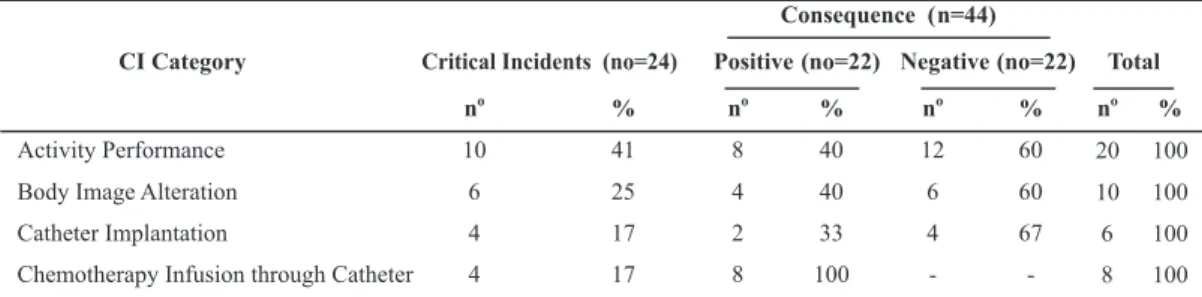
After carefully reading the patients’ reports, 24 critical incidents were identified (average of 1.6 incidents per subject). They were grouped into four categories according to the similarity of the reports, namely Activity Perfor-mance, Body Image Alteration, Catheter Implantation and Chemotherapy Infusion through the Catheter. Yet, positive and negative consequences were identified for three categories. In the chemotherapy infusion category, there were no negative consequences (Table 1).
Table 1
Table 1 Table 1
Table 1 Table 1 - Absolute and percentile frequency of critical incidents by category and their consequences - Ribeirão Preto
- 2002
The category with the highest number of critical incidents was Activity Performance, with ten (41%) of the critical incidents mentioned, followed by the Body Image Alteration category, with six (25%). The Chemotherapy Infusion through Catheter and the Catheter Implantation category had each four (17%) of the reported critical incidents.
Regarding the Activity Performance category (greater independence or patient restriction to perform daily life activities), the totally implanted catheter allowed greater independence for the patient according to four (40%) reports of critical incidents. The patients mentioned that, during the chemotherapy infusion, there was greater independence, since their arms and hands remained free from the external venous device, favoring their daily life
activities. Self-care was one of them. When the device was not being used for medication infusion, it did not interfere in their independence.
However, six (60%) of the critical incidents indicated activity restriction: greater dependency of the nursing team as a consequence of pain-related limitation after the im-plantation, movement discomfort, sleep disorders, discom-fort when wearing seatbelts in vehicles and limitations for practicing sports.
The critical incidents in this category received 20 ref-erences in relation to consequences. The positive conse-quences (40%) for the patients were: greater freedom of movement, little interference in the performance of daily
Consequence (n=44)
CI Category Critical Incidents (no=24) Positive (no=22) Negative (no=22) Total
no % no % no % no %
Activity Performance 10 41 8 40 12 60 20 100
Body Image Alteration 6 25 4 40 6 60 10 100
Catheter Implantation 4 17 2 33 4 67 6 100
activities and also lower dependence on the nursing team when the catheter is in use, lower anxiety related to chemo-therapy treatment. The negative consequences (60%) refer-red to the impossibility or interference to perform activi-ties, which were usually practiced before the implanta-tion of the catheter, causing, according to them, feelings of limitation and anguish.
In the Body Image Alteration category, in which the crit-ical incidents related to bodily perceptions were included, three (50%) of them indicated patient dissatisfaction with their physical appearance and placement of the implanted catheter. They were also concerned about the prominence of the reservoir and its unusual location. One (16.7%) in-cident showed the conflict endured by a female patient before the catheter implantation. She was worried about the appearance of the location and about other people look-ing at it. However, two (33.3%) critical incidents indicated that, due to the fact that the catheter is placed under the skin, body aesthetics is favored and physical appearance is preserved.
In this category, there were 10 references regarding consequences. They were positive in 40% of the cases. They did not alter the way in which the patient with the catheter perceives the body. They said that the chosen position for the catheter is privileged and favors body aesthetics. However, 60% of the consequences in this category were negative for the patients. In these cases, they reported that they felt ashamed of their bodies and began to wear other clothes, or that they limited the type of clothing. There were feelings of dissatisfaction with the body and sadness because they were not wearing what they wished.
In the Catheter Implantation category, three (75%) critical incidents were identified and evidenced that the catheter implantation is a time-consuming, painful and traumatizing procedure. One (25%) incident indicated that doctors were careful and skilled, contributing to calmness during the procedure.
For this category, six consequences were mentioned; 33% were positive (calmness when the catheter was insert-ed and low-intensity pain) and 67% were negative (a proce-dure that generated traumatizing feelings).
There was the inclusion, in the Chemotherapy Infusion through Catheter category, of the critical incidents related to patients’ perception of chemotherapy administration through the totally implanted catheter. The four (100%) critical incidents evidenced that the catheter facilitated the treatment, since it preserves the veins, decreasing the number of punctures. The patients also noticed that the chemotherapy administration was less painful and stress-ful, becoming safer.
All eight (100%) consequences in this category obtain-ed positive references. They diminishobtain-ed anxiety and stress, and the patients were more at ease during the infusion of chemotherapy drugs.
DISCUSSION
The long-term totally implanted venous catheter has been recommended in literature as a practical venous access, with few risks for the patient’s treatment(2,5-6,12-13). It
favors the quality of life of the cancer patients, since it prac-tically does not restrict physical mobility. It provides freed-om to choose activities and favors body image(5,13,14).
How-ever, some studies also show limitations and opposite feelings concerning such considerations(4,15). This
contra-diction has also been found in the present study.
Regarding the Activity Performance category and its positive aspects, the research on the satisfaction level of this clientele with the device showed that their arms are free during the chemotherapy treatment. Emotional stress is reduced when it comes to chemotherapy, and it benefited the clientele. On the other hand, the disadvantage was the sleep disorder as a consequence of the catheter position(6).
In another study(13), 201 (87%) of the patients did not notice
changes in their daily routine in relation to the catheter. Nevertheless, another study carried out with 69 patients with totally implanted catheter found that 51% of them showed discomfort when wearing seatbelts and 42% began to show sleep disorders after the implantation of the cathe-ter. This study found in some reports that the catheter al-lowed the patients to perform daily activities, since their arms and hands remained free from the external venous device, favoring self-care. However, most of the critical in-cidents in this category indicated some sort of restriction after the implantation, such as a greater dependency on the nursing team to perform self-care, impairment when moving in bed, discomfort when wearing seatbelts in vehicles and limitation of sport practice. Nurses should consider such aspects when dealing with this clientele’s education, and some adaptation to reality should occur.
Regarding the Body Image Alteration category, the literature(14) indicates that the catheter implanted
subcu-taneously minimizes problems with the patients’ body self-image. However, the findings of another study(4) showed that
37% of the patients are dissatisfied with the catheter placement and 50% of them showed alteration of their body image. They had their physical appearance modified because of either the visible healing or the prominent cath-eter reservoir, consequently visible when wearing certain clothes. In another study, also carried out with this clien-tele, 44% of the patients showed alteration in their body image(15). These aspects are present in the findings of this
study: 50% of the critical incidents in this category. They re-ported dissatisfaction with the place of catheter implan-tation and showed, in the consequences, the modification in their bodily views and feelings. However, two incidents in this category showed that the catheter favored bodily esthetics for being implanted subcutaneously.
sta-tus and economical questions, the emotional aspects should be related to bodily self-image, puncture panic, among others(1).
It is worth mentioning that the decision of implanting or not the catheter does not belong exclusively to the multi-disciplinary team. The patients’ participation should also be taken into account. They will help to choose the type of catheter, the insertion site, as an attempt to reduce feelings of bodily self-image alterations, as well as being informed about the limitations imposed by the treatment.
It should be pointed out that both the Activity Perfor-mance and the Catheter Implantation categories had most of the critical incidents related to the acute phase of the procedure, and, thus, the negative consequences mentioned are also related to this phase.
The literature shows that, regarding catheter implant-ation, 40% of the patients were subjected to catheter insertion and reported that the procedure was worse than expected. The same author states that the patients had re-ceived both verbal and written information before the catheter insertion procedure. In the present study, this category showed a lower number of critical incidents than the previous ones, and the catheter implantation was described as painful, time-consuming and traumatizing.
While the catheter implantation is a common proce-dure for the healthcare team, it is not so for the patient. Hence, education is extremely important and helps pre-venting tiresome situations. An educational plan with the pre-implantation, implantation and post-implantation catheter phases is advisable. The nurse begins the first step of the educational plan by explaining and providing written material about the purpose and process of the catheter implantation. After that, she may show a cath-eter. After the implantation, the nurse explains step by step the ways in which the catheter is accessed. In the third step, the nurse calls the patient before the therapy begins, with the purpose of reinforcing the educational content. According to the author, her clinical experience has shown that the patients retain little information dur-ing the first meetdur-ings. Finally, if the patient maintains anxi-ety related to access, some 2.5%-lidocaine cream may be used before placing the catheter(17).
It is fundamentally important, besides their technical role, for nurses to multiply information, clarify the procedure, solve doubts and set aside any fears and taboos by implementing a nursing care that favors the patients’ disease awareness.
In the Chemotherapy Infusion through the Catheter cat-egory, only positive aspects were present, such as safer treatment, reduction in the number of punctures received, reduction of pain and stress during infusion. A similar situa-tion was found in a study that points out the advantages of using the totally implanted catheter when it comes to di-minishing the emotional factors that cause the cancer pa-tients to feel stress during chemotherapy, as well as reduc-tions in trauma and discomfort experienced by patients during peripheral chemotherapy infusion.
CONCLUSIONS
The use of the critical incident technique to obtain the patients’ perception regarding long-term totally implanted catheter allowed the determination of feelings experienced by this clientele. It also allowed the consideration that this type of catheter may have favored patients’ independ-ence during the chemotherapy drug infusion, since the pa-tients reported lower dependence on the nursing team. How-ever, there were restrictions for some patients’ daily activi-ties when the device was heparinized. Considering the body self-image, the dissatisfaction expressed by the patients stands out. Some aspects should be pointed out before the implantation of this type of catheter. Nevertheless, regard-ing the chemotherapy infusion, all the critical incidents indicated positive aspects, with the catheter as a facilitator of the oncology treatment, since it reduces the unpleasant aspects of this therapy. Regarding the catheter implantation, most of the critical incidents identified showed that the insertion procedure is tiresome, painful and stressful.
With these situations, the nursing professionals are re-garded as having an important role in this process. They should be ready to identify situations that may be stressful for the patient and develop an educational plan about the preparation for catheter implantation, possible restrictions, changes in body image, as well as positive aspects that confer freedom in relation to other therapeutic procedures.
REFERENCES
1. Bonassa EMA, Santana TR. Enfermagem em terapêutica oncológica. São Paulo: Atheneu; 2005.
2. Perdicaris AAM. Cateteres venosos. Rev Soc Bras Cancerol. 2000;(11):6-9.
3. Phillips LD. Manual de terapia intravenosa. Porto Ale-gre: Artmed; 2001. Cateteres de acesso venoso central; p. 334-72.
4. Rodgers HC, Liddle K, Nixon SJ, Innes JA, Greening AP. Totally implantable venous access devices in cystic fibrosis: complications and patients’ opinions. Eur Respir J. 1998;12(1):217-20.
6. Chernecky C. Satisfaction versus dissatisfaction with venous access devices in outpatient oncology: a pilot study. Oncol Nurs Forum. 2001;28(10):1613-6.
7. Flanagan JC. A técnica do incidente crítico. Arq Bras Psicol Apl. 1973;25(2):99-141.
8. Dela Coleta JA. A técnica dos incidentes críticos: aplica-ção e resultados. Arq Bras Psicol Apl. 1974;26(2):35-58.
9. Carlucci, VDS, Rossi LA, Ficher AMFT, Ferreira E, Carvalho EC. A experiência da queimadura na perspectiva do pa-ciente. Rev Esc Enferm USP. 2007;41(1):21-8.
10. Nogueira MS. Incidentes críticos da passagem de plan-tão [dissertação]. Ribeirão Preto: Escola de Enferma-gem de Ribeirão Preto, Universidade de São Paulo; 1988.
11. Hayashida M, Mendes IAC, Nogueira MS, Trevisan MA. Laboratório de enfermagem como subsistema tecno-lógico organizacional: análise de sua utilização atra-vés dos incidentes críticos. Rev Gaúcha de Enferm. 1998;19(2):111-7.
12. Charvát J, Linke Z, Horáèkova M, Prausová J. Implantation of central venous ports with catheter insertion via the right internal jugular vein in oncology patients: single center experience. Support Care Cancer. 2006; 14 (11): 1162-5.
13. Kreis H, Loehberg CR, Lux MP, Ackermann S, Lang W, Beckmann MW, et al. Patients’ attitudes to totally implantable venous access port systems for gyne-cological or breast malignancies. Eur J Surg Oncol. 2007;33(1):39-43.
14. Barrios CH, Zuke JE, Blaes B, Hirsch JD, Lyss AP. Evaluation of an implantable venous access system in a general oncology population. Oncology. 1992;49(6):474-8.
15. Campbell WB, Elworthy S, Peerlinck I, Vanslembroek K, Bangur R, Stableforth D, et al. Sites of implantation for central venous access devices (Ports): a study of the experiences and preferences of patients. Eur J Vasc Endovasc Surg. 2004;28(6):642-4.
16. Borst CG, Kruif ATCM, Dam FSAM, Graaf P.W. Totally implantable venous access ports- the patients’ point of view: a quality control study. Cancer Nurs. 1992; 15 (5):378-81.
17. Hotchkiss SM. Nurses must provide effective teaching and support in oncology outpatient settings. Oncol Nurs Forum. 1997;24(8):1330-1.