RETROSPECTIVE STUDY OF POSTOPERATIVE COMPLICATIONS IN PRIMARY LIP AND PALATE SURGERY
ESTUDIO RETROSPECTIVO DE LAS COMPLICACIONES POST-OPERATORIAS EN LA CIRURGÍA PRIMARIA DE LABIO Y PALADAR
Janir Biazon1, Aparecida de Cássia Giani Peniche2
RESUMEN
El presente estudio retrospectivo sobre complicaciones de cirugías primarias de labio y paladar, del Hospital de Rehabili-tación de Anomalías Craneofaciales de la Universidad de Sao Paulo, tuvo como obje-tivos identificar las complicaciones más fre-cuentes y verificar la relación entre las com-plicaciones identificadas y las variables de-mográficas. Fueron verificadas 555 histo-rias clínicas de pacientes sometidos a ciru-gía de labio y/o paladar en un período de seis meses, de los cuales se excluyeron los pacientes sindrómicos, aquellos que tuvie-ron complicaciones intraoperatorias y las historias clínicas incompletas, dando como resultado una muestra de 484 historias clínicas. Se obtuvo un predominio del sexo masculino (60.5), de raza blanca (91.9%), eutrófica con un promedio de edad de 37 meses, la fisura de mayor incidencia fue la transforame (64.5%) y la cirugía predomi-nante la queiloplastia (56.6%). El dolor fue la complicación más frecuente seguida de la desaturación de oxígeno y taquicardia. No hubo asociación estadísticamente signi-ficativa entre las complicaciones identi-ficadas y el sexo, estado nutricional y proce-dimiento quirúrgico.
DESCRIPTORES
Complicaciones postoperatorias. Labio leporino.
Fisura del paladar.
Retrospective study of postoperative
complications in primary lip and
palate surgery
RESUMO
Estudo retrospectivo das complicações de cirurgias primárias de lábio e palato, do Hospital de Reabilitação de Anomalias Craniofaciais da Universidade de São Pau-lo, teve como objetivos identificar as com-plicações mais freqüentes, e verificar a associação entre as complicações identi-ficadas e as variáveis demográficas. Foram verificados 555 prontuários de pacientes submetidos à cirurgia de lábio e/ou palato em um período de seis meses, destes foram excluídos pacientes sindrônicos, aqueles que tiveram complicações intra-operatórias e com os prontuários incompletos, resul-tando numa amostra de 484 prontuários. Obteve-se o predomínio do sexo masculino (60,5), a etnia branca (91,9%), eutrófica com média de idade de 37 meses, a fissura mais incidente foi a transforame (64,5%) e a cirur-gia predominante foi a queiloplastia (56,6%). A dor foi a complicação mais freqüente se-guida da desaturação de oxigênio e taqui-cardia. Não houve associação estatistica-mente significante entre as complicações identificadas e o sexo, estado nutricional e procedimento cirúrgico.
DESCRITORES
Complicações pós-operatórias. Fenda labial.
Fissura palatina.
1 Master’s Degree in Nursing by the Programa de Pós Graduação em Saúde do Adulto - PROESA (Graduate Program in Adult Health), Department of
Medical-Surgical Nursing, School of Nursing, University of São Paulo (EEUSP). São Paulo, SP, Brazil. [email protected] 2 Associate Professor at the Department
O
RIGINAL
A
R
TICLE
ABSTRACT
This retrospective study addressed the complications of primary lip and palate sur-geries, and was carried out at Craniofacial Anomalies Rehabilitation Hospital at Uni-versity of São Paulo. The present study aimed to identify the most frequent com-plications, as well as verifying the rela-tions between demographic variables and the complications observed. The sample com-prised the records of 484 patients sub-mitted to primary lip and palate surgery during the period of November 2000 to April 2001. The results demonstrated predomi-nance of white male individuals with a median age of 12 months. The most fre-quent type of cleft was complete cleft lip and palate, and cheiloplasty was the most prevalent surgery. Of the 484 patients in-cluded in the study, 58.05% presented at least one or more postoperative complica-tions. Pain was the most frequent problem in the evaluated group, followed by oxygen desaturation and tachycardia.
KEY WORDS
Postoperative complications. Cleft lip.
INTRODUCTION
Lip or palate cleft is the most common congenital mal-formation, occurring among 1.2 to 1.6% of the live-born. In Brazil, some authors(1) report the prevalence of one case for
every 650 of the live-born. Estimates show that there are roughly 260,908 people with cleft lip and palate in the country(2).
For children born with a cleft, the reconstructing surgery is not only an esthetic challenge, but also functional. The primary lip surgery, also known as cheiloplasty, is per-formed to close the lip opening, caused by birth defect. If the cleft is bilateral, the closure of both sides may be per-formed at once, or the surgeon may opt to do it in two steps. The primary palate surgery, palatoplasty, is performed in order to close the palate opening in one or two steps.
The Rehabilitation Hospital of Cranioencephalic Anom-alies at USP (HRAC-USP) recommends the minimum age of three years old in order to undergo
cheilo-plasty, and at least one year old when it comes to palatoplasty, if the patient meets the re-quired organic conditions to be subjected to safe general anesthesia. These are: minimum weight of 4,500g, hemoglobin levels higher than 9.5g/dl for primary cheiloplasty and over 10g/dl for palatoplasty; white series without alterations; activated prothrombin and par-tial thromboplastin times, and fibrinogen doses within reference values.
Since this type of procedure does not characterize an emergency, due to the routine established by institutions, it presents a postoperative period with minimum risks. However, some authors(3-5) show that hypoxemia, respiratory
obstructions, hipovolemia, tongue edema are some of the complications commonly observed in post-anesthetic recovery rooms and associated with the type of surgery, to the type of anomaly and surgical technique.
Thus, in order to scientifically support the nursing care provided to patients with cleft lip and palate, and having in mind that with the knowledge about the complications there are improvements in the healthcare quality given to the SRPA patient, the objective is the identification of the most frequent complications in primary lip and palate surgeries in the postoperative period; verifying the possi-ble associations between the most frequent postoperative complications and variables such as gender, ethnicity, age group, anthropometric assessment, type of cleft, and anesthetic surgical procedure performed.
METHOD
The study was carried out in the Craniofacial Anom-alies Rehabilitation Hospital (HRAC), localized in Bauru, SP, a specialized center for the rehabilitation of people with lip and palate injuries, hearing impairments, cranio-facial deformity, extremity malformations, and also multi-ple, visual or language impairments.
After the legal research procedures, in a 6-month period, 555 records of patients who underwent primary lip and/or palate surgery were accessed at the Data Processing Center (CPD) at HRAC of the University of São Paulo (USP). Of them, those excluded belonged to syndromic patients and/or with Pierre Robin sequence, five with complications during the intraoperative period and 30 were incomplete. Hence, the sample was composed of 464 patient records. For data collec-tion, a form was elaborated with the following items: identi-fication, age, ethnicity, gender, anthropometric measurements (Z score), type of cleft, surgical and anesthetic procedures performed and also clinical parameters and symptoms considered by several authors(6) as
indicators of SRPA complications when altered, such as: heart rate, temperature, blood pres-sure, oxygen saturation, tongue edema, hypo-ventilation, high respiratory obstruction, bleeding, pain, nausea and vomit, agitation/ dysphoria, states of consciousness. It should be noted that among these parameters, some like hypoventilation, high respiratory obstruc-tions, tongue edema, nausea, vomit, bleeding and pain are recorded according to the judg-ment of the professionals (i.e., notes).
Due to the different recording notations, some criteria were established to identify possible complications and the physiological system involved, according to the chart.
In order to obtain the anthropometric measurements (Z score), the data on weight, height and age were inserted in computer software: Anthropometric Statistical package interactive data entry program. It uses standard deviation from NCHS population growth curves of the Center of Dis-ease Control (World Health Organization, 1986). In this program, it is possible to calculate the Z score of patients with heights up to 140 cm.
For the statistical analysis of the study, the following was calculated: average, standard deviation and the variation coefficient as well as the absolute and relative frequencies, the McNemar association and comparison coefficient and the Pearson contingence coefficient. In all the analyses, the statistics were considered significant when p < 0.05. For children born
with a cleft, the reconstructing surgery
Table 1 - Table 1 - Table 1 - Table 1 -
Table 1 - Criteria for identification of complications - Bauru - 2003
Physiological System Involved Complication Identification Criteria
Hypoventilation Observation note
Stridor (observation note)
Laryngospasm (observation note) High Respiratory Obstruction
Observation note
Oxygen Desaturation Oxygen Saturation <90% Respiratory
Tongue Edema Observation note
Agitation/Dysphoria (observation note)
Crying (observation note)
Tachycardia
Did not receive pre-medication for pain (observation note)
Did not receive surgical incision infiltration with local anesthetics (observation note)
Needed pain medication in the SRA Pain
Observation note
Agitation/Dysphoria Observation note
Sleepiness Unconsciousness for over 15 minutes after admission
Hypothermia Temp. <36ºC Central Nervous
Hyperthermia Temp. >37ºC
Tachycardia Heart frequency up to 11 m > 160 b/min., up to 24 m > 140 b/min., and up to 36 m > 120 b/min. and over 36 m > 115 b/min
Bradycardia Heart frequency up to 36 m <70 b/min and over 36 m < 50 b/min
Hypertension Systolic Pressure > 20% than preoperative period
Hypotension Systolic Pressure < 20% than preoperative period Cardiovascular
Hemorrhage Observation note
Gastrointestinal Nausea and Vomit Observation note
Malnutrition Z Score < -2.0
Nutritional Risk Z Score between -1.28 and -2.0 Endocrinological
Overweight Z Score higher than 1.28
RESULTS
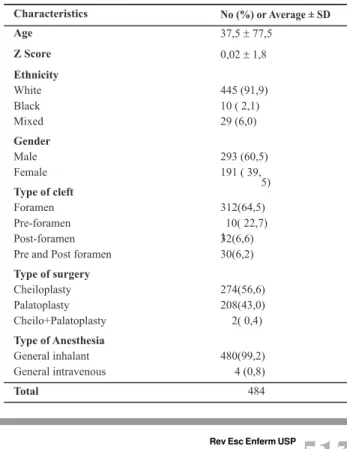
The demographic data are represented in Table 2 and display a sample with the patients average age of 37.5 months (sd = 77 months and 5 days), average Z score of 0.02 (sd= 1.8). The majority of the sample was white (91.9%), males (60.5%), with a foramen cleft type (64.5%), and subjected to cheiloplasty (56.6%). Regarding the type of anesthesia, inhalatory general anesthesia with sevo-flurane was predominance (99.2%).
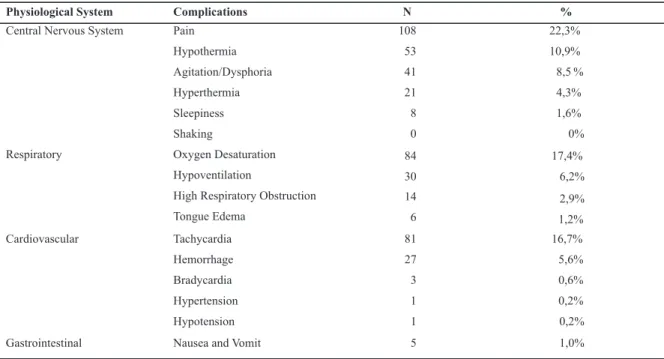
In this study, the most frequent complications were considered to be those with over 77 citations in the exam-ined records. Notes about pain were found in 108 records (22.3%), oxygen desaturation in 84 (17.4%) with an aver-age of 75 (sd=0.1), tachycardia in 81 (16.74%) with an average rate of 175 beats per minute (sd=23).
Table 2 Table 2 Table 2 Table 2
-Table 2 - Characteristics of the patients subjected to surgery - Bauru - 2003
Characteristics No (%) or Average ± SD
Age 37,5±77,5
Z Score 0,02±1,8
Ethnicity White Black Mixed
445 (91,9) 10 ( 2,1) 29 (6,0)
Gender Male Female
293 (60,5) 191 ( 39,
5) Type of cleft
Foramen Pre-foramen Post-foramen Pre and Post foramen
Type of surgery Cheiloplasty Palatoplasty Cheilo+Palatoplasty
312(64,5)
1 10( 22,7) 32(6,6) 30(6,2)
274(56,6) 208(43,0) 2( 0,4)
Type of Anesthesia General inhalant General intravenous
480(99,2) 4 (0,8)
*35 patients with heights over 140 cm were excluded from the sample
Table 3 - Table 3 - Table 3 -
Table 3 - Table 3 - Distribution of the most frequent complications and the involved physiological systems, after primary cleft lip and palate surgery - Bauru - 2003
Table 4 - Table 4 - Table 4 -
Table 4 - Table 4 - Distribution of patients according to gender, type of surgery, anthropometric measurements and complications - Bauru - 2003
Association among the studied variables
The analyses presented herein are those whose sample population could be treated statistically.
Regarding the 293 male patients, 172 had complica-tions within the studied period. Of the 191 female patients, 109 showed some type of complication. However, there was no significant association between gender and post-operative complications. (χ2 = 0.128 and p > 0.50). The
same applies to the occurrence of complications in func-tion of the type of surgery, the statistical tests (χ2 = 0.672
and p > 0.30) and the anthropometric measurements (χ2 = 3.466 and p > 0.10), i.e., there was no association
between these studied variables.
Pain is the most-often cited complication, as the data in Table 4 show, and there is higher occurrence of pain in cheiloplasty (χ2 =7.730; p < 0.05 e ϕ=0.13).
Complication
Yes No Total
Gender
M
F
172
109 121
82
Type of surgery
Cheiloplasty
Palatoplasty
Cheilo+Palatoplasty
163
116
2 1 1 1
92
0
Anthropometric Measurements*
Malnutrition
Eutrophic
Obese
Nutritional Risk
8
221
18
20 5
139
17
21
293
191
274
208
2
13
360
35
41
Pain O Desaturation2
Type of surgery N (A) Sample (B) A/B N (A) Sample (B) A/B
Cheiloplasty 74 274 27,0% 41 274 14,0%
Palatoplasty 34 208 16,3% 42 208 20,2%
Cheilo+Palatoplasty 0 2 0,0% 1 2 50,0%
Total 108 484 22,3% 84 484 17,3%
Table Table Table Table
Table 5555 - Distribution of patients in function of the occurrence of pain and oxygen desaturation, by surgery type - Bauru - 20035
Physiological System Complications N %
Central Nervous System Pain
Hypothermia
Agitation/Dysphoria
Hyperthermia
Sleepiness
Shaking
108
53
41
21
8
0
22,3%
10,9%
8,5 %
4,3%
1,6%
0%
Respiratory Oxygen Desaturation
Hypoventilation
High Respiratory Obstruction
Tongue Edema
84
30
14
6
17,4%
6,2%
2,9%
1,2%
Cardiovascular Tachycardia
Hemorrhage
Bradycardia
Hypertension
Hypotension
81
27
3
1
1
16,7%
5,6%
0,6%
0,2%
0,2%
It does not apply to the second most-often cited com-plication, oxygen desaturation (χ2 =2.269; p > 0.10).
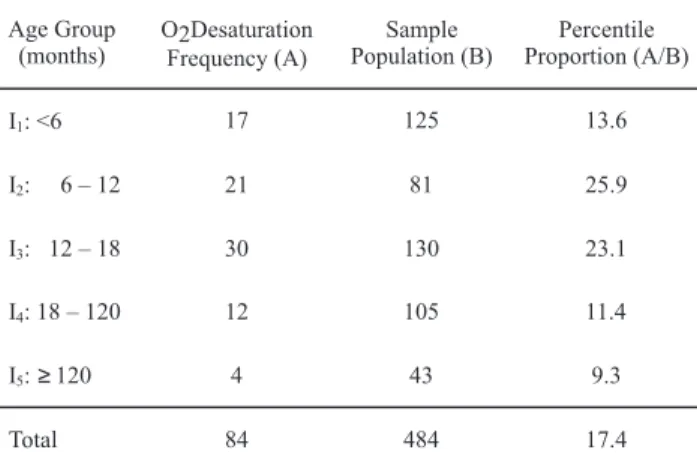
Oxygen desaturation also showed a statistically signif-icant relationship with the age group from 6 to 12 months and from 12 to 18 months (c2 = 12.864; p < 0.02 and C=0.16)
whose occurrence proportions were 25.9% and 23.1%, respectively (Table 6).
DISCUSSION
The age of the group in the study showed an average age of 37.5 months. The higher concentration of patients in the age group from 0 to 18 months is justified because it is the right moment to perform the cleft lip and palate correc-tion, that is, the cheiloplasty procedure, starting at three months old and palatoplasty, starting at 12 years old, are considered by surgeons as favorable, concerning the surgi-cal anesthetic procedure(7).
The anthropometric measurements showed an average Z score (weight in relation to height, regarding gender and age) of 0.02. It should be pointed out that from the sample of 484 patients, it was possible to calculate the Z score of 449, given that the height of 35 individuals was over 140 cm.
Among these 449 patients, 360 (80.2%) were classified as eutrophic. The nutritional and metabolical status of the surgical patient is an important variable when it is relat-ed to postoperative complications, since the organism great-ly depends on recovery, maingreat-ly regarding healing the sur-gical wound, showing evidence of interference in the organ-ism’s defense mechanisms(8).
It has been demonstrated, in the present study, that there was no significant statistical association between the nutritional status of the anthropometric measurement and postoperative complications. This finding should be further investigated in other studies, since it was not pos-sible to properly analyze the patients’ nutritional status, as the survey was limited to anthropometrical data,
with-out considering other biochemical, clinical and dietary information.
Concerning gender, there was a higher incidence of males (60.5%). This finding corroborates others found in litera-ture, in which there were 60% of clefts in males(9).
Regarding the cleft, the incisive foramen cleft (64.5%) was the most common. This is often the most common type in the population. It has been found that white patients are pre-dominant (91.9%), which contrasts to other authors(6-9) who
indicate a higher prevalence of cleft lip and palate in yellow patients (1:674 live-born), followed by white patients (1:1000 births) and lower incidence in black patients (1:1821 births).
Considering the type of primary surgery performed, cheiloplasty appears in higher numbers (56.6%), followed by palatoplasty, 43.0%.
Regarding the type of anesthesia performed in the sur-gical procedures, the general inhalatory procedure ap-pears in 99.2%, with sevoflurane used as the main agent. This drug determines good cardiopulmonary stability and predictable response, both in the induction period and anesthetic emergency, with properties such as absence of pain, no irritation of the airways, low blood/gas partition coefficient and little depression of the cardiovascular and respiratory systems. The low blood/gas partition coeffi-cient provides rapid increase in the alveolar concentration during the anesthesia induction, and fast drops during the elimination of the inhalatory agent, providing faster induc-tion and recovery(10).
Postoperative Complications in the Postanesthetic Recovery Period
More specifically, in a retrospective study on lip and palate surgery complications, some authors(11) obtained
complication rates from 14.2% to 17.4%. Thus, the constant presence of complications is detected, with an occurrence variation that is determined not only by the specificity of each procedure, but also related to the patient risks.
In the present study, 58.0% of the 484 patients subjected to primary lip and palate surgery at HRAC-USP showed at least one complication at the SRPA. Despite its high inci-dence, when compared to specific literature, there was no significant statistical association (χ2 = 0.672 and p > 0.30)
between postoperative complications and the type of sur-gical procedure. This fact may be associated with the meth-odology employed, i.e., despite the seriousness and legality of the records used for the research, the likelihood of dif-ferent judgments of an observed fact should be noted.
Among the cited complications, the most frequent was pain, followed by oxygen desaturation and tachycardia.
When the patients with pain are associated with the type of surgical procedure, the higher occurrence of this symptom was found in cheiloplasty, with 27.0%. This type of surgery often occurs, at the HRAC-USP, before patients are 12 months
Table 6 - Table 6 - Table 6 - Table 6 -
Table 6 - Distribution of patients with oxygen desaturation, according to age group - Bauru - 2003
χ2 = 12.864, p < 0.02 and C=0.16
Age Group (months)
O Desaturation Frequency (A)
2 Sample
Population (B)
Percentile Proportion (A/B)
I1: <6 17 125 13.6
I2: 6 – 12 21 81 25.9
I3: 12 – 18 30 130 23.1
I4: 18 – 120 12 105 11.4
I5: 120 4 43 9.3
Total 84 484 17.4
old. Nevertheless, in this age group, the verbal answer is impaired. Thus, the measurement and evaluation of compli-cations in pediatric patients are challenges to the profes-sionals working with this type of clientele. For this analysis, several factors should be considered, such as the nature of harmful stimuli, physiological, behavioral and emotional responses and environmental and situational factors.
Taking tachycardia into consideration as an adopted criterion to identify pain, it was found that, of the 108 patients who presented it, 25 showed tachycardia, which demonstrated the existence of an association (χ2 = 4.108;
p > 0.05 e ϕ=0.09) between tachycardia and pain. Tachy-cardia is caused by pain due to cardiovascular effects initiated catecholamine, aldosterone, cortisol and anti-diuretic hormones. These hormones have direct effects on the heart and its vascularization, increasing salt and wa-ter retention, which increases the cardiovascular system load(12). Besides the alterations in the cardiovascular
pa-rameters, significant alterations in the transcutaneous oxygen and palm perspiration have been observed in chil-dren subjected to painful clinical procedures. These physi-ological variations have been useful to examine the pain-ful experiences associated with short-term medical pro-cedures; however, there are no physiological responses that directly reflect the perception of pain in children(13).
The same was observed in relation to these patients with pain and the records of agitation/dysphoria (χ2 = 9.472 and p
> 0.01). The subjective suffering status caused by pain can be observed in behaviors such as facial expressions (making faces), posture (guard) and focalization (crying and moaning).
Regarding the routinely use of pre-emptive analgesia at the HRAC-USP to reduce postoperative pain, 423 of the 484 patients in the study received pre-medication. Even so, 52 patients had new records, meaning that they re-quired other strategies to relieve pain.
The HRAC-USP surgeons, as an alternative to reduce post-operative pain, performed infiltrations in the surgery wounds with local anesthesia, which has shown to effectively reduce immediate postoperative pain. However, empirically, its adop-tion in the clinical practice has been slow, which can con-tribute to increasing the immediate postoperative pain.
Oxygen desaturation, as the second most frequent compli-cation (17.4%), is also mentioned in another study(14), which
identified, among the 24,157 patients who received general anesthesia, a occurrence roughly 1.3% of other respiratory complications. The most critical complication was hypoxemia, followed by hypoventilation and respiratory obstruction.
The physiological changes during anesthesia and sur-gery are not immediately reversed after the end of the pro-cedure, and several associated complications occur dur-ing the first hours after anesthesia. This is the postoperative period, when the patients are prone to develop oxygen desaturation. Some authors(6) found evidence of
hypox-emia in the immediate postoperative period of 23.8% in
1,213 children subjected to elective plastic surgery, with 2.9% showing severe hypoxemia (oxygen saturation lower or equal to 85%). One study(3) found a 14.8% incidence of
hypoxemia , and 6.2% of severe hypoxemia in 420 chil-dren subjected to simple plastic surgery.
The age between 44 and 74 weeks after birth is when children have demonstrated greater vulnerability to events of oxygen desaturation in the postoperative period(4). In this
study, the age group in which there was oxygen desaturation was from 6 to 18 months, with a significant statistical as-sociation (χ2 = 12.864 and p > 0.002 and C= 0.16) between
age group and oxygen desaturation.
The palate closure is a type of surgery with high risks of postoperative hypoxemia, when compared with other plas-tic surgeries(5). However, in the present study, both
cheilo-plasty and palatocheilo-plasty showed similar frequencies of oxy-gen desaturation and no statistical significance (χ2 = 2.269;
p > 0.10). The palate closure procedure, associated with the result obtained, cannot be considered responsible for the occurrence of oxygen desaturation in the studied sample.
The incidence of oxygen desaturation, in this study, may also be related to other factors such as upper airway mal-formation and absence of oxygen during patient trans-portation from the operating room to the SRPA, a proce-dure that is not a routine of this institution, contributing to increasing the incidence of oxygen desaturation.
Regarding the third most commonly mentioned com-plication, cardiovascular complications in the postop-erative period have been reported by several authors(15-16) as
the most common at SRPA admission, i.e., in 13.1% of 1,047 cases treated within a year.
In this study, tachycardia stands out in 81 patients (16.7%), with average heart frequency of 179 beats/minute.
CONCLUSIONS
Based on the findings related to the demographic data of this retrospective study on postoperative complications of primary lip and palate surgery, it may be concluded that the studied group showed an average age of 37 months; patients were predominantly white, 91.9%; patients were predominantly males; the anthropometric measurement showed that most were eutrophic; the most common type of cleft was transforamen; cheiloplasty stands out as the most commonly performed type of surgery; general inhalatory anesthesia was predominant.
REFERÊNCIAS
1. Capelozza Filho L, Alvares ALG, Rossato C, Vale DMV, Janson GRP, Beltrami LER. Conceitos vigentes na etiologia das fissuras lábio-palatinas. Rev Bras Cir. 1988;78(4):233-40.
2. Bachega MI. Indicadores psicossociais e repercussões na qualidade de vida de adolescentes com fissura labio-palatal [tese]. Botucatu: Faculdade de Ciências, Universi-dade Estadual Paulista “Júlio de Mesquita Filho”; 2002.
3. Xue FS, Huang YG, Luo LK, Deng XM, Liao X, Tong SY, et al. Observation of early postoperative hypoxaemia in children undergoing elective plastic surgery. Paediatr Anaesth. 1996;6(1):21-8.
4. Wood FM. Hypoxia: another issue to consider when timing cleft repair. Ann Plast Surg. 1994;32(1):15-20.
5. Henriksson TG, Skoog VT. Identification of children at high anaesthetic risk at the time of primary palatoplasty. Scand J Plast Reconstr Surg Hand Surg. 2001;35(2):177-82.
6. Xue FS, Tong SY, Liao X, Liu JH, Zhang RJ, An G, et al. Ob-servation of the correlation of postanaesthesia recovery scores with early postoperative hypoxaemia in children. Paediatr Anaesth. 1999;9(2):145-51.
7. Silva MLN, Silva Filho OG, Freitas JAS. Abordagem interdisciplinar no tratamento das fissuras labiopala-tinas. In: Campos CAH, Costa HOO, editores. Tratado de otorrinolaringologia. São Paulo: Roca; 2003. p. 534-66.
8. Lacerda RL. Fatores de risco individuais. In: Lacerda RL, coor-denadora. Buscando compreender a infecção hospitalar no paciente cirúrgico. São Paulo: Atheneu; 1992. p. 81-9.
9. Capelozza Filho L, Miranda E, Alvares ALG, Rossato C, Vale DMV, Janson GRP, et al. Conceitos vigentes na epidemiologia das fissuras lábio-palatinas. Rev Bras Cir. 1987;77(4):223-30.
10. Freire EMA, Vieira AM. Comparação da indução anes-tésica inalatória com halotano, isoflurano e sevo-flurano em anestesia pediátrica. In: Anais do 44° Con-gresso Brasileiro de Anestesiologia; 1997 nov. 15-19; Rio de Janeiro, BR. Rio de Janeiro: Sociedade Brasilei-ra de Anestesiologia - Seção-RJ; 1997. p. 5.
11. Canady JW, Gloswacki R, Thompson AS, Morris HL. Complication outcomes based on preoperative admis-sion and length of stay for primary palatoplasty and cleft lip/palate revision in children aged 1 to 6 years. Ann Plast Surg. 1994;33(6):576-80.
12. Lubenow TR, Ivankovich AD, McCarthy RJ. Management of acute postoperative pain. In: Linppincott-Raven Interactive Anesthesia Library [CD-ROM]. Version 2.0. Philadelphia: Lippincott-Raven; 1997.
13. Houck CS, Berde CB, Anand KJS. Pediatric pain mana-gement. In: Gregory GA, coordinator. Pediatric anes-thesia. 3rd ed. New York: Churchill Livingstone; 1994.
p. 743-71.
14. Rose DK, Cohen MM, Wigglesworth DF, DeBoer DP, Math M. Critical respiratory events in the postanesthesia care unit: patient, surgical and anesthetic factors. Anes-thesiology. 1994;81(2):410-8.
15. Rose DK, Cohen MM, DeBoer DP, Math M. Cardiovascular events in the postanesthesia care unit. Anesthesiology. 1996;84(4):772-81.