O
RIGINAL
A
R
TICLE
RESUMO
O artigo apresenta uma ferramenta da Aprendizagem Signifi ca va denominada V de Gowin e a possibilidade de seu uso em um processo de desempacotamento de produções acadêmicas de Enfermagem. Objetiva construir uma proposta de alteração da ferramenta com a u lização dos elementos que compõem a trajetória processual da Teoria da Intervenção Práxica da Enfermagem em Saúde Cole va (TIPESC) e analisar uma dissertação produzida nesta área de conhecimento. Trata-se de um estudo descritivo e exploratório que apresenta o V de Gowin, propondo alterações no seu domínio metodológico. Constatou-se a possibilidade de u lização para análises de produções acadêmicas de enfermagem deste instrumento heurís co que já se mostrou ú l para apoiar processos de ensino e aprendizagem e analisar produções acadêmicas na área, pela capacidade de captar e interpretar qualquer fenômeno articulado aos processos de produção e reprodução social.
DESCRITORES
Educação em enfermagem Pesquisa em enfermagem Aprendizagem
ABSTRACT
The paper presents a meaningful learning tool known as Gowin’s V and highlights the possibility of using it in the process of unpacking academic work in nursing. Our study aims to propose an amendment to this tool using the elements that comprise the procedural trajectory of the Theory of Nursing Praxis Interven on in Collective Health (TIPESC) and to analyze a disserta on produced in this field. This descriptive and exploratory study presents Gowin’s V and proposes changes to its methodology. It thus shows the possibility of using this heuristic instrument to analyze academic work in nursing. Gowin’s V has already proven to be useful in suppor ng teaching and learning processes and analyzing academic work in the area through its ability to capture and interpret any phenomenon articulated in the processes of social produc on and reproduc on.
DESCRIPTORS
Educa on, nursing Nursing research Learning
RESUMEN
El ar culo presenta una herramienta de Aprendizaje Signifi ca vo denominada V de Gowin y su posible u lización en un proceso de desempaquetado de producciones académicas de Enfermería. Objetiva construir una propuesta de alteración de la herramienta con la utilización de los elementos que componen la trayectoria del proceso de la Teoría de la Intervención Práxica de Enfermería en Salud Colec va (TIPESC) y analizar una disertación generada en tal área cognosci va. Estudio descrip vo-exploratorio, que presenta la
V de Gowin, proponiendo alteraciones de su dominio metodológico. Se constató la posibilidad de u lización para el análisis de producciones académicas de enfermería de este instrumento heurís co, que ya fue ú l como apoyo de procesos de enseñanza-aprendizaje y para analizar producciones académicas en el área, en razón de que permite captar e interpretar cualquier fenómeno articulado al os procesos de producción y reproducción social.
DESCRIPTORES
Educación en enfermería Inves gación en enfermería Aprendizaje
Constructing a Gowin’s V diagram to
analyze academic work in Nursing
*CONSTRUÇÃO DE UM V DE GOWIN PARA ANÁLISES DE PRODUÇÕES ACADÊMICAS DE ENFERMAGEM
CONSTRUCCIÓN DE UNA V DE GOWIN PARA ANÁLISIS DE PRODUCCIONES ACADÉMICAS DE ENFERMERÍA
César Cavalcanti da Silva1, Ana Karla Sousa de Oliveira2, Emiko Yoshikawa Egry3, Eufrásio de Andrade Lima Neto4, Ulisses Umbelino dos Anjos5, Ana Tereza Medeiros Cavalcanti da Silva6
703
Rev Esc Enferm USP 2013; 47(3):702-6 www.ee.usp.br/reeusp/ Constructing a Gowin’s V diagram to
analyze academic work in Nursing
Silva CC, Oliveira AKS, Egry EY, Lima Neto EA, Anjos UU, Silva ATMC
INTRODUCTION
It is impossible to speak of Gowin’s V, the Epistemo-logical V, or even the V Diagram without understanding the no on of meaningful learning, a central concept in Ausubel’s theory:
Meaningful learning is a process in which new information is related to a relevant aspect of an individual’s knowledge structure. This process involves the interaction of new information with a specifi c knowledge structure, which Ausubel defi nes as subsumption theory, or simply subsumption, existing in the learner’s cognitive structure(1).
In other words, meaningful learning is a mechanism that facilitates the acquisi on and reten on of new informa on, since exis ng knowledge in the learner’s cogni ve struc-ture acts as a kind of anchor for new knowledge. Exis ng knowledge is thus called an advance organizer and acts as a cogni ve bridge.
David Ausubel was an American educa onal psycholo-gist who died in 2008. Dissa sfi ed with his early educa on,
he conducted studies on the learning process, arguing that new knowledge needed to make sense to those who re-ceived it. He based his educa onal system on the principle that teachers need to discover what their students already know in order to anchor new learning to this knowledge.
Although meaningful learning regards the cogni ve aspect of the teaching-learning process with greater vigor, it s ll considers the emo onal side of this process:
Meaningful learning requires that the learning material be poten ally signifi cant and that the learner express a
willingness to relate the new material, in a substanƟ ve and
non-arbitrary way, to their knowledge structure(1).
In composing his theory, Ausubel did not fail to con-sider the importance of the emo onal domain. However, it was Joseph Novak who gave a humanis c touch to meaningful learning by examining its refi nement, tes ng,
and dissemina on. For Novak, any educa onal event is an ac on aimed at changing the meanings and feelings between the learner and the teacher, and the purpose of this exchange is meaningful learning of contextually-accepted new knowledge(1).
The ac on of switching between meanings and feel-ings in an educa onal event also involves a third element, namely the educa onal material: by using these materials, students and teachers collec vely analyze and contextual-ize the structure of the knowledge produc on process(1).
To help students understand knowledge structure and the ways in which humans produce it, Novak and Gowin proposed a heuris c method involving fi ve ques ons and
a scheme to unpack knowledge in a par cular fi eld. They
called this method the Epistemological V or Gowin’s V. The
fi ve ques ons used are as follows:
• What is(are) the focus ques on(s)?
• What are the key concepts?
• Which method(s) was(were) used to answer the focus ques on(s)?
• What are the knowledge claims?
• What are the value claims?(2)
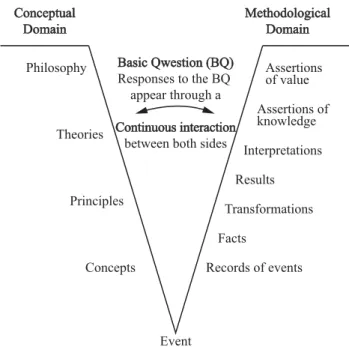
The Epistemological V described by Ferracioli(3) and presented below shows the interac on between the con-ceptual and methodological domains as well as each one of the fi ve dimensions proposed using for the tool in its
original format.
Adopting this model, we have subsequently proposed changes that replace the five questions used in the original tool with the items that comprise the procedural trajectory of the Theory of Nursing Praxis Intervention in Collective Health (TIPESC)(4). The revised model may be represented as follows:
Our study thus aimed to develop a proposed amend-ment to the model suggested by Moreira and Buchweitz(1) by using the elements that comprise the TIPESC(4) proce-dural trajectory and analyzing a disserta on wri en in this knowledge area.
METHOD
This descrip ve and exploratory study aims to present the heuris c instrument en tled Gowin’s V or the Epistemological
Methodological
Methodological
Domain
Domain
Conceptual
Conceptual
Domain
Domain
Philosophy
Theories
Principles
Concepts
Assertions of value
Assertions of knowledge
Interpretations
Results
Transformations
Facts
Records of events
Event Basic Qwestion (BQ)
Basic Qwestion (BQ)
Responses to the BQ appear through a
Continuous interaction
Continuous interaction
between both sides
V, while proposing changes to the methodological domain
by replacing the fi ve ques ons used in the original tool with
the items that comprise the TIPESC(4) procedural trajectory. This study was approved by the Ethics Commi ee according to the CEP/CES Protocol No. 148/2010.
Using on the tool thus formed, we analyzed the dis-sertation entitled Alternatives Strategies and Tactics in the Modeling of Health Services: Seeking New
Knowl-edge for Health Promotion Processes(5). This study was
conducted in 71 Family Health Units from the third, fourth, and fifth health districts in the municipality of João Pessoa, Brazil.
RESULTS
The following diagram represents the proposed con-struc on of the model of Gowin’s V adapted to the unpack-ing of academic work in nursing.
Conceptual Domain Methodological Domain
Philosophy:
The tension between theory and practice cannot be completely transposed, but it can be exposed and analyzed(6).
Basic Question Are there alternative
strategies and practices within the work processes
of nurses and physicians from family health teams?
Capture of objective reality:
Professional insertion for conducting research in 71 family health units from the third, fourth, and fi fth health districts in the municipality of João Pessoa.
Theories:
Ausubel’s Theory of Meaningful Learning; Theory of Nursing Praxis Intervention in Collective Health.
Interpretation of objective reality: The predominance of females and training of more than 10 years in the workforce establishes instrumental knowledge that contradicts the SUS. The predominance of health activities related to care is characterized by a mixture of different care models that are not always compatible with the ESF.
Principle:
Alternative strategies or tactics for hegemonic models constitute an important locus for the experimentation and construction of new care models.
Intervention project in objective reality:
Conducting a second interview with the professionals who used alternative strategies and tactics within their work processes.
Key Concepts:
Meaningful learning; work process; care models; alternative strategies and tactics.
Intervenção na realidade objetiva:
Upon examining the use of alternative strategies and tactics within work processes, details were requested for the subsequent reverberation of these activities.
Reinterpretation of objective reality: The presence of alternative strategies and tactics within the work processes of nurses and physicians can constitute an embryo for transforming these processes, thus overcoming instrumental knowledge centered on functionalism.
Event
Visits to the family health units to map health activities within the work processes of medical professionals and nurses from each family health team in the third, fourth, and fi fth health districts in the municipality of
João Pessoa.
Figure 3 – The Theory of Nursing Praxis Intervention in Collective Health as decoded by Godwin’s V
Conceptual Domain Methodological Domain
Philosophy Basic research question Continuous interaction from both sides
Grasping the objective reality
Theories Interpretation of the objective reality
Principles Construction of an intervention project
Concepts Intervention in objective reality
Reinterpretation of objective reality
Event
705
Rev Esc Enferm USP 2013; 47(3):702-6 www.ee.usp.br/reeusp/ Constructing a Gowin’s V diagram to
analyze academic work in Nursing
Silva CC, Oliveira AKS, Egry EY, Lima Neto EA, Anjos UU, Silva ATMC
DISCUSSION
ExplanaƟ on of Godwin’s V to analyze the unpacking of the academic producƟ on of Nursing
Basic Research QuesƟ on
The research consisted of mapping the health ac vi es used in the work processes of medical professionals and nurses from family health teams in the third, fourth, and fi h health
districts in the municipality of João Pessoa. It a empted to highlight the founda ons of the care being used and the char-acteris cs of the assistance model being employed. While try-ing to iden fy any signifi cant changes in health care prac ces,
the following ques on was asked: Are alterna ve strategies and prac ces being used within the work processes of nurses and physicians from family health teams?
Associated research quesƟ ons
1) Can the possible alterna ve strategies and tac cs iden
-fi ed within the work processes of nurses and physicians
change the axis of health ac ons that are hegemonically centered on professional procedures?
2) Can the possible alterna ve strategies and tac cs incite changes in the process of decision making at the local level of basic health units as well as at the central level of the Municipal Department of Health?
Event
At the apex of the V diagram is the event, which cor-responded to the visits to family health units in this study. Both the visits and the ques onnaires exploring the health ac vi es performed by nurses and physicians provided informa on about the work process and the characteris cs of care models used.
LeŌ side of Gowin’s V
The le side of the diagram contains the conceptual domain of knowledge, which is to be unpacked. This corre-sponds to the theore cal part of the study, which comprises most of its references.
Philosophy
The basic inspira on mo va ng the study’s construc on was the confl ict between theory and prac ce, which was
represented by the confronta on between the exis ng care models and the resultant work processes.
Theories
Ausubel’s theory of meaningful learning, which supports the heuris c instrument proposed by Novak and Gowin and their goal to unpack knowledge in any
par cular fi eld, is complementary to the TIPESC, which
captures and interprets phenomena ar culated in the processes of social production and reproduction and func ons in the environment and structure of any given historically-determined social context. While the former
brings knowledge to the fore, unveiling it as the set of informa on, the la er seeks its determinants, revealing its essence beyond appearances.
Principle
The major principle is the possibility and necessity of change. Given that theory and prac ce can be exposed and analyzed, the existence of alterna ve strategies or tac cs in hegemonic models must be addressed, as they are an important locus for the experimenta on and construc on of new care models.
Key Concepts
Meaningful learning; work process; care models; alter-na ve strategies and tac cs.
Right side of Gowin’s V
This side of the diagram contains the study’s procedural aspects and in the proposal, it follows the steps used in the TIPESC in terms of its ability to capture and interpret phenomena, func on in their environments and structures, and reinterpret them once again in order to interpose the interven on instruments.
Capture of objecƟ ve reality
Health ac vi es within the working process of physi-cians and nurses from the teams at 71 family health units in the third, fourth, and fi h health districts in the municipality
of João Pessoa were thus captured. The founda ons of the care provided were uncovered, as was the care model being employed from the perspec ve of singular, par cular, and structural dimensions(5).
The singular dimension refers to the direct interven on of phenomena in their objec ve and subjec ve aspects (meaning). The par cular dimension comprises the pro-cesses of social reproduc on ar culated in the hegemonic modes of produc on. Finally, the structural dimension re-fers to the poli cal and ideological forms derived from the produc on rela onships(4).
In the nursing study analyzed using Gowin’s V, the sin-gular dimension refers to the health ac vi es of nurses and doctors who are part of the ESF in developing alterna ve strategies and tac cs. These health ac vi es or ac ons are opera onalized within the limits established by the health care levels (primary, secondary, and ter ary), with the ac vi es being related to the administra ve, educa onal, or purely care domains: this thus cons tutes the phenom-enon’s par cular dimension. These ac vi es are anchored in philosophical and organiza onal principles adopted by the SUS, the main public health policy in force in the country, and they are considered to be the structural dimension(5).
InterpretaƟ on of objecƟ ve reality
Among the 180 family health teams in João Pessoa’s
fi ve health districts, a sample based on sta s cal
teams from the third, fourth, and fi h health districts. The
health teams had a predominance of females and training of more than 10 years. The workforce uses instrumental knowledge in opposi on to the principles of the SUS, and the predominance of health ac vi es related to the care dimension are characterized by a mixture of Priva zed and Sanitarian/Campaign care models, which are not always compa ble with the ESF.
IntervenƟ on project in objecƟ ve reality
Having confi rmed the use of alterna ve strategies and
tac cs within the work processes of nurses and physicians from the sampled teams, all the professionals were revisited and a second interview was conducted at a me and place determined by the professionals.
IntervenƟ on in objecƟ ve reality
In reality, the interven on maintained two entry criteria for par cipa ng in the study: 1) all nurses and physicians who implemented health ac vi es or ac ons that were not refl ected or contained in the known care models (Priva zed,
Campaign, and ESF); 2) all nurses and physicians who ced health ac vi es or ac ons guided by the Municipal Department of Health, but using a par cular ra onale or skill to render it diff erent from the usual or standardized manner. The cut-off criteria were thus applied to all pro-fessionals who performed ac vi es or ac ons within their work process that were already refl ected or contained in
the known care models(5).
ReinterpretaƟ on of objecƟ ve reality
The presence of alterna ve strategies and tac cs was verifi ed within the work processes of the nurses and doctors
interviewed. The study concluded that these individuals could cons tute an embryo for the transforma on of these processes, by overcoming instrumental knowledge centered on func onalism.
The possibility of using Gowin’s V model derived from
Ausubel’s pedagogical concept of meaningful learning was also verifi ed using the elements that comprise the TIPESC
procedural trajectory, which resulted in enhancing the knowledge produced in the fi eld of nursing.
The lack of depth in the knowledge produced was im-posed as a limit for this tool’s use, since its purpose was to help learners understand the knowledge structure and the ways in which it are produced(8).
CONCLUSION
Gowin’s V or the Epistemological V is a heuris c tool
that is not, strictly speaking, an innova on for interpre ng material for instruc onal technologies. However, the possi-bility of the model providing a visual synthesis for academic work has not yet fully been explored. The applica on of the TIPESC’s procedural elements in the model in order to uncover the methodology of academic work is an example of the possibili es that this instrument off ers researchers and educators, par cularly in the fi eld of nursing.
The use of TIPESC takes into account the specific academic work in this knowledge fi eld, as it captures and
interprets any phenomena ar culated in the processes of social produc on and reproduc on, thus promo ng a wider range of issues to be considered in the research.
The involvement of students, teachers, and educa onal materials in Gowin’s V is characterized by the sharing of
meaning, which, if not achieved, should be restated so that the learner can build their own learning path, with the idea of learning to learn.
Gowin’s V is an instrument that facilitates human
empow-erment by encouraging an open rela onship between
learn-ers, teachlearn-ers, and educa onal material for sharing meaning. It can be an excellent tool to assist teaching, research, and learning processes in training the nursing workforce.
1. Moreira MA, Caballero MC, Rodriguez ML. Aprendizagem signifi ca va: um conceito subjacente In: Actas del Encuentro Internacional sobre el Aprendizaje Signifi ca vo; 1997; Burgos, España [Internet]. [citado 2011 abr. 25]. Disponível em: h p:// www.if.ufrgs.br/~moreira/apsigsubport.pdf
2. Santos ACK. A construção de um Vê de Gowin para o trabalho em modelagem: o caso do Sistema Semiquan ta vo VISQ [Internet]. Fundação Universidade Federal do Rio Grande; 2011 [citado 2011 abr. 25]. Disponível em: h p://www.api. adm.br/GRS/referencias/v_gowin.pdf
3. Ferraciolli L. O V epistemológico como instrumento metodológico para o processo de investigação. Rev Didática Sistêmica [Internet]. 2005 [citado 2011 abr. 25]. Disponível em h p://www. seer.furg.br/ojs/index.php/redsis/ar cle/view/1191
4. Egry EY. Saúde cole va: construindo um novo método em enfermagem. São Paulo: Ícone; 1996.
5. Oliveira AKS. Estratégias e tá cas alterna vas na modelagem dos Serviços de Saúde: buscando novos saberes para os processos de promoção da saúde [dissertação]. João Pessoa: Universidade Federal da Paraíba; 2011.
6. Silva CC, Egry EE. Constituição de competências para intervenção no processo saúde-doença da população: desafi o ao educador de enfermagem. Rev Esc Enferm USP. 2003;37(2):11-6.
7. Silva NN. Amostragem probabilís ca: um curso introdutório. São Paulo: EDUSP; 2004.