Frailty syndrome in an independent urban population in
Brazil (FIBRA study): a cross-sectional populational study
Síndrome da fragilidade em uma população urbana independente no Brasil
(estudo FIBRA): um estudo transversal populacional
Larissa Barradas Calado
I,
Eduardo Ferriolli
II,
Júlio César Moriguti
II, Edson Zangiacomi Martinez
III, Nereida Kilza da Costa Lima
IIDivision of General Internal Medicine and Geriatrics, Department of Internal Medicine, Faculdade de Medicina de Ribeirão Preto (FMRP),
Universidade de São Paulo (USP), Ribeirão Preto, SP, Brazil
ABSTRACT
CONTEXT AND OBJECTIVE: Frailty is a multifactorial syndrome. The aim of this study was to determine the prevalence and characteristics of frailty syndrome in an elderly urban population.
DESIGN AND SETTING: Cross-sectional study carried out at the homes of a randomized sample repre-senting the independent elderly individuals of Ribeirão Preto, Brazil.
METHODS: Sociodemographic characteristics, clinical data and criteria of the frailty phenotype were ob-tained at the subjects’ homes; 385 individuals were evaluated. Frailty was deined based on detection of weight loss, exhaustion, weakness, slowness and low physical activity level. Individuals with three or more of these characteristics were classiied as frail and those with one or two as pre-frail. Speciic cutof points for weakness, slowness and low physical activity level were calculated.
RESULTS: The participants’ mean age was 73.9 ± 6.5 years, and 64.7% were women. 12.5% had lost weight over the last year; 20.5% showed exhaustion, 17.1% slowness, 24.4% low physical activity level and 20.5% weakness. 9.1% were considered frail and 49.6% pre-frail. Frail subjects were older, attended more medi-cal visits, had a higher chance of hospitalization within the last 12 months and had more cerebrovascular events, diabetes, neoplasms, osteoporosis and urinary and fecal incontinence.
CONCLUSION: In this independent elderly population, there were numerous frail and pre-frail individu-als. Frailty syndrome was associated with high morbidity. Cutof points for weakness, slowness and low physical activity level should be adjusted for the population under study. It is essential to identify frail and pre-frail older individuals for appropriate interventions.
RESUMO
CONTEXTO E OBJETIVO: Fragilidade é uma síndrome multifatorial. O objetivo deste estudo foi determinar a prevalência e características da síndrome da fragilidade em uma população urbana de idosos.
TIPO DE ESTUDO E LOCAL: Estudo transversal realizado nas casas em amostra randomizada para repre-sentar os idosos independentes de Ribeirão Preto, Brasil.
MÉTODO: Características sociodemográicas, dados clínicos e critérios do fenótipo da fragilidade foram obtidos nas casas. Foram avaliados 385 idosos. A deinição da fragilidade foi baseada na detecção de per-da de peso, exaustão, fraqueza, lentidão e baixo nível de ativiper-dade física. Idosos com três ou mais destas características foram classiicados com frágeis; com uma ou duas características como pré-frágeis. Foram calculados pontos de corte especíicos para fraqueza, lentidão e baixo nível de atividade física.
RESULTADOS: A média de idade dos participantes foi de 73,9 ± 6,5 anos, com 64,7% de mulheres. 12,5 % perderam peso no último ano, 20,5% tiveram exaustão, 17,1% lentidão, 24,5% baixo nível de atividade física e 20,5% fraqueza. Foram considerados frágeis 9,1% e pré-frágeis 49,6%. Os frágeis eram mais velhos, foram em mais consultas médicas, tiveram maior chance de internação nos últimos 12 meses e tiveram mais eventos cerebrovasculares, diabetes, neoplasias, osteoporose, incontinência fecal e urinária.
CONCLUSÃO: Em uma população idosa independente, existem vários indivíduos frágeis e pré-frágeis. A síndrome da fragilidade foi associada com alta morbidade. Pontos de corte para fraqueza, lentidão e baixo nível de atividade física devem ser ajustados para a população em estudo. É essencial identiicar idosos frágeis e pré-frágeis para intervenções apropriadas.
IMD, MSc. Student in the Postgraduate Program on Internal Medicine, Department of Internal Medicine, Faculdade de Medicina de Ribeirão Preto (FMRP), Universidade de São Paulo (USP), Ribeirão Preto, SP, Brazil.
IIMD, PhD. Associate Professor, Division of General Internal Medicine and Geriatrics, Department of Internal Medicine, Faculdade de Medicina de Ribeirão Preto (FMRP), Universidade de São Paulo (USP), Ribeirão Preto, SP, Brazil.
IIIMD, PhD. Associate Professor, Department of Social Medicine, Faculdade de Medicina de Ribeirão Preto (FMRP), Universidade de São Paulo (USP), Ribeirão Preto, SP, Brazil.
KEY WORDS: Frail elderly.
Socioeconomic factors. Morbidity.
Cross-sectional studies. Urban population.
PALAVRAS-CHAVE: Idoso fragilizado. Fatores socioeconômicos. Morbidade.
INTRODUCTION
Frailty is a clinical multifactorial syndrome involving reduction of the functional reserves and dysfunction of various organic sys-tems. It results in marked reduction of the ability to reestablish functions ater aggression of various natures.1
Based on this multifactorial concept, Fried et al. proposed that a phenotype with ive components should be envisaged: weight loss, exhaustion, weakness, slowness and low physical activity.2 Individuals with three or more of these characteristics
would be classiied as frail and those with one or two charac-teristics as pre-frail. According to Fried et al., older individuals who meet these criteria are more susceptible to falls, functional decline, recurrent hospitalization and death within three years.2
hese criteria are the ones most frequently used by investigators in epidemiological and clinical studies.3-5
he incidence and prevalence of frailty syndrome vary and are inluenced by the geographic location studied, by socioeconomic factors such as education, and by age, such that its incidence and prevalence are higher among individuals aged 80 years or over.2,3,6-10
Studies conducted both in Brazil and in other countries have reported diferent prevalence rates, ranging from 6.9% to 40.6% among frail elderly individuals and 46.3% to 60.1% among pre-frail individuals.2,4,11-14 In this regard, frailty syndrome should
be targeted by earlier investigations and interventions, given its impact on elderly individuals, their families and society as a whole.1 Despite recent initiatives, there are few Brazilian
stud-ies assessing this condition, and interventions that reduce the impact of this syndrome are still insuicient.15
OBJECTIVE
he aims of this study were to determine the prevalence and sociodemographic and clinical proiles of frailty syndrome in an independent elderly urban Brazilian population, and to calcu-late speciic cutof points for weakness, slowness and low physi-cal activity for populations similar to the one studied here. hese parameters are inluenced by anthropometric data and they are relected in the prevalence of frailty syndrome.
METHODS
Setting and participants
A population-based epidemiological cross-sectional study, form-ing part of the multicenter “Study of Frailty in Elderly Brazilian Individuals” (FIBRA), was conducted in Ribeirão Preto, state of São Paulo, Brazil. his city has approximately 600,000 inhabit-ants, 8.7% of them over 65 years of age (Brazilian Institute for Geography and Statistics).
he inclusion criteria were that the subjects needed to be aged 65 years or over and living in a randomly selected house.
he sample was obtained in a random manner from area con-glomerates and its size was calculated by estimating the propor-tion of frailty (i.e. the value at which the sample size obtained would be the maximum possible: P = 0.50; q = 0.50), according to the older population of the city. he signiicance level was set at 5% (alpha = 5%; Z = 1.96). he sample size was established as 385 volunteers for a sampling error of 5%.
he exclusion criteria comprised presence of severe cogni-tive deicit suggescogni-tive of dementia ater evaluation by the Mini Mental State Examination (MMSE); situations of being bedrid-den or needing to use a wheelchair; presence of sequelae from a stroke with localized loss of strength; greater age with presenta-tion of end-stage disease; or situapresenta-tions of undergoing treatment for cancer, except for skin cancer.
In order to obtain a representative sample of the elderly pop-ulation of Ribeirão Preto, we calculated the proportion of older individuals in each neighborhood in relation to the total num-ber of older individuals in the city, on the basis of data from the Brazilian Institute for Geography and Statistics. We then calculated the density of elderly people per household in each neighborhood. he city blocks in which households were vis-ited were identiied and selected randomly using maps sup-plied by the Brazilian Institute for Geography and Statistics and by the city’s administration. If the home was inhabited by more than one elderly individual, all of them were invited to partic-ipate. Situations in which the elderly individuals categorically stated that they did not want to participate or that they wanted to discontinue participation, ater starting, were considered to be refusals. When an elderly individual was present and interested in participating, but declared that he or she was unable to do so at that moment, or a resident or neighbor said that an elderly per-son lived in the house but was not present at that moment, the interviewer scheduled a new visit, orally and in writing, up to a total of three attempts. If the house was closed on the occasion of the irst visit by the interviewer, and it was not possible to know whether an elderly individual lived there, this was considered to be a loss of data. Refusal did not involve exclusion of the home from the total count because the sample calculation had taken the possibility of this occurrence into consideration.
An additional proportional number of city blocks was selected in each neighborhood in order to cover for absences and to replace losses due to the exclusion criteria of the study. he elderly individuals were invited to participate through per-sonal contact at their homes.
Measurements
was conducted in Ribeirão Preto in 2008/2009. It involved under-graduate and postunder-graduate students at the Ribeirão Preto Medical School and Ribeirão Preto College of Nursing, University of São Paulo, and recruited volunteers. All of this investigative team received prior training at four meetings. Kits containing a tape measure, scale, caliper, a dynamometer for measuring hand-grip strength and markers for the walking test were acquired for applying the protocol ater the pilot study had been concluded.
In the standard questionnaire, the subjects were asked to self-report any chronic diseases that had been recognized by a doc-tor during the past year, and also to state the number of visits to doctors and admissions to hospital that they had had, also dur-ing the past year.
he frailty criteria adopted in the present study were based on the clinical syndrome described and deined by Fried et al.2
heir deinition originated within the context of cardiovascular health studies and women’s health and aging studies. he group proposed that a frailty phenotype with ive components should be envisaged, deined operationally as described below. hese cri-teria have now become established and are widely used in stud-ies on frailty.
1. Weight loss: report of a loss ≥ 4.5 kg or ≥ 5% of body weight during the previous year.
2. Exhaustion: assessed through a self-report of fatigue in response to two questions on the Center for Epidemiological Studies Depression Scale (CES-D). When a subject stated that on three or more days of the week he felt he had to make much more efort to carry out his usual tasks and could not continue them, he received scores for fatigue.
3. Weakness: mean of three measurements with a hydrau-lic dynamometer (JAMAR Model J00105) on the dominant hand, adjusted for sex and body mass index (BMI). Subjects were considered to be positive when their handgrip strength was below the 20th percentile for this population.2
4. Low physical activity level: measured from the weekly energy expenditure in kilocalories, with adjustment for sex, based on self-reported activities and physical exercise, and assessed using the Minnesota Leisure Time Activities Questionnaire, which has been validated in Brazil.16 Subjects in the lowest
quartile were considered to be positive for this criterion.2
5. Slowness: measured from the time, in seconds, taken to walk 4.6 m and adjusted for sex and height. his criterion was pos-itive for the slowest 20% of the subjects.2
Older subjects with three or more of these characteristics were classiied as frail and those with one or two characteristics as pre-frail.2
he study by Fried et al.2 proposed cutof points for the
crite-ria of weakness, low physical activity and slowness critecrite-ria, since
calculation of these criteria depends on the anthropometric vari-ables and intrinsic characteristics of each population. However, in this study we chose to calculate speciic cutof points for the sample and compared them with the values obtained by Fried et al.2
Ethics
Our study was approved by the Ethics Committee of the University Hospital, Ribeirão Preto Medical School, University of São Paulo. Written informed consent was obtained from all participants.
Statistics
Descriptive data were analyzed: means and standard devia-tions (SD) were used for continuous variables and proportions were calculated for categorical variables. Diferences between frail groups were investigated using the Fisher exact test for cat-egorical variables, and analysis of variance (ANOVA) followed by the Bonferroni test was used for continuous and parametric vari-ables. All analyses were carried out using the SAS 9.0 sotware, and the signiicance level was set at P < 0.05.
RESULTS
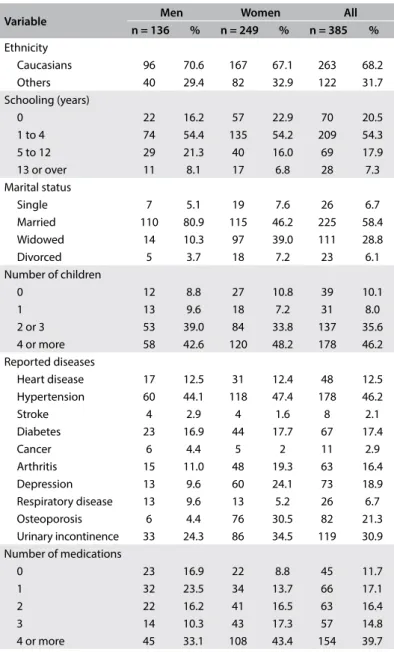
A total of 385 individuals were studied, among whom 249 (64.7%) were women. he overall mean age of the participants was 73.9 ± 6.5 years, with means of 74.0 ± 6.6 years for men and 73.9 ± 6.5 years for women (P = 0.84). he participants were predominantly white (68.2%), had 1 to 4 years of schooling (54.3%), were married (58.4%) and had four or more children (46.2%) (Table 1).
In this study population, systemic arterial hypertension was the most common self-reported disease (46.2%), followed by uri-nary incontinence (30.9%) and osteoporosis (21.3%). More than one third of the participants reported that they took four or more medications per day (Table 1).
According to the frailty criteria used in the present study, 9.1% of the sample was considered frail, 49.6% pre-frail and 41.3% non-frail. he mean age was 72.2 ± 5.9, 74.7 ± 6.4 and 77.7 ± 7.6 years for the non-frail, pre-frail and frail groups, respectively (P < 0.01). Post-test analysis showed that there were diferences in age between all groups: frail versus non-frail (P < 0.01), frail versus pre-frail (P = 0.01) and non-frail versus pre-frail (P = 0.01).
Regarding the frailty criteria, 12.5% were positive for weight loss over the last year, 20.5% for exhaustion, 17.1% for slowness, 24.4% for low physical activity and 20.5% for weak-ness. he exhaustion criterion was mainly reported by females (P < 0.001), whereas no diference between the sexes was observed for the remaining criteria.
0 (zero) kcal/week and men with values below 107.49 kcal/week were scored as frail.
Analysis on the associations between the sociodemographic variables listed in Table 1 and frailty did not reveal any difer-ences between the levels of the syndrome (P > 0.05). here were associations between frailty and stroke (P = 0.02), diabetes (< 0.001), neoplasia (P = 0.02), osteoporosis (P = 0.007), urinary incontinence (P = 0.001) and fecal incontinence (P = 0.002). he elderly subjects who were considered to be frail attended more medical visits (P = 0.03) and had a greater chance of hav-ing been hospitalized (P < 0.001) within the 12 months pre-ceding the interview than did non-frail and pre-frail subjects. No diference was observed between the frail, pre-frail and non-frail groups regarding the number of medications used (P = 0.54) (Table 4).
DISCUSSION
In this study, 9.1% of the sample was frail, 49.6% pre-frail and 41.3% non-frail. Data regarding frailty syndrome are necessary for planning public health policies, since this is considered to be a clinical, non-unidirectional and potentially reversible syn-drome.17 Early recognition and adoption of proactive measures at
diferent stages of the process can prevent or delay the occurrence of adverse health outcomes. In Brazil, this information was scarce before the creation of the FIBRA Network project, to which the present study belongs.
The prevalence of the frailty syndrome differed accord-ing to the region studied. In Santa Cruz, a city in the state of Rio Grande do Norte, the prevalence of frailty was found to be 17.1%. This value is higher than those found in developed countries, perhaps as a result of exposure to various adverse factors and stressors that typically affect people’s lives in that region.4 The SABE 2000 study, conducted in the city of São
Paulo, evaluated 688 elderly individuals aged 75 years or over and found that the prevalence of frailty was 29.5% and pre-frailty, 50.6%.18 The large number of frail subjects in that study
was due, in part, to the greater age of the sample. Moreover, the prevalence of frailty was 9% in Campinas, state of São Paulo, a city with 1.1 million inhabitants,13 and 8.7% in Belo
Horizonte, state of Minas Gerais state,14 which has around 2.3
million. These rates were similar to those detected in the pres-ent study. All of these cities have high human developmpres-ent indexes (HDI).13,14,18
he prevalence of the components of frailty syndrome tends to be higher in places with a low HDI.13 he percentage of frailty
syndrome detected in the population of the present study was similar to that observed in developed countries.2,3 his may
partly be explained by the high HDI of the city of Ribeirão Preto, which is considered to be one of the highest in the state of São
Table 1. Characteristics of the study population (n = 385)
Variable Men Women All
n = 136 % n = 249 % n = 385 % Ethnicity
Caucasians 96 70.6 167 67.1 263 68.2
Others 40 29.4 82 32.9 122 31.7
Schooling (years)
0 22 16.2 57 22.9 70 20.5
1 to 4 74 54.4 135 54.2 209 54.3
5 to 12 29 21.3 40 16.0 69 17.9
13 or over 11 8.1 17 6.8 28 7.3
Marital status
Single 7 5.1 19 7.6 26 6.7
Married 110 80.9 115 46.2 225 58.4
Widowed 14 10.3 97 39.0 111 28.8
Divorced 5 3.7 18 7.2 23 6.1
Number of children
0 12 8.8 27 10.8 39 10.1
1 13 9.6 18 7.2 31 8.0
2 or 3 53 39.0 84 33.8 137 35.6
4 or more 58 42.6 120 48.2 178 46.2
Reported diseases
Heart disease 17 12.5 31 12.4 48 12.5
Hypertension 60 44.1 118 47.4 178 46.2
Stroke 4 2.9 4 1.6 8 2.1
Diabetes 23 16.9 44 17.7 67 17.4
Cancer 6 4.4 5 2 11 2.9
Arthritis 15 11.0 48 19.3 63 16.4
Depression 13 9.6 60 24.1 73 18.9
Respiratory disease 13 9.6 13 5.2 26 6.7
Osteoporosis 6 4.4 76 30.5 82 21.3
Urinary incontinence 33 24.3 86 34.5 119 30.9 Number of medications
0 23 16.9 22 8.8 45 11.7
1 32 23.5 34 13.7 66 17.1
2 22 16.2 41 16.5 63 16.4
3 14 10.3 43 17.3 57 14.8
4 or more 45 33.1 108 43.4 154 39.7
BMI = body mass index; kgf = kilogram force.
Table 2. Reference values for hand grip strength score
BMI (kg/m2) Cutof (kgf)
Men Women
≤ 23 < 17.33 < 12.87
> 23 to ≤ 28 < 24.93 < 14.27 > 28 to ≤ 30 < 28.27 < 10.53
> 30 < 18 < 16.40
Table 3. Reference values for slowness score (4.6-m walk test)
Height (cm) Cutof (seconds)
Men < 168 > 4.88
Men > 168 > 4.97
Women < 155 > 5.73
Variable Non-frail Pre-frail Frail P
n = 159 % n = 191 % n = 35 %
Heart diseases 15 9.4 24 12.6 9 25.7 0.09
Hypertension 70 44.0 91 47.6 17 48.6 0.81
Stroke 0 0 5 2.6 3 8.6 0.02
Diabetes 15 9.4 38 19.9 14 40.0 < 0.001
Cancer 3 1.9 4 2.1 4 11.4 0.02
Arthritis 22 13.8 32 16.7 9 2.6 0.51
Depression 8 5.0 12 6.3 6 1.7 0.10
Respiratory diseases 27 17.0 34 17.8 12 3.4 0.14
Osteoporosis 26 16.4 41 21.5 15 42.9 0.007
Urinary incontinence 33 20.8 71 37.2 15 42.9 0.001
Fecal incontinence 2 1.3 4 2.1 4 11.4 0.002
Number of medications per day
0 25 15.7 18 9.4 2 5.7
0.54
1 36 22.7 25 13.1 5 14.3
2 26 16.3 31 16.2 6 17.2
3 23 14.5 30 15.7 4 11.4
4+ 49 30.8 87 45.6 18 51.4
Number of doctor visits over the last 12 months
0 18 11.3 15 7.9 0 0
0.03
1 to 4 101 63.5 115 60.2 18 51.4
5 or more 40 25.2 61 31.9 17 48.6
Hospitalization over the last 12 months
Yes 22 13.8 37 19.4 15 42.8
< 0.001
No 137 86.2 154 80.6 20 57.2
Table 4. Associations between self-reported health conditions and frailty syndrome
Paulo and in Brazil, and close to what is seen in developed coun-tries.2,3 In contrast, in places where the HDI is considered to be
medium or low, there is a high prevalence of frailty. Sousa et al. believed that prevalences of frailty higher than those found in developed countries may be due to lifelong exposure to diferent adverse and stressful factors that are characteristic of vulnerable regions.4 Factors such as precarious social conditions, childhood
lived in poverty, adverse working conditions during adulthood, situations of health risk and violence may indirectly interfere with the development of subclinical inlammatory processes and with the immune response to stress. hese processes are closely linked to frailty4.
Frailty was signiicantly associated with age. Many studies have shown the inluence of aging on the process of becoming frail.2,19-21 Advancing age is a complex phenomenon that it is
dif-icult to classify into diferent levels. It is associated with progres-sive loss of homeostatic and hemodynamic regulation, which makes the body less resilient, and oten not at all resilient, to adverse situations, depending on the functional reserves of dif-ferent physiological systems. It is in this context that the frailty syndrome arises.22 hus, implementation of diagnostic eforts
and early intervention regarding the consequences of normal and
pathological decline due to aging is unquestionably an important public health issue.
No other association between frailty and sociodemographic variables was detected in the present study, probably because there was some homogeneity of schooling and family charac-teristics among the older subjects of this population. Woo et al. observed that the frailty index was higher among subjects of low educational level, with low income and with inadequate inan-cial situations.23 Espinoza et al. observed an association between
low schooling levels and the onset of new cases of frailty, while Bilotta et al. reported that the syndrome was associated with age, female sex, widowhood, dependence on other people for activi-ties of daily living, depression, comorbidiactivi-ties and use of several medications.6,9
people are recognized to be at high risk of adverse health results and to have impaired ability to tolerate hospitalization and invasive procedures. hus, this group has accentuated needs for health services, care and institutionalization, as well as high mortality.24 Furthermore, with aging, the number of visits to
doctors increases considerably. People aged 75 years or over attend around seven visits to doctors per year for monitoring of both acute and chronic illnesses.25
he relationship between frailty and chronic diseases is com-plex. he terms primary and secondary frailty have been used to characterize frailty in the absence or presence of chronic dis-eases. he number of older people with primary frailty is very small. More importantly, development of diseases can precipitate frailty through requiring mobilization of resources by the organ-ism, with consequences for the functional reserves. he develop-ment of characteristics of frailty is evident in the advanced stages of many diseases.26
In the present study, the most prevalent criterion of frailty syndrome was low physical activity, followed by weakness and exhaustion. he prevalence of the criteria varies according to the population studied, although weakness characterized by low handgrip strength has been the most prevalent criterion in many studies, underscoring the importance of muscle strength in the genesis of the syndrome.27-29
In an investigation on the early manifestations and devel-opment of frailty phenotype in women, Xue et al. reported that the incidence of frailty among women who were non-frail at the beginning of the study was 9%.29 Despite the heterogeneity
observed, weakness was the most common initial manifestation and its occurrence together with slowness and low physical activ-ity preceded exhaustion and weight loss in 76% of the women who were not frail at the beginning of the study.29 hese indings
suggest that weakness can serve as a sign of increased vulnerabil-ity in the initial stages of frailty.
he speciic cutof points for the criteria of weakness, slow-ness and low physical activity that were calculated in this study were lower than those proposed by Fried et al.2 hese lower
val-ues may perhaps be due to the lower valval-ues of the anthropomet-ric variables of height and BMI that were used for calculating these parameters.
In a study on frailty, Santos calculated specific cutoff val-ues for his sample regarding the criteria of gait time and hand-grip strength.20 When these specific cutoff points were used,
the frequencies of frail, pre-frail and non-frail subjects were very similar to those observed in the study by Fried et al.2
However, there were higher frequencies of frail and pre-frail subjects and a lower frequency of non-frail subjects when the reference values proposed by Fried et al. were used.2 This
indicates that these cutoff points should be adjusted for the
population studied because of the specificity of the anthropo-metric measurements involved.
he Minnesota Leisure Time Activities Questionnaire, which has already been validated in Brazil,16 is a long questionnaire
that covers some activities little practiced by elderly Brazilians. his characteristic may have inluenced the very low cutof points detected for this criterion. However, it is important to recognize that the elderly population studied here presented low physical activity levels and that changing this condition is an important goal to be achieved.
Women had worse performance regarding the criteria involv-ing physical efort, i.e. they were slower and had lower energy consumption and lower grip strength in this study. However, because of the lower cutof points for women than for men regarding these criteria, this diference did not afect the women’s syndrome scores. he only criterion that was signiicantly more present among women was fatigue.
It is of fundamental importance to recognize frailty syndrome in elderly populations in view of these individuals’ high suscep-tibility to stressful events. here may be the possibility of halting or even reversing the progression of the syndrome. Although the results from the present study cannot be applied to populations with diferent characteristics, they may be useful for making esti-mates for use in medium-sized urban populations and may be of help in drawing up public policies.
he main limitation of this study was its cross-sectional nature, which did not allow any temporal relationship between the variables to be established. On the other hand, cross-sectional studies are important in order to show the burden of frailty in the population and the factors associated with such cases, as done in the present investigation. Studies with this design are subject to survival bias, which could lead to underestimation of the associa-tions observed.
Another limitation that can be mentioned was our decision to exclude patients who were already known to be dependent. his may have inluenced the frailty rate obtained. However, this was a decision based on our interest in evaluating frail and potentially vulnerable individuals among independent elderly subjects, since these individuals are not identiied through con-ventional evaluation.
CONCLUSION
past year than did the pre-frail and non-frail groups. he cutof points detected for weakness, slowness and low physical activ-ity were lower than those proposed by Fried et al., thus indicat-ing that these cutof points should be adjusted for the popula-tion studied. he present study provides data to support public health strategies for early detection of pre-frailty and frailty in Brazilian cities, with a focus on appropriate interventions for prevention and reversal of this syndrome, thereby reducing complications, hospitalizations and mortality.
REFERENCES
1. Fried LP, Ferrucci L, Darer J, Williamson JD, Anderson G. Untangling the concepts of disability, frailty, and comorbidity: implications for improved targeting and care. J Gerontol A Biol Sci Med. 2004;59(3):255-63.
2. Fried LP, Tangen CM, Walston J, et al. Frailty in older adults: evidence for a phenotype. J Gerontol A Biol Sci Med Sci. 2001;56(3):M146-56. 3. Blaum CS, Xue QL, Michelon E, Semba RD, Fried LP. The association
between obesity and the frailty syndrome in older women: the Women’s Health and Aging Studies. J Am Geriatr Soc. 2005;53(6):927-34. 4. Sousa AC, Dias RC, Maciel ÁC, Guerra RO. Frailty syndrome and
associated factors in community-dwelling elderly in Northeast Brazil. Arch Gerontol Geriatr. 2012;54(2):e95-e101.
5. Walston J, McBurnie MA, Newman A, et al. Frailty and activation of the inlammation and coagulation systems with and without clinical comorbidities: results from the Cardiovascular Health Study. Arch Intern Med. 2002;162(20):2333-41.
6. Bilotta C, Nicolini P, Casè A, et al. Frailty syndrome diagnosed according to the Study of Osteoporotic Fractures (SOF) criteria and an adverse health outcomes among community-dwelling older outpatients in Italy. A one-year prospective cohort study. Arch Gerontol Geriatr. 2012;54(2):e23-8.
7. Han TS, Tajar A, Lean ME. Obesity and weight management in the elderly. Br Med Bull. 2011;97:169-96.
8. Santos-Eggiman B, Cuénoud P, Spagnoli J, Junod J. Prevalence of frailty in middle-aged and older community-dwelling Europeans living in 10 countries. J Gerontol A Biol Sci Med Sci. 2009;64(6):675-81. 9. Espinoza SE, Jung I, Hazuda H. Frailty transitions in the San Antonio
Longitudinal Study of Aging. J Am Geriatr Soc. 2012;60(4):652-60. 10. Strandberg TE, Sirola J, Pitkälä KH, et al. Association of midlife obesity
and cardiovascular risk with old age frailty: a 26-year follow-up of initially healthy men. Int J Obes (Lond). 2012;36(9):1153-7.
11. Alvarado BE, Zunzunegui MV, Béland F, Bamvita JM. Life course social and health conditions linked to frailty in Latin American older men and women. J Gerontol A Biol Sci Med Sci. 2008;63(12):1399-406. 12. Sánchez-García S, Sánchez-Arenas R, García-Peña C, et al. Frailty
among community-dwelling elderly Mexican people: prevalence and association with sociodemographic characteristics, health state and the use of health services. Geriatr Gerontol Int. 2014;14(2):395-402.
13. Neri AL, Yassuda MS, Araújo LF, et al. Metodologia e peril sociodemográico, cognitivo e de fragilidade de idosos comunitários de sete cidades brasileiras: Estudo FIBRA [Methodology and social, demographic, cognitive, and frailty proiles of community-dwelling elderly from seven Brazilian cities: the FIBRA Study]. Cad Saúde Pública. 2013;29(4):778-92. 14. Vieira RA, Guerra RO, Giacomin KC, et al. Prevalência de fragilidade e fatores
associados em idosos comunitários de Belo Horizonte, Minas Gerais, Brasil: dados do estudo FIBRA [Prevalence of frailty and associated factors in community-dwelling elderly in Belo Horizonte, Minas Gerais State, Brazil: data from the FIBRA study]. Cad Saúde Pública. 2013;29(8):1631-43. 15. Pegorari MS, Tavares DMS. Fatores associados à síndrome de
fragilidade em idosos residentes em área urbana [Factors associated with the frailty syndrome in elderly individuals living in the urban area]. Rev Latinoam Enferm. 2014;22(5):874-82.
16. Lustosa LP, Pereira DS, Dias RC, et al. Tradução e adaptação transcultural do Minnesota Leisure Time Activities Questionnaire em idosos. Geriatria & Gerontologia. 2011;5(2):57-65.
17. Gill TM, Gahbauer EA, Allore HG, Han L. Transitions between frailty states among community-living older persons. Arch Intern Med. 2006;166(4):418-23.
18. Nunes DP. Validação da avaliação subjetiva de fragilidade em idosos no munícipio de São Paulo: Estudo SABE [dissertation]. São Paulo: Faculdade de Saúde Pública da Universidade de São Paulo; 2011. Available from: http://hygeia.fsp.usp.br/sabe/Teses/Danipires%20 nunes.pdf. Accessed in 2016 (Jun 7).
19. Klein BE, Klein R, Knudtson MD, Lee KE. Frailty, morbidity and survival. Arch Gerontol Geriatr. 2005;41(2):141-9.
20. Santos EGS. Peril de fragilidade em idosos comunitários de Belo Horizonte: um estudo transversal [dissertation]. Belo Horizonte: Universidade Federal de Minas Gerais; 2008. Available from: http:// www.bibliotecadigital.ufmg.br/dspace/bitstream/handle/1843/ MSMR-7W4PX3/_rika_gon_alves_silva_santos.pdf?sequence=1. Accessed in 2016 (Jun 7).
21. Hubbard RE, Lang IA, Llewellyn DJ, Rockwood K. Frailty, body mass index, and abdominal obesity in older people. J Gerontol A Biol Sci Med Sci. 2010;65(4):377-81.
22. Fulop T, Larbi A, Witkowski JM, et al. Aging, frailty and age-related diseases. Biogerontology. 2010;11(5):547-63.
23. Woo J, Goggins W, Sham A, Ho SC. Social determinants of frailty. Gerontology. 2005;51(6):402-8.
24. Fried LP, Walston JD, Ferrucci L. Frailty. In: Halter JB, Ouslander JG, Tinetti ME, et al, editors. Hazzard’s Geriatric Medicine and Gerontology. 6th ed. New York: McGraw-Hill; 2009. p. 631-45.
25. Guralnik JM, Ferrucci L. Demography and epidemiology. In: Halter JB, Ouslander JG, Tinetti ME, et al, editors. Hazzard’s Geriatric Medicine and Gerontology. 6th ed. New York: McGraw-Hill; 2009. p. 45-67.
27. Bastos-Barbosa RG, Ferrioli E, Coelho EB, et al. Association of frailty syndrome in the elderly with high blood pressure and other cardiovascular risk factors Am J Hypertens. 2012;25(11):1156-61. 28. Drey M, Pfeifer K, Siebe CC, Bauer JM. The Fried frailty criteria as
inclusion criteria for randomized controlled trial: personal experience and literature review. Gerontology. 2011;57(1):11-8.
29. Xue QL, Bandeen-Roche K, Varadhan R, Zhou J, Fried LP. Initial manifestations of frailty criteria and the development of frailty phenotype in the Women’s Health and Aging Study II. J Gerontol A Biol Sci Med Sci. 2008;63(9):984-90.
Acknowledgements: The FIBRA Study was supported by the National Council for Scientiic and Technological Development (Conselho Nacional de Desenvolvimento Cientíico e Tecnológico, CNPq – Grant 5550777/2006-3) and by MCT/CNPq/MS-SCTIE-DECIT/CT-Health no. 17/2006 - Study of Population Aging and Elderly Health, Step 2
Master’s thesis submitted to the Faculdade de Medicina de Ribeirão Preto (FMRP), Universidade de São Paulo (USP) on February 19, 2013
Sources of funding: National Council for Scientific and Technological Development (Conselho Nacional de Desenvolvimento Científico e Tecnológico, CNPq – Procedural no. 5.550.777/2006-3) and MCT/CNPq/MS-SCTIE-DECIT/CT-Health no. 17/2006
Conlict of interest: None
Date of irst submission: September 21, 2015
Last received: May 12, 2016
Accepted: May 18, 2016
Address for correspondence:
Nereida Kilza da Costa Lima
Faculdade de Medicina de Ribeirão Preto (FMRP), Universidade de São Paulo Rua Mariano Casadio, 275