The effects of immunization with recombinant Sm14 (rSm14)
in reducing worm burden and mortality of mice
infected with Schistosoma mansoni
Os efeitos da imunização com Sm14 recombinante (Sm14r) na redução da carga de
vermes e na mortalidade de camundongos infectados com
Schistosoma mansoni
Fábio Ribeiro1, Cristiane dos Santos Vieira1, Adriana Fernandes1, Neusa Araújo1 and Naftale Katz1
Abstract To investigate whether mice immunization with the recombinant form of a 14.7 KDa Schistosoma mansoni protein (rSm14) confers protection against a S. mansoni lethal challenge infection, rSm14-immunized mice were challenged with different cercarial burdens. A significant protection was detected in immunized mice challenged with 100 or 1,000 S. mansoni cercariae when compared with their controls (p< 0.004 and p< 0.01 respectively). Differently from previous report, none of the mice from the control group (not immunized and infected with 1000 cercariae) died before the 30th day post-infection. A direct correlation between the number
of challenge cercariae and the precocity of mice death was found. IgM anti-rSm14 antibodies were significantly produced (p< 0.05) mainly in the groups of immunized mice infected with 500 or 1000 cercariae. IgG and IgA anti-rSm14 antibodies were not significantly detected. In Western immunoblots, all mice sera showed a specific antibody response with a 14.7 KDa antigen being reacted with particular intensity in sera from immunized mice. The results show that immunization with rSm14 reduced mice worm burden independently of the cercariae load of challenge infection. No correlation was found between serum antibodies and worm burden reduction. In relation to cercarial load and the rate and precocity of mice mortality a direct correlation was found.
Key-words: Schistosoma mansoni. recombinant Sm14. Immunization. Fatty acid binding protein.
Resumo A fim de investigar se a imunização de camundongos com a proteína recombinante de14,7 KDa (Sm14r) de Schistosoma mansoni confere proteção contra uma infecção letal por S. mansoni, camundongos imunizados com Sm14r foram infectados com diferentes cargas de vermes.Uma proteção significativa foi demonstrada nos camundongos imunizados e infectados com 100 ou 1.000 cercárias de S. mansoni quando comparados com os controles (p< 0,004 e p< 0,01 respectivamente). Diferentemente de resultados anteriores, nenhum camundongo do grupo controle (não imunizado e infectado com 1.000 cercárias) morreu antes do 30o
dia após infecção. Uma correlação direta entre o número de cercárias e o tempo de morte dos camundongos foi detectada. Anticorpos IgM anti-Sm14r foram produzidos significativamente (p< 0,05), principalmente, nos grupos de camundongos imunizados e infectados com 500 ou 1.000 cercárias. Anticorpos IgG e IgA anti-Sm14r não foram produzidos em quantidades significativas. Os testes de immunoblots demonstraram que todos os soros de camundongos revelaram uma banda específica de aproximadamente 14,7 KDa, e com maior intensidade nos soros dos camundongos imunizados. A maior reatividade foi encontrada no soro no período da terceira imunização.Os resultados mostram que imunização com Sm14r reduz a carga de vermes independentemente da carga de cercárias da infecção. Nenhuma correlação foi encontrada entre tipos de anticorpos e redução da carga de vermes. Uma correlação direta foi encontrada em relação a carga de cercárias e a taxa e precocidade da mortalidade dos camundongos.
Palavras-chaves: Schistosoma mansoni. Imunização. Sm14 recombinante. Proteínas carreadoras de ácidos graxos.
1. Laboratório de Esquistossomose do Centro de Pesquisas René Rachou da Fundação Oswaldo Cruz, Belo Horizonte, MG. Suporte financeiro: FIOCRUZ/CNPq e FAPEMIG.
Endereço para correspondência. Dr. Fábio Ribeiro. Laboratório de Esquistossomose, Centro de Pesquisas René Rachou. Av. Augusto de Lima 1715, 30190-002 Belo Horizonte, MG, Brasil.
Tel: 55 31 32953566, Fax: 55 31 32953115. E-mail: [email protected]
The study of candidate antigens for a vaccine against schistosomiasis is a subject that has aroused great interest, mainly in the last two decades. Immunization with secreted and excreted antigens (SE) derived from Schistosoma
mansoni adult worms conferred protection against lethal
infection when mice were challenged with 1,000 S. mansoni
cercariae13. The complete sequence of nucleotides from a
Sm14 expressed in Escherichia coli has already been determined. This protein contains a sequence of aminoacids with significant homology to proteins of fatty acids binding proteins (FABPs) family7. The protective
activity of recombinant Sm14 (rSm14) in immunized mice
challenged with S. mansoni cercariae has been shown12.
The authors reported that similar protection levels were detected in immunized mice with rSm14 in the presence or absence of Freund’s complete adjuvant.
As Sm14 is one of the component antigens of SE, it would be important to evaluate whether this protein has the same prophylactic potential of SE against lethal infection by S. mansoni. Thus, an experimental protocol was carried out in which mice were previously immunized with the recombinant protein and challenged with different S. mansoni cercarial burdens, including those expected to be lethal.
MATERIAL AND METHODS
Parasite and hosts. Female Swiss mice were used
for immunization with rSm14 and posterior challenge infection with S. mansoni cercariae (LE strain) kept routinely
on Biomphalaria glabrata snails, at our laboratory.
Obtention and concentration of cercariae.B. glabrata
snails infected with S. mansoni were put into a beaker with dechlorinated water and exposed to artificial light for 2 hours. The discharged cercariae were concentrated according to the technique previously described8.
Infection and recovery of parasites. Mice were infected
with different cercarial burdens by subcutaneous route9.
Perfusion of mice for worm recovery was carried out as prescribed9. In summary, after sacrifice of the animals by
cervical fracture, the viscera were exposed, the portal vein was torn and the terminal portion of the large intestine was tied up. Mice were then perfused through the thoracic aorta artery and also through the hepatic hilum.
Recombinant Sm14 (rSm14). Expression and
purification of rSm14 has been carried out at the Instituto Butantan, São Paulo, Brazil. Briefly, a BL21-DE3
Escherichia coli colony transformed with plasmid
pRSET6xHis was induced in culture medium in presence of ampicillin 100µg/ml plus 1mM Isopropyl β -D-thiogalactopyranoside (IPTG) for 3 hours at 37oC. Cell
recovery was carried out by centrifugation at 5,000rpm for 15 minutes. Cells were suspended, and submitted to French pressure at 2,000 GAGE 3X. The lysate was centrifuged at 5,000rpm for 15 minutes at 4oC. The
soluble cell-free extract was centrifuged at 5,000rpm for 15 minutes, filtered and used for purification of rSm14 using a 5ml Ni-Sepharose column (Armershan Pharmacia Biotech, England, U.K).
Experimental protocol. Mice were divided into
seven groups of 12 animals each. Mice were immunized (footpad injection) with 3 doses of rSm14 (20µg) on days 0, 7 and 21. Forty-five days after the last immunization, the animals were infected with 100, 500 or 1,000 cercariae. Control groups received phosphate buffer saline (PBS) on the same days of the above immunization protocol, and were infected with 100, 500 or 1,000 cercariae, respectively, on the same date for infection of immunized groups (Table 1). One group of mice was immunized with rSm14 (10µg), on the same
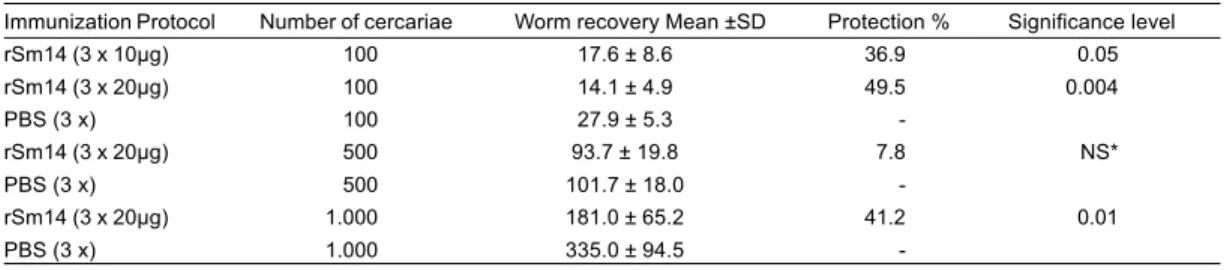
Table 1 - Protective activity of rSm14 in mice previously immunized and challenged with different S. mansoni cercarial burdens.
Immunization Protocol Number of cercariae Worm recovery Mean ±SD Protection % Significance level
rSm14 (3 x 10µg) 100 17.6 ± 8.6 36.9 0.05
rSm14 (3 x 20µg) 100 14.1 ± 4.9 49.5 0.004
PBS (3 x) 100 27.9 ± 5.3
-rSm14 (3 x 20µg) 500 93.7 ± 19.8 7.8 NS*
PBS (3 x) 500 101.7 ± 18.0
-rSm14 (3 x 20µg) 1.000 181.0 ± 65.2 41.2 0.01
PBS (3 x) 1.000 335.0 ± 94.5
-*NS = Not significant
date of the other groups. Forty-five days after challenge infection, half of each group was sacrificed for worm burden evaluation. The other half was kept under observation to evaluate the kinetic of mortality in rSm14-immunized mice and respective controls bearing a heavy infection with S. mansoni.
Enzyme-linked immunosorbent assay (ELISA).
Mice were anesthetized with ether for blood collection,
through the orbital plexus throughout the experiments, or through the brachial vein, before perfusions. Blood collected was kept on ice for 30 minutes and later for 30 minutes at room temperature. Sera were centrifuged, aliquoted and stored at -20oC until use.
0 10 20 30 40 50 60 70 80 90
1 24 34 44 50 51 57 58 63 66 72 76 80 85 91 98 101 104
Days after infection
Mo
rta
li
ty
r
a
te
(%
)
.
Immunized Controls
3X in phosphate buffer saline containing 0.05% Tween 20 (PBST20) and non-specific binding sites were blocked with 2.5% non-fat milk in PBST20 for 1 hour at 37oC.
Plates were washed 3X with PBST 20. Sera were diluted 1/100 in PBST20 and incubated for 1 hour at 37oC. After
incubation, plates were washed 3 X with PBST20 and then a second goat anti-mouse IgG, IgM or IgA antibody conjugated with peroxidase (Sigma, St. Louis, Mo, USA) was added at dilution 1/3,000. After a new incubation at 37oC for 1 hour, the plates were once more washed 3 X,
and substrate 2,2’-azino-bis(3-ethylbenz-thiazoline-6-sulfonic acid (ABTS - Sigma, St. Louis, Mo, USA) was added. Readings were taken using ELISA reader (BIORAD Mod. 3550) at 405nm.
Western-blotting. rSm14 was applied into 15%
polyacrylamide gel containing sodium dodecylsulphate (SDS-PAGE), as described4. SDS-PAGE gels were
electrotransferred onto nitrocellulose membrane (Armershan Pharmacia Biotech, England, UK). After transferring, membrane was stained with Ponceau’s
solution and then sliced into strips. Membrane strips were blocked with 5% skimmed milk in transblotting solution containing 0.05% Tween 20 (TBST20) for 2 hours. Strips were then washed 3X with TBST20 for 10 minutes. Mice sera were added at 1/100 dilution at room temperature for 1 hour. After washing in TBST20, a secondary alkaline phosphatase-labeled goat anti-mouse IgG (Promega, Madison, WI, USA) was added at dilution 1/5,000 for 1 hour at room temperature. Development was carried out by addition of p-nitroblue tetrazolium chloride and 5-bromo-4-chloro-3-indolyl phosphate (NBTBCIP - Bio-Rad Lab., CA, USA) as substrate. Reaction was interrupted with milli-q water.
Statistical analysis.Percentage of protection conferred
in immunized groups was assessed according to the following formula: P = [(C-V)\ C] x 100 where C represents the mean number of parasites in control animals, V represents the mean number of parasites in vaccinated animals. Analysis of variance test with statistical level of significance set at P < 0.05 was used for the studied groups.
RESULTS
Protection against infection. Mice immunized with
rSm14 (10 or 20µg) and infected with 100 cercariae showed 36.9% and 49.5% protection respectively in relation to the non-immunized control group. rSm14-immunized group and challenged with 500 cercariae did not show significant worm burden reduction. However, those infected with 1,000 cercariae presented 41.2% of worm burden reduction (p<0.01) (Table 1).
Mortality rate. The group of mice immunized with
20µg/rSm14 and challenged with 100 S. mansoni
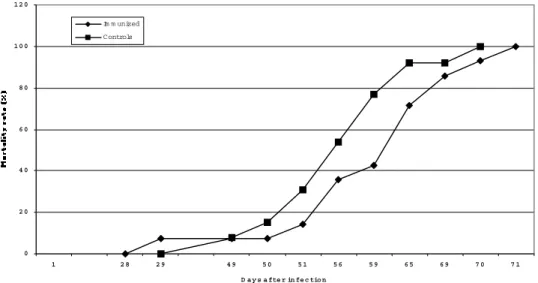
cercariae presented on day 66 after infection 14% of dead animals, whereas the control group reached 50% mortality (Figure 1). Immunized group and infected with 500 cercariae (which did not show significant worm burden reduction) presented, on day 59 after infection, a mortality rate of 42.8%, whereas the control group
showed 76.9% (Figure 2). rSm14-immunized mice and challenged with 1000 cercariae demonstrated that 48 days after infection the mortality rate was 38% against 82% mortality for the control group (Figure 3). Statistical analysis of the mortality rate among the immunized and
control groups showed no significant differences probably due to the reduced number of surviving mice along the experiment. Days that represent 50 or 90% mortality of immunized groups and respective controls showed that a direct correlation has been found between the number
of cercariae of the challenge infection and the precocity of the animals death. It is interesting to remark, this correlation has been found not only in the two immunized and protected groups, but also in the non-protected one (Tabela 2).
Evaluation of the immune response – ELISA: it was
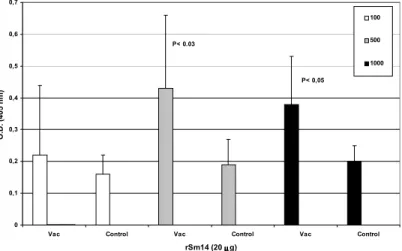
not detected any significant difference in IgA and IgG anti-rSm14 (20µg) antibody levels in sera from immunized mice collected 45 days after infection in relation to the control groups. There was no difference in IgG anti-rSm14 antibody levels between 10 or 20µg-immunized groups (data not shown). However, IgM
anti-rSm14 antibody levels in sera from mice immunized with rSm14 (20µg), collected 45 days after infection with 500 or 1,000 cercariae, were statistically significant when compared with non-immunized mice groups (Figure 4).
Western blotting: as can be seen in (Figura 5),
immunoblotting demonstrated that sera of mice collected at the same date of the third immunization showed the highest reactivity against rSm14 (lane 7). Sera from immunized mice (rSm14 / 20µg) which were infected with 100 cercariae as well as their respective controls presented only a slight reactivity. However, sera proceeding from mice immunized with rSm14 (20µg) and
0 2 0 4 0 6 0 8 0 1 0 0 1 2 0
1 2 8 2 9 4 9 5 0 5 1 5 6 5 9 6 5 6 9 7 0 7 1
D a y s a fte r in fe c tio n
Im m unized C ontrols
Figure 2 - Mortality rate of mice immunized with rSm14 (20µg) and infected with 500 S. mansoni cercariae.
0 20 40 60 80 100 120
1 42 43 44 48 49 50 57
Days after infection
Mo
rta
li
ty
r
a
te
(%
)
.
Immunized Controls
0 0,1 0,2 0,3 0,4 0,5 0,6 0,7
Vac Control Vac Control Vac Control
rSm14 (20 µµµµg)
O
.D
.
(4
0
5
n
m
)
.
100
500
1000 P< 0.03
P< 0,05
Figure 4 - IgM anti-rSm14 antibody levels in sera from immunized mice.
Table 2 - Effect of immunization with rSm14 on mortality time after infection with different S. mansoni cercarial burdens.
Group infected Group infected Group infected Mortality with 100 cercariae with 500 cercariae with 1000 cercariae
M50C 66 55 45
I 85 60 49
M90C >104 64 49
I >104 70 57
Protection % 49.5 7.8 41.2
M50 = mortality of 50% of the animals expressed in days. M90 = mortality of 90% of the animals expressed in days. C = controls. I = immunized mice
Figure 5 - Western Immunoblotting of rSm14 recognition by immune or normal mice sera. M = Molecular weight. 1) 20µg + Inf. 100 cercariae. 2) 20µg + Inf. 500 cercariae. 3) 20µg + Inf. 1000 cercariae. 4) Inf. 100
VWX YZX [VX
\XX]XXXX^XXXX_XXXXVXXXX`XXXXYXXXXZXXXXaX
bcdX
i n f e c t e d w i t h 5 0 0 c e r c a r i a e ( l a n e 5 ) r e a c t e d against the rSm14 antigen showing a reactive band with approximately 14 KDa. Conversely, the respective control group demonstrated light reactivity.
In relation to the group infected with 1,000 cercariae, the non-immunized group (lane 6) presented higher activity when compared with the rSm14-immunized group (lane 3).
DISCUSSION
In the present report we have studied the humoral response induced in rSm14-immunized mice as well as the capacity of the recombinant protein in protecting mice from different challenge infections (100, 500 or 1,000 cercariae) including that supposed to be lethal for the animals up to 30th day after infection. On the
contrary to findings previously reported in the literature13,
our results have demonstrated that S. mansoni infection of mice with 1,000 cercariae did not lead the animals to death up to the 30th day of infection. The diverging results
between two similar infection protocols could be perhaps explained by the use of a S. mansoni strain, which has been maintained at the laboratory of the Centro de Pesquisas René Rachou, Belo Horizonte, Brazil, routinely, for more than 30 years. The strain used in our experiments may have had its virulence altered after maintenance for all these years in genetically different hosts from that used by other authors. This diminished virulence could develop a less drastic pathogenesis in mice. The immunization schedule used was able to attain a significant protection (about 50%) in the group of animals immunized with rSm14 (20µg) and infected with 100 or 1,000 cercariae, thus suggesting that there was no correlation between the infectious burden and worm burden reduction conferred by the immunization. For unknown reasons, the immunized group and that infected with 500 cercariae did not show significant protection when compared to the control group. As far as the mortality rate is concerned, a notable delay on M50 was detected in the immunized animal groups infected with 100, 500 or 1,000 cercariae. It is worthwhile to note that when a higher number of cercariae were inoculated the mortality rate of mice not only was more precocious, but also higher. The same trend was observed in M90 to both immunized and control group. In regard to mortality rate the results showed that in spite of the groups of immunized mice challenged with 100, 500 or 1.000 S. mansoni cercariae had presented on day 66 (14% of dead animals whereas the control group reached 50% of mortality), 59 (42.8%, whereas the control group showed 76.9% mortality) and 48 (38% against 82% mortality) respectively, statistical analysis of the mortality rate among the immunized and control groups showed significant differences probably due to the reduced number of surviving mice during the experiment. ANOVA simulation tests using groups formed by 15 mice demonstrated significant differences among immunized and infected groups and their respective controls.
Previous studies have demonstrated the role of the host’s humoral response in the elimination mechanisms
of S. mansoni from mice submitted to different immunization
protocols 11 5 6 2. Immunization of mice with rSm14 did not
produce significant IgG and IgA anti-rSm14 antibody levels. However, significant IgM anti-rSm14 antibody levels could be detected, mainly in the groups of immunized mice and infected with 500 or 1,000 cercariae.
O t h e r s t u d i e s u s i n g h u m a n m o d e l s , h a v e detected low but significant IgM anti-rSm14 antibody levels in human serum from individuals in different clinical forms (compensated hepatosplenic and individuals termed normal endemic who were stool-negative in repeated examinations but living in continuous contact with contaminated water) but IgM anti-rSm14 antibody levels were not significant in human serum from patients at intestinal, acute or decompensated hepatosplenic1. Immunoblotting
showed that sera of mice collected at the same date of the third immunization presented the highest reactivity against rSm14. Sera from immunized mice that were infected with 100 cercariae presented a slight reactivity whereas its control group was negative. Sera from mice immunized with rSm14 (20µg) and infected with 500 cercariae reacted a g a i n s t r S m 1 4 s h o w i n g a r e a c t i v e b a n d . I t s respective control group demonstrated a light reactivity. The lack of correlation between protection and IgG, IgM or IgA antibody levels could be due to immunization of mice with rSm14 leads rather to a cellular immune response than a humoral immune response. The study on cytokine profile to detect IFN-γ or TNF-α and lymphoproliferative assays would lead to a better understanding of the effector mechanisms involved in worm burden reduction of rSm14-immunized mice. According to some researchers, optimal vaccination against S. mansoni
requires the induction of both humoral and cell-mediated immune mechanisms3 14.In summary,
REFERENCES
1. Brito CFA, Fonseca CT, Goes AM, Azevedo V, Simpson AJG,
Oliveira SC.Human IgG1 and IgG3 recognition of Schistosoma
mansoni 14 KDa fatty acid-binding protein. Parasite Immunology 22: 41-48, 2000.
2. Curtis RHC, Fallon PG, Doenhoff MJ. Sm480: a high molecular
weight Schistosoma mansoni antigen associated with protective
immunity. Parasite Immunology 18: 149-157, 1996.
3. Jankovic D, Wynn TA, Kulberg MC, Hieny S, Caspar P, James S,
Cheever AW, Sher A. Optimal vaccination against Schistosoma
mansoni requires the induction of both B cell-and IFN-γ -dependent effector mechanisms. Journal of Immunology 162: 345-351, 1999.
4. Laemmli UK. Cleavage of structural proteins during the assembly
of the head of bacteriophage T4. Nature 227: 685-690, 1970.
5. Mangold BL, Dean DA. Passive transfer with serum and IgG
antibodies of irradiated cercariae-induced resistance against
Schistosoma mansoni in mice. Journal of Immunology 136: 2644-2648, 1986.
6. Mangold BL, Dean DA. The role of IgG antibodies from
irradiated cercariae-immunized rabbits in the passi ve
transfer of immunity to Schistosoma mansoni-infected mice.
American Journal of Tropical Medicine and Hygiene 47: 821-829, 1992.
7. Moser D, Tendler M, Griffiths G, Klinkert Mo-Quen.A 14-KDa
Schistosoma mansoni polypeptide is homologous to a gene family
of fatty acid binding proteins. Journal of Biological Chemistry
266: 8447-8454, 1991.
8. Peters PA, Warren K. A rapid method of infecting mice and other
laboratory animals with Schistosoma mansoni: subcutaneous
injection. Journal of Parasitology 55: 558, 1969.
9. Pellegrino J, Macedo DG. A simplified method for the concentration
of cercariae. Journal of Parasitology 41: 329-330, 1956.
10. Pellegrino J, Siqueira A.Técnica de perfusão para colheita de
Schistosoma mansoni em cobaias experimentalmente infestadas. Revista Brasileira de Malariologia e Doenças Tropicais 8: 589-597, 1956.
11. Sher A, Hieny S, James SL, Asofsky R. Mechanisms of protective
immunity against Schistosoma mansoni infection in mice
vaccinated with irradiated cercariae. II. Analysis of immunity in hosts deficient in T lymphocytes, B lymphocytes, or complement. Journal of Immunology 128: 1880-1884, 1982.
12. Tendler M, Brito CA, Vilar, MM, Serra-freire N, Diogo CM, Almeida MS, Delbem ACB, Silva JF, Savino W, Garratt RC, Katz N, Simpson AJG.A Schistosoma mansoni fatty acid-binding protein, SM14, is the potential basis of a dual-purpose anti-helminth vaccine. Proceedings of National Academy of Science USA 93: 269-273, 1996.
13. Tendler M, Pinto RM, Lima AO, Savino W, Katz, N. Vaccination in murine schistosomiasis with adult worm-derived antigens: variables influencing protection in outbred mice. International Journal for Parasitology 21: 299-306, 1991.